
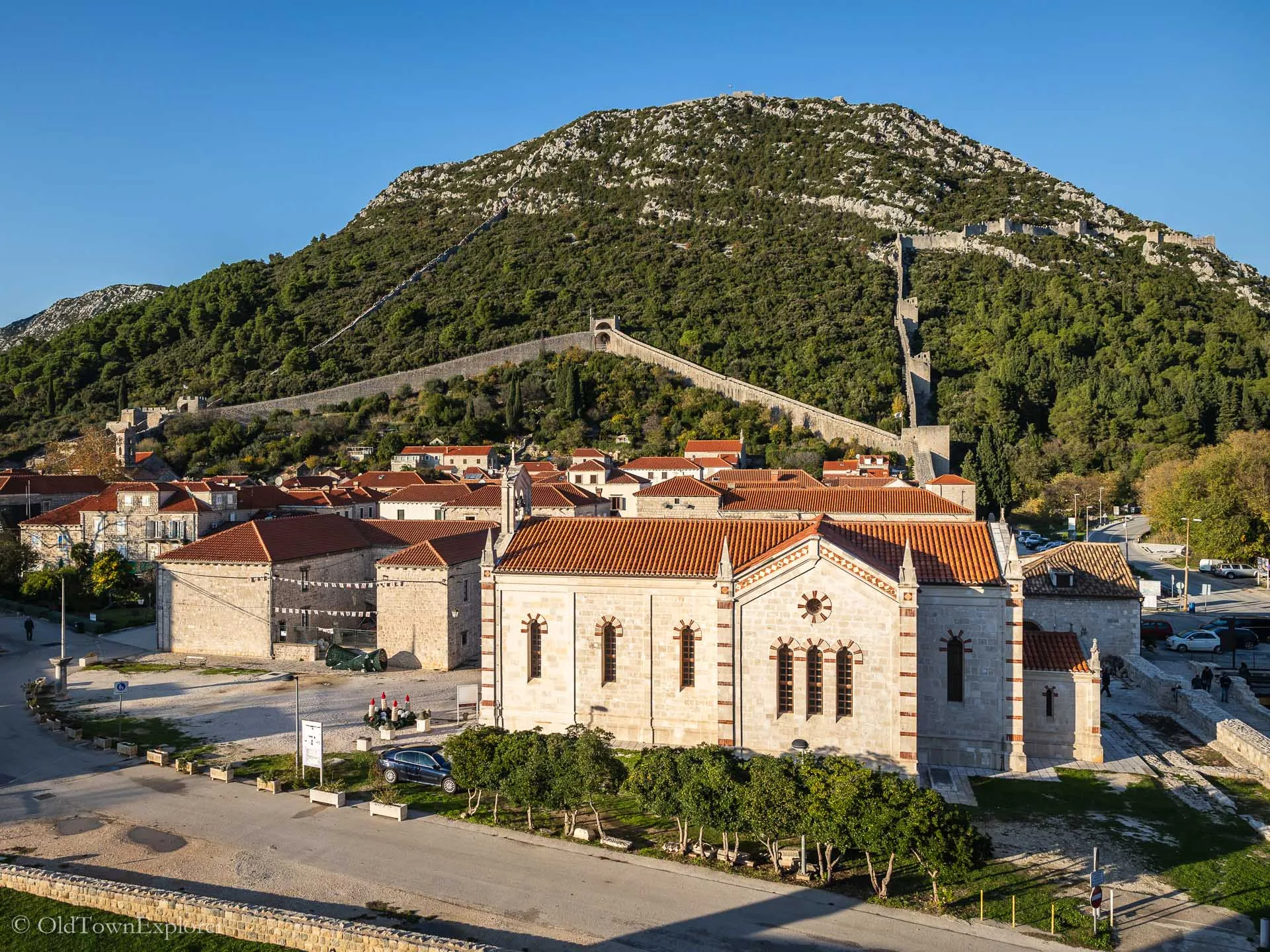
Discover the Walls of Ston: History, Routes & What to See
The Walls of Ston are a medieval defensive system linking Ston and Mali Ston across a steep ridge at the entrance to the Pelješac Peninsula. The Dubrovnik Republic built the complex to secure its new territory, protect the two planned towns, and guard the salt pans that supported its trade.
The visit is larger than a walk around one old town. The fortifications include the Ston and Mali Ston town walls, the Great Wall between them, three main fortresses, dozens of towers, bastions, pre-walls, gates, and traces of the former moat.
We walked the full wall route during our stay in Ston. Drawing on that walk and further research, this guide explains the history, fortifications, short and long route choices, entrance system, viewpoints, walking effort, and practical details that determine how to plan the visit.
This website contains affiliate links that may earn us a small commission at no additional cost to you.
Walls of Ston at a Glance
The main decision is whether to walk the shorter circuit above Ston or begin near Koruna Fortress in Mali Ston and cross the longer Great Wall route to Ston.
Key visit details:
- What it is: A connected medieval system of town walls, ridge walls, fortresses, towers, bastions, gates, pre-walls, and former moat defenses.
- Where it is: Between Ston and Mali Ston at the eastern entrance to the Pelješac Peninsula.
- Why go: The elevated route shows the planned towns, salt pans, Ston Field, Mali Ston Bay, and surrounding limestone hills as one landscape.
- Route choices: Entrance A leads around the shorter Ston circuit. Entrance B near Koruna Fortress begins the full Great Wall crossing to Exit C in Ston.
- Time needed: The official route description estimates roughly 20 minutes for the Ston circuit and 40 minutes for the crossing, but stairs, photographs, heat, and viewpoint stops make most visits longer.
- Entry: The ticketed route has two entrances and one exit. Keep the ticket until the visit ends because re-entry is not permitted.
- Main trade-off: The best views require sustained stone steps, exposed slopes, and little protection from the sun or wind.
Take the Ston circuit when time or climbing ability is limited. Begin in Mali Ston when the full ridge crossing is the main reason for the visit.
History of the Walls of Ston
The walls developed over several centuries rather than from one architect’s finished design. Each phase responded to changes in the territory, town plan, weapons, salt trade, and condition of the earlier defenses.
The Dubrovnik Republic Acquires Pelješac
The Dubrovnik Republic acquired Ston and the Pelješac Peninsula in 1333. The isthmus mattered because it controlled access to the peninsula and contained salt pans that produced one of the Republic’s most valuable commodities.
Defensive work began soon after the acquisition. The project was tied from the start to the creation of two new towns rather than to one isolated wall.

The Great Wall and Two Planned Towns
The Great Wall crossed the ridge between Ston and Mali Ston and separated the peninsula from the mainland side of the isthmus. Koruna, Podzvizd, and Veliki Kaštio formed its three principal fortresses.
Ston became the administrative and economic center beside the salt pans. Mali Ston developed as a fortified harbor and storage point on the northern bay. Straight streets and regular building blocks were laid out beneath the defenses in both towns.
Expansion Through the Fifteenth and Sixteenth Centuries
The defensive system was repeatedly extended, strengthened, and adapted as military technology changed. Local builders worked alongside masters connected with Dubrovnik’s major construction projects, including Onofrio of Naples, Michelozzo of Florence, Juraj Dalmatinac, Paskoje Miličević, and others.
No single architect designed the entire surviving complex. The different towers, bastions, curtain walls, gates, and pre-walls reflect several building campaigns spread across generations.
Demolition and Decline
Parts of the defenses were removed after the fall of the Dubrovnik Republic. A wall section was demolished for the visit of Emperor Franz Joseph I in 1874, and further southern walls and towers were taken down for building stone in 1905.
Those losses explain why the preserved system is shorter and less complete than the original fortification line.
Restoration and Heritage Status
The Society of Friends of Dubrovnik Antiquities began sustained restoration work at Ston in 1961. Repairs and reconstruction have continued across Veliki Kaštio, the Great Wall, towers, parapets, and other parts of the complex.
The historical ensemble of Ston and Mali Ston, the connecting walls, Ston Field, Mali Ston Bay, and the salt pans has been on Croatia’s UNESCO Tentative List since 2005. It is not currently inscribed on the World Heritage List.
Architecture and Layout of the Walls of Ston
The fortifications combine several defensive systems shaped by the ridge, salt pans, marshy ground, harbor, and two planned settlements. Understanding those parts makes the view from the walls more meaningful.
Three Connected Fortification Zones
The first zone encloses Ston in an irregular pentagonal plan beside the saltworks. The second is the Great Wall crossing the ridge. The third surrounds Mali Ston and descends to its fortified harbor.
The three zones worked together. Ston protected the saltworks and administration, the ridge controlled the land crossing, and Mali Ston guarded transport and storage on the bay.
Fortresses, Towers, Bastions, and Pre-Walls
The official DPDS inventory includes three main fortresses, forty-one towers, seven bastions, four pre-walls, and a water-filled moat that once ran around the western, southern, and eastern sides of Ston.
Square and round towers let defenders watch and fire along adjoining wall faces. Semicircular bastions strengthened corners and lower sections where later weapons required broader defensive platforms.
Local Stone and Steep Terrain
Limestone walls climb directly over the ridge rather than following an even contour. Builders had to move stone, lime, timber, water, and other materials onto steep ground, then adapt the wall line to slopes, hollows, and unstable land near the salt pans.
The surviving route changes constantly between stairs, narrow parapet walks, tower passages, level stretches, and sharp descents.
The Great Wall
The Great Wall is the long defensive spine between the two towns. UNESCO describes the original cross-isthmus wall as about 1,200 meters long, while the wider fortification system originally extended for roughly seven kilometers.
The visitor route passes named and unnamed Gothic towers as it rises from Koruna, crosses the ridge, and descends toward Barabanata at Ston.
The Planned Towns Below
The regular street blocks of Ston and Mali Ston are part of the same design as the walls. Ston’s straight streets sit between the hillside defenses and geometric salt pans, while Mali Ston’s smaller grid descends from Koruna toward the harbor.
Pause where the parapets open toward the towns. The view reveals why the walls, streets, salt production, storage, and port were planned together.
What to See at the Walls of Ston
The Walls of Ston contain three main fortresses, towers and wall positions along both visitor routes, several bastions, fortified gates, pre-walls, and lower harbor defenses. The official visitor route passes only some of these structures, but the complete inventory helps explain how the defenses protected Ston, Mali Ston, the salt pans, and the ridge between the two towns.
Prioritize Veliki Kaštio, Koruna Fortress, Podzvizd Fortress, and the towers on your chosen walking route. The smaller bastions and connecting walls become easier to recognize once you understand which fortification zone they belong to.
For a shorter visit, focus on Veliki Kaštio, the Arcimun–Sokolić defenses, Minčeta, Stoviš, Nad vodom, and Barabanata. The full crossing from Koruna adds Dolina, Dobri, Gornja kula, Lastva, the summit defenses, and the changing views between Mali Ston Bay and the salt pans.
Forts

Veliki Kaštio
Veliki Kaštio, also called the Fortress of St. Jerome, stands beside the salt pans at the southern edge of Ston. Its broad rectangular structure defended the lower approach to town, the port facilities, and the salt-production area.
Walk around the exterior before climbing the walls. The fort’s low, heavy form contrasts with the narrow towers and steep ridge defenses above Ston.

Koruna Fortress
Koruna Fortress rises above Mali Ston and forms the northern anchor of the Great Wall. Its closely grouped towers resemble a crown, which explains the name Koruna.
The fortress overlooks Mali Ston’s planned streets, harbor, bay, and the beginning of the full wall crossing. Begin here when you want to walk the Great Wall from Mali Ston to Ston.
Podzvizd Fortress
Podzvizd Fortress occupies the high defensive ground above Ston where the town walls meet the ridge fortifications. Its position controlled the upper approach and helped connect the defenses around Ston with the Great Wall.
Look for Podzvizd from the streets and salt pans before the climb. Its position explains the triangular outline of the walls above the town.
Towers
Kula Arcimun
Kula Arcimun, also called the Arcimun Tower or Arcimun Roundel, stands near Entrance A on the western side of Ston. Its rounded form marks the beginning of the shorter circuit above the town.
Arcimun also gives its name to the adjoining bastion and pre-wall. Treat the tower and bastion as connected parts of the same western entrance complex, while retaining each as a separate architectural feature.

Kula Minčeta
Kula Minčeta stands on the wall circuit above Ston. Its rounded defensive form projects beyond the adjoining wall, giving guards a view along the wall faces and across the lower town.
From this section, look down toward Ston’s regular street blocks and the geometric salt pans beyond the southern wall.

Kula Stoviš
Kula Stoviš is one of the named towers on the shorter Ston circuit. It stands between the western Arcimun and Sokolić defenses and the eastern towers leading toward Barabanata.
The tower breaks up the climb and gives a changing view across the roofs, field, saltworks, and surrounding limestone slopes.

Kula Nad vodom
Kula Nad vodom stands above the eastern side of Ston near the Church of the Holy Name of Jesus and Trg Marina Držića. Its name means “Tower Above the Water,” reflecting its position over the lower ground and former water defenses.
Pause here for views across the eastern town wall and the streets below before continuing toward Barabanata.
Kula Barabanata
Kula Barabanata stands at the point where the short Ston circuit and the full Great Wall crossing reach Exit C. It therefore acts as the common end of both ticketed routes.
The tower is an important orientation point rather than merely another stop. From here, the wall route descends into Ston near the eastern side of the historic center.
Kula Toljevac
Kula Toljevac stands on the Mali Ston waterfront where the lower defensive wall reaches the harbor. Its cylindrical shape differs from the larger Koruna complex rising above the settlement.
View the tower with the harbor wall, Orsan Arsenal, and Kaše breakwater. Together, they show how Mali Ston’s defenses extended from the ridge to the water.

Kula Dobri
Kula Dobri is one of the named Gothic towers on the Great Wall between Mali Ston and Ston. It divides the long ridge wall into defensible sections and forms one of the clearest landmarks during the full crossing.
The tower also gives you a natural place to pause during the climb and compare the views toward Mali Ston Bay with the higher ridge ahead.
Gornja kula
Gornja kula means “Upper Tower” and stands on the higher part of the Great Wall route. Its position reflects the sustained climb from Koruna Fortress toward the central ridge.
Look back from this section to see how the wall rises above Mali Ston and separates the northern bay from the Ston side of the isthmus.
Dolina Tower
Dolina Tower is another named Gothic tower on the Great Wall. Its name refers to a lower fold or hollow in the terrain through which the defensive line passes.
The surrounding section shows how the builders adjusted the wall to the natural rise and fall of the ridge rather than forcing it onto a level course.
Position of Lastva
Lastva is a named defensive position on the Great Wall rather than one of the three main fortresses. It belongs to the sequence of towers and strongpoints encountered between Koruna Fortress and Barabanata.
Use Lastva as an orientation point on the full crossing. The changing views from this section help show the distance between the two fortified towns.
Bastions
Sokolić Bastion
Sokolić is one of the principal bastions on the western side of Ston. It strengthens the wall near the route from Arcimun toward Stoviš and projects outward from the main defensive line.
The bastion and the adjoining rebuilt wall form part of the shorter visitor circuit. Notice how the wider defensive platform differs from the narrower tower structures nearby.

Bastion Arcimun
Bastion Arcimun forms part of the western entrance defenses beside Kula Arcimun. The rounded tower, bastion, and pre-wall work together as one fortified approach to Ston.
The reconstructed wall between Arcimun and Sokolić now carries visitors onto the shorter circuit. Look down from this section to see the western edge of the town plan.
Three Bastions of Veliki Kaštio
Three bastions strengthen Veliki Kaštio and distinguish it from the earlier towers along the ridge. Their broader projecting forms improved the fort’s ability to defend the lower approach and the saltworks.
Walk around the fort at ground level to compare the bastions from several angles. They are easier to understand from outside than from the higher wall route.
Podzvizda bastion
The Podzvizd bastion belongs to the high fortification complex above Ston. It strengthened the meeting point between the upper town defenses and the ridge wall.
Although closely connected with Podzvizd Fortress, the bastion is a separate defensive element. View both as parts of the same summit complex rather than unrelated attractions.
Arcimun Bastion in Mali Ston
Mali Ston has its own Arcimun bastion, separate from the Arcimun defenses in Ston. It forms part of the lower defensive system associated with Koruna Fortress and the walls descending toward the harbor.
This second Arcimun explains why the name appears in more than one part of the fortification inventory. Check whether you are looking at the Ston or Mali Ston structure when using a map.
Other

Field Gate
Field Gate, or Poljska vrata, connected the fortified town with Ston Field and the salt pans. The Croatian name refers to the field; it should not be translated as “Polish Door.”
The gate preserves carved stonework and an early-sixteenth-century Latin inscription connected with the defense of Ston. See it with Veliki Kaštio, the public fountain, civic buildings, and the saltworks immediately outside the walls.
Arcimun–Sokolić Defensive Wall
The defensive wall between Arcimun and Sokolić connects the two western strongpoints above Ston. This is the structure previously identified separately as the Sokolić Defensive Wall.
The restored section now forms part of the visitor route from Entrance A. Its parapet gives broad views over the western town blocks and the lower landscape.
Bartolomija Redoubt
Bartolomija, also called the Bartolomeo Redoubt, is the traditional name associated with the strongest summit position in the wall system. It was named for St. Bartholomew, regarded as a protector of weapons.
The position is closely tied to the high defenses around Podzvizd. Treat Bartolomija as part of the summit fortification complex rather than expecting a separate low-level attraction with its own visitor entrance.
How to Visit the Walls of Ston
The route choice matters more than the nominal length of the wall system. Decide whether you want the short circuit or full crossing before buying a ticket and choosing where to park or arrive.
Tickets and Current Hours
A ticket is required for the visitor route on the walls. Check the official Walls of Ston page and official ticket shop for current opening times, prices, and purchase options.
Do not rely on old seasonal price or hour tables. Access can also change because of weather, conservation work, or operational decisions.
The Short Ston Circuit
Entrance A leads around the walls immediately above Ston and finishes at Exit C near Barabanata. This route passes the western bastions and several named towers before descending near the eastern side of town.
Take this circuit when you want salt-pan and town views without committing to the longer ridge crossing.
The Full Great Wall Crossing
Entrance B begins near Koruna Fortress in Mali Ston. The route follows the Great Wall through the Dolina, Dobri, Gornja kula, and Lastva sections before reaching Exit C at Barabanata in Ston.
This is the stronger choice when the ridge, defensive system, and changing views between the bay and salt pans are the main reasons for the visit.
Veliki Kaštio and Ground-Level Views
The exterior of Veliki Kaštio, the lower walls, towers, gates, and saltworks can be seen from public streets without completing the ticketed climb. That makes a ground-level visit worthwhile when stairs, heat, wind, or limited time rule out the upper route.
Check current official information when planning around access inside Veliki Kaštio rather than its exterior.
Visit Length
Allow about one and a half to two hours for the full wall crossing. We walked at a fast pace, but the sustained climbs, steep descents, stone steps, and pauses at the towers and viewpoints still made this a substantial walk.
Allow at least an hour for the shorter circuit above Ston. Heat, wind, photography, and time spent examining the fortifications can extend either route, so do not treat the walls as a quick addition at the end of the day.
Last Entry Can Be Earlier Than Expected
Check the current hours before arriving and begin the full route at least one and a half to two hours before the last entry time. Do not assume you can spend the early afternoon in the old town and save the walls for later, particularly in autumn or winter.
Stairs and Accessibility
The upper routes contain sustained stone steps, steep slopes, narrow passages, and uneven surfaces. They are not step-free and do not suit every mobility level.
Travelers who skip the climb can still see Veliki Kaštio, Field Gate, the lower walls, the town plan, and the saltworks from ground level.
How to Get to the Walls of Ston
The best arrival point depends on the route. Central Ston suits the short circuit and ground-level sights, while Mali Ston is the official starting point for the full Great Wall crossing.
Use the main Ston guide for the wider transport decision and onward travel around Pelješac.
From Central Ston
Walk from the historic center toward the wall entrance marked on the western side of town. The compact streets, Veliki Kaštio, saltworks, Field Gate, and lower fortifications are all close enough to combine on foot.
Start here when you want the shorter circuit or need to decide about the climb after seeing the walls from below.
From Mali Ston
Entrance B sits near Koruna Fortress above Mali Ston. Begin here for the full Great Wall route to Ston.
Allow time to see Toljevac Tower, the harbor, and the lower Mali Ston defenses before climbing. Once you finish in Ston, the ticket does not permit re-entry for a return over the same route.
By Car
Parking areas sit outside the compact historic centers of Ston and Mali Ston. Park in the town that matches your chosen starting point rather than assuming the route will return you to the same place.
For the full crossing, plan how you will return to a vehicle left in Mali Ston after exiting in Ston.
By Bus or Guided Tour
Travelers arriving without a car should confirm how much independent time they will have in Ston and whether the visit begins in Ston or Mali Ston. A short organized stop may allow the town circuit but not the complete Great Wall crossing.
What to Expect Upon Arrival at the Walls of Ston
The first on-site decision is not simply whether to enter. You must choose the correct entrance for the route, understand where it ends, and carry what you need before beginning the exposed climb.
Two Entrances and One Exit
The current visitor layout has Entrance A in Ston, Entrance B near Koruna Fortress in Mali Ston, and Exit C near Barabanata in Ston. Entrance A serves the short circuit, while Entrance B serves the full crossing.
Check the current official route information before arrival in case conservation or operational work changes that arrangement.
Keep the Ticket Until the End
The official visitor rules require you to keep the ticket throughout the walk. A ticket covers one visit, and re-entry is not allowed after leaving the route.
That rule matters most when coordinating the full crossing, a parked car, or separate plans in Ston and Mali Ston.
The Climb Begins Quickly
The visitor routes rise onto stone steps soon after entry. The full crossing becomes steeper and more exposed as it moves away from Mali Ston and climbs toward the ridge.
Pause before entering when anyone in the group is uncertain about stairs, heights, heat, or the lack of a simple halfway return.
Carry Water and Sun Protection
The official visitor rules recommend water, a hat or cap, sunscreen, and suitable clothing and footwear. Arrange those items before presenting the ticket rather than expecting the route itself to function like a serviced promenade.
Wind can be as important as heat on the upper wall, particularly when carrying loose hats or light clothing.
Plan the Route End
The complete route finishes in Ston rather than returning to Koruna. Decide in advance whether you will continue into Ston, walk back by a ground-level connection, arrange a pickup, or move on to another part of the day.
That return decision is part of the wall visit, especially when the car or accommodation is in Mali Ston.
Tips for Visiting the Walls of Ston
The strongest visit comes from matching the route to the weather, available time, physical effort, and plans after leaving the walls.
Choose the Route Before Buying the Ticket
The short Ston circuit and full crossing do not begin at the same entrance. Decide which walk you want before parking, arranging transport, or joining the ticket queue.
Begin in Mali Ston for the Full Crossing
Entrance B near Koruna is the official start for the Great Wall route. Beginning there lets the sequence move through the named ridge towers and finish in Ston near Barabanata.
The Short Circuit Still Gives Strong Views
You do not need the complete crossing to see the street grid, salt pans, Ston Field, and lower defenses from above. The short circuit is a reasonable choice in limited time or when the ridge climb would be too demanding.
Avoid the Hottest Part of a Summer Day
The upper walls have long exposed sections with little shade. Earlier or later walking hours reduce heat, but the route still needs to fit the current official opening period.
Wear Shoes That Grip on Stone
The route combines worn steps, uneven stone, steep gradients, and narrow passages. Shoes with secure soles matter more than heavy hiking footwear for most visitors.
Bring Water, a Hat, and Sunscreen
Carry enough water for the selected route and the walk after the exit. A secure hat is better than a loose one when wind increases on the ridge.
Keep the Ticket Accessible
Do not discard the ticket after entering. Official staff may ask to see it before the visit ends, and it cannot be reused after leaving the route.
Supervise Children and Plan for Dogs
Children must remain under adult supervision. Dogs are permitted under the current rules, but they must be on a leash, and larger dogs must also wear a muzzle.
Take Photographs Away from the Edge
The official rules prohibit leaning, climbing, or taking photographs from the wall edge. Stop where the parapet or platform gives secure footing rather than trying to photograph while moving on the stairs.
Leave Time for Ston or Mali Ston Afterward
The walls make more sense when paired with the saltworks and planned streets below. A finish in Ston can lead into the civic center, while time in Mali Ston can add the harbor and a local oyster meal.
Where to Stay When Visiting the Walls of Ston
Central Ston is the practical base for the short wall circuit, Veliki Kaštio, the saltworks, historic streets, and the route exit. Mali Ston is the stronger base when the full crossing will begin at Koruna and the harbor or oyster restaurants are part of the evening.
Choose the base by the first morning decision. Ston reduces walking for the lower fortifications and civic center, while Mali Ston places the Great Wall entrance and northern defenses close at hand.
Hotels and Apartments in Ston and Mali Ston
Use the interactive map below to compare hotels and apartments near central Ston, the saltworks, the Ston wall entrance and exit, Koruna Fortress, and Mali Ston’s waterfront.
FAQs About the Walls of Ston
Are the Walls of Ston worth visiting?
Yes, especially when fortifications, viewpoints, historic town planning, or the saltworks interest you. The route shows how Ston, Mali Ston, the ridge, salt pans, and bay fit together.
How long does it take to walk the Walls of Ston?
The official estimates are roughly 20 minutes for the short Ston circuit and 40 minutes for the Great Wall crossing. Allow longer for stairs, photographs, viewpoints, ticketing, heat, and stops at the fortresses.
How long are the Walls of Ston?
The original fortification system extended for roughly seven kilometers. About 5.5 kilometers of walls survive across the wider complex, while the cross-isthmus Great Wall is about 1.2 kilometers long.
Why were the Walls of Ston built?
The Dubrovnik Republic built the walls to secure Pelješac, defend Ston and Mali Ston, control the isthmus, and protect the valuable salt pans and associated trade.
Where should I start the Walls of Ston walk?
Start at Entrance A in Ston for the shorter circuit. Start at Entrance B near Koruna Fortress in Mali Ston for the full Great Wall crossing to Exit C in Ston.
Can I walk only a short part of the walls?
Yes. The Ston circuit passes several towers and bastions and still gives elevated views of the town and salt pans. Ground-level views of Veliki Kaštio, Field Gate, and the lower walls require even less climbing.
Do I need a ticket for the Walls of Ston?
Yes, a ticket is required for the visitor routes on the walls. Check the official Walls of Ston page and ticket shop for current prices, opening times, and access information.
Are the Walls of Ston difficult to walk?
The short circuit still has stone steps, while the full crossing involves sustained climbing, exposed slopes, and uneven surfaces. Neither upper route is step-free.
Can children and dogs walk the Walls of Ston?
Children may visit but must remain under adult supervision. Dogs are permitted under the current rules when kept on a leash, and larger dogs must wear a muzzle.
Are the Walls of Ston a UNESCO World Heritage Site?
No. The wider historical ensemble of Ston, Mali Ston, the walls, Ston Field, Mali Ston Bay, and the salt pans is on Croatia’s UNESCO Tentative List, but it is not currently inscribed on the World Heritage List.
The Walls of Ston are worth visiting because the climb reveals more than a line of medieval defenses. From the parapets, the planned streets, salt pans, ridge forts, Mali Ston harbor, and surrounding landscape appear as parts of one carefully controlled system.
Plan the rest of the stay with our main Ston guide. For the civic buildings, churches, street grid, and wider fortified landscape, continue to Ston Architecture. Is Ston Worth Visiting? compares a short stop with an overnight stay, while Mali Ston Oysters covers the meal and farm experiences that pair naturally with the wall crossing.
