
Discover the Best Things to See in Trogir: Architectural Attractions, Walking Tours & Travel Tips
Trogir, Croatia is a compact island town where medieval churches, Venetian palaces, and a scenic waterfront promenade create a captivating walking experience. From the intricate carvings of the Cathedral of Saint Lawrence to the imposing Fortress of Kamerlengo, Trogir’s top sights are easily explored on foot, offering visitors a rich blend of history and architecture.
We spent the entire month of December visiting Trogir’s most iconic landmarks and compiled this guide to the 19 best things to see—including architectural highlights, scenic walkways, and historic fortifications.
If you’re short on time, follow our Trogir Walking Tour itinerary to visit all the top attractions in one day, while enjoying the charm of its pedestrian-only streets.
This website contains affiliate links that may earn us a small commission at no additional cost to you.
Best Things to See in Trogir

Cathedral of Saint Lawrence
aka Trogir Cathedral aka Cathedral of St. John of Trogir
The church took five centuries to build. The first floor is Gothic, the second floor is Venetian floral Gothic, and the third is Renaissance style.
The Cathedral’s construction began in 1213 on the foundations of an early Christian cathedral that the Saracens destroyed in 1123. The Cathedral was primarily completed by 1251. The first floor is Gothic and was built by Masters Stejpan and Matej (after the Venetians demolished it in 1420, it was restored by Matija Gojković). The church’s second floor is Gothic and was probably the work of Venetian masters. Construction ended in 1589 with the completion of the last floor of the bell tower in the Mannerism style of the architect Trifun Bokanič. The fourth pyramidal end of the bell tower is decorated with four mannerist sculptures by the Venetian sculptor Alessandro Vittorio.
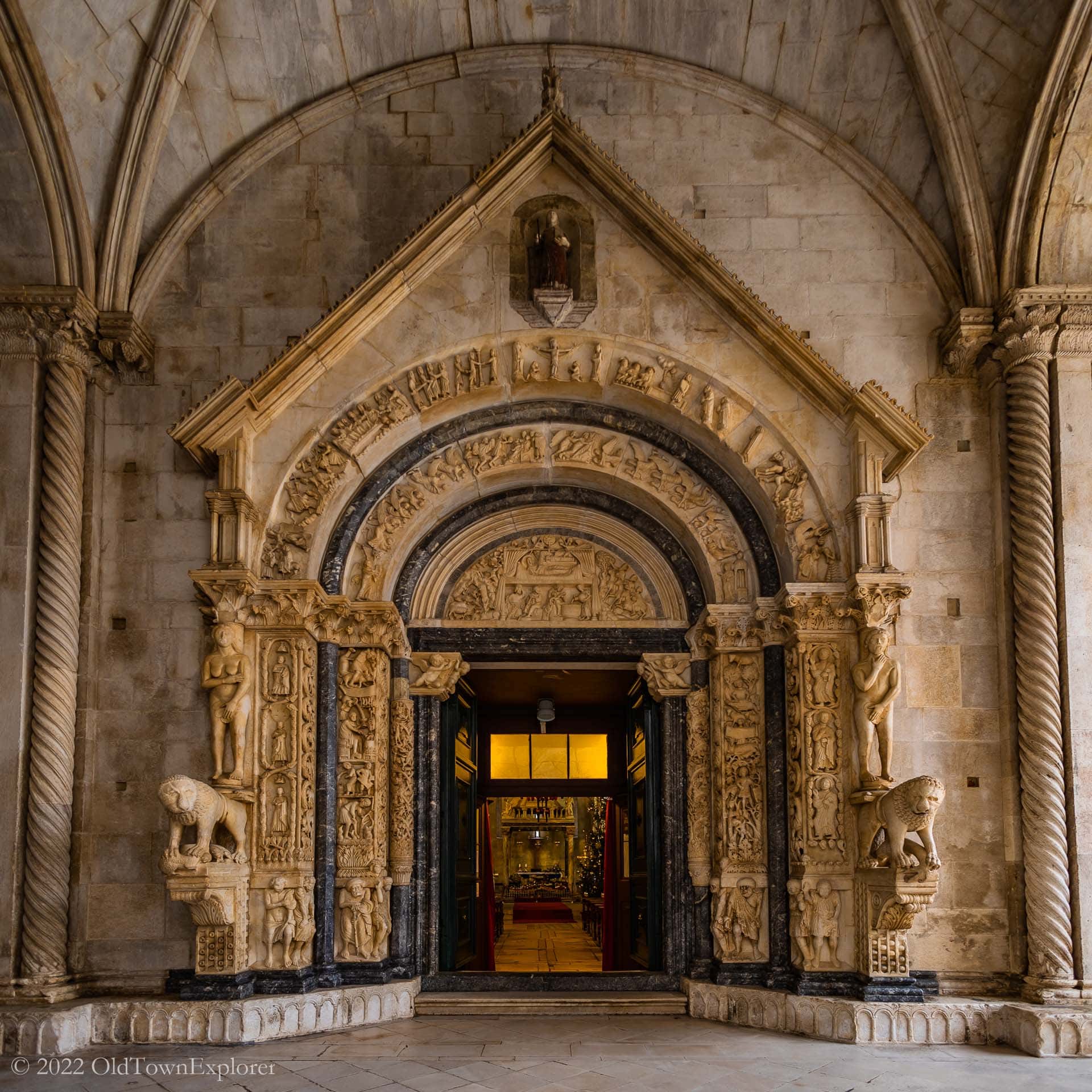
Radovan’s Portal
Radovan’s portal is the main entrance of the Cathedral. Master Radovan carved it in 1240 and signed it, although it was completed only in the 14th century. The portal is the most monumental work of the Romanesque-Gothic style in Croatia. It includes the First Sin (Adam and Eve) and Birth of Christ, the Christological cycle, individual saints and apostles, depiction of months, and stylistically summarizes different traditions from southern Italian to French. It’s the most significant medieval portal on the eastern Adriatic and in this part of Europe.
The Chapel of Blessed John
In 1460, Andrija Aleša received the task of adding the baptistery to the Cathedral. At the same time the construction of the baptistery began, Aleši was also working on remodeling the cathedral sacristy. The construction of the baptistery lasted until 1467. In 1468, Andrija Aleši and Nicholas Florentine signed a contract to build the chapel of St. John of Trogir.
The Chapel of St. John was renovated in 2002 under the leadership of the American foundation Venetian Heritage Incorporation and its leader Lawrence Lovett. After April 2010, the restoration of the southern portal by Petar Pozdanić was completed (together with the prince’s Baroque door, above which there is an inscription of Bishop Preguan dating the construction of the Cathedral in 1213).

Fortress of Kamerlengo
aka Kastel Kamerlengo
Kaštel Kamerlengo was built in the southwest of the city, to defend the sea channel and the approach to the port. The walls got their present form after the arrival of the Venetian government. The fort has a trapezoidal floor plan with a monumental polygonal tower facing the sea at the place of the Chain Tower and smaller corner towers.
Around the fortress there was a rampart with a retaining wall, and a wide defensive moat towards the city from the north and east. The main gate of the castle with a lunette and drawbridge is on the north side of the castle. In the inner courtyard there were residential buildings for the castellan and crew and the chapel of St. Brand.

Church of Saint John the Baptist
Crkva sv. Ivana Krstitelja u Trogiru
Church of St. John the Baptist in Trogir is located in the eastern part of the historic core. The Romanesque church was built at the end of the 12th and the beginning of the 13th century on the site of an early Christian building within the Benedictine Monastery. It is a one-nave elongated building with a rectangular apse and a pentagonal apse placed on the north side of the sanctuary. It was built with regular stonework and covered with a two-gable roof made of corrugated iron. The main portal has a profiled stone frame with octagonal columns and a lunette with an oculus which has a sculpture of the Lamb of God. On the southern facade is the coat of arms of the Cipiko family and the figure of a Benedictine. The reconstruction of the roof was completed in the 1930s.

Monastery and Church of Saint Nicholas
The Church and Monastery of St. Nicholas in Trogir were founded in 1064 and expanded to include Romanesque and Gothic features. The current church, dating to the 15th century, sits above the early medieval church of St. Dujma. It has a single nave with a rectangular layout. The bell tower, attributed to Tripun Bokanić’s workshop from the late 16th to early 17th century, is notable. The main facade showcases a Renaissance window with a relief of Nicholas the Florentine beneath it. The interior boasts 18th-century stucco paintings by Giuseppe Montiventi and Baroque marble altars by Nicola Grassi.
Currently, only three Benedictine sisters reside in the monastery.
The Monastery of St. Nicholas
The monastery originally had two buildings: the church of Domnius and a nearby house. Over time, it evolved architecturally, with renovations to the city walls and the church in the 14th century. The complex later included the Cega and Vitturi Palaces, along with a tower from the same family, supported by donations from wealthy families whose daughters joined the monastery. In the late 16th century, a bell tower was added to the central atrium, surrounded by Romanesque and Gothic styles.
The Church of St. Nicholas
The Church of St. Nicholas shares the monastery’s fate. It was renamed, expanded, and welcomed local residents and congregants. In the eighteenth century, it became a single-nave Baroque church adorned with stuccowork. The choir was constructed, and semicircular windows were opened, flooding the nave with light. It features two marble altars: the northern altar is dedicated to St. Benedict, and the southern one is dedicated to the Immaculate Conception. Initially, the monastery honored St. Domnius, who sought refuge there, after whom the church was named. As it was near the harbor, fishermen and sailors frequented the church, contributing to its upkeep. They placed an image of St. Nicholas, the patron saint of travelers and mariners, on the high altar. By the mid-thirteenth century, St. Nicholas became the monastery’s second patron alongside Domnius, but eventually, only St. Nicholas was honored.

City Hall
Ayuntamiento Trogir aka the Rector’s Palace
The City Hall (the Rector’s Palace) was the expression of the political and economic strength of the city in the first half of the 15th century. Its present appearance comes from the end of the 20th century when it was partly restored. The large courtyard with a monumental Gothic staircase and a decorated well-head is entered through a small entrance porch.

Monastery and Church of Saint Dominic
Crkva i samostan sv. Dominik
The Monastery and Church of Saint Dominic was founded in 1265. It got its present appearance in the first half of the 15th century. This is evidenced by a stone tablet placed on the eastern wall of the monastery cloister, on which it is written that the monastery complex was built in 1425 with the help of the fifth Duke of Trogir, Jakov di Giorgio from Venice. It has been upgraded and adapted several times depending on needs and opportunities.
On February 22, 1944, during the bombing of English planes, the monastery was significantly damaged. The north wing of the monastery was demolished, while the east and west suffered minor damage. The church was not directly hit, but the detonation damaged its roof. The renovation of the monastery-church complex began in the early 1970s.
In recent years, the internal renovation of the church began, which was completed with some details in 2020.

City Loggia
aka Trogir Lodge
The Loggia was the courtroom in Trogir. In 1471 the Loggia was restructured by Niccolò di Giovanni Fiorentino on the eastern wall of which he had three niches containing a Lion of San Marco, San Lorenzo, and San Giovanni da Traù, both patron saints of Trogir. This sculptural triptych was a tribute to the Republic of Venice. The historic Lion of Mark was destroyed by a bomb attack perpetrated by Sokol in 1932. A knight representing Petar Berislavić, Ban of Croatia from 1513 to 1520, made by sculptor Ivan Meštrović was carved along its southern wall. The Loggia was restored in 1892.

Trogir Promenade
aka Riva
The waterfront promenade of Trogir Old Town showcases large palm trees and many large boats docked on Trogir Island. You will also find several cafes and restaurants.

Church of Saint Sebastian
aka City Clock Tower
The church is no longer used for services but still houses the stone sarcophagi and photos of locals killed in the 1990s war. It’s topped by a large, blue-faced Renaissance clock.

Grand Cipiko Palace
The Great Cipiko Palace, a complex of Romanesque buildings in the center of Old Town, was most likely built around 1457. The palace was rebuilt several times. After 1474 a Renaissance courtyard with galleries was built by Nikola Florentinec. A late Renaissance reconstruction around 1600 is related to the activities of the Bokanić workshop. The main entrance facade on the east has a Renaissance portal by Ivan Duknović. The portal on the southern facade is the work of Florentinac.

Monastery and Church of Saint Peter
aka St. Peter’s Church
The Church of St. Petra in Trogir is located in the historical core. It is an elongated quadrangular building with a bell tower and a sacristy at the back of the sanctuary. The church is best known for the sculpture of its patron St. Peter, the apostle, who looks down from the door holding a Bible and scrolls. The sculpture from the 15th century is the work of Nikola Florentinac. The baroque interior dates to the 17th century including two lateral marble altars dedicated to the Virgin and St. Ignatius Loyola, the statues of St. Peter and Paul, a wooden organ cabinet, the coat of arms of the Budva noble family Marković, and a richly decorated wooden ceiling.
In the courtyard south of the church, a well with relief decorations that belonged to the former monastery has been preserved.

Church of All Saints
Crkva Svih Svetih u Trogiru
The Church of All Saints is located in the Pasika area. It has a rectangular floor plan with a square apse in the west. The main portal is framed by a softly profiled stone frame, cushioned architrave, and cornice. On the sides of the portal are two rectangular windows with beveled sides of the stone frame. Above the cornice is a plaque inscribed in Latin and the year 1588, surmounted by three coats of arms, the central one belonging to Bishop Antonio Guido. A rosette is in the middle of the facade, with a belfry above the gable. Above the northern part of the facade is a smaller belfry on a trestle for one bell. The stone steps along the north facade lead to the choir from the outside.

Elementary School “Petar Berislavić”
aka Elementary School “Petar Berislavić”

North City Gate
North Land Gate
The North Gate is on the coastal side, at the end of a small bridge. It is somewhat unassuming, in a small section of wall crammed between two shops. The north gate was built around the year 1656 in Romanesque style. Large rectangular stone blocks frame a rounded arch. On top is a Gothic 15th-century statue of St. Ivan Trogirski, the patron saint of Trogir, in Bishop’s robes and miter. Also known as John, the Bishop of Trogir, he was consecrated at the end of the 11th century.

South City Gate
aka Marine Gate aka Sea Gate
Small Lodge
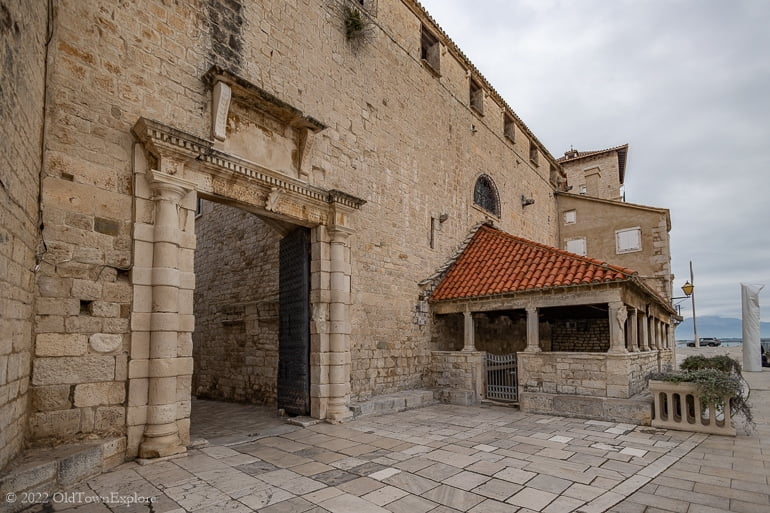
The small lodge in Trogir is outside the city stone walls, east of the southern city gate. It was built on a rectangular floor plan in the first half of the 16th century. It is made of stone masonry and covered with a three-pitched roof covered with a cupola. On the west and south walls, eight octagonal columns are placed in a regular rhythm, with a half column on the east. They have profiled square bases and carry stone beams and a wooden roof. The lodge is entered through the central openings on the south and west sides. It was initially used to accommodate travelers who arrived after the gate was closed but was more recently a fish market.

Church of Our Lady of Mount Carmel
aka Church of Mother Mary of Carmel
The church was built in the 17th century.

Garagnin-Fanfogma Palace
aka The Museum of the City of Trogir
The Garagnin-Fanfogna Palace in Trogir opposite the mainland gate is a complex of Romanesque and Gothic houses united by the restoration of the old and new Garagnin houses in the second half of the 18th century according to the project of Ignacio Macanović. At the western end of the complex is a tower above the archway over the street. The two-story stone building opposite the northern city gate has a monumental late-baroque profiled portal with the family coat of arms on the ground floor. At the northeast corner of the block is a cistern with a terrace. The trapezoidal courtyard has an original baroque pavement. The southern one-story building with an external staircase, once used as a farm, is now a city lapidary.
The Museum of the City of Trogir
The Museum was opened to the public in 1966. It is located in the Garagnin Palace. The permanent exhibition of the Museum shows historical movements, artistic styles, and everyday life of the city from the Middle Ages to the present day.

St. Mark’s Tower
aka Tower of St. Marka (Kula Sv. Marka) aka Tower of St. Brand in Trogir
The Tower of St. Marka is located in the northwest of the old part of Trogir. The round tower adapted to defend against cannon shots was built by the Republic of Venice during the 15th century, at the time of Turkish attacks. The tower faces the mainland and was originally connected by the city walls to the Kamerlengo fortress.
If you’re still on the fence after reading about the best things to see, check out “Is Trogir Worth Visiting.” We review a long list of factors you should consider before reserving a room and booking your flight.
Trogir Walking Tour
If you only have one day (or even just a couple hours) in Trogir, we suggest visiting the recommended sites in the following order:
- North City Gate
- Garagnin-Fanfogma Palace
- Grand Cipiko Palace
- Cathedral of Saint Lawrence
- City Loggia
- Church of San Sebastian
- City Hall
- Church of Saint John the Baptist
- Trogir Promenade
- South City Gate
- Small Lodge
- Monastery and Church of Saint Nicholas
- Monastery and Church of Saint Peter
- Church of All Saints
- Elementary School “Petar Berislavić”
- Monastery and Church of Saint Dominic
- Fortress of Kamerlengo
- St. Mark’s Tower
- Church of Our Lady of Mount Carmel
Following the suggested itinerary will take you past all 19 Best Things to See in Trogir and through much of the Old Town!
Depending on your level of urgency, it will take about 1hr to 1hr 30min to complete the walking tour. This estimate allows time to stop for photos and take a peak inside the churches (along with an occasional drink of water). But it does not include tours of Trogir attractions.
Significantly, the time estimate does not include a tour of Kamerlengo Castle, which we strongly recommend. Although you could stay longer, an hour is plenty of time to tour the castle. Also, the time allotted does not include visiting the City Museum. It won’t take long to see the Museum, but if you’re tight on time, you could skip this one.
If you have more time, after you finish the tour of the small town, you can pick up a rental bike from Kamerlengo Castle and bike to the beautiful beaches of Ciovo Island. Okrug Gornji Beach is a very popular beach on the island.
Map of Things to See in Trogir
Our suggested Trogir Walking Tour starts and ends at the bridge leading from the mainland onto the island. Along the way, you will see many interesting architectural buildings and pass through much of the Old Town.
The tour enters the Old Town through the North Gate, passes the iconic St. Lawrence Cathedral and numerous other historic buildings in the main square, then proceeds past the beautiful Church of St. John the Baptist on the way to the Promenade. You will then visit several churches and monasteries in Old Town before re-emerging onto the Promenade on your way to the famous Kamerlengo Castle.
PRO TIP: If you want to take in a bonus sight, go behind the castle and past Marmont’s Gloriette on your way to St. Mark’s Tower rather than crossing the old town as Google Maps suggests.
City Tours in Trogir
Want to take a tour of Trogir with a guide? Book a highly-rated city tour in Trogir to learn about its history!
Trogir Information and Travel Tips
What is Trogir Famous for?
Trogir is famous for its beautifully preserved medieval Old Town, a UNESCO World Heritage Site. The Old Town features stunning architecture, including the iconic St. Lawrence Cathedral and numerous other historic buildings in the main square. Additionally, Trogir is a popular destination for sailing enthusiasts due to its marina and multiple sailboat rental companies. Plenty of beach and boating activities are available during the summer months for those who have time for a more extended stay.
Is Trogir a beautiful city?
Trogir is a beautiful walled city on a small island connected by a bridge to the mainland. The Old Town is a Unesco World Heritage Site and should be included in your Croatia itinerary.
What food is Trogir Famous for?
Trogir is known for seafood and smoky cured pork products. Additionally, Trogir is known for shortbread cookies called Rafioli.
Where to stay in Trogir?
For the best experience, we recommend staying in Trogir Old Town. The castle marker on the map below is the main square of the Old Town and the center of activity.
The interactive map shows the hotel and apartment options near our recommended location. You can click on it and change the filters to meet your needs. Select your travel dates to get specific availability and prices.
Book your stay now!
How Much Time Do You Need in Trogir?
You can see all of Trogir on foot in a few hours. However, we recommend staying at least one night to enjoy dinner and the promenade after dark. Of course, there’s plenty to see and do including beach and boating activities during the summer months if you have time for a longer stay.
How to get to Trogir?
If you fly into Split Airport, you can get to the historic city center by taxi or bus. If you can walk to your accommodation from the bus station with your luggage, I recommend taking the bus. There is a bus stop at the airport, and it is a short 10 min ride to the Trogir Bus Station.
If you need door-to-door service, then a taxi from the airport to the front door of your hotel is best. To schedule a taxi or private transfer, we recommend GetTransfer.
Best WIFI for a Trogir visit?
Do you need wifi during your trip and don’t want to pay for roaming? We use eSIMs from Airalo during our travel and highly recommend them. They are cheap, easy to set up, and allow you to leave your primary sim card in your phone (so you don’t loose it). Click below for more info.

Is Trogir Worth a Day Trip?
Absolutely! If you’re staying in Split, Trogir is well worth a day trip.
What is the best time to visit Trogir?
The time of the year with good weather and fewer crowds is often referred to as the shoulder season. The shoulder season in Trogir is April, May, September, and October. For many, this is the best time of the year to visit.

Is it safe to travel to Trogir?
Do they speak English in Trogir?
What region is Trogir in?
How Far Is Trogir from Split?
Where is Trogir?
Trogir is located on a small island connected to the mainland by bridges on the central Adriatic coast of Croatia. It is located less than 20 miles west of Split and only 3 miles west of the Split Airport. It is a 3hr 15min drive northwest of Dubrovnik, a 1hr 30min drive southeast of Zadar, and a 3hr 45min drive south of Zagreb.
