
Graz Architecture
Explore Graz Architecture: Churches, Palaces & More
Graz, the capital of Styria, is a city of Renaissance courtyards, Baroque palaces, Gothic churches, and unique hillside fortifications. Its well-preserved historic center and Eggenberg Palace are part of a UNESCO World Heritage Site, recognized for showcasing a harmonious blend of architectural styles spanning over 900 years.
Throughout Graz, you’ll encounter medieval churches, ornate façades, early modern residences, and courtyards that remain active civic and cultural spaces. From the iconic Clock Tower on Schlossberg Hill to the arcaded Landhaus and vibrant Hauptplatz, the city offers an immersive architectural experience rooted in history.
We spent a month in Graz exploring its streets, courtyards, and landmarks. This guide brings together everything we learned to help you navigate the city’s architecture with context and confidence.
This page contains affiliate links. We may earn a small commission at no extra cost to you.
Architecture in Hauptplatz
Graz’s main square, Hauptplatz, is the architectural heart of the Old Town. This section includes the city’s town hall, historic fountains, and prominent facades that reflect centuries of urban development and design.

Town Hall
Grazer Rathaus
- Architect: Wielemans and Reuter
- Style: Neoclassical
- Built: 1893
- Address: Hauptplatz 1, 8010 Graz
The neoclassical town hall was completed in 1893, replacing an earlier Baroque building. The facade was simplified in the 20th century, but original statues representing science, arts, trade, and crafts are being restored.
Fountain of Archduke Johann
- Style: Historicist
- Built: 1878
- Address: Hauptplatz, 8010 Graz
This large bronze monument honors Archduke Johann of Austria, known as the "Styrian Prince." Surrounding female allegories represent four Styrian rivers: Mur, Enns, Drau, and Sann.
Luegghaus
- Style: Late Baroque
- Address: Hauptplatz 12, 8010 Graz
Positioned on the corner of Sporgasse, this ornate building features intricate stucco and grotesque faces hidden among fruits and flowers. Today, it houses a Swarovski shop.
White House
Weißsche Haus
- Architect: Unknown
- Style: High Baroque palace façade (hochbarock)
- Built: 1710; formed from a redesign of an earlier complex, later placed under heritage protection in 1994
- Address: Hauptplatz 3, 8010 Graz
Weißsche Haus has a monumental five‑story block and interior courtyard, featuring a Baroque sandstone relief of the Virgin Mary with Child.
Eagle Pharmacy
aka Adler Pharmacy
- Architect: Unknown
- Style: Historical building core from the 16th century, enhanced in the 17th century by a polygonal corner oriel supported on columns, with a sculpted eagle house emblem (dated 1535), and a rounded‑arch stone portal installed in 1778
- Built: Original structure dates to the 16th century; oriel added in the 17th century; portal from the late 18th century
- Address: Hauptplatz 4, 8010 Graz, Austria
Located in the historic center of Graz, the Eagle Pharmacy is one of the city’s oldest apothecaries, with origins dating back to the early 16th century. The building features a beautifully preserved Baroque façade, while its interior retains elements of traditional pharmacy design, offering a glimpse into centuries of medical history in Styria.
Bürgerhaus Zum großen Christoph
- Architect: Unknown
- Style: 17th-century residence featuring two rectangular cantilevered bay windows (Erker) on corbels, a façade fresco of Saint Christopher by P. Scholz surrounded by foliage and band‑work stucco frame, and a sandstone relief of the Marien‑Gnadenbild in a style recalling Lucas Cranach, installed in 1975
- Built: 17th century
- Address: Hauptplatz 6, 8010 Graz
This historic townhouse in Graz, known as “Zum großen Christoph” (“At the Great Christopher”), dates back to the Renaissance period and is noted for its ornate façade with intricate stucco work. Its name and decorative elements are linked to the figure of St. Christopher, the patron saint of travelers, a common protective symbol in the city’s early urban architecture.
Architecture in Schlossberg
Schlossberg Hill overlooks Graz and contains the city’s oldest fortifications. This section features towers, staircases, wells, and monuments that reflect Graz’s military history and its transformation into a public space.
Clock Tower
Uhrturm
- Style: Gothic base, Renaissance reconstruction
- Built: 13th century; modified mid-16th century
- Address: Schlossberg 6, 8010 Graz
The 28-meter-tall Clock Tower is the city’s most recognizable landmark. It features reversed clock hands (large for hours, small for minutes) and three historic coats of arms. Saved from demolition after Napoleon’s victory in 1809.
Schlossberg Funicular
Funicular Built: 1894
Both options bring visitors to the hilltop. The funicular climbs a 61% slope. The glass elevator shaft offers views of the cliffside.
Schlossberg Lift
- Lift Modernized: 21st century
The Schlossberg lift in Graz provides a quick and easy way to reach the top of Schlossberg Hill. It blends well with the hill's appearance and is an excellent option for those who need to rush or are unable to walk. Inside the glass cabins, visitors can admire the bright, rocky elevator shaft and the sky above, offering a unique view of the mountain.
Felsensteig Stairs
- Built: Early 20th century
- Address: Bastionsanlagen, 8010 Graz
A zigzagging staircase descending the rocky slope, also called the Kriegssteig, offering views over the city.
Turkish Well
Türkenbrunnen
- Built: 1554–1558
This deep well was dug during fortress expansion to ensure water supply during sieges.
Starcke-Haus
- Address: Schloßberg 4, 8010 Graz, Austria
The Starcke Haus is a gourmet restaurant and café.
Gothic Gate
Gothisches Burgtor
Rediscovered in 1982, this gate once connected defensive walls. A nearby tower was replaced in the 19th century by a terrace.
Hackher Lion
- Built: 1909
- Address: Hackher-Löwe, 8010 Graz
Monument commemorating Major Hackher’s 1809 defense of Schlossberg against Napoleonic troops.
Cannon Hall
aka Graz Museum Schlossberg
- Architect: Unknown (part of historic fortress engineering)
- Style: Military fortification architecture
- Built: 16th century (as part of the fortress expansions on the Schlossberg)
- Address: Schlossberg, 8010 Graz, Austria
Originally a fortified casemate designed to house artillery defending Graz, Cannon Hall now forms part of the Graz Museum Schlossberg’s “Historical Trail.” Inside are four preserved cannons, once used to signal fires or attacks. Exhibits illustrate the military history of the Schlossberg and its role in the city’s defense network.
Herbersteingarten
aka Hanging Gardens of Graz
- Architect: Unknown (landscape work commissioned by Herberstein family)
- Style: Terraced Mediterranean garden
- Built: Original vineyard terraces date to the 17th century; redesigned as a public garden in 1930
- Address: Schlossberg, southwest slope below the Uhrturm, 8010 Graz, Austria
Once private vineyard terraces of the noble Herberstein family, this steep garden was transformed into a public park in 1930. Known as the “Hanging Gardens of Graz,” it features lemon, fig, and pomegranate trees along winding paths and offers sweeping views over the old town.
Bell Tower
Glockenturm
- Built: 1588
- Address: Schlossberg 6, 8010 Graz
Home to the 4,600 kg "Liesl" bell, this octagonal tower was built by Archduke Charles II. Along with the Clock Tower, it was preserved through public fundraising after the Napoleonic wars.
Churches in Graz
Graz has a wide range of historic churches that span from the Gothic period to the Baroque and Neo-Gothic eras. This section covers major religious buildings, including pilgrimage sites, former monastic churches, and the city’s cathedral.
Graz Cathedral
Dom
- Style: Gothic
- Built: 1438–1462
- Address: Burggasse 3, 8010 Graz
Commissioned by Emperor Frederick III, the cathedral blends Gothic structure with later Baroque elements. The Landplagenbild fresco on the exterior wall is one of the oldest artworks in Graz.
Franciscan Monastery
- Built: 13th century
- Address: Franziskanerplatz 14, 8010 Graz
Part of Graz’s original fortifications, rebuilt after WWII. Its Gothic cloister garden is still intact.
Parish Church
Stadtpfarrkirche
- Style: Gothic with Baroque elements
- Built: 1440
- Address: Herrengasse 23, 8010 Graz
Initially a Dominican church, it became a parish church in 1585. Noted for its Gothic windows and Baroque altarpieces.
Priests' Seminary
Priesterseminar Graz
- Architect: Founded and constructed by Jesuits; specific architect’s name is unknown
- Style: A Renaissance-style quadrangular complex centered around a courtyard, featuring interiors with elaborate Baroque elements—especially a richly decorated “Prunkstiege” (splendid staircase) added ca. 1712
- Built: Late 16th century (post-1585), initially as a Jesuit college (Kollegium). The courtyard's Renaissance character and the later Baroque staircase reflect phased development through the early 18th century
- Address: Bürgergasse 2, 8010 Graz, Austria
Originally established as a Jesuit college, the structure was built in the late 16th century and features a Renaissance-style courtyard. Inside, the early 18th-century “Prunkstiege” is the architectural highlight, richly adorned with stucco and inspirational inscriptions. Over the centuries, the building has served many roles—including a prison, administration building, and barracks—before returning to its religious roots as the current Priests’ Seminary and Diocesan Museum.
Church of Trinity
- Style: Italian and South German Baroque
- Built: 1704–1722
- Address: Schlossbergplatz, 8010 Graz
Originally built for the Ursulines. Features monumental columns and a voluted gable.
Mariatrost Basilica
- Style: Baroque
- Built: 18th century
- Address: Kirchplatz 9, 8044 Graz
A major pilgrimage site atop Purberg Hill, northeast of the city.
Stiegenkirche
aka Staircase Church
- Architect: Rebuilt under architect Archangelo Carlone (1625–1627); staircase added by Antonio Solari (c. 1636)
- Style: Baroque architecture integrated into earlier Gothic structure
- Built: Originally referenced in 1343 (medieval church); extensively rebuilt 1619–1627; staircase c. 1636; post–WWII restoration 1950–53; interior renovations in 1962
- Address: Sporgasse 21, 8010 Graz
The oldest parish church in Graz, hidden behind an adjacent house and reached via a dramatic staircase. It began as a medieval church later reconstructed in the Baroque period. The staircase—its defining feature—was crafted by Antonio Solari. After wartime damage in 1945, it was restored mid-century and updated internally in the 1960s.
Mariahilferkirche
aka Church of Our Lady of Succor
- Architect: Giovanni Pietro de Pomis (design), with later modifications by Josef Hueber (1742–44)
- Style: Baroque architecture with Lombard-Palladian façade and later onion-dome towers
- Built: Originally constructed 1607–1611; towers and vestibule added 1742–1744; façade figures installed then
- Address: Mariahilferplatz 3, Graz (near minorite monastery)
A Baroque monastery church originally for Minorites, now a parish church. Built to designs by de Pomis and later enhanced with towers and sculptures by Hueber and Straub. It features a richly decorated interior, frescoes, and remains a cultural hub attached to a monastery and cultural center.
Leechkirche
aka Maria am Leech aka University Church
- Architect: Unknown medieval builders; early-Gothic training but no single documented architect
- Style: Early Gothic (initially a Romanesque circular chapel, later Gothic nave, with 14th–15th-century stained glass and early Gothic porch)
- Built: First chapel circa 1000 AD; replaced by a round chapel in 1202; current church constructed 1275–1293; consecrated in 1293; towers added around 1500; renovated 1991–1994
- Address: Zinzendorfgasse 3, 8010 Graz
The oldest Catholic church in Graz, built over a prehistoric burial mound. It evolved from a round chapel to its current early Gothic form by the 13th century, with significant features like a Madonna tympanum (c.1290), medieval stained glass, and period furnishings. Now serves as the university church and retains sacred and historical significance.
Herz Jesu Kirche
- Style: Neo-Gothic
- Built: 1880s
- Address: Sparbersbachgasse 58, 8010 Graz
The tallest church in Graz, with soaring spires and stained-glass windows.
Palaces and Houses in Graz
Noble residences and historic civic buildings are scattered throughout Graz. This section includes palaces, Renaissance arcades, and well-known facades that represent the wealth and influence of former aristocratic families.
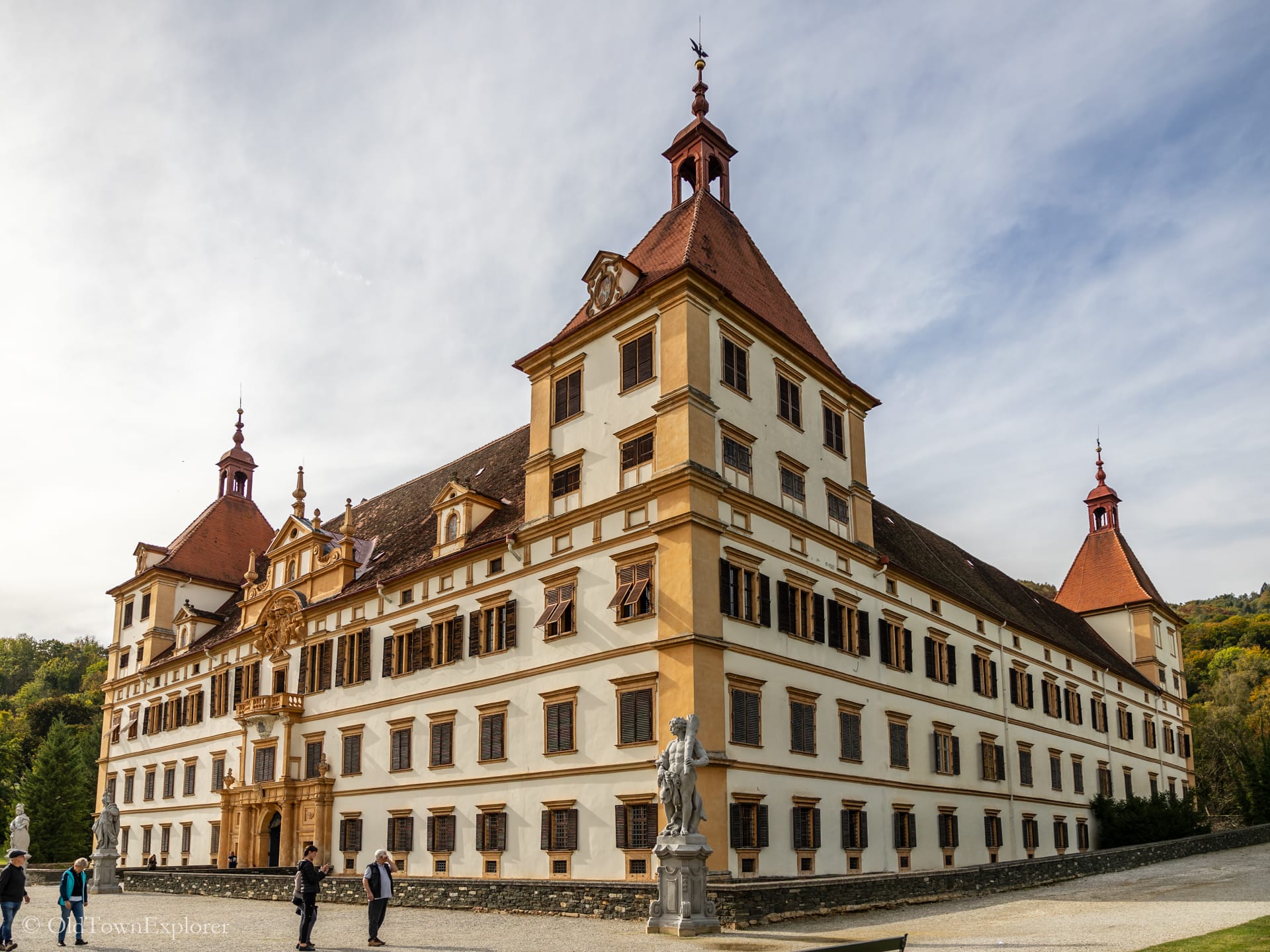
Eggenberg Palace
- Style: Baroque with medieval foundations
- Built: 17th century
- Address: Eggenberger Allee 90, 8020 Graz
A UNESCO site with state rooms, gardens, and museum collections from the Joanneum.
Grazer Landhaus
- Style: Renaissance
- Built: 1527
- Address: Herrengasse 16, 8010 Graz
Features a classic arcade courtyard and currently houses the Styrian parliament.
Painted House
Gemaltes Haus
- Style: Baroque
- Painted: 1742
- Address: Herrengasse 3, 8010 Graz
Frescoed with mythological figures by Johann Mayer, this facade makes the Herzoghof building one of Graz’s most photographed.
Palais Saurau
- Style: Baroque/Renaissance
- Address: Sporgasse 25, 8010 Graz
Notable for its dramatic courtyard arches and Turkish statue above the entry.
Courtyards in Graz
Graz is known for its hidden courtyards, many of which are tucked behind unassuming facades. These arcaded spaces reveal layers of architectural history and remain some of the most photogenic spots in the Old Town.
Landhaus Courtyard
- Address: Herrengasse 16 / Landhaus, 8010 Graz
The arcaded inner courtyard at Landhaus Graz is a stunning example of Italian Renaissance art.
Hof des deutschen Ritterordens courtyard
- Address: Sporgasse 22, 8010 Graz
The Gothic arcaded courtyard at the "Hof des deutschen Ritterordens" is a must-see. The ground is completely covered with "Murnockerl," which is the Graz term for the cobblestones smoothed by the Mur River. These stones were utilized to pave streets and courtyards.
The stone portal, featuring the cross of the order on its headstone, dates back to the early 16th century. You can find the entrance at Sporgasse 22.
Generalihof
- Architect: Unknown
- Style: Italianate Renaissance courtyard with arcaded facades
- Built: Date unknown; recognized today for its Renaissance-style courtyard, though exact original construction is undocumented
- Address: Herrengasse 9, 8010 Graz
One of Graz’s most striking historic courtyards, now housing the Klapotetz wine bar and occasionally hosting jazz concerts and cultural gatherings.
Palais Niederösterreich
- Architect: Specific architect not documented
- Style: 19th-century Historicist / Neoclassical
- Built: 1839–1848
- Address: Herrengasse 13, 8010 Graz
Known today as the Palais Niederösterreich (formerly the Estates House of Lower Austria), a representative city palace from the mid-19th century; its façade contributes to the architectural breadth of Herrengasse.
Palais Herberstein
aka Museum im Palais
- Architect: Original houses evolved over centuries; no single architect identified
- Style: Renaissance origin with later Baroque/Rococo interior modifications (notably mid‑18th-century state rooms)
- Built: Combined from older structures (16th century), acquired by Herberstein family before 1581, remodeled into city palace over time; state rooms added 1754–1757
- Address: Sackstraße 16, 8010 Graz
Now houses the History Museum (Museum im Palais). Its richly decorated Rococo state rooms and stately staircase remain central features of its adaptation as a cultural venue.
Palais Attems
- Architect: Johann Joachim Carlone; additional contributions possibly by Andreas Stengg
- Style: Italianate Baroque city palace, richly ornamented with stucco, pilasters, and monumental portal
- Built: 1702–1716
- Address: Sackstraße 17, 8010 Graz
Considered the most significant noble palace in Styria. Its U‑shaped layout, ornate façade, and grand staircases reflect elite Baroque urban architecture. Today it houses arts institutions and event spaces.
Other Attractions in Graz
Not all historic architecture in Graz fits neatly into a category. This section highlights additional buildings and structures of architectural interest, from the city’s opera house and armory to modern landmarks like the Island in the Mur.
Styrian Armoury
Landeszeughaus
- Architect: Antonio Solar
- Built: 1642–1644
- Address: Herrengasse 16, 8010 Graz
Constructed between 1642 and 1644, the Landeszeughaus was designed by the Tyrolean architect Antonio Solar to serve as a central armory for the Styrian estates. The building is five stories high and approximately 50 meters long, with a façade adorned with Baroque statues of Mars and Minerva by Giovanni Mamolo.

Glockenspiel
- Built: Early 20th century
- Address: Glockenspielplatz 4, 8010 Graz, Austria
The Glockenspiel is a beautiful, historic clock located in Graz. It was added over a century ago and is now one of the city's top tourist attractions. It chimes three times each day, at 11 am, 3 pm, and 6 pm. The building that houses it is over 800 years old.
Grazer Burg with Double Spiral Staircase
- Built: 15th century
- Address: Hofgasse 15, 8010 Graz
Unique Renaissance staircase with twin spirals meeting at each floor.
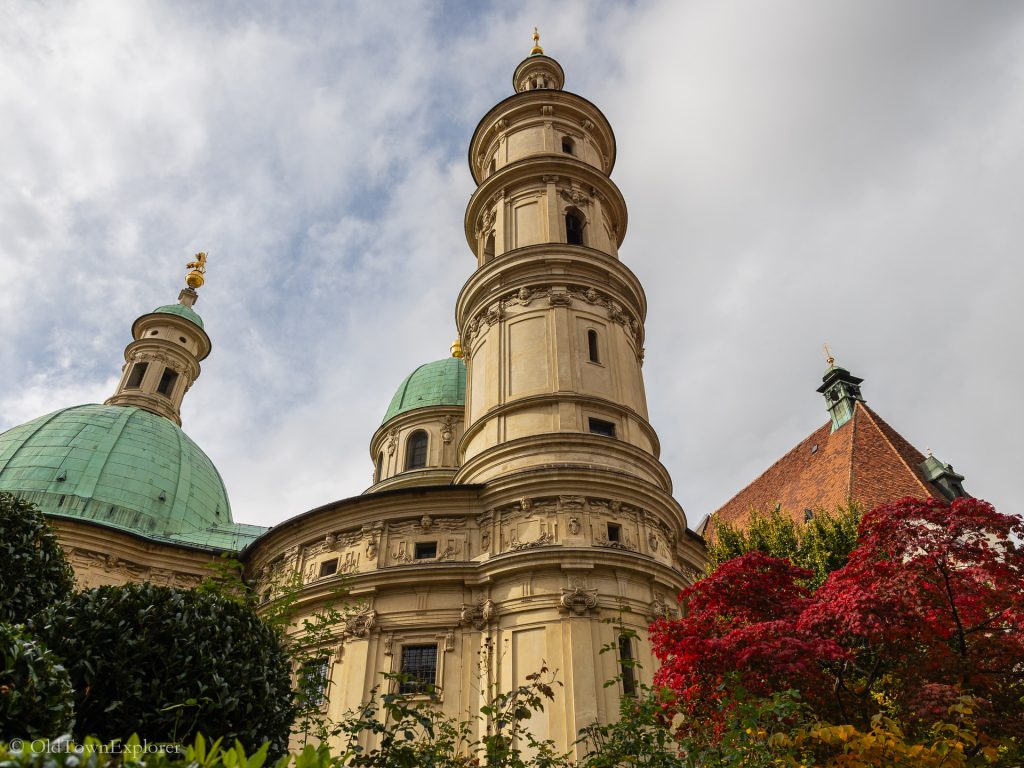
Mausoleum of Emperor Ferdinand II
- Built: 17th century
- Address: Bürgergasse 1, 8010 Graz
Elaborate tomb beside the cathedral. Features red marble sarcophagus.
Island in the Mur
- Built: 2003
- Architect: Vito Acconci
- Address: Lendkai 19, 8020 Graz
A floating steel structure shaped like a shell, connected to both riverbanks.
Opera House
- Built: 1899
- Style: Historicist
- Address: Kaiser-Josef-Platz 10, 8010 Graz
The Opera House, once the city theatre, is now the second largest opera house in Austria. It was named "Opera House of the Year" in 2001.

Hofbäckerei Edegger-Tax
- Built: 1896 (façade)
- Address: Hofgasse 6, 8010 Graz
In 1880, Franz Tax III moved the bakery to its present location and transformed it into a renowned establishment. When Emperor Franz Joseph visited Graz in 1883, the bakery supplied treats for the royal court. In 1888, the bakery received an Imperial and Royal Warrant of Appointment due to the exceptional quality of its products. A skilled carpenter named Anton Irschik crafted the carved wooden shop portal in 1896.
Reinerhof
- Architect: Unknown; founded by the Rein Monastery, who donated the site in 1164
- Style: Medieval core with later modifications; features a 15th-century building nucleus, Biedermeier‑style facades from 1839–1840 (designed by Georg Hauberisser the Elder), and a preserved late‑Gothic single‑pillar hall
- Built: First mentioned in 1164; core dates to the 15th century; alterations occurred through the 16th–18th centuries; facade renewal in 1839–1840; renovation and archaeological restoration conducted in 1992–1994
- Address: Schlossbergplatz / Sackstraße 20, 8010 Graz — located right next to the Schlossberg tunnel entrance.
The Reinerhof is recognized as the oldest non‑ecclesiastical building in Graz. Originally belonging to the Rein Monastery, it later became part of residential and institutional use. The building retains medieval architectural elements, Biedermeier facades, and a Gothic hall. It's now adapted for mixed uses—hosting a café, museum, offices, and shops—following award-winning conservation and restoration works by Christian Andexer and Georg Moosbrugger (1992–1994).
City Tours in Graz
To learn more about Graz’s architecture, consider booking a guided walking tour of the Old Town or Schlossberg area.
Best Places To Stay In Graz
Hotels in Graz
We recommend staying near Hauptplatz, the main square of the Old Town. This central area is surrounded by historic buildings and makes it easy to explore Graz’s architecture on foot. The streets are walkable, mostly pedestrianized on weekends, and connected by tram.
Here’s a map with hotel and apartment options that can be filtered by dates and availability.
FAQs About Graz Architecture
What is Graz famous for architecturally?
Graz is known for its Renaissance courtyards, Baroque palaces, Gothic churches, and the Schlossberg hilltop fortress. It’s also a UNESCO City of Design.
What is the most famous building in Graz?
The Clock Tower (Uhrturm) on Schlossberg Hill is Graz’s most iconic landmark.
Who designed the Kunsthaus Graz?
Kunsthaus Graz was designed by Colin Fournier and Sir Peter Cook.
Where can I see Baroque architecture in Graz?
Eggenberg Palace, Palais Saurau, and Mariatrost Basilica are prime examples.