
Gdansk Architecture
Explore Gdansk Architecture: Churches, Palaces & More
Gdańsk is a city shaped by centuries of trade, conflict, and cultural exchange—and nowhere is that history more vivid than in its architecture. From towering Brick Gothic churches to ornate Renaissance townhouses and Dutch-inspired façades, Gdańsk’s buildings tell the story of a once-powerful Hanseatic port reborn after war.
Gdańsk's Old Town is generally considered to encompass two main historical districts: the Old Town (Stare Miasto) and the Main City (Główne Miasto). Unlike the Old Town, the Main City was rebuilt after World War II and includes some of the city's best-known historical monuments.
This guide explores the most significant architectural landmarks across the Main City and Old Town, highlighting gates, churches, granaries, and hidden gems that define the character of this Baltic jewel.
We spent a month in Gdansk researching the city's historic architecture. We’ve summarized the information we collected so you can start enjoying these sights as soon as you arrive!
This page contains affiliate links. We may earn a small commission at no extra cost to you.
Attractions Along the Royal Route in Gdansk
The Royal Route is Gdańsk’s most iconic thoroughfare, lined with some of the city's finest examples of Gothic, Renaissance, and Mannerist architecture. From grand city gates to richly decorated townhouses and civic buildings, this historic route offers a striking showcase of the city's architectural legacy and former wealth as a Hanseatic power.
For an official overview of the route and its main landmarks, the Royal Route guide from Visit Gdańsk outlines the sequence from Upland Gate to Green Gate and explains what to look for at each stop.
Upland Gate
Brama Wyżynna
- Architect: Hans Kramer; decorative work by Wilhelm van den Blocke
- Style: Renaissance (Antwerp-inspired)
- Built: 1574–1576; facade and attica completed 1588
- Address: Wały Jagiellońskie 2A, 80-887 Gdańsk, Poland (entrance to Ulica Długa)
Grand ceremonial gate of the Royal Route. Its richly sculpted facade displays coats of arms and Latin maxims, marking the ceremonial entrance for monarchs.
Prison Tower and Torture Chamber
Prison Tower (Wieża więzienna) and Torture Room (Katownia)
- Architect: Rebuilt by Antoni van Obberghen
- Style: Functional fortification architecture
- Rebuilt: 1593–1604 (originally 14th century)
- Address: Targ Węglowy 26, 80-836 Gdańsk, Poland
Comprised two connected buildings—torture chamber/courthouse and prison tower. Active until mid‑19th c., severely damaged in WWII, now restored, housing the Amber & Torture Museum.
Court of the Brotherhood of St. George
Dwór Bractwa św. Jerzego
- Architect: Designed by Jan (Johann) Glothau/Glothaua
- Style: Late Gothic with Flemish defensive motifs
- Built: 1487–1494
- Address: Targ Węglowy 27, adjacent to Golden Gate
Brick manor built as headquarters for an elite arquebus brotherhood, featuring battlements, an octagonal cupola topped with a St. George statue. Severely damaged in WWII, restored in 1950s, now houses the Polish Architects Association.
Golden Gate
Brama Złota
- Architect: Abraham van den Blocke (designed); built by Jan Strakowski
- Style: Dutch Mannerism (Renaissance)
- Built: 1612–1614
- Address: Ulica Długa (western end)
Ornate ceremonial gate featuring allegories of civic virtues; inscriptions in Latin. Damaged in WWII, restored in 1957 and again in the 1990s.
Ulica Długa
"Long Lane"
- Style: Primarily a mix of Dutch Mannerism, Gothic, and Renaissance façades
- Original Layout: Traced to the 13th–14th centuries, fully developed by the late Middle Ages
- Address: Runs from the Golden Gate (Złota Brama) to the Long Market (Długi Targ)
Ulica Długa was the main axis of civic life and a key part of the coronation route for Polish monarchs visiting Gdańsk. Lined with the residences of the city’s wealthy patricians, it showcases elaborate merchant houses with richly ornamented façades. Though much was destroyed in 1945, reconstructions in the 1950s and '60s faithfully restored the street’s Hanseatic charm.
This street seamlessly transitions into Długi Targ, forming a continuous ceremonial corridor.
Uphagen’s House
Dom Uphagena
- Architect: Unknown
- Style: Rococo / early-classical merchant townhouse
- Built: c. 1776
- Address: Ulica Długa 12
Elegantly preserved merchant’s residence, now a museum showcasing late‑18th‑c. domestic interiors.
Lion’s Castle
Lwi Zamek / Dom Schwartzwaldów
- Architect: Attributed to Hans Kramer; portal sculptor F. Vroom
- Style: Flemish-influenced Renaissance
- Built: 1569
- Address: Ulica Długa 35
Lavish town house featuring Renaissance façade with stone lions added later. Destroyed in WWII; rebuilt 1950–53 with heritage-faithful reconstruction.
Main Town Hall
Ratusz Głównego Miasta
- Architect: Unknown
- Style: Gothic base with Renaissance/Baroque additions
- Built: Originating from 1379; major upgrades in 16th–17th c.
- Address: Ulica Długa 46/47
The city’s most iconic civic building with a distinctive tall tower and an ornate carillon. It served as the seat of municipal government and is now a museum.
Długi Targ
"Long Market"
- Architect: developed over centuries with no single architect
- Style: Dominated by Mannerist and Dutch/Flemish Renaissance façades; Baroque influences appear in the decorative elements
- Original Layout: Developed in the 13th century; took current form by the 16th century
- Address: Extends from the Main Town Hall (Ratusz Głównego Miasta) to the Green Gate (Zielona Brama)
Originally a merchant’s marketplace, Długi Targ became a prestigious plaza for civic life, ceremonies, and public announcements. Today, it is Gdańsk’s most photographed location, marked by numerous Tenement Houses.
Many of these houses were reconstructed after WWII with façades restored based on 17th–18th century engravings.
Hewel’s House
Hewel's Dwór
- Architect: Unknown
- Style: Mannerist–Renaissance
- Built: Early 17th century
- Address: Długi Targ 1
Once home to merchant and shipowner Georg Hewel, this prestigious townhouse is marked by elaborate Mannerist ornament and classic Old Town architecture.
Curicke’s House
Kamienica Curicke
- Architect: Unknown
- Style: Renaissance
- Built: After 1632
- Address: Długi Targ 9
Purchased by the Curicke family, famed for Georg Curicke’s historical writings. Retains Renaissance façade elements among the Long Market ensemble.
Schumann House
Kamienica Schumana
- Architect: Unknown
- Style: Renaissance with Flemish influences
- Built: Circa 1560 (estimate)
- Address: Długi Targ 45
Known historically as the “King’s House,” it features Flemish guild-hall-influenced façade and a Zeus sculpture. Its ornate form echoes buildings in Antwerp.
Artus’ Court
Dwór Artusa
- Architect: Rebuilt facade by Abraham van den Blocke (1617)
- Style: Gothic core, Renaissance façade and interior
- Built: Original 1348–50; rebuilt 1477–81; façade redone 1617
- Address: Długi Targ 44
Merchant guildhouse inspired by King Arthur's Round Table—ceremonial and commercial center with a magnificent Great Hall, later stock exchange, now museum.
Current visitor information for Artus Court, the Main Town Hall, Uphagen’s House, and other historic interiors along the route is available on the Museum of Gdańsk website.
Neptune’s Fountain
Fontanna Neptuna
- Architect: Designed by Abraham van den Blocke; sculpted by Johann Rogge and other artists
- Architectural Style: Mannerist / Renaissance
- Built: Original fountain built in 1615–1627
- Address: Długi Targ, 80-833 Gdańsk, Poland
A symbol of Gdańsk’s maritime heritage, this bronze statue of Neptune has been a city landmark for centuries. The fountain was restored after WWII.
New Jury House
Nowy Dom Ławy
- Architect: Unknown
- Style: Renaissance guildhouse
- Built: Late 16th–early 17th century (exact year unconfirmed)
- Address: Nowy Dom Ławy (Sień Gdańska), Długi Targ 43, 80-828 Gdańsk, Poland
Historically used by mercantile juries for arbitration. Façade restored; now used for official events.
Golden House
Złota Kamienica
- Architect: Abraham van den Blocke (design and sculptural programme)
- Style: Flemish Mannerism
- Built: 1609–1618
- Address: Długi Targ 41
Lavishly decorated façade with gilded reliefs depicting allegorical and historical scenes—once called the “jewel of Gdańsk architecture.” Largely destroyed in WWII, it was authentically rebuilt post-war.
Ferber House
Dom Ferberów
- Architect: Unknown
- Style: Dutch Mannerism
- Built: 1560
- Address: Długi Targ 28
Built for Mayor Konstantin Ferber, this townhouse features a decorative attic, richly carved façade with coat-of-arms of Gdańsk, Royal Prussia, Poland, and sculptures. It survived WWII and was restored faithfully.
Green Gate
Zielona Brama
- Architect: Regnier (Reiner) van Amsterdam; constructed from plans by Hans Kramer
- Style: Dutch-Flemish Mannerism
- Built: 1564–1568
- Address: Długi Targ (eastern end; connecting to Motława waterfront)
Palatial gate built as a royal residence, echoing Antwerp City Hall. Now hosts the National Museum, occasional exhibitions, and offices.
Religious Buildings in Gdansk
Gdańsk’s Main City and Old Town are home to an exceptional collection of religious architecture, ranging from soaring Gothic basilicas to richly decorated Baroque chapels. These sacred sites reflect the city’s diverse spiritual heritage and its historical importance as a cultural crossroads on the Baltic.
Main City (Główne Miasto)
Basilica of the Assumption of the Blessed Virgin Mary
aka St. Mary’s Basilica
- Architects: Heinrich Ungeradin, Hans Brandt, Heinrich Haetzl; side Royal Chapel by Tylman Gamerski
- Style: Brick Gothic, with later Baroque chapel
- Built: Groundbreaking 1343; main construction 1379–1502; Royal Chapel added 1672–1681
- Address: ul. Podkramarska 5, Gdańsk
One of the world’s largest brick churches—nicknamed the "Crown of Gdańsk." An imposing hall church measuring approximately 105 m × 66 m, featuring star-vaulted ceilings, 37 chapels, an astronomical clock (1464), and a 78 m tower offering panoramic views.
Royal Chapel
Kaplica Królewska
- Architect: Unknown
- Style: Baroque
- Built: 1678–1681 (after St. Mary’s completion)
- Address: ul. Świętego Ducha 58
A chapel adjacent to St. Mary’s Basilica, built as a royal oratory. Boasts lavish Baroque frescoes, stucco work, and ceiling art. Occasionally open during Sunday services.
Hospital Church of the Holy Spirit
Kościół św. Ducha
- Architect: Unknown
- Style: Brick Gothic
- Built: Founded in the 14th century (exact dates not online)
- Address: U Furty 3, 80-837 Gdańsk, Poland
A medieval parish church near St. Mary’s. Its compact Gothic hall design served city residents; currently deconsecrated.
Saint John’s Church
Kościół św. Jana
- Architect: Unknown (14th‑century guild church, expanded later)
- Style: Brick Gothic hall church
- Built: 1370–1465
- Address: ul. Świętojańska 50, Gdańsk
A three-nave brick Gothic hall church featuring a stellar lierne vault, a Renaissance altarpiece by Abraham van den Blocke, and a historic tower (rebuilt 1568). Post-WWII restored; now hosts worship services and cultural events.
Church of St. Nicholas (Dominican)
Bazylika św. Mikołaja
- Architect: Original medieval architect unknown; Dominican extensions from 14th c.
- Style: Brick Gothic
- Built: Core building 1348–1487; Dominican origins date to 1227
- Address: ul. Świętojańska 72, Gdańsk
A hall-style Brick Gothic basilica and the only central Gdańsk church to survive WWII undamaged. Boasts a richly decorated interior with Gothic, Renaissance, Baroque, and Rococo elements (15th c. Pietà, main altar 1643). It remains an active Dominican basilica.
Old Town (Stare Miasto)
St. Catherine’s Church (with carillon)
- Architect: Unknown
- Style: Brick Gothic
- Built: Circa 1227–1239, completed mid‑14th century
- Address: ul. Profesorska 3
Gdańsk’s oldest church. Features a 76 m Baroque‑topped tower with a 50‑bell carillon and houses the Museum of Turret Clocks. Burned in 2006 and meticulously restored.
St. Bridget’s Church
Kościół św. Brygidy
- Architect: Original medieval plans (c. 1394–1420); rebult post‑WWII based on those designs
- Style: Gothic (rebuilt in 1973)
- Built: c. 1396–1420; destroyed 1945, rebuilt 1973
- Address: ul. Profesorska 17
Gothic sanctuary once linked to the Solidarity movement. Features the spectacular Amber Altar (installed 2017) and a crypt opened after discovering 17th-century remains.
Co-Cathedral of St. Bartholomew and the Protection of the Most Holy Mother of God in Gdańsk
- Architect: Unknown
- Style: Gothic
- Built: 15th century
- Address: Zaułek Św. Bartłomieja 1, Gdańsk
It was built in the Gothic style in the 15th century. The tower dates back to 1591–1600, the current dome was built in 1982, the portal was built in 1647. There is an iconostasis inside.
From 1524 until its destruction in 1945, it was a Lutheran church. After its reconstruction, it belonged to the Jesuits (until 1990). Since January 31, 2001, the church has been a co-cathedral of the Wrocław-Gdańsk eparchy.
The Greek Catholic parish in Gdańsk has existed since 1957. Since 2020 it has belonged to the Olsztyn-Gdańsk Eparchy, previously it belonged to the Wrocław-Gdańsk Eparchy.
Church of St. James
- Architect: Unknown
- Style: Late Gothic (with elements of Brick Gothic and Renaissance)
- Built: First mentioned circa 1415 as a sailors' chapel; Current structure erected in 1436–1437, replacing an earlier church destroyed in the Hussite conflicts
- Address: Łagiewniki 63, 80‑855 Gdańsk, Poland
Built beside a hospital for sailors, its foundation famously included sand from Jerusalem, symbolizing a spiritual connection and the church’s role as a shelter for weary travelers
The original church was destroyed by fire in 1663, and the current tower was added during the rebuild.
In the mid-20th century, frescoes and stained-glass windows were added by artist Zofia Baudouin de Coutenay, and local craftsmen created the interior furnishings.
Church of St. Elizabeth
- Architect: Unknown
- Style: Got
- Built: 1417
- Address: Elżbietańska 1, 80-894 Gdańsk, Poland
The church is a Gothic brick building with a single aisle and a tower aligned on its axis, featuring a stellar vault, a presbytery, and a side chapel. Constructed in 1417, it stands on the site of a chapel that once served the hospital for the poor. In 1547, due to fortification efforts, the church cemetery was removed, and the main entrance to the church was bricked up.
Church of St. Joseph
Św. Józefa
- Architect: Unknown
- Style: Brick Gothic with Baroque interior elements
- Built: Begun late 15th century (chancel completed c. 1496; extended west in 1623)
- Address: Elżbietańska 9/10, 80-894 Gdańsk, Poland
Originally planned as a large three-aisled hall church, financial constraints limited it to a single aisle with a chancel, sacristy, and partial west section. It features a stellar net vault in the chancel and a distinctive late Gothic stepped gable, with external buttresses rare for Gdańsk churches. Severely damaged by fire in 1663, it was rebuilt with a Baroque interior. The Carmelites were expelled in 1823, and the church became a parish in 1840. In 1945, Soviet forces set it ablaze, causing significant loss of life; reconstruction by the Oblates of Mary Immaculate began in 1947, with reconsecration in 1953.
Franciscan Church of the Holy Trinity
Kościół Świętej Trójcy
- Architect: Built by Franciscans as part of their monastery.
- Style: Brick Gothic.
- Built: Circa 1419–1514
- Address: Rzeźnicka 13 (part of Franciscan monastery complex)
Late-Gothic three-aisle hall church with distinctive stepped gables, stellar vault, and cloister. After Reformation, served as gymnasium/museum; now part of National Museum Foundation.
Palaces and Houses in Gdansk
The historic palaces and townhouses of Gdańsk showcase the city’s prosperity during its Hanseatic golden age. From ornate Renaissance façades to Baroque merchant homes, these richly decorated buildings reflect centuries of artistic influence, civic pride, and international trade. Many have been carefully restored, preserving their architectural detail and historical significance within both the Main City and Old Town.
Main City (Główne Miasto)
English House
Dom Angielski
- Architect: Hans Kramer (master builder); façade sculpted by Wilhelm Jacobsen of Brussels
- Style: Flemish/German Mannerist Renaissance
- Built: 1568–1570
- Address: ul. Chlebnicka 13–16
A monumental townhouse with a 15.5 m wide Renaissance façade featuring a triumphal-arch entrance and sculpted angels. It later hosted English merchants, hence the name. The lower façade survived WWII and the building was restored in the 1970s; today it houses the Gdańsk Academy of Fine Arts.
Schlieff House
Kamienica Schlieffów
- Architect: Commissioned by Valentine Schlieff
- Style: Brick Gothic with ornate stone tracery
- Built: 1520; restored in the 1970s
- Address: Chlebnicka Street
The only surviving late-Gothic stone-tracery townhouse in Gdańsk, featuring lions and crenellated attic. Its original Venetian tracery was taken to Potsdam in the 19th c. and reconstructed on Berlin’s Peacock Island. The façade was later reconstructed in 1970 from archival drawings.
Old Town (Stare Miasto)
House of the Pelplin Abbots
Pelplin Abbots' House
- Architect: Possibly inspired by or ornamented by Abraham van den Blocke
- Style: Dutch Mannerism
- Built: Early 17th century (around 1612)
- Address: Elżbietańska 3, 80-894 Gdańsk, Poland
A three-storey tenement with richly ornamented façade—stone bust friezes, S-shaped gable volutes, obelisk pinnacles—and original 17th‑c. staircases. Served as lodging for Pelplin Abbey’s abbots until 1823; today, it houses the University of Gdańsk’s Art History Institute.
House of Preachers
Dom Kaznodziei
- Architect: Anthonis van Obbergen
- Style: Dutch Renaissance / Mannerism
- Built: 1599–1602
- Address: ul. Katarzynki 1–3
Originally for Lutheran clergy from St. Catherine’s Church, this tripartite townhouse showcases ornamental gables, strapwork, a German biblical inscription, and a distinctive three-part façade. Survived WWII; restored in 1970.
Malt House
Lew Hewelion - Browarnik
Address: Długie Pobrzeże 11, 80-888 Gdańsk, Poland
House of Charity
Dom Ubogich / Spend- und Waisenhaus
- Architect: Barthel Ranisch
- Style: Baroque institutional architecture
- Built: 1698–1699 (extended in 1749)
- Address: Near Polish Post Defenders Square, Gdańsk, Poland
Originally constructed as a combined shelter for homeless adults, beggars, and orphans in the aftermath of wars with Sweden, the House of Charity was later expanded in 1749. Following its closure in 1906, the building served various institutional roles—including medical and editorial functions—survived the Second World War intact, and was officially registered as a historical monument in 1967. From 2022 onward, it has been undergoing renovation to become a House of Literature, a cultural center honoring figures such as Daniel Chodowiecki and Günter Grass.
City Gates in Gdansk
City gates in Gdańsk once controlled access to a fortified Hanseatic port, guiding merchants, travelers, and goods between the city and the Motława River. From river-facing water gates that linked warehouses to ships, to landward gates integrated into bastion defenses, these structures reveal how Gdańsk balanced trade, security, and representation. Today, surviving gates like Brama Mariacka, Brama Chlebnicka, and Brama Nizinna are preserved as architectural landmarks, anchoring views along streets, quays, and former fortification lines.
For a more technical look at the surviving walls, bastions, and gate system, this study of Gdańsk’s city defensive walls explains how the fortifications developed over time.
St. Mary’s Gate
Brama Mariacka
- Architect: Not found in sources
- Style: Late Gothic, water tower gate
- Built: Late 14th century (c.1377)
- Address: ul. Chlebnicka (river side)
One of three surviving river gates; functioned as both water tower and customs point. It has preserved much of its Gothic form and survived WWII.
Chlebnicka Gate
Brama Chlebnicka
- Architect: Unknown
- Style: Gothic with 15th‑century Flemish‑Renaissance elements
- Built: First documented 1377; rebuilt mid‑15th century; later turned into housing
- Address: ul. Chlebnicka 21
Oldest surviving late‑Gothic river gate in Gdańsk, later repurposed into townhouses. Survived WWII, and has one of its characteristic octagonal towers preserved.
Lowland Gate
Brama Nizinna
- Architect: Jan Strakowski (based on Cornelius van den Bosche’s plans)
- Style: 17th-century bastion-fortified Renaissance military architecture
- Built: 1626; completed with ravelin 1649–1650
- Address: ul. Dolna Brama 5 (border of Old Town)
One of Gdańsk’s four modern era city gates, built to guard access from the south; structure survives intact and remained passable.
Cow Gate
Brama Krowia
- Architect: Not detailed
- Style: Late Gothic water gate
- Built: 2nd half of 14th century
- Address: ul. Ogarna / near Motława
A red-brick Gothic river gate bearing the name of the adjacent dairy market ("Krowia"). It is among the best-preserved medieval water gates.
Gate of the Holy Spirit
Brama Świętego Ducha
- Architect: Unknown
- Style: Late Gothic water tower, 14th-century; rebuilt 1985–1987
- Built: Late 14th century; underwent 1980s reconstruction
- Address: ul. Św. Ducha (near Green Gate)
Historic waterfront gate that once included river access and storage. Later became residential and commercial; reconstruction restored its medieval form.
Market Gate
Brama Straganiarska
- Architect: Unknown
- Style: Gothic water gate
- Built: 14th–15th century (c.1400s)
- Address: ul. Straganiarska, onto Motława
One of several medieval water gates leading from the market district to the port, allowing direct merchant access to ships.
St. John's Gate
Brama Świętojańska / Św. Jana
- Architect: Unknown
- Style: Late Gothic
- Built: 14th century
- Address: ul. Świętojańska
A landward gate formerly part of city defences leading into the St. John district. Now fully restored and preserved.
Towers in Gdansk
The medieval towers of Gdańsk once formed a crucial part of the city's fortified walls, serving as watchtowers, arsenals, and symbols of civic defense. Built primarily in the Gothic style, many of these structures have been preserved or carefully restored, offering a glimpse into the city's strategic and architectural past.
Lighthouse Tower
aka Lantern Tower (Baszta Latarnia)
- Architect: Unknown
- Style: Gothic tower
- Built: 14th century
- Address: Northern city wall near Brama Mariacka
The oldest surviving tower of Gdańsk’s medieval defences. Named for its upper lantern-like structure—once a watch post; fully restored after WWII.
The Straw Tower
Baszta Słomiana
- Architect: Unknown
- Style: Gothic defensive tower
- Built: 14th–15th century
- Address: At the corner of ul. Słomiana (near southern city wall)
Octagonal lookout and defensive tower integrated into the fortification wall. Originally served city defence; still partially preserved and restored.
Corner Tower
Baszta Narożna
- Architect: Unknown
- Style: Gothic fortification
- Built: Founded March 26, 1343, completed mid‑14th century; expanded later in the 15th century
- Address: Ogarna, 80-980 Gdańsk, Poland
A hexagonal/tower on a rectangular base measuring approx. 6×12 m, originally open to the city side. The tower protected the city’s northeastern corner and later served as fire brigade headquarters (1856–1857). Damaged in WWII, rebuilt in the 1960s, and now connected to a scout (Pfadfinder) facility.
Jacek Tower
Baszta Jacek
- Architect: Unknown
- Style: Gothic – medieval fortification
- Built: Circa 1400
- Address: ul. Pańska 1 (corner of Podwale Staromiejskie)
Gdańsk’s tallest medieval tower at ~36 m with an octagonal plan. Functioned as defensive and observation post. After 1945 damage, restored in 1950s; now contains a photo studio and exhibitions.
Swan Tower
Baszta Łabędź
- Architect: Unknown
- Style: Gothic city-defence tower
- Built: 14th–15th century
- Address: Northern Main City wall near ul. Chlubna
One of the northern flank towers named after a swan figure; part of Gdańsk’s medieval fortifications, restored in post-war reconstruction.
Anchormen’s Tower
Bazyl Anchora
- Architect: Unknown
- Style: Gothic
- Built: 14th century (per medieval fortification maps)
- Address: Near Motława riverfront on eastern wall
Named for its proximity to the anchoring area ("anchor men"); part of the riverside defensive line, rebuilt post-war.
Trumpet Tower
Baszta pod Zrębem
- Architect: Unknown
- Style: Late Gothic cylindrical defensive tower, later rebuilt in classical form
- Built: 1487
- Address: South-east boundary of the Old Suburb (Stare Przedmieście), near modern Bear Gate area
Named for its location on Pod Zrębem Street, originally a truncated-cylindrical tower with conical roof, repurposed as a powder tower in the 17th century. It has survived intact, with 19th-century alterations but preserved medieval fortification character.
The White Tower
Baszta Biała
- Architect: Unknown — built by city masons
- Style: Late medieval brick fortification
- Built: 1460–1461
- Address: ul. Rzeźnicka 47, near Chmielna
Horseshoe‑shaped, five‑storey tower with loopholes for small arms and cannons; originally stored gunpowder. After WWII destruction, it was restored in the 1980s and now houses the Tri‑city Mountaineering Club.
Bridges in Gdansk
Gdańsk’s bridges span its many waterways, connecting historic districts and facilitating commerce and daily life. From medieval footbridges to modern engineering marvels like cable-stayed structures, these bridges showcase a blend of functional design and evolving architectural styles that reflect the city’s rich maritime heritage.
Footbridge to Ołowianka Island
- Architect/Design Team: Ponting Bridges (Slovenia); design by Viktor Markelj & team
- Style: Contemporary steel-and-glass bascule drawbridge with minimal historic visual impact
- Built: Construction began July 11, 2016; opened June 17, 2017
- Address: Connects Old Town (ul. Św. Ducha / ul. Targ Rybny) to Ołowianka Island over Motława River
A modern pedestrian-and-cycle bridge that rotates/opening spine to let boats pass. Designed to remain visually discreet and respectful of historic panorama.
Chlebowy Bridge
aka Bread Bridge / Love Bridge
- Architect: Unknown
- Style: Medieval canal footbridge, later modified
- Built: Original in 14th century; rebuilt many times (including 20th-century updates)
- Address: Crosses the Radunia Canal near Main Town Hall (Kanał Raduni)
Known as “Bread Bridge” from historic bread stalls and “Love Bridge” for the love-lock tradition. Pedestrian-only, charming site near the city center.
Third Millennium John Paul II Bridge
Most III Tysiąclecia Jana Pawła II
- Architect: Designed by Krzysztof Wąchalski (Biuro Projektów Budownictwa Komunalnego S.A.)
- Style: Modern cable-stayed bridge with inverted-Y pylon
- Built: Began August 2, 1999; completed October 15, 2001; opened November 9, 2001
- Address: Spans the Martwa Wisła River; connects northern port area to road network
A landmark cable-stayed bridge featuring a 100 m-high pylon and 230 m main span. Formerly Poland’s longest single-pylon cable-stayed structure; crucial transport link.
Green Bridge
Most Zielony
- Architect: Originally designed by the municipal engineering office; rebuilt post-WWII
- Style: Modernist steel girder bridge
- Built: Originally built 1864; current form rebuilt in 1959 after wartime destruction
- Address: Spans the Motława River near ul. Chmielna and Podwale Przedmiejskie
One of Gdańsk’s main river crossings, connecting the Old Town with the Wrzeszcz district. It is a key road bridge rebuilt after WWII with modern engineering techniques, retaining importance for urban transport.
New Motława Bridge
aka Nowa Motławska Bridge
- Architect: Unknown
- Style: Modern steel bridge with pedestrian and vehicular use
- Built: Early 21st century (around 2012)
- Address: Connects Główne Miasto with Ołowianka Island across the Motława River
A recent addition to the city infrastructure, designed to alleviate traffic and improve access to Ołowianka. It features contemporary engineering and blends into the historic cityscape.
Rotating Drawbridge to Granary Island
Kładka Grzegorza
- Architect: Designed by Studio Bednarski (London), winner of an international competition
- Architectural Style: Modern, minimalistic engineering with visual harmony to historic cityscape
- Built: Constructed in 2020, inaugurated September 3, 2020
- Address: Spanning Motława River—connects Długie Pobrzeże in Główne Miasto to Granary Island (Wyspa Spichrzów)
This elegant rotating footbridge enhances pedestrian and cyclist access while preserving views of historic riverfront architecture. Its central span pivots 90° in about two minutes to allow river traffic, operating within scheduled hours (April through October hourly, plus request-based at night during off-season). The bridge features sleek steel and glass elements, discreetly blending into the urban fabric and supporting the revitalization of Granary Island with a modern landmark.
Stągiewny Drawbridge
Zwodzony most Stągiewny
- Architect (Designer): Europrojekt Gdańsk S.A.—responsible for the bridge design
- Architectural Style: Contemporary / Functional Infrastructure
- Year Built: Opened in 2020
- Address: ul. Stągiewna, 80-750 Gdańsk (connecting Granary Island with the Main City across the Nowa Motława River)
The Stągiewny Drawbridge is a pedestrian and cyclist bascule bridge designed to provide modern access to the revitalized Granary Island while preserving the area's historical integrity. It operates by lifting the middle section to allow river traffic on the Nowa Motława. Though contemporary in construction, the bridge was designed with a minimalist aesthetic to harmonize with nearby historical architecture, including the Stągiewna Gate and historic granaries.
Historical Streets in Gdansk
Gdańsk’s historic streets are the veins of its vibrant past, lined with centuries-old merchant houses, guild halls, and market squares. These thoroughfares showcase a rich blend of Gothic, Renaissance, and Baroque architecture, reflecting the city’s prominence as a Hanseatic trading hub and its diverse cultural influences over time.
St. Mary’s Street
Ulica Mariacka
- Architect: Various; known for work by wealthy merchant families and architects in the Renaissance style
- Architectural Style: Renaissance and Baroque townhouse façades
- Built: Mostly 16th–17th centuries
- Address: Runs parallel to the Motława River between Long Market and Chmielna Street
Famous for its ornate amber shops and decorative façades, this narrow street exemplifies Gdańsk’s mercantile wealth. It’s one of the most picturesque streets in the Old Town, lined with richly adorned merchant houses.
Chlebnicka Street
Ulica Chlebnicka
- Architect: Multiple, typical Hanseatic architecture
- Architectural Style: Gothic and Renaissance merchant houses
- Built: Dates to medieval period, rebuilt after wartime destruction
- Address: Runs parallel to the Motława River, connecting Long Market with the Granary Island area
Once a hub for grain trade (“chleb” means bread), lined with granaries and merchant homes, the street is a reminder of Gdańsk’s vital role in Baltic trade.
Long Quay
Długie Pobrzeże
- Architect: Multiple architects over time
- Architectural Style: Eclectic mix—Gothic, Renaissance, Baroque granaries and warehouses
- Built: Established as the riverfront quay in medieval times; buildings date mostly 16th–18th centuries
- Address: Riverside promenade along the Motława River opposite Main Town (Główne Miasto)
The historic port riverfront lined with granaries and merchant buildings. Today, it is a scenic walkway with cafes and views of the waterfront and historic cranes.
Piwna Street
Ulica Piwna
- Architect: Unknown
- Architectural Style: Gothic and Renaissance merchant houses
- Built: Medieval origins, with buildings mainly from 15th–17th centuries
- Address: Runs parallel to Long Street (Ulica Długa), in Main City (Główne Miasto)
Historically a bustling street of merchants and craftsmen, Piwna Street is lined with well-preserved townhouses showcasing rich decorative façades and guild emblems. Its name means “Beer Street,” highlighting its mercantile past.
Świętojańska Street
Ulica Świętojańska
- Architect: Various historic architects
- Architectural Style: Gothic and Baroque influences
- Built: Medieval origins, rebuilt after WWII
- Address: Extends from the Green Gate (Brama Zielona) toward the Old Town
An important historical route in Gdańsk connecting key city gates and squares. Known for its elegant merchant houses and proximity to major city landmarks.
Ogarna Street
Ulica Ogarna
- Architect: Multiple, including notable local masters
- Architectural Style: Gothic and Renaissance
- Built: Established in the Middle Ages, rebuilt extensively post-war
- Address: Runs from Long Market toward the Old Town (Stare Miasto)
One of Gdańsk’s oldest streets, historically hosting merchants and artisans. Today it retains charming architectural details and leads toward the historical heart of the Old Town.
Other Architectural Attractions in Gdansk
Beyond its famed landmarks, Gdańsk is home to a wealth of other architectural gems that reveal the city’s rich history and cultural diversity. From grand gates and historic granaries to striking churches and elegant merchant houses, these attractions offer deeper insight into the city’s evolution as a vibrant Hanseatic port and cultural hub.
Main City (Główne Miasto)
The Great Armoury
Wielka Zbrojownia
- Architect: Designed by Antoni van Obberghen
- Architectural Style: Dutch Mannerism
- Built: 1602–1605
- Address: ul. Piwna 27/29
One of the most impressive Renaissance buildings in Gdańsk, it served as an arsenal for the city’s weapons and military equipment. It features richly decorated gables and façades.
Market Hall
Hala Targowa
- Architect: Unknown
- Architectural Style: Functionalist / Modern
- Built: 20th century (opened 1908)
- Address: ul. Podwale Przedmiejskie 8
A covered market hall serving as a central place for trade in fresh produce and goods, important for the city’s commercial life.
City Court
Sąd Miejski
- Architect: Various, including later 19th-century renovations
- Architectural Style: Eclectic / Neo-Renaissance
- Built: Originally medieval; rebuilt and expanded in 19th century
- Address: ul. Okopowa 21
The judicial center for the city, reflecting Gdańsk’s civic authority. The building combines historic and 19th-century architectural features.
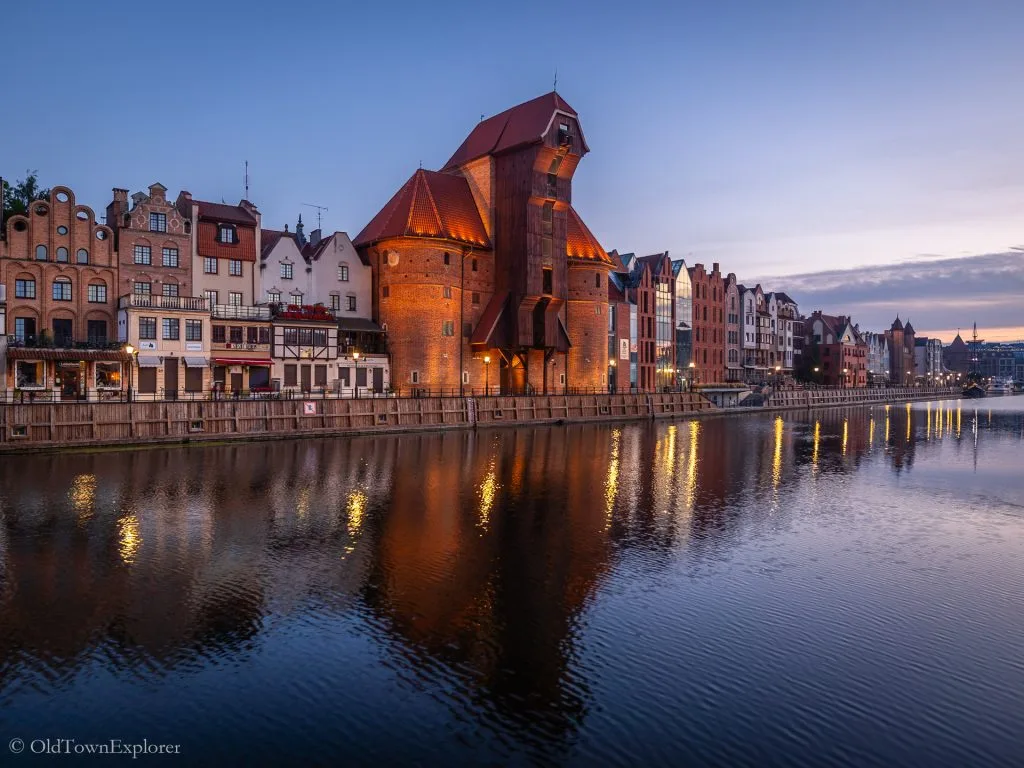
Crane
Żuraw
- Architect: Unknown medieval builders
- Architectural Style: Medieval timber and brick construction
- Built: Circa 1444 (original); reconstructed post-war
- Address: ul. Długie Pobrzeże 18
Historic port crane on the Motława River, used for loading cargo and raising ship sails; iconic symbol of Gdańsk’s maritime heritage.
Monument to Those Who Deserved the Polishness of Gdańsk
Pomnik Tym, którzy zasłużyli się polskością Gdańska
- Architect: Sculptor Henryk Kitowski
- Architectural Style: Modern sculpture
- Built: Unveiled in 1983
- Address: Podwale Staromiejskie, 80-844 Gdańsk, Poland
A tribute to individuals who contributed to preserving Polish identity and culture in Gdańsk during difficult historical periods.
Old Town (Stare Miasto)
Old Town Hall
Ratusz Starego Miasta
- Architect: Not precisely known; built by local guild masons and city architects
- Architectural Style: Gothic with Renaissance modifications
- Built: Original construction in the 14th century; rebuilt in the 16th century after fires
- Address: ul. Długa 43, Gdańsk Old Town
The seat of the Old Town’s municipal government, featuring a tall tower and richly decorated façades. The building reflects medieval civic power and has been restored following WWII damage.
The Great Mill
Wielki Młyn
- Architect: Unknown
- Architectural Style: Late Gothic brick industrial architecture
- Built: Completed in 1350–1360; one of the largest medieval mills in Europe
- Address: ul. Wielkie Młyny 1, near the Motława River
A massive brick grain mill powered by the Motława River, integral to Gdańsk’s medieval grain trade and economy. It was damaged during WWII and later restored and repurposed.
Little Mill
Mały Młyn
- Architect: Unknown
- Architectural Style: Gothic/Industrial
- Built: First records in the 14th century
- Address: ul. Stągiewna 30
Smaller than the Great Mill, it served as a supplementary grain mill facility for the city. It is a historic industrial building connected to the Old Town’s economic history.
PAN Library
aka Polish Academy of Sciences Library
- Architect: Unknown
- Architectural Style: Modernist
- Built: 20th century (exact year varies by source)
- Address: ul. Wały Jagiellońskie 1A
A modern research library branch of the Polish Academy of Sciences, providing academic resources, located near Old Town.
Polish Post Office
Poczta Polska
- Architect: Ludwig Fahrenkrog (original building)
- Architectural Style: Early 20th-century historicism / Neo-Renaissance influences
- Built: Completed 1900
- Address: ul. 3 Maja 9
Site of heroic defense during the 1939 invasion of Poland; the building has historic and symbolic significance. It survived WWII and serves as a post office today.
Monument to the Defenders of the Polish Post Office
- Architect: Designed by sculptor Ryszard Winiarski and architect Bohdan Urbanowicz
- Architectural Style: Modernist monument
- Built: Unveiled in 1979
- Address: ul. 3 Maja, near the Polish Post Office
Commemorates the brave defense of the post office staff during the 1939 German invasion, symbolizing Polish resistance.
Monument to the Fallen Shipyard Workers of 1970 and Health and Safety Hall
- Architect: Monument by sculptor Wojciech Mokwiński and architect Ryszard Semka; Health and Safety Hall by Lech Kaczyński and Jerzy Zbigniew Szukalski
- Architectural Style: Monument - Modernist; Hall - Functionalist
- Built: Monument unveiled in 1980; Hall built 1971
- Address: ul. Doki 1, near Gdańsk Shipyard (adjacent to Old Town)
The monument honors workers killed in 1970 protests; the adjacent hall served shipyard workers’ safety needs and social functions.
Monument to King Jan III Sobieski
- Architect: Sculptor Marian Konieczny
- Architectural Style: Bronze equestrian statue, realistic style
- Built: Erected 1997
- Address: ul. Długa near Long Market (Długi Targ)
Honors the Polish king known for the 1683 Battle of Vienna; symbolizes national pride and historic valor.
City Tours in Gdansk
City tours in Gdańsk provide an organized way to understand the city’s maritime history, reconstructed urban core, and the architectural influences that shaped its development. Many tours focus on the Main Town, the waterfront, and the civic and religious buildings rebuilt after the Second World War.
Best Places to Stay in Gdansk
Hotels in Gdansk
If you are planning a trip to Gdansk, there are plenty of excellent places to stay. However, for the best experience, we strongly recommend staying in one of the two main historical districts: the Old Town (Stare Miasto) or the Main City (Główne Miasto). Somewhat confusingly, the Main City - NOT the Old Town - is the central, historic area in Gdańsk. The castle marker on the map below is the heart of the Main City. We suggest staying as close to it as possible, depending on your budget and preferences.
Here’s a map with hotel and apartment options that can be filtered to meet your needs. Select your travel dates to get specific availability and prices.
Things to Know About Gdansk Architecture
Hanseatic Heritage
Gdańsk’s architecture reflects its important role as a major port city in the Hanseatic League, blending Gothic, Renaissance, and Baroque styles shaped by centuries of trade and cultural exchange.
Brick Gothic Dominance
Due to the scarcity of natural stone, the city’s medieval buildings prominently feature Brick Gothic architecture—characterized by distinctive red bricks and pointed arches.
Royal Route
The famous Royal Route (Droga Królewska) is lined with some of Gdańsk’s most iconic buildings, including grand merchant houses, historic gates, and civic landmarks showcasing Renaissance and Baroque ornamentation.
War Damage and Reconstruction
Much of Gdańsk’s Old Town and Main City were heavily damaged during WWII. The city undertook meticulous restoration efforts, rebuilding historic sites to their original grandeur using archival materials and traditional techniques.
Architectural Diversity
Gdańsk’s architecture showcases a unique blend of styles from Dutch Mannerism to modernism, reflecting its multicultural history and evolving urban landscape.
Waterfront Significance
The Motława River waterfront and Granary Island feature historic granaries and port structures integral to Gdańsk’s maritime commerce, combining functional design with historic charm.
FAQs About Gdansk Architecture
What is the architecture style of Gdańsk?
Gdańsk features a rich architectural blend dominated by Brick Gothic, Renaissance, and Baroque styles. Its historic buildings often showcase the red-brick Gothic style typical of Northern Europe, combined with ornate Renaissance and Baroque façades influenced by Dutch and Flemish merchants. This unique mix reflects Gdańsk’s centuries-old status as a major Hanseatic port and cultural crossroads.
What is Gdańsk, Poland known for?
Gdańsk is known for its stunning medieval Old Town, rich maritime history, and vibrant Hanseatic architecture. The city boasts iconic landmarks such as St. Mary’s Basilica, the Royal Route with its grand merchant houses, and the historic port crane called Żuraw. Gdańsk is also famous for its role in the Solidarity movement and beautiful Baltic Sea coastline.
What is the most famous architecture in Poland?
Poland’s most famous architecture includes the Gothic Wawel Castle in Kraków, the Renaissance Old Town of Warsaw, and the Brick Gothic buildings of Gdańsk’s Main City. Gdańsk’s historic granaries, medieval churches, and ornate merchant houses are celebrated examples of Poland’s rich architectural heritage, attracting visitors from around the world.
Why does Gdańsk look Dutch?
Gdańsk’s “Dutch look” comes from strong historical ties with the Netherlands during the Renaissance period. Wealthy Dutch and Flemish merchants influenced local architecture, introducing ornate gables, decorative façades, and vibrant colors typical of Dutch Mannerism. This blend gave Gdańsk its unique skyline, often compared to Dutch port cities.
What are the must-see architectural landmarks in Gdańsk?
Gdańsk’s must-see architectural landmarks include St. Mary’s Basilica, the Main Town Hall, Artus Court, the Golden Gate, and the medieval Crane (Żuraw) on the Motława River. Visitors also admire the colorful merchant houses along Long Market (Długi Targ) and the historic granaries on Granary Island.
How old is the architecture in Gdańsk?
Gdańsk’s architecture dates back to the Middle Ages, with many buildings originating in the 14th and 15th centuries. The city’s historic core was extensively rebuilt after World War II, carefully restoring its Gothic, Renaissance, and Baroque heritage.
Can you visit the historic gates and towers in Gdańsk?
Yes, many historic gates and towers such as the Golden Gate, Green Gate, High Gate (Brama Wyżynna), and St. Mary’s Gate are open to visitors. Some house museums or galleries, offering panoramic views of the city and insights into Gdańsk’s medieval defenses.
What is unique about Gdańsk’s Brick Gothic architecture?
Gdańsk’s Brick Gothic architecture is unique for its extensive use of red brick in large-scale civic and religious buildings. This style is a hallmark of Northern European medieval architecture, characterized by pointed arches, intricate brick patterns, and soaring towers, all adapted to local materials and climate.
Are there any guided architecture tours in Gdańsk?
Yes, many guided walking tours focus on Gdańsk’s architecture, covering the Royal Route, historic granaries, medieval gates, and religious buildings. These tours provide historical context and access to lesser-known architectural gems.
How was Gdańsk’s architecture affected by World War II?
Gdańsk suffered significant destruction during World War II, with much of the Old Town and Main City heavily damaged. Post-war reconstruction efforts prioritized historical accuracy, using archival drawings and photographs to restore buildings to their pre-war appearance.