
Orvieto Architecture
Explore Orvieto Architecture: Churches, Palaces & More
Orvieto concentrates centuries of architectural history on a single volcanic plateau, with churches, palaces, city gates, and underground structures all within walking distance. At its center, the Orvieto Cathedral (Duomo di Orvieto) stands as one of the most important examples of Italian Gothic architecture, with its striped stone façade, sculpted portals, and frescoed chapels visible from across the city.
Civic buildings such as the Palazzo del Capitano del Popolo and the surrounding palaces illustrate how public power and noble families shaped Orvieto’s urban form, from medieval fortifications to Renaissance façades. As you move between Piazza del Duomo, Piazza della Repubblica, and Piazza del Popolo, you can read the development of Orvieto architecture directly in the stone, from Etruscan foundations to later additions.
The importance of Orvieto’s cathedral, palaces, fortress, and archaeological areas is highlighted in UNESCO’s summary of Orvieto’s historic center, which lists the city on the tentative list for World Heritage status.
We spent two weeks in Orvieto researching the historic architecture. We’ve summarized the information we collected so you can start exploring Orvieto architecture as soon as you arrive.
This page contains affiliate links. We may earn a small commission at no extra cost to you.
Churches in Orvieto
As you delve into the architectural wonders of Orvieto, the intricate designs of its churches will undoubtedly leave you in awe. Additionally, the Church of San Giovenale showcases early Christian influences in Orvieto's architectural landscape, providing a glimpse into centuries-old traditions. Prepare to be transported through time as you uncover the stories embedded in each stone of Orvieto's churches.

Orvieto Cathedral
Duomo di Orvieto aka Cattedrale di Santa Maria Assunta
- Architect: Lorenzo Maitani, Arnolfo di Cambio
- Style: Italian Gothic and Romanesque
- Built: 1290–1591
- Address: Piazza del Duomo, 26, 05018 Orvieto TR, Italy
Built on the orders of Pope Urban IV to enshrine the Corporal of Bolsena, this cathedral dominates Orvieto from atop a volcanic plug. Its façade combines rose windows, golden mosaics, and bronze doors, while inside are two frescoed chapels with vivid depictions of Judgment Day. The cathedral houses five Renaissance bells and centuries of artistic craftsmanship.
Before your visit, check the official Duomo di Orvieto site for updated opening hours, ticket options, and information on current exhibitions and guided tours.
Church of Santi Apostoli
Chiesa SS. Apostoli
- Architect: Unknown
- Style: Romanesque (modified)
- Built: 12th century (original); later modifications
- Address: Via Lattanzi, 05018 Orvieto TR, Italy
Located in the historic center, this three-naved church has an unfinished façade and contains Vincenzo Pasqualoni’s Immaculate Conception with the Apostles Philip and James. Today, it functions as an exhibition hall for the Museo MODO.
Church of Sant’Andrea
- Architect: Unknown
- Style: Romanesque
- Built: 12th century
- Address: Corso Cavour, 1, 05018 Orvieto TR, Italy
Standing beside the Town Hall in Piazza della Repubblica, this church features a striking façade and a rare twelve-sided bell tower. Over centuries, it has undergone significant architectural changes while maintaining its medieval presence.
Church of S.Maria dei Servi
- Architect: Virginio Vespignani (restoration)
- Style: Gothic (restored with Neo-Classical elements)
- Built: 1265 (original convent); 1857 (restoration)
- Address: Via Belisario, 2, 05018 Orvieto TR, Italy
Near Corso Cavour, this church is noted for its tufa walls and Neo-Classical façade, restored by Vespignani in 1857. The adjoining convent dates to the 13th century and preserves traces of its medieval origin.
Abbey of Saint Severo and Martirio
- Architect: Unknown
- Style: Romanesque with later Gothic additions
- Built: 1055 (original); later modifications
- Address: Località La Badia, 05018 Orvieto TR, Italy
Nestled below a cliff, this former Benedictine abbey boasts a distinctive twelve-sided tower. Over time, it has been expanded by Premonstratensian canons and now operates as a luxury hotel while retaining its medieval cloister and refectory.
Church of San Lorenzo de’Arari
- Architect: Unknown
- Style: Romanesque
- Built: 1291
- Address: Via Ippolito Scalza, 05018 Orvieto TR, Italy
This three-naved church is a fine example of Orvieto’s Romanesque tradition, once richly frescoed. Classical columns divide the interior, though only fragments of the original wall paintings remain.
Church of Sant Agostino
- Architect: Unknown
- Style: Gothic
- Built: 1264
- Address: Piazza S. Giovenale, 7, 05018 Orvieto TR, Italy
Built by Augustinian friars, this Gothic church retains frescoes depicting the life of St. Augustine. Once part of the MODO Museum circuit, it formerly housed Francesco Mochi’s Annunciation and a collection of Apostles and Saints statues.
Church of Sant Angelo
- Architect: Unknown
- Style: Romanesque with later additions
- Built: 11th–12th century (original)
- Address: Piazza Sant’Angelo, 7, 05018 Orvieto TR, Italy
Erected over an ancient temple, this medieval church incorporates a bell tower, baptismal font, and former hospital. It safeguards the relics of Saints Severo and Martirio beneath the main altar.
Church of San Domenico
Chiesa di San Domenico
- Architect: Unknown; Petrucci Chapel by Michele Sanmicheli
- Style: Gothic (original); Baroque and modern alterations
- Built: 1233 (original); 1932 (partial reconstruction)
- Address: Piazza Ventinove Marzo, 13A, 05018 Orvieto TR, Italy
Founded soon after St. Dominic’s death, this early Dominican church preserves the apse, transept, and the Petrucci Chapel. It holds St. Thomas Aquinas’ teaching desk and Arnolfo di Cambio’s Monument to Cardinal De Braye.
Church of San Giovanni Evangelista
- Architect: Unknown
- Style: Romanesque origins with later modifications
- Built: 11th–12th century (estimated)
- Address: Via Ripa Serancia, 14, 05018 Orvieto TR, Italy
Among the city’s oldest churches, it may rest atop Roman and Etruscan foundations. Its spacious cloister, built in the early 1500s, reflects the Renaissance influence on Orvieto’s ecclesiastical architecture.
Church of San Francesco
- Architect: Unknown
- Style: Gothic (original); Baroque (renovations)
- Built: 1234–1266 (original); 1768–1773 (renovations)
- Address: Via Ippolito Scalza, 05018 Orvieto TR, Italy
Founded by the Franciscans, this was the largest church in Orvieto before the Duomo was completed. Its single nave and quadrangular apse are typical of early Franciscan design. Later Baroque renovations added side chapels and a dome over the transept.
Church of San Giovenale
Chiesa di San Giovenale
- Architect: Unknown
- Style: Romanesque with Gothic additions
- Built: 1004 (original); modifications in 14th and 19th centuries
- Address: Via Volsinia, 41, 05018 Orvieto TR, Italy
Standing on the site of an Etruscan temple, this is Orvieto’s oldest church. Its bare façade is flanked by a tall bell tower, and Gothic extensions replaced the original apse. The upper section was rebuilt in 1825.
Church of San Lodovico
Chiesa di San Lodovico
- Architect: Unknown
- Style: Baroque
- Built: 1778
- Address: Piazza de’ Ranieri, 5, 05018 Orvieto TR, Italy
Completed in the late 18th century, the church houses Andrea di Giovanni’s 1410 Massacre of the Innocents and Girolamo Nebbia’s 1637 altarpiece of the Madonna and Child with St. Lodovico.
Church of San Rocco
- Architect: Unknown
- Style: Renaissance (modified)
- Built: 15th–16th century (estimated)
- Address: Piazza del Popolo, 18/27, 05018 Orvieto TR, Italy
This small church in Piazza del Popolo is no longer in regular use but occasionally hosts exhibitions and events. It is one of three historic churches in the square.
Chiesa degli Scalzi
- Architect: Unknown
- Style: Renaissance
- Built: 17th century (estimated)
- Address: Via Luca Signorelli, 05018 Orvieto TR, Italy
A restored Renaissance church in Piazza Ippolito Scalza, formerly associated with Giuseppe and Giacomo degli Scalzi.
Church of the Madonna del Velo
Santuario Madonna della Cava
- Architect: Unknown
- Style: Baroque (with later restoration)
- Built: 1751
- Address: Via della Cava, 51, 05018 Orvieto TR, Italy
Built against the tufa cliff, this unique sanctuary has served many uses before being restored as part of the Orvieto Archaeological Park.
Church of San Bernardino
- Architect: Cosimo Poli
- Style: Baroque
- Built: 1657–1666
- Address: 05018 Orvieto TR, Italy
Built for the Poor Clares to a design by Cosimo Poli, this elliptical-plan church features a nuns’ choir above the organ and commemorative inscriptions to its founders. It is one of Orvieto’s few pure Baroque buildings.
Church of San Giacomo all’Ospedale
- Architect: Unknown
- Style: Neoclassical (rebuilt)
- Built: 1830–1835 (reconstruction)
- Address: Piazza del Duomo, 20, 05018 Orvieto TR, Italy
Originally used by a confraternity from 1615, the church fell into ruin before being rebuilt in the early 19th century. Today, it serves as an occasional exhibition space.
Palaces in Orvieto
Here are some of the most beautiful and famous historic palaces located in the city of Orvieto. In addition to the most important medieval palaces such as Palazzo Comunale, Palazzo del Popolo, Palazzo Soliano, and Palazzo dei Sette, there are many other elegant historic buildings spanning from the Middle Ages to the Renaissance period, which belonged to the Pope or local noble families. These palaces often bear the names of the families that owned them and are located along the city center.
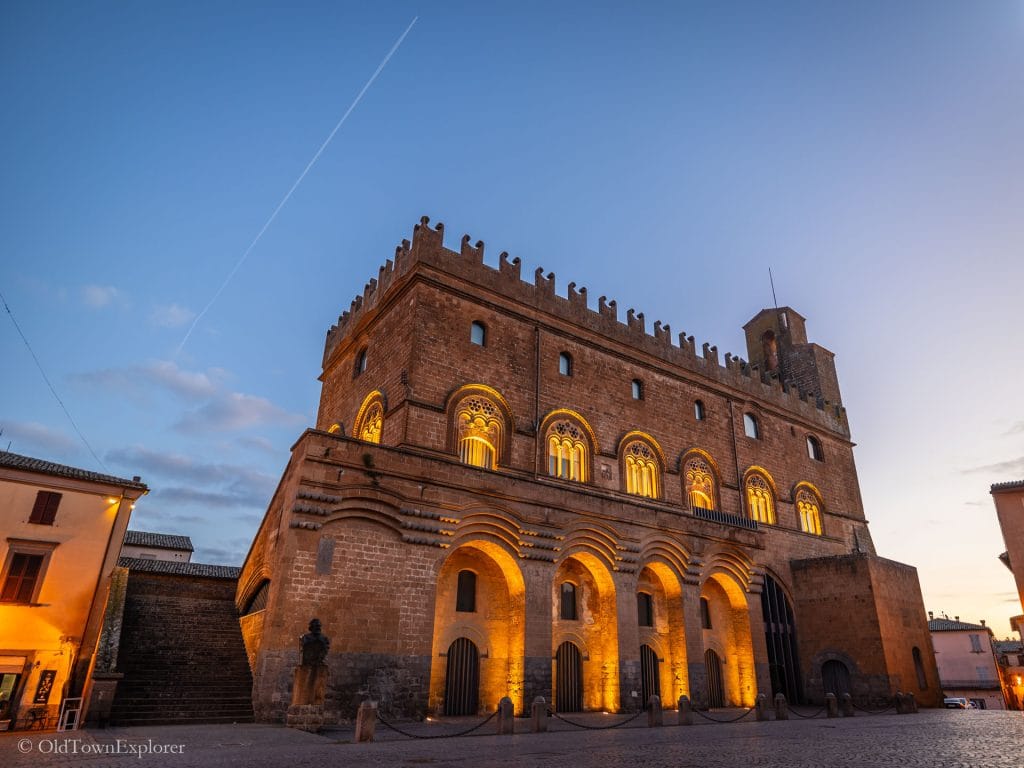
Palazzo del Popolo
Palazzo del Capitano del Popolo
- Architect: Paolo Zampi (restoration)
- Style: Medieval civic architecture
- Built: 14th century (original); 19th century (restoration)
- Address: Piazza del Popolo, 1, 05018 Orvieto TR, Italy
Once the residence of the Captain of the People, this medieval palace played a central role in civic life. Later restorations uncovered Etruscan remains and medieval aqueduct traces, now displayed in the “Etruscan Room.”
Palazzo Comunale
aka Town Hall
- Architect: Ippolito Scalza (1600 renovation)
- Style: Medieval with Renaissance modifications
- Built: 12th century (original); 1600 (renovation)
- Address: Via Giuseppe Garibaldi, 8, 05018 Orvieto TR, Italy
Situated in Piazza della Repubblica beside Sant’Andrea, this elegant building has served as Orvieto’s municipal headquarters for centuries, with Renaissance elements added by local master Ippolito Scalza.

Palazzo Soliano
- Architect: Unknown
- Style: Medieval civic architecture
- Built: 1297
- Address: Piazza del Duomo, 1, 05018 Orvieto TR, Italy
Commissioned by Pope Boniface VIII to mark reconciliation with the city, this “Palazzone” stands beside the Duomo. Today it houses the Emilio Greco Museum and the cathedral ticket offices.
Palazzo dei Sette
- Architect: Unknown
- Style: Medieval
- Built: 13th–14th century
- Address: Adjacent to Torre del Moro, 05018 Orvieto TR, Italy
Named for the seven judges representing Orvieto’s guilds, this medieval palace later served as a papal residence and the home of architect Antonio da Sangallo. It now hosts exhibitions and cultural events.
Palazzo Buzi
- Architect: Ippolito Scalza
- Style: Renaissance
- Built: Circa 1580
- Address: Via delle Scalette, 1/3, 05018 Orvieto TR, Italy
Designed by Ippolito Scalza, this Renaissance palace links Piazza Marconi with Piazza del Duomo and showcases his characteristic architectural precision.
Palazzo Ottaviani
- Architect: Unknown
- Style: Renaissance
- Built: 16th century
- Address: Piazza della Repubblica, 05018 Orvieto TR, Italy
Once home to the Locanda delle Belle Arti, this fine Renaissance building hosted Garibaldi and now serves as the headquarters of a local bank.
Palazzo Crispo Marsciano
- Architect: Antonio da Sangallo
- Style: Renaissance
- Built: 16th century
- Address: Via Postierla, 9, 05018 Orvieto TR, Italy
Overlooking Piazza Marconi, this imposing Sangallo design stands beside San Bernardino, combining fortress-like massing with Renaissance elegance.
Palazzo Clementini
aka Palazzo Cornelio
- Architect: Ippolito Scalza; completed by Gustavo Giovannoni (1937)
- Style: Renaissance
- Built: Begun 1567; completed 1937
- Address: Piazza Ippolito Scalza, 05018 Orvieto TR, Italy
Originally commissioned by Monaldo Clementini, this Renaissance palace features finely rusticated stonework and decorative window pediments. It now houses the local classical high school.
Palazzo dell’Opera del Duomo
- Architect: Vespignani
- Style: Neoclassical
- Built: 19th century
- Address: Piazza del Duomo, 26, 05018 Orvieto TR, Italy
Built to house the cathedral works office, this palace has served both administrative and exhibition functions, preserving documents and artifacts related to the Duomo’s construction.
Palazzo Simoncelli
- Architect: Unknown
- Style: Renaissance
- Built: 16th century
- Address: Piazza del Popolo, 05018 Orvieto TR, Italy
Originally a noble residence with mullioned windows, the palace was remodeled in the 18th and 19th centuries by the Ravizza family.
Palazzo Gualterio
- Architect: Antonio da Sangallo (original); Simone Mosca (modifications)
- Style: Renaissance
- Built: 16th century
- Address: Corner opposite Torre del Moro, 05018 Orvieto TR, Italy
Once home to the Gualterio family, this palace boasts stucco and fresco decorations inside. Its design blends Sangallo’s structure with Mosca’s embellishments.
Palazzo Carvajal-Simoncelli
- Architect: Ippolito Scalza
- Style: Renaissance with Spanish influences
- Built: 16th century
- Address: Via Malabranca, 05018 Orvieto TR, Italy
Built for Monsignor Carvajal, this palace incorporates basalt on its lower level and bears an inscription proclaiming it was built “for the convenience of friends.”
Palazzo Fillippeschi Simoncelli
- Architect: Unknown
- Style: Renaissance
- Built: Late 15th–early 16th century
- Address: Via Filippeschi, 19, 05018 Orvieto TR, Italy
This historic palace features a late-16th-century façade, elegant courtyard with portico, and rounded-arch columns.
Palazzo Monaldeschi
- Architect: Simone Mosca; Ippolito Scalza (participation)
- Style: Renaissance
- Built: 16th century
- Address: Near San Francesco, 05018 Orvieto TR, Italy
Once home to the Monaldeschi family, the palace has richly frescoed ceilings by Cesare Nebbia and has served as an art institute.
Palazzo Netti
- Architect: Unknown
- Style: 19th-century residential architecture
- Built: 19th century
- Address: Via Maitani, 05018 Orvieto TR, Italy
Named after Aldobrando Netti, an early pioneer of hydroelectric power in the region, this palace reflects the more modern architectural period of Orvieto’s history.
City Gates in Orvieto
The city gates of Orvieto mark the boundary between the volcanic plateau and the historic center. Built into the tufa cliffs, these entrances once controlled access to the fortified hilltop. From the grand Porta Maggiore to the medieval Porta Vivaria, each gate reflects the city’s defensive ingenuity and architectural evolution.
Over time, some gates were lost or restructured as the city expanded. Among the vanished entrances was Porta Cassia, once located near today’s Piazza Cahen. Though only a few remain in use, Orvieto’s surviving gates continue to embody the city’s medieval character and strategic importance.
Porta Maggiore
- Architect: Unknown
- Style: Etruscan and medieval fortification
- Built: Ancient (Etruscan origins); modified in medieval period
- Address: End of Via della Cava, 05018 Orvieto TR, Italy
The primary historic entrance to Orvieto, used for centuries as the main access route, including for papal arrivals. A niche above the gate holds a copy of Pope Boniface VIII’s statue.
Porta Soliana
aka Porta Rocca
- Architect: Unknown
- Style: Medieval Gothic
- Built: 13th century
- Address: Integrated into Fortezza Albornoz, eastern side of Orvieto, 05018 Orvieto TR, Italy
Originally known as Porta Postierla, this gate is built into the fortress walls and decorated with black-and-white stripes echoing the Duomo. Pope Boniface VIII placed his statue above its twin arches in 1297.
Porta Romana
- Architect: Unknown
- Style: Neoclassical
- Built: 1822
- Address: Southern approach to Orvieto, 05018 Orvieto TR, Italy
Built to replace the ancient Porta Pertusa, this neoclassical entryway features the city’s coat-of-arms symbols: an imperial eagle and a duck.
Porta Vivaria
- Architect: Unknown
- Style: Ancient
- Built: Etruscan origins
- Address: Pathway to Etruscan necropolis, 05018 Orvieto TR, Italy
The least visible of Orvieto’s gates, Porta Vivaria connects the city center to the necropolis via a scenic cliffside walkway. It saw strategic use during World War II.
Other Attractions in Orvieto
Exploring the architectural marvels of Orvieto is a journey through time and craftsmanship. As you continue your exploration of Orvieto's architectural treasures, the blend of history and artistry comes to life in every corner of this enchanting city.
There are numerous monuments and attractions in Orvieto. A city that is a perfect example of an italian medieval hill town. Here are the main sights and symbols of the city, from the stunning Duomo and the St.Patrick well to other important medieval and Etruscan attractions like the Etruscan Necropolis and the Temple of Belvedere.
Moreover, you can not miss the original and important underground locations of Orvieto, natural and artificial caves, wells and tunnels digged from the etruscan period until today.
Pozzo di San Patrizio
aka Well of St. Patrick
- Architect: Antonio da Sangallo the Younger
- Style: Renaissance engineering
- Built: 1527–1537
- Address: Piazza Cahen, 5B, 05018 Orvieto TR, Italy
Commissioned by Pope Clement VII, this cylindrical well features two helical ramps in a double helix, allowing donkeys to carry water up and down without crossing paths. At 53.15 meters deep with 248 steps and 70 windows, it is an extraordinary feat of Renaissance hydraulic design.
Etruscan Temple of Belvedere
- Architect: Unknown
- Style: Etruscan temple architecture
- Built: 5th century BC (est.)
- Address: Giardini Pubblici, Piazza Cahen, 05018 Orvieto TR, Italy
Likely dedicated to the god Tinia, this ancient temple features a pronaos with four columns and three cellae. Notable high reliefs depict scenes with stylistic similarities to works of Phidias. Artifacts are housed in Orvieto’s archaeological museums.
The Basement of Sant’Andrea
- Architect: Unknown
- Style: Multi-period archaeological remains
- Built: Bronze Age origins
- Address: Beneath Church of Sant’Andrea, Piazza della Repubblica, 05018 Orvieto TR, Italy
An underground site showing four historical phases—from Bronze Age artifacts to an early Christian church with mosaic floors, offering a unique look at Orvieto’s layered history.
Orvieto Underground
- Architect: Unknown
- Style: Etruscan to medieval subterranean engineering
- Built: Various periods over three millennia
- Address: Various locations, 05018 Orvieto TR, Italy
A network of over 1,200 man-made caves, tunnels, wells, and cisterns. Highlights include medieval dovecotes and an olive oil mill with original presses and grinders.
Teatro Mancinelli
- Architect: Unknown
- Style: 19th-century Italian theater
- Built: 1866
- Address: Corso Cavour, 122, 05018 Orvieto TR, Italy
Opened with Donizetti’s “La Favorita,” this elegant theater was renamed in 1922 to honor local musicians Luigi and Marino Mancinelli. Restored in 1993, it hosts opera, concerts, and theater performances year-round.
Fanum Voltumnae
Campo della Fiera
- Architect: Unknown
- Style: Etruscan sanctuary
- Built: 6th century BC (est.)
- Address: Campo della Fiera, 05018 Orvieto TR, Italy
Believed to be the central sanctuary of the Etruscan League, this active archaeological site has revealed temple remains, Roman baths, and medieval structures.
Torre del Moro
- Architect: Unknown
- Style: Medieval civic architecture
- Built: 13th century
- Address: Corso Cavour, 87, 05018 Orvieto TR, Italy
A 47-meter tower symbolizing municipal power, oriented to the cardinal points dividing the city’s districts. Restored in 1866 with a clock and civic bells, it offers panoramic city views from its summit.
Pozzo della Cava
- Architect: Unknown
- Style: Etruscan well construction
- Built: Ancient (Etruscan period)
- Address: Via della Cava, 28, 05018 Orvieto TR, Italy
A 36-meter-deep hand-dug well with Etruscan “pedarole” footholds. Open year-round, it is known for its annual mechanized Nativity scene during the Christmas season.
Fortezza Albornoz
- Architect: Ugolino di Montemarte
- Style: Medieval military fortification
- Built: 1364
- Address: Via Postierla, 301, 05018 Orvieto TR, Italy
Built under Cardinal Albornoz to secure papal control, this fortress originally had walls, a moat, and drawbridges. Today, only parts remain, serving as public gardens with scenic views.
Etruscan Necropolis of Crocifisso del Tufo
- Architect: Unknown
- Style: Etruscan funerary architecture
- Built: 8th–3rd centuries BC
- Address: Via Volsinia, 05018 Orvieto TR, Italy
Over 200 tuff-stone tombs arranged in a grid, reflecting the wealth of Orvieto’s Etruscan population. Artifacts are displayed in local museums.
Il Labirinto di Adriano
- Architect: Unknown
- Style: Multi-period underground complex
- Built: Various historical periods
- Address: Via della Pace, 26/36, 05018 Orvieto TR, Italy
A private archaeological site discovered beneath a pastry shop, containing Etruscan cisterns, medieval structures, and even a 250,000-year-old petrified plant.
Santuario and Necropoli della Cannicella
- Architect: Unknown
- Style: Etruscan sanctuary and necropolis
- Built: 7th–3rd centuries BC
- Address: SP43, 05018 Orvieto TR, Italy
An Etruscan sacred site linked to funerary rites, featuring a sanctuary with water channels and offerings, surrounded by tombs on terraces.
City Tours in Orvieto
City tours in Orvieto provide an organized way to understand the town’s elevated setting, its medieval street network, and the architectural development that took place from the Etruscan period through the Middle Ages and Renaissance. Many tours focus on the cathedral, underground areas, and the compact historic center.
Things to Know About Orvieto Architecture
Historical Evolution of Orvieto's Architecture
The architectural landscape of Orvieto reflects a rich history influenced by various periods. The city's architecture showcases a blend of Italian Gothic and medieval styles, with important chapels and stunning churches. Orvieto's iconic Duomo, dating back to the 13th century, is renowned for its intricate details and ornate design. The palaces, such as Palazzo del Popolo and Palazzo Soliano, stand as a testament to the noble families that once resided in the city, adding to the historical evolution of Orvieto's architecture.
Orvieto's Architectural Influence on Modern City Planning
Orvieto's architectural heritage has significantly influenced modern city planning. The medieval layout, characterized by narrow streets surrounding the Piazza del Duomo, showcases a practical and aesthetic harmony. The integration of iconic structures like the Cathedral of Orvieto and Palazzo del Popolo reflects a blend of functionality and cultural significance. These architectural marvels serve as timeless examples of how historical design elements can shape contemporary urban spaces. The preservation of Orvieto's architectural ethos offers valuable insights into sustainable and visually captivating city planning strategies.
Best Places To Stay In Orvieto
Hotels in Orvieto
There are many great places to stay in Orvieto. For the best experience, we recommend staying near Piazza della Repubblica (the castle marker on the map below). The area around Piazza della Repubblica is the most pedestrian-friendly, surrounded by restaurants and historical shops, and the main attractions are nearby.
Here’s a map with hotel and apartment options that can be filtered to meet your needs. Select your travel dates to get specific availability and prices.
FAQs About Orvieto Architecture
What is special about Orvieto?
Orvieto, a charming hilltop town in Italy, is known for its stunning Duomo (cathedral) with intricate Gothic architecture and beautiful frescoes. The town is also famous for its well-preserved medieval and Renaissance buildings, impressive Etruscan ruins, and underground tunnels and caves that can be explored. Orvieto is renowned for its white wine, Orvieto Classico, which has been produced in the region for centuries. Additionally, the town hosts a vibrant cultural scene with music festivals, art exhibitions, and traditional events that showcase the rich history and heritage of Orvieto. It is a popular destination for tourists looking to experience authentic Italian culture, history, and cuisine in a picturesque setting atop a volcanic tuff cliff.
What is the Orvieto Cathedral famous for?
The Orvieto Cathedral, also known as the Cattedrale di Santa Maria Assunta, is famous for its stunning Gothic architecture, intricate facade adorned with mosaics and sculptures, and beautiful frescoes inside the cathedral. It is considered one of the great masterpieces of Italian Gothic architecture and is a popular tourist attraction in Orvieto, Italy.
How old is the Duomo in Orvieto?
The Duomo in Orvieto, Italy, is over 700 years old. It was constructed between 1290 and 1591 and is known for its stunning Gothic architecture and beautiful frescoes.
Why is Orvieto Cathedral striped?
Orvieto Cathedral is striped because of the alternating bands of white travertine and dark basalt stone used in its construction. This distinctive striped pattern gives the cathedral a unique and visually striking appearance, making it one of the most recognizable landmarks in Orvieto, Italy. The use of contrasting materials not only adds to the aesthetic appeal of the cathedral but also highlights the architectural details and decorative elements, showcasing the skill and craftsmanship of the builders who worked on this magnificent structure.
What are the building materials of Orvieto Cathedral?
Orvieto Cathedral, a stunning architectural masterpiece located in Italy, was constructed using various building materials. The primary materials used in the construction of Orvieto Cathedral include:
- White and black striped marble: The distinctive exterior facade of the cathedral is adorned with intricate patterns created using white and black striped marble.
- Travertine stone: The cathedral's walls and pillars are predominantly made of travertine stone, a type of limestone known for its durability and unique texture.
- Terracotta: Terracotta tiles were used to create the decorative elements on the roof of the cathedral, adding a touch of warmth to the overall design.
These materials come together to form the breathtaking structure that is Orvieto Cathedral, representing a harmonious blend of artistry and architectural ingenuity.