
Slovakia Architecture
Explore Slovakia Architecture: Architectural Styles & UNESCO World Heritage Sites
Slovakia architecture reflects medieval Hungarian towns, mining wealth, Habsburg administration, and twentieth-century Czechoslovak planning. Hilltop castles, Gothic churches, timber sanctuaries, and engineered mining landscapes make those layers visible across the country.
Bratislava provides the broadest urban sequence, Banská Štiavnica combines town architecture with mining infrastructure, and Levoča with Spiš Castle forms the strongest medieval route. Smaller fortified towns, mountain villages, and wooden churches extend the architecture journey well beyond those three starting points.
We spent a month in Bratislava while traveling in Slovakia, walking the Old Town, castle hill, Danube riverfront, and modern districts. This page covers the main styles, UNESCO cultural sites, regional differences, and architecture routes.
Slovakia Architecture at a Glance
Best Starting Points
- Bratislava: Start with Bratislava architecture for Gothic churches, Baroque and Rococo palaces, castle reconstruction, Secession details, modern bridges, and socialist-era landmarks
- Banská Štiavnica: Follow burgher houses, churches, two castles, mining administration buildings, shafts, tunnels, reservoirs, and water channels through a combined town and industrial landscape
- Levoča and Spiš: Compare a walled medieval town, Gothic religious art, Spiš Castle, Spišská Kapitula, Spišské Podhradie, and the church at Žehra
These three starting points cover the capital, the principal mining landscape, and the country’s most extensive medieval architectural ensemble.
Core Architecture Identity
- Great Moravian, Romanesque, and Gothic: Small stone churches, rotundas, basilicas, fortified towns, ribbed vaults, hall churches, castles, gates, and market squares
- Renaissance and Baroque: Burgher houses, town halls, palaces, monastery complexes, domes, stucco interiors, planned squares, and reconstructed fortifications
- Timber and mountain construction: Log houses, shingled roofs, wooden bell towers, Roman Catholic churches, Protestant articular churches, and churches of the Eastern rite
- Modern and industrial: Mining systems, railway buildings, Secession façades, functionalist structures, socialist housing estates, bridges, memorials, and civic buildings
Slovakia’s architecture is defined as much by mines, villages, frontier systems, and mountain construction as by city monuments.
UNESCO and Major Heritage Sites
- Historic towns and mining: Bardejov and Banská Štiavnica combine planned streets, churches, houses, defenses, civic buildings, and economic infrastructure
- Medieval and rural settlements: Levoča with Spiš Castle and Vlkolínec connect fortified architecture, religious centers, town planning, and mountain homesteads
- Serial properties: The Danube Limes and eight Carpathian wooden churches require routes between archaeological or religious components
Slovakia’s cultural properties range from compact town centers to landscapes and serial sites spread across several districts.
Main Regions and City Bases
- Bratislava and western Slovakia: Castle architecture, Gothic churches, Baroque palaces, Great Moravian sites, Danube defenses, Secession, and twentieth-century planning
- Central mining region: Banská Štiavnica, Kremnica, Banská Bystrica, mining towns, castles, reservoirs, churches, civic squares, and industrial structures
- Spiš, Šariš, and eastern towns: Levoča, Spiš Castle, Bardejov, Košice, medieval walls, Gothic churches, merchant houses, and religious complexes
- Northern mountains and rural Slovakia: Vlkolínec, Orava, Liptov, wooden churches, log houses, castles, farm buildings, and mountain settlement patterns
A balanced route combines one city base with a mining, castle, wooden-church, or village circuit.
Architecture Visiting Notes
- Rail routes: Bratislava, Banská Štiavnica, Košice, Levoča-area gateways, Bardejov, and larger regional towns can be connected partly by train or bus
- Road routes: Wooden churches, castles, Vlkolínec, mining infrastructure, and dispersed medieval components require closer transport planning
- Interior access: Churches, castles, mines, towers, museums, and religious compounds may use guided entry, seasonal schedules, or local custodians
Plan compact town walks separately from rural serial properties and archaeological excursions.
Architectural Styles in Slovakia
Slovak architecture developed through Great Moravian settlement, the Kingdom of Hungary, mining and trading towns, Habsburg administration, industrialization, Czechoslovak state-building, and postwar urban expansion. Stone, brick, timber, plaster, ceramic tile, iron, glass, and reinforced concrete appear in different combinations across the country.
Great Moravian and Romanesque Architecture
Early medieval architecture survives through archaeological foundations, small stone churches, rotundas, basilicas, fortified settlements, and religious compounds. Thick masonry walls, semicircular arches, narrow openings, apses, and compact plans distinguish the surviving Romanesque buildings.
The Church of St. Margaret of Antioch is located at Kopčany near the Morava River, not in Bratislava. Other Romanesque routes include the Rotunda of St. George in Skalica, the churches at Bíňa and Diakovce, early construction at Nitra, and the Romanesque origins of later medieval churches and castles.
Gothic Churches, Towns, and Castles
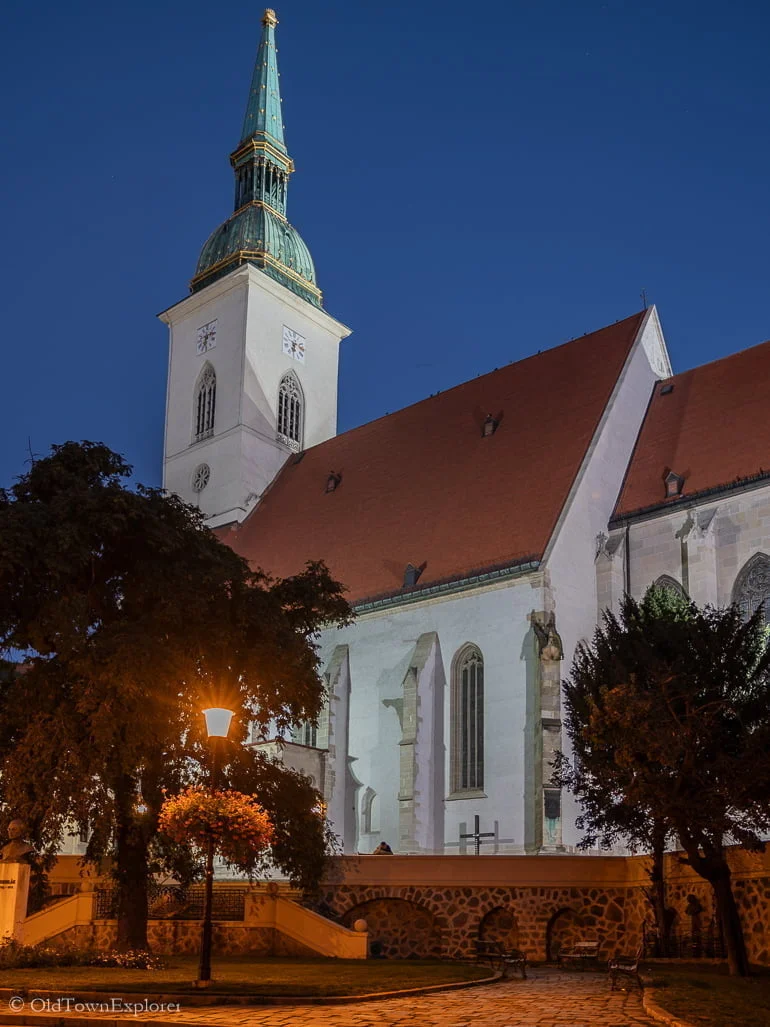
Gothic architecture expanded through royal towns, parish churches, castles, town walls, gates, market squares, civic buildings, and merchant houses. Pointed arches, ribbed vaults, buttresses, traceried openings, high chancels, towers, and steep roofs appear across both western and eastern Slovakia.
St. Martin’s Cathedral is Bratislava’s principal Gothic reference point, while St. Elizabeth’s Cathedral in Košice, St. Giles in Bardejov, St. James in Levoča, and St. Catherine in Banská Štiavnica show regional differences in scale, plan, art, and civic position. Spiš Castle records the expansion of a fortified complex through Romanesque, Gothic, residential, military, and service areas.

Renaissance and Baroque Architecture
Renaissance architecture reshaped townhouses, castles, town halls, mining buildings, watchtowers, and defensive systems. Arcaded courtyards, sgraffito, regular window grids, decorative attic walls, portals, and more comfortable residential ranges were inserted into medieval towns and fortresses.
Baroque rebuilding added domes, stucco, paired towers, ceremonial stairs, palace courts, monastery ranges, formal gardens, and coordinated church interiors. Bratislava’s palaces, Trnava’s religious buildings, the mining towns of central Slovakia, and regional manor houses preserve separate civic, ecclesiastical, and residential forms.
Mining and Technical Architecture
Mining produced a separate architectural and engineering system in central Slovakia. Town houses, administrative buildings, mints, schools, castles, churches, shafts, adits, processing structures, water channels, and reservoirs were connected to the extraction and processing of gold, silver, copper, and other ores.
Banská Štiavnica presents the most complete sequence. Its urban center must be read together with the Old Castle, New Castle, Mining Academy buildings, tunnels, shafts, towers, and the tajchy water-management system in the surrounding hills. Kremnica, Banská Bystrica, and Špania Dolina extend the mining route through coin production, defensive architecture, civic buildings, and former extraction settlements.
Wooden Churches and Vernacular Architecture
Traditional timber construction appears in churches, houses, barns, bell towers, gates, farmyards, and mountain settlements. Horizontal log walls, timber frames, steep shingled roofs, narrow floor plans, rear agricultural buildings, and protection against snow or rain reflect local materials and climate.
The UNESCO wooden-church series contains two Roman Catholic churches, three Protestant articular churches, and three churches of the Eastern rite. Differences in floor plan, tower form, galleries, painted ceilings, iconostases, and exterior massing reflect separate worship traditions within the Carpathian region.
Vlkolínec preserves a broader village system of narrow plots, log houses, stables, barns, smaller outbuildings, a stream, a bell tower, a church, and fields extending into the surrounding slopes.
Historicism, Secession, and Twentieth-Century Architecture
Nineteenth-century expansion introduced Neoclassical, Neo-Gothic, Neo-Renaissance, and Neo-Baroque institutions, theaters, railway buildings, apartment houses, banks, synagogues, and civic offices. Bratislava and Košice contain the strongest city routes, while regional towns add administrative and transport architecture tied to the Austro-Hungarian period.
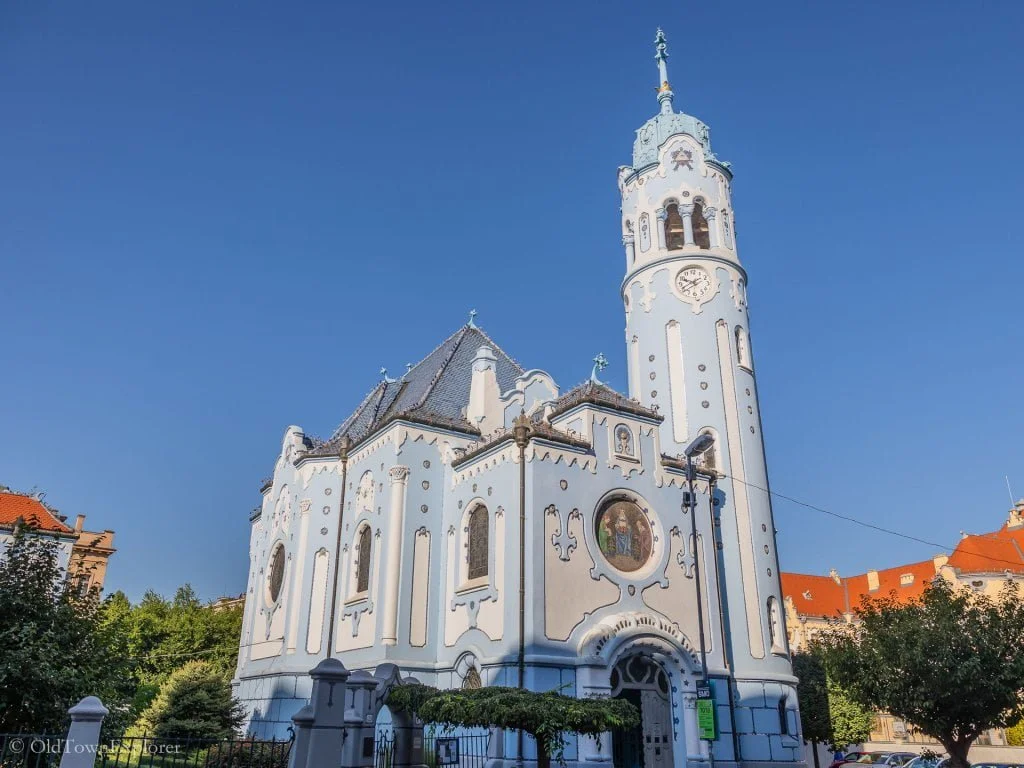
Secession and Art Nouveau introduced curved lines, ceramic ornament, floral or geometric surfaces, stained glass, ironwork, and coordinated interiors. The Blue Church in Bratislava is the site’s strongest supporting page for Hungarian Secession architecture.
Interwar and socialist-era construction added functionalist houses, sanatoria, offices, memorials, cultural buildings, bridges, industrial sites, and large housing estates. Bratislava’s SNP Bridge, Slovak Radio Building, riverfront development, and Petržalka show how construction scale and urban planning changed during the twentieth century.
Architecture by Region in Slovakia
Slovakia’s regional architecture reflects river corridors, mining resources, former administrative borders, religious communities, mountain terrain, and twentieth-century industrialization. The Danube capital differs from central mining towns, eastern merchant centers, and the timber settlements of the northern Carpathians.
Bratislava and Western Slovakia
Bratislava contains the broadest urban sequence, including castle archaeology, Gothic churches, Renaissance and Baroque rebuilding, Rococo and Neoclassical palaces, Secession façades, interwar structures, socialist architecture, and recent riverfront development.
Western Slovakia extends the route through Devín, Trnava, Nitra, Skalica, Kopčany, Komárno, and Danube archaeological sites. Castles, Great Moravian remains, Romanesque churches, brick defenses, Baroque religious centers, manor houses, and frontier engineering appear within day-trip distance of the capital.
Central Slovakia and the Mining Towns
Banská Štiavnica, Kremnica, Banská Bystrica, Špania Dolina, and surrounding settlements record the relationship between mineral extraction and town growth. Market squares, burgher houses, churches, castles, mints, schools, mines, adits, reservoirs, and transport routes formed connected economic systems.
The region also contains Hronsek’s wooden articular church, Zvolen Castle, hill fortifications, rural mining settlements, and modern memorial architecture. Elevation changes and dispersed industrial remains make road or hiking routes as important as town-center walks.
Spiš, Šariš, and Eastern Slovakia
Levoča, Spiš Castle, Spišské Podhradie, Spišská Kapitula, Žehra, Bardejov, and Košice form the principal eastern route. Romanesque and Gothic churches, castles, town walls, merchant houses, civic squares, religious precincts, late medieval altars, and later Renaissance or Baroque alterations appear across the region.
Bardejov presents a compact fortified trading town, while the Spiš property connects a castle, ecclesiastical center, merchant settlement, rural church, and the planned town of Levoča. Košice adds a larger urban route of Gothic, Historicist, Secession, industrial, and twentieth-century architecture.
Northern Mountains and Rural Slovakia
Orava, Liptov, the High Tatras, and the northeastern Carpathians shift the emphasis toward castles, log houses, wooden churches, farm buildings, mountain villages, railway infrastructure, sanatoria, and tourist architecture.
Vlkolínec preserves a compact mountain settlement, while the UNESCO wooden churches are distributed between north-central and eastern Slovakia. Their distance from one another makes them a multi-day road route rather than one attraction cluster.
UNESCO World Heritage Sites in Slovakia
Slovakia has eight properties on the UNESCO World Heritage List: six cultural and two natural. The cultural properties below cover fortified towns, Roman frontier structures, mining systems, castle and religious complexes, a mountain village, and eight wooden churches.
Bardejov Town Conservation Reserve
Bardejov developed near a trade route crossing the Carpathians between the Kingdom of Hungary and Poland. Its surviving medieval plan is organized around a large market square with regular streets, narrow property divisions, merchant houses, a central town hall, and a surrounding system of walls, towers, and gates.
Three sides of the square are lined by burgher houses whose forms record medieval plots and later Renaissance or Baroque changes. The fourth side is dominated by the Gothic Church of St. Giles, which contains a group of late Gothic altars. The Renaissance town hall stands within the square rather than along its edge.
The property also includes a small Jewish suburb developed around an eighteenth-century synagogue. Religious, ritual, community, and service buildings extend the architectural story beyond the fortified Christian trading town.
Frontiers of the Roman Empire – The Danube Limes (Western Segment)
The Danube Limes is a transnational serial property extending for almost 600 kilometers through Germany, Austria, and Slovakia. Its 77 components represent roads, legionary fortresses, settlements, forts, temporary camps, watchtowers, bridgehead positions, and supporting civilian architecture along the Roman frontier.
Slovakia’s components are concentrated at Gerulata in Rusovce and Iža–Kelemantia near Komárno. Gerulata includes a military camp, civilian settlement, a house with a hypocaust heating system, and a cemetery. Iža contains a fort and temporary camps positioned on the north bank of the Danube as a bridgehead connected with the Roman system across the river.
These are archaeological sites rather than complete standing towns. Plans, reconstructed wall lines, foundations, museum displays, terrain, and the relationship with the Danube are central to understanding the architecture.
Historic Town of Banská Štiavnica and the Technical Monuments in its Vicinity
Banská Štiavnica is a mining town whose urban form and surrounding landscape developed through the extraction of gold, silver, and other ores. The property includes the historic center and a much larger area of mining and metallurgical remains in the surrounding Štiavnické Hills.
The town center contains late Gothic and Renaissance burgher houses, the town hall, the Church of St. Catherine, the Old Castle, the Renaissance New Castle, the Piarg Gate, mining administration buildings, educational institutions, squares, churches, and later Baroque additions.
Outside the center, shafts, tunnels, mining towers, processing structures, channels, and artificial reservoirs form an engineered water-management system. The property should therefore be explored as both a town and an industrial landscape rather than as a single historic square.
Levoča, Spišský Hrad and the Associated Cultural Monuments
This serial property connects Levoča with Spiš Castle, Spišské Podhradie, Spišská Kapitula, and Žehra. Together, the components preserve military, urban, political, religious, mercantile, and cultural functions associated with medieval settlement in the Spiš region.
Spiš Castle contains Romanesque and Gothic fortifications, palatial areas, towers, courtyards, service spaces, and later defensive additions spread across a prominent hill. Spišské Podhradie developed below the castle, while Spišská Kapitula forms an ecclesiastical settlement centered on St. Martin’s Cathedral. The church at Žehra adds a rural religious component with medieval architecture and mural painting.
Levoča preserves its walled town plan, market square, civic buildings, merchant houses, and the Church of St. James. The church contains late Gothic altars associated with Master Paul of Levoča, including the tall principal altarpiece that forms one of the property’s central artistic elements.
Vlkolínec
Vlkolínec is a mountain settlement associated administratively with Ružomberok. Its plan follows narrow lots arranged along a stream and sloping terrain, with houses toward the road and stables, barns, and smaller outbuildings behind them.
The surviving settlement includes 43 largely intact homesteads, a wooden bell tower, a nineteenth-century church, a school, fields, pastures, haylofts, and surrounding mountain slopes. Most houses use log construction on stone foundations, with plastered or coated exterior surfaces and steep roofs.
The architecture should be read through complete farm plots rather than individual house façades. Road alignment, the central watercourse, gates, rear agricultural buildings, plot widths, and the transition from settlement to fields show how the village functioned.
Wooden Churches of the Slovak part of the Carpathian Mountain Area
This serial property contains eight wooden churches built between the sixteenth and eighteenth centuries. The Roman Catholic components are at Hervartov and Tvrdošín; the Protestant articular churches are at Kežmarok, Leštiny, and Hronsek; and the Eastern-rite churches are at Bodružal, Ladomirová, and Ruská Bystrá.
The churches share timber construction and shingled exterior surfaces, but their plans and interiors differ according to denomination. The Catholic churches retain forms connected with medieval western church design. The Protestant churches use broad worship spaces and galleries, while the Eastern-rite churches use divided plans, towers, domes, and iconostases tied to Byzantine liturgy.
Painted ceilings, wall paintings, carved altars, galleries, icon screens, bell towers, churchyards, gates, and cemeteries form part of the route. Because the eight components are widely dispersed, visitors should group them by region rather than attempt the full series from one base.
Natural World Heritage Properties
The Caves of Aggtelek Karst and Slovak Karst and Slovakia’s components of the Ancient and Primeval Beech Forests of the Carpathians and Other Regions of Europe are the country’s two natural World Heritage properties.
Nearby villages, forestry structures, mountain buildings, roads, and visitor facilities may fit a regional architecture itinerary, but architecture is not the basis of either inscription.
Tentative Architecture Sites
Slovakia currently has 12 properties on its tentative list. Architecture-focused entries include the medieval wall paintings of the Gemer and Abov churches, the Chatam Sófer Memorial, Komárno’s fortification system, Košice’s lenticular historic core, the Tokaj wine region, and the Great Moravian settlement connection between Mikulčice and the Church of St. Margaret at Kopčany.
Tentative status means these properties may be considered for future nomination. It does not give them the same status as Slovakia’s eight inscribed World Heritage properties.
How to See Slovakia Architecture
City Architecture Routes
Bratislava should be divided among the Old Town, castle hill, eastern Secession streets, the Danube riverfront, and modern districts beyond the medieval center. The Old Town covers Gothic churches, gates, civic buildings, palaces, and courtyards, while the river and outer districts add bridges, modernist buildings, memorials, and housing estates.
Bardejov, Levoča, Košice, Banská Štiavnica, Trnava, and Kremnica support more compact town walks. Their strongest routes connect market squares with churches, town halls, merchant houses, walls, gates, castles, and later civic expansion.
Castle and Mining Routes
Castle routes vary from excavated or ruined fortifications to heavily reconstructed residential complexes. Spiš Castle requires time for its successive enclosures, towers, courtyards, palace ranges, chapel, and relationship with the surrounding settlements.
Banská Štiavnica requires separate time for the town center and the mining landscape. Add shafts, adits, reservoirs, channels, castles, mining schools, and processing sites rather than treating the central square as the complete property.
Wooden Churches and Rural Sites
The eight World Heritage wooden churches are distributed across north-central and eastern Slovakia. Their denomination, floor plan, tower form, roof, gallery system, paintings, and liturgical furnishings differ enough that each component should be treated separately.
Vlkolínec and other rural settlements also require attention to houses, farmyards, barns, gates, plot lines, roads, streams, fields, and the surrounding slopes. These sites are easier to understand when the settlement system remains the focus.
Transport, Interiors, and Access
Rail and bus services cover the main cities and many regional towns, but rural churches, castles, archaeological sites, mines, and mountain villages often need a car, local transfer, taxi, or organized excursion.
Allow separate time for castle interiors, Gothic altars, painted church ceilings, iconostases, mine galleries, archaeological museums, towers, and defensive viewpoints. Check current access through the official monument, municipality, museum, parish, or tourism organization before departure.
FAQs About Slovakia Architecture
What defines Slovakia architecture?
Slovakia architecture is defined by Great Moravian and Romanesque churches, Gothic towns and castles, Renaissance and Baroque civic buildings, mining infrastructure, wooden churches, mountain settlements, Secession façades, modernism, and socialist-era urban planning.
Which city is the main starting point for architecture in Slovakia?
Bratislava is the main city base because it combines a castle site, Gothic churches, Baroque and Rococo palaces, Neoclassical civic buildings, Secession architecture, modern bridges, socialist-era landmarks, and a compact historic center.
Where can Gothic architecture be seen in Slovakia?
Bratislava, Košice, Bardejov, Levoča, Spiš, and Banská Štiavnica form the main Gothic route. Churches, castles, walls, gates, merchant houses, civic squares, ribbed vaults, carved portals, and late medieval altars appear in different combinations at each destination.
Where can wooden churches be seen in Slovakia?
The eight UNESCO components are at Hervartov, Tvrdošín, Kežmarok, Leštiny, Hronsek, Bodružal, Ladomirová, and Ruská Bystrá. They represent Roman Catholic, Protestant, and Eastern-rite traditions and are spread across north-central and eastern Slovakia.
How many UNESCO World Heritage properties does Slovakia have?
Slovakia has eight World Heritage properties: six cultural and two natural. The cultural properties include historic towns, Roman frontier sites, mining infrastructure, medieval castle and religious complexes, a mountain village, and wooden churches.
Can Slovakia architecture be explored without a car?
Yes, for Bratislava, Košice, Bardejov, Banská Štiavnica, and several other towns. A car or organized transfer provides more control for wooden churches, Spiš-area components, Vlkolínec, castles, Roman archaeological sites, and mining structures outside town centers.