
Beaune Architecture
Explore Beaune Architecture: Hospices, Walls & More
Beaune architecture grew inside a compact walled town shaped by religion, charity, trade, and Burgundy’s wine economy. The medieval rampart line still defines the center, while hospitals, churches, market buildings, and private houses show how closely those parts of city life developed.
Romanesque and Gothic churches sit beside late-medieval houses and Renaissance details. Early-modern convent buildings and later civic additions extend the sequence. Narrow street fronts often open into deeper courtyards, while walls and bastions mark the edge of the old town. These layers fit the broader story of architecture in France, but Beaune keeps them unusually close together.
We spent two weeks in Beaune exploring its architecture. Drawing on that stay and further research, this page compares the Hospices, churches, house streets, and ramparts to help you decide what to prioritize, what to notice, and how much time to allow.
This page contains affiliate links. We may earn a small commission at no extra cost to you.
Beaune Architecture at a Glance
Beaune is compact enough for a short architecture walk. Pair the major monuments with at least one street of private houses and part of the old defensive edge.
- First priority: Start around the Hospices de Beaune, the Halles, Place Monge, and Notre-Dame for the densest group of major buildings.
- Best street detail: Rue de Lorraine and rue Maufoux add protected houses, hôtels particuliers, courtyards, and wine-trade properties to the monumental core.
- Best urban feature: Follow part of the ramparts to see how gates, bastions, gardens, and later streets grew around the old defensive line.
- Main styles: Expect Romanesque and Gothic churches, late-medieval houses, Renaissance details, and early-modern to 19th-century civic and commercial buildings.
- Interior choice: Give the Hospices the largest block of interior time; much of Beaune’s remaining architecture can be appreciated from streets, squares, and courtyards where public access is available.
- Time: Two hours covers the core, a half day adds a useful wall section and more houses, and a full day leaves room for outer churches, chapels, and secondary institutional sites.
If you have only half a day, stay with the walled center and one rampart segment rather than spending time reaching the most distant chapel and school sites.
What to See in Beaune
After the Hospices, choose among three main additions: the Notre-Dame church quarter, the private-house streets, and the rampart edge. A short visit needs only one or two; a longer architecture day can connect all three.
Start with the Hospices, Halles, and Notre-Dame
The Hospices and Halles face one another across Place de la Halle, while Notre-Dame and its chapter buildings add the older religious center nearby. Schools and later civic buildings around the church show how religious, educational, and public uses overlapped in the same compact quarter. Place Monge and the Clock Tower connect these areas through the civic heart of the old town.
Add the private houses on rue de Lorraine and rue Maufoux
The private houses show how merchant and elite properties used narrow street fronts and deeper plots. Look for corner turrets, Renaissance ornament, wrought iron, and entrances that hint at courtyards behind the street wall. Rue de Lorraine works especially well on the way toward Saint-Nicolas Gate, while rue Maufoux connects the Hôtel-Dieu side of the center with the western ramparts.
Use the ramparts to understand the shape of the town
The walls, bastions, gates, and later promenades still mark the old town’s edge. Even a partial circuit shows the relationship between the dense center and the outer churches, convent sites, gardens, and later institutional buildings.
Save the outer stops for a longer architecture day
Saint-Nicolas Church, the Baptault estate chapel, the 14 rue de Chorey Carmel, and Jules Ferry College broaden the chronology and building types, but they are less efficient on a short central walk. Add them when architecture is the main reason for spending a full day in Beaune.
Hospices and Care Buildings
Beaune’s hospital architecture is concentrated near the historic core. The Hôtel-Dieu and Hospice de la Charité show how care buildings changed from the 15th century into later institutional forms, while a relocated Romanesque portal adds an older architectural fragment near the Hôtel-Dieu.

Hospices de Beaune
Hôtel-Dieu
- Architect: Unknown
- Style: Flamboyant Gothic with Burgundian glazed-tile roof
- Built: 1443–1457
- Address: 2 rue de l’Hôtel-Dieu, 21200 Beaune
Beaune’s best-known monument is the city’s main former hospital complex. It stands out for its courtyard range, steep rooflines, dormers, and glazed tiles, which make it one of the clearest visual markers in the center. Look for the contrast between the restrained street side and the inner court, where the roof pattern and timber gallery do most of the visual work. It sits on the south side of the historic core, a short walk from Place Monge and Notre-Dame.
Check the official Hospices de Beaune visitor information before visiting, especially for access details.
Hospice de la Charité / Hôpital de la Sainte-Trinité
Architect: Louis Moyne for the 1820–1826 rebuilding; earlier phases Unknown
- Style: 17th- to 19th-century hospital architecture
- Built: 1645–1892
- Address: 3 rue Rousseau-Deslandes, 21200 Beaune
The former hospice extends Beaune’s care history beyond the Hôtel-Dieu and shows how hospital architecture changed over time. It is organized around a formal rectangular court, with older ranges from the 17th and 18th centuries and later additions that made the complex larger and more regular. Look for the entrance portals, the court layout, and the way the wings read as a working institutional ensemble rather than a single show front. It lies just east of the old center, close enough to fit naturally into the same walking circuit as the Hôtel-Dieu.
Maladrerie de Saint-Gilles de Mauves
- Architect: Unknown
- Style: Romanesque
- Built: 12th century
- Address: Rue Nicolas-Rollin / rue de l’Hôtel-Dieu, 21200 Beaune
The protected fragment in Beaune is a 12th-century Romanesque gate from the former Saint-Gilles leper hospital at Mauves in the Orne. The gate was transferred to Beaune in 1930. It is a relocated medieval fragment, not part of Beaune’s historic hospital network. Look for the round-arched Romanesque stonework near the Hôtel-Dieu side of the center.
Religious Buildings in Beaune
Notre-Dame anchors Beaune’s religious center, while chapels and convent buildings extend toward the former edges of town and beyond the walls. Begin around Notre-Dame, then add Saint-Nicolas, the Oratory, or the former convent precincts as time allows.
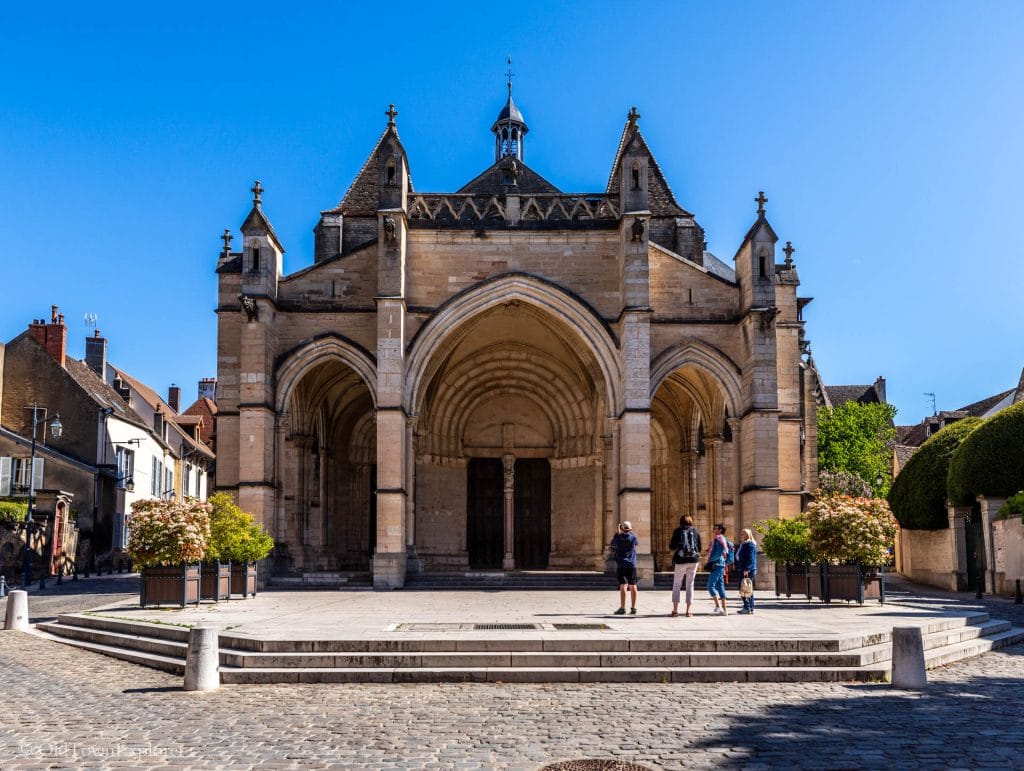
Collegiate Church of Notre-Dame and presbytery
- Architect: Unknown
- Style: Romanesque with Gothic additions and a Renaissance bell tower
- Built: Mid-12th century to early 13th century; later additions
- Address: Place du Général-Leclerc / impasse Notre-Dame, 21200 Beaune
Beaune’s main church is one of the clearest architecture anchors in the old center. It stands out for its Romanesque massing, later Gothic work, and a bell tower rebuilt in the Renaissance period. Look for the rounded core first, then the later layers that show how the church changed without losing its basic form. It sits inside the historic center beside the chapter buildings, a short walk from Place Monge and the Hôtel-Dieu.
Check the Collégiale Notre-Dame visitor information for current opening details and tapestry access.
Saint-Nicolas Church
- Architect: Unknown
- Style: Romanesque with later Gothic work
- Built: 12th, 14th, and 15th centuries
- Address: Rue du Faubourg-Saint-Nicolas, 21200 Beaune
The church shows how Beaune extended beyond its tight medieval core. It is older in feel than many central buildings, with Romanesque fabric and later additions that changed the porch and tower. Look for the sculpted porch, the tower, and the way the building stands slightly apart from the busiest center streets. It sits outside the old walls to the northeast, so it works best as an outer stop after the core monuments.
Chapel of the Oratory
- Architect: Louis Trestournel
- Style: Early 18th-century chapel
- Built: 1708–1710
- Address: 75 rue de Lorraine, 21200 Beaune
The chapel was built from 1708 to 1710 to plans by Louis Trestournel, a member of the Oratorian congregation. Its rue de Lorraine frontage adds an early 18th-century religious layer to the walk toward Saint-Nicolas Gate; parts of the street elevation were repaired in the late 19th century.
Jacobins Chapel
- Architect: Unknown
- Style: Late Gothic convent chapel with later alterations
- Built: Founded 1475; church consecrated 1483; altered later
- Address: Rue Eugène-Spuller / place de Morimont, 21200 Beaune
The chapel shows the convent layer of late medieval Beaune. What stands out is not a complete church exterior but the surviving fabric of a Dominican site that was cut back and reused after the Revolution. Look for the remaining chapel volume and the preserved timber roof structure that points to the original scale of the building. It sits on the east side of the historic center near place de Morimont, just outside the most direct Notre-Dame to Hôtel-Dieu line.
Chapel of the Baptault estate
- Architect: Unknown
- Style: Medieval chapel with 15th-century restoration
- Built: 12th century; restored in the 15th century
- Address: Route de Pommard / chemin de Baptault, 21200 Beaune
The chapel brings the architectural story out from the town center into Beaune’s vineyard edge. It stands out for its small scale, long continuity, and 15th-century wall paintings in the apse. Look for the simple rural form first, then the painted apse if access is possible. It sits well west of the historic core, so it is not part of the standard old-town loop and works better as a separate stop.
Saint-Baudèle
- Architect: Unknown
- Style: Early Christian or early medieval remains
- Built: Possible late 4th-century origin; underground oratory possibly established in the early 8th century
- Address: Place Général Leclerc, 21200 Beaune
Saint-Baudèle survives in the cellar of a later house on Place Général Leclerc rather than as a complete standing church. Its early dating is uncertain, with historical accounts placing an earlier chapel at the end of the 4th century and an underground oratory in the early 8th century. Treat it as evidence of Beaune’s earliest Christian history, not as a major exterior stop.
Saint-Flocel
- Architect: Unknown
- Style: Pre-Romanesque / early Romanesque chapel
- Built: 10th century; later repairs and restorations
- Address: 20 rue Paradis, 21200 Beaune
Saint-Flocel adds another early layer to Beaune’s church map. It stands out for its small barrel-vaulted form and for the fact that it preserves an older scale of worship space than Notre-Dame or Saint-Nicolas. Look for the narrow proportions, plain masonry, and the sense that the building was fitted into the edge of the early fortified area. It sits near the old core along rue Paradis, so it is easy to connect with Notre-Dame and the nearby chapter buildings.
Notre-Dame Chapel
- Architect: Unknown
- Style: Unknown
- Built: Unknown
- Address: Rue du Faubourg-Saint-Nicolas, 21200 Beaune
The small chapel stands on rue du Faubourg-Saint-Nicolas, northeast of the historic center. Look for its modest scale and position along the northern approach to the old town rather than expecting the architectural weight of Notre-Dame or Saint-Nicolas. If you are already extending the walk beyond the ramparts, pair it with Saint-Nicolas Church.
Former Carmelite chapel
- Architect: Unknown
- Style: 19th-century Carmelite chapel and monastic complex
- Built: 1836–1837
- Address: 14 rue de Chorey, 21200 Beaune
The Carmelites moved to 14 rue de Chorey in 1836, where they built a chapel, cloister buildings, and related structures; the chapel was consecrated in 1837. The site now functions as the Sanctuaire de l’Enfant-Jésus de Beaune. It sits north of the historic core and works best as an additional stop with Saint-Nicolas rather than as part of the shortest old-town circuit.
Fortifications, Gates, and Towers in Beaune
The fortification line still shapes how Beaune fits together. Walls, gates, bastions, and later promenades form a ring around the historic core, so even a partial circuit explains where the old town ended and how later streets and gardens reused the defensive edge.
Fortifications
- Architect: Unknown
- Style: Defensive walls from late Roman, medieval, and early modern phases
- Built: From the late 3rd or 4th century onward, with later medieval and bastioned additions
- Address: Boulevard Perpreuil, boulevard Saint-Martin, boulevard Saint-Nicolas, rue Maufoux, avenue de la République, 21200 Beaune
The walls are the main frame for reading Beaune on foot. They stand out because they preserve the city’s edge, even where later gardens, roads, and house plots have softened the old military line. Look for changes in wall thickness, shifts in level, and stretches where the rampart walk gives views into private courts and merchant properties. The remains wrap around the historic center, so they help connect major sites like Notre-Dame, the Hôtel-Dieu, and the outer gate sectors into one route.
The protected fortification remains include wall sections, towers, ditches, and parts of the chemin de ronde around the old town.
Saint-Martin Bastion
- Architect: Unknown
- Style: 17th-century bastioned military architecture with 18th-century promenade alterations
- Built: 1636–1637; altered from 1761 onward
- Address: Place Saint-Martin / Square des Lions, 21200 Beaune
The bastion shows how Beaune adapted its defenses to artillery and then reused them when the military need faded. It stands out for its heavy earth-and-stone form and for the later transformation into a public walk, which changed a defensive work into an urban overlook. Look for the broad mass of the bastion, the later stair access, and the way the site feels more like a raised edge than a tower or gate. It sits on the west side of the historic core, so it is one of the clearest outer markers on a full rampart circuit.
Saint-Nicolas Gate
- Architect: Nicolas Lenoir Le Romain
- Style: 18th-century monumental city gate on the site of a medieval fortified gate
- Built: 1762–1770
- Address: Rue de Lorraine, 21200 Beaune
The gate shows Beaune moving from a purely defensive entrance to a more formal civic one. It stands out for its later date and its composed 18th-century design, which replaced an older medieval gate. Look for the symmetry, the cleaner classical lines, and the way the gate reads as an entrance statement rather than a compact fortress. It stands on the north side of the old town near the Oratory sector, where it still marks one of the historic approaches into Beaune.
Clock Tower
- Architect: Unknown
- Style: Medieval belfry tower
- Built: 13th to 14th centuries; clock installed in 1397
- Address: Place Monge, 21200 Beaune
The Clock Tower is the vertical marker that helps make sense of the center. It stands out because, unlike the longer wall stretches, it works as a single upright landmark tied to timekeeping and civic identity. Look for the plain stone shaft, the later clock function, and its position on Place Monge, where it still reads as a center-point building rather than part of the wall edge. It sits inside the historic core, so it links the market and civic center to the larger ring of gates and ramparts around it.
Palaces, hôtels particuliers, and notable houses
Beaune’s private houses work at a smaller scale than the Hospices or the walls. Merchant, church-elite, and noble properties line old streets with narrow fronts and deeper plots, often revealing courtyards, turrets, galleries, or service ranges behind the street wall.
Hôtel des Ducs de Bourgogne
- Architect: Unknown
- Style: Late medieval and Renaissance urban palace
- Built: 15th–16th centuries
- Address: Rue du Paradis, 21200 Beaune
The former ducal residence is one of the clearest signs that Beaune was more than a market town. It explains the political side of the old center, since it occupied a large part of the former castrum beside Notre-Dame and the chapter precinct. Look for the scale of the plot and the way later museum use still sits inside a much older power center. It stands in the east side of the historic core, a short walk from the collegiate church and Place Monge.
Hôtel de Saulx
- Architect: Unknown
- Style: Late Gothic with timber framing and court-centered hôtel layout
- Built: Second half of the 15th century; 16th-century additions
- Address: 13 place Fleury, 21200 Beaune
It is one of the best buildings in Beaune for understanding the private hôtel form around a courtyard. It stands out for its trapezoidal court, stair turret, timber-framed ranges, and surviving stone cross windows in the older corner pavilion. Look for the court-facing elevations rather than only the street line, since the plan matters as much as the front here. It sits just west of the tight center near rue Louis-Véry, so it works well between the ramparts walk and the core monuments.
Hôtel Meursault / Hôtel de la Rochepot
- Architect: Unknown
- Style: Early 16th-century Gothic-Renaissance transition
- Built: 16th century
- Address: 9 place Monge / 15 rue de l’Enfant, 21200 Beaune
It is one of the strongest town-house facades in central Beaune. It stands out for its open street front and for the interior gallery system around the court, where stone arcades, rib-vaulted levels, and sculpted busts give the house unusual depth. Look for both sides of the building: the public face on Place Monge and the more architectural sequence through the courtyard. It sits directly on one of the main visitor squares, so it is easy to pair with the Clock Tower, market area, and Notre-Dame.
Hôtel Moyne-Blandin
- Architect: Louis Moyne
- Style: Late 18th-century townhouse
- Built: Circa 1780
- Address: 40 rue Maufoux, 21200 Beaune
The house shows a later Beaune, when parts of the old defensive edge were being turned into residential plots. It stands out for its date, its position on the former bastion area, and its preserved interior decoration. Look for the shift in mood from medieval density to a more regular late 18th-century residence. It sits on rue Maufoux on the southwest side of the center, close to the wall line and the southern walking circuit.
Maison du Colombier
- Architect: Unknown
- Style: 16th-century town house with corner turret
- Built: 16th century
- Address: 1 rue Maufoux / 2 rue Charles-Cloutier, 21200 Beaune
Maison du Colombier is protected for its 16th-century corner turret as well as its street facades and roofs. The turret gives the corner more architectural weight than many of Beaune’s narrower house fronts, making this an easy stop between the Hôtel-Dieu and rue Maufoux.
Maison Champy
- Architect: Unknown
- Style: Late 19th-century wine-trade cuverie
- Built: 1890
- Address: 3 rue du Grenier-à-Sel, 21200 Beaune
Maison Champy’s business dates to 1720, but the protected wine building at 3 rue du Grenier-à-Sel was built in 1890 as a large cuverie. The site connects Beaune’s long wine-trade history with a purpose-built late 19th-century production building rather than an intact 18th-century merchant house.
House, 9 rue Monge
- Architect: Unknown
- Style: Late medieval house
- Built: 15th century
- Address: 9 rue Monge, 21200 Beaune
The protected house fills in the ordinary but still important fabric around Place Monge. It stands out less as a grand monument than as a preserved piece of the medieval street and courtyard pattern, with the protection focused on its court-side facades and roofs. Look for how the property sits within a continuous row while still holding older fabric behind the street front. It is in the heart of the old center, close to the Clock Tower and the market zone.
House, 1 rue Rousseau-Deslandes / rue de Lorraine
- Architect: Unknown
- Style: 16th-century urban house
- Built: 16th century
- Address: 1 rue Rousseau-Deslandes / rue de Lorraine, 21200 Beaune
The protected house is dated to the 16th century. Its position at the meeting of rue Rousseau-Deslandes and rue de Lorraine makes it a useful domestic stop when walking north from the central hospice and market area toward the Oratory and Saint-Nicolas Gate.
House, 10 rue Rousseau-Deslandes
- Architect: Unknown
- Style: Medieval house
- Built: 13th century
- Address: 10 rue Rousseau-Deslandes, 21200 Beaune
The house adds another early domestic layer to Beaune’s street fabric. It stands out because a 13th-century date is unusually early for a surviving town house and because the protected parts are the front and roof. Look for the vertical proportions and the way the house holds its place in a tight old-town frontage. It lies just east of the core near the charity hospice zone, so it fits naturally into a walk that links care buildings with private houses.
House, 18 rue de Lorraine
- Architect: Hugues Sambin (attributed)
- Style: Late 16th-century Renaissance town house
- Built: 1577
- Address: 18 rue de Lorraine, 21200 Beaune
It is one of the clearest houses in Beaune for reading late 16th-century street architecture. It stands out for its dated front, its attributed link to Hugues Sambin, and its decorative treatment, including an ornate dormer. Look for the inscription date and the way ornament is concentrated into a narrow urban frontage. It sits on rue de Lorraine north of the center, on the route toward the Oratory and Saint-Nicolas Gate.
House, 22 rue de Lorraine
- Architect: Unknown
- Style: Late 16th- to early 17th-century town house
- Built: Late 16th to early 17th century; later alterations including 1855
- Address: 22 rue de Lorraine, 21200 Beaune
The house dates mainly from around the turn of the 17th century, although the street facade was altered more than once, including in 1855. Look for it as part of the sequence of older properties along rue de Lorraine rather than as a separate detour.
House, 24 rue de Lorraine
- Architect: Unknown
- Style: Early 16th-century hôtel with later facade work
- Built: Early 16th century; altered in the 18th and 19th centuries
- Address: 24 rue de Lorraine, 21200 Beaune
The house began in the early 16th century and was remodeled later, including an 18th-century facade campaign that added a new porch and wrought-iron window guards. The broad street elevation makes it one of the easiest rue de Lorraine houses to compare with the narrower fronts nearby.
House, 29 rue Maufoux
- Architect: Unknown
- Style: Late-medieval to Renaissance town house
- Built: 15th–16th centuries
- Address: 29 rue Maufoux, 21200 Beaune
The protected house contains 15th- and 16th-century fabric, including courtyard facades, roofs, galleries, and a well. Those inward-facing features make the property a good example of why Beaune’s private houses are often more complex than their street fronts suggest.
Municipal Buildings in Beaune
Around Notre-Dame and the western side of the center, schools, chapter buildings, convent properties, and later civic offices sit close together. Their proximity shows how religious, educational, administrative, and commercial functions shared the same compact urban fabric.
Former Chamber of Commerce of Beaune
- Architect: Félix Goin; Arthur Montoy directed the interior design and fit-out
- Style: Late 19th-century institutional conversion with Neo-Gothic interior decoration
- Built: Possible 18th-century core; substantially remodeled after 1887
- Address: 6 rue Vergnette-de-la-Motte, 21200 Beaune
The Chamber of Commerce acquired the former Carmelite dependency known as the Petites Boucheries in the late 1880s. Arthur Montoy and architect Félix Goin directed the conversion, including the interior layout, facade, and extensive Neo-Gothic decorative work. The building adds a late 19th-century civic and commercial layer beside the older Carmelite precinct.
Chapter
- Architect: Unknown
- Style: 13th-century Gothic canonical house
- Built: 13th century
- Address: Impasse Notre-Dame, 21200 Beaune
The building is one of the clearest medieval institutional survivals in Beaune. It was part of the chapter precinct around Notre-Dame and shows how the collegiate church was supported by a wider group of residential and working buildings. Look for its compact block, the court setting, and the surviving Gothic details in the upper openings rather than expecting a monumental church front. It sits directly beside the Notre-Dame group in the middle of the historic core, so it reads best as part of that larger cluster.
Chapter Cellar
- Architect: Unknown
- Style: Medieval canonical house with cellar spaces
- Built: 13th century
- Address: Impasse Notre-Dame, 21200 Beaune
The protected building adds the working side of the chapter precinct. It shows that the church center was not only ceremonial but also practical, with storage and production space tied to the canons’ urban properties. Look for it as part of the dense run of chapter buildings behind Notre-Dame, where the value comes from surviving fabric and use pattern more than from a show front. It sits in the same tight cluster as the Chapter and the presbytery, so it fits naturally into the shortest old-town architecture walk.
Chapter Cellar, 2 rue Paradis
- Architect: Unknown
- Style: Medieval canonical house with later rebuilding
- Built: 13th century, with later rebuilding
- Address: 2 rue Paradis, 21200 Beaune
It is one of the former canons’ houses linked to the chapter estate. It stands out because one part keeps 13th-century fabric while another was rebuilt much later, so the site shows architectural layering in a direct way. Look for the depth of the parcel and think of it as part residence, part service building tied to the collegiate quarter. It sits just off the Notre-Dame area on rue Paradis, still inside the main historic core.
Private Boys' School
- Architect: Unknown
- Style: School building
- Built: Unknown
- Address: Impasse Notre-Dame, 21200 Beaune
The facades facing impasse Notre-Dame are protected. The building keeps the scale of the old chapter quarter rather than standing apart like a large modern school complex. Look at it together with the Chapter and other buildings around Notre-Dame, where religious, educational, and civic uses sit unusually close together.
Jules Ferry College
- Architect: Robert Camelot, Jacques Herbé, and Paul Herbé
- Style: 1930s modern school architecture
- Built: 1935–1937
- Address: 45 boulevard Jules-Ferry, 21200 Beaune
The building is one of the clearest 20th-century entries in Beaune’s protected architecture. It stands out because it was designed as a large girls’ school in the 1930s, so it brings a more modern, planned, and functional language than the medieval and early modern center. Look for the broader footprint, the more regular composition, and the shift from old-town parcel logic to an institutional campus layout. It sits outside the tight historic core on boulevard Jules-Ferry, so it works better as an outer stop than as part of the central monument cluster.
Building, Cour des Chartreux
- Architect: Unknown
- Style: Medieval domestic or service building linked to the former Charterhouse
- Built: 14th century
- Address: Cour des Chartreux, 21200 Beaune
The building preserves a small but real part of the former Chartreux setting inside Beaune. The protected feature is a 14th-century chimney, which makes the site more about surviving fabric than about a complete facade composition. Look for it as a fragment of a larger vanished monastic property and not as a stand-alone major monument. It sits northeast of the core in the Chartreux court area, still close enough to fit into a longer central walk.
Ursuline Convent
- Architect: Denis Quinard and others
- Style: Convent complex with 17th-century core and later civic reworking
- Built: Major convent campaign from 1697, with later rebuilding
- Address: 4 rue de l’Hôtel de Ville, 21200 Beaune
The complex shows how a convent became one of Beaune’s main civic buildings. It stands out for its U-shaped plan, its cloister history, and the way later rebuilding gave it a more formal public face once it became the town hall. Look for the change between convent fabric and later municipal presentation, especially on the court and street sides. It sits just north of the Notre-Dame area in the center, so it belongs fully to the main visitor zone.
Carmelite Convent
- Architect: Denis Quinard and others
- Style: Convent complex with 17th-century church and later civic reuse
- Built: Major work from 1640 to 1657; later changes
- Address: Place Ziem / rue du Tribunal, 21200 Beaune
The former convent connects religious architecture, public administration, and commercial institutions in one site. It stands out for its long timeline, from earlier priory remains to the 17th-century Carmel and then the post-Revolution reuse that brought in schools, offices, and Chamber of Commerce functions. Look for the cloister range and the former church front, which still carry the strongest architectural signal. It sits on the west side of the historic core near place Ziem, so it links well with the former Chamber of Commerce and the rampart side of town.
Markets, commercial, and wine-related buildings in Beaune
Commerce, storage, and the wine trade are woven into Beaune’s old center. Market halls, merchant houses, cellar buildings, and reused religious sites cluster around the route between Place Monge, Notre-Dame, and the Hôtel-Dieu.
For wine bars, shops, and tasting rooms in the same streets, continue with Beaune Wine.
Halles de Beaune
- Architect: Petit; later reworked by Allaire
- Style: 19th-century market hall
- Built: 1872–1873
- Address: Place de la Halle, 21200 Beaune
The halls are the clearest market building in central Beaune. They stand out because they sit directly opposite the Hôtel-Dieu, so the market and hospital form one of the city’s strongest public spaces. Look for the long covered volume and the way the hall works as an open civic container rather than a monument with a single grand front. It sits in the tight historic core, a few steps from Place Monge and the main pedestrian route through town.
Maison des Templiers
- Architect: Unknown
- Style: Medieval stone town house with Gothic gallery elements
- Built: 13th century, with later changes
- Address: 23 rue de l’Hôtel-Dieu, 21200 Beaune
The house shows Beaune’s commercial fabric at a smaller scale than the market halls or the big merchant properties. It stands out for its medieval gallery and carved capitals, which make it one of the most readable older houses on this side of the center. Look for the surviving arcade and upper-level details rather than expecting a large courtyard ensemble. It sits near the Hôtel-Dieu, so it fits naturally into the busiest architecture walk in Beaune.
Former Cordeliers site / Marché aux Vins
- Architect: Unknown
- Style: Former Gothic convent church, later adapted for wine cellars and tasting spaces
- Built: 13th–14th centuries, with later reuse
- Address: 7 rue de l’Hôtel-Dieu, 21200 Beaune
The site shows how religious buildings in Beaune were sometimes absorbed into the wine trade rather than simply lost. It stands out for the surviving chapels and arches of the former Cordeliers church, which still shape the interior even after later commercial reuse. Look for the church-scale volume and the remaining Gothic structure inside the adapted complex. It sits opposite the Hôtel-Dieu in the heart of the old town, so it is one of the easiest examples of reuse to read on foot.
If you want to include a historic cellar visit or producer tasting, compare wineries in Beaune.
Burgundy Wine Museum building
- Architect: Unknown
- Style: Late medieval and Renaissance urban palace reused as a wine museum
- Built: 15th–16th centuries
- Address: Rue Paradis, 21200 Beaune
The former ducal residence now houses Beaune’s wine museum, adding viticulture, cellars, presses, and Burgundy wine culture to a much older political building. Look first at the scale of the former palace plot, then at the museum use as a later layer. It sits beside the Notre-Dame precinct on the east side of the historic core.
For the appellations, villages, and vineyards behind these buildings, continue with Burgundy Wine. Beaune and the Côte de Beaune vineyard landscape form part of UNESCO’s Climats, terroirs of Burgundy World Heritage site.
Bouzaize Wash House
- Architect: Unknown
- Style: 19th-century wash house
- Built: 1887
- Address: Rempart des Dames / Bouzaize sector, 21200 Beaune
The wash house shows the working side of Beaune’s urban economy. It stands out because it sits where the Bouzaize comes back into the open air after passing under the Hôtel-Dieu sector, tying water, laundry work, and the edge of the old town into one place. Look for the practical open structure and the relation to the stream rather than expecting a formal monument. It sits on the rampart side of town just outside the tight center, so it works best on a longer walk that includes the walls.
Monuments and Memorials in Beaune
Public sculpture is a smaller part of Beaune’s architectural landscape than churches, houses, walls, or hospital buildings. Place Marey adds a different kind of civic landmark through the monument to Étienne-Jules Marey.
Monument to Marey
- Architect: Régis-Joseph Jardel
- Style: Early 20th-century public monument
- Built: 1911; inaugurated 1913
- Address: Place Marey, 21200 Beaune
The monument honors Étienne-Jules Marey, the Beaune-born scientist known for his work on movement and chronophotography. It stands out because it is not just a standing statue: Marey is shown seated, with books and scientific instruments, while the base includes moving horses and a bird in flight that point directly to his research. Look for the stone composition as a whole, not only the figure, since the carved base carries much of the meaning. It sits just southwest of the tight historic core, so it fits easily into a walk between the Hôtel-Dieu area, rue Maufoux, and the rampart side of town.
Things to Know Before You Go
Most of Beaune’s architecture can be explored independently, but the old walls, private houses, ticketed interiors, and outer sites reward different amounts of time.
Stay close to the walled center for the shortest walks
The Hospices, Halles, Place Monge, Notre-Dame, chapter buildings, and several protected houses are concentrated inside the old defensive line. A central base also makes it easy to return to the same streets in different light without planning transport.
Expect a mostly exterior architecture walk
Many private houses and former convent buildings are best treated as exterior stops unless public access is clearly indicated. Plan around streets, squares, gates, publicly accessible courtyards, and the wall line, then choose interior time separately for places such as the Hospices and Notre-Dame.
Treat the ramparts as their own walking loop
The tour of Beaune’s ramparts runs for about 2.5 kilometers around the historic center. You do not need the entire circuit on a short visit; one western or northern section is enough to see how the defensive edge relates to the streets inside.
Wear shoes that work on steps, slopes, and old paving
The central streets fit together easily on foot, but parts of the rampart route use stairs and changes in level. Comfortable walking shoes matter more on a full wall circuit than on a short Hospices-to-Notre-Dame loop.
Plan the longest exterior walks around weather and crowds
Most of the architecture route is outdoors. Choose quieter morning hours for the central squares when possible, and save the Hospices or another interior for rain. Wet paving and rampart steps also deserve more care in poor weather.
Return after dark for the major monuments
Beaune lights many central monuments and sections of the fortifications at night. If evening architecture is a priority, check the Lumières à Beaune program before planning around seasonal projections or special lighting.
Stay at street level if stairs are a problem
Some rampart sections include stairs or slopes. A street-level circuit still gives useful views of gates, bastions, and the old town edge, while individual interiors should be checked separately for current accessibility.
Two hours: keep to the core
Walk from the Hospices and Halles to Place Monge, the Clock Tower, Notre-Dame, and the nearby chapter buildings, then add a short stretch of rue de Lorraine or rue Maufoux. This is enough to compare Beaune’s hospital, market, church, civic, and domestic architecture without rushing to the outer sites.
Half a day: add houses and one rampart section
After the central monuments, continue along rue de Lorraine toward Saint-Nicolas Gate or take rue Maufoux toward the western ramparts. A half day gives you both major buildings and the smaller street architecture that gives the center its character.
Full day: add the outer religious and institutional sites
Use the extra time for Saint-Nicolas Church, the 14 rue de Chorey Carmel, a longer rampart circuit, and selected outer sites such as Jules Ferry College. The Baptault estate chapel is farther from the center and makes sense only if you specifically want the rural religious layer at Beaune’s vineyard edge.
Architecture Tours in Beaune
Independent walking works well for the central Hospices, Halles, Notre-Dame, house streets, and ramparts. A guided walk becomes more useful when you want access to courtyards, gardens, or details that are easy to miss from the street.
Guided Tours
Beaune’s tourism office lists guided heritage visits that move through the historic center and, on some routes, beyond the ramparts. Check guided visits in Beaune for current dates, languages, route details, and accessibility before choosing a tour.
Where to Stay for Architecture Walks
For architecture, the main choice is whether to stay inside the walled center, immediately outside the ramparts, or closer to the station.
For architecture-focused travel, staying inside or right beside Beaune’s historic core is the most efficient base, especially near the Hospices de Beaune, where you are within a short walk of the Hôtel-Dieu, the Halles, Place Monge, Notre-Dame, the chapter quarter, and several of the streets that best show the town’s houses, civic buildings, and old street pattern.
Just outside the ramparts still keeps the old center close while making the wall circuit and outer stops easier to reach. You give up the ability to step directly into Place de la Halle or the Notre-Dame quarter, but the main architecture remains within a compact walk.
The station side works well if rail convenience matters most. It is still practical for walking into the historic center, but it is less immediate for early-morning or evening walks around the Hospices, Notre-Dame, and the ramparts.
Hotels and Apartments in Beaune
Use the interactive map below to compare hotels and apartments inside the old walls, around the ramparts, and toward the station.
FAQs About Beaune Architecture
What is Beaune architecture known for?
Beaune architecture is known first for the Hospices de Beaune, especially its courtyard and glazed tile roof. Beyond that, the city is known for its compact walled form, Romanesque and Gothic churches, market buildings, convent sites, and merchant houses with deeper courts behind narrow fronts. The strength of Beaune is not one single style but the way several periods remain legible in a small area.
Is Beaune architecture worth it if I have limited time?
Yes. Beaune is one of the easier architecture destinations in Burgundy for a short visit because the center is compact and the main stops are close together. Even two hours is enough to understand the basic structure of the city if you focus on the Hospices, Notre-Dame, Place Monge, and part of the wall edge.
What’s the best short route for first-timers?
Start at the Hospices de Beaune, cross to the Halles, continue to Place Monge and the Clock Tower, then walk to Notre-Dame and the chapter quarter. After that, either return through rue Paradis or head north toward Saint-Nicolas Gate. This route is short, clear, and gives you hospital, market, civic, and religious architecture in one walk.
Are the key sites inside the old town walls?
Most of the main headline sites are inside or right beside the old town walls. The Hospices, Halles, Notre-Dame, Place Monge, the chapter buildings, and several major houses all sit in the core. Outer stops like Saint-Nicolas Church, the Baptault chapel, and parts of the wall circuit expand the story, but the center carries most of the essential architecture.
What styles will I actually see?
You will mostly see Romanesque, Gothic, late medieval urban fabric, Renaissance details, 17th-century chapel and convent architecture, 18th-century civic work, and some 19th- and 20th-century institutional buildings. In practice, Beaune is more layered than pure. Many buildings combine parts from different periods rather than presenting one clean style.
Can I understand Beaune’s main architecture from the outside?
Yes, but the Hospices is still worth interior time. The walls, gates, Clock Tower, market hall, church exteriors, protected house fronts, and much of the street pattern can be seen without building the day around interiors. Pair those exterior stops with the Hospices rather than treating the hospital as the whole architectural story; Notre-Dame is also worth entering when it is open.
Should I focus on churches or houses after the Hospices?
For most first-time visitors, churches are the better second step because Notre-Dame and Saint-Nicolas help explain Beaune’s age, layout, and early importance. Houses become more rewarding once you already understand the town plan. If you like urban detail more than major monuments, then move from the Hospices to Place Monge, rue Paradis, and rue Maufoux.
Is Beaune architecture mostly about wine buildings?
Not exactly. Wine is an important layer, especially in merchant houses, cellar sites, and reused commercial buildings, but the architecture story is broader than that. Hospital buildings, churches, walls, gates, convents, and civic structures do just as much to explain the city.
Where should I stay for architecture walks in Beaune?
Stay inside or immediately beside the walled center if architecture is a priority. That puts the Hospices, Halles, Place Monge, Notre-Dame, rue de Lorraine, rue Maufoux, and several rampart access points close enough for repeated short walks.
Do I need a full day for Beaune architecture?
A full day is ideal, but not required. Two hours covers the essentials, and a half day is enough for the center plus one outer ring. A full day becomes most useful when you want to include smaller houses, suburban churches, wall sections, and reused institutional sites rather than only the best-known monuments.
For wine after the architecture walk, Beaune Wine covers bars, shops, and nearby tasting choices. For Burgundy dishes, markets, and restaurants around the same walkable center, continue with Beaune Food.