

Discover Civita di Bagnoregio: History, Architecture & Must-See Attractions
Civita di Bagnoregio, Italy is a small hill town in northern Lazio, set on a narrow plateau of volcanic tuff above the surrounding valleys. Today it’s reached on foot via a long pedestrian bridge from the modern town of Bagnoregio, and its story is closely tied to erosion, landslides, and repeated earthquakes that made the historic core progressively smaller over time.
Architecturally, Civita is defined by compact medieval street patterns, tuff stone construction, and buildings that cluster toward the safer interior of the plateau. The town’s edges feel abrupt because the plateau drops away quickly, and many viewpoints make the relationship between settlement and geology easy to read. Even on a short visit, you can see how building massing, limited access points, and simple façades reflect both security concerns and the constraints of the site.
We visited Civita di Bagnoregio during our two-week stay in Orvieto. In this post, we’ll cover what to see and how to plan a day trip.
This post contains affiliate links that may earn us a small commission at no additional cost to you.
Civita di Bagnoregio at a Glance
Civita di Bagnoregio is a pedestrian-only historic town on a tuff plateau, best known for its bridge approach and cliff-edge setting.
- Located in northern Lazio, a practical day trip from Orvieto
- Historic core sits on volcanic tuff shaped by erosion and landslides
- Medieval street pattern with tight lanes and small squares
- Fully walkable on foot, but includes slopes, stairs, and uneven stone paving
- Typical visit takes 2–4 hours (longer if you linger at viewpoints)
- Key landmarks include the pedestrian bridge, the main square, and the town’s primary church
- Best in spring and fall; summer can be crowded and mid-day sun can feel intense on exposed paths
Below, we’ll cover Civita’s history first, then the architectural structure of the town, then the main sites to look for on a short walking loop.
History of Civita di Bagnoregio
Civita’s timeline is shaped by early settlement on defensible high ground, followed by centuries of instability that pushed residents toward safer terrain.
Etruscan period (Unknown–3rd century BCE)
The site is commonly associated with Etruscan settlement patterns in the region, where plateau towns offered defense and clear sightlines over river valleys. Specific founding details for Civita itself are unknown.
Roman period (3rd century BCE–5th century CE)
Under Roman influence, the broader area remained inhabited and connected to regional routes. How much of Civita’s current town plan reflects Roman-era layout is unknown, but reused stone elements appear in some later structures.
Early medieval period (6th–10th centuries)
After the fall of the Western Roman Empire, many hilltop sites regained importance for security. Civita’s enclosed core and limited access align with this defensive logic, although precise dates for early fortification phases are unknown.
High and late medieval period (11th–14th centuries)
This is the period most visible in today’s town fabric: dense stone housing, narrow lanes, and a central square anchored by the main church. The settlement pattern suggests incremental growth within a confined footprint rather than planned expansion.
Early modern period (15th–18th centuries)
Regional earthquakes and ongoing erosion contributed to repeated damage and rebuilding. Over time, stable daily life became harder to maintain on the plateau, and population gradually shifted toward Bagnoregio below.
Modern era (19th century–present)
By the modern period, Civita had a greatly reduced resident population and became increasingly dependent on visitors. Conservation efforts now focus on stabilizing structures and managing access to reduce further loss.
Architecture of Civita di Bagnoregio
Civita’s architecture is best understood as a compact medieval town adapted to a fragile plateau, where materials, street layout, and building placement respond to risk.
Volcanic tuff stone construction
Tuff is the dominant material in walls, façades, and foundations, giving the town a consistent color and texture. In many places, you can see how stone blocks are sized and stacked for thick load-bearing walls rather than thin façade treatments.
Dense medieval street network
The historic core is organized around narrow lanes that widen into small pockets of space instead of broad streets. This layout supports foot traffic and wind shelter, and it concentrates movement toward the central square.
Cliff-edge settlement limits
The plateau edge acts like a hard boundary: buildings and paths terminate quickly, and perimeter viewpoints often sit where the ground begins to fall away. The town’s “compressed” feel comes from having little room to expand outward.
Simple façades and small openings
Many buildings use restrained exterior detailing, with modest window openings and practical doors opening directly onto lanes. The overall effect is functional: a built fabric designed for durability and close-quarter living.
Access control and approach sequence
The bridge-to-gate approach creates a clear threshold into the historic core. That controlled entry is historically consistent with fortified towns, even though parts of the approach infrastructure are modern.
Rooflines, drainage, and slope adaptation
Civita’s building and street details reflect ongoing adaptation to rainwater runoff on a fragile plateau. Roof pitches and stone paving work with the town’s narrow lanes and subtle grade changes to move water through the street network rather than toward building foundations. These small choices reduce runoff pressure near the plateau edges and help explain why movement through the historic core feels naturally funneled along a few stable routes.
Architectural Attractions in Civita di Bagnoregio
Civita di Bagnoregio’s architectural landmarks are compact and closely spaced, making it easy to encounter multiple building types within a short walk.

Pedestrian Bridge to Civita di Bagnoregio
- Style: Modern pedestrian infrastructure
- Built: 1965
- Address: Connects Bagnoregio to Civita di Bagnoregio
The bridge forms a long, linear approach that isolates the historic core from its surroundings. From an architectural perspective, it functions as a deliberate threshold, emphasizing the town’s separation from the modern settlement below. The alignment frames the skyline of the plateau and exposes the tuff cliff face beneath the buildings.
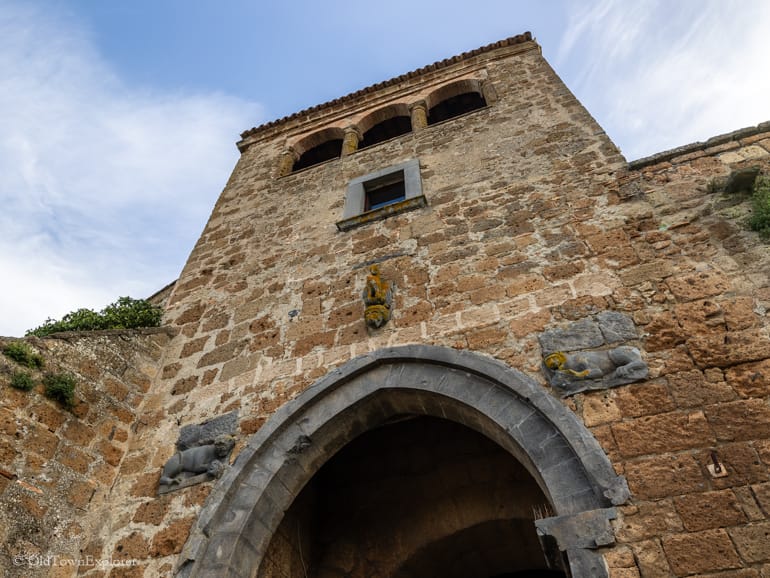
Porta Santa Maria
- Style: Medieval fortified gateway
- Built: 13th century (approximate)
- Address: Western entrance to the historic center
Porta Santa Maria is the sole formal entrance into Civita’s historic core. The gate’s thickness and limited opening reflect defensive priorities rather than ceremonial display. Embedded stonework suggests reuse of earlier materials, reinforcing the layered history of the site.

Palazzo Alemanni–Mazzocchi
- Style: Renaissance palazzo
- Built: 1550s (16th century)
- Address: Piazza San Donato, Civita di Bagnoregio
Palazzo Alemanni–Mazzocchi is the largest palazzo in Civita and one of the clearest examples of formal Renaissance-era architecture in the historic core. Look for the ashlar stone portal and the more “palazzo-like” façade proportions compared with the smaller medieval houses nearby. Today, the building is associated with the Museo Geologico e delle Frane, tying the site’s civic architecture directly to the story of erosion and landslides that shaped Civita’s survival.
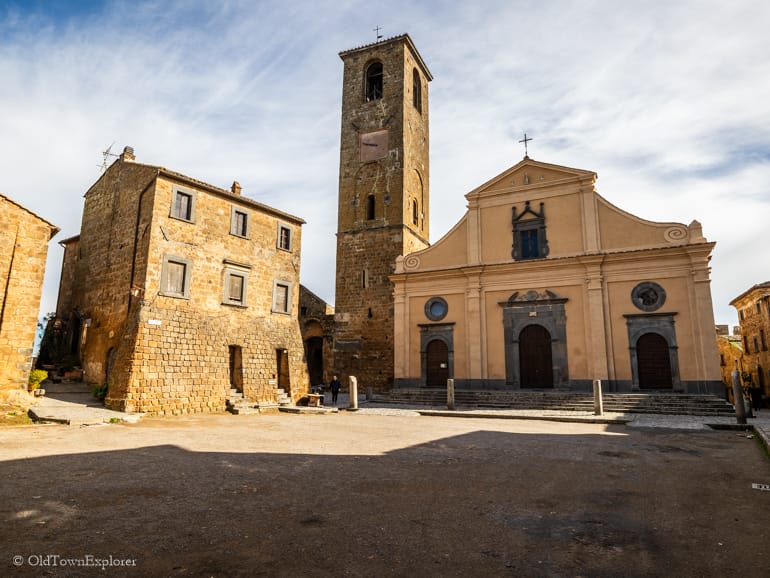
Piazza San Donato
- Style: Medieval civic square
- Built: Medieval period
- Address: Center of Civita di Bagnoregio
Piazza San Donato is the spatial heart of Civita, where the town’s main circulation routes converge. Its small scale reflects the constraints of the plateau and contrasts with larger planned squares elsewhere in central Italy. Architecturally, the square reads as an enclosed room defined by continuous stone façades.
Church of San Donato
- Style: Romanesque with later modifications
- Built: Origins unknown; medieval reconstruction
- Address: Piazza San Donato, Civita di Bagnoregio
The church anchors the main square and provides the clearest example of formal religious architecture in the town. Its restrained façade emphasizes mass and proportion rather than decoration. The building’s position reinforces the medieval relationship between civic life and religious authority.
Former Episcopal Buildings Adjacent to San Donato
- Style: Medieval civic architecture
- Address: Buildings flanking Piazza San Donato
These structures indicate Civita’s former administrative role within the region. Architecturally, they blend into the surrounding fabric, using the same tuff stone construction and limited openings. Their proximity to the church highlights the close association between governance and religious institutions.
Medieval Stone Houses Along the Main Spine
- Style: Medieval vernacular
- Built: 12th–15th centuries (approximate)
- Address: Primary lane between Porta Santa Maria and Piazza San Donato
This stretch of housing best illustrates Civita’s everyday architecture. Buildings are tightly spaced, with thick walls and modest openings that prioritize structural stability. Variations in roof height and alignment reveal incremental construction over time.
Secondary Lanes Off the Main Axis
- Style: Medieval street and housing fabric
- Built: Medieval period
- Address: Side lanes branching from the central route
These narrower lanes show how Civita adapted limited space into livable residential corridors. The irregular turns and slight level changes reduce sightlines and wind exposure. Architecturally, they reinforce the sense of enclosure created by continuous stone walls.
Stone Paving and Stairways of the Historic Core
- Style: Traditional pedestrian paving
- Address: Throughout Civita di Bagnoregio
Stone paving varies in width, slope, and finish depending on location. Steps are often integrated directly into the street surface to manage elevation change. These details reflect long-term adaptation to erosion and drainage challenges.
Cliff-Edge Building Line
- Style: Settlement edge condition
- Built: Medieval period onward
- Address: Perimeter of the historic core
The outermost buildings define a clear architectural edge where the plateau drops away. Their orientation and massing avoid extending too close to unstable ground. This edge condition explains why Civita feels compact and inward-facing.
Tuff Cliff Face Beneath the Town
- Style: Geological formation shaping architecture
- Address: Visible from bridge and perimeter viewpoints
The exposed tuff layers are essential to understanding Civita’s architecture. Erosion patterns are visible beneath the buildings, illustrating why construction favors the plateau interior. The cliff face functions as both foundation and long-term threat.
Walking Tour in Civita di Bagnoregio
Total time: approximately 2–4 hours, depending on stops and viewpoint time
Suggested Route:
Pedestrian Bridge → Porta Santa Maria → Main approach lane → Piazza San Donato → Church of San Donato → Residential lanes loop → Perimeter viewpoints → Return to the gate and cross the bridge back
How to Get to Civita di Bagnoregio from Orvieto
Civita di Bagnoregio is reached via the modern town of Bagnoregio, where you walk to the pedestrian bridge and cross into Civita on foot. From Orvieto, the most practical options are bus, car, or taxi.
By Bus
You can reach Civita di Bagnoregio by taking a regional Cotral bus from Orvieto (old town) to Bagnoregio, then walking to the pedestrian bridge access area.
Where to catch the bus in Orvieto (old town)
Cotral buses for Bagnoregio commonly depart from Orvieto – Piazza d’Armi. Use this stop page to confirm the stop name and departures: Moovit stop page
How to check the exact schedule (recommended)
Cotral schedules vary by day and season. Use Cotral’s official timetable search and check runs from Orvieto (or Orvieto Piazza d’Armi) to Bagnoregio.
Route overview (for stops and structure)
For a visual overview of the route and intermediate stops, see the Moovit line page for the Cotral route between Orvieto and Bagnoregio.
After you arrive in Bagnoregio
Civita di Bagnoregio is pedestrian-only. From your Bagnoregio stop, walk to the bridge entrance, then cross the pedestrian bridge into Civita.
By Car
Driving is often the simplest option for a day trip from Orvieto. You’ll park outside the historic core near Bagnoregio, then walk to the pedestrian bridge.
By Taxi
A taxi from Orvieto can provide direct point-to-point transport to the access area near the bridge.
Getting Around Civita di Bagnoregio
Civita is pedestrian-only and navigated entirely on foot. Walkability is straightforward in terms of distance, but the experience includes slopes, stairs, and uneven stone paving that can slow you down. The approach involves the bridge crossing and then gradual elevation changes within the town. Parking is outside the historic core in the Bagnoregio access area, and viewpoints are reached via perimeter paths that may be exposed to wind and weather.
Making the Most of Your Day Trip
Morning - Arrive early, cross the pedestrian bridge, and walk the main lane into the historic core before crowds build.
Midday - Spend time in Piazza San Donato and visit the Church of San Donato, then loop through residential lanes to see the town fabric up close.
Afternoon - Follow the perimeter paths and stop at multiple viewpoints to understand the plateau edge and the geology driving the town’s form.
Late afternoon / sunset - Walk back through the core at a slower pace, then return across the bridge when the light is lower and crowds often thin.
Tips for Visiting Civita di Bagnoregio
Start early
Arriving earlier usually means a quieter bridge crossing and easier movement through narrow lanes. It also gives you more time to linger at viewpoints without feeling rushed.
Wear good shoes
Expect uneven stone paving, steps, and sloped lanes. Footwear with solid traction helps on worn stone surfaces, especially after rain.
Best time to visit
Spring and fall are typically more comfortable for walking and less intense than summer heat. March can be a strong choice if you want mild conditions and fewer peak-season crowds.
Food and drink
Food and drink options inside Civita can be limited and may vary by season. If you want a reliable plan, consider eating before or after your visit in Orvieto or Bagnoregio.
Give yourself time for viewpoints
The perimeter lookouts are a core part of the experience because they explain the town’s setting. Build in extra minutes for photos and for simply taking in the plateau edge.
Watch the weather
Wind can be noticeable on the bridge and along exposed edges. If conditions are wet, stone paving can feel slick, so move slower on steps and steeper lanes.
Expect narrow spaces
The historic core was not designed for high visitor volumes. Be prepared for pinch points on main lanes, especially near the gate and the central square.
Plan for the bridge crossing
The bridge is part of the visit, not just a connector. Budget time for the crossing both ways, plus short stops to look back at the town silhouette.
FAQs About Civita di Bagnoregio, Italy
Is Civita di Bagnoregio worth visiting?
Yes, especially if you want a compact medieval hill town where geology visibly shapes the settlement. The bridge approach and cliff-edge viewpoints make it distinct from many nearby towns.
How long should I spend in Civita di Bagnoregio?
A typical visit is 2–4 hours. If you want to move slowly, take photos, and pause at multiple viewpoints, plan closer to the upper end.
Is Civita di Bagnoregio walkable?
Yes, the entire historic core is pedestrian-only and small in scale. The main challenge is the combination of the bridge crossing, elevation changes, and uneven stone surfaces.
When is the best time to visit Civita di Bagnoregio?
Spring and fall are generally the most comfortable seasons for walking. Visiting earlier in the day can also make the experience smoother due to narrower lanes and limited space.
Can I visit Civita di Bagnoregio as a day trip from Orvieto?
Yes, it’s a common pairing because the distance is manageable and Civita’s footprint fits well into a half-day or short full-day plan.
What’s the main architectural character of Civita di Bagnoregio?
The town is primarily medieval in feel, with dense stone housing, tight lanes, and a central square anchored by the main church. The use of tuff stone and the settlement’s relationship to the plateau edge are key features.
