
Avignon Architecture
Explore Avignon Architecture: Papal Palaces, Churches & More
Avignon architecture reflects the city’s transformation into the seat of the papacy during the 14th century. The papal court reshaped the walled city with the Palais des Papes, cardinal residences, Gothic churches, and administrative buildings designed to project spiritual and political authority.
Later generations added Baroque chapels, hôtels particuliers, civic buildings, and industrial structures without erasing the compact medieval framework. Fortified walls still define the center, while carved portals, enclosed courtyards, and towers reveal later layers at walking pace.
We spent a month in Avignon, using the papal precinct and walls as starting points for our walks. Drawing on those walks and further research, this page compares buildings, streets, viewpoints, and architecture-walking choices to help you decide what to prioritize, what details to notice, how much time to allow, and whether interiors or guided tours fit your visit.
This page contains affiliate links. We may earn a small commission at no extra cost to you.
Avignon Architecture at a Glance
Avignon’s compact center makes the main architectural periods easy to compare on foot, but the strongest experience comes from mixing famous interiors with streets and buildings that need only an exterior look.
- Best first stop: Place du Palais for the Palais des Papes, Notre-Dame des Doms, the Petit Palais, and the Hôtel des Monnaies.
- Best river view: Rocher des Doms and the Rhône side of the walls, with the Pont Saint-Bénézet below.
- Best church details: Saint-Pierre’s carved doors, Saint-Didier’s restrained Southern Gothic mass, and Saint-Agricol’s layered medieval fabric.
- Best street for urban form: Rue des Teinturiers for its canal, waterwheels, paving, trees, chapel façades, and surviving industrial character.
- Best later architecture: Place de l’Horloge, where the 19th-century Hôtel de Ville and opera surround the medieval Tour Jacquemart.
- Best base: Inside the ramparts, where nearly every first-priority site is walkable.
Allow at least half a day if you want to enter the Palais des Papes and still notice the surrounding churches and streets. Two hours is enough only for an exterior-focused circuit through the papal and civic core.
What to See in Avignon
The main choice is not which single monument to see, but how far to go beyond the UNESCO core. Place du Palais gives you the greatest concentration of monumental architecture; the streets to its south and east reveal the cardinal residences, churches, townhouses, and working infrastructure that made Avignon a city rather than a ceremonial enclave.
With that contrast in mind, decide whether your time belongs mostly to the palace precinct, to the quieter medieval streets, or to a broader walk that includes later civic and industrial architecture.
The Papal Precinct and Rhône Edge
Begin on Place du Palais, where the fortified palace, cathedral, Petit Palais, and former mint show different kinds of authority around one space. Continue to Rocher des Doms for the river relationship, then descend toward the Pont Saint-Bénézet or follow the walls from outside for their clearest scale.
Gothic Churches and Cardinal Residences
South and east of the palace, Avignon becomes more intimate. Saint-Pierre, Saint-Didier, Saint-Agricol, Livrée Ceccano, and the Collège de Croix show how ecclesiastical and residential buildings were fitted into narrow streets and small squares.
Townhouses, Civic Squares, and Working Architecture
Place de l’Horloge, Rue Joseph-Vernet, Rue Violette, the Banasterie quarter, and Rue des Teinturiers carry the story into the 17th, 18th, and 19th centuries. Saint-Joseph-Travailleur and the railway roundhouse are worthwhile only when modern concrete and engineering matter enough to justify leaving the compact center. For national context, see our France Architecture guide.
UNESCO and Papal Core in Avignon
Avignon’s UNESCO-listed historic center brings the Palais des Papes, the episcopal ensemble, the Pont Saint-Bénézet, and part of the surrounding medieval city into one compact area. Together they show how religious, administrative, military, and ceremonial architecture supported the 14th-century papal court.

Palais des Papes
- Architect: Pierre Poisson and Jean de Louvres led the principal 14th-century campaigns
- Style: Fortified Gothic palace
- Built: Principally 1335–1352
- Address: Place du Palais, 84000 Avignon
The Palais des Papes joins the austere Palais Vieux of Benedict XII to the more ceremonial Palais Neuf of Clement VI. From Place du Palais, look for the heavy wall planes, defensive towers, crenellations, and the flying buttress spanning Rue Peyrolerie. Inside, the courtyards, great halls, chapels, and surviving frescoes reveal the contrast between the fortified exterior and the sophistication of the papal court. Allow about two hours for the palace and gardens, and check the official Palais des Papes website for the current route, restoration work, access conditions, and tickets.
Papal Gardens
- Architect: Unknown
- Style: Restored palace gardens within medieval enclosures
- Built: 14th-century origins; restored and reopened after work completed in 2020
- Address: Palais des Papes, Place du Palais, 84000 Avignon
The Papal Gardens occupy enclosed terraces beside the palace and should not be confused with the public Rocher des Doms garden. The orchard, water features, planted beds, and walled garden rooms introduce the quieter domestic side of the papal residence. Access is normally tied to the palace visit, so confirm the current route through the official palace website.
Notre-Dame des Doms
- Architect: Unknown
- Style: Provençal Romanesque with later Gothic and Baroque alterations
- Built: Mainly 12th century; altered in later centuries
- Address: Place du Palais, 84000 Avignon
Notre-Dame des Doms predates the papal palace and adds a Romanesque church to the otherwise Gothic precinct. Notice the rounded entrance arch, classical ornament around the porch, the compact nave, later side chapels, and the gilded statue of the Virgin above the tower. Inside, the Gothic tomb of Pope John XXII is the principal architectural monument. The cathedral remains a place of worship, and access may change for services; check the official visitor information before relying on an interior visit.
Rocher des Doms
- Architect: Not applicable
- Style: 19th-century public garden on a limestone outcrop
- Built: Laid out from 1830
- Address: Montée des Moulins, 84000 Avignon
Rocher des Doms rises above the Rhône beside the palace and cathedral. From its terraces, you can see how the surviving bridge, river approaches, walls, Villeneuve-lès-Avignon, and Fort Saint-André relate to the papal high ground. Use it as a viewpoint rather than a substitute for the separate Papal Gardens.
Pont Saint-Bénézet
- Architect: Unknown
- Style: Medieval stone arch bridge with an integrated chapel
- Built: First construction traditionally dated 1177–1185; repeatedly rebuilt
- Address: Boulevard du Rhône, 84000 Avignon
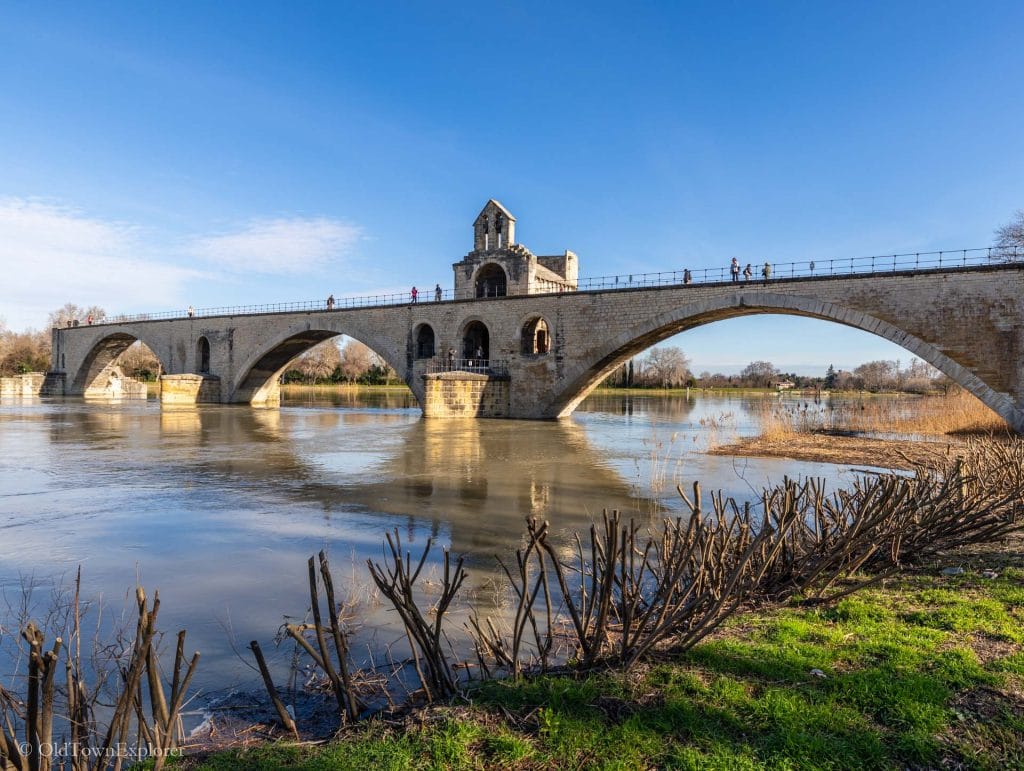
Four of the bridge’s original 22 arches survive over the Rhône. Walking onto the bridge makes its narrow width, exposed river position, and former scale easier to understand than the familiar side view alone. An audioguide and three-dimensional reconstruction help explain the lost crossing; check the official Pont Saint-Bénézet website for current access and ticket combinations.
Saint-Bénézet Chapel
Chapelle Saint-Nicolas
- Architect: Unknown
- Style: Romanesque and 15th-century chapel built into the bridge structure
- Built: Medieval; altered in the 15th century
- Address: On the second pier of Pont Saint-Bénézet, Boulevard du Rhône, 84000 Avignon
The bridge chapel is dedicated to Saint Nicholas. Its association with Saint Bénézet comes from the bridge’s name and legend. The chapel’s stacked levels and position on a narrow pier show how worship space was incorporated into a major piece of medieval infrastructure. It forms part of the ticketed bridge visit; the official bridge website carries current access details.
Walls of Avignon
- Architect: Unknown
- Style: Medieval curtain walls with towers and gates
- Built: Begun in 1355 and largely completed by 1370
- Address: Encircling Avignon intra-muros
The roughly 4.3-kilometer wall circuit still defines the old town’s footprint. For the clearest sense of scale, walk outside the walls along the Rhône side or between Porte de la République and Porte Saint-Michel, where the repeating towers, crenellations, gates, and long curtain walls are easier to see. A limited elevated section can be reached from the Pont Saint-Bénézet entrance toward Rocher des Doms; check access locally before making it essential to your route.
Papal Residences and Institutions in Avignon
The popes brought cardinals, administrators, and educational institutions that required buildings of their own. These sites are less theatrical than the main palace, but they explain Avignon’s unusual density of fortified residences, large halls, towers, and reused medieval compounds.
Petit Palais
- Architect: Unknown
- Style: Gothic episcopal palace with a major late-15th-century rebuilding
- Built: 14th–15th centuries
- Address: Place du Palais, 84000 Avignon
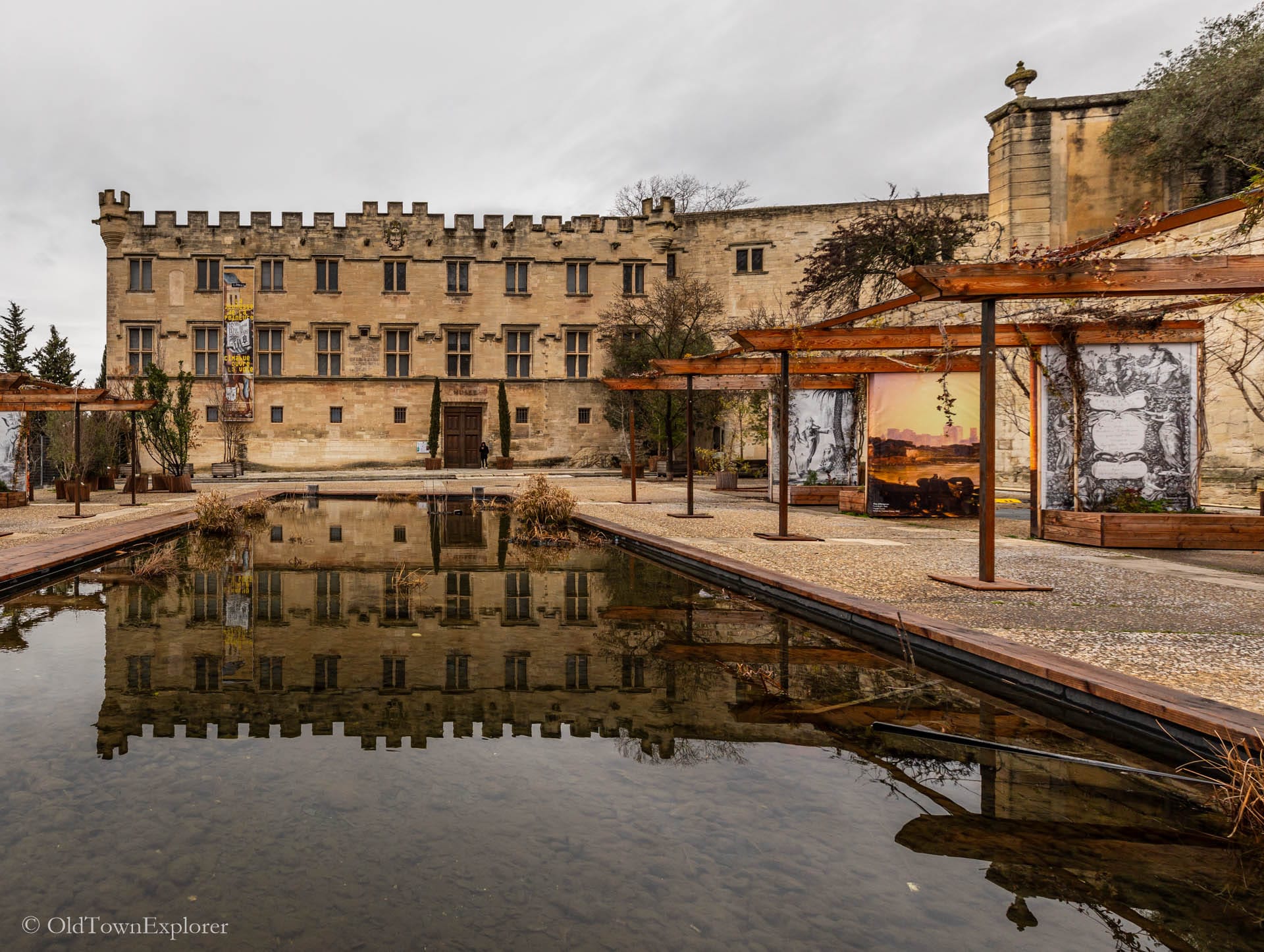
The former cardinal residence and archiepiscopal palace forms the quieter side of Place du Palais. Its crenellated façade, mullioned windows, courtyard, and large service spaces make the building worth attention even before its medieval and Renaissance art collection. See the official Petit Palais page for current access.
Livrée Ceccano
- Architect: Unknown
- Style: Fortified 14th-century cardinal residence
- Built: 14th century
- Address: 2 bis Rue Laboureur, 84000 Avignon
Now a municipal library, Livrée Ceccano retains the scale and defensive character of a cardinal’s urban palace. Its reuse gives it an advantage over many private livrées: when the library is open, you can experience medieval rooms as part of an ordinary city institution. Check the official Livrée Ceccano information.
Livrée de Viviers and Collège de Croix
- Architect: Unknown
- Style: Medieval cardinal residence with later institutional additions
- Built: 14th–15th centuries; altered in the 18th century
- Address: 5 Rue du Collège-de-la-Croix, 84000 Avignon
The surviving wing of the former Livrée de Viviers includes a large ceremonial hall and medieval painted ceilings within a complex adapted repeatedly for education and community use. It is more rewarding for its layered institutional history than for a single monumental façade. The official Rue du Collège de la Croix page gives current context.
Hôtel des Monnaies
- Architect: Not securely attributed
- Style: Early-17th-century ceremonial façade
- Built: 1619
- Address: Place du Palais, 84000 Avignon
The former mint faces the entrance of the Palais des Papes and provides a deliberately ornate counterpoint to the palace’s severe Gothic walls. Its rustication, inscriptions, coats of arms, and animal reliefs make the façade the main architectural experience; the building is not a routine interior visit. See the official Hôtel des Monnaies page for current status.
Vice-Management of Buildings
Vice-Gérence (ancienne)
- Architect: Unknown.
- Style: Multi-period complex (12th, 14th, and 19th-century campaigns)
- Built: 12th century; 14th century; 19th century (main campaigns)
- Address: 10 rue de Mons, 84000 Avignon
Historically linked to papal administration and fiscal/judicial functions, the Vice-Gérance complex sits near the Palais des Papes and preserves a layered stone-built fabric across medieval and modern campaigns.
Religious Buildings in Avignon
Beyond the cathedral, Avignon’s religious architecture ranges from broad Southern Gothic naves to small confraternity chapels, a circular 19th-century synagogue, medieval ruins, and a modern concrete church. Several interiors have limited or worship-dependent access, so treat façades, doors, bell towers, and their surrounding squares as part of the visit.
Abbey
Saint-Ruf Abbey
aka Abbey of Saint-Ruf of Avignon
- Architect: Unknown
- Style: Medieval monastic ruins
- Built: Founded 1039; occupied/altered through the medieval and early modern periods (surviving remains are partial).
- Address: 27 avenue Moulin-Notre-Dame, 84000 Avignon
Former abbey of canons regular and mother house of the Order of Saint-Ruf. The site preserves fragments of the abbey church and associated structures as ruins outside the intra-muros core.
Churches / Temples / Synagogues
Saint-Agricol Collegiate Church
aka Collegiate Church of Saint Agricol
- Architect: Unknown
- Style: Southern Gothic
- Built: Early 14th century (on the site of an earlier church).
- Address: Rue Saint-Agricol, 84000 Avignon
Collegiate church rebuilt in the early 1300s, known for keeping the relics of Saint Agricol, patron saint of Avignon.
Saint Didier Church
aka Collegiate Church of Saint-Didier
- Architect: Unknown
- Style: Southern Gothic
- Built: 1356–1359
- Address: Place Saint-Didier, 84000 Avignon
Mid-14th-century collegiate church that preserves its original plan; furnishings were reshaped after Revolutionary confiscations.
Saint Peter’s Church
aka Collegiate Church of Saint-Pierre aka Basilique Saint-Pierre
- Architect: Unknown
- Style: Gothic with later late-medieval additions
- Built: Rebuilt as a collegiate church in 1358; side chapels and nave enlargement in the 15th century.
- Address: Place Saint-Pierre, 84000 Avignon
Gothic basilica in the city center with later medieval chapels and a reworked nave; frequently visited for its carved wooden doors (Renaissance-era work noted in heritage programming).
Church of the Celestines
Église des Célestins
- Architect: Unknown
- Style: Gothic convent church
- Built: Construction begins 1389; major stone phases and completion in the 15th century (commonly given through 1452).
- Address: Place des Corps-Saints, 84000 Avignon
Former Celestine convent church tied to late Avignon papacy-era patronage; the surviving church and parts of the monastic complex remain key heritage elements at Place des Corps-Saints.
Saint-Martial Church
aka Saint Martial Temple
- Architect: Unknown
- Style: Gothic
- Built: 14th century; construction completed 1388.
- Address: Rue Henri-Fabre, 84000 Avignon
Former monastic/school church later reassigned for Protestant worship; the protected building is recorded in the national monument register as “Église Saint-Martial, devenue Temple Protestant.”
Saint-Symphorien Church
Church of Saint-Symphorien-les-Carmes (former Carmelite monastery church)
- Architect: Unknown
- Style: Gothic mendicant-order church (Carmelite context)
- Built: 14th century core (multi-phase medieval construction).
- Address: Place des Carmes, 84000 Avignon
Former Carmelite monastery church with a large medieval interior volume typical of mendicant churches in southern France.
Saint Joseph the Worker Church
Église Saint-Joseph-Travailleur
- Architect: Guillaume Gillet (design); Charles André (architect of execution)
- Style: Modernist reinforced concrete church with hyperbolic-paraboloid roof forms
- Built: Begun 1967; consecrated 19 October 1969
- Address: Rue Étienne-Martelange (Champfleury), Avignon
Triangular-plan church in board-formed concrete with laminated timber shell roofing; protected as a historic monument ensemble in the French national register.
Avignon Synagogue
- Architect: Joffroy
- Style: 19th-century synagogue with a centralized plan
- Built: 1846–1848 (after an 1845 fire destroyed the previous building).
- Address: Place Jérusalem, 84000 Avignon
Rebuilt mid-19th century in the former Jewish quarter area; noted for a centralized plan and protected interior elements in heritage records.
Église Saint-Ruf (parish church)
- Architect: Léon Véran
- Style: Neo-Romanesque
- Built: 1912
- Address: Quartier Saint-Ruf, Avignon
Early 20th-century parish church built for the Saint-Ruf district; the building is documented as unfinished, with its bell tower never completed.
Chapels
Chapel of Our Lady of Miracles
Chapelle Notre-Dame-des-Miracles
- Architect: Unknown
- Style: Gothic (multi-phase chapel)
- Built: 1327–1745 (construction phases)
- Address: 13 rue Velouterie, 84000 Avignon
A Marian chapel built in multiple campaigns from the 14th to the 18th century. It sits on rue Velouterie and is protected as a Monument Historique (Mérimée PA00081823).
Chapel of the Oratory
Chapelle de l’Oratoire
- Architect: Ferdinand Delamonce; Jean-Ange Brun; Jean-Baptiste II Péru
- Style: 18th-century classical / baroque-influenced façade
- Built: Begun 1713; completed 1749
- Address: Rue Joseph-Vernet, 84000 Avignon
An 18th-century Oratorian chapel recognized for its formal classical composition. Protected as a Monument Historique (Mérimée PA00081816).
Chapel of the Black Penitents
Chapelle des Pénitents Noirs de la Miséricorde
- Architect: Unknown
- Style: Baroque
- Built: 1631–1739 (main documented build window)
- Address: 57 rue Banasterie, 84000 Avignon
Penitents’ confraternity chapel on rue Banasterie, known for its baroque character. Classified as a Monument Historique (Mérimée PA00081817).
Chapel of the White Penitents
aka Notre-Dame-la-Principale / Chapelle des Pénitents blancs
- Architect: Jean-Baptiste II Péru (noted for major 1758 work)
- Style: Gothic / late medieval fabric with major early modern alterations
- Built: Medieval church documented from the 11th century; major rebuild/alterations in the 16th century; important 1758 intervention
- Address: Place de la Principale (Notre-Dame-la-Principale), 84000 Avignon
A multi-phase church later associated with the White Penitents. The protected complex is recorded as “Ancienne église Notre-Dame la Principale” (Mérimée PA00125729).
Chapel of the Grey Penitents
aka Chapelle Sainte-Croix / Chapelle des Pénitents Gris
- Architect: Unknown
- Style: Composite (late 16th–19th century fabric)
- Built: Late 16th century elements; vestibule ceiling dated 1631; Notre-Dame-de-Délivrance chapel 1708–1709; main nave rebuilt 1816–1818
- Address: 8 rue des Teinturiers, 84000 Avignon
A penitents’ chapel assembled from several historic parts, with a documented sequence from the late 1500s through the early 1800s.
Chapel of the Purple (Violet) Penitents
Chapelle des Pénitents Violets
- Architect: Unknown
- Style: Historic façade with pediment (protected elements focus)
- Built: Unknown
- Address: Place du Grand-Paradis (return façade on rue de La-Farre), 84000 Avignon
The monument protection targets the principal pedimented façade on Place du Grand-Paradis and the return façade on rue de La-Farre (Mérimée PA00081818).
Saint Charles Chapel
Chapelle Saint-Charles et sa sacristie
- Architect: Unknown
- Style: Baroque / 18th-century chapel architecture (attributed by period)
- Built: Unknown
- Address: Rue Boussingault (listed around no. 41), 84000 Avignon
A chapel and sacristy complex protected as a Monument Historique (Mérimée PA00081820).
Sainte-Garde Chapel
Chapelle Sainte-Garde
- Architect: Jean-Baptiste Lambertin
- Style: 18th-century classical (Corinthian vocabulary in descriptions)
- Built: 1770–1775
- Address: 1–3 rue Général-Leclerc (corner with rue Saint-Jean-le-Vieux), 84000 Avignon
Built for the Sainte-Garde seminary and later reused as part of civic/judicial functions. Protected as a Monument Historique (Mérimée PA00081821).
Templar Chapel
Chapelle des Templiers / Le Petit Louvre
- Architect: Unknown
- Style: Gothic (13th-century commandery chapel)
- Built: Late 13th century (work begins 1273; completed 1281)
- Address: 23 rue Saint-Agricol, 84000 Avignon
Former Templar commandery chapel considered one of the major Gothic religious buildings of Provence. Protected as a Monument Historique (Mérimée PA00081860).
Chapel of the Incarnate Word
Chapelle du Verbe Incarné
- Architect: Unknown
- Style: Early modern religious architecture; surviving chapel from a 17th-century convent foundation
- Built: Convent founded 1639; chapel survives as the main remnant
- Address: 21 rue des Lices, 84000 Avignon
The remaining chapel of the former “Dames du Verbe Incarné” convent, now widely known as a performance venue during the Festival period. Protected as a Monument Historique (Mérimée PA00081822).
Saint Catherine’s Chapel (old)
Chapelle Sainte-Catherine (ancienne)
- Architect: Unknown
- Style: Unknown
- Built: Unknown
- Address: 8 bis rue Sainte-Catherine, 84000 Avignon
Former chapel protected as a Monument Historique (Mérimée PA00081819).
Cordeliers Tower and Chapel
Tour et chapelle des Cordeliers
- Architect: Unknown
- Style: Medieval convent remnants (tower + chapel components)
- Built: Unknown
- Address: Rue des Teinturiers (listed around no. 4), 84000 Avignon
Surviving tower and chapel elements from the Cordeliers (Franciscan) complex. Protected as a Monument Historique (Mérimée PA00081950).
Convents / Cloisters / Religious Houses
Convent of the Sisters of Our Lady
Ancien couvent des religieuses bénédictines de Notre-Dame
- Architect: Unknown
- Style: 17th-century convent complex (later reuses)
- Built: 17th century (community established in Avignon in the 1600s; later reuses)
- Address: 1 rue des Ortolans, 84000 Avignon
Former convent later reused for other functions (including a period as a Masonic lodge; now a school use is recorded in summaries). The official monument record is Mérimée PA84000032.
Convent of Saint Praxedes
Couvent de Sainte-Praxède
- Architect: Unknown
- Style: 17th-century convent fabric (protected element focuses on the infirmary stair)
- Built: 4th quarter of the 17th century (main campaign)
- Address: 4 rue Petite-Calade, 84000 Avignon
Convent complex where the protected component is the stair of the former infirmary (Mérimée PA00081827).
Saint-Véran Convent – Chapel
Couvent de Saint-Véran, ancien
- Architect: Unknown
- Style: Religious complex with earlier fabric (site includes medieval phases per heritage documentation)
- Built: Medieval phases recorded for the chapel (late 11th/12th century onward in heritage description); later restorations documented
- Address: 7 route de Morières, 84000 Avignon
Former convent site whose chapel carries the protected designation in the Avignon monument list (Mérimée PA00081828).
Chapel of the Visitation
Couvent de la Visitation, ancien / Monastère du Saint-Sacrement
- Architect: François de Royers de La Valfenière
- Style: 17th-century religious architecture (convent + chapel ensemble)
- Built: 17th century (inception recorded as 1638 in compiled heritage data; protected ensemble is the former Visitation convent)
- Address: 35–37 rue Paul-Saien, 84000 Avignon
A protected convent complex including chapel, cloister, stairs, elevations and roofs in the official listing (Mérimée PA00081829).
Carmelite Cloister
Le Carmel d’Avignon
- Architect: Unknown
- Style: Multi-phase convent complex (domestic core evolving into a convent; large building with parkland)
- Built: First built in the 15th century; expanded over time; Carmelite occupation documented from the early 19th century until 2022
- Address: 3 rue de l’Observance, 84000 Avignon
A south-ramparts convent site that grew from a small 15th-century house with a chapel into a large convent complex set within parkland. Known today in programming and venue listings as “Le Carmel d’Avignon.”
College-Associated Religious Fabric
Chapel of Our Lady of the Ovens and Saint Nicholas College
Ancienne chapelle Notre-Dame des Fours et ancien collège Saint-Nicolas d’Annecy
- Architect: Unknown
- Style: Medieval chapel and college complex
- Built: Middle Ages (main construction campaign)
- Address: 13bis & 17 rue du Collège-d’Annecy; 83 rue Joseph-Vernet, 84000 Avignon
Former Savoyard college in Avignon, also recorded as the “collège des Savoyards” or “Grand Collège,” with an associated chapel dedicated to Notre-Dame des Fours. The chapel name refers to Gallo-Roman pottery kilns documented on the site.
Arch of the former Jesuit college
Arceau de l’ancien collège des Jésuites
- Architect: Unknown
- Style: Masonry street arch / college linkage structure
- Built: 17th century (date not fixed in the monument record; historic accounts place it in the Jesuit college period)
- Address: Rue Frédéric-Mistral, 84000 Avignon
Stone arch spanning the street, built to connect parts of the former Jesuit college complex. Protected as a historic monument element (“Arceau du lycée enjambant la rue”).
Avignon High School, Lapidary Museum and former chapel of the Jesuit college
Chapelle du Collège des Jésuites / Musée lapidaire
- Architect: Étienne Martellange (plans, 1616); François de Royers de la Valfenière (site architect from 1620)
- Style: Baroque church architecture (Jesuit college chapel)
- Built: 17th century (design initiated 1616; construction active from the 1620s; later reused as the Lapidary Museum)
- Address: 27 rue de la République, 84000 Avignon
Former Jesuit college chapel on Avignon’s main axis, later adapted to house the city’s lapidary and archaeological collections. The protected monument record identifies the chapel as a key historic fabric component of the lycée/museum ensemble.
Palaces & Historic Residences in Avignon
Avignon’s private architecture is one of its biggest surprises: behind ordinary street frontages are courtyards, staircases, salons, gardens, and preserved façades shaped by aristocratic and ecclesiastical wealth. This section gathers hôtels particuliers and named houses—some now museums or institutions, others protected for a single doorway, window, stair, or room.
Hôtels Particuliers and Notable Named Hotels
Hôtel de Caumont
- Architect: Unknown
- Style: Hôtel particulier (early modern townhouse)
- Built: Unknown
- Address: 5 rue Violette, 84000 Avignon
Courtyard-and-garden townhouse parcel typical of Avignon’s intra-muros hôtels particuliers, with a formal entry sequence leading into enclosed outdoor space.
4 rue Violette
- Architect: Unknown
- Style: Hôtel particulier (street elevation protected)
- Built: Unknown
- Address: 4 rue Violette, 84000 Avignon
Protected for its external envelope (elevation and roof), representing the street-facing architectural fabric of the Violette sector townhouse belt.
Hôtel Adhémar de Cransac
- Architect: Unknown
- Style: Hôtel particulier
- Built: Unknown
- Address: 11 rue Taulignan, 84000 Avignon
Townhouse with protected circulation and reception elements (courtyard/stair/salon fabric), characteristic of elite domestic planning behind a dense street frontage.
Hotel Armand
- Architect: Unknown
- Style: Hôtel particulier
- Built: Unknown
- Address: 6 impasse de l’Oratoire, 84000 Avignon
Courtyard/garden townhouse with a staircase-centered internal organization; protected scope emphasizes domestic interiors and circulation.
Hôtel de Gasqui
aka Hotel de la Bastide
- Architect: Unknown
- Style: Hôtel particulier (elevation-focused protection)
- Built: Unknown
- Address: 16 allée des Trois-Pilats, 84000 Avignon
Former Hôtel de la Bastide parcel protected primarily for its exterior architectural presentation within a quieter intra-muros lane.
Hôtel de Beaumont
aka Hôtel de Teste
- Architect: Unknown
- Style: Hôtel particulier
- Built: Unknown
- Address: 9–11 rue de la Croix, 84000 Avignon
Townhouse organized around a courtyard with a preserved stair and reception-room sequence; protection includes interior décor and key domestic spaces.
Hotel Bernard de Rascas
- Architect: Unknown
- Style: Hôtel particulier
- Built: Unknown
- Address: 40 rue des Marchands, 84000 Avignon
Elite townhouse fabric inserted into a commercial street, typically combining a retail-facing street edge with private circulation and reception spaces behind.
Hôtel Berton des Balbes de Crillon
aka Hotel Berton de Crillon
- Architect: Unknown
- Style: Major hôtel particulier
- Built: Unknown
- Address: 7 rue du Roi-René, 84000 Avignon
Large townhouse parcel with protected courtyard and stair composition; the preserved envelope and internal circulation mark it as a high-status residence near the palace-sector streets.
Blanchetti Hotel
- Architect: Unknown
- Style: Hôtel particulier
- Built: Unknown
- Address: 3 place de la Bulle, 84000 Avignon
Courtyard-centered townhouse with protected ground-floor fabric, reflecting domestic planning behind a compact square frontage.
Brancas Hotel
- Architect: Unknown
- Style: Hôtel particulier
- Built: Unknown
- Address: 7 rue Félix-Gras, 84000 Avignon
Protected townhouse interior and circulation elements (notably stair/reception rooms) typical of the Joseph-Vernet sector’s elite residences.
Hotel de Brantes
- Architect: Unknown
- Style: Hôtel particulier (façade/elevation emphasis)
- Built: Unknown
- Address: 2 rue Petite-Fusterie, 84000 Avignon
Protected street elevation within a dense medieval parcel grid, representing the townhouse façade layer of the Petite-Fusterie streetscape.
Hôtel Calvet de la Palun
(Former Bank of France, Carré du Palais)
- Architect: Unknown
- Style: Hôtel particulier later adapted to institutional/financial use
- Built: Unknown
- Address: 1 place du Palais, 84000 Avignon
Prominent palace-square block combining townhouse origins with later administrative reuse; reads as part of the monumental civic edge of Place du Palais.
Hôtel de Seguins-Vassieux / Hôtel de Pertuis de Montfaucon / Hôtel de Chansiergues
aka Hotel de Chancergues
- Architect: Unknown
- Style: Hôtel particulier ensemble (multi-address block)
- Built: Unknown
- Address: 25 rue de la Petite-Fusterie; 17 rue Saint-Étienne, 84000 Avignon
Consolidated townhouse fabric protected for elevations and roofs, reflecting parcel aggregation and shared envelope lines across adjoining addresses.
Ancézune Hotel / Gramont-Caderousse Hotel / Charavin Hotel
- Architect: Unknown
- Style: Hôtel particulier ensemble
- Built: Unknown
- Address: 4 rue du Lunel (listed as “Plan de Lunel”), 84000 Avignon
Grouped townhouse components protected for vestibule and staircase elements, highlighting the importance of circulation spaces in Avignon’s hôtels particuliers.
Brancas de Rochefort Hotel / Espine Hotel
aka Hotel de l’Espine
- Architect: Unknown
- Style: Hôtel particulier ensemble
- Built: Unknown
- Address: 35 rue Joseph-Vernet, 84000 Avignon
Protected roof/envelope components on a principal townhouse street; illustrates continuous elite residential fabric along rue Joseph-Vernet.
Puget de Chastueil Hotel / Félix Hotel
aka Félix’s private mansion (Avignon)
- Architect: Unknown
- Style: Hôtel particulier ensemble
- Built: Unknown
- Address: 52 rue de la Bonneterie, 84000 Avignon
Protected elevations/roof on a commercial axis, showing how elite domestic architecture coexists with dense retail street frontages.
Hotel Fortia of Montreal
- Architect: Unknown
- Style: Hôtel particulier
- Built: Unknown
- Address: 10 rue du Roi-René, 84000 Avignon
Palace-sector townhouse protected for its exterior presentation; part of the high-status residential belt around the papal precinct.
Hôtel de Galéans des Issarts
- Architect: Unknown
- Style: Major hôtel particulier with garden/orangery ensemble
- Built: Unknown
- Address: 5 rue du Four; rue Bertrand; 38–38ter rue de la Banasterie, 84000 Avignon
Large multi-frontage townhouse parcel combining courtyard, garden ground, and an orangery element, reflecting an elite compound embedded in the intra-muros grid.
Hotel Geoffroy
aka Geoffroy private mansion (Avignon)
- Architect: Unknown
- Style: Hôtel particulier
- Built: Unknown
- Address: 13 rue Victor-Hugo, 84000 Avignon
Protected ensemble including courtyard/garden and reception circulation; reads as a townhouse compound rather than a single street-front room sequence.
Jean de Sudre Hotel
- Architect: Unknown
- Style: Hôtel particulier
- Built: Unknown
- Address: 2 rue du Puits-de-la-Reille, 84000 Avignon
Townhouse with protected garden and well, emphasizing enclosed domestic outdoor infrastructure within the city core.
Hotel du Laurens
- Architect: Unknown
- Style: Hôtel particulier (stair/elevation focus)
- Built: Unknown
- Address: 14 rue Saint-Étienne, 84000 Avignon
Protected staircase and façade components; illustrates the role of stair design and street presentation in townhouse status architecture.
Hotel Le-Gras
- Architect: Unknown
- Style: Hôtel particulier (interior-focused protection)
- Built: Unknown
- Address: 10 rue Petite-Saunerie, 84000 Avignon
Protected dining-room interior décor and associated elements, preserved as a representative domestic reception space within an urban townhouse.
Hôtel de Luynes
- Architect: Unknown
- Style: Hôtel particulier
- Built: Unknown
- Address: 14 rue des Trois-Faucons, 84000 Avignon
Courtyard-and-stair townhouse fabric typical of the Trois-Faucons sector, with protected exterior and key circulation spaces.
Hôtel Madon de Châteaublanc
- Architect: Unknown
- Style: Hôtel particulier
- Built: Unknown
- Address: 13 rue Banasterie, 84000 Avignon
Protected for courtyard, vestibule, stair, reception rooms, and interior décor—an intact domestic sequence embedded in the Banasterie street block.
Hotel of Saint-Priest d’Urgel / Hotel of Monery
Hotel of Saint-Priest; Hotel de Monery
- Architect: Unknown
- Style: Hôtel particulier (interior décor emphasis)
- Built: Unknown
- Address: 21–23 rue Petite-Fusterie, 84000 Avignon
Protected primarily for interior decorative fabric, indicating preserved reception finishes rather than only the street façade.
Hotel de Montaigu
- Architect: Unknown
- Style: Hôtel particulier (interior décor emphasis)
- Built: Unknown
- Address: 37 rue du Four-de-la-Terre, 84000 Avignon
Protected interior décor within a townhouse parcel; part of the Four-de-la-Terre block of dense intra-muros domestic architecture.
Hotel de Galéans-Gadagne / Hotel de Montfaucon
- Architect: Unknown
- Style: Hôtel particulier ensemble
- Built: Unknown
- Address: 7 rue Violette, 84000 Avignon
Protected envelope and townhouse fabric at a key Violette address; reads as a paired/combined hôtel-particulier history on a single parcel line.
Hotel de Vervins / Hotel Pamard / Hotel La Mirande
- Architect: Unknown
- Style: Hôtel particulier ensemble
- Built: Unknown
- Address: 4 place de la Mirande, 84000 Avignon
Palace-adjacent townhouse ensemble protected for exterior fabric; represents the immediate residential belt around the cathedral/palace precinct.
Peilhon de Faret Hotel
- Architect: Unknown
- Style: Hôtel particulier
- Built: Unknown
- Address: 2–4 rue Rappe, 84000 Avignon
Protected for elevations/roof and interior decoration, combining street presentation with preserved domestic interiors on a central lane.
Hotel Raoulx
- Architect: Unknown
- Style: Hôtel particulier (stair/elevation/roof emphasis)
- Built: Unknown
- Address: 35 rue de la Bonneterie, 84000 Avignon
Protected townhouse components including stair and roofline; shows elite domestic fabric threaded into a high-activity commercial street.
Hôtel de Raousset-Boulbon
- Architect: Unknown
- Style: Hôtel particulier (courtyard feature emphasis)
- Built: Unknown
- Address: 33 rue Joseph-Vernet, 84000 Avignon
Protected courtyard elements (including fountain), reflecting the importance of enclosed outdoor composition in Avignon’s townhouse architecture.
Hotel de Roussas / Hotel Rata de Gargarilla
aka Hotel de Ratta
- Architect: Unknown
- Style: Hôtel particulier (courtyard/passage/gate emphasis)
- Built: Unknown
- Address: 6 rue Bouquerie; 19bis–21 rue Saint-Agricol, 84000 Avignon
Protected for courtyard and passage/gate elements with interior décor, indicating a townhouse compound with controlled access and layered circulation.
Avignon Wine House / Hôtel de Rochegude
- Architect: Unknown
- Style: Hôtel particulier (balcony/elevation emphasis)
- Built: Unknown
- Address: 4–6 rue des Trois-Faucons, 84000 Avignon
Townhouse façade protected for balcony and elevation, representing decorative street presentation on a central residential lane.
Hotel de Sade
- Architect: Unknown
- Style: Hôtel particulier (elevation emphasis)
- Built: Unknown
- Address: 4 rue Dorée, 84000 Avignon
Protected façade/elevation on rue Dorée, part of the dense palace-sector townhouse fabric.
Hotel de Salvador
aka Salvati-Palasse Hotel (Avignon)
- Architect: Unknown
- Style: Hôtel particulier (stair/courtyard/portal/gallery emphasis)
- Built: Unknown
- Address: 19 rue du Roi-René, 84000 Avignon
Protected townhouse circulation and access features—stair, portal, courtyard, and gallery—forming a strong architectural sequence from street entry to interior spaces.
Bassinet Hotel / Taillades Hotel
Hotel des Taillades
- Architect: Unknown
- Style: Hôtel particulier ensemble (passage/vault emphasis)
- Built: Unknown
- Address: 58 rue Joseph-Vernet, 84000 Avignon
Protected for covered passage and vault with elevation fabric, showing townhouse access infrastructure and the formalization of internal passageways.
Tonduti de Malijac Hotel
- Architect: Unknown
- Style: Hôtel particulier ensemble (stair/handrail emphasis)
- Built: Unknown
- Address: 19 rue Petite-Fusterie; 7, 9, 11 rue Joseph-Vernet, 84000 Avignon
Protected staircase and handrail elements across a multi-address townhouse ensemble, emphasizing preserved circulation craftsmanship.
Valabrègue Hotel
- Architect: Unknown
- Style: Hôtel particulier
- Built: Unknown
- Address: 4 rue de la Croix, 84000 Avignon
Protected courtyard/garden enclosure and interior décor elements; reads as a townhouse compound with preserved paving and reception-room finishes.
Joannis de Verclos Hotel
- Architect: Unknown
- Style: Hôtel particulier (elevation/roof emphasis)
- Built: Unknown
- Address: 4 place de la Principale (Main Square), 84000 Avignon
Protected façade and roofline on a central square address, representing townhouse street presence at an urban node.
Hôtel de Villeneuve-Martignan (Calvet Museum)
- Architect: Unknown
- Style: 18th-century hôtel particulier adapted for museum use
- Built: Unknown
- Address: 65 rue Joseph-Vernet, 84000 Avignon
Large townhouse ensemble (courtyard/garden/ground/building scope) reused as the Calvet Museum, preserving major domestic volumes suited to exhibition display.
Hôtel de Baroncelli-Javon / Palais du Roure
- Architect: Unknown
- Style: Hôtel particulier / palace-scale townhouse ensemble
- Built: Unknown
- Address: 3–5–7 rue du Collège-du-Roure, 84000 Avignon
Consolidated townhouse complex known as the Palais du Roure, with preserved structural and spatial fabric typical of large intra-muros residences adapted for cultural use.
Hôtel d’Europe (Avignon)
- Architect: Unknown
- Style: Historic townhouse adapted for hotel use
- Built: Unknown
- Address: 12 place Crillon, 84000 Avignon
Hotel installed in a historic intra-muros building fronting Place Crillon. The architectural interest is the townhouse-scale fabric adapted to hospitality use within the central street-and-square network.
Other Historic Residences
Porch building
- Architect: Unknown
- Style: Historic urban building with porch/covered access element
- Built: Unknown
- Address: 54 rue de la Bonneterie, 84000 Avignon
Building recorded for its porch element and associated architectural fabric, with protected components including staircase, living room, elevation, handrail, roof, and interior décor.
Houses and Tower of Mirault
- Architect: Unknown
- Style: Urban houses with integrated tower element (elevation and roof protected)
- Built: Unknown
- Address: 11–13–13bis Place du Palais, 84000 Avignon
Group of buildings and a tower preserved as a combined streetscape element on the Place du Palais address range.
24 Place du Change
aka 5 rue des Trois-Carreau
- Architect: Unknown
- Style: Historic urban residential building (multi-address parcel)
- Built: Unknown
- Address: 24 Place du Change; 5 rue des Trois-Carreaux, 84000 Avignon
Residential building recorded under two addresses, reflecting a corner or multi-frontage parcel in the intra-muros street grid.
Casal House (Tower)
- Architect: Unknown
- Style: Urban house with integrated tower element
- Built: Unknown
- Address: 6 rue Joseph-Vernet, 84000 Avignon
House incorporating a tower element, preserved as part of the vertical domestic fabric along rue Joseph-Vernet.
Jean-Vilar House (Maison Jean Vilar)
- Architect: Unknown
- Style: Historic urban house with courtyard and garden ensemble
- Built: Unknown
- Address: Rue de Mons, 84000 Avignon
House organized with courtyard, garden, and gate elements, forming a townhouse-scale ensemble within the intra-muros fabric.
Forli House / Queen Jeanne’s House
- Architect: Unknown
- Style: Historic urban house (street elevation protected)
- Built: Unknown
- Address: 22 - 24bis rue Saint-Étienne, 84000 Avignon
Houses preserved for their elevation, recorded as the Queen Jeanne’s House group on rue Saint-Étienne.
King René’s house
- Architect: Unknown
- Style: Historic urban residence with preserved interior décor
- Built: Unknown
- Address: 11 rue du Roi-René; 6 rue Grivolas, 84000 Avignon
Named residence recorded for interior decorative fabric, linked to a multi-address parcel within the palace-sector street network.
Municipal & Civic Buildings in Avignon
From civic squares and theatres to prefectural administration and public services, these buildings show Avignon’s public face across centuries. Many are adaptations of earlier elite residences into modern institutions—useful for seeing how the city kept functioning long after the papal era.
Town Hall
Hôtel de Ville (Avignon)
- Architect: Joseph-Auguste Joffroy (overall project); Léon Feuchère (façade)
- Style: Neoclassical civic architecture with an integrated medieval belfry
- Built: Belfry completed 1363; new town hall built 1845–1856
- Address: Place de l’Horloge (Clock Square), 84000 Avignon
The 19th-century town hall wraps an older Gothic belfry (Tour Jacquemart) that kept the historic municipal clock in place. The main frontage uses a neoclassical vocabulary (ashlar masonry, ordered vertical rhythm) to formalize the city’s central civic square.
Opera / Theatre-Opera of Avignon
Opéra Grand Avignon
- Architect: Léon Feuchère; Théodore Charpentier
- Style: 19th-century theatre architecture with a classical/“gréco-romain” façade language
- Built: Rebuilt 1846–1847 after the 1846 fire
- Address: Place de l’Horloge (Clock Square), 84000 Avignon
Avignon’s municipal opera house occupies the theatre plot beside the town hall on the main civic square. The current building dates from the post-fire reconstruction campaign of 1846–47 and is protected as a historic monument.
Vaucluse Academy
Académie de Vaucluse aka “Hôtel Salvati-Palasse”
- Architect: Unknown
- Style: Hôtel particulier (townhouse) used as an institutional headquarters
- Built: Unknown
- Address: 5 rue Galante, 84000 Avignon
The Académie de Vaucluse occupies the Hôtel Salvati-Palasse on rue Galante. The building is protected as a monument historique under the Académie de Vaucluse listing.
Old Comedy
Ancienne Comédie
- Architect: Thomas Lainé
- Style: 18th-century theatre façade with Ionic pilasters and a classical pediment
- Built: 1732–1733
- Address: Place Crillon (listed as 9 place Crillon), 84000 Avignon
Built as an Italian-style theatre, the former Comédie is identifiable by a strongly composed classical frontage—four Ionic pilasters, an entablature, and a triangular pediment—forming a compact civic performance landmark near the city core.
Mint
Hôtel des Monnaies
- Architect: Unknown (no secure attribution).
- Style: 17th-century institutional façade facing Place du Palais
- Built: 1619
- Address: 9 Place du Palais, 84000 Avignon
Built opposite the main entrance of the Palais des Papes as the city’s papal mint, the Hôtel des Monnaies is a key early-17th-century administrative building on the ceremonial approach to the palace square.
Hôtel du Département
aka Hôtel Desmarets de Montdevergues
- Architect: Pierre II Mignard (plans); François II Franque (rebuilding campaign)
- Style: Early-18th-century hôtel particulier adapted for administration
- Built: Rebuilt c. 1710 (major campaign)
- Address: 1 Place de la Préfecture / Rue Viala, 84000 Avignon
Originally an aristocratic townhouse, later adapted to departmental government use. The early-18th-century rebuilding campaign defines much of the present structure, with formal elevations and interior circulation typical of major Avignon hôtels particuliers.
Hôtel de la Préfecture
aka Hôtel Forbin de Sainte-Croix
- Architect: Jean-Baptiste Franque
- Style: 18th-century hôtel particulier with later administrative adaptations
- Built: Early 18th century (documented construction date 1722 in common references)
- Address: 3 rue Viala / Place de la Préfecture, 84000 Avignon
A major 18th-century townhouse that became a core state administration address in Avignon. The ensemble includes the square/garden setting and protected architectural elements listed under its monument historique record.
Towers in Avignon
Towers are Avignon’s vertical punctuation marks: defensive survivals, bell towers, institutional remnants, and riverside markers. Some stand as isolated fragments; others are stitched into dense street blocks—useful for reading the medieval city in three dimensions.
Augustins Tower
Tour des Augustins
- Architect: Unknown
- Style: Medieval bell tower / fortified tower form (stone, vertical shaft)
- Built: 1372–1377
- Address: 16 rue Carreterie, 84000 Avignon
Former convent bell tower built as a tall, narrow stone structure overlooking rue Carreterie. It reads as a late-medieval vertical landmark, with later municipal timekeeping additions tied to its clock function.
Madeleine Tower
Tour de la Madeleine (ancienne)
- Architect: Unknown
- Style: Medieval fortified tower (stone, compact defensive massing)
- Built: 13th century
- Address: 28 rue Petite-Fusterie, 84000 Avignon
Surviving 13th-century tower integrated into the dense street block near the palace-sector streets. Its massing and limited openings read as a defensive domestic or institutional tower type within the medieval city.
Saint-Jean-le-Vieux Tower
Tour Saint-Jean-le-Vieux
- Architect: Unknown
- Style: Medieval tower linked to a Hospitaller complex (stone tower with internal stair core)
- Built: 14th century
- Address: Place Pie, 84000 Avignon
The main surviving vertical remnant of the former Hospitaller (Order of Saint John) presence in this part of Avignon. The tower reads as a compact medieval masonry volume, historically embedded in a larger block that has since been cleared.
Saunerie Tower
Tour dite de la Saunerie
- Architect: Unknown
- Style: Fortified tower with later access elements
- Built: Tower: Unknown; access vestibule/stair: 19th century
- Address: 25 rue Carnot, 84000 Avignon
Fortified tower preserved with a later vestibule and stair that formalize entry and circulation. The site is a good example of how medieval defensive fabric was adapted with 19th-century access work for continued use within the street network.
Tour (28 Quai de la Ligne)
- Architect: Unknown
- Style: Fortified riverside tower element (stone defensive fabric)
- Built: Unknown
- Address: 28 quai de la Ligne, 84000 Avignon
Fortified tower structure on the Rhône riverfront alignment below the Rocher des Doms sector. It reads as part of the defensive and waterfront-built edge of Avignon, where masonry structures address the river corridor and access routes along the quay.
Roman Ruins in Avignon
Avignon’s oldest layers are often modest in scale but powerful in what they reveal—Roman masonry absorbed into later fabric and structural remnants embedded in the street network. This section collects the ancient and archaeological survivals that still appear in the living city.
For a Roman-architecture day trip from Avignon, see Orange, France, which covers the Roman theatre, triumphal arch, and station-to-center walking route.
Roman arcades
- Architect: Unknown
- Style: Roman masonry remains (arcade fragments reused within later street fabric)
- Built: Roman period (exact century: Unknown)
- Address: Rue de la Peyrolerie, 84000 Avignon
Surviving Roman-period arcade elements preserved as masonry remains within Avignon’s dense intra-muros street network. The fragment reads as structural stonework from an earlier urban phase, later absorbed into the medieval and early modern street frontage line.
Ancient remains of a retaining wall
- Architect: Unknown
- Style: Ancient masonry retaining structure (substructure / terrace support)
- Built: Ancient period (exact date: Unknown)
- Address: 1 rue Racine, 84000 Avignon
Remains of a retaining wall preserved as an archaeological fragment, indicating earlier ground engineering and terracing works within the historic city. The site represents substructure fabric rather than a standing building, and it helps document Avignon’s pre-medieval urban layers.
Other Attractions in Avignon
Not everything fits neatly into monuments, churches, or palaces—yet many “in-between” sites are what visitors search for and remember. This section groups the remaining targets into practical sub-buckets: landscapes and memorials, museums and cultural sites, markets, infrastructure, venues, and preserved commercial interiors.
Papal Gardens (Jardins pontificaux du Palais des Papes)
Architect / designer: Unknown
Style: Reconstructed pontifical gardens (medieval palace gardens interpreted through modern restoration)
Built / laid out: 14th century origins; modern restoration and re-layout 2017–2020
Address: East side of the Palais des Papes (behind/along the palace), 84000 Avignon
A restored sequence of gardens associated with the papal palace complex, organized as separate garden rooms (including a private “papal” garden, palace garden zones, and an orchard/verger area). They read as structured terraced landscapes protected by palace walls.
Franque Market
Marché Franque
- Architect: Unknown
- Style: Historic market shopfront and interior commercial fabric
- Built: Unknown
- Address: 22 rue du Vieux-Sextier, 84000 Avignon
Protected historic market premises recorded as a “shop” with roof and interior components. It reads as a preserved piece of small-scale commercial architecture within the older street network near the central market zone.
Railway roundhouse
Rotonde ferroviaire
- Architect / engineer: Unknown
- Style: Industrial railway infrastructure (roundhouse with radial service bays)
- Built: Unknown
- Address: Rue Pierre-Sémard, 84000 Avignon
Historic railway servicing structure used for locomotive/rolling-stock maintenance, organized as a roundhouse-type plan with bays arranged around a turning and servicing zone. It represents Avignon’s preserved rail-era industrial fabric and is one of the clearest “infrastructure heritage” visitor targets near the station-side rail corridors.
Entrance to the Essaïon-Avignon Theatre / Gate of the Carmelite Convent
Porte de l’ancien couvent des Carmes
- Architect: Unknown
- Style: Historic convent gateway (stone portal) adapted as a theatre entrance
- Built: Unknown
- Address: 31 rue Carreterie, 84000 Avignon
Historic gateway associated with the former Carmelite convent, preserved as a street-facing portal on rue Carreterie. The protected scope focuses on the gate/entrance elements (portal and elevations), which now form the entrance sequence for the Essaïon-Avignon theatre.
Bar du Centre
- Architect: Unknown
- Style: Historic café/bar interior (protected room and décor)
- Built: Unknown (interior décor date: Unknown)
- Address: 26 rue du Portail-Matheron, 84000 Avignon
Street-level bar noted for a protected interior room and decorative scheme. The heritage interest is primarily in the preserved interior décor rather than the full building exterior.
Mouret Hat Shop
- Architect: Unknown
- Style: Historic commercial storefront with preserved interior decoration
- Built: Unknown
- Address: 20 rue des Marchands, 84000 Avignon
Former hat shop with a protected storefront and interior decorative elements, representing small-scale retail architecture in the intra-muros shopping streets.
Salt granary
Grenier à sel
- Architect: Unknown
- Style: Historic storage/administrative building (salt control and warehousing function)
- Built: Unknown
- Address: 4 rue du Rempart-Saint-Lazare, 84000 Avignon
Former salt granary tied to regulated storage and distribution. It is a rare surviving example of a civic supply and control building type in Avignon’s historic street network.
General alms
Aumône générale
- Architect: Unknown
- Style: Institutional stone building (charitable administration / distribution use)
- Built: Unknown
- Address: 21bis rue des Lices, 84000 Avignon
Former charitable institution building associated with organized alms distribution. The protected scope is recorded for exterior fabric (elevation and roof), reflecting the surviving historic envelope rather than a fully preserved interior program.
Sainte-Marthe Hospital
Hôpital Sainte-Marthe
- Architect: Unknown
- Style: Hospital complex with a chapel and multi-phase institutional fabric
- Built: 17th–19th centuries (complex developed in successive campaigns; specific phases vary by wing)
- Address: 34 boulevard Limbert, 84000 Avignon
Historic hospital complex that includes a chapel, garden spaces, and formal circulation elements such as staircases and vestibules. The ensemble reads as a long-running civic health institution with layered construction and later adaptations for modern medical use.
Jesuit Novitiate / Saint Louis Hospice
Cloître Saint-Louis / Chapelle Saint-Louis
- Architect: Unknown
- Style: Religious-institutional complex with cloister organization and later hospice functions
- Built: Unknown
- Address: 20 rue du Portail Boquier, 84000 Avignon
Former Jesuit novitiate later reused as Saint Louis Hospice, structured around a cloister and enclosed courtyards. Today it is widely known under the names Cloître Saint-Louis and Chapelle Saint-Louis, and it remains a key large-scale institutional complex just outside the busiest palace square area.
Pommer Bathhouse Showers
Bains Pommer
- Architect: Unknown
- Style: Early 20th-century public bathhouse (hygiene infrastructure)
- Built: Early 20th century (exact year: Unknown)
- Address: 68 rue Philonarde, 84000 Avignon
Purpose-built municipal bath and shower facility from the period when cities expanded public hygiene services. The building is a rare surviving example of public bathhouse infrastructure in Avignon’s historic fabric.
Things to Know Before You Go
Avignon’s main monuments sit close together, but opening patterns, summer crowds, stone paving, and the climb to Rocher des Doms affect how much architecture you can see comfortably in a day.
Stay Inside the Ramparts for the Shortest Walks
An intra-muros base puts the papal precinct, major churches, cardinal residences, civic buildings, and historic streets within walking distance. If you arrive by car, compare garages and park-and-ride options on the official Avignon parking page rather than expecting convenient street parking in the old town.
Expect Stone Paving and One Noticeable Climb
Most of the historic center is compact and only gently sloped, but paving can be uneven around older lanes and squares. The main climb is from the palace area to Rocher des Doms. Comfortable shoes matter more than hiking footwear, and the broad central streets are easier than the narrow medieval lanes for wheels or limited mobility.
Visit the Papal Precinct Early
Place du Palais and the ticketed monuments become busier as the day develops, especially during summer and the July festivals. An early palace entry lets you visit the surrounding square, cathedral, bridge, and viewpoints later, when you can adjust the route around crowds and heat.
Separate Exterior Stops from Interior Visits
You can plan on entering the ticketed Palais des Papes and Pont Saint-Bénézet, but many churches, chapels, courtyards, and former cardinal residences have limited or event-dependent access. Build the walk around façades, portals, towers, and public squares, then treat any additional open interior as a bonus.
Check the Weather Before Crossing Open Squares
Summer sun can make Place du Palais, the bridge, and exposed stretches beside the walls tiring by midday. The mistral can make the bridge and Rocher des Doms feel much cooler and windier than the sheltered lanes. Use churches, museums, and palace interiors for the hottest or windiest part of the day.
Return to the Rhône Edge for Evening Light
Late light brings out the limestone surfaces of the palace, bridge, and western walls. Rocher des Doms gives a broad view, while the Rhône bank and Île de la Barthelasse give a clear silhouette of the palace, cathedral, rock, and bridge together.
Accessibility Varies Sharply by Monument
The old town can be explored along relatively level routes, but individual monuments differ. The Palais des Papes has many steps and is not fully accessible to visitors with reduced mobility. Pont Saint-Bénézet has lift access, but the operator advises checking that the lift is working before arrival. Confirm current conditions on the palace and bridge websites.
A Two-Hour Walk Should Stay Exterior-Focused
Start on Place du Palais, compare the palace, cathedral, Petit Palais, and Hôtel des Monnaies, then climb to Rocher des Doms and descend toward Pont Saint-Bénézet. Finish with an outside view of the Rhône-side walls. Entering the palace will consume most of this time.
A Half Day Can Include One Major Interior
Combine the two-hour exterior circuit with the Palais des Papes, or choose the bridge and one nearby museum instead. If church doors are open, add Notre-Dame des Doms or Saint-Pierre without making the rest of the route depend on interior access.
A Full Day Reveals the City Beyond the UNESCO Core
Spend the morning around the palace, cathedral, gardens, bridge, and walls. After lunch, walk south through Place de l’Horloge toward Saint-Pierre, Saint-Didier, Livrée Ceccano, Rue Joseph-Vernet, or Rue des Teinturiers. This longer circuit shows how papal architecture was absorbed into later commercial, civic, and residential streets.
Architecture Tours in Avignon
A tour is most valuable when it connects the famous monuments to the cardinal residences, churches, private mansions, and defensive streets that are easy to pass without recognizing. Choose by subject and access rather than by the number of stops advertised.
Guided Tours
The Avignon Tourist Office schedules cultural and thematic walks, while the Palais des Papes offers monument-focused guided visits. A city walk is the better choice for urban history, façades, livrées, and the walls; a palace tour is better for rooms, frescoes, court life, and construction phases. Programs change through the year, so compare the current listings on the official guided-tour calendar and the Palais des Papes website. If a tour includes a monument, check whether admission is included and whether the language and interior route match what you want to see.
Best Places to Stay In Avignon for Architecture Walks
Most major architectural sights lie inside the ramparts. The best area depends on whether you value the shortest walk to the palace, quieter historic lanes, station access, or easier parking.
- Place du Palais and the Northern Old Town: This is the closest base for the Palais des Papes, Notre-Dame des Doms, Rocher des Doms, Pont Saint-Bénézet, and the Rhône-side walls. It is ideal for early and evening views, but the palace square and nearby lanes can feel busy during the day and during major events.
- Place de l’Horloge and the Central Lanes: The center balances access to the papal precinct with short walks to Saint-Pierre, Saint-Didier, Livrée Ceccano, and the shopping streets. Restaurants and cafés are plentiful, though rooms facing the busiest squares may pick up evening noise.
- Rue Joseph-Vernet and the Western Old Town: The western side suits travelers who want hôtels particuliers, museums in historic mansions, quieter streets, and quick access to the walls. The palace remains walkable, but the area feels less dominated by the main sightseeing flow than Place du Palais.
- Avignon Centre Station and the Southern Gates: Staying near Porte de la République gives the simplest walk from Avignon Centre station and straightforward access to Rue de la République, Saint-Martial, the Cloître Saint-Louis, and the southern walls. The trade-off is a longer walk to the palace and bridge. Avignon TGV station is outside the center and requires a train, bus, taxi, or other transfer.
For the shortest walks to Avignon’s principal monuments, choose the northern or central old town. The western old town offers a quieter historic setting, while the southern gates are better for station access than for immediate proximity to the papal precinct.
Hotels and Apartments in Avignon
Use the map to compare properties inside the ramparts with those near Avignon Centre station or the outer parking areas. Before booking, check the exact walking route, stairs or lift access, air conditioning in warm weather, and whether a car can reach the property during restricted-access periods.
FAQs About Avignon Architecture
What is Avignon architecture known for?
Avignon is known for the architecture created around the 14th-century papal court: the fortified Palais des Papes, cardinal residences, Gothic churches, administrative buildings, and an almost complete circuit of medieval walls. Romanesque, Baroque, Neoclassical, industrial, and modern buildings add later layers.
Is Avignon a UNESCO World Heritage Site?
Yes. UNESCO inscribed the Historic Centre of Avignon in 1995. The designated ensemble centers on the Palais des Papes, the episcopal buildings, Notre-Dame des Doms, and Pont Saint-Bénézet, with the surrounding medieval landscape and defenses contributing to its significance.
What architectural styles will I see in Avignon?
The city’s strongest styles are Provençal Romanesque, fortified Gothic, Southern Gothic, Renaissance, Baroque, and 19th-century Neoclassical and revival architecture. Later stops include railway structures, early public-health buildings, and the modern concrete church of Saint-Joseph-Travailleur.
Which Avignon Buildings Should a First-Time Visitor Prioritize?
Begin with the Palais des Papes, Notre-Dame des Doms, Pont Saint-Bénézet, Rocher des Doms, and the walls. Add Saint-Pierre for its carved façade and doors, Saint-Didier for its restrained Southern Gothic form, and either Livrée Ceccano or the Petit Palais to understand the cardinal and episcopal residences.
Do You Need Tickets or Reservations?
The Palais des Papes, its Papal Gardens, and Pont Saint-Bénézet are ticketed. Advance booking is not always compulsory, but it can reduce uncertainty during busy periods. Many churches are free when open, while private mansions, chapels, and institutional buildings may offer interiors only during events or guided visits. Check official listings shortly before your visit.
How Much Time Do You Need for Avignon’s Architecture?
Two hours allows an exterior circuit of the papal precinct and river edge. A half day is enough for that walk plus one major interior. A full day adds churches, cardinal residences, civic squares, and later architecture; a second day gives time for museums in historic buildings and the quieter eastern and western streets.
What Is the Best Self-Guided Architecture Walk?
Start at Place du Palais, climb to Rocher des Doms, descend to Pont Saint-Bénézet, and follow the walls toward Place de l’Horloge. Continue to Saint-Pierre, Livrée Ceccano, and Saint-Didier. With more time, extend west along Rue Joseph-Vernet or east toward Place des Carmes and Rue des Teinturiers.
Is Avignon’s Architecture Accessible?
Many exterior landmarks can be seen along compact central routes, but uneven paving and the climb to Rocher des Doms require care. Accessibility inside monuments varies considerably: the Palais des Papes has many steps and is not fully accessible, while Pont Saint-Bénézet has lift access subject to availability. Verify the current route with each monument before visiting.
Can You Take Photographs Inside the Palais des Papes?
Photography is generally allowed in the Palais des Papes but prohibited in rooms with fragile painted decoration. The affected rooms can change with conservation work or exhibitions, so follow the signs and staff instructions during the visit.
Where Can You See Modern Architecture in Avignon?
For modern architecture, go to Saint-Joseph-Travailleur west of the historic center, where a triangular plan and expressive concrete structure date from the late 1960s. The railway roundhouse adds an industrial stop, while the green wall at Les Halles can be seen during a central walk. Plan Saint-Joseph-Travailleur as a separate stop beyond the main old-town circuit.
Architecture can fill a full day in Avignon, especially if you combine the papal precinct with the quieter churches, livrées, and hôtels particuliers inside the walls. Between walks, explore Avignon food and Avignon wine, or compare the city’s medieval concentration with the wider story of architecture in France.