
Como Architecture
Explore Como Architecture: Religious Buildings & More
Como architecture is shaped by the city’s position between Lake Como, the Po plain, and the Alpine routes leading north. That location mattered from the Roman period onward, and it still helps explain the city’s walls, churches, civic buildings, villas, and waterfront.
What stands out in Como architecture is how many layers are still easy to read on foot. You can move from Roman remains to Romanesque churches, then to neoclassical villas and civic buildings, and then to a compact group of Rationalist works from the 20th century. The city also keeps a clear contrast between the walled center and the open lakefront.
This guide starts with the top architecture attractions in Como, then moves into practical points that help explain the city before the full architectural directory.
This page contains affiliate links. We may earn a small commission at no extra cost to you.
Top Architectural Attractions in Como
Use these sites as the main anchors for understanding Como architecture. Together, they cover the city’s strongest layers: Romanesque religious buildings, medieval civic space, lakefront villa architecture, 20th-century Rationalism, and the defensive landscape above the center. If you have limited time, start with these before moving into the full category sections below.
- Como Cathedral
- Basilica of Sant’Abbondio
- Basilica of San Fedele
- Broletto
- Villa Olmo
- Casa del Fascio
- Tempio Voltiano
- Castel Baradello
These eight sites also group well into a practical walking plan: start in the old center with the cathedral, Broletto, and San Fedele; move out to Sant’Abbondio; then use the lakefront for Villa Olmo and Tempio Voltiano; finish with Casa del Fascio for the Rationalist layer and Castel Baradello for the city’s defensive setting.
Religious Buildings in Como
Religious buildings are one of the clearest ways to understand Como architecture. The city has early Christian foundations, major Romanesque churches, later Gothic and Baroque rebuilding, and a few former sacred sites that still show how the city expanded beyond its walls. Most of the key churches sit either inside the walled center or on the roads that once led into it, so they also help explain how medieval Como was organized. In Como, church architecture is not just about facades. It also shows older street lines, former monastic zones, and the shift from the Roman core to later suburbs.
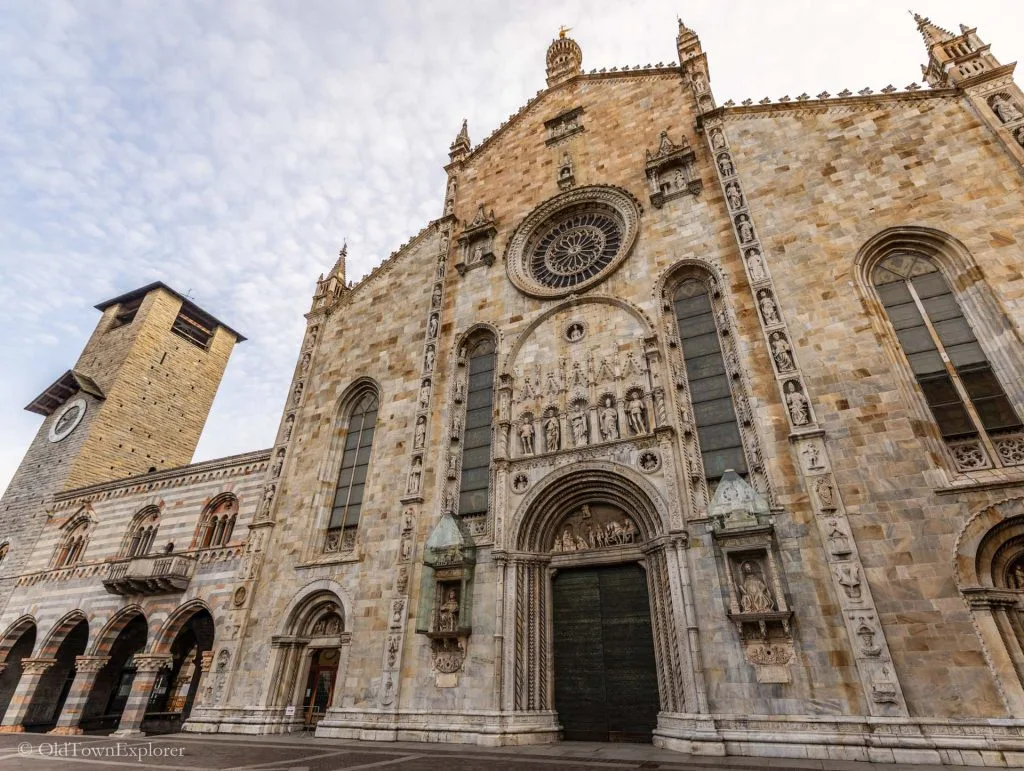
Como Cathedral
Basilica Cattedrale di Santa Maria Assunta
- Architect: original overall designer unknown; first credited designer Lorenzo degli Spazi; later work by Pietro da Breggia and Florio da Bontà; dome by Filippo Juvarra
- Style: Gothic, Renaissance, Baroque
- Built: 1396–1770
- Address: Piazza del Duomo, Como
Como Cathedral is the city’s cathedral and the main religious building in central Como. It stands out because it records several centuries of construction in one building, so the facade, dome, and interior do not belong to a single campaign or style. Look for the late Gothic front, the Renaissance sculpture, and the later dome beside the Broletto. It sits at the heart of the historic center on the city’s main cathedral square.
Basilica of Sant’Abbondio
- Architect: Unknown
- Style: Romanesque
- Built: 1050–1095 on an earlier 5th-century church
- Address: Via Regina Teodolinda, 35, Como
Sant’Abbondio is one of the main Romanesque churches in Como and one of the city’s most important medieval monuments. It stands out for its twin bell towers, long basilican body, and frescoed apse, which make it one of the clearest Romanesque reads in the city. Look for the paired towers rising from the east end, the plain stone exterior, and the long interior volume. It sits just outside the old core on the southwest side of central Como.
Basilica of San Fedele
- Architect: Unknown
- Style: Romanesque with later alterations
- Built: c. 1120; later rebuilding and restoration
- Address: Piazza San Fedele, Como
San Fedele is a Romanesque basilica in the center of Como built on the site of an earlier church. It stands out for its sculpted portals and for the bell tower that rises above one of the city’s most important medieval squares. Look for the carved doorway details, the compact urban setting, and the tower working above the tight block pattern. It sits deep inside the historic core west of the cathedral.
Basilica of San Carpoforo
- Architect: Unknown
- Style: Early Christian origins with Romanesque fabric
- Built: late 4th century; enlarged in the 8th century; rebuilt after 1000
- Address: Via San Carpoforo, Como
San Carpoforo is one of the oldest Christian sites in Como and is traditionally linked to the city’s first Christian community. It stands out because the building keeps an austere Romanesque form while preserving a much earlier religious history under and around it. Look for the raised presbytery, the crypt, and the bell tower joined closely to the church fabric near the apsidal end. It sits on the southern edge of the city below the Baradello hill and away from the busiest center streets.
Church of SS. Cosma and Damiano
- Architect: Unknown
- Style: Romanesque with later alterations
- Built: 11th century; altered in the early 16th century
- Address: Via Regina, 27, Como
This is a former church within the Sant’Abbondio area and part of the wider monastic zone outside the old center. It helps explain how religious life in Como spread beyond one major basilica into a larger complex of supporting sacred buildings. Look for its simpler scale and secondary role next to Sant’Abbondio rather than a monumental front. It sits just southwest of the historic core within the wider Sant’Abbondio complex.
Basilica of San Giorgio
Basilica di San Giorgio in Borgovico
- Architect: Unknown
- Style: Romanesque core with Baroque rebuilding
- Built: c. 1050–1075; largely rebuilt in the 17th century
- Address: Via Borgovico, 136, Como
San Giorgio in Borgovico is a lakeside-suburb church with a Romanesque past and a later Baroque face. It stands out because parts of the earlier church survive behind and within a later rebuilding, which makes it a good example of layered church history in Como. Look for the Baroque facade and the surviving older apse fabric. It sits in Borgovico west of the center on the road toward Cernobbio.
Church of Sant’Agostino
- Architect: Unknown
- Style: Gothic Cistercian with Romanesque and Baroque elements
- Built: 14th century
- Address: Piazza Amendola, 22, Como
Sant’Agostino is one of the clearest non-Romanesque medieval churches in Como. It stands out because it is the city’s only Gothic Cistercian church and because it marks the eastern edge of the old urban approach near the lake. Look for the simpler Gothic massing and the later interior additions. It sits just northeast of the walled center near the waterfront side of town.
Church of San Giacomo
- Architect: Giovanni Antonio Piotti di Vacallo (facade remodeling)
- Style: Romanesque core with later remodeling
- Built: probably 11th century; major early modern alterations
- Address: Piazza Guido Grimoldi, Como
San Giacomo is a small but important church beside the cathedral precinct. It stands out because it was once larger and tied to the civic heart of medieval Como, and its reduced form still shows that earlier importance. Look for the apse and the tight fit beside the Broletto area. It sits directly behind the cathedral in the densest part of the historic center.
Sanctuary of the Holy Crucifix
- Architect: major phases by Angelo Bianco, Carlo Francesco Silva, Antonio Nolfi and Giulio Galliori; campanile by Francesco Brachetto
- Style: Neoclassical and Neo-Baroque over earlier fabric
- Built: 17th–19th centuries
- Address: Viale Varese, 23, Como
The Sanctuary of the Holy Crucifix is a votive sanctuary on the ring just outside the old walls. It stands out because its porticoes, later front, and bell tower give it a processional character that differs from the tighter church fabric inside the center. Look for the porticoed frontage, the tower, and the freestanding position along the ring road. It sits just outside the southern edge of the historic core on Viale Varese.
Church of S. Eusebio
Chiesa dei Santi Eusebio e Carlo
- Architect: Unknown
- Style: Medieval origins with later rebuilding
- Built: documented in the 12th century; heavily rebuilt later
- Address: Città murata, Como; exact street address Unknown
Sant’Eusebio is a church in the walled center with medieval roots but a much later outward appearance. It helps explain how several parish churches inside Como were repeatedly rebuilt, leaving the medieval street network more legible than the original fabric. Look for its compact urban setting rather than a monumental exterior. It sits within the old city west of the cathedral area.
Church of the Gesù
Chiesa dei Santi Felice e Amanzio
- Architect: Giovanni Tristano; modified by Giovanni Antonio Piotti
- Style: Counter-Reformation, single-nave church
- Built: 1576–1579
- Address: Via Primo Tatti, 14, 22100 Como CO
The church of the Gesù, formally dedicated to Saints Felice and Amanzio, is one of Como’s clearest Counter-Reformation churches. It stands out because its single nave and Jesuit planning differ sharply from the city’s Romanesque basilicas. Look for the broad preaching-hall interior and the late 16th-century front. It sits in the center of the walled city not far from Piazza Volta.
Church of San Donnino
- Architect: Unknown
- Style: Baroque with Neoclassical facade elements
- Built: medieval origins; rebuilt in the 17th century; pronaos of 1813
- Address: Via Armando Diaz, Como
San Donnino is a small urban church with a long building history hidden behind a later front. It stands out because traces of the older church survive while the present approach is shaped by a neoclassical pronaos and a Baroque interior scheme. Look for the stair approach and temple-like entry. It sits inside the walled center on a secondary street west of the cathedral zone.
Church of SS. Giuliano and Ambrogio
- Architect: Unknown
- Style: Romanesque origins with Baroque rebuilding
- Built: founded by 1054; rebuilt 1674–1679
- Address: Via Giuseppe Brambilla, 61, Como
San Giuliano is a church in the old Borgo San Giuliano quarter east of the center. It stands out because it began as part of a monastic complex and still records the move from an older Romanesque church to a later Baroque rebuilding. Look for the parish-scale church body and the older bell tower that survives as a clearer sign of the medieval phase. It sits on the east side of the city beyond the densest central lanes.
Church of Santa Cecilia
- Architect: Bernardo Folla da Osteno
- Style: 16th-century church within a larger convent complex; interior with Baroque and Rococo decoration
- Built: from 1573; later additions
- Address: Via Cesare Cantù, 57, Como
Santa Cecilia is the church embedded in the former monastic complex that now includes the Alessandro Volta high school. It stands out because the sacred building and school frontage still read as one architectural ensemble near Porta Torre. Look for the church frontage beside the porticoed school complex. It sits just inside the southeastern side of the walled city.
Hermitage of San Donato
- Architect: Unknown
- Style: Hermitage and former convent with medieval and later phases
- Built: before 1435–1458; earlier cult site on the spot
- Address: Salita San Donato / Via per Brunate, 39, Como
The Hermitage of San Donato is a hillside religious complex above the city rather than a church in the street grid below. It stands out because it connects sacred architecture with an older lookout route and the slope between Como and Brunate. Look for the isolated perch and the compact former convent form. It sits on the climb above the city rather than inside the historic center.
Former Church of San Francesco
- Architect: Unknown
- Style: Medieval church with later alterations
- Built: c. 1230; documented by 1252
- Address: Viale or Largo Spallino, 1, Como
The former church of San Francesco is now reused as the Spazio Antonio Ratti cultural venue. It stands out because parts of the medieval envelope survive, including traces of the older fabric and the memory of a Franciscan complex just outside the walls. Look for the surviving side walls and reused shell. It sits south of the historic center between Porta Torre and the San Vitale line.
Former Church of San Lazzaro
- Architect: Unknown
- Style: Medieval hospital church with later alterations
- Built: documented by 1310; hospital linked to the late 12th century
- Address: On the road from San Rocco toward Castel Baradello and San Carpoforo
The former church of San Lazzaro belonged to a leper hospital and quarantine zone on the way into Como from the south. It stands out because it shows how religious architecture also served control, care, and entry into the city, not only parish worship. Look for its position on the outer approach rather than in the center. It sits on the southern side of Como below the Baradello route.
Palaces and Villas in Como
Palaces and villas show a different side of Como architecture from the churches and walls. Inside the walled center, palaces mark old family power, later civic reuse, and the shift from medieval plots to larger Renaissance and Baroque fronts. Along the lake, villas explain how Como expanded toward Borgovico and the waterfront with formal residences, gardens, and long facades facing the shore. Together, these buildings help the reader see the city as both a compact old town and a lakefront seat of elite domestic architecture.
Villa Olmo
- Architect: Simone Cantoni
- Style: Neoclassical
- Built: 1782–1812
- Address: Via Simone Cantoni, 1, Como
Villa Olmo is the best-known historic villa in Como and one of the city’s clearest neoclassical landmarks. It stands out for its broad lakefront facade, formal symmetry, and the way it turns a private residence into a public architectural anchor on the western edge of town. Look for the long central block and the relationship between the house, the gardens, and the shore. It sits west of the historic center on the main lakefront route toward Borgovico.
Villa Gallia
- Architect: Simone Cantoni for the 19th-century neoclassical updating; original architect Unknown
- Style: Late Renaissance core with Neoclassical remodeling
- Built: 1614–1619; remodeled in 1815
- Address: Via Borgovico, 154, Como
Villa Gallia is one of the earliest major villas on Como’s Borgovico lakefront. It stands out because it preserves a 17th-century residence on a site already tied to Paolo Giovio’s 16th-century suburban villa, then adds a later neoclassical layer through Simone Cantoni’s work. Look for the formal mass facing the lake and its place in the sequence of villas along Via Borgovico. It sits just west of the center between the inner city and the longer lakefront villa stretch.
Villa Saporiti
- Architect: Leopoldo Pollack; later staircase by Luigi Cagnola
- Style: Neoclassical
- Built: 1783–1793
- Address: Via Borgovico, 148, Como
Villa Saporiti is a late 18th-century villa built in the same Borgovico strip that includes several of Como’s major lakeside residences. It stands out for its severe neoclassical front and for the way it forms part of an almost continuous architectural edge between the center and Villa Olmo. Look for the clean facade and the ordered composition rather than heavy surface decoration. It sits on Via Borgovico just west of the historic center and close to Villa Gallia.
Villa Geno
- Architect: Giacomo Tazzini
- Style: Late Neoclassical
- Built: mid-19th century, after 1850
- Address: Viale Geno, 12, Como
Villa Geno is a 19th-century villa on the eastern lakeside approach to the center. It stands out because it gives the lake edge a more courtly neoclassical form at the point where the city begins to open toward the Geno promenade. Look for its formal front and how it reads against the water rather than against a tight urban street wall. It sits east of the historic core along the road toward the funicular and the outer lakefront walk.
Villa del Grumello
- Architect: Unknown
- Style: 16th-century villa with later phases
- Built: rebuilt in the second half of the 16th century
- Address: Via per Cernobbio, 11, Como
Villa del Grumello is a lakeside residence set in a large historic park west of the center. It stands out because it shows the suburban villa model in a more garden-based setting, where the house and grounds work together as one composition above the water. Look for the relationship between the villa, the terraced landscape, and the long view back toward Como. It sits beyond the denser urban core on the road toward Cernobbio, just outside the main center.
Palazzo Cernezzi
- Architect: Unknown
- Style: 16th- and 17th-century palace over medieval fabric
- Built: 16th–17th centuries
- Address: Via Vittorio Emanuele II, 97, Como
Palazzo Cernezzi is one of the key palaces inside Como and now serves as the city hall. It stands out because it was built over earlier medieval structures and still incorporates the remains of a medieval tower, which makes it useful for reading the overlap between noble residence and civic reuse. Look for the heavier palace mass and the traces of older fabric embedded in the complex. It sits inside the historic center on one of the main streets running through the walled city.
Palazzo Giovio
- Architect: Simone Cantoni for the 18th-century modernization
- Style: Renaissance palace with later 18th-century updating
- Built: 16th century; updated c. 1770–1780 and 1794
- Address: Piazza Medaglie d’Oro, 1, Como
Palazzo Giovio was the urban residence of one of Como’s major learned families. It stands out because the building records both a 16th-century noble house and later 18th-century work connected to Simone Cantoni, including a new facade and garden arrangement. Look for its scale on Piazza Medaglie d’Oro and its connection to the nearby museum palaces. It sits within the walled center north of the cathedral area.
Palazzo Olginati
- Architect: Unknown
- Style: Palazzo with major 19th-century alterations
- Built: 17th century; altered in 1805 and 1856
- Address: Piazza Medaglie d’Oro, 6, Como
Palazzo Olginati is one of the historic palaces grouped around Piazza Medaglie d’Oro. It stands out because it helps form a palace cluster with Palazzo Giovio and related museum buildings, showing how elite residences shaped one part of the old city. Look for the urban frontage and the way the palace holds the square line rather than opening to a garden like the lakeside villas. It sits in the historic center, a short walk north of the cathedral and Broletto.
Palazzo Natta
- Architect: Probable renovation by Giovanni Antonio Piotti; original architect Unknown
- Style: 16th-century palace with later renovations
- Built: later 16th century; reworked after 1579
- Address: Via Natta, 12–14, Como
Palazzo Natta is a historic palace in the center associated with one of Como’s established families. It stands out because it shows the city’s palace type in a tighter street setting than the broader fronts on the main squares. Look for the compact urban frontage and the way the palace sits within the grain of the walled city rather than dominating a large open space. It sits inside the historic core west of the cathedral district.
Palazzo Volpi
- Architect: Sergio Venturi
- Style: 17th-century palace with later museum adaptation
- Built: 1622–1633
- Address: Via Armando Diaz, 82–84, Como
Palazzo Volpi is a city palace that now houses the civic art gallery. It stands out because it links aristocratic domestic architecture with later public reuse, which is a recurring pattern in Como’s historic center. Look for the palace scale on Via Diaz and the way it still reads as a residence even after conversion to museum use. It sits inside the walled city southwest of the cathedral zone.
Villa Dosso Pisani
- Architect: Luigi Conconi
- Style: Art Nouveau and Eclecticism
- Built: 1897–1910
- Address: Via Cardina 36, Como
Villa Dosso Pisani adds a later domestic layer that differs from the stronger neoclassical lakefront villas already on the page. It stands out because it brings Art Nouveau and eclectic design into a city better known for Romanesque churches, neoclassical villas, and Rationalist buildings. Look for a more decorative domestic language than at Villa Olmo or Villa Saporiti. It sits outside the tight historic core within the wider residential fabric of Como.
Civic and Institutional Buildings in Como
Civic and institutional buildings show how Como architecture moved from medieval government space to theaters, museums, schools, and public culture. This category matters because many of the city’s most useful public buildings sit right in the old center, where they connect directly to the cathedral, main squares, and old street network. In Como, these buildings are not one single style. They range from medieval civic masonry to neoclassical museum architecture and 19th-century theater design. Most are either inside the walled center or on the short walk between the center and the lakefront.
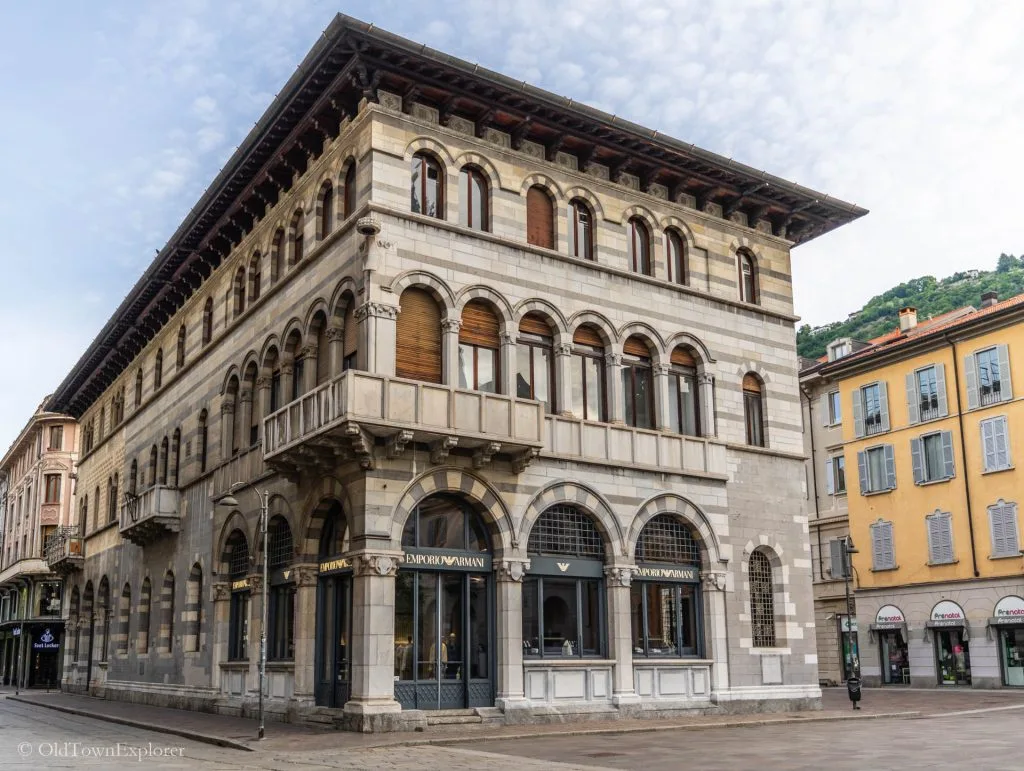
Broletto
- Architect: Unknown
- Style: Medieval civic building with Gothic additions
- Built: 1215; enlarged in 1433
- Address: Piazza del Duomo, Como
The Broletto is the medieval town hall of Como and one of the clearest civic buildings in the city. It stands out because it sits directly beside the cathedral and still reads as the public counterpart to the religious center. Look for the striped stonework, the pointed arches, and the attached civic tower with bell. It sits in the middle of the historic core on Piazza del Duomo, where many first-time visitors begin their walk.
Tempio Voltiano
- Architect: Federico Frigerio
- Style: Neoclassical
- Built: 1927–1928
- Address: Viale Guglielmo Marconi, Como
The Tempio Voltiano is a museum dedicated to Alessandro Volta and one of the most legible civic buildings on Como’s lakefront. It stands out because it uses a temple-like neoclassical form for a modern museum, linking civic memory with formal monumentality. Look for the symmetrical front, the raised setting, and the way the building faces the open lake edge. It sits just south of the old center on the waterfront, between the station area and the main lakeside promenade.
Teatro Sociale
- Architect: Giuseppe Cusi; enlarged by Leopoldo Rospini
- Style: Neoclassical theater
- Built: 1811–1813; enlarged in 1855
- Address: Via Vincenzo Bellini, 3, Como
Teatro Sociale is Como’s main historic theater and one of the city’s strongest early 19th-century civic buildings. It stands out because it brings a formal neoclassical facade into the tight grain of the old center, close to the cathedral district. Look for the ordered front, the theater block behind it, and the way it marks a cultural node rather than a religious or administrative one. It sits inside the walled center a short walk northeast of Piazza del Duomo.
Former Ospedale Grande di Sant’Anna / Conservatory Building
- Architect: Pietro da Breggia and Tommaso Rodari associated with the late 15th-century hospital campaign
- Style: Late Gothic to early Renaissance institutional architecture
- Built: completed in 1485
- Address: Via Luigi Cadorna, 4, Como
This building began as Como’s main hospital and now houses the conservatory, which gives it a long public life across different uses. It stands out because it preserves the scale of a major late medieval institution rather than a palace or church. Look for the large block and the restrained historic frontage, which still suggest a building planned for care and administration. It sits just outside the densest cathedral area on the southwest side of the center.
Museo archeologico Paolo Giovio
- Architect: Unknown
- Style: Historic palace complex reused as a museum
- Built: Buildings of various dates; museum opened in the 20th century
- Address: Piazza Medaglie d’Oro, 1, Como
The Paolo Giovio Archaeological Museum is one of the best places to connect Como’s architecture with its Roman and earlier past. It stands out because the museum is housed across three historic palaces, so the institutional use sits inside older urban fabric rather than a purpose-built museum block. Look for the palace fronts around Piazza Medaglie d’Oro and the way the museum occupies a whole cluster rather than a single isolated building. It sits inside the historic center north of the cathedral precinct.
Pinacoteca Civica
- Architect: Unknown
- Style: 17th-century palace reused as a civic gallery
- Built: 17th century palace; museum use later
- Address: Via Diaz, 84, Como
The Pinacoteca Civica is Como’s main civic art gallery and is housed in Palazzo Volpi. It stands out because it shows a common Como pattern: a former aristocratic residence turned into a public cultural building. Look for the palace shell rather than a purpose-built gallery front, and note how the museum remains embedded in the old city street wall. It sits inside the walled center southwest of the cathedral district.
Museo storico Giuseppe Garibaldi
- Architect: Unknown
- Style: Historic palace reused as a museum
- Built: Palazzo of earlier date; museum inaugurated in 1932
- Address: Piazza Medaglie d’Oro, 1, Como
The Giuseppe Garibaldi Historical Museum adds a Risorgimento and modern-history layer to Como’s institutional buildings. It stands out because it is housed in Palazzo Olginati, so the museum sits inside a historic urban palace rather than a separate exhibition building. Look for the shared palace setting around Piazza Medaglie d’Oro and the way this museum clusters with other civic museum functions nearby. It sits within the walled center in the same northern-central museum zone as the archaeological museum.
Museo Didattico della Seta
- Architect: Unknown
- Style: Modern industrial and educational reuse
- Built: Modern museum institution; association recognized in 1999
- Address: Via Valleggio, 3, Como
The Silk Museum is important because silk production is one of the industries that shaped modern Como. It stands out less for a historic facade than for what it explains about the city’s industrial and technical life. Look for the museum as part of a broader educational and production district rather than as a monument in a square. It sits northeast of the historic center, outside the main cathedral-and-lakefront visitor path.
Mercato Coperto
- Architect: Unknown
- Style: Market hall
- Built: 20th century
- Address: Via Giuseppe Sirtori, 1, Como
The covered market is a useful civic building because it shows the everyday service side of the city rather than the ceremonial side. It stands out as a practical urban structure tied to food trade, regular local use, and the edge of the old center near Porta Torre. Look for the functional market-hall format rather than ornamental frontage. It sits just outside the walled center on the southeastern side of the historic core.
Liceo ginnasio statale Alessandro Volta
- Architect: Simone Cantoni
- Style: Italian Neoclassical architecture
- Built: founded in 1773; current building date Unknown
- Address: Via Cesare Cantù, Como
The Alessandro Volta high school is one of the clearest educational buildings in central Como. It stands out because it ties the city’s institutional life to a neoclassical urban frontage rather than to a church or palace type. Look for the formal facade and its relationship to nearby religious and civic buildings in the old center. It sits inside the walled city near Santa Cecilia and Porta Torre.
Pontificio Collegio Gallio
- Architect: Pellegrino Tibaldi
- Style: Late Renaissance institutional architecture
- Built: from 1583
- Address: Via Tolomeo Gallio, 1, Como
Collegio Gallio is one of the largest historic educational complexes in Como. It stands out because of its scale and because it marks the northern edge of the historic center with a more ordered late Renaissance institutional form. Look for the long facade and the way the complex reads as a major enclosed school precinct rather than a single compact building. It sits just outside the old center near the lakefront side of the city.
Seminario Maggiore di Como
- Architect: Simone Cantoni
- Style: Italian Neoclassical architecture
- Built: late 18th century; exact date range Unknown
- Address: Viale Cesare Battisti 8, Como
The major seminary adds another strong neoclassical institutional building to the city’s religious and educational landscape. It stands out because it combines ecclesiastical use with the scale and order of an Enlightenment-era public institution. Look for the disciplined facade and the large block form. It sits north of the historic center on the approach toward the lakefront and stadium area.
Teatro Cressoni Pisani
- Architect: Pietro Luzzani
- Style: Early 20th-century entertainment architecture
- Built: 1870–1871
- Address: Via Diaz, Como
Teatro Cressoni adds a smaller-scale entertainment building to Como’s civic architecture. It stands out because it represents the commercial and popular side of public culture rather than the more formal civic role of Teatro Sociale. Look for it as part of the city’s wider cultural fabric rather than as a headline monumental building. It sits within the urban area of Como rather than on the lakefront villa axis.
Rationalist and Modern Architecture in Como
This category works for Como because it is not a side topic here. Como is one of the key cities for Italian Rationalism, and several of its best-known 20th-century buildings are close to the old center or the lakefront. These buildings help explain how the city added a new architectural layer without losing its medieval and neoclassical core. In practice, this section is less about generic modernity and more about a small, distinct Como group centered on Giuseppe Terragni and related interwar works.
Casa del Fascio
- Architect: Giuseppe Terragni
- Style: Italian Rationalism
- Built: 1933–1936
- Address: Piazza del Popolo 4, Como
Casa del Fascio is the main Rationalist building in Como and the clearest 20th-century counterpoint to the cathedral and Broletto nearby. It stands out for its strict geometry, flat surfaces, and carefully controlled facade grid, which give the building a very different presence from the city’s older masonry buildings. Look for the square plan, the layered window pattern, and the plain marble-and-glass exterior. It sits just north of the cathedral area, at the edge of the historic center.
Novocomum
- Architect: Giuseppe Terragni
- Style: Italian Rationalism
- Built: 1928–1929
- Address: Viale Giuseppe Sinigaglia 1, Como
Novocomum is one of the earliest major modern apartment blocks in Italy and one of the buildings that made Como important in early modern architecture. It stands out because it breaks sharply from historic house fronts and uses curved corners, horizontal lines, and a stripped-down facade. Look for the rounded corner volumes and the way the building reads as a modern urban block rather than a palace. It sits near the lakefront, southwest of the historic center and close to the stadium.
Asilo Sant’Elia
- Architect: Giuseppe Terragni
- Style: Italian Rationalism
- Built: 1935–1937
- Address: Via dei Mille / corner of Via Andrea Alciato, Como
Asilo Sant’Elia is a nursery school designed for a growing 20th-century neighborhood rather than for the old center. It stands out because Terragni used Rationalist planning on a smaller civic scale, with clear volumes, strong light, and spaces organized for daily use. Look for the low horizontal massing and the clean relationship between blocks, openings, and outdoor space. It sits east of the historic core in a more residential part of the city.
Monument to the Fallen
Monumento ai caduti
- Architect: Giuseppe Terragni, based on a design concept by Antonio Sant’Elia
- Style: Rationalist memorial tower
- Built: completed 1933
- Address: Viale Giancarlo Puecher, Como
The Monument to the Fallen belongs here as well as in the monuments section because it is one of the clearest public expressions of Como’s Rationalist phase. It stands out for its tall stripped-down tower form and for the way it uses mass and stone instead of figurative decoration. Look for the vertical block, the large openings, and the austere lakefront setting beside the Tempio Voltiano. It sits on the waterfront just south of the old center.
Fontana di Camerlata
- Architect: Cesare Cattaneo and Mario Radice
- Style: Rationalist / abstract modern
- Built: 1935–1936; reinstalled in Como in 1964
- Address: Piazzale Camerlata, Como
The Fontana di Camerlata is one of the strongest abstract modern works in Como. It stands out because it uses rings and vertical elements to create a sculptural traffic landmark rather than a traditional fountain with figurative ornament. Look for the repeated circular forms and the stark white concrete structure set in a major road junction. It sits well outside the historic center at one of the main western approaches into the city.
Casa Giuliani Frigerio
- Architect: Giuseppe Terragni
- Style: Italian Rationalism
- Built: 1939
- Address: Viale Rosselli 24, Como
Casa Giuliani Frigerio is Terragni’s last completed building and an important apartment house in Como’s modern architectural story. It stands out because the facade is more layered and varied than Casa del Fascio, while still keeping the clean lines and controlled composition of Rationalism. Look for the projecting balconies, the changing facade depth, and the careful balance between solid and void. It sits near Novocomum on the lakefront side of the city, southwest of the old center.
Casa Pedraglio
- Architect: Giuseppe Terragni
- Style: Italian Rationalism
- Built: 1934–1935
- Address: Via Mentana 6, Como
Casa Pedraglio is a smaller residential work, but it helps show how Rationalism moved from major public buildings into ordinary urban housing. It stands out for its compact plan and the distinctive balconies, which give the facade a sharper rhythm than many nearby historic buildings. Look for the balcony composition and the clean, undecorated surfaces. It sits near Como Borghi station, east of the historic center.
Albergo Posta
- Architect: Giuseppe Terragni
- Style: Italian Rationalism
- Built: designed 1930
- Address: At the corner of Piazza Volta and Via Garibaldi, Como
Albergo Posta is useful because it shows Rationalist design entering a central commercial corner rather than a large public plot. It stands out for bringing modern lines and simplified surfaces into one of the busiest parts of central Como. Look for the pared-back facade treatment and the way the building turns the street corner. It sits inside the central urban area near Piazza Volta, a short walk from the cathedral and lakefront.
Stadio Giuseppe Sinigaglia
- Architect: Giovanni Greppi
- Style: Rationalist architecture
- Built: 1927
- Address: Viale Giuseppe Sinigaglia, 2, Como
Stadio Giuseppe Sinigaglia is one of the city’s clearest Rationalist-era public buildings outside the usual Terragni group. It stands out because it applies stripped-down modern design to a sports building on a prominent lakefront-side site. Look for the clean lines, the functional massing, and the way the stadium sits within the broader modern zone near Novocomum. It lies southwest of the historic center near the waterfront.
Fortifications, Gates, and Towers in Como
Fortifications help explain how Como held its ground between the lake, the plain, and the routes leading north. This category matters because the city still keeps major traces of its Roman and medieval defenses, from wall lines and gates to the hilltop castle above the center. In Como, these structures are not just isolated monuments. They show how the city was entered, defended, and watched over from both the plain and the slopes above town. Most of the key sites sit either on the edge of the walled center or just above it.
Castel Baradello
- Architect: Unknown
- Style: Medieval military architecture
- Built: 12th century on earlier fortification remains
- Address: Via Castel Baradello, 5, 22100 Como CO, Italy
Castel Baradello is the main castle above Como and the clearest defensive landmark in the city’s wider setting. It stands out because it controls the southern approach and gives a direct read on why the hill mattered long before modern Como spread across the plain. Look for the tall central tower and the commanding position above the city. It sits southwest of the historic core on the ridge above San Carpoforo and the old access routes.
Walls of Como
Mura di Como
- Architect: Unknown
- Style: Roman and medieval fortifications
- Built: Roman origins; major medieval rebuilding in the 12th century
- Address: Around the historic center of Como
The walls of Como are one of the main reasons the city’s historic core still feels so legible. They stand out because long stretches survive and still define the shape of the old center better than in many Italian cities of similar size. Look for the surviving wall lines along the ring roads and green edges around the center. They run around much of the historic core and connect directly to the main gates and towers.
Porta Torre
- Architect: Unknown
- Style: Romanesque military architecture
- Built: 1192
- Address: Via Cesare Cantù / Piazza Vittoria, Como
Porta Torre is the strongest surviving gate tower in Como and one of the city’s most recognizable medieval structures. It stands out for its height, stripped defensive form, and the way it still marks a major entrance into the old center. Look for the tall open-sided tower and the heavy masonry with few decorative concessions. It sits on the southern edge of the walled city at Piazza Vittoria, where many visitors enter the center on foot.
Porta Pretoria
- Architect: Unknown
- Style: Roman gate remains
- Built: Roman period, probably 1st century BC to 1st century AD
- Address: Near Piazza Giuseppe Verdi / historic center of Como
Porta Pretoria is one of the main surviving traces of Roman Como. It stands out because it helps connect the later medieval city to the much older Roman defensive and urban system underneath it. Look for the surviving masonry remains rather than a complete freestanding gate. It sits within the historic center, not far from the cathedral and theater area.
Torre San Vitale
- Architect: Unknown
- Style: Medieval defensive tower
- Built: Unknown
- Address: Viale Cesare Battisti, 8, 22100 Como CO, Italy
Torre San Vitale is one of the towers tied to the defensive line of medieval Como. It helps explain that the city’s fortifications were more than just one wall and one gate. Look for its surviving mass within the later urban fabric rather than an isolated monument setting. It sits near the southeastern side of the old center along the former defensive perimeter.
Torre Gattoni
- Architect: Unknown
- Style: Medieval tower
- Built: Unknown
- Address: Viale Varese, 2, 22100 Como CO, Italy
Torre Gattoni is one of the lesser-known towers that still help map medieval Como at a finer scale. It stands out less for monumentality than for showing how tower architecture remained embedded in later urban blocks. Look for vertical masonry integrated into surrounding buildings rather than a fully detached tower. It sits within the historic center.
Torre Pantera
- Architect: Unknown
- Style: Medieval tower
- Built: Unknown
- Address: Via Pretorio, 9, 22100 Como CO, Italy
Torre Pantera is another surviving tower fragment from the medieval city. It helps explain that Como once had a denser tower landscape tied to family power and urban defense. Look for the tower as part of the later street wall rather than as a freestanding lookout. It sits within the walled center among later buildings.
Castello della Torre Rotonda
- Architect: Unknown
- Style: Medieval fortification
- Built: 13th century; strengthened in the 14th century
- Address: Via Bertinelli, 22100 Como (CO), Italy
Castello della Torre Rotonda helps widen the defensive story beyond Porta Torre and Baradello. It stands out because it points to a more complex fortified landscape than the surviving headline sites alone suggest. Look for it as part of the city’s layered defensive network rather than as a major standalone destination. It belongs to the wider medieval defensive story of Como rather than to the cathedral-side core.
Archaeological Sites and Roman Remains in Como
The Roman and pre-Roman layer is one of the keys to reading Como architecture well. These sites explain why the historic center has such a clear outline, why some streets feel older than the buildings on them, and why later churches and palaces sit where they do. In Como, archaeology is not limited to one fenced site. It appears in baths, wall fragments, burial grounds, reused plots, and isolated remains that survive inside the later city. This category helps connect Roman Como with the medieval and early modern city built over it.
Roman Baths
- Architect: Unknown
- Style: Roman architecture
- Built: Roman period, probably 1st–3rd century AD
- Address: Viale Lecco, Como
The Roman Baths are one of the clearest surviving public remains from Roman Como. They stand out because they show that the city had substantial urban infrastructure, not just walls and houses. Look for the masonry remains and the sense of buried civic scale rather than a complete standing building. They sit on the eastern side of the historic center, close to the old urban edge.
Roman Villa, Via Zezio
- Architect: Unknown
- Style: Roman domestic architecture
- Built: Roman period
- Address: Via Zezio, Como
The Roman villa on Via Zezio helps show the domestic side of Roman Como. It stands out because it points to residential building beyond the better-known baths and wall traces. Look for it as evidence of Roman occupation and urban spread rather than as a monumental ruin. It sits north of the historic core on the slope side of the city.
Necropolis of Ca’ Morta
- Architect: Unknown
- Style: Archaeological burial site
- Built: Protohistoric to Roman-period use
- Address: Ca’ Morta area, Como
The Necropolis of Ca’ Morta is one of the most important burial sites linked to the wider Como area. It stands out because it pushes the city’s story back before the medieval and Roman standing monuments that most visitors notice first. Look for it as a site that explains long-term settlement and funerary practice rather than architecture in the narrow sense. It sits outside the dense historic center in the wider Como plain.
Prestino Excavations
- Architect: Unknown
- Style: Archaeological site
- Built: Prehistoric and Roman-period remains
- Address: Via Isonzo, Prestino, Como
The excavations at Prestino broaden the archaeological map beyond the center. They stand out because they show occupation and activity in the outer districts, not only within the later walled core. Look for them as part of the wider settlement history of Como rather than as a single architectural monument. They sit in the Prestino area west-southwest of the historic center.
Rondineto Rock-Cut Rooms
- Architect: Unknown
- Style: Rock-cut archaeological remains
- Built: Unknown
- Address: Rondineto area, Como
The rock-cut rooms at Rondineto are unusual because they show excavation into the terrain rather than freestanding construction. They stand out for giving the archaeological layer a more fragmentary and landscape-based character than the baths or wall remains. Look for the carved spaces as evidence of older use of the site rather than a complete preserved complex. They sit outside the main visitor center in the Rondineto area.
Breccia Protohistoric Settlement
- Architect: Unknown
- Style: Protohistoric settlement remains
- Built: Pre-Roman
- Address: Breccia, Como
The Breccia settlement remains are useful because they add a pre-Roman layer to the story of Como. They stand out by showing that the area had organized occupation before the later Roman city took shape. Look for them as settlement evidence rather than monumental architecture. They sit in the Breccia district outside the historic center.
Roman Wall Remains at Parini Middle School Courtyard
- Architect: Unknown
- Style: Roman fortification remains
- Built: Roman period
- Address: Courtyard of Scuola Media Parini, Como
These wall remains matter because they show how Roman Como survives inside later everyday buildings and institutions. They stand out for being part of the city’s buried and reused fabric rather than a freestanding monument area. Look for them as a fragment that helps map the old perimeter. They sit within the built-up city, not far from the historic core.
Roman Wall Remains on Via Cesare Cantù
- Architect: Unknown
- Style: Roman fortification remains
- Built: Roman period
- Address: Via Cesare Cantù, Como
The remains on Via Cesare Cantù are another example of Roman fabric surviving inside the later city. They stand out because they make the Roman wall line more legible when read together with other fragments. Look for masonry incorporated into later structures and street edges. They sit inside the walled center on one of the central streets.
Roman Wall Remains at the Former Silk Factory on Via Carducci
- Architect: Unknown
- Style: Roman fortification remains
- Built: Roman period
- Address: Former silk factory basement, Via Carducci, Como
These remains are important because they show how archaeology in Como often survives below later industrial and urban uses. They stand out as a reminder that Roman material is often found in foundations and basements rather than in open-air display. Look for them as part of the broader Roman wall circuit. They sit south of the historic center in the Via Carducci area.
Roman Wall Remains at Via Cinque Giornate 59
- Architect: Unknown
- Style: Roman fortification remains
- Built: Roman period
- Address: Via Cinque Giornate 59, Como
The remains at Via Cinque Giornate 59 add another fixed point to the Roman outline of the city. They stand out because even small fragments help make the old defensive line more concrete on today’s street map. Look for them as part of a distributed archaeological system rather than a single destination. They sit on the edge of the historic center.
Votive Circle, Tre Camini Area
- Architect: Unknown
- Style: Archaeological ritual site
- Built: Unknown
- Address: Tre Camini area near Montano Lucino, west of Como
The votive circle in the Tre Camini area is useful because it widens the story beyond the urban center and shows ritual activity in the greater Como area. It stands out for being a ceremonial site rather than a domestic or defensive one. Look for it as evidence of older cultural use of the landscape. It sits outside Como proper near the newer Sant’Anna hospital zone.
Streets, Squares & Waterfront in Como
This category ties the rest of the page together. In Como, streets, squares, and the lake edge are not filler between landmarks. They explain how the cathedral precinct, the old market spaces, the walled center, and the waterfront connect into one walkable sequence. This section is useful because several of the city’s key architectural reads happen in public space: the relationship between the Duomo and Broletto, the older market role of Piazza San Fedele, the open lakefront edge at Piazza Cavour, and the promenade that links the center to the Tempio Voltiano and the diga foranea.
Piazza del Duomo
- Architect: Unknown
- Style: Medieval and later civic-religious square
- Built: Medieval formation with later alterations
- Address: Piazza del Duomo, Como
Piazza del Duomo is the main architectural center of Como. It stands out because the square brings the cathedral, the Broletto, and the civic tower into one compact space, making the relationship between religious and civic power easy to read at street level. Look for how tightly the buildings meet each other and how little empty space separates the main facades. It sits in the middle of the historic center and works as the clearest starting point for a first architecture walk.
Piazza San Fedele
- Architect: Unknown
- Style: Medieval square
- Built: Medieval formation on the site of the Roman forum
- Address: Piazza San Fedele, Como
Piazza San Fedele is one of the most useful squares for understanding older Como. It stands out because it preserves the role of a long-standing market space and is anchored by the Basilica of San Fedele, with dense medieval building fronts around it. Look for the irregular enclosure, the close street entries, and the way the basilica facade is partly constrained by the surrounding urban fabric. It sits inside the walled center west of the cathedral precinct.
Piazza Cavour
- Architect: Unknown
- Style: 19th-century lakefront square with later urban role
- Built: Modern square formed on the filled-in former harbor edge
- Address: Piazza Cavour, Como
Piazza Cavour is the main hinge between the old city and the lake. It stands out because it opens the dense center toward the water and frames the lake as part of the urban experience rather than as a separate excursion. Look for the broad open edge, the line of historic buildings around the square, and the direct visual connection from the city to the first basin of Lake Como. It sits immediately north of the waterfront promenade and east of the shortest route to the cathedral area.
Lungolago di Como
- Architect: Unknown
- Style: Waterfront promenade and urban edge
- Built: Developed in phases from the 19th century onward
- Address: Lakefront promenade, Como
The lungolago is the public edge that makes Como read as both a walled city and a lake city. It stands out because the promenade links monuments, civic buildings, boat access, and long views into one continuous urban sequence. Look for the shift from tighter center streets to a wider open shoreline with major public buildings and memorials spaced along it. It runs along the first lake basin directly beside the historic center.
Waterfront stretch around the Tempio Voltiano
- Architect: Unknown
- Style: Formal waterfront cultural zone
- Built: 20th-century arrangement around earlier promenade lines
- Address: Viale Guglielmo Marconi / Viale Giancarlo Puecher, Como
This lakefront stretch is useful because it gathers the Tempio Voltiano, the Monument to the Fallen, and nearby open space into one readable civic composition. It stands out as the most formal part of the waterfront, where museum architecture and memorial architecture sit directly on the shore rather than behind dense street blocks. Look for the spacing between buildings, the open lawns and paths, and the strong lake-facing orientation. It sits just south of the historic center on the walk toward the station side of the waterfront.
Diga Foranea Piero Caldirola
- Architect: Unknown
- Style: 19th-century harbor works with later public promenade use
- Built: 1870; later adapted as a public walk and monument setting
- Address: Diga foranea Piero Caldirola, Como
The diga foranea matters because it extends the city’s public space out into the lake. It stands out by turning infrastructure into a walkable architectural setting, especially with The Life Electric placed at its end. Look for the straight projecting line of the pier, the changing view back toward Como, and the way the monument completes the route. It sits off the central waterfront opposite Piazza Cavour and is reached from the lungolago.
Things to Know About Como Architecture
Como architecture is easier to understand when you know what to look for before you start walking. The points below highlight the city’s main building layers, how the center and waterfront differ, and which patterns will help the rest of the guide make more sense.
Como is easy to read in layers
Como architecture is not all from one period. The city combines Roman remains, Romanesque churches, medieval walls, neoclassical villas, and a strong group of Rationalist buildings from the 20th century. That mix is one of the main reasons the city works well for architecture walking.
The old center and the lakefront feel different
The walled center is tighter, denser, and more church- and civic-focused. The lakefront has more open space, larger freestanding buildings, monuments, and villa facades facing the water. It helps to think of them as two connected but different parts of the city.
Romanesque is one of the key styles in Como
Romanesque is one of the main architecture terms to know in Como. It usually means thick masonry walls, round arches, and a heavier, more solid look than later Gothic buildings. Sant’Abbondio, San Fedele, and San Carpoforo are the clearest places to see it.
Bell towers help with orientation
Bell towers break up the skyline of Como and help mark older parish zones. They are especially useful around Sant’Abbondio, San Fedele, and some outer church sites. In most cases, though, they make more sense as part of the church entry than as separate attractions.
The cathedral area is the clearest starting point
If you only have a short time, start at Piazza del Duomo. The cathedral and the Broletto give the clearest quick read on the relationship between religious and civic architecture in medieval Como.
The villas are best understood as a sequence
The lakefront villas make more sense when read together rather than one by one. Villa Olmo, Villa Gallia, Villa Saporiti, and Villa Geno help show how elite domestic architecture spread along the shore outside the tighter old core.
Rationalist architecture is a real part of Como’s identity
In many cities, modern architecture would feel like a side topic. In Como, it does not. Casa del Fascio, Novocomum, Asilo Sant’Elia, and related works make Rationalism one of the city’s defining architectural layers.
The walls still shape the city
Even if you do not follow the full line of the walls, they still help explain the shape of the historic center. Gates, towers, and surviving wall sections make the old core easier to understand than in many other Italian cities.
Some of the best architecture is in public space
Not every important architecture stop in Como is a single building. Piazza del Duomo, Piazza San Fedele, Piazza Cavour, and the waterfront all help connect separate monuments into one walkable urban sequence.
The best reading of Como needs both the center and the edges
To understand Como architecture well, do not stay only in the center. Sites like Sant’Abbondio, Villa Olmo, Tempio Voltiano, and Castel Baradello help explain how the city expands beyond the walled core into lakefront, suburban, and defensive landscapes.
Best Places to Stay In Como
Hotels in Como
For an architecture-focused stay, the best base is usually the historic center or just beside the walls. It keeps you close to the cathedral, Broletto, San Fedele, Teatro Sociale, and many of the city’s smaller churches, while still making it easy to walk to the lakefront. If the plan is to spend most of the day exploring on foot, this is the most practical area to stay.
A second good option is the area around Como San Giovanni. It still gives you easy access to the center, but it also puts you closer to the Tempio Voltiano, the Monument to the Fallen, and the Rationalist buildings on the lakefront side of town. This area works well if you want to combine the old center with the waterfront in the same walk.
If villas and the western lakefront matter more than immediate access to the cathedral area, stay toward Borgovico. That part of Como is more convenient for Villa Olmo, Villa Gallia, Villa Saporiti, and the promenade west of the center, while still being walkable to the old town.
Use an interactive map to compare places to stay inside the walls, near Como San Giovanni, and along the Borgovico side of the lakefront.
City Tours in Como
Como is best experienced on foot, which makes it easy to follow the city’s architecture at street level. Below are curated walks and tours that highlight Como’s main architectural layers, from the cathedral precinct, Broletto, and Piazza San Fedele to the walled perimeter, lakefront civic buildings, and the waterfront route that connects monuments, villas, and Rationalist landmarks.
FAQs About Como Architecture
What is Como architecture known for?
Como architecture is known for its Romanesque churches, walled medieval core, lakefront villas, and 20th-century Rationalist buildings. What makes the city unusual is that all four layers are strong enough to shape a short visit.
Is Como architecture worth it if I have limited time?
Yes, especially if you want a city where several styles are close together. Even in a short visit, you can see the cathedral, Broletto, San Fedele, the lakefront, and at least one major Rationalist building without needing a car.
What’s the best short route for first-timers?
Start at Piazza del Duomo, then walk to San Fedele, Casa del Fascio, and Teatro Sociale. After that, continue to Piazza Cavour and the waterfront, then finish at Tempio Voltiano or head back through the center.
Are the key sites inside the old town / walls?
Many of the main sites are inside or right beside the walled center, including the cathedral, Broletto, San Fedele, Teatro Sociale, and several smaller churches. Some important sites, though, sit just outside it, especially Sant’Abbondio, Tempio Voltiano, Villa Olmo, and Castel Baradello.
What styles will I actually see?
You will mostly see Romanesque, Gothic, Renaissance, Baroque, Neoclassical, and Italian Rationalist architecture. That range is one of Como’s strengths, since the shifts are visible without needing long travel between sites.
What’s the best viewpoint for the skyline?
For the broadest read of the city, Baradello gives the clearest sense of Como’s position between lake, plain, and walls. For a lower and easier skyline read, the lakefront and outer pier area show the waterfront edge well.
Is Como mainly a church city or a villa city?
It is both, but in different zones. The old center is strongest for churches and civic buildings, while the lakefront and Borgovico side are stronger for villas and larger freestanding residences.
Is Rationalist architecture really a major part of Como?
Yes. In Como, Rationalism is not an extra topic. Casa del Fascio, Novocomum, Sant’Elia, and related works make the city one of the most important places in Italy for this 20th-century layer.
Do I need to enter museums and villas to enjoy the architecture?
No. Como works well from the outside because many of the main reads are urban: squares, facades, church exteriors, walls, gates, and the waterfront. Interiors add depth, but the city is still rewarding if you mostly walk and observe.
Is Como better for a half day or a full day of architecture?
A half day works well for a first pass through the center and lakefront. A full day is better if you want to include Sant’Abbondio, villas, Rationalist sites, and outer places like Baradello without rushing.
Como architecture stands out for the way so many building periods remain easy to read in one compact city. Roman remains, Romanesque churches, medieval walls, neoclassical villas, and Rationalist landmarks all sit close enough together to make architecture one of the strongest reasons to explore Como on foot.
What makes the city especially rewarding is the contrast between the walled center and the open lakefront. In a short walk, you can move from cathedral squares and old parish churches to civic buildings, villa facades, memorials, and the shoreline edge of the lake. That mix gives Como a broader architectural range than many towns of a similar size.
If you want to understand Como well, it helps to look beyond the headline sights and pay attention to how the city connects its churches, public buildings, defensive edges, and waterfront spaces. Taken together, those layers make Como architecture more than a list of landmarks. They make it one of the clearest and most walkable architecture cities on the lake.