
Discover Orange: History, Architecture & Must-See Attractions
Orange sits in the Rhône Valley in southern France, north of Avignon. The town is best known for major Roman monuments tied to the Roman colony of Arausio. Those sites still shape how most visitors spend a day here.
Architecturally, Orange is a mix of Roman stonework and a smaller Provençal town core around it. The main sights cluster close together, so most day trips work as a walk from the train station to the Roman sites, then through the historic center, with a final climb to the hilltop park for views.
We visited Orange during our month-long stay in Avignon. In this post, we’ll cover what to see and how to plan a day trip.
This post contains affiliate links that may earn us a small commission at no additional cost to you.
Orange at a Glance
Orange, France is a compact Provençal town built around two standout Roman monuments and a walkable historic center.
- Location: Rhône Valley, about 20–30 km north of Avignon
- Architectural character: Roman monuments plus a smaller medieval-to-19th-century town core
- Walkability: Very walkable once you reach the center; short distances between major sights
- Typical time required: 3-6 hours for the core sights and a walking loop
- Key landmarks: Théâtre antique d’Orange, Arc de Triomphe d’Orange, Cathédrale Notre-Dame-de-Nazareth
- Food and wine role: Nearby wine country exists, but the town visit is mostly monument-led (wine is optional)
- Seasonality: February can be cold and windy in the Rhône Valley, with shorter daylight
Next, we’ll cover the history that shaped Orange, then the architecture, then a sight-by-sight plan.
History of Orange
Orange’s history is visible in its streets because the biggest building projects happened in a few clear waves.
Roman Arausio and monument building (1st century BC–3rd century AD)
Orange grew as the Roman colony of Arausio, which brought planned streets and large public buildings. The Roman theatre and triumphal arch are the most visible results. Their stone construction still dominates the town’s skyline and tourist routes today.
Late Antiquity and early medieval contraction (4th–10th centuries)
As Roman rule weakened, large entertainment buildings stopped being maintained. Parts of the Roman town footprint likely shrank or shifted over time (exact changes: Unknown). Later building reused Roman stone, which is why Roman blocks and fragments still show up in the area.
Medieval town and church-centered core (11th–13th centuries)
In the Middle Ages, the town’s daily life focused more on churches and a tighter core. The cathedral area became a key anchor in the street network. This period helps explain why you can walk quickly from the Roman monuments into a smaller set of lanes and squares.
Principality of Orange and early modern power (16th–18th centuries)
Orange became tied to the Principality of Orange and the House of Orange-Nassau. Political control affected fortifications and civic buildings, and the town developed more administrative architecture around the central squares. Some early modern townhouses and civic structures reflect this phase.
Modern preservation and UNESCO recognition (19th–21st centuries)
In the 19th century, interest in Roman sites grew and restoration work expanded (project specifics: Unknown). In 1981, the Roman Theatre and its surroundings and the Triumphal Arch were listed as UNESCO World Heritage, which reinforced the focus on protecting the Roman core. Today’s visitor experience is shaped by that protection and the compact “monuments-first” walking pattern.
For the official property description and criteria, see the UNESCO listing for the Roman Theatre and Triumphal Arch of Orange.
Architecture of Orange
Orange’s architecture follows its history: Roman stone monuments first, then a smaller town core that wraps around them.
For broader context on Roman, Romanesque, and later styles across the country, see France Architecture.
Roman public architecture as the main framework
The Roman theatre and arch are not “ruins on the edge.” They sit close to the center and define the day-trip route. Because they are large and made from heavy stone blocks, they set the visual scale for everything around them.
Theatre wall and vertical landmark
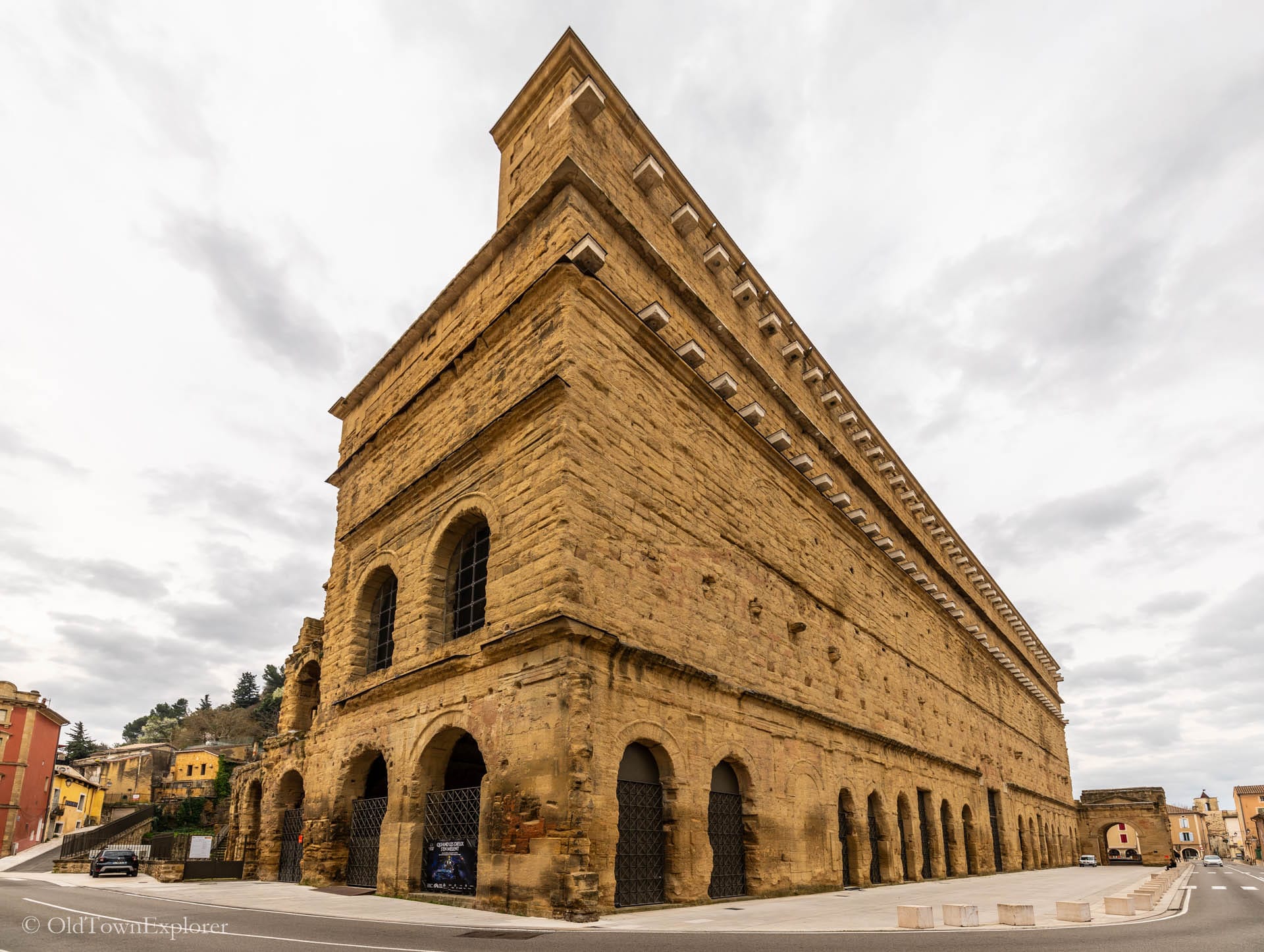
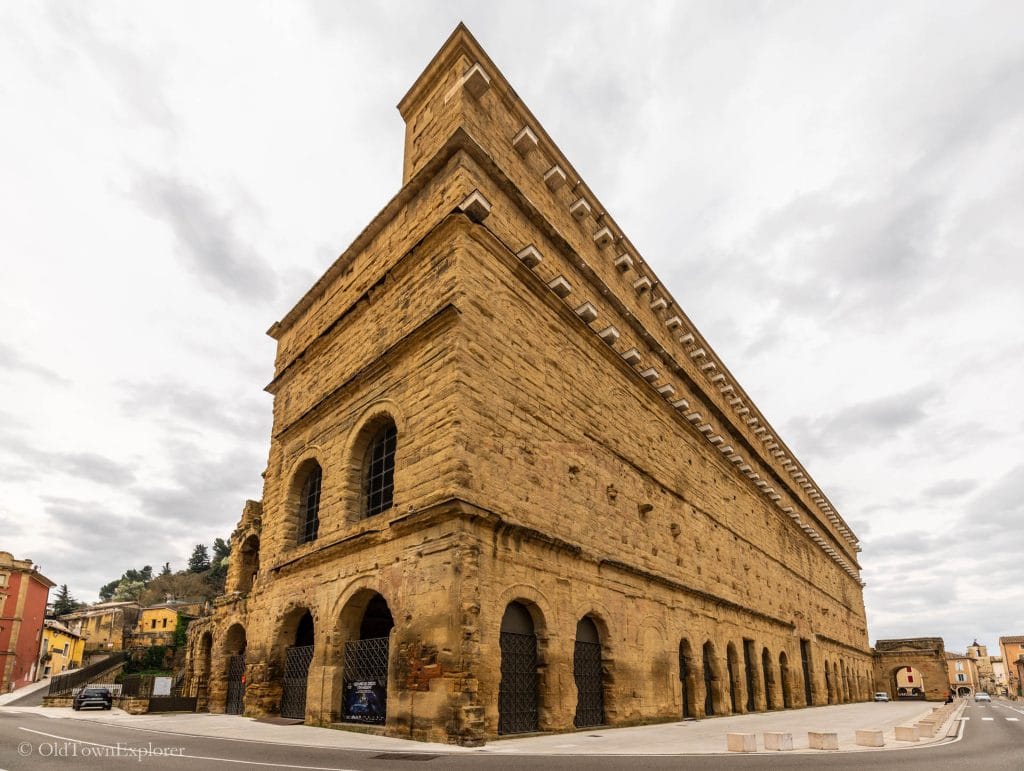
The theatre’s stage wall is a strong vertical plane that you can spot from nearby streets. “Massing” means the building’s overall shape and size from the street. Here, the theatre’s massing feels like a stone cliff, which is unusual in a town center.
Triumphal arch as a gateway form
The arch reads like a stone gate on a main approach road. Its carved surfaces and layered openings show how Romans used monuments to mark movement through a city. Even if you do not study the details, the arch’s proportions and blockwork are easy to notice.
Materials: pale stone and carved blocks
The key historic material is pale stone cut into large blocks for Roman construction. Later buildings often use smaller stone, stucco, or mixed masonry. The shift in block size is one of the easiest ways to “date” what you are seeing while walking.
Street pattern: short connectors between big anchors
Orange’s walkability comes from short streets that link the station side, the theatre area, and the central squares. The town is mostly flat, so the main constraint is not steep grades but crossing busier roads as you move between clusters.
Church placement and heavier church forms
The cathedral sits as a solid, heavier building compared with surrounding houses. Church buildings tend to be thicker-walled and more compact in shape, which stands out against smaller street façades. This is typical of Romanesque-era construction in southern France.
Civic buildings and reuse of older structures
Orange’s civic center includes an Hôtel de Ville in a reused townhouse (original form and later phases: partially documented). This kind of reuse is common in older towns: the function changes, but the building stays because it already has a prime location and durable structure.
The hill relationship: Colline Saint-Eutrope
The Colline Saint-Eutrope adds the one big change in elevation. It gives you a viewpoint over the town and helps explain why the Roman monuments sit where they do in relation to the wider valley. It also adds a “finish” to a walking loop after the core sights.
Architectural Attractions in Orange
Orange’s main sights fit together in a simple way: the Roman theatre and museum sit close to the center, the arch is a short walk away, and the cathedral and civic squares connect the gaps. The hilltop park works best as the final stop.
Roman Orange: UNESCO core
Roman Theatre of Orange
Théâtre antique d’Orange
- Architect: Unknown
- Style: Roman (early Imperial)
- Built: Early 1st century AD (under Augustus)
- Address: Rue Madeleine Roch, 84100 Orange
This is a large Roman theatre built for public performances in the Roman colony. It matters because it is one of the best-preserved Roman theatres in Europe. Look for the towering stage wall and the stepped seating form that wraps the performance space. It sits close to the historic center and sets the scale for the streets around it.
For current hours, tickets, and museum access, use the official Roman Theatre of Orange practical information.
Museum of Art and History of Orange
Musée d’art et d’histoire
- Architect: Unknown
- Style: Early modern townhouse (museum in a historic building)
- Built: 17th century building
- Address: Rue Madeleine Roch, 84100 Orange
This is the town museum located near the Roman theatre. It matters because it holds objects and documents that help explain Orange beyond the big monuments. Architecturally, notice the townhouse scale and its street-facing façade opposite the theatre. It sits in the same monument cluster as the theatre.
Triumphal Arch of Orange
Arc de Triomphe d’Orange
- Architect: Unknown
- Style: Roman (early Imperial)
- Built: Early 1st century AD
- Address: Avenue de l’Arc de Triomphe, 84100 Orange
This is a Roman arch built as a monumental marker on a main approach route. It matters because it shows how Romans used sculpture and stonework to project power and identity. Look for the stacked openings and carved surfaces that read from a distance. It sits just outside the tightest core, on a straightforward walking route from the center.
Roman Wall Remains and Gate
Rempart romain d’Orange
- Architect: Unknown
- Style: Roman defensive infrastructure
- Built: Early Roman Empire
- Address: 310 Rue Saint-Clément, 84100 Orange
This is a surviving section of Orange’s Roman-era city defenses, including a well-preserved gate area. It matters because it marks the edge of the ancient town and hints at the larger Roman footprint. Look for the heavy stone construction and how the line of wall relates to modern streets. It sits toward the southwest side of the town area, away from the theatre cluster.
Forum of Arausio: Temple and Sacred Area
Forum – temple et aire sacrée
- Architect: Unknown
- Style: Roman (Imperial civic/religious complex)
- Built: Unknown (Roman period)
- Address: Rue Pontillac area, 84100 Orange
This is the archaeological zone tied to the Roman forum, including remains of the paved area, porticoes, and the sacred precinct. It matters because it was the political and religious center of Roman Orange, not just an “extra” ruin. Look for low stone foundations, substructures, and how the remains align with today’s street grid. It sits at the foot of Colline Saint-Eutrope, inside the walkable center.
Mur Pontillac
Roman forum enclosure wall fragment
- Architect: Unknown
- Style: Roman (forum boundary / enclosure)
- Built: Unknown (Roman period)
- Address: Rue Pontillac, 84100 Orange
This is a visible fragment linked to the enclosure of the Roman forum area. It matters because it shows how large Roman public space was laid out under the modern town. Look for heavy masonry and how the wall reads as a straight edge in a tight street. It sits in the Pontillac area, close to other forum-related remains.
Forum romain
(formerly identified as “Gymnase romain”)
- Architect: Unknown
- Style: Roman
- Built: Unknown (Roman period)
- Address: 2 bis Rue Pontillac, 84100 Orange
This is a set of Roman remains in the Pontillac area that were long described locally as a “gymnasium,” and are now commonly framed as part of the forum zone. It matters because it adds a second Roman layer beyond the theatre and arch. Look for exposed masonry and partial walls that show the footprint of a large public complex. It sits within the historic center, a short walk from Place Clémenceau.
Churches and religious buildings
Cathedral of Notre-Dame-de-Nazareth
Cathédrale Notre-Dame-de-Nazareth
- Architect: Unknown
- Style: Romanesque
- Built: 12th century (dedication 1208)
- Address: Rue Notre Dame, 84100 Orange
This is Orange’s historic cathedral, tied to the medieval town core. It matters because it shows the shift from Roman civic buildings to church-centered urban life. Look for the heavier walls and compact shape typical of Romanesque construction. It sits near central squares and short streets in the historic core.
Église Saint-Florent (former Cordeliers complex)
- Architect: Unknown
- Style: Unknown
- Built: Unknown
- Address: Rue Saint-Florent, 84100 Orange
This is a church building associated with a former religious complex. It matters as a reminder that Orange’s historic center includes more than Roman sites. Look for the simpler church massing compared with the cathedral area and how it fits a tight street frontage. It sits within the broader walkable center.
Protestant Temple of Orange
Temple protestant d’Orange
- Architect: Unknown
- Style: Unknown
- Built: Unknown (Protestant use established in the 19th century)
- Address: Rue Pontillac, 84100 Orange
This is a Protestant place of worship linked to Orange’s post-Reformation religious history. It matters because Orange was connected to wider Protestant and political networks over time. Look for a functional exterior and a building adapted for later religious use. It sits in the walkable center, not far from the main squares.
Chapelle Saint-Louis
Ancienne chapelle Saint-Louis
- Architect: Unknown
- Style: Unknown
- Built: Unknown
- Address: Rue de l’Ancien Collège, 84100 Orange
This is a historic chapel building in the center that is also used as an event space. It matters because it’s a named religious structure that adds depth beyond the cathedral and the main Roman monuments. Look for a compact chapel volume and a street-facing entrance on a narrow lane. It sits in the central area, close to the Pontillac streets and squares.
Squares and civic center
Town Hall of Orange
Hôtel de Ville / Mairie d’Orange
- Architect: Unknown
- Style: Early modern civic building (adapted from a townhouse)
- Built: 17th century core
- Address: Place Clémenceau, 84100 Orange
This is the town’s main civic building in the central square. It matters because it shows how Orange’s administration settled into the medieval-to-early modern center, not the Roman monument zone. Look for the formal façade facing the square and the way it anchors civic space. It sits in the heart of the historic core.
Place Clémenceau
- Architect: Unknown
- Style: Urban square
- Built: Unknown
- Address: Place Clémenceau, 84100 Orange
This is the main civic square, used as a meeting point in the center. It matters because it concentrates town functions like the mairie and nearby streets. Look for how building fronts create an “outdoor room” with clear edges. It sits between the cathedral zone and the rest of the center.
Place aux Herbes
- Architect: Unknown
- Style: Market square
- Built: Unknown
- Address: Place aux Herbes, 84100 Orange
This is a traditional square that often reads as a market-oriented space. It matters because it shows the smaller, everyday scale of Orange compared with the Roman monuments. Look for the tight block edges and the way cafés and storefronts typically face inward. It sits in the walkable core near other central streets.
Fontaine publique du XVIIIe siècle
Fontaine publique
- Architect: Unknown
- Style: 18th-century civic street feature
- Built: 18th century
- Address: 6 Place des Frères Mounet, 84100 Orange
This is a protected public fountain from the 18th century. It matters because it marks everyday infrastructure—water access and civic improvement—rather than monumental power. Look for carved stonework and how the fountain is set into the square edge for easy approach. It sits in the center, within the walkable core.
Centre hospitalier (cours Pourtoules)
(protected interior stair and ironwork)
- Architect: Unknown
- Style: Early modern / institutional building (details vary)
- Built: Unknown
- Address: Cours Pourtoules, 84100 Orange
This is a historic hospital complex where the protected element is the interior stair and ironwork rather than the whole exterior. It matters because it shows civic and charitable building in the early modern town. Look for institutional scale and durable masonry, plus any visible ironwork details if accessible. It sits near the edge of the central area, still reachable on foot from the main squares.
Hilltop viewpoint and later layers
Colline Saint-Eutrope
- Architect: Unknown
- Style: Landscape park with historic remains
- Built: Unknown
- Address: Colline Saint Eutrope, 84100 Orange
This is a hilltop park above the town with traces of Orange’s later fortified history. It matters because it gives a clear sense of the town’s position in the Rhône Valley. Look for how paths, retaining edges, and ruins (if visible) sit on the slope. It sits directly above the central area and works well as a final climb.
Château des Princes d’Orange / Princes de Nassau
(ruins on Colline Saint-Eutrope)
- Architect: Unknown
- Style: Medieval to early modern fortification (phases)
- Built: Unknown (major phases: 13th–17th centuries)
- Address: Colline Saint-Eutrope, 84100 Orange
These are the remains of the fortress complex that once controlled the hill above the town. It matters because it explains Orange’s later defensive skyline and why the hill is more than just a viewpoint. Look for wall lines, terraces, and earthworks that trace the plan of the former castle. It sits directly above the theatre area, reached by the hill paths.
Roman Capitole terrace / platform
Capitole romain
- Architect: Unknown
- Style: Roman (hilltop sacred complex / sanctuary terrace)
- Built: Unknown (Roman period)
- Address: Colline Saint-Eutrope, 84100 Orange
This is the terrace area associated with the hilltop “Capitole” mentioned in descriptions of the Roman sacred complex. It matters because it links the forum/temple zone below to a higher ceremonial point on the hill. Look for flattened platform geometry and retaining edges that read as intentional construction, not natural slope. It sits near the upper part of Colline Saint-Eutrope, above the forum zone.
Other Attractions
Théâtre municipal d’Orange
- Architect: Unknown
- Style: 19th century (municipal cultural building)
- Built: 19th century
- Address: Cours Aristide Briand, 84100 Orange
This is Orange’s later municipal theatre, separate from the Roman theatre. It matters because it shows how the town added modern civic culture buildings on main boulevards. Look for a formal street façade and a public-building scale designed for an audience venue. It sits outside the tightest medieval streets, on a wider thoroughfare.
Hôtel de Jonc
- Architect: Unknown
- Style: Early modern townhouse
- Built: Unknown (protected elements focus on façades and roofs)
- Address: 12 bis–14 Rue Petite-Fusterie, 84100 Orange
This is a protected townhouse known for its street façades and roofline. It matters because it represents the private, urban architecture that fills in between monuments. Look for the façade composition, entry passage, and how the building sits tight to the street line. It sits in the historic core on small lanes, near the central squares.
Îlot Pontillac
- Architect: Unknown
- Style: Mixed periods (block formed over time)
- Built: Unknown (medieval core with later reshaping)
- Address: 11 Rue de l’Ancien Collège, 84100 Orange
This is a protected block of buildings tied to the Pontillac area, shaped by multiple phases rather than one build date. It matters because it shows how Orange’s center evolved through subdivision and reuse, not just new construction. Look for varied façade rhythms, different openings, and how several buildings read as one continuous street wall. It sits in the walkable center near the forum-related streets.
Walking Tour in Orange
Orange is easy to do as a walking loop from the train station if you keep the “outlier” sights on the edges of the day. This route starts by walking straight to the Triumphal Arch while your legs are fresh. Then it works back through the cathedral and the main squares, cuts through the forum area, and finishes with the museum and Roman theatre. Save Parc de la Colline Saint-Eutrope for last so the only sustained climb happens at the end, right after the theatre area.
Start: Gare d’Orange
- Triumphal arch, Av. de l'Arc de Triomphe, 84100 Orange
- Orange Cathedral, Rue Notre Dame, 84100 Orange
- Hôtel de Ville d'Orange, Pl. Georges Clemenceau, 84100 Orange
- Pl. aux Herbes, 84100 Orange
- Le Forum, 3 Rue du Mazeau, 84100 Orange
- Museum of Art and History of Orange, Rue Madeleine Roch, 84100 Orange
- Théâtre antique d'Orange, Rue Madeleine Roch, 84100 Orange
- Parc de la Colline Saint-Eutrope, 148 All. du Dr Rassat 126, 84100 Orange
Realistic total time:
3–4 hours for the core loop
5-6 hours if you slow down at the theatre area and spend more time on the hill
How to Get to Orange from Avignon
Orange is one of the easiest day trips from Avignon because it sits on the same Rhône Valley transport corridor. Most visitors use the train, since the ride is short and Orange’s station is close enough to walk into the historic center. Driving can make sense if you want flexibility or you plan to continue on to nearby villages, but the simplest plan is still “arrive by rail, do a walking loop, and head back.” Below are the practical options and what each one is best for.
By Train
Departure station(s): Avignon Centre is the simplest option; Avignon TGV can work but may require a change
Arrival station: Gare d’Orange (Avenue Frédéric-Mistral, 84100 Orange)
Typical travel-time range: About 13–25 minutes from Avignon Centre on many services; longer if routing via Avignon TGV with a change
Check current departures on the SNCF Connect Avignon to Orange timetable before you leave.
Once you arrive: The station is walkable to the center. Plan on a short walk to reach the Roman theatre area and the main squares.
By Bus
Bus can make sense if you want a direct city-to-city ride without using the rail schedule. Service patterns vary by day and season, so check the current timetable before you commit. Once you arrive, the visit still works best on foot.
By Car
A simple strategy is to park outside the tightest center and walk in. This reduces stress and keeps the day focused on the compact core. If you drive, watch for restricted-access rules and one-way streets near the center.
By Taxi
Taxi or rideshare can be practical if you are traveling as a group or returning late. For most day trips, it is usually unnecessary because the train ride is short and the town is walkable. Avoid planning around fixed prices unless you confirm them locally.
Making the Most of Your Day Trip to Orange
Orange, France works best as a “tight loop” day trip from Avignon. The key is to group sights by location so you are not crossing the same streets over and over. Start with the Roman theatre area while you’re fresh, then use the central squares and cathedral zone as your middle block, and save the hill climb for later when you want a clear finish. If you keep the order consistent, you can see the main monuments and the historic core in one day without feeling rushed.
Morning – architectural spine
Start with the Roman Theatre of Orange while your energy is high and the day is fresh. This puts the biggest structure first and sets context for everything else you will see. Add the Museum of Art and History right after because it is next door and helps explain the Roman layer.
Midday – civic core / street structure
Move into the center to connect the town’s everyday layout: Place Clémenceau, the Hôtel de Ville, and nearby streets and squares. This sequence works because walking distances are short, and you can keep stops close together without backtracking.
Afternoon – cathedral
Go to the Cathedral of Notre-Dame-de-Nazareth when the center is easiest to navigate. If you want a wine element without a car, keep it simple and local by focusing on an in-town glass or bottle from a shop. The goal is to keep the day walk-based, not countryside-based.
Late afternoon / evening – optional wine bar or wrap-up
Walk out to the Triumphal Arch later in the day when you want a longer, straighter leg of the route. Finish at Colline Saint-Eutrope for a viewpoint, then descend back toward the station. This works because the hill climb is easier to treat as a final “capstone” rather than interrupting the core loop.
Tips for Visiting Orange
Start early because the main sights cluster tightly
Orange’s top monuments sit close together, so arriving early helps you see them before the center feels busy. It also gives you more daylight for the hilltop park in February.
Wear shoes that handle stone and mixed paving
Expect smooth stone steps and uneven patches near older streets. Good grip matters more than cushioning here because you will be turning and stopping often.
Plan for Rhône Valley wind in Winter
Cold wind can make a mild temperature feel much lower. Bring a wind layer so you can still enjoy open areas like the arch approach and the hill viewpoint.
Treat the Colline Saint-Eutrope as your final climb
Do the flatter center first, then climb once at the end. This keeps the walking rhythm simple and avoids repeated up-and-down.
Keep your route station-to-center-to-arch-to-hill
This order reduces backtracking. It also groups sites by distance: theatre and museum together, civic core together, then the arch.
If you want wine, keep it in-town
Without a car, a countryside tasting plan is hard to pull off in one day. A city-based stop is the most realistic way to include wine without breaking the walking loop.
For a broader look at nearby appellations and grapes, see Southern Rhone Valley Wine.
Use the cathedral and squares to “reset” your navigation
The cathedral area and Place Clémenceau are easy anchors in the street network. If you feel turned around, navigate back to one of these points and restart the loop.
Don’t overpack the day with far-edge detours
The Roman wall remains can be worth it, but it adds distance away from the core. If daylight is short or weather is bad, skip that detour and focus on the theatre, arch, and center.
Expect a mostly flat walk, with one main slope
Most of Orange is flat, which keeps the day trip low-effort. The one exception is the Colline Saint-Eutrope, which you should plan for with a steady pace.
Build in a buffer for seasonal closures
In Winter, some places may have limited schedules or closures. Keep your plan flexible so the day still works as a walking loop.
FAQs About Orange
Is Orange worth visiting as a day trip?
Yes, Orange is worth it if you want major Roman monuments without a long travel day. The theatre and arch are close together and easy to reach from Avignon.
How long should I spend in Orange?
Plan 4–7 hours for the core walking loop. Add time only if you include the Roman wall detour and the hilltop park.
How is Orange different from nearby towns?
Orange is more monument-focused than many nearby Provençal towns. If you compare it with Avignon, Orange is smaller and faster to cover, but it has outsized Roman architecture.
Is Orange walkable?
Yes, Orange is very walkable for a day trip. The center is compact, and most major sights are within easy walking distance once you arrive.
Can I do wine tasting without a car?
You can keep wine simple in Orange by staying in town. A full vineyard visit usually needs a car or dedicated tour; wineries in Châteauneuf-du-Pape are a better fit if you plan a separate wine-focused stop nearby.
When is the best time to visit Orange?
Spring and early fall are usually easiest for walking because temperatures are milder. February can still work, but plan for wind and shorter days.
Should I start with the theatre or the arch?
Start with the theatre if you want the biggest structure first and the shortest initial walk from the center. Save the arch for later as a longer leg that breaks up the day.
Is Orange a good base, or better as a quick visit?
Orange is usually better as a quick visit from Avignon or another nearby base. The core sights fit well into one day, and the rail connection makes it easy.
Do I need a guided tour to understand Orange?
No, you can understand the basics by focusing on the Roman monuments and how the town wraps around them. If you want deeper context, add a museum stop near the theatre.
What’s the simplest one-day plan?
Train to Orange, walk to the Roman Theatre and museum, cross into the civic center and cathedral, walk out to the arch, then finish at Colline Saint-Eutrope before returning to the station.
