
Split Architecture
Explore Split Architecture: Diocletian’s Palace, Churches & More
Split architecture begins with Diocletian’s Palace, a late Roman complex that still shapes the streets, gates, squares, and buildings of the historic center. The palace is not a sealed ruin: medieval churches, Gothic and Renaissance houses, Baroque façades, and later civic buildings were inserted into and around its Roman walls.
The strongest first route runs from the Golden Gate to the Peristyle, Cathedral of St. Domnius, Temple of Jupiter, Vestibule, and palace substructures. Continue through the Iron Gate to Pjaca, then walk west toward Marmontova and Prokurative or south to the Riva. Veli Varoš adds smaller stone houses and steep lanes beyond the formal palace core.
We spent a month in Split researching its architectural history. Drawing on that stay and further research, we compare the main periods, building groups, walking priorities, exterior and interior choices, tours, and stay areas so you can decide what to see first and how much time to set aside.
This page contains affiliate links. We may earn a small commission at no extra cost to you.
Split Architecture at a Glance
Split is easiest to understand as a living city built through a Roman palace rather than beside one.
Key architecture points:
- Core identity: Diocletian’s Palace supplies the Roman walls, gates, street grid, ceremonial spaces, and building fragments around which the later city developed.
- First priorities: Start with the Golden Gate, Peristyle, Cathedral of St. Domnius, Temple of Jupiter, Vestibule, palace substructures, Iron Gate, and Pjaca.
- What to notice: Look for Roman masonry and columns, medieval reuse of imperial spaces, Romanesque bell towers, Gothic and Renaissance windows and courtyards, and later Baroque façades.
- Exterior and interior choice: The palace gates, street grid, squares, walls, façades, and Riva can be understood outside. The substructures, cathedral complex, museums, and other interiors require separate time and access.
- Main trade-off: The historic center is compact but architecturally dense. Trying to inspect every small palace, church, monument, and interior can weaken a short visit.
Use a short visit to understand the palace plan and its main squares. Add noble palaces, smaller churches, statues, Veli Varoš, Prokurative, the Riva, and later civic buildings when architecture is one of the main reasons for your stay. The sections below organize Split’s architectural sights by attraction type.
Attractions in Diocletian’s Palace
Diocletian’s Palace is the core of Split architecture because the late Roman palace still shapes the street plan, gates, cellars, courtyards, and later church spaces inside the old city. The main route moves from the Peristyle and Cathedral of St. Domnius to Diocletian’s Cellars, Jupiter’s Temple, the Vestibule, and the palace gates.
Visit Split provides official visitor context for Diocletian’s Palace, including its Roman palace layout and surviving structure. For a broader route that includes major sights beyond architecture, use our guide to the Best Things to See in Split.

Split Peristyle
- Architect: Unknown
- Style: Late Roman/Classical with Corinthian columns, Greek-influenced symmetry, ceremonial function
- Built: c. 295–305 AD
- Address: 21000 Trg Peristil BB, 21000, Split, Croatia
The Split Peristyle (Peristil), a square located at the eastern part of Diocletian's Palace, is considered the most beautiful in the city. It is surrounded by the Cathedral of St. Domnius and the entrance to the basement of the Palace. Near the entrance to the Cathedral, there are two preserved Egyptian sphinxes which are more than 3000 years old.
Cathedral of St. Domnius
- Architect: Unknown; Nikola Tvrdoje directed part of the bell tower’s construction in the 15th century
- Style: Ancient Roman mausoleum; Romanesque and Gothic bell tower
- Built: Early 4th century; converted into a cathedral in the 7th century; bell tower begun in the 13th century
- Address: Kraj sv. Duje 3, 21000 Split, Croatia
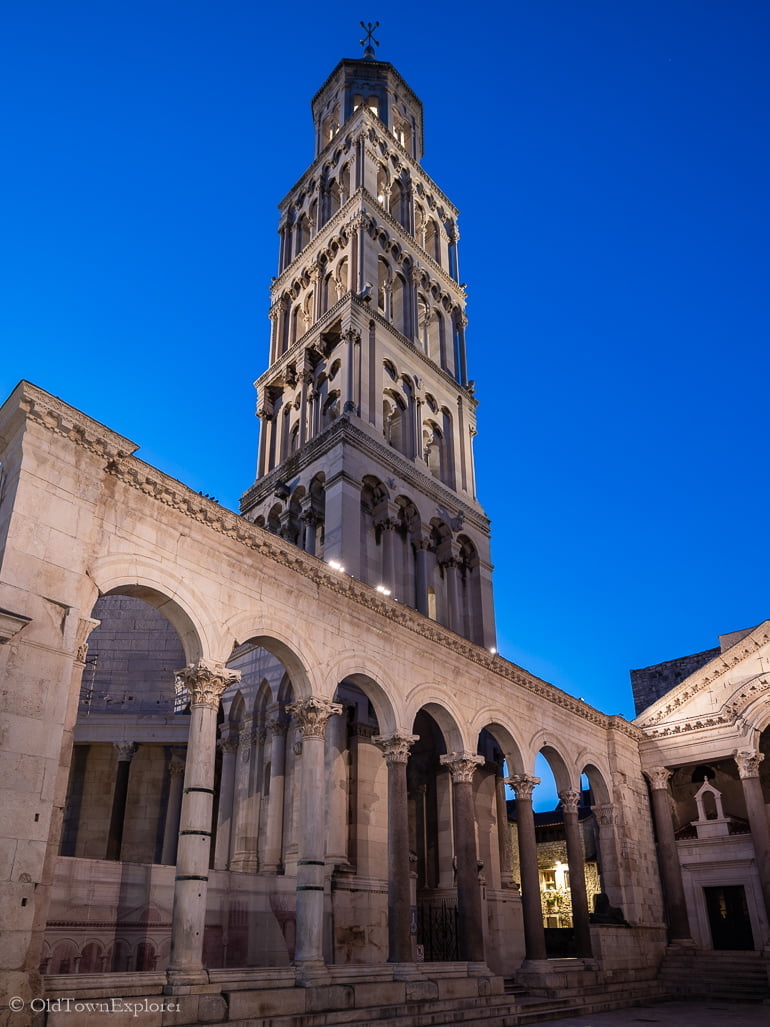
The Cathedral of Saint Domnius stands in the former mausoleum of Emperor Diocletian at the center of Diocletian’s Palace. The octagonal Roman structure was built in the early fourth century and converted into a Christian cathedral in the seventh century, when relics associated with the martyrs Saint Domnius and Saint Anastasius were brought from Salona.
The cathedral preserves the mausoleum’s Roman form, including its ring of columns, carved frieze, niches, and brick dome. Medieval and later additions changed the building without hiding its ancient structure. The tall bell tower was begun in the 13th century, continued over several centuries, and extensively restored between 1890 and 1908.
The cathedral complex faces the Peristyle and includes five distinct visitor spaces:
- Cathedral: The former imperial mausoleum, with Roman architecture, medieval choir stalls, altars, sculpture, and later liturgical additions.
- Bell Tower: A Romanesque-Gothic tower beside the mausoleum, with stairs leading to views across Diocletian’s Palace and central Split.
- Baptistery of Saint John: The former Roman Temple of Jupiter, located across the narrow street west of the Peristyle.
- Cathedral Treasury: A collection of manuscripts, reliquaries, liturgical vessels, vestments, paintings, and other sacred objects connected with the cathedral.
- Crypt of Saint Lucy: The chamber beneath the former mausoleum, now dedicated to Saint Lucy.
Choose the cathedral when you want to see how Split adapted the ceremonial buildings of Diocletian’s Palace rather than abandoning them. The Roman mausoleum is the architectural core, while the bell tower, baptistery, treasury, and crypt reveal the complex’s later Christian history.

Diocletian's Cellars
- Architect: Unknown
- Style: Roman
- Built: 4th century AD (c. 295–305)
- Address: Ul. Iza Vestibula 3, 21000, Split, Croatia
The Cellars of Diocletian's Palace, also known as the "basement halls," is a series of underground structures in the southern part of Diocletian's Palace. They were used to support Emperor Diocletian's private quarters and are considered one of the most well-preserved ancient complexes of this kind globally.
The basement halls of Diocletian's Palace, or substructures, are a well-preserved complex from classical antiquity. This space has 60 rooms that mirror the floor plan of the buildings above. It was initially used for storage and to elevate the imperial residence above ground level. In the early Middle Ages, part of it was inhabited, but later residences were removed during reconstruction.
Although mostly buried and inaccessible, the basements were cleared and opened to the public in the 1950s and 1960s. Restoration of the eastern wing was completed in 1995. Today, visitors can access the basement halls from the seafront promenade or via stairs from the peristyle. It is a popular historical attraction that hosts various events, including art exhibitions, theatre performances, and gastronomic fairs.
The basement halls have also become famous as a filming location for the "Game of Thrones." Fans can recognize it as the setting for Meereen, Queen Daenerys Stormborn, and her dragons.

Church of St. Roch
- Architect: Unknown
- Style: Renaissance
- Built: 1516
- Address: Poljana kraljice Jelene, 21000, Split, Croatia
The Church of St. Roche, built in 1516, is a beautiful example of Renaissance architecture. Interestingly, it was constructed by converting a Romanesque 13th-century house, with the northern wall remaining intact. What's more, part of the colonnade of the portico of the Decumanus of Diocletian's Palace has been integrated into the church's southern wall. It's worth noting that St. Barbara's Church used to be located right beside it.

Jupiter’s Temple / Baptistery of St. John
- Architect: Unknown
- Style: Roman imperial temple with rich decorative reliefs and barrel-coffered vault; repurposed as an Early Christian baptistery in the 6th century
- Built: c. 295–305 AD; adapted in the 6th century
- Address: Ul. Kraj Svetog Ivana 2, 21000, Split, Croatia
The Temple of Jupiter was built from 295 to 305 AD as part of the construction of Diocletian's Palace. It was dedicated to the supreme Roman god and Diocletian's divine father, Jupiter. The temple is located in the western part of the imperial complex, near the Peristyle.
The temple was turned into the Baptistery of St. John the Baptist in the 6th century AD.
Above the temple entrance is a relief depicting various gods and heroes, such as Victoria, Triton, Helios, Hercules, Jupiter, and Apollo. The doorways are richly decorated, especially the impressive barrel-coffered vault of the temple.
Inside the temple are sarcophagi in which two Archbishops of Split, Ivan of Ravenna (died c. 10) and Lovre (died c. 1099), were buried. In addition, a large bronze statue of St. John the Baptist was made by Ivan Maštroviae. A Renaissance sarcophagus of Jakov Selembrije from the 16th century is placed in front of the baptistry.

Vestibule
aka The Rotonda
- Architect: Unknown
- Style: Roman late-antiquity imperial architecture; circular hall with dome, octagonal core, and decorated entry suitable for ceremonial reception
- Built: Early 4th century AD (by the beginning of the 4th century)
- Address: Ul. Iza Vestibula 1, 21000, Split, Croatia
The Vestibule, also known as The Rotonda or The Atrium, is the first section of the imperial corridor in Diocletian's Palace that once led from the Peristyle to the imperial apartments.
Religious Buildings in Split
Split boasts a wealth of historical heritage, and its religious buildings witness this. With a range of magnificent churches and ancient cathedrals, each structure has its tale of faith and devotion.

Church of St. Martin
- Architect: Unknown
- Style: Romanesque and Ancient Roman
- Built: 6th century (within a 4th-century structure) renovated (9th century)
- Address: Dioklecijanova ul. 10, 21000, Split, Croatia
The Church of St. Martin is one of the oldest churches in Diocletian's Palace. It was built between the 5th and 6th centuries in the sentries' walkway above the Golden Gate and has undergone numerous renovations. The church is particularly notable for its Early Romanesque chancel screen from the 11th century, which remains in its original location. The screen bears an inscription that speaks of the church's dedication to the Virgin, St. Gregory the Pope, and St. Martin. Since the 14th century, a Dominican convent has stood adjacent to the church.
The church's present appearance is a replica of the early Croatian church from the 6th century. An altar partition in the pre-Romanesque style was added in the 11th century and has been preserved in its original location. This uniqueness places the small church of St. Martin among the best-preserved sacral monuments of the ancient world. Today, the church is an integral part of the Dominican nunnery.

Church of Our Lady of the Bell Tower and the Municipal Clock
- Architect: Unknown
- Style: Romanesque (belltower); Romanesque (clock)
- Built: 6th century; 16th century (clock)
- Address: Ul. Ispod ure 2, 21000, Split, Croatia
The Church of Our Lady of the Bell Tower (Gospa od Zvonika) has a fascinating history dating back to the 6th century. It was built on the sentries' walkway above the Iron Gate of Diocletian's Palace and was originally dedicated to Saint Theodore. In the 11th century, an Early Romanesque bell tower was added, making it the oldest preserved bell tower on the Croatian side of the Adriatic.
During this period, the church received significant contributions from Firminus, a city benefactor, and his first and second wives, Magi and Brita. Notable remnants from this era include fragments of a chancel screen with an inscription mentioning their names. In the 13th century, the church was renamed after the installation of the icon of Our Lady of the Bell Tower, which is currently safeguarded in the treasury of Split Cathedral.
Adjacent to the Iron Gate and facing the square (Pjaca), a Romanesque tower was built. In the 16th century, a Romanesque municipal clock was installed in this tower, adding a touch of modernity to the ancient structure. The church and its surrounding elements stand as a testament to the rich historical and architectural heritage of the region.

Church of the Holy Spirit
- Architect: Unknown
- Style: Gothic (probable local medieval Gothic)
- Built: Likely 15th century
- Address: Domaldova ul. 7, 21000, Split, Croatia
Dominican Church and Monastery of St. Catherine of Alexandria
- Architect: Unknown
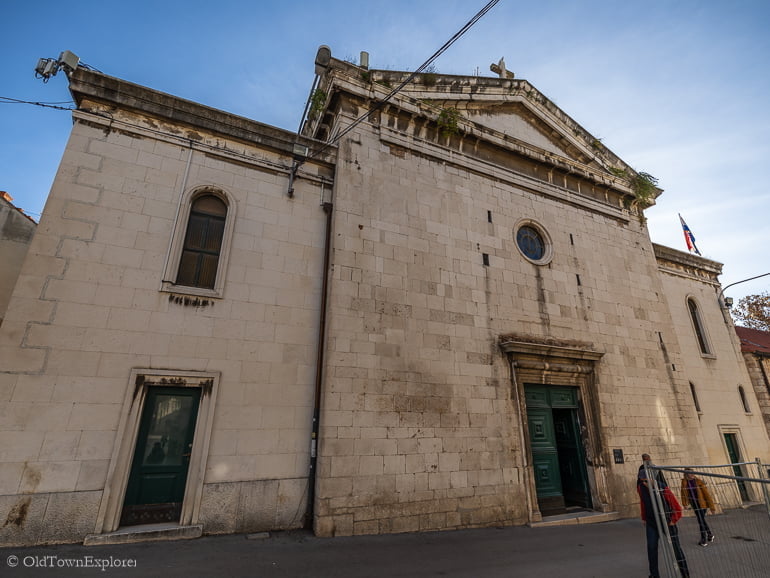
- Style: Initially Gothic, later Baroque elements from 17th-century reconstruction
- Built: Founded circa 1245; underwent major phases of Baroque reconstruction in the mid-17th century; reconstructed and reopened in 2009
- Address: Hrvojeva 2, 21000, Split, Croatia
Dominican Monastery of St. Catherine of Alexandria

Remains of the Church of St. Michael in Ripa Maris
- Architect: Unknown
- Style: Medieval Pre-Romanesque
- Built: Founded in medieval era by St. John of Ravenna; expanded in the 11th century; demolished in 1906
- Address: Ul. Mihovilova širina 1, 21000, Split, Croatia
Remains of the Church of St. Michael in Ripa Maris are inside Diocletian's Palace. According to tradition, the Church was founded by St. John of Ravenna and later expanded in the 11th century. Unfortunately, the church was demolished in 1906.

Church of St. Philip Neri
- Architect: Francesco Melchiori (Venetian military architect of Vicenza)
- Style: Baroque
- Built: 1735 (built on earlier 1680 church)
- Address: Poljana Grgura Ninskog 1, 21000 Split
In 1672, a clergyman named Nikola Bjanković from Split and a Bishop from Makarska decided to establish a Philippine congregation and construct a church dedicated to St. Philip Neri. The church was built on the site of the Papalić house, which was donated by a nobleman named Frane Soppe Papalić. Additionally, two more sites were purchased adjacent to the house. The church's construction began in 1679 and was completed by 1680.

One-time Convent of the Poor Clares of St. Nicholas
- Architect: Unknown
- Style: Gothic monastic complex
- Built: Established in the 15th century; functioned until 1884; currently houses the Ethnographic Museum
- Address: Ul. Iza Vestibula 4, 21000, Split, Croatia
The site where the Diocletian's Palace's triclinium and residential area once stood was later used as the location of the Split Poor Clares convent from the 15th century until 1884. This historically significant complex has been thoroughly investigated and found to have exceptional historical stratigraphy. Nowadays, the complex houses the Ethnographic Museum, which displays parts of a Romanesque street, the Chapel of St. Andrew de Fenestris, the Palace of King Ladislav of Naples, the palace of the noble Božlčević (or Natalis) family, and other features dating back to the 18th and 19th centuries.

Church and Monastery of St. Francis
- Architect: Unknown
- Style: Gothic
- Built: 13th-century cloister
- Address: Trg Franje Tuđmana 1, 21000, Split, Croatia
The Church and Monastery of St. Francis has a 13th-century cloister and houses the tomb of Croatian author Marko Marulić.

The Bell Tower and the Chapel of the Holy Arnir
- Architect: Unknown
- Style: 18th-century bell tower; chapel is medieval remnants
- Built: Bell tower constructed between 17th c. and completed in 1708; original monastery founded 1069; chapel remains of structure demolished
- Address: Ulica kralja Tomislava 15, Split, Croatia (near Silver Gate entrance)
Split Synagogue
- Architect: Unknown
- Style: Romaniote-style sanctuary (converted Renaissance-era medieval houses); interior redesigned c. 1728; Aron Hakodesh in Classicist style
- Built: Early 1500s
- Address: Zidovski Prolaz (“Jewish Passage”), western wall of Diocletian’s Palace, Split, Croatia
Old Archiepiscopal Seminary – Islamic Place of Worship
- Architect: Unknown
- Style: Historicist (original seminary) — adapted for Islamic use
- Built: Late 19th–early 20th century (original seminary); converted mid-20th century for Islamic worship
- Address: Bosanska ulica 4, 21000, Split, Croatia
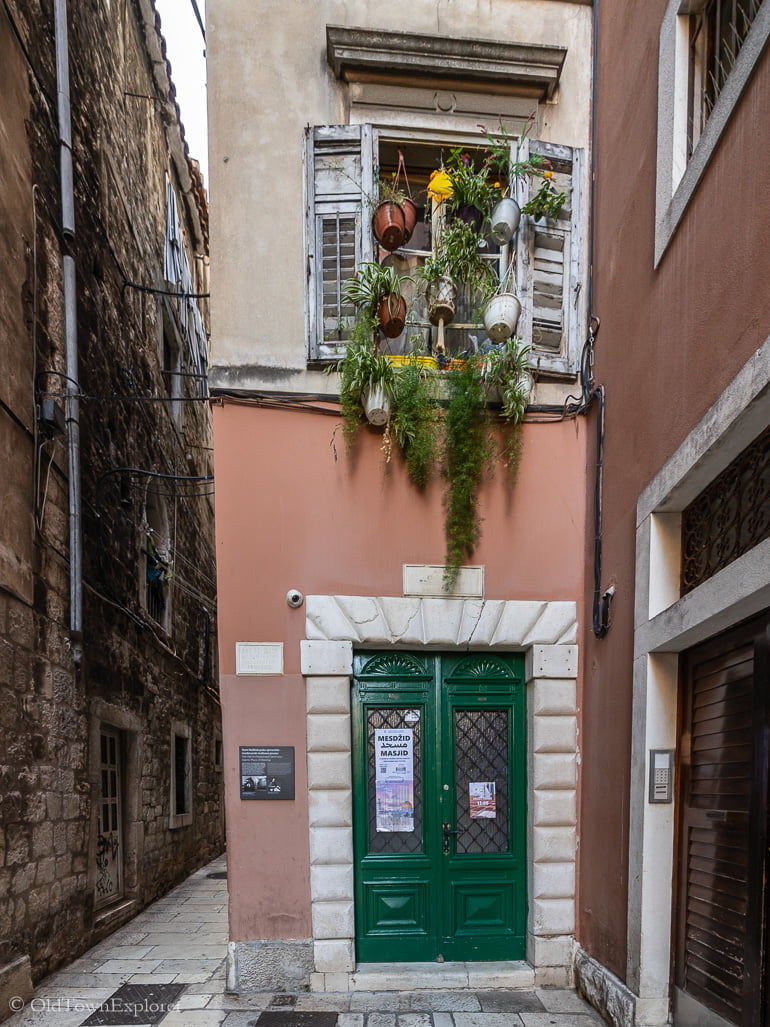
Originally constructed as the Archiepiscopal Seminary for the Catholic Archdiocese of Split, this historic building reflects the late 19th- to early 20th-century ecclesiastical architecture common in Dalmatia. It was built to train clergy for the local church but, in the post–World War II period, the building was repurposed to meet the needs of Split’s growing Muslim community.
Today, it functions as the city’s main Islamic place of worship, serving around 200 Muslim families. The interior has been adapted for prayer with simple furnishings, carpets, and the absence of figurative decoration, while the exterior retains much of its original seminary appearance. This transformation is a unique example of adaptive reuse of religious architecture in Croatia, highlighting Split’s evolving cultural and religious diversity.
Palaces in Split
Split is not only known for its religious buildings but also for its magnificent palaces that stand as symbols of the city's rich history. These palaces serve as a testament to the grandeur and luxury of the past, offering visitors a glimpse into the lives of those who once resided within their walls.

Large Papalic Palace
- Architect: George of Dalmatia (Juraj Dalmatinac)
- Style: Gothic-Renaissance
- Built: 15th-century
- Address: Papalićeva Ulica 1, Split, Splitsko-dalmatinska 21000, Croatia
Papalic's Palace, a 15th-century gothic-renaissance masterpiece made by Juraj Dalmatinac, is located next to the Golden Gate. Nowadays, it is the location of the Split City Museum.
The Late Gothic palace was put up in the mid-15th century by the patrician Split Papalić family, who entrusted the construction to George of Dalmatia and his workshop. It was a place that in its time hosted the meeting of the Split Humanist Circle. With a richly decorated portal, loggia, well and external staircase in the courtyard, with its large salon, painted ceiling and four-light mullioned window on the first floor, it was a model for all Split palaces in the second half of the 15th century. Since its renovation in 1950, it has housed the Split City Museum.
Augubio Palace
- Architect: George of Dalmatia
- Style: Romanesque and Baroque (remodel)
- Built: 15th century
- Address: Dioklecijanova 1, 21000, Split, Croatia
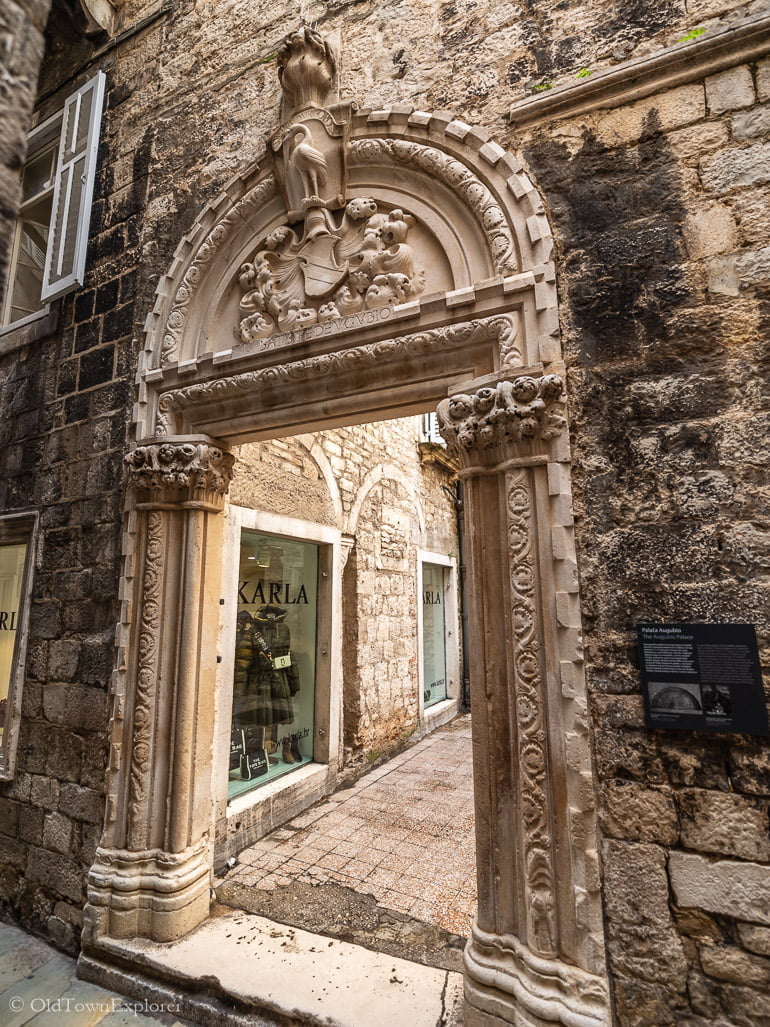
Palace Augubio is in the heart of Diocletian's Palace, a UNESCO World Heritage Site. It was built in the Late Gothic style during the second half of the 15th century by a wealthy merchant named Giovanni Battista De Gubbio. The palace is attributed to the circle around George of Dalmatia and was later remodeled in the Baroque style. Interestingly, the oldest parts of the palace are Romanesque, as confirmed by a fresco depicting a peacock discovered on the second floor.
The palace's opulent portal was designed based on the portal of the Large Papalić Palace, and the original owner's name is carved on the lunette. The expressive stone sculpting is believed to be the work of Andrija Aleši, the most prominent master of the workshop of George of Dalmatia.

Andric House
aka Emanuel Vidović Gallery
- Architect: Vicko Andrić
- Style: Classicist
- Built: 1830s–1840s (adaptation of earlier medieval structures)
- Address: Poljana kraljice Jelene 1, 21000, Split, Croatia
The Classicist style building, which spans three stories, was originally designed by architect Vicko Andric for the Classics High School. It was constructed by rebuilding several medieval houses along the eastern wall of Diocletian's Palace.
Today, the building is home to the Emanuel Vidović Gallery, dedicated to showcasing the life and work of the renowned Split and Croatian painter Emanuel Vidović (1870-1953).

Grisogono Palace
- Architect: Unknown
- Style: Romanesque (13th century) with later Gothic remodeling (15th century)
- Built: 13th century; remodeled in the second half of the 15th century
- Address: Ul. Kralja Petra Krešimira IV 8, 21000, Split, Croatia
The Grisogono Palace is a medieval house belonging to the Grisogono family, a prominent patrician family of the old Split. It was built on the corner of the Decmanus - the main street in Diocletian's Palace - and the Peristyle.
This house is part of a larger Romanesque family palace dating back to the 13th century. The house was remodeled in the Gothic style in the latter half of the 15th century. At the beginning of the 21st century, the house was restored, and the painted Gothic ceilings on the first and second floors of the palace were also restored.

Cindro Palace
- Architect: Unknown
- Style: Baroque
- Built: 17th century
- Address: Ul. kralja Petra Krešimira lV 5A, 21000, Split, Croatia
The Cindro Palace (Palača Cindro) was built by the Croatian noble Cindro family in the 17th century. It is on the street that leads from Peristil to Pjaca.
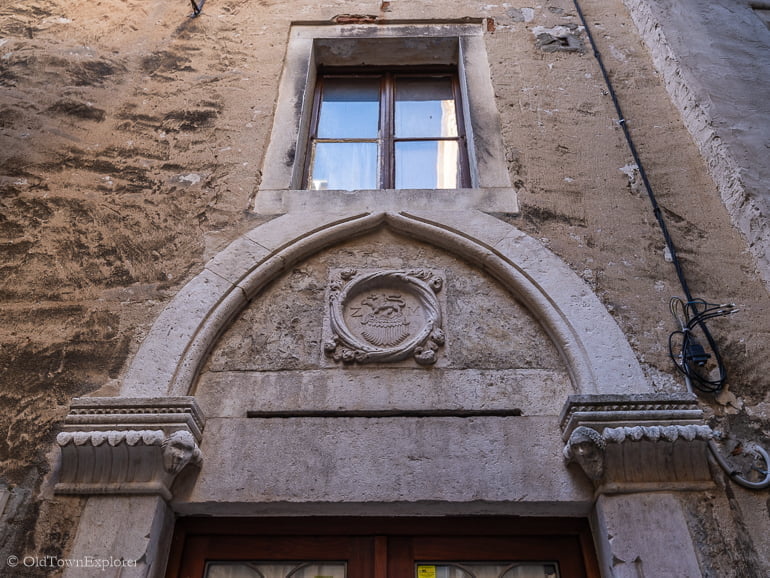
Marulic Palace
- Architect: George of Dalmatia
- Style: Gothic
- Built: second half of the 15th century
- Address: Papalićeva ul. 4, 21000, Split, Croatia
Marulic Palace (Palača Marulić) is a late Gothic palace that dates back to the second half of the 15th century. According to tradition, it's believed that the great poet Marko Marulić, known as "the father of Croatian literature," was born there. The palace is attributed to the workshop of George of Dalmatia. In the 19th century, the palace underwent significant modifications and extensions in the courtyard. The courtyard portal, which features the coat of arms of the Marulić family in the lunette, is still preserved.
Skocibucic Palace
Palača Skočibušić Lukarić
- Architect: Unknown
- Style: Romanesque
- Built: 15th century (rebuilt)
- Address: Peristil ul. 5, 21000, Split, Croatia
The Skočibučić-Lukaris Palace is situated in the southwest corner of the Peristyle. Its main facade is located inside the western colonnade. The palace is a spacious complex with several Romanesque houses near the baptistery and Vestibule. On the northern facade, you can see traces of the Romanesque phase, including the remains of the monophore and the Romanesque cornice that divides the floors. The palace also features a monumental Gothic portal with a lunette, which includes a coat of arms with the image of an ox.
The Skočibučić family rebuilt the palace in the 15th century around an inner courtyard with a Gothic loggia. On the northern wall, you can see fragments of frescoes with geometric decoration and medallions. The Skočibučić-Lukaris Palace is an example of the layered construction that characterizes the former imperial square and Diocletian's Palace. It played a vital role in the development of the medieval city when the seat of church and secular power was on the Peristyle.
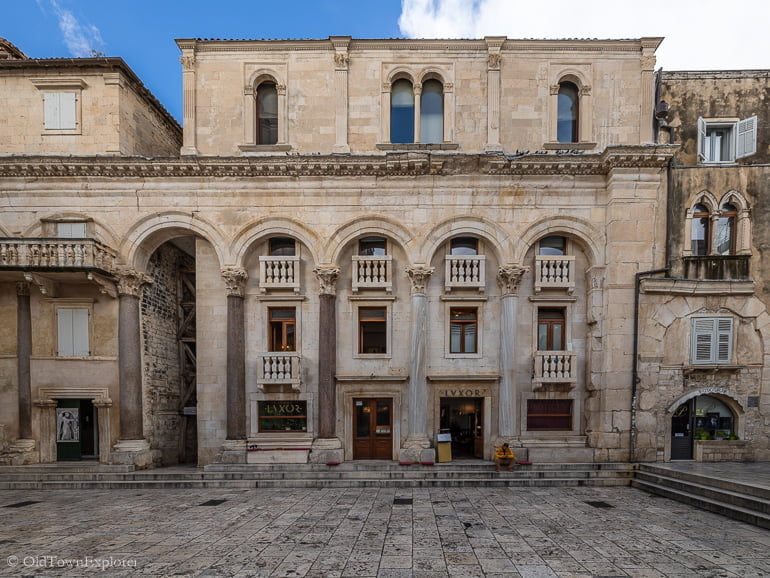
Cipci Palace
- Architect: Unknown
- Style: Gothic
- Built: 15th century
- Address: Bosanska ul. 5, 21000, Split, Croatia
Golden Gate Palace
- Architect: George of Dalmatia
- Style: Late Gothic
- Built: second half of the 15th century
- Address: Ulica Majstora Jurja 15, Split, 21000, Croatia
The Golden Gate Palace is a Late Gothic palace that was built in the second half of the 15th century. The design and execution of the palace are attributed to George of Dalmatia. The identity of the patrician family for whom it was built is unknown, but their coat of arms can be found in the lunette of the courtyard portal. Later on, it belonged to the old Split patrician family of Cindo, whose coat of arms is visible on a capital of the courtyard loggia. In 1960, the courtyard with loggia and staircase, the first-floor loggia, and the elevation of the Romanesque palace facing Dioklecijanova Street underwent renovation.
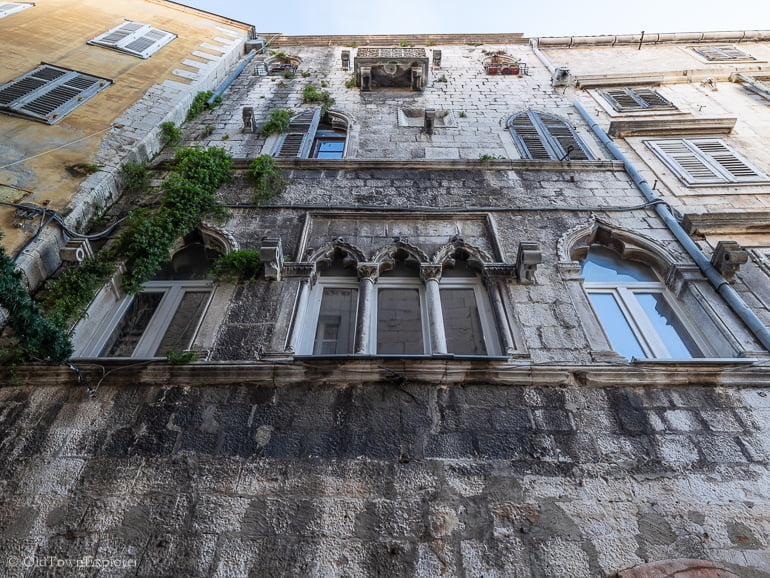
Cambi Palace
- Architect: Unknown
- Style: Gothic
- Built: first half of the 15th century
- Address: Bosanska ul. 3-1, 21000, Split, Croatia
The Cambi Palace is a Gothic palace that belonged to the Cambi family, a patrician family of Split. It was constructed in the first half of the 15th century and underwent some modifications in the 19th century. The principal façade of the palace is the most stylistically coherent among all the Split Gothic palaces built before the arrival of George of Dalmatia.
Alberti Palace
- Architect: Unknown
- Style: Gothic core; Baroque façade remodel in late 18th century
- Built: Original medieval structure; remodeled in second half of 18th century
- Address: Ul. Petra Kružića 4, 21000, Split
The Alberti Palace (Palača Alberti) was originally owned by the Alberti family from Split and is predominantly built in the Gothic architectural style. The coat of arms of the Alberti family can be found on the lunette of the portal in Kružićeva Street.
In the latter half of the 18th century, the palace underwent significant renovations, where a new three-story volume and the main Baroque-style façade were added in the place of the demolished part of the rampart. The palace is a rare example of Split architecture, featuring a Venetian palace concept with a central hall divided into three parts, with balconies on both sides.
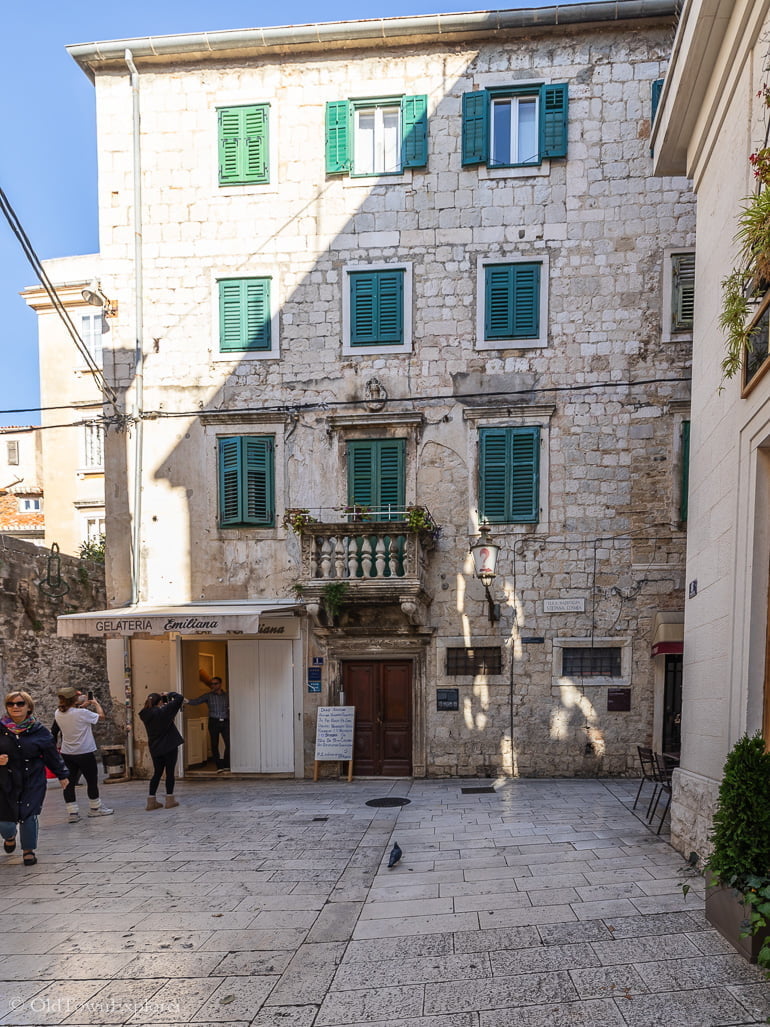
Dragisic (de Caris) – Geremia Palace
- Architect: Unknown
- Style: Romanesque; Gothic and Renaissance (15th century rebuild); Baroque (17th century rebuild)
- Built: 13th century; 15th century (rebuilt); 17th century (rebuilt); 19th century (rebuilt)
- Address: Cosmijeva ul., 21000, Split, Croatia
Dragisic (de Caris) – Geremia Palace dates back to the 13th century, originally built in the Romanesque style. In the 15th century, it was renovated in Gothic and Renaissance styles while preserving its historical layers. Later, in the 17th century, the Baroque style was added by Juraj Dragišić, a canon and writer from a patrician family from Poljica. The family coat of arms can be seen above the former courtyard portal in the Baroque style. The palace underwent significant remodeling in the 19th century.

Karepic Palace
- Architect: Unknown
- Style: Romanesque origins with Gothic remodel; Renaissance façade (1564)
- Built: Romanesque original pre-15th century; remodeled 1564
- Address: Bosanska ul. 1, 21000, Split, Croatia
The Renaissance palace belonged to the Karepić family, who moved from Trogir to Split around 1300. The oldest parts of the palace suggest it was a Gothic reconstruction of a Romanesque house. The current appearance of the palace was acquired in 1564, during the time of Canon and Vicar Ivan Karepić, who was the last member of the Karepić family to own the house. The family coat of arms on the main façade has an inscription below that tells of the Renaissance renovations.

Milesi Palace
- Architect: Unknown
- Style: Baroque with Renaissance portal
- Built: 18th century
- Address: Trg Braće Radić 7, 21000, Split, Croatia
The Milesi Palace (Palača Milesi) is an 18th-century palace built in the Baroque style by the wealthy Milesi family once they had acquired the status of urban patricians. The palace features round openings for shops on the principal elevation and a re-utilized Renaissance portal on the western elevation. The grandeur of the elevation's modeling and its dramatic position on the square set it apart from other Baroque palaces in Split and Dalmatia. Today, the palace is home to the Split section of the Croatian Academy of Sciences and Arts.

Tartaglia Palace
- Architect: Unknown
- Style: Baroque
- Built: 18th century
- Address: Ul. Pavla Šubića 2, 21000, Split, Croatia
The Tartaglia Palace is an 18th-century baroque palace that once belonged to the Tartaglia family, one of Split's oldest noble families. This magnificent three-story building has a main facade with seven longitudinal axes, with the central one highlighted by balconies. It was built by combining several older houses in the medieval part of the city north of the Milesi Palace. The palace was designed in Venetian Baroque palaces, featuring a central organization of space, as interpreted by local builders. The palace's rooms are arranged around an inner courtyard, accessed through an atrium with the height of the ground floor and a mezzanine from the main portal.
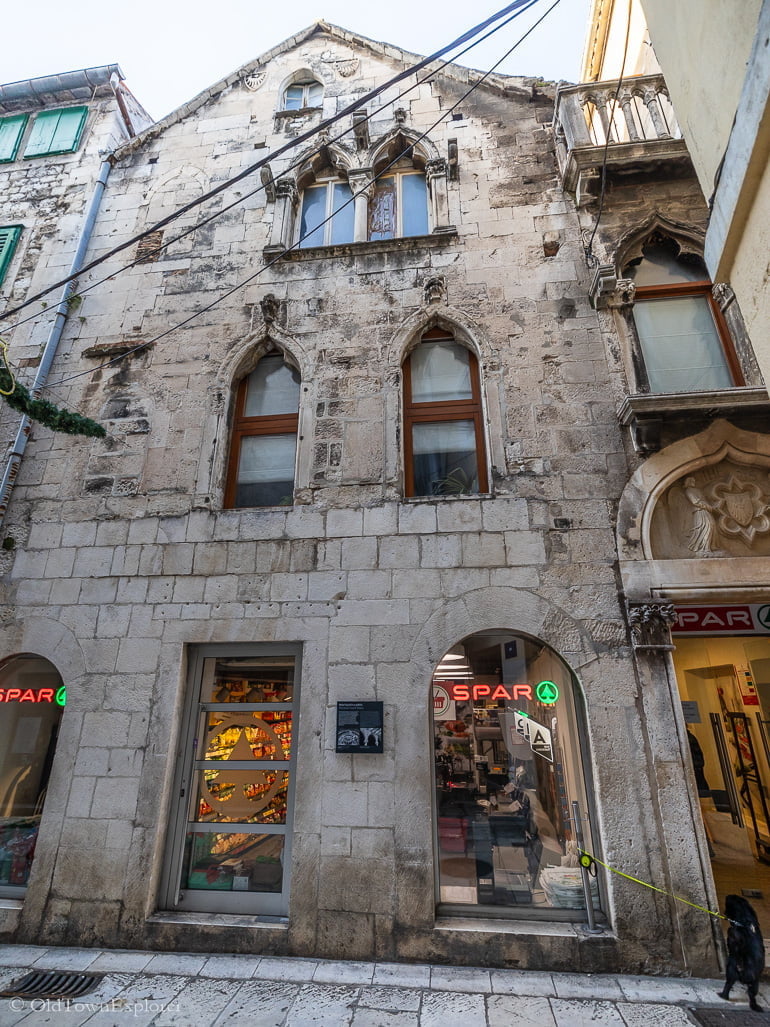
Small Papalic Palace
- Architect: Unknown
- Style: Medieval
- Built: 13th century (ground floor); 15th century (upper floors)
- Address: Ul. Pavla Šubića 3-5, 21000, Split, Croatia
The Small or Little Papalić Palace (Mala Papalićeva Palača) has a ground floor that dates back to the 13th century, while the upper floors were built in the 15th century. On the lunette of the portal, you can see a relief featuring two angels and the family coat of arms.

Pavlovic Palace
- Architect: Unknown
- Style: Renaissance core with Baroque remodeling
- Built: 16th century; remodeled 17th century
- Address: Palača Pavlović, Narodni trg, 21000, Split, Croatia
The Pavlovic Palace (Palača Pavlović) is a Renaissance palace that belonged to an old Split patrician family from the 16th century. During the Baroque period, the palace was extended, and a closed courtyard and portal in the western part was acquired. At that time, the main façade was also remodeled. The palace has an exceptional town planning value as it forms the southern façade of the main city square, Pjaca. It stands opposite the Rector's Palace, which was subsequently demolished.
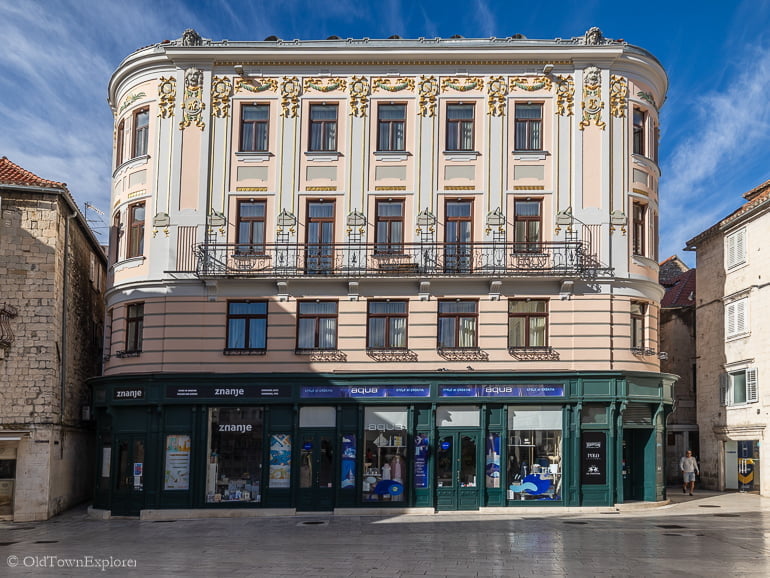
Nakic Palace
- Architect: Kamilo Tončić (1902 design)
- Style: Secessionist (Art Nouveau)
- Built: 1902–1903
- Address: Narodni trg 3, 21000, Split, Croatia

Ciprianis-Benedetti Palace
- Architect: Unknown
- Style: Romanesque
- Built: 1394
- Address: Bosanska ul. 2, 21000, Split, Croatia
The Ciprianis-Benedetti Palace was constructed in 1394 for Cipriano de Ciprianis, a nobleman from Split who governed Korčula on behalf of King Tvrtko of Bosnia. The Benedetti family acquired the palace in 1860.
The palace is notable for its sculptures and windows. The loggia-like upper level with double rows of six mullioned windows featuring Late Romanesque columns is particularly impressive. The mid-relief sculpture of St. Anthony the Hermit, standing under a narrow canopy, is also noteworthy.
Bajamonti-Deskovic Palace
- Architect: Giovanni Battista Meduna
- Style: neo-Renaissance
- Built: 1858
- Address: Trg Franje Tuđmana 3, 21000, Split, Croatia
The Bajamonti-Dešković Palace was constructed in 1858 and is a neo-Renaissance building that follows the classicist style. It was the official residence of Dr. Antoni Bajamonti, the mayor of Split. The Dešković family has owned it since 1900.
On the first floor, the salons have ceilings painted with allegorical images by Antonio Zuccaro in 1858. The main facade has four monumental stone statues of allegories of the Virtues that originally came from Venice in the 18th century. The attic of the palace was home to the studios of well-known photographers and painters from Split during the late 19th century and the first half of the 20th century.
The palace is an outstanding example of 19th-century residential architecture in Split and has a distinct stylistic and urban value.

Iron Gate Palace
- Architect: George of Dalmatia
- Style: Gothic
- Built: mid-15th century
- Address: Bajamontijeva ul. 2, 21000, Split, Croatia
The Iron Gate Palace, built in the mid-15th century, is a late Gothic palace that underwent several renovations. The workshop of George of Dalmatia is linked to these remodelings. A grand palace it once was, but only the portal on the first floor and the half-column with capital of the courtyard loggia remain today. Two antique heads from the period of the Tetrarchs have been built into the courtyard's northern wall. They probably belonged to the statues that once adorned the Iron Gate of Diocletian's Palace. The elevation looking onto Pjaca Square is in the Renaissance style and was rebuilt in the 19th century. Since 1999, the Split Literary Circle has occupied the palace.
Gates in Split
These magnificent gates to Diocletian's Palace stand as a testament to the city's rich history and are a gateway into the past.

Golden Gate
- Architect: Unknown
- Style: Roman military and monumental gate architecture
- Built: 4th century AD
- Address: Dioklecijanova 7, 21000, Split, Croatia
The Golden Gate (Zlatna Vrata) is the name for the north entrance to the Palace.
It was the main entrance to the Palace. So it had been elaborately decorated with statutes of the Emperor Diocletian and his co-regent Maximilian in the upper row of the niches and with a sculpture of an eagle as a symbol of Jupiter between the two. There were the statues of their two successors to the thorne - caesars Galerius and Constantine - in the lower row of the niches.
It is well preserved, although niches in the wall miss statues.

Silver Gate
- Architect: Unknown
- Style: Roman
- Built: 4th century AD
- Address: Hrvojeva, 21000, Split, Croatia
The Eastern Gate of Diocletian's Palace, also known as the Silver Gate, was named after St. Apollinaire, a highly venerated saint of the Early Christian period. Similar to the northern and western gates of the Palace, the sentry corridor above the Silver Gate was transformed into a church, possibly in the 6th century.
The wall structure and the gate were incorporated into other buildings in the following years. For instance, the Church of Saints-Innocents ("Dušice") was built using these structures, but unfortunately, it was demolished during World War II.
The Silver Gate was rediscovered in the early 1950s, and efforts were made to restore it to its original appearance by excavating it to the original level. During this restoration, many additional structures that had been added to the eastern wall of the Palace in previous centuries were removed.

Bronze Gate
- Architect: Unknown
- Style: Roman utilitarian gate architecture
- Built: 4th century AD
- Address: Obala Hrvatskog narodnog preporoda 22, 21000, Split, Croatia
The Bronze Gate, also known as "the Southern Gate," is one of the four main Roman gates that lead into the stari grad of Split. It was constructed as a part of Diocletian's Palace and originally served as a sea gate for the Emperor's boat to enter the complex. Today, it is the primary entry point from the promenade to the cathedral.

Iron Gate
- Architect: Unknown
- Style: Roman
- Built: 4th century AD
- Address: Ul. Ispod ure, 21000, Split, Croatia
The Iron Gate, also known as "the Western Gate," is one of the four main Roman gates that lead to the stari grad of Split, which was once Diocletian's Palace. Originally used as a military entrance to the complex, this gate is the only one that has been in continuous use up to the present day.
Within the Iron Gate, you can find the beautiful 10th-century Church of Our Lady of Belfry.

Venetian Gate
- Architect: Unknown
- Style: Medieval city gate architecture
- Built: Late Middle Ages (14th–15th century)
- Address: Poljana kraljice Jelene bb, 21000, Split, Croatia
Near the Silver Gate was a smaller gate known as the Venetian Gate, which was opened during the late Middle Ages. This gate was used as the entrance to the city when additional structures obstructed the Silver Gate.
Pistura Gate
- Architect: Unknown
- Style: Medieval
- Built: 14th century
- Address: Unknown precise street location (northern side of Split’s extended medieval walls)
In the 10th and 11th centuries, the city of Split began building an extension along the western walls of the Palace. The West Gate, also known as the Iron Gate, connected the two parts of the city. However, the North Gate is no longer in use and has been blocked off by a wall.
In the 14th century, new defensive walls were built around the extended zone, and two new gates were added - The Butchers' Gate to the west and the Sea Gate to the south. A small gate was also opened in the city wall on the north side of the street, which was used as the main communication passage to the north, leading towards Solin and Klis after the town had been extended towards the west.
In the Middle Ages, the city streets were formed in this extended zone, and the 13th and 14th centuries, a few mansion houses of wealthy citizens were built, some of which have been preserved until the present day.
Statues in Split
Throughout the city of Split, statues stand as silent witnesses to its rich history and cultural heritage. These sculptural masterpieces dot the streets, squares, and parks, capturing the essence of different periods and characters that have shaped the city.

Statue of Gregory of Nin
- Architect: Ivan Meštrović
- Style: 20th-century monumental realism
- Built: 1929 (original in Split; later relocated; current statue placed in 1954)
- Address: Ul. kralja Tomislava 12, 21000, Splitska, Croatia
Gregory of Nin (Grgur Ninski) was a medieval bishop who advocated for Slavic worship and is considered a national hero in Croatia. The statue of Gregory of Nin is located near the Golden Gate entrance and is a masterpiece of Ivan Mestrovic, the most renowned Croatian sculptor.

Marko Marulic Statue
- Architect: Ivan Meštrović
- Style: 20th-century monumental realism
- Built: 1925
- Address: Trg Braće Radić 5, 21000, Split, Croatia
Marko Marulic, a poet from the 15th century, is known as the "Father of Croatian Literature." A statue of Marulić, created by Ivan Mestrovic, can be found in the Fruit Square. This remarkable piece of art represents the cultural and literary presence felt throughout Split. Marulić was also involved in the Humanist circle during his time and is credited with being the first to use the Croatian language. As a result, many believe that he played a significant role in the Croatian Renaissance.
The Engish translation of the inscription on the statue is:
In this house (according to tradition) 18. VII. 1450. born
Marko Marulić
prosa and in the verses of sparsely agreeing
according to our seasoning
the screams hit the Croatian art book.
mankind comes to the works of the mind
they have a classic Christian ruin in them.
about the four hundred year anniversary of the death of the year 1925.
this panel places the hometown.
and in 1999 renewed the literary circle of Split-Marulianum.
Other Attractions in Split
Besides the rich cultural and literary heritage, Split has many other attractions worth exploring.

Split Riva
- Architect: Unknown
- Style: 19th-century neoclassical waterfront promenade
- Built: Early 19th century (French rule, c. 1807–1813)
- Address: 21.000, Split, Croatia
Riva is a promenade near the Diocletian's palace in Split, Croatia. It hosts important political, social, and entertainment events and is a special place for locals.
One of the first medieval structures built at the waterfront, near the Palace, was a wall that ran from the southeastern tower of the Palace (also known as the Archbishop's Tower) towards the seafront. This wall was mentioned in the municipal Statute from 1312. A similar wall was erected to the west, protecting the entire space in front of the Palace and the city with walls.
Riva got its present appearance in the early 19th century, during the period of French rule. It was extended and graveled, and a series of houses bearing some characteristic architectural features of that period were erected. Some of these houses have been well-preserved up to the present time.
Radić Brothers Square
aka Fruit Square
- Architect: Various
- Style: Venetian Gothic (tower), Baroque (palace)
- Built: 15th century (tower), 17th century (palace)
- Address: Trg Braće Radić 5, 21000, Split, Croatia
Radić Brothers Square (Trg braće Radić), aka the Fruit Square, is in the southern part of the palace, just near Split Riva. On the west side of the Square is the octagonal Venetian Tower (15th century), built when the Venetians ruled the city and defended it from occasional attacks by the Turks but also from rebellions against their authority in the city itself. On the Square's north side is the baroque palace Milesi (17th century), in front of which is a bronze monument to Marko Marulić. The monument was made by Ivan Meštrović, and the sculpture was unveiled on July 26, 1925.

Marmont's Street
- Architect: Unknown
- Style: Early 19th-century neoclassical urban street design
- Built: Early 19th century
- Address: Marmontova ul. 5, 21000, Split, Croatia
Marmont's Street is a beautiful street between the Croatian National Theater and Riva. It was named after Napoleon's General Marmont, who, interestingly, was one of the occupiers of Split. Despite this fact, people still highly regard Marmont due to his huge contribution to the city's architecture.

Prokurative
aka Republic Square
- Architect: Antonio Bajamonti (design inspired by Venetian arcaded squares)
- Style: Neo-Renaissance
- Built: Mid-19th century (c. 1850s)
- Address: Prokurative, Trg Republike, Croatia
Prokurative, also known as Republic Square, is a famous square in Split, Croatia. It was designed by the Marmont and is located near the end of Marmont's Street and the monastery of St. Francis on Riva. The square is reminiscent of St. Mark's Square in Venice and is located west of Riva. It was named after the arches on the neo-Renaissance buildings surrounding the square on three sides.
The square is only open on the south side, offering a beautiful view of the harbor and the waterfront. Antonio Bajamonti, one of the most renowned mayors in the city's history, initiated the building of Prokurativa in the mid-19th century. The colonnade is inspired by Venetian architecture, and the reliefs above the windows evoke ancient and Renaissance influences.
The square is a popular venue for cultural events, especially the pop music festival. The local bars and restaurants also make it a popular hangout spot for the citizens of Split. The plateau on the south side is an integral part of Prokurative. It features a neo-classical fountain since 1947, destroyed by the communist authorities due to its alleged connection to the Italian rule over Split and Dalmatia.

People’s Square
People's Square aka Pjaca (The Square)
- Architect: Various medieval and Renaissance builders
- Style: Medieval square with Renaissance civic buildings
- Built: Developed from the 13th century onward
- Address: 21000, Grad, Split, Croatia
People’s Square (Narodni Trg) is the heart of the Old Town. Cafes and restaurants spill out into the square, and one of the highlights of a visit here is gazing up at the old town clock.

Venetian Tower
- Architect: Venetian military engineers
- Style: Venetian Gothic military architecture
- Built: 15th century
- Address: Trg Braće Radić 6, 21000, Split, Croatia
In 1420, the Republic of Venice conquered Split and ruled the city for nearly four centuries until 1797. During that time, they constructed a castle in the western part of the harbor. The castle's Great Tower, the only remaining part of the structure, still dominates the urban landscape of Split today. It is located on Voćni trg in the center of the old town near the Riva.
The Venetian Tower (Mletački kaštel) has a regular octagonal floor plan with dimensions of 10.5 x 10.5 m and a total height of 24 m. Four floors have been preserved because the ground floor is considered the first due to its elevated position. The floors are connected by a staircase located within the thickness of the Tower's walls, which are vaulted with stone blocks. The room on the first floor has a tufa barrel vault, and the other floors have similar vaults except for the third floor, which has a wooden structure.
At the top was another cantilevered floor (mashikul), but only the triple consoles were preserved. The tented roof was removed between 1549 and 1570 to install artillery on the terrace, which dominated the town.

Old Town Hall
- Architect: Unknown
- Style: Gothic (original), Neo-Gothic (rebuild)
- Built: 1443–1445; rebuilt 1890
- Address: Narodni trg, 21000, Split, Croatia
The Old Town Hall is the only building of the original complex that remains after being demolished in 1825. The complex included the Rector's Palace, the theatre, and the jail. The town hall was reconstructed in neo-Gothic style in 1890. Although most of the original architecture is lost, the portico on the main façade, the north wall, and the Chapel of St Lawrence (Lovro) remain today. The Chapel was built in 1455 as a bridge between the Town Hall and the Karepić Palace. From 1910 to 2005, the Ethnographic Museum was located in the Town Hall. Today, it serves as an exhibition venue.
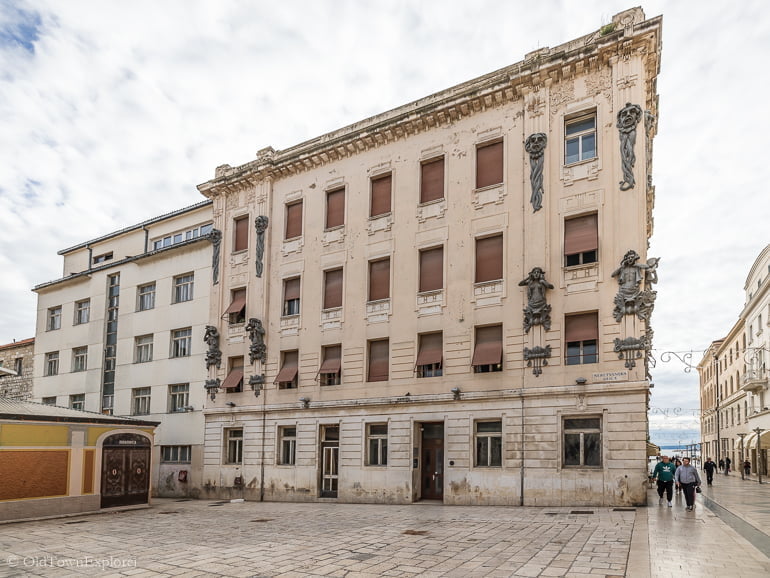
Sulphur Spa
- Architect: Kamilo Tončić
- Style: Croatian Art Nouveau
- Built: 1903
- Address: Neretvanska ul., 21000, Split, Croatia
The Toplice KBC Split (Sumporne Toplice) was constructed in 1903 by Kamilo Tončić. It's a significant example of Croatian Art Nouveau architecture, with its beautifully decorated exteriors and interiors. The building is built on top of natural sulfur springs used for healing since the 18th century.
Sustipan
- Architect: Unknown
- Style: Medieval monastic architecture; 19th-century landscaped cemetery
- Built: Monastery (Middle Ages), cemetery (1820s–1850s)
- Address: Sustipanski put, 21000, Split, Croatia
Sustipan is a small peninsula located in the southwestern part of Split. During the Middle Ages, a Benedictine monastery and a church were in the area. In the 19th century, one of the most beautiful cemeteries in Croatia was built in Sustipan. However, the cemetery was removed by the Communist authorities in the 20th century. Today, Sustipan is a beautiful small forest park, perfect for socializing and romantic walks.

Marjan Forest Park
- Architect: Unknown
- Style: Landscaped public park with Mediterranean flora
- Built: Declared a park in 1964 (historic use since Middle Ages)
- Address: Obala Hrvatskog narodnog preporoda 25, 21000, Split, Croatia
Marjan Forest Park is a beautiful recreational spot in Split, featuring activities such as jogging, cycling, and taking romantic or family walks. The park also offers lookout points and a botanical garden for visitors to enjoy. Additionally, three beaches are at the foot of Marjan Hill: Kasjuni, Bene, and Kastelet.
The Croatian House
- Architect: Kamilo Tončić
- Style: Croatian Art Nouveau (original), stripped classical (1942 remodeling)
- Built: 1908
- Address: Obala Hrvatskog narodnog preporoda 23, 21000, Split, Croatia
The Croatian House was opened in 1908. It played a significant role in the music scene of Split, serving as a venue for concerts and a gathering place for musicians until World War I. However, due to the altered political climate after the war, the House lost its importance in shaping the artistic and musical life of the city. In 1930 and 1939, the house received extensions and remodeling. Still, in 1942, it underwent a thorough refurbishment that destroyed all decorations on the facade and grand hall's interior. This reconstruction aimed to highlight the House's monumental aspects, following the spirit of fascist architecture.
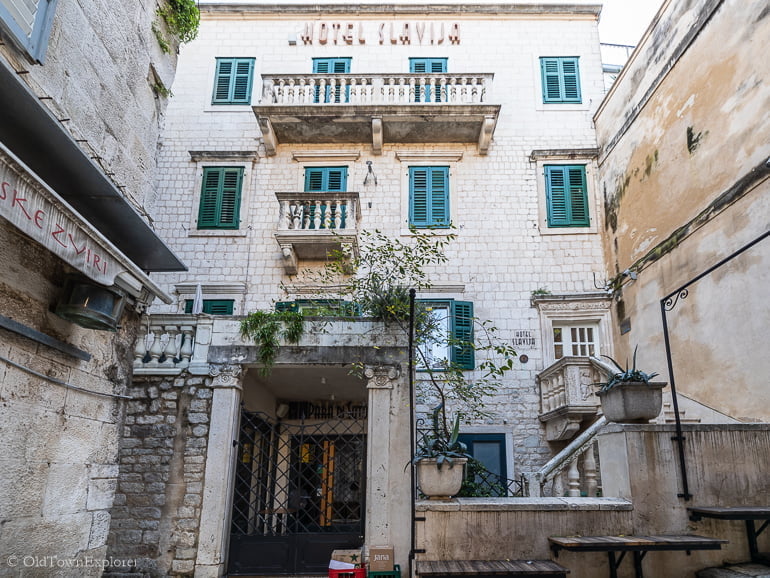
Hotel Slavija
- Architect: Unknown
- Style: Renaissance-Baroque (original palace), early 20th-century hotel conversion
- Built: Palace (late 16th–early 17th century); hotel conversion c. 1900–1905
- Address: Andrije Buvine 2, 21000, Split, Croatia
Hotel Slavija is the oldest continuously operating hotel within the walls of Diocletian's Palace. It is located in the private southern part of Diocletian's Palace, above the western thermal baths. Even today, parts of the ancient walls can be seen in several places in the hotel building.
The history of the building dates back to the end of the 16th and the beginning of the 17th century. During this period, the Renaissance-Baroque Brešan Palace complex was built above the mentioned Western Baths of Diocletian, originally built in the 4th century. The building was later adapted into Hotel Slavija at the beginning of the 20th century.

Venetian Bulwarks
- Architect: A. Maglia (Venetian military engineer)
- Style: Renaissance star-fort bastion system
- Built: 16th century
- Address: Remnants integrated into Split’s old town perimeter
In the 16th and 17th centuries, Split was involved in the Venetian-Turkish wars, and as a defensive measure, modern star-shaped bastions were built around the city. However, during the French administration in Dalmatia in the early 19th century, some parts of the bastions were demolished to allow the city to expand beyond its boundaries into the free territory surrounding it.
Lazareti
- Architect: Unknown
- Style: Renaissance economic and fortification architecture
- Built: 16th century
- Address: Obala Lazareta 3, Split, 21000, Croatia
The Split Lazareti was a group of buildings constructed to temporarily store commercial goods that arrived in Split from Bosnia and by sea. The purpose of this was to facilitate commercial transshipment and quarantine. These Lazareti buildings were built in the late 16th century and were located southeast of Diocletian's Palace on the east coast. Unfortunately, they were demolished after World War II.
The lazarets in Split were the second oldest on the eastern coast of the Adriatic, after those in Dubrovnik. They were the largest and most organized complex of economic and fortification architecture in Dalmatia. They were named after St. Lazarus, the patron saint of the sick.
Things to Know Before You Go
Split’s historic center is compact, but the architecture is unusually dense. Plan the walk by urban layer and viewing type rather than trying to enter every church, palace, museum, and cellar.
Read the Palace as a Street Plan
Diocletian’s Palace combined an imperial residence with the ordered plan and defenses of a Roman military camp. Its main north–south and east–west streets still connect the gates with the ceremonial center around the Peristyle.
Enter through the Golden Gate when you want the clearest approach through the palace plan. The Iron and Silver gates connect the Roman enclosure with later commercial streets and squares, while the Bronze Gate opens toward the waterfront.
Understand the UNESCO Area
The Historical Complex of Split with the Palace of Diocletian includes more than the surviving Roman structures. Medieval churches, fortifications, Gothic palaces, and Renaissance and Baroque buildings form part of the protected historic ensemble.
The designation does not cover the whole modern city. Areas such as Veli Varoš, Prokurative, the wider waterfront, and later residential streets still matter architecturally, but they play a different role from the palace-centered UNESCO property.
Separate Exterior Viewing From Interior Visits
Many of Split’s most important architectural relationships can be understood outside. The gates, palace street grid, Peristyle, Roman walls, Pjaca, Fruit Square, Riva, Marmontova, Prokurative, and Veli Varoš do not depend on entering every building.
Allow separate time for the palace substructures, cathedral complex, museums, galleries, and other interiors that interest you. Check the individual site before visiting rather than assuming that every church, palace, or museum follows the same access schedule.
Use Pjaca and the Riva to See the City Expand
Pjaca developed immediately outside the palace’s western wall and became a major civic square. It is one of the clearest places to compare the Roman enclosure with later Gothic, Renaissance, and civic architecture.
The Riva turns the palace’s southern façade into the backdrop for a later public waterfront. Walk both places when you want to understand how Split changed from an enclosed palace settlement into a city organized around squares, commerce, and the harbor.
Add Veli Varoš for a Different Scale
Veli Varoš lies west of the historic core on the lower slopes toward Marjan. Its small stone houses, churches, narrow lanes, and irregular street pattern contrast with the palace’s monumental walls and ordered Roman plan.
Walk here when domestic architecture and neighborhood scale interest you as much as imperial buildings. The lanes rise away from the waterfront, so the area requires more effort than the level route through the palace, Pjaca, and Riva.
Expect Smooth Stone, Steps and Crowds
Polished paving inside the palace can become slippery after rain. Steps appear around many historic buildings, while Veli Varoš and routes toward Marjan involve slopes.
The palace lanes and Peristyle can also become congested. Visit the main Roman spaces earlier in the day when you want clearer views of columns, façades, paving, and street alignments.
Choose a Short, Half-Day or Full-Day Plan
For a short architecture visit, walk from the Golden Gate to the Peristyle, Cathedral of St. Domnius, Temple of Jupiter, Vestibule, Bronze Gate, Riva, Iron Gate, and Pjaca. This gives you the Roman plan, medieval reuse, and later civic city without trying to enter every building.
A half day allows one or two important interiors and more time around the palace gates and noble palaces. A full architecture day can add Veli Varoš, Prokurative, the western waterfront, smaller religious buildings, monuments, parks, and later civic architecture.
Architecture Tours in Split
A guided architecture tour can make the Roman palace plan and later building layers easier to recognize. The center is simple to walk independently, but reused walls, fragments of Roman buildings, medieval additions, and changes to the original streets are not always obvious without explanation.
Guided Tours
Compare tours by their focus on Diocletian’s Palace, the Peristyle, palace gates, Cathedral of St. Domnius, Temple of Jupiter, and later buildings beyond the Roman core. Check whether interiors and admission charges are included, how far the walk continues outside the palace, the group size, language, meeting point, and cancellation terms before booking.
Where to Stay for Architecture Walks
The main decision is whether to sleep inside the palace streets, beside the western civic center, or closer to Bačvice and the transport terminals.
Hotels and Apartments in Split
For most architecture-focused visits, stay inside Diocletian’s Palace or along its western edge near Pjaca, Marmontova, Prokurative, and Veli Varoš. These areas put the Roman core, medieval churches, noble palaces, major squares, waterfront, and later western neighborhoods within an easy walk.
Compare these areas before booking:
- Inside Diocletian’s Palace: Choose this area for the shortest walks to the Peristyle, cathedral complex, Temple of Jupiter, palace gates, and substructures. Historic buildings may have stairs, limited vehicle access, and evening noise.
- Pjaca, Marmontova and Prokurative: This is the strongest all-round base for reaching both the palace and the later civic city. It also shortens walks to the Riva, Matejuška, and Veli Varoš.
- Veli Varoš: Stay here for small-scale stone architecture, neighborhood lanes, churches, and quick access to Marjan. Expect slopes, steps, and less direct vehicle access on some streets.
- Bačvice: This area is convenient for the ferry port, railway station, bus station, and eastern side of the center. Most major architectural sights remain walkable, but the western squares and Veli Varoš are farther away.
Choose the palace or its western edge for a short architecture trip. Bačvice makes more sense when an early ferry, bus, or train matters as much as immediate access to the historic core.
Use the interactive map below to compare hotels and apartments near Diocletian’s Palace, Pjaca, Marmontova, Prokurative, Veli Varoš, Bačvice, and the transport terminals.
FAQs About Split Architecture
What Is Split Famous for Architecturally?
Split is best known for Diocletian’s Palace, a late Roman imperial complex that became the framework for the medieval and later city. Roman walls, gates, streets, columns, and ceremonial spaces survive beside Romanesque churches, Gothic and Renaissance palaces, Baroque façades, and later civic buildings.
What Should I See First in Split?
Start with the Golden Gate, Peristyle, Cathedral of St. Domnius, Temple of Jupiter, Vestibule, palace substructures, Bronze Gate, Riva, Iron Gate, and Pjaca. This sequence shows the Roman plan, medieval reuse, waterfront relationship, and expansion beyond the western palace wall.
Is Diocletian’s Palace One Building?
No. It was a large fortified imperial complex containing residential, ceremonial, religious, military, and service areas. Later inhabitants converted its streets, rooms, walls, and open spaces into houses, churches, palaces, shops, and public squares, creating the historic center visible today.
Is All of Split a UNESCO World Heritage Site?
No. UNESCO lists the Historical Complex of Split with the Palace of Diocletian, which centers on the Roman palace and the medieval and early modern city built through it. Veli Varoš, Prokurative, later waterfront areas, and the wider modern city are not all included within that property.
Which Architectural Styles Can You See in Split?
The historic center contains late Roman architecture followed by Romanesque, Gothic, Renaissance, and Baroque additions. Outside and around the palace, later civic streets and buildings add nineteenth- and twentieth-century layers.
Can You Understand Split’s Architecture Without Entering Buildings?
Yes. The palace street grid, gates, Peristyle, Roman walls, Pjaca, Fruit Square, Riva, Marmontova, Prokurative, and Veli Varoš can all be studied outside. Interiors such as the palace substructures, cathedral complex, museums, and galleries add depth but are not required to understand the city’s main urban pattern.
What Is the Best Short Architecture Route in Split?
Enter through the Golden Gate and walk to the Peristyle, Cathedral of St. Domnius, Temple of Jupiter, Vestibule, and Bronze Gate. Follow the Riva west, re-enter through the Iron Gate, and finish at Pjaca. This route connects the Roman palace, medieval religious reuse, waterfront, and later civic square.
How Much Time Should I Spend Exploring Split’s Architecture?
A short walk is enough to understand the palace plan and see the main exterior landmarks. Allow half a day when you want one or two interiors and closer study of the gates, churches, and palaces. A full day gives you time for Veli Varoš, Prokurative, monuments, parks, and later buildings beyond the palace core.
Is Split Easy to Explore on Foot?
The palace, Pjaca, Fruit Square, Riva, Marmontova, and Prokurative form a compact walking area. Polished stone, steps, crowds, and uneven historic surfaces require care. Veli Varoš and routes toward Marjan add slopes.
Where Should I Stay for Architecture Walks?
Stay inside Diocletian’s Palace for the shortest walks to the Roman and medieval core. The area around Pjaca, Marmontova, and Prokurative gives you the best balance between the palace, waterfront, Veli Varoš, and later civic architecture. Choose Bačvice when proximity to the ferry, bus, and railway terminals matters more.
Who Built Diocletian’s Palace?
Roman emperor Diocletian commissioned the palace around the turn of the fourth century as an imperial residence and fortified complex near his birthplace in Dalmatia. The names of the individual architects and builders are not securely known.
For the broader national timeline behind Split’s Roman, medieval, Renaissance, Baroque, and later buildings, start with Croatia Architecture. For neighborhoods, seasons, transport, and length-of-stay decisions, return to the main Split travel guide. Plan meals and market stops through Split Food, and use Split Wine for wine bars, bottle shops, and nearby winery visits.