
Wroclaw Architecture
Explore Wroclaw Architecture: Market Square, Gothic Churches & More
Wroclaw architecture is shaped by river islands, medieval churches, market streets, bridges, former defensive lines, and prewar modernism. The city sits on the Oder River in Lower Silesia, where trade, church power, Prussian administration, railway growth, and postwar rebuilding all left visible marks.
The best starting point is the Old Town. From the Rynek, you can reach St. Elizabeth’s Basilica, St. Mary Magdalene, the University of Wrocław, Wrocław Market Hall, Sand Island, and Ostrów Tumski on foot. East of the center, Centennial Hall, the Four Domes Pavilion, the Pergola, and the WuWA estate show a very different side of the city.
We spent a month in Wroclaw researching the Old Town architecture. This guide covers Market Square, religious buildings, palaces, residential buildings, fortifications, bridges, markets, civic buildings, transport architecture, historic modernism, and older urban areas.
This page contains affiliate links. We may earn a small commission at no extra cost to you.
Wroclaw Architecture at a Glance
- Best starting point: Rynek and the Old Town Hall
- Best short route: Rynek, St. Elizabeth’s Basilica, St. Mary Magdalene, University of Wrocław, Market Hall, Sand Bridge, Tumski Bridge, Ostrów Tumski
- Best church area: Ostrów Tumski and Sand Island
- Best bridge walk: Sand Bridge, Tumski Bridge, Mill Bridges, University Bridges, Pomeranian Bridges
- Best modernist route: Centennial Hall, Four Domes Pavilion, Pergola, WuWA estate
- Best commercial architecture stops: Wrocław Market Hall, Feniks, Renoma
- Best area for palace and civic buildings: west and north of the Rynek
- Best station-area architecture: Wrocław Główny, Renoma, Wrocław Opera, Monopol Hotel
Wroclaw is best read in layers: medieval church city, market city, fortified city, Prussian administrative city, railway city, and prewar modernist city.
Best Wroclaw Architecture Sites to Prioritize
If you only have one day in Wroclaw, start with these architecture sites:
- Old Town Hall
- St. Elizabeth’s Basilica
- St. Mary Magdalene
- University of Wrocław
- Wrocław Market Hall
- Sand Bridge
- Tumski Bridge
- Archcathedral of St. John the Baptist
- Centennial Hall
- WuWA Estate
Together, these sites show the city’s Gothic, Baroque, commercial, bridge, religious, civic, and modernist architecture. They also create a practical first route: start in the Rynek, move through the Old Town and river islands, then treat Centennial Hall and WuWA as a separate eastern architecture route.
Attractions in Market Square
Market Square is the best place to begin an architecture walk in Wroclaw. The Rynek combines civic architecture, commercial buildings, reconstructed façades, historic houses, and one of the city’s most important churches at the edge of the square. It also gives the clearest first view of how Wrocław’s medieval market plan continued to shape later building phases.
The official Wrocław tourism portal describes the Market Square as the city’s central square and one of Poland’s important historic sites. For official visitor information, see the Visit Wrocław Market Square and Town Hall page.
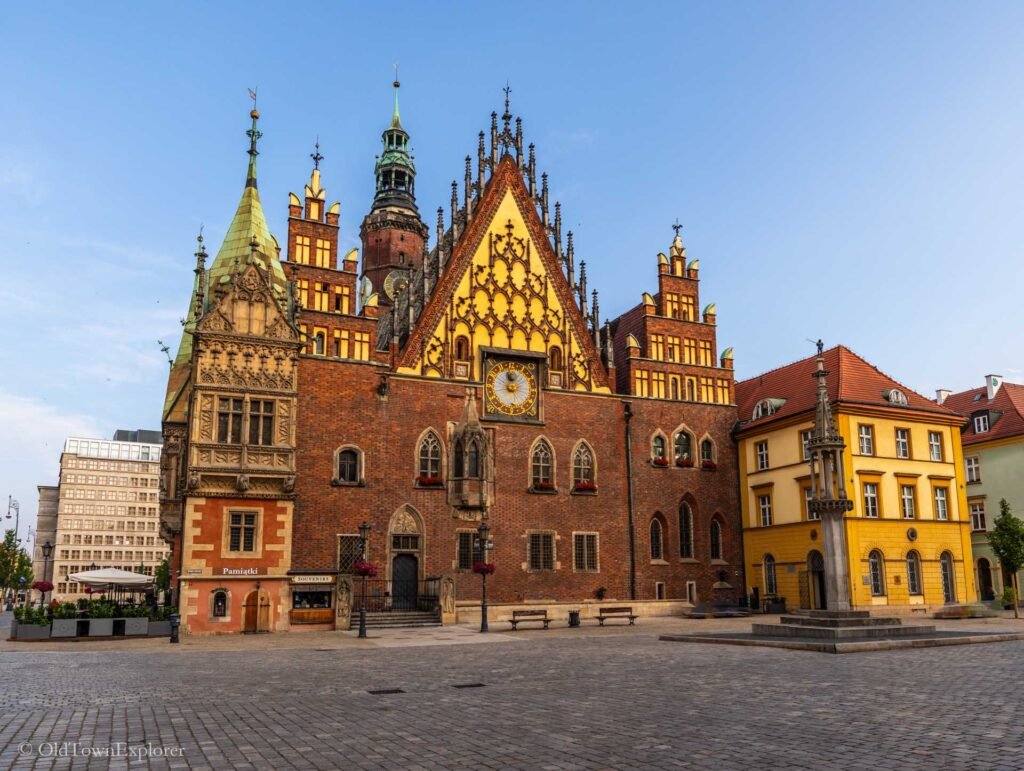
Old Town Hall / Museum of Bourgeois Art
- Architect: Unknown
- Style: Gothic with Renaissance additions
- Built: late 13th century to 16th century
- Address: Sukiennice 14/15, Rynek, Wrocław
The Old Town Hall is the civic anchor of the Rynek and one of the most important buildings in central Wrocław. Its Gothic halls, sculpted exterior, clock, gables, and later additions reflect the square’s long role in government, trade, courts, and public ceremony.
Because the building stands inside the Market Square rather than along one edge, it also explains the Rynek’s unusual spatial character: a large public square organized around a dense block of civic and commercial buildings.
New Town Hall
- Architect: Friedrich August Stüler
- Style: Neo-Gothic
- Built: 1860s
- Address: Rynek, Wrocław
The New Town Hall adds a 19th-century civic layer to the Market Square. Its Neo-Gothic language connects later municipal architecture with the older Gothic vocabulary already associated with the Rynek. Notice how the building continues the square’s administrative role while using a more regular 19th-century façade.
St. Elizabeth’s Basilica
- Architect: Unknown
- Style: Brick Gothic
- Built: 12th–15th century
- Address: ul. św. Mikołaja / northwest corner of the Rynek, Wrocław
St. Elizabeth’s Basilica is one of the major parish churches of medieval Wrocław and one of the strongest vertical markers in the Old Town skyline. Its tower, brick nave, churchyard setting, and small altar houses show how parish architecture shaped the northwest edge of the Rynek.
The basilica is especially important because it links the Market Square with the older religious fabric behind it, including the Hansel and Gretel houses and the former parish cemetery area.
Hansel and Gretel Houses
- Architect: Unknown
- Style: Late medieval / early modern town-house architecture
- Built: medieval origins with later rebuilding
- Address: northwest corner of the Rynek, Wrocław
The Hansel and Gretel houses stand beside St. Elizabeth’s Basilica and mark the entrance toward the churchyard. Their small scale contrasts with the large market square and the church tower behind them. Notice the narrow plots, joined upper passage, and way these buildings preserve the older edge between civic space and parish space.
Feniks Department Store / Former Barasch Brothers’ Department Store
- Architect: Georg Schneider
- Style: Art Nouveau origins with later modernized façade
- Built: 1902–1904, altered in 1929
- Address: Rynek 31/32, Wrocław
The Feniks Department Store began as the Barasch Brothers’ Department Store on the Market Square. It shows the rise of early 20th-century retail architecture in the heart of the Old Town, where a large shop replaced older commercial buildings. Notice the corner position, the later simplified façade, and the way the store faces both the Rynek and the narrow streets behind it. It sits directly on the Market Square, making it one of the easiest commercial buildings to add to a central walking route.
Market Square Town Houses
- Architect: Various / Unknown
- Style: Gothic, Renaissance, Baroque, Classicist, Historicist, and postwar reconstruction layers
- Built: medieval origins to 20th-century rebuilding
- Address: Rynek, Wrocław
The town houses around the Rynek are essential to understanding Wroclaw architecture because they preserve the rhythm of the medieval market square even where façades were rebuilt or altered. Read the square side by side: plot width, gables, arcades, rooflines, window spacing, and ground-floor shops reveal different layers of Gothic, Renaissance, Baroque, Historicist, and postwar reconstruction.
Religious Buildings in Wroclaw
Religious buildings are one of the clearest ways to read Wroclaw architecture. Churches, monasteries, convents, synagogues, and parish buildings mark the oldest islands, the medieval market city, former gate routes, and later confession districts. Ostrów Tumski and Sand Island hold the city’s strongest church-island architecture, while the Old Town adds large parish churches, monastic complexes, a synagogue, and Protestant buildings within the street grid.
Old Town Churches and Synagogues
Church of St. Anthony of Padua
- Architect: Unknown Italian designer; construction led by Mateusz Biener
- Style: Baroque
- Built: 1685–1692
- Address: ul. św. Antoniego 30, Wrocław
The Church of St. Anthony of Padua is a Baroque church tied to the former Franciscan Reformed complex near today’s Four Denominations District. It shows a later Catholic layer in the western part of the Old Town, away from the large medieval parish churches around the market. Notice the compact street frontage, the Baroque massing, and the way the church fits into the narrow block structure west of the Rynek.
St. Barbara’s Church, now the Orthodox Cathedral of the Nativity of the Blessed Virgin Mary
- Architect: Unknown
- Style: Gothic
- Built: 13th century, rebuilt in the 15th–16th centuries
- Address: ul. św. Mikołaja 40, Wrocław
St. Barbara’s Church is a former medieval church now used as an Orthodox cathedral. It adds a non-Roman Catholic layer to the Old Town’s religious map and sits close to the western edge of the market district. Notice the Gothic walls, the tower, and the Orthodox use of a building that began as a medieval city church near ul. św. Mikołaja.
Corpus Christi Church
- Architect: Unknown
- Style: Brick Gothic
- Built: 15th century
- Address: corner of ul. Świdnicka and ul. Bożego Ciała, Wrocław
Corpus Christi Church is a Gothic church linked to the Knights Hospitaller and the southern approach to the medieval city. It sits near one of the main walking routes from the Market Square toward the former Świdnicka Gate area. Notice the brick walls, pointed windows, and long urban edge along one of the busiest streets in the historic center.
Church of St. Adalbert
- Architect: Unknown
- Style: Romanesque origins with Gothic rebuilding
- Built: early 12th century, expanded 13th–15th centuries
- Address: pl. Dominikański 2–4, Wrocław
The Church of St. Adalbert is one of the oldest church sites on the left bank of the Oder. Its Romanesque origins, later Gothic rebuilding, and Dominican history make it an important stop between the Market Square area and the eastern edge of the Old Town. The long brick body, monastic setting, and position beside pl. Dominikański make the church especially useful for understanding the transition from the market city toward the river islands.
Church of St. Dorothy, St. Stanislaus, and St. Wenceslaus
- Architect: Unknown
- Style: Gothic
- Built: 1351–1401, with later changes
- Address: pl. Franciszkański, Wrocław
This large Gothic church stands in the southern part of the Old Town near Świdnicka Street. Its three patrons point to Wrocław’s position between Silesian, Polish, and Bohemian political worlds. Notice the high hall form, the long choir, and the way the church sits close to the former southern city gate route rather than directly on the Market Square.
Church of St. Christopher
- Architect: Henry of Ząbkowice involved in 15th-century vaulting
- Style: Gothic
- Built: 15th century
- Address: pl. św. Krzysztofa 1, Wrocław
The Church of St. Christopher is a small Lutheran church near the eastern side of the Old Town. It shows how smaller medieval churches survived within dense commercial blocks. Notice the compact footprint, Gothic vaulting, and the position near pl. Dominikański and the main route toward the river islands.
Parish Church of St. Mary Magdalene
- Architect: Unknown
- Style: Romanesque elements and Brick Gothic
- Built: 1342–1360, rebuilt after 1945
- Address: ul. Szewska 10, Wrocław
St. Mary Magdalene is a major Gothic church just east of the Market Square and now serves as a Polish-Catholic cathedral. Its two towers and bridge between them make it one of the key skyline markers in the central city. Notice the tower pair, the large brick nave, and the close link between Szewska Street, Łaciarska Street, and the market area.
Evangelical Church of Divine Providence
- Architect: Unknown
- Style: Baroque / 18th-century Protestant church architecture
- Built: mid-18th century
- Address: ul. Kazimierza Wielkiego 29, Wrocław
The Evangelical Church of Divine Providence is the main Lutheran church in central Wrocław. It stands near the Four Denominations District and shows the Protestant layer of the city’s religious architecture. Notice the restrained exterior, the central location near Kazimierza Wielkiego Street, and the contrast with the larger Gothic Catholic churches nearby.
White Stork Synagogue
- Architect: Carl Ferdinand Langhans
- Style: Neoclassical
- Built: 1826–1829
- Address: ul. Pawła Włodkowica 5a / 7, Wrocław
The White Stork Synagogue is the key surviving synagogue in central Wrocław. It anchors the Jewish layer of the Four Denominations District and stands inside a courtyard-like urban setting. Notice the Neoclassical exterior, the setback from Włodkowica Street, and the connection to the western Old Town’s mixed religious history.
Old Town Monasteries, Convents, and Religious Support Buildings
Bernardine Monastery Complex
- Architect: Unknown
- Style: Gothic
- Built: 15th century, with later changes
- Address: ul. Bernardyńska 5, Wrocław
The Bernardine monastery complex includes St. Bernard’s Church and former monastery buildings now used by the Museum of Architecture and offices. It shows how former religious complexes were reused after secularization and wartime rebuilding. Notice the Gothic church walls, cloister-like arrangement, and location southeast of the Rynek near the route toward the Panorama Racławicka area.
Dominican Monastery Complex of St. Catherine
- Architect: Unknown
- Style: Gothic and later monastery architecture
- Built: second half of the 14th century to 18th century, rebuilt after 1945
- Address: ul. św. Katarzyny 18 / ul. Purkyniego 1, Wrocław
The St. Catherine Dominican complex is a former monastic site near the eastern side of the Old Town. It adds to the chain of religious houses around the edge of the medieval city. Notice the relationship between the church, former monastery, and the modern traffic corridor near pl. Dominikański.
Dominican Monastery Complex of St. Adalbert
- Architect: Unknown
- Style: Romanesque origins, Gothic church and monastery fabric
- Built: 1226–18th century, rebuilt after 1945
- Address: pl. Dominikański, Wrocław
The Dominican complex at St. Adalbert includes the church and surviving monastery wing with the Old Refectory. It is one of the strongest monastic anchors inside the Old Town edge. Notice how the church, convent buildings, and open square show the Dominican presence at a main eastern approach to the historic center.
Jesuit Monastery Complex with Church of the Name of Jesus
- Architect: Teodor Moretti; construction led by Mateusz Biener and Jan Knoll
- Style: Baroque
- Built: 1689–1698 for the church; Jesuit college 1726–1732
- Address: pl. Uniwersytecki 1, Wrocław
The Jesuit complex combines the Church of the Name of Jesus with the former Jesuit college, now part of the University of Wrocław. It is the main Baroque religious and academic ensemble in the Old Town, with a scale and interior program very different from the city’s Gothic parish churches. The complex frames University Square and links the northern Old Town, the Oder riverfront, and the university quarter into one architectural group.
Jesuit Pastoral Building
- Architect: Unknown
- Style: 18th- and 19th-century institutional residential architecture
- Built: 18th/19th century
- Address: pl. Nankiera 17, Wrocław
The Jesuit pastoral building adds a residential and administrative layer to the religious blocks near Nankiera Square. It shows how clergy and educational functions shaped the Old Town north of the Rynek. Notice the street frontage and the building’s position between the university area and Sand Island.
Poor Clares Monastery Complex with Church and Chapel of St. Jadwiga
- Architect: Unknown
- Style: Gothic and Baroque monastery architecture
- Built: 13th–17th century, rebuilt after 1945
- Address: pl. Nankiera 16, Wrocław
The Poor Clares complex stands near one of the densest religious areas of the Old Town. Its church, St. Jadwiga chapel, and monastery buildings show the medieval convent layer close to the university and river routes. Notice the compact urban setting near Nankiera Square and the short walk to St. Vincent, St. Matthias, and Sand Island.
Premonstratensian Monastery Complex with Church of St. James and St. Vincent
- Architect: Unknown
- Style: Romanesque origins, Gothic church, Baroque monastery additions
- Built: from 1232, with 14th-, 17th-, and 18th-century phases, rebuilt after 1945
- Address: pl. Nankiera 15, Wrocław
The Premonstratensian complex centers on the Church of St. James and St. Vincent, now the Greek Catholic cathedral. It is one of the main religious complexes on the northern edge of the Old Town. Notice the large Gothic church, the former monastery buildings, and the site’s position near the route from the Rynek to Sand Island.
Order of Hospitallers with the Red Star and St. Matthias Church
- Architect: Unknown
- Style: Gothic church with Baroque monastery buildings
- Built: 13th–18th century; oratory from 1697 and 1911; monastery from 1675–1715
- Address: pl. Nankiera / ul. Szewska 36a–37, Wrocław
This complex includes St. Matthias Church, the oratory building now used by the Academic Chaplaincy “Maciejówka,” and the former monastery now occupied by the Ossolineum. It shows how a medieval order shaped one of the most important religious and scholarly blocks near the university. Notice the Gothic church, the former monastery frontage, and the position between Szewska Street and Nankiera Square.
Monastery Complex of the Corpus Christi Rectory
- Architect: Unknown
- Style: Baroque / 18th-century rectory architecture
- Built: mid-18th century
- Address: ul. Bożego Ciała 1, Wrocław
The Corpus Christi rectory is part of the religious group around Corpus Christi Church. It shows the practical parish architecture that stood beside major churches, not just the worship space itself. Notice the rectory’s placement near the church and the southern Old Town route along ul. Świdnicka.
St. Joseph’s Convent
- Architect: Unknown
- Style: Baroque / 18th-century convent architecture
- Built: 1734–1755
- Address: ul. Kuźnicza 35, Wrocław
St. Joseph’s Convent belongs to the dense religious and academic blocks north of the Market Square. It shows how convent buildings formed part of the Old Town’s everyday street fabric. Notice the urban frontage and the short walk to University Square, Nankiera Square, and the river.
Former Rectory of the Church of St. Vincent, now Greek Catholic Parish Building
- Architect: Unknown
- Style: 19th-century rectory architecture
- Built: 1834
- Address: ul. Łaciarska 34, Wrocław
This former rectory served the Church of St. Vincent and now connects to the Greek Catholic parish. It adds a support-building layer to the large church complex near Nankiera Square. Notice its position close to St. Vincent and St. James Cathedral and the short route from the Old Town toward Sand Island.
Academic Pastoral Care “Maciejówka”
- Architect: Unknown
- Style: Baroque and later institutional architecture
- Built: 1697, altered in 1911
- Address: ul. Szewska 36a, Wrocław
“Maciejówka” occupies the former oratory building of the Order of Hospitallers with the Red Star. It connects student religious life with one of the Old Town’s older monastic blocks. Notice its position beside St. Matthias Church and the former monastery now linked to the Ossolineum.
Ossolineum Building, Former Monastery of the Hospitallers with the Red Star
- Architect: Unknown
- Style: Baroque monastery architecture
- Built: 1675–1715
- Address: ul. Szewska 37, Wrocław
The Ossolineum occupies a former monastery building tied to the Order of Hospitallers with the Red Star. It shows one of the strongest examples of religious buildings reused for scholarship and culture in central Wrocław. Notice the long frontage, courtyard character, and location between Szewska Street, Nankiera Square, and the university area.
House with Relics of the Cemetery Church of St. Agnes
- Architect: Unknown
- Style: Gothic remains with later building fabric
- Built: 14th century remains, later building from 1820
- Address: ul. Szewska 47, Wrocław
This house preserves relics of the former cemetery church of St. Agnes. It shows that parts of Wrocław’s religious map survive inside later buildings, not only as freestanding churches. Notice the address on Szewska Street and its place in the dense northern Old Town church district.
Religious Buildings on Ostrów Tumski
Archcathedral of St. John the Baptist
- Architect: Unknown
- Style: Gothic with Neo-Gothic additions
- Built: 13th–14th century, with later rebuilding through the 19th and 20th centuries
- Address: Plac Katedralny 18, Ostrów Tumski, Wrocław
The Archcathedral of St. John the Baptist is the main cathedral of Wrocław and the strongest skyline marker on Ostrów Tumski. Its twin west towers, long nave, chapels, and brick Gothic structure show why Cathedral Island remained the city’s religious center. Notice the tower line from the river approaches, the scale of the choir, and the way the cathedral anchors the eastern end of the island, about 15–20 minutes on foot from the Market Square.
For official visitor information about Ostrów Tumski and the cathedral area, see the Visit Wrocław tourism portal.
Church of St. Giles
- Architect: Unknown
- Style: Late Romanesque / Early Gothic
- Built: mid-13th century, rebuilt after 1953
- Address: ul. św. Idziego 4/6, Ostrów Tumski, Wrocław
The Church of St. Giles is a small medieval church on Cathedral Island and one of the oldest surviving church buildings in Wrocław. Its modest scale contrasts with the cathedral nearby and shows the layered church fabric of Ostrów Tumski. Notice the brickwork, the small proportions, and the passage near the Dumpling Gate between the cathedral area and the river islands.
Church of the Holy Cross
- Architect: Master Wiland
- Style: Brick Gothic
- Built: 1288–1350
- Address: pl. Kościelny, Ostrów Tumski, Wrocław
The Church of the Holy Cross is a two-level Gothic church on Ostrów Tumski. Its stacked church plan makes it one of the most unusual religious buildings in the city. Notice the long brick elevation, tall windows, and the position near the St. John of Nepomuk monument, just west of the cathedral.
St. Martin’s Church
- Architect: Unknown
- Style: Gothic with earlier site history
- Built: 13th century, rebuilt 1958–1968
- Address: ul. św. Marcina, Ostrów Tumski, Wrocław
St. Martin’s Church stands on Ostrów Tumski near the former ducal castle area. The church is small, but its site connects religious architecture with Wrocław’s earliest political center. Notice the plain brick body, the island setting, and the short walk from the cathedral and Holy Cross Church.
Church of St. Peter and St. Paul
- Architect: Unknown
- Style: Gothic with later rebuilding
- Built: 15th century, with 20th-century rebuilding
- Address: ul. Katedralna 4, Ostrów Tumski, Wrocław
The Church of St. Peter and St. Paul is a small Gothic church on Cathedral Island. It adds another layer to the dense church cluster around the cathedral. Notice the brick form, modest scale, and position along Katedralna Street, close to the main Ostrów Tumski route.
Statue of the Virgin Mary with Jesus
- Architect: Unknown
- Style: Baroque religious sculpture
- Built: 1647
- Address: square in front of the Cathedral, Ostrów Tumski, Wrocław
The statue of the Virgin Mary with Jesus stands in the cathedral square and adds a sculptural layer to the religious setting of Ostrów Tumski. It frames the approach to the cathedral and marks the square as more than an entry space. Notice the statue’s placement before the cathedral façade and its role in the island’s devotional landscape.
Statue of St. John of Nepomuk
- Architect: Unknown
- Style: Baroque religious sculpture
- Built: 1731
- Address: in front of the Church of the Holy Cross, Ostrów Tumski, Wrocław
The statue of St. John of Nepomuk stands before the Church of the Holy Cross on Cathedral Island. Its placement links a bridge-and-river saint with one of the city’s main island churches. Notice the sculptural group, the open church square, and the way the monument shapes views between the cathedral and Holy Cross Church.
Religious Buildings on Sand Island
Orthodox Church of Sts. Cyril and Methodius
- Architect: Unknown Italian designer; construction associated with Zygmunt Linde
- Style: Baroque
- Built: 1686–1690
- Address: ul. św. Jadwigi 12, Sand Island, Wrocław
The Orthodox Church of Sts. Cyril and Methodius began as St. Anne’s Church in an Augustinian monastery complex. It is one of the main religious buildings on Sand Island and shows how a Baroque Catholic church later became an Orthodox church. Notice the Baroque façade, the island setting, and the close relationship with St. Mary on the Sand and the former monastic buildings.
Augustinian Monastery Complex with St. Anne’s Church
- Architect: Unknown
- Style: Gothic monastery fabric and Baroque church
- Built: late 13th century and 17th century, rebuilt after 1945
- Address: ul. św. Jadwigi 12, Sand Island, Wrocław
The Augustinian monastery complex includes the former St. Anne’s Church, now the Orthodox Church of Sts. Cyril and Methodius, and monastery buildings. It shows the long religious use of Sand Island, from medieval monastic life to modern Orthodox worship. Notice how the church and former monastery sit within a short walk of St. Mary on the Sand and the bridges to Ostrów Tumski.
Augustinian Monastery Complex “Na Piasku” with Church of the Blessed Virgin Mary
- Architect: Master Pieszko for the Gothic church
- Style: Gothic
- Built: second half of the 12th century to 18th century, rebuilt after 1945
- Address: ul. św. Jadwigi 3/4, Sand Island, Wrocław
The “Na Piasku” complex centers on the Church of St. Mary on the Sand and former monastery buildings now tied to university use. It is one of the most important religious groups between the Old Town and Cathedral Island. Notice the large Gothic hall church, the island position, and the way the complex guides walkers from the market area toward Ostrów Tumski.
Salesian Convent
- Architect: Unknown
- Style: Late medieval religious architecture with postwar rebuilding
- Built: second half of the 14th century, rebuilt after 1945
- Address: ul. św. Jadwigi 11, Wrocław
The Salesian convent stands on Sand Island near other former monastic buildings. It adds to the island’s tight cluster of religious and educational institutions. Notice the compact placement along ul. św. Jadwigi and the short distance to St. Mary on the Sand and Sts. Cyril and Methodius.
Palaces in Wroclaw
Palaces in Wroclaw show how noble families, bishops, bankers, and political figures used city residences rather than fortified castles. Most central examples sit inside or just beside the Old Town street grid, often near Szewska Street, Wierzbowa Street, Włodkowica Street, or former civic routes. Together, they trace the shift from medieval plots to Baroque, Classical, and 19th-century representative façades.
Several now serve university, museum, hotel, office, or institutional uses, so the exterior often tells more of the story than public interior access.
Royal Palace / Former Spätgen Palace
- Architect: Johann Boumann for the 1750s royal expansion; later work by Carl Gotthard Langhans and Friedrich August Stüler
- Style: Baroque, Rococo, Classicist, and Neo-Renaissance layers
- Built: 18th century, with major phases after 1717, 1750–1753, 1795–1796, and 1844–1846
- Address: ul. Kazimierza Wielkiego 35, Wrocław
The Royal Palace is one of Wrocław’s main palace buildings and now houses branches of the City Museum of Wrocław. It began as an aristocratic residence, then became a Hohenzollern royal residence after Frederick the Great acquired it in 1750. The long street frontage, palace garden, courtyard layout, and later façade changes make it one of the best places to see how royal, civic, and museum uses accumulated west of the Rynek.
Hohenlohe Palace / Schlegenberg Palace
- Architect: Unknown
- Style: Classicism
- Built: 1801, with 19th-century alterations
- Address: ul. Wita Stwosza 12, Wrocław
Hohenlohe Palace is a corner city palace near Wita Stwosza and Łaciarska streets. It shows the stricter Classical side of Wroclaw architecture after earlier Baroque town-house traditions. Notice the plain wall surfaces, balanced window rhythm, and corner position a short walk east of the Market Square.
Hoym Family Palace
- Architect: Unknown
- Style: Early 19th-century palace architecture
- Built: beginning of the 19th century
- Address: ul. Parkowa 28, Wrocław
The Hoym Family Palace is an outlying palace east of the Old Town, near the park and river-side districts. It extends the palace category beyond the dense central grid and into Wrocław’s later residential landscape. Notice the detached setting and broader plot, which differ from the tighter Old Town palaces on Szewska, Wierzbowa, and Włodkowica streets.
Wallenberg-Pachaly Palace
- Architect: Carl Gotthard Langhans
- Style: Neoclassical
- Built: 1785–1787
- Address: ul. Szajnochy 10, Wrocław
Wallenberg-Pachaly Palace is one of Wrocław’s clearest Neoclassical city palaces. It was built for the Wallenberg-Pachaly banking family and later had university use, which ties private residence, finance, and education in one building. Notice the measured façade, restrained ornament, and location west of the Rynek near the old financial and administrative quarter.
Hornes Palace
- Architect: Johann Blasius Peintner
- Style: Baroque
- Built: c. 1730
- Address: ul. Szewska 48, Wrocław
Hornes Palace is a Baroque city palace on Szewska Street, close to the university quarter. It shows how noble residences were inserted into the Old Town’s narrow street pattern. Notice the formal street frontage and its position beside the Palace of the Dukes of Legnica and Brzeg, forming a short palace cluster north of the Market Square.
Palace of the Dukes of Legnica and Brzeg
- Architect: Unknown
- Style: Gothic origins with Renaissance, Baroque, and Neoclassical alterations
- Built: 14th century origins, major phases around 1467, 1560, 1670, and the 19th century
- Address: ul. Szewska 49, Wrocław
The Palace of the Dukes of Legnica and Brzeg was the Wrocław city residence of the Silesian Piast line connected with Legnica and Brzeg. It shows how a medieval plot could be reshaped into a princely urban residence over several centuries. Notice the long layered history behind the present façade and the location on Szewska Street near the university and northern Old Town church district.
Bishop’s Summer Palace
- Architect: Christoph Hackner
- Style: Baroque with later Neo-Baroque changes
- Built: 1732–1737, with later rebuilding
- Address: ul. gen. Romualda Traugutta 111–113, Wrocław
The Bishop’s Summer Palace is a former residence of the Wrocław bishops and now houses the Ethnographic Museum. It stands outside the Old Town, showing how elite religious residence could move into a more open suburban setting. Notice the palace-and-garden relationship, the formal central block, and the location southeast of the historic core along Traugutta Street.
Leipziger Palace
- Architect: Carl Schmidt
- Style: Neo-Renaissance
- Built: 1872–1874
- Address: ul. Wierzbowa 15, Wrocław
Leipziger Palace was built for banker Ignatz Leipziger near the southern edge of the Old Town. It shows the 19th-century banking and civic layer of Wroclaw architecture, with a more elaborate palace form than the older Szewska Street residences. Notice the decorated façade, the position near Park Staromiejski, and the short walk to the Opera and former city promenade.
Oppersdorf Palace
- Architect: Christoph Hackner
- Style: Baroque
- Built: 1714–1720
- Address: ul. Wierzbowa 30, Wrocław
Oppersdorf Palace is a Baroque palace now incorporated into the Dominikański office complex. It shows how a small historic palace can survive inside a much larger modern commercial block. Notice the white façade, central emphasis, and its position between the Old Town core and the eastern approach through Dominikański Square.
Ballestrem Palace
- Architect: Albert Grau
- Style: Historicist with Neo-Romanesque and Neo-Gothic elements
- Built: 1898–1899
- Address: ul. Pawła Włodkowica 4, Wrocław
Ballestrem Palace was built for Franz Xaver von Ballestrem on Włodkowica Street. It adds a late 19th-century noble residence to the western Old Town and the Four Denominations District area. Notice the medieval-style details, the façade facing the old moat side, and the contrast with the older synagogue and church buildings nearby.
Residential Buildings in Wroclaw
Residential buildings in Wroclaw architecture range from medieval institutional houses to 19th-century tenements, interwar model housing, villas, dormitories, and community buildings. The Old Town and island areas show compact street houses tied to churches, schools, and former religious institutions. This category is especially good for seeing the city beyond headline monuments, because many entries are ordinary residential buildings with clear period details.
Old Town Residential Buildings
House at 5 Igielna Street
- Architect: Unknown
- Style: 19th-century Old Town residential architecture
- Built: 19th century
- Address: ul. Igielna 5, Wrocław
This house stands on Igielna Street, a narrow lane close to the Market Square. It shows how 19th-century housing filled small Old Town plots near the main commercial core. Notice the tight street width, vertical façade pattern, and the short walk to the Rynek.
House of the Young Ladies of Trzebnica
- Architect: Unknown
- Style: Medieval origins with later alterations
- Built: early 13th century to 20th century
- Address: pl. Nankiera 8, Wrocław
The House of the Young Ladies of Trzebnica stands near Nankiera Square, one of the densest historic areas north of the Market Square. It shows how medieval and later residential-institutional buildings mixed with churches and monastic complexes. Notice the layered fabric and the short walk to St. Vincent, St. Matthias, and the university quarter.
House at 7a Wolności Square
- Architect: Unknown
- Style: Palace-complex residential architecture
- Built: Unknown
- Address: pl. Wolności 7a / Kazimierza Wielkiego area, Wrocław
This house is tied to the former royal palace complex near Wolności Square. It shows how residential and palace service buildings shaped the area west of the Market Square. Notice the relation to the palace block, the square, and the former city promenade.
Ostrów Tumski Residential Buildings
House at 1 Katedralna Street
- Architect: Unknown
- Style: 18th-century island residential architecture
- Built: mid-18th century
- Address: ul. Katedralna 1, Ostrów Tumski, Wrocław
This entry preserves part of the ground floor of an 18th-century house on Cathedral Island. It shows that residential fabric survived beside the major churches of Ostrów Tumski. Notice the lower-level masonry and the position near the main cathedral approach.
Sand Island and River-Island Residential Buildings
Two Houses at 9 and 10 St. Jadwiga Street
- Architect: Unknown
- Style: Island residential and institutional architecture
- Built: Unknown
- Address: ul. św. Jadwigi 9–10, Sand Island, Wrocław
These two houses sit on Sand Island, close to former monastic buildings and the route toward Ostrów Tumski. They show the small-scale residential layer within one of Wrocław’s oldest church and river areas. Notice the quiet island setting, compact façades, and proximity to St. Mary on the Sand.
House at 32 Słodowa Street
- Architect: Unknown
- Style: Late 18th-century residential architecture
- Built: late 18th century
- Address: ul. Słodowa 32, Wrocław
This house stands near Słodowa Island and the northern river edge of the Old Town. It shows the smaller residential layer near the Oder, where houses sat close to warehouses, bridges, and religious sites. Notice the older proportions and the short walk from the university quarter to the islands.
Four Denominations District and Jewish Community Buildings
House of the Former Jewish Community Board with School and Mikveh
- Architect: Unknown
- Style: Late 19th-century Jewish community architecture
- Built: 1899–1901
- Address: ul. Pawła Włodkowica 5–7/9, Wrocław
This building belonged to the Jewish community complex near the White Stork Synagogue. It combined administrative, educational, and ritual functions in the western Old Town. Notice the courtyard setting, the connection to the synagogue area, and the location within the Four Denominations District.
Spring Bath Building at the Mikveh
- Architect: Unknown
- Style: Early 20th-century ritual bath architecture
- Built: 1902
- Address: ul. Pawła Włodkowica 5a, Wrocław
The spring bath building served the mikveh in the Jewish community complex. It shows that Wrocław’s residential and community architecture included ritual infrastructure as well as houses and schools. Notice its position inside the Włodkowica courtyard group near the White Stork Synagogue.
House with Garden at Włodkowica Street
- Architect: Unknown
- Style: 19th-century residential architecture
- Built: 1830s and 1870s
- Address: ul. Pawła Włodkowica 8–8a, Wrocław
This house with garden stands near the western edge of the Old Town. It shows a looser residential pattern than the tighter plots around the Rynek. Notice the garden relationship and the location near the synagogue, Lutheran church, and former city moat.
Fortifications and Defensive Architecture in Wroclaw
Fortifications in Wroclaw architecture are easiest to understand through traces rather than a complete wall circuit. The medieval walls, gates, moat line, towers, Arsenal, and former defensive edges shaped the Old Town even where the original structures no longer survive in full. This category helps explain why certain streets curve, why the former moat creates a green edge around parts of the center, and how the city expanded beyond its medieval limits.
City Arsenal
- Architect: Unknown
- Style: Gothic and later military architecture
- Built: 15th century, with later additions
- Address: ul. Cieszyńskiego 9, Wrocław
The City Arsenal is one of the strongest surviving military buildings in the Old Town. It shows how Wrocław stored weapons and military supplies inside the city’s defensive system. Notice the brick walls, courtyard arrangement, and location near the western edge of the historic center.
Medieval City Wall Remains
- Architect: Unknown
- Style: Medieval defensive architecture
- Built: medieval period, with later alterations and losses
- Address: various locations around the Old Town edge, Wrocław
Wrocław no longer reads as a fully walled city, but surviving wall fragments and the former moat line still explain the Old Town’s shape. These remains are useful because they show where the dense medieval city ended before later expansion. Notice how the former defensive edge relates to the promenade, parks, and larger 19th-century streets outside the old core.
Former Świdnicka Gate Area
- Architect: Unknown
- Style: Former medieval gate and defensive route
- Built: medieval origins; gate no longer survives in its original form
- Address: Świdnicka Street area, Wrocław
The former Świdnicka Gate area helps explain the southern approach to the Old Town. Even without the original gate as a complete structure, this route remains important because Świdnicka Street still carries movement between the Market Square, Opera area, Renoma, and station-side districts. Notice how the street links medieval commercial space with later civic and retail buildings.
Former Oławska Gate Area
- Architect: Unknown
- Style: Former medieval gate and defensive route
- Built: medieval origins; gate no longer survives in its original form
- Address: Oławska Street / eastern Old Town edge, Wrocław
The former Oławska Gate area marks one of the eastern approaches into the medieval city. It helps explain why the route toward pl. Dominikański, St. Adalbert, and the river islands feels like a transition from market city to outer routes. Notice the way traffic corridors and rebuilt streets now occupy what was once a defensive edge.
Former Mikołajska Gate Area
- Architect: Unknown
- Style: Former medieval gate and defensive route
- Built: medieval origins; gate no longer survives in its original form
- Address: ul. św. Mikołaja / western Old Town edge, Wrocław
The former Mikołajska Gate area helps explain the western side of the Old Town. It connects the Market Square area with St. Barbara’s Church, the Four Denominations District, Włodkowica Street, and the former moat side. Notice how this route leads from the commercial center toward religious, residential, and palace buildings west of the Rynek.
Former City Moat and Promenade
- Architect: Unknown
- Style: Former defensive landscape and later urban promenade
- Built: medieval and early modern defensive origins; later transformed into promenade landscape
- Address: Old Town edge, Wrocław
The former city moat is one of the clearest ways to read the Old Town edge. It shows how defensive infrastructure became an urban landscape after military functions declined. Notice the water, green strips, and street edges that mark the shift from the tight medieval city to later civic, railway, and residential districts.
Bridges in Wroclaw
Bridges are central to Wroclaw architecture because the city grew across the Oder River, islands, canals, and former mill areas. Sand Bridge and Tumski Bridge organize the classic walk from the Old Town to the church islands, while Grunwaldzki Bridge, Zwierzyniecki Bridge, and the Pomeranian Bridges show later engineering and expansion beyond the medieval core.
Sand Bridge
- Architect: Unknown
- Style: 19th-century iron bridge architecture
- Built: 1861
- Address: between the Old Town side and Sand Island, Wrocław
Sand Bridge is one of the most important central crossings for architecture walks. It links the Market Hall area with Sand Island and the route toward Ostrów Tumski. Notice the iron structure, river setting, and way the bridge turns the walk from commercial Old Town into church-island architecture.
Tumski Bridge
- Architect: Unknown
- Style: Steel bridge architecture
- Built: 1889
- Address: between Sand Island and Ostrów Tumski, Wrocław
Tumski Bridge is the main pedestrian bridge between Sand Island and Ostrów Tumski. It works as both a crossing and a visual threshold into the cathedral area. Notice the views toward the cathedral towers, the short span over the river channel, and the way the bridge frames the approach to the oldest religious district.
Mill Bridges
- Architect: Unknown
- Style: Historic bridge and river-industrial crossing architecture
- Built: 19th century with later changes
- Address: Młyńskie Bridges area, Wrocław
The Mill Bridges show the working river side of Wrocław. They connect areas once tied to mills, islands, and practical river movement rather than only ceremonial routes. Notice the relationship between the bridges, water channels, nearby islands, and the northern edge of the Old Town.
University Bridges
- Architect: Unknown
- Style: Early 20th-century bridge architecture
- Built: early 20th century
- Address: near the University of Wrocław, Wrocław
The University Bridges link the university quarter with the northern river areas. They show how academic, residential, and river routes meet around the Oder. Notice the views back toward the university buildings and the way the bridges help extend an Old Town walk toward Słodowa Island and beyond.
Pomeranian Bridges
- Architect: Unknown
- Style: Historic bridge engineering
- Built: 20th century phases
- Address: Pomeranian Bridge group, Wrocław
The Pomeranian Bridges are useful for a wider river route through central Wrocław. They show the larger scale of river crossings beyond the short church-island bridges. Notice the layered bridge group, traffic movement, and views toward the university quarter and Kępa Mieszczańska.
Grunwaldzki Bridge
- Architect: Richard Plüddemann and engineers associated with the bridge project
- Style: Suspension bridge / early 20th-century engineering
- Built: 1908–1910
- Address: pl. Grunwaldzki / Oder crossing, Wrocław
Grunwaldzki Bridge is one of Wrocław’s most recognizable large bridges. It points toward the eastern civic, academic, and modernist areas and works well as a transition between the central islands and the Centennial Hall side of the city. Notice the pylons, suspension structure, and long river views.
Zwierzyniecki Bridge
- Architect: Unknown
- Style: Historic truss bridge architecture
- Built: 1895–1897
- Address: near the zoo and Szczytnicki Park, Wrocław
Zwierzyniecki Bridge belongs to the eastern route near the zoo, Szczytnicki Park, and Centennial Hall. It shows how bridge architecture supported the city’s expansion toward leisure, exhibition, and park districts. Notice the metal structure, decorative details, and relationship to the eastern visitor route.
Osobowicki Bridges
- Architect: Unknown
- Style: Historic road and river bridge architecture
- Built: 19th and 20th century phases
- Address: northern Wrocław, Osobowice route
The Osobowicki Bridges are better for a wider bridge itinerary than a first Old Town walk. They show how Wrocław’s bridge network extended north as the city grew beyond the center. Notice their practical role in connecting outer districts across river channels.
Trzebnicki Bridges
- Architect: Unknown
- Style: Historic bridge engineering
- Built: 20th century phases
- Address: northern Wrocław, Trzebnicka route
The Trzebnicki Bridges belong to the northern river-crossing system. They help explain how movement toward northern districts and roads required larger infrastructure beyond the central islands. Notice the difference between these wider crossings and the compact pedestrian bridges near Sand Island and Ostrów Tumski.
Warsaw Bridges
- Architect: Unknown
- Style: Historic bridge engineering
- Built: 20th century phases
- Address: eastern / northeastern Wrocław route
The Warsaw Bridges extend the architecture story into the city’s larger road and river network. They are not first-priority stops for most visitors, but they help show how Wrocław’s crossings served outer districts as well as central walking routes. Notice their scale and transport role compared with the smaller historic bridges near the Old Town.
Markets and Commercial Buildings
Markets and commercial buildings show how Wrocław’s architecture served trade, retail, and daily shopping. The Rynek gives the older market setting, while Wrocław Market Hall, Feniks, and Renoma show later commercial architecture at different scales. Since Feniks is located directly on Market Square, it is covered in the Market Square section above and is not repeated here.
Wrocław Market Hall
- Architect: Richard Plüddemann and Heinrich Küster
- Style: Historicist exterior with early reinforced-concrete interior structure
- Built: 1906–1908
- Address: ul. Piaskowa 17, Wrocław
Wrocław Market Hall is one of the strongest commercial architecture stops in the city. Its exterior fits the historic street setting near Sand Island, while the interior shows an early reinforced-concrete market structure with tall supports and a clear market floor. It is especially useful because it pairs architecture with food shopping and sits directly on the route from the Old Town toward Sand Island and Ostrów Tumski.
For architectural background, see the Architectuul profile of Wrocław Market Hall.
Renoma
- Architect: Hermann Dernburg
- Style: Modernist department-store architecture
- Built: 1929–1930
- Address: ul. Świdnicka 40, Wrocław
Renoma is one of Wrocław’s clearest prewar commercial buildings. It shows how department-store architecture moved toward large modern retail volumes, long façades, and a stronger street presence in the early 20th century. Notice the horizontal rhythm, the scale of the building, and its location on the route between Wrocław Główny, the Opera, and the southern edge of the Old Town.
Civic and Cultural Buildings in Wroclaw
Civic and cultural buildings in Wroclaw show the city’s shift from trade and church power toward administration, education, scholarship, theatre, and public culture. The strongest group sits between the Rynek, University Square, the former city moat, and the southern Old Town edge, where Baroque university buildings, reused monasteries, theatres, museums, and later cultural venues sit within a compact walking area.
University of Wrocław
- Architect: Jesuit complex with later academic use
- Style: Baroque
- Built: main building 1728–1740
- Address: pl. Uniwersytecki 1, Wrocław
The University of Wrocław is one of the main Baroque architecture stops in the Old Town. Its most important interior is Aula Leopoldina, a ceremonial hall where architecture, painting, sculpture, and woodcarving work together as one Baroque interior. Notice the long river-side block, the ceremonial staircase areas, and the way the university quarter connects the Rynek with the Oder.
For official background on Aula Leopoldina, see the University of Wrocław history and decor page.
Ossolineum
- Architect: Unknown
- Style: Baroque monastery architecture reused for scholarship
- Built: 1675–1715
- Address: ul. Szewska 37, Wrocław
The Ossolineum occupies the former monastery of the Hospitallers with the Red Star. It is one of the strongest examples of religious architecture reused for cultural and scholarly purposes in central Wrocław. Notice the long frontage, courtyard character, and location between Szewska Street, Nankiera Square, and the university area.
Museum of Architecture / Former Bernardine Monastery
- Architect: Unknown
- Style: Gothic monastery architecture with later reuse
- Built: 15th century, with later changes and postwar rebuilding
- Address: ul. Bernardyńska 5, Wrocław
The Museum of Architecture occupies part of the former Bernardine monastery complex. It is useful because the building itself is part of the architecture story, not just the museum collection. Notice the Gothic church walls, former monastic arrangement, and location near the route between the Old Town and Panorama Racławicka area.
Wrocław Opera
- Architect: Carl Ferdinand Langhans
- Style: Classicist and later theatre architecture
- Built: 1841, with later rebuilding
- Address: ul. Świdnicka 35, Wrocław
Wrocław Opera is one of the key cultural buildings along the southern Old Town edge. Its theatre architecture connects the former city promenade with the civic and entertainment district near Świdnicka Street. Notice the formal façade, urban placement, and proximity to Renoma, the Monopol Hotel, and Park Staromiejski.
Monopol Hotel
- Architect: Unknown
- Style: Historicist with Neo-Baroque influences
- Built: 1892
- Address: ul. Heleny Modrzejewskiej 2, Wrocław
The Monopol Hotel is one of Wrocław's most recognizable historic hotels and an important part of the city's late 19th-century urban expansion. Built near the former city promenade and railway-era commercial district, it reflects the period when Wrocław was developing beyond its medieval core into a larger administrative and commercial center.
Notice the elaborate historicist façade, corner position, roofline details, and relationship to nearby civic landmarks such as Wrocław Opera, Renoma, and Wrocław Główny. Together, these buildings illustrate the city's transformation during the late 19th and early 20th centuries.
National Forum of Music
- Architect: Kuryłowicz & Associates
- Style: Contemporary cultural architecture
- Built: 2015
- Address: pl. Wolności 1, Wrocław
The National Forum of Music is a modern cultural building on Wolności Square. It is newer than the historic architecture focus of this page, but it matters because it now shapes one of the main civic spaces west of the Rynek. Notice its placement beside the Royal Palace area, the former city moat, and the cultural route toward the Opera.
Transport Architecture in Wroclaw
Transport architecture shows how Wrocław expanded beyond the medieval center. Railway stations, bridges, tram routes, and major roads changed the city’s scale and created new approaches to the Old Town. The most useful transport architecture stop for most visitors is Wrocław Główny, followed by the station-to-Old-Town route through Piłsudskiego Street, Renoma, the Opera area, and Świdnicka Street.
Wrocław Główny Railway Station
- Architect: Wilhelm Grapow
- Style: Historicist railway architecture
- Built: 1855–1857, with later changes
- Address: ul. Piłsudskiego 105, Wrocław
Wrocław Główny is the main railway station and one of the city’s most important transport buildings. Its long façade, platforms, halls, and station-area setting show how railway growth changed Wrocław beyond the medieval center. Notice the relationship between the station, Piłsudskiego Street, Renoma, the Opera, and the southern approach to the Old Town.
Nadodrze Railway Station
- Architect: Unknown
- Style: 19th-century railway architecture
- Built: 1868, with later alterations
- Address: pl. Staszica area, Wrocław
Nadodrze Railway Station belongs to the northern expansion of the city. It is less important for first-time visitors than Wrocław Główny, but it helps explain the development of Nadodrze, Ołbin, and northern residential districts. Notice the station’s role in connecting outer districts rather than framing the main tourist arrival route.
Historic Modernism in Wroclaw
Historic modernism is one of the strongest reasons to look beyond the Old Town. Centennial Hall, the Four Domes Pavilion, the Pergola, Renoma, and the WuWA estate show the prewar side of Wrocław architecture: concrete engineering, exhibition planning, department-store design, and experimental housing. These buildings are historic even though they look very different from the Gothic churches and Baroque university buildings in the center.
Centennial Hall
- Architect: Max Berg
- Style: Early modernist reinforced-concrete architecture
- Built: 1911–1913
- Address: Wystawowa 1, Wrocław
Centennial Hall is the most important modernist building in Wrocław and a UNESCO World Heritage Site. UNESCO describes it as a major work in the history of reinforced-concrete architecture, designed by Max Berg and built from 1911 to 1913. Notice the large dome, concrete structure, exhibition setting, and distance from the Old Town, which makes this best as a separate route.
For official details, see the UNESCO World Heritage listing for Centennial Hall.
Four Domes Pavilion
- Architect: Hans Poelzig
- Style: Early 20th-century exhibition architecture
- Built: 1912–1913
- Address: ul. Wystawowa 1, Wrocław
The Four Domes Pavilion belongs to the exhibition district around Centennial Hall. It shows how Wrocław’s early 20th-century architecture combined cultural display, public grounds, and new construction methods. Notice the pavilion form, relationship to Centennial Hall, and role in the larger exhibition landscape.
Pergola
- Architect: Unknown
- Style: Early 20th-century landscape and exhibition architecture
- Built: early 20th century
- Address: Centennial Hall area, Wrocław
The Pergola is part of the eastern exhibition grounds and helps connect architecture with landscape planning. It works best as part of the Centennial Hall route rather than as a separate destination. Notice the curved form, planting structure, and relationship to the hall and surrounding parkland.
WuWA Estate
- Architect: Multiple architects
- Style: Modernist / International Style
- Built: 1929
- Address: Tramwajowa, Dembowskiego, and Zielonego Dębu streets, Wrocław
The WuWA estate was built as a model housing exhibition and is one of the strongest places to see interwar modernist housing in Wrocław. The estate includes multi-family houses, villas, dormitory buildings, and experimental residential forms. Notice the flat roofs, simple cubic forms, garden setbacks, and planned relationship between housing and open space.
Historic Districts in Wroclaw
Wroclaw architecture is not limited to individual buildings. Several areas work best as connected districts, where street patterns, river crossings, churches, public spaces, and reused buildings explain how the city grew over time. These areas are useful for planning walks because they connect many of the entries above into practical routes.
Market Square and Old Town Core
The Market Square and surrounding Old Town streets are the best starting point for Wroclaw architecture. This area connects the Old Town Hall, St. Elizabeth’s Basilica, St. Mary Magdalene, commercial buildings, palaces, narrow residential streets, and former defensive routes. Start here if you want the clearest first view of the city’s medieval market plan and later rebuilding.
University Quarter and Nankiera Square
The university quarter and Nankiera Square form one of the densest historic areas north of the Rynek. This route connects the University of Wrocław, the Church of the Name of Jesus, St. Matthias, the Ossolineum, former monastery buildings, and the route toward Sand Island. It is one of the best areas for reading Baroque, Gothic, academic, and reused religious architecture together.
Sand Island
Sand Island is a short but important architecture area between the Old Town and Ostrów Tumski. It includes St. Mary on the Sand, former monastic buildings, the Orthodox Church of Sts. Cyril and Methodius, and bridge approaches from the Old Town. Use it as the transition between the market city and the cathedral island.
Ostrów Tumski
Ostrów Tumski is the main cathedral island and one of the oldest parts of Wrocław. It brings together the Archcathedral of St. John the Baptist, Church of the Holy Cross, St. Giles, St. Martin’s, smaller church buildings, religious sculpture, and traces of the older ducal zone. It works best as a slow route rather than a quick photo stop.
Four Denominations District
The Four Denominations District west of the Rynek is one of the best places to compare religious and residential architecture in a compact area. St. Anthony’s Church, the Evangelical Church of Divine Providence, the White Stork Synagogue, Włodkowica Street, courtyards, palaces, and former community buildings show how different religious communities shaped this part of the Old Town.
Centennial Hall and Szczytniki Area
The Centennial Hall and Szczytniki area is the main eastern architecture route. It connects Centennial Hall, the Four Domes Pavilion, the Pergola, Szczytnicki Park, the zoo-side bridges, and the WuWA estate. Use this area when you want the city’s strongest prewar modernist and exhibition architecture.
Nadodrze and Ołbin
Nadodrze and Ołbin show the northern residential expansion beyond the Old Town. Look for 19th-century and early 20th-century apartment buildings, churches, former institutional buildings, railway connections, and streets that feel different from the Market Square core. These districts are better for a wider architecture itinerary than a first short walk.
Architecture Routes in Wroclaw
Wroclaw architecture is easiest to plan as a set of connected walks. Start with the Rynek and Old Town, then continue to Sand Island and Ostrów Tumski. If you have more time, treat Centennial Hall and WuWA as a separate eastern route rather than forcing them into a short central walk.
Short Old Town architecture route
Start in the Rynek with the Old Town Hall, Market Square town houses, St. Elizabeth’s Basilica, St. Mary Magdalene, Wrocław Market Hall, and the University of Wrocław. This route gives the fastest range of Wroclaw architecture in a compact area. It covers Gothic churches, civic buildings, commercial architecture, Baroque university buildings, and narrow Old Town streets without needing transport.
Ostrów Tumski and Sand Island walk
Start near Wrocław Market Hall, then cross Sand Bridge to Sand Island. Continue past St. Mary on the Sand, cross Tumski Bridge, and walk toward the Archcathedral of St. John the Baptist. This walk shows the city’s older religious geography and gives clear views of bridges, church towers, river channels, and the island route.
Bridges and river islands walk
For a bridge-focused walk, link Sand Bridge, Tumski Bridge, the Mill Bridges, University Bridges, and the Pomeranian Bridges. This route works well for readers who want to understand Wrocław as a river city rather than only as a market-square city.
Centennial Hall and WuWA modernism route
Use this as a separate route east of the Old Town. Start at Centennial Hall, then walk to the Four Domes Pavilion, the Pergola, and the WuWA estate around Tramwajowa, Dembowskiego, and Zielonego Dębu streets. This route explains the prewar modernist side of Wroclaw architecture.
Full-day Wroclaw architecture route
A full-day route can start in the Rynek, continue through the Old Town churches and civic buildings, cross to Sand Island and Ostrów Tumski, then shift east to Centennial Hall and WuWA. This gives the clearest range of Wroclaw architecture in one day.
A practical order is:
- Rynek and Old Town Hall
- St. Elizabeth’s Basilica
- St. Mary Magdalene
- Feniks and Market Hall
- University of Wrocław
- Sand Bridge and Sand Island
- Tumski Bridge and Ostrów Tumski
- Grunwaldzki Bridge
- Centennial Hall and Four Domes Pavilion
- WuWA estate
This is a long day, so it works better with an early start and a clear lunch stop near the Old Town or Market Hall.
City Tours in Wroclaw
A city tour can help if you want Wroclaw architecture explained in a short amount of time. The most useful tours for this page are Old Town walking tours, Ostrów Tumski walks, university-quarter routes, and private guides who can connect the Rynek, churches, bridges, Market Hall, and modernist sites into one clear plan.
For an architecture-focused visit, choose a tour that spends time outside, not only inside museums. The best routes explain the Market Square, church towers, river crossings, postwar rebuilding, Baroque university buildings, and modernist buildings around Centennial Hall.
Best Places to Stay in Wroclaw
Hotels in Wroclaw
For most visitors, the Old Town is the best place to stay for an architecture focused visit. It keeps the largest number of architecture categories within walking distance and reduces the need to cross the city more than once.
Use the interactive map below to compare accommodations by price, location, and availability.
Things to Know About Wroclaw Architecture
Start in the Old Town, but do not stop there
The Old Town gives the clearest first look at Wroclaw architecture. The Rynek, Old Town Hall, St. Elizabeth’s Basilica, St. Mary Magdalene, Market Hall, and the University of Wrocław are close enough for one walk.
The city’s architecture is broader than the Old Town. Ostrów Tumski, Sand Island, Centennial Hall, WuWA, outer villas, and northern bridges show how Wrocław grew beyond the medieval center.
Use bridges as route markers
Bridges are the easiest way to organize the city. Sand Bridge and Tumski Bridge lead toward the church islands, while Grunwaldzki Bridge points toward the eastern civic and modernist areas.
For a longer walk, follow the Oder edges rather than moving only from square to square. The river route makes the city’s islands, mills, bridges, and church towers easier to understand.
Ostrów Tumski is the oldest architecture area
Ostrów Tumski is the main cathedral island and one of the oldest parts of Wrocław. It is the place to see the city’s early religious and political layers together.
The cathedral is the main landmark, but the area also includes smaller churches, former church institutions, and traces of the older ducal zone. It works best with Sand Island and Tumski Bridge as one route.
Many buildings were rebuilt after 1945
Wrocław suffered severe damage in 1945, and many historic buildings were repaired or rebuilt after the war. That does not make them less important, but it does mean the city often shows medieval plans, later façades, and postwar reconstruction in the same place.
This is especially clear around churches, civic buildings, and the Old Town streets. Look for the overall form, surviving details, and rebuilt sections together.
Modernism is part of the historic story
Wrocław’s modernist architecture is prewar and central to the city’s identity. Centennial Hall, the Four Domes Pavilion, the Pergola, Renoma, and WuWA show early 20th-century experiments in concrete, housing, retail, and exhibition planning.
Exteriors are often enough for a strong architecture walk
Many entries can be read from the street. Churches, bridges, façades, palaces, villas, and former fortification lines often show their main architecture value from outside. Save interior time for the University of Wrocław, Aula Leopoldina, some churches, the Old Town Hall, and Market Hall.
FAQs About Wroclaw Architecture
What is Wroclaw architecture known for?
Wroclaw architecture is known for Gothic brick churches, a large Market Square, historic bridges, river islands, Baroque university buildings, rebuilt Old Town streets, and prewar modernism. The city is not defined by one style. Its strongest feature is the way medieval, Baroque, 19th-century, and early modernist layers sit close together.
Is Wroclaw architecture worth seeing with limited time?
Yes, if you focus on the right route. With limited time, start at the Rynek, see the Old Town Hall, St. Elizabeth’s Basilica, St. Mary Magdalene, the University of Wrocław, Market Hall, Sand Bridge, Tumski Bridge, and Ostrów Tumski. That route gives a strong cross-section without needing a tram or taxi.
What is the best short architecture route in Wroclaw?
The best short route starts at the Rynek and ends on Ostrów Tumski. Walk from the Old Town Hall to St. Elizabeth’s Basilica, St. Mary Magdalene, the University of Wrocław, Market Hall, Sand Bridge, Tumski Bridge, and the cathedral area. This route covers civic, religious, commercial, bridge, and island architecture in one walk.
Are the main architecture sites inside the Old Town?
Many are inside or near the Old Town, but not all. The Rynek, Old Town Hall, St. Elizabeth’s Basilica, St. Mary Magdalene, Market Hall, the university, and several palaces are central. Centennial Hall, WuWA, the Four Domes Pavilion, Wrocław Główny, several villas, and outer bridges sit outside the Old Town.
What styles will I see in Wroclaw?
You will see Gothic, Baroque, Classicist, Neo-Gothic, Neo-Renaissance, Art Nouveau, early modernist, and interwar modernist architecture. Brick Gothic churches are the clearest medieval style, while the university and several churches show Baroque work. Centennial Hall, Renoma, and WuWA show the city’s early 20th-century shift toward modernism.
Is Ostrów Tumski part of the Old Town?
Ostrów Tumski is not the same as the Market Square Old Town, but it is one of Wrocław’s oldest and most important historic areas. It sits northeast of the Rynek across the river islands. For architecture, it should be treated as part of the central historic route.
Where can I see modernist architecture in Wroclaw?
The strongest modernist route is east of the Old Town around Centennial Hall, the Four Domes Pavilion, the Pergola, and the WuWA estate. Renoma on Świdnicka Street also adds a central commercial example. These sites are prewar, so they fit the city’s historic architecture story.
What are the best bridges to see in Wroclaw?
For a short central walk, start with Sand Bridge, Tumski Bridge, the Mill Bridges, University Bridges, and the Pomeranian Bridges. For a wider route, add Grunwaldzki Bridge, Zwierzyniecki Bridge, Osobowicki Bridges, Trzebnicki Bridges, and the Warsaw Bridges. The best first-time bridge route is the one from the Old Town to Sand Island and Ostrów Tumski.
Is Wrocław Market Hall worth visiting for architecture?
Yes. Wrocław Market Hall is one of the best places to combine food and architecture in the city. The exterior fits the historic street setting near Sand Island, while the interior shows an early reinforced-concrete market structure with tall supports and a clear market floor.
Where should I stay for architecture walks in Wroclaw?
Stay in the Old Town for the easiest first visit. It puts the Rynek, churches, palaces, Market Hall, university quarter, bridges, and river islands within walking distance. Stay near Centennial Hall only if your main focus is prewar modernism, parks, WuWA, and the eastern exhibition grounds.