
Dubrovnik Food
Explore Dubrovnik Food: Old City Restaurants, Markets & What to Eat
Dubrovnik is a good city for Adriatic fish, shellfish, and southern Dalmatian dishes. The clearest first orders are black risotto or shellfish na buzaru; later meals can move toward šporki makaruli, zelena menestra, or rozata, which are more closely tied to Dubrovnik.
Most first meals happen inside the Old City, where traditional seafood restaurants and modern dining rooms sit within a compact network of lanes and squares. Gundulićeva Poljana works for a short market stop during sightseeing, while Gruž is better for fish, produce, apartment supplies, and a day connected to the port.
We spent a month in Dubrovnik and had first visited the city more than a decade earlier. For a short stay, plan one seafood meal, one traditional Dubrovnik dish, and one market stop before deciding whether Ston, Pelješac, or Konavle deserves a separate food-and-wine outing.
This page contains affiliate links. We may earn a small commission at no extra cost to you.
Dubrovnik Food at a Glance
Plan Dubrovnik food around one seafood meal, one city-specific dish, one market stop, and a clear choice between traditional and modern restaurants.
Key food points:
- What to order first: Choose black risotto or shellfish na buzaru for a first seafood meal, then try rozata for dessert.
- Dubrovnik dishes: Look for šporki makaruli or zelena menestra when you want something more closely tied to the city than grilled fish or risotto.
- Traditional dining: Proto centers on fish and shellfish, Marco Polo combines Dalmatian recipes with modern touches, and Kopun gives older Croatian recipes and meat dishes more room.
- Modern dining: Restaurant 360, Restaurant Dubrovnik, Stara Loza, and Zuzori suit a planned dinner with contemporary cooking or presentation.
- Markets: Gundulićeva Poljana fits a short Old City stop; Gruž makes more sense for fish, produce, apartment supplies, or a port-side day.
- Main trade-off: The Old City keeps restaurants close together on foot, but market shopping and regional seafood outings require leaving the walls.
For a short stay, do not try to cover every regional dish. One seafood meal, one traditional Dubrovnik plate, and one well-chosen market or regional outing gives a clearer picture than several similar Old City dinners.
What to Eat in Dubrovnik
Dubrovnik menus combine southern Dalmatian seafood with several dishes closely tied to the city. Our Dalmatia Food page explains the wider regional cooking behind these menus. In Dubrovnik, choose between seafood, a city-specific meat or pasta dish, and a local dessert rather than ordering several similar seafood plates.
Seafood and Shellfish
Crni rižot is black risotto colored with squid or cuttlefish ink. Shellfish na buzaru arrives in a sauce of wine, garlic, parsley, olive oil, and breadcrumbs. Either works well as a first course before grilled fish, octopus, or another larger seafood plate.
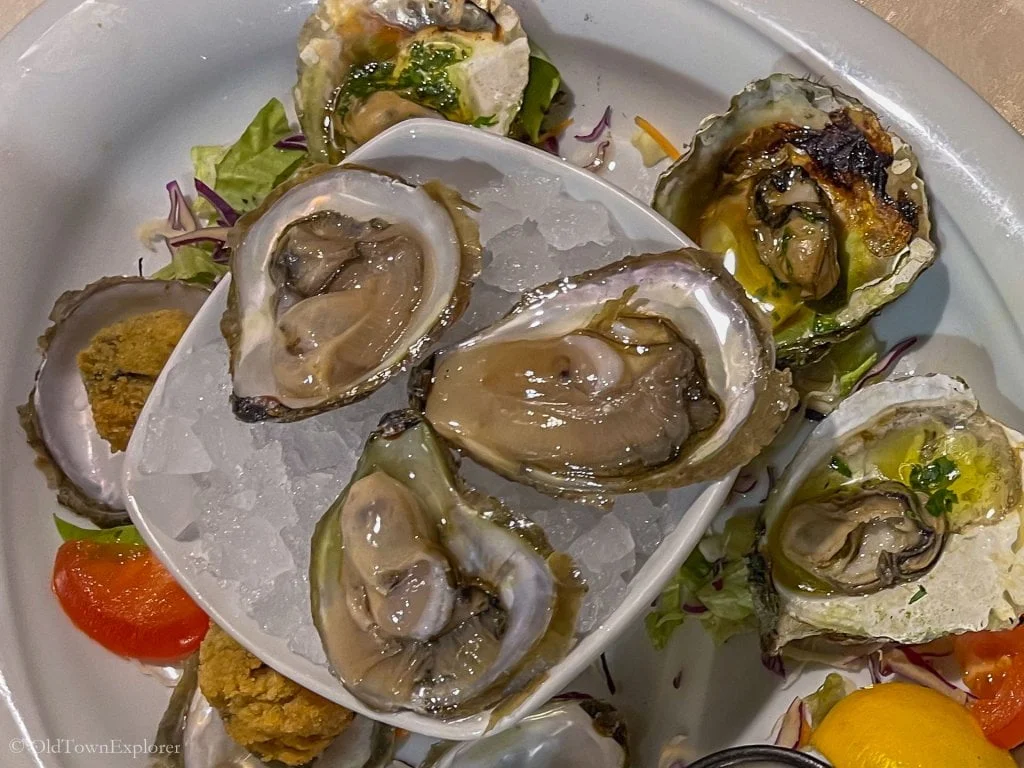
Look for Ston or Mali Ston beside oysters when shellfish is the reason for the meal. The oysters come from the nearby bay rather than Dubrovnik itself, but Old City restaurants make them easy to try without taking a separate trip.
Traditional Dubrovnik and Dalmatian Dishes
Dubrovnik menus draw heavily from the wider food of Dalmatia, especially seafood, shellfish, olive oil, cured meat, slow-cooked dishes, pasta, stews, figs, sheep’s cheese, and coastal desserts. Our Dalmatia Food page explains the regional dishes, products, and cooking traditions behind many meals served in Dubrovnik.
These are the main names to recognize before choosing where to eat:
- Crni rižot: black risotto made with squid or cuttlefish ink, often ordered as a first seafood dish.
- Shellfish na buzaru: mussels, shrimp, or other shellfish cooked with wine, garlic, olive oil, parsley, and breadcrumbs.
- Ston oysters: the clearest regional shellfish order when a restaurant identifies the oysters with Ston or Mali Ston.
- Peka: meat, seafood, or octopus slow-cooked under a covered bell. It may need to be ordered in advance, so confirm availability before planning the meal around it.
- Šporki makaruli: a Dubrovnik pasta dish served with a slow-cooked meat sauce.
- Rozata: Dubrovnik’s best-known custard dessert and the clearest local sweet to try first.
For a first meal, choose crni rižot or shellfish na buzaru. Add šporki makaruli when you want a dish more closely tied to Dubrovnik, and finish with rozata. Save peka for a restaurant that confirms it is available, and treat Ston oysters as a regional choice when the menu names their origin.
From there, choose the setting that fits the meal: an Old City restaurant for seafood or traditional Dubrovnik dishes, Gundulićeva Poljana for produce and picnic food, or a separate trip toward Ston, Pelješac, or Konavle.
Dubrovnik Sweets
Rozata is the dessert to order first. It is a set custard similar to crème caramel, traditionally scented with rose liqueur or another local aromatic ingredient.
For something easier to carry, look for arancini, strips of candied citrus peel, or dried figs. They make better market or food-shop purchases than another sit-down dessert during a full day inside the walls.
Where to Eat in Dubrovnik’s Old City
The Old City is compact enough to cross on foot, but its restaurants do not sit on one flat strip. Stradun is level, while many side streets climb steeply. Choose a restaurant near the part of the Old City where you expect to finish the day rather than judging the walk by distance alone.
Stradun Side Streets and Prijeko
The lanes branching from Stradun and the parallel Prijeko street hold both seafood restaurants and modern dining rooms. This is the simplest area for a first evening because you can compare traditional fish, modern Dalmatian cooking, and seasonal Adriatic menus without leaving the walls.
Proto sits on Široka, Restaurant Dubrovnik is on Marojice Kaboge, and Stara Loza is on Prijeko. Check the exact approach before booking because two restaurants that look close on a map may sit on different levels of the Old City.
Luža, Lučarica and the Eastern Old City
The streets around Luža Square, Lučarica, St. Dominika, and Cvijete Zuzorić put you close to the Old Port and the Ploče side of the walls. Marco Polo, Restaurant 360, and Zuzori are among the choices in this part of the Old City.
Eat here when your evening begins near the harbor, the cathedral, Rector’s Palace, or the eastern gate. This side also works well when you want dinner before returning to accommodation near Ploče.
Gundulićeva Poljana and the Jesuit Steps
Gundulićeva Poljana suits a daytime market stop, while the streets and square above it lead toward Kopun and other restaurants near the Jesuit Steps. This part of the Old City works well when you want to pair the market with a traditional dinner later in the day.
The climb is short but steep. Account for the steps when summer heat, luggage, a stroller, or limited mobility affects the evening plan.
Traditional Restaurants in Dubrovnik’s Old City
Dubrovnik’s traditional restaurants range from seafood-focused dining rooms to places that give older Croatian meat dishes and regional recipes more space. Proto is the strongest choice for fish and shellfish, Marco Polo suits a mixed Dalmatian meal, and Kopun is the better fit when you want traditional dishes beyond seafood.
Proto Fish Restaurant
- Address: Široka no. 1, 20000 Dubrovnik
Proto Fish Restaurant is in the heart of Dubrovnik’s Old City. Its official restaurant page emphasizes traditional fish and meat dishes, Adriatic fish, shellfish, crabs, mollusks, and dining on Široka Street, while Michelin lists Proto Fish as a Dubrovnik seafood restaurant.
It makes the most sense for a longer seafood meal inside the walls, especially when fresh fish, shellfish, grilled seafood, or a more formal dinner is the priority.
Marco Polo
- Address: Lučarica 6, 20000 Dubrovnik
Marco Polo is in Dubrovnik’s Old Town near St. Blaise’s Church. Michelin describes the restaurant as Mediterranean with strong traditional characteristics, and the restaurant’s official site confirms its Lučarica 6 location.
It fits a meal inside the Old City that leans toward traditional Mediterranean and local cooking rather than a modern tasting-menu format.
Restaurant Kopun
- Address: Poljana Ruđera Boškovića 7, 20000 Dubrovnik
Restaurant Kopun is on Poljana Ruđera Boškovića inside the Old City. Its official page frames the restaurant around traditional Croatian cuisine, with emphasis on Dubrovnik and coastal regions.
It is better suited to a quieter Old City dinner focused on Dubrovnik-area or Croatian meat dishes, traditional recipes, and a square away from the busiest Stradun flow.
Modern Restaurants in Dubrovnik’s Old City
Modern Dubrovnik restaurants are strongest when they keep a clear connection to Adriatic fish, Dalmatian ingredients, Croatian olive oil, local wines, Old City settings, or Dubrovnik and Mediterranean food traditions. Modern should describe the cooking approach, not just décor or price.
Restaurant 360
- Address: Sv. Dominika bb, 20000 Dubrovnik
Restaurant 360 sits near the walls and St. John Fortress. Its official contact page lists the Sv. Dominika address and identifies the restaurant as a Michelin one-star restaurant, while Michelin lists it among Dubrovnik restaurants.
Restaurant 360 belongs in the modern section because the decision is fine dining, tasting menus, Old City walls, and a planned dinner rather than a traditional konoba-style meal.
Restaurant Dubrovnik
- Address: Marojice Kaboge 5, 20000 Dubrovnik
Restaurant Dubrovnik is in the Old Town on Marojice Kaboge. Its official site confirms the address, and its menu and restaurant positioning make it a better fit for a more structured modern Dalmatian dinner than for a simple traditional restaurant entry.
Restaurant Dubrovnik works best as a quieter Old City dinner choice when a rooftop or more formal dining setting is part of the appeal.
Stara Loza
- Address: Prijeko 22, 20000 Dubrovnik
Stara Loza is within Prijeko Palace in the Old Town. Its current menu page describes modern Mediterranean cooking rooted in Dubrovnik and the Adriatic coast, with fresh Adriatic fish, Croatian olive oil, vegetables from Dalmatian gardens, seafood, brodetto, Dalmatian prosciutto, and land-based dishes.
Stara Loza is a stronger match for an Old City meal built around local ingredients, seafood, and a contemporary menu format.
Above 5 Rooftop Restaurant
- Address: Od Sigurate 4, 20000 Dubrovnik
Above 5 Rooftop Restaurant is on Od Sigurate in the Old Town. Its official page describes a rooftop restaurant in the center of the Old Town with Mediterranean food, seasonal produce, and modern gastronomy.
Above 5 is mainly a rooftop and modern Mediterranean dinner decision, especially when the setting is part of the reason for choosing the restaurant.
Zuzori
- Address: Cvijete Zuzorić 2, 20000 Dubrovnik
Zuzori is in the heart of the Old Town. Its official page describes a modern Mediterranean kitchen, regional ingredients, Croatian wines, and food inspired by Mediterranean food culture with international influences.
Zuzori is a better fit for readers who want to stay inside the Old City while moving away from a strictly traditional seafood or konoba format.
Pavvo
- Address: Cvijete Zuzorić 1, 20000 Dubrovnik
Pavvo is at Cvijete Zuzorić 1 in Dubrovnik Old Town. Its official page describes global flavors with a Mediterranean heart and a restaurant rooted in the Mediterranean rather than a traditional Dubrovnik format.
Pavvo should replace the older Bistro Tavulin listing for this address unless current owner-supplied information confirms a separate active Tavulin concept.
Markets in Dubrovnik
Dubrovnik’s market stops split between the small Old City market at Gundulićeva Poljana and the larger Gruž market near the port. The Old City market is the easier stop during a short visit, while Gruž gives more useful context for longer stays, apartment cooking, seafood shopping, and ferry-side planning.
Gundulićeva Poljana Market
Gundulićeva Poljana Market is the main Old City market stop. It sits on Gundulić Square and is convenient for fruit, vegetables, herbs, small food items, and a quick look at market activity inside the walls.
The market is best treated as a short Old City food stop, not as the city’s only food-market experience.
Gruž Market
Gruž Market is outside the Old City near the port area and gives a broader market context than the small Old City market. It is a stronger stop for longer stays, apartment cooking, seafood shopping, and days tied to the ferry or port side of the city.
Gruž gives longer-stay visitors a better look at everyday food shopping outside the walled-center restaurant circuit.
Food Tours in Dubrovnik
Take a guided food tour early in the trip if you want help recognizing Dubrovnik dishes, wider Dalmatian food, and wines from Pelješac or Konavle before choosing restaurants on your own.
Guided Tours
Compare tours by the dishes and drinks included, the number of full servings versus small tastings, the walking distance and stairs, the meeting point, group size, dietary options, and cancellation terms. Check whether the route stays inside the Old City or includes a market, wine tasting, or another stop beyond the walls.
Best Places to Stay in Dubrovnik for Food
Stay inside the Old City when evening meals are a priority and you are comfortable carrying luggage through pedestrian streets and possible staircases. Pile and Ploče keep you close to the gates with easier vehicle access, while Gruž makes more sense when the market, bus station, or ferry port shapes the trip.
Hotels and Apartments in Dubrovnik for Food
The Old City is the strongest food base for most first-time visitors because the traditional restaurants, modern restaurants, market, wine bars, and dessert stops are close together. Pile and Ploče are the better alternatives when easier arrivals and fewer luggage complications matter more than sleeping inside the walls.
Use the interactive map below to compare hotels and apartments near Dubrovnik’s Old City, Pile, Ploče, Gruž Market, the ferry port, and other practical areas for food-focused stays.
FAQs About Dubrovnik Food
What food is Dubrovnik known for?
Dubrovnik is known for seafood, shellfish, black risotto, buzara, grilled fish, octopus, peka, pašticada, šporki makaruli, zelena menestra, Ston oysters, Dalmatian pršut, olive oil, and rozata.
Is Dubrovnik food different from Dalmatia food?
Dubrovnik food is best understood as a city-level expression of southern Dalmatian food. The city adds Old City restaurant geography, Ston and Pelješac routes, Konavle links, and Dubrovnik-specific menu terms, while Dalmatia Food explains the broader regional dish and product background.
What should I order first in Dubrovnik?
Start with crni rižot, shellfish na buzaru, grilled fish, octopus, or Ston oysters. For a more traditional meat or pasta meal, look for peka, pašticada, šporki makaruli, or zelena menestra.
Where should I start eating in Dubrovnik?
Start inside the Old City for the easiest first meals, especially around routes between Stradun, the harbor, Pile, Ploče, and the main side streets. Add Gruž for market context and Ston or Pelješac when oysters, salt, wine, or a regional food route are part of the trip.
Which market should I visit in Dubrovnik?
Gundulićeva Poljana Market is the easiest market stop inside the Old City. Gruž Market is better for a broader food-market view and makes more sense for longer stays, apartment cooking, seafood shopping, or port-side planning.
Is Dubrovnik a good base for Ston and Pelješac food routes?
Yes. Dubrovnik is a strong base for Ston, Mali Ston, and Pelješac food routes because those areas connect oysters, mussels, salt, seafood, Plavac Mali, Dingač, Postup, and southern Dalmatian wine roads.
What dessert should I try in Dubrovnik?
Rozata is the clearest Dubrovnik dessert to try first. Fritule, gelato, cakes, and café pastries also work well as shorter sweet stops during Old City walks.
For the rest of the trip, start with our main Dubrovnik guide, then continue with Dubrovnik Wine for wine bars and local wine choices, and Dubrovnik Architecture for the walls, gates, monasteries, palaces, and Old City walking routes. For wider regional food context, our Dalmatia Food page explains the dishes, products, and cooking traditions behind many Dubrovnik menus.