
Bordeaux Architecture
Explore Bordeaux Architecture: What to See & How to See It
Bordeaux’s architecture reflects its long history as a port on the Garonne. Roman remains, medieval churches, defensive gates, 18th-century limestone façades, railway structures, warehouses, and recent cultural buildings appear across the city.
The most extensive transformation came during the 18th century, when new squares, quays, boulevards, and civic buildings opened the old port toward the river. This classical cityscape forms the heart of Bordeaux, Port of the Moon, the UNESCO-listed urban area.
We spent a month in Bordeaux, walking its squares, churches, and riverfront districts. This overview will help you compare the major buildings, streets, bridges, and viewpoints and decide what to cover in two hours, a half day, or a full day.
This page contains affiliate links. We may earn a small commission at no extra cost to you.
Bordeaux Architecture at a Glance
Bordeaux combines a concentrated historic center with industrial, transport, and contemporary architecture spread farther along both banks of the Garonne.
- Core identity: Coordinated 18th-century limestone streets and riverfront façades surrounding older medieval churches, gates, and lanes
- Strongest starting area: Place Pey-Berland for religious and civic architecture or Place de la Bourse for the classical riverfront
- First buildings to notice: Bordeaux Cathedral and Tour Pey-Berland, or the Grand Théâtre and the Place de la Bourse ensemble
- Key features: Aligned cornices, wrought-iron balconies, carved stone façades, detached bell towers, monumental gates, and framed views toward the river
- Main trade-off: The medieval and classical center is walkable, while La Cité du Vin, Darwin, MÉCA, and several bridges require longer walks or tram connections
Choose Place Pey-Berland when churches, towers, and medieval streets matter most. Choose Place de la Bourse when the priority is classical planning, riverfront façades, and public squares.
What to See in Bordeaux
Bordeaux’s architecture is organized around three broad layers: the medieval streets and religious buildings of the older center, the formal squares and limestone façades created during the city’s 18th-century expansion, and the industrial and contemporary structures extending along the Garonne.
The first decision is whether to concentrate on the classical center, compare it with medieval Bordeaux, or continue along the river to the city’s warehouses, railway architecture, cultural buildings, and modern bridges.
Golden Triangle and the 18th-Century Riverfront
The Grand Théâtre, Allées de Tourny, Place de la Bourse, and Cours de l’Intendance show how Bordeaux expanded beyond its medieval limits. Look for continuous cornice lines, repeated window spacing, wrought-iron balconies, pale limestone, and carefully framed views between streets and squares.
This is the strongest area for comparing individual monumental buildings with large-scale urban planning. Much of the architecture can be appreciated from outside, although the Grand Théâtre and several civic interiors require separate access.
Cathedral Quarter, Medieval Streets, and Southern Gates
Bordeaux Cathedral, Tour Pey-Berland, Saint-Pierre, the Grosse Cloche, Porte Cailhau, Saint-Michel, and Sainte-Croix reveal the city that existed before its classical transformation. The churches retain Gothic, Romanesque, and Baroque details, while the gates and irregular streets mark former entrances, parish centers, and routes through the medieval port.
Detached bell towers are an important Bordeaux feature. Tour Pey-Berland and the Flèche Saint-Michel should be considered separately from their churches because they create different skyline views and may involve timed access and long stair climbs.
Port Warehouses, Railway Buildings, and Contemporary Architecture
CAPC, Bordeaux Saint-Jean station, Darwin, La Cité du Vin, MÉCA, and the modern Garonne bridges extend the architecture story beyond the old center. These sites compare stone warehouses, metal railway engineering, military reuse, cultural construction, and large-scale infrastructure.
They are more dispersed than the medieval and classical sites. Choose one riverfront cluster rather than treating every outlying building as part of the same short architecture walk.
Attractions in the Golden Triangle
The Golden Triangle is bounded by Cours de l’Intendance, Cours Georges-Clémenceau, and Allées de Tourny. Its broad streets, formal intersections, limestone façades, and cultural buildings show the scale of Bordeaux’s 18th-century expansion.
The Grand Théâtre is the main monument, but the surrounding streets and triangular sites show how individual buildings were fitted into a coordinated urban plan.
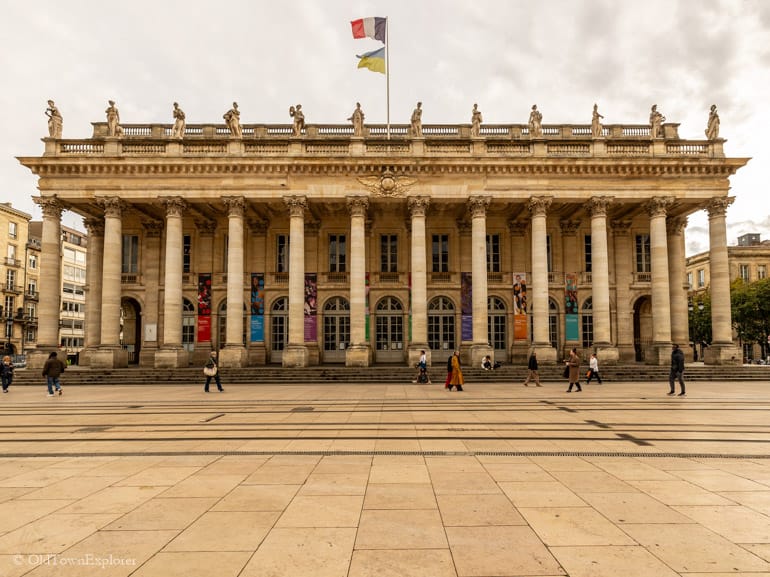
Grand Théâtre de Bordeaux
- Architect: Victor Louis
- Style: Neoclassical
- Built: 1773–1780
- Address: Place de la Comédie
The Grand Théâtre has a temple-like portico of twelve Corinthian columns beneath statues representing nine Muses and three goddesses. Its balanced façade anchors Place de la Comédie and terminates several important views through the Golden Triangle.
The exterior can be examined without a ticket. Access to the auditorium, staircase, and other interiors depends on performances or scheduled visits.
Maison Gobineau
- Architect: Victor Louis
- Style: Neoclassical
- Built: Completed 1789
- Address: 1 Cours du XXX Juillet
Maison Gobineau occupies a narrow triangular site where the Allées de Tourny meets Cours du XXX Juillet. Its curved, prow-like end demonstrates how classical façades were adapted to an irregular urban parcel.
The building now houses the Bordeaux Wine Council and its wine bar. The most useful architectural view is from outside, where its shape can be compared with the adjoining street lines.
Allées de Tourny
- Architect: Not applicable; laid out under Intendant Tourny
- Style: 18th-century classical boulevard
- Built: Developed during the 1740s and 1750s
- Address: Between Place de la Comédie and Place Tourny
The Allées de Tourny forms one side of the Golden Triangle and replaces part of Bordeaux’s former defensive edge with a broad promenade. Repeated stone façades, aligned rooflines, and the long central perspective show the shift from enclosed medieval streets to planned urban expansion.
Stand near Place de la Comédie or Place Tourny to see the boulevard’s full width and façade rhythm rather than focusing on one building.
Église Notre‑Dame & Cour Mably
- Architect: Pierre Duplessy-Michel and Mathieu Labat
- Style: Baroque
- Built: 1684–1707
- Address: Place du Chapelet and Rue Mably
Église Notre-Dame and Cour Mably are the principal surviving parts of the former Dominican convent. The church’s sculpted Baroque façade contrasts with the restrained stone arcades of the former cloister behind it.
The ensemble belongs in the Golden Triangle because the church, courtyard, and surrounding streets form one architectural stop. A shorter cross-reference appears under Religious Buildings without duplicating this full entry.
Hôtel de Sèze
- Style: 18th-century classical townhouse
- Built: 18th-century core; later adapted as a hotel
- Address: 23 Allées de Tourny
Hôtel de Sèze occupies a historic townhouse facing the Allées de Tourny. Its symmetrical limestone elevation, tall windows, and restrained ornament contribute to the continuous classical frontage of the boulevard.
It is a working hotel rather than a public monument. The façade and its relationship to the adjoining buildings are the dependable exterior features to examine.
Place des Grands Hommes / Galerie des Grands Hommes
- Architect: Current gallery by Claude-Henri Aubert
- Style: Contemporary commercial gallery within an 18th-century square
- Built: Current gallery opened 1991
- Address: Place des Grands Hommes
Place des Grands Hommes sits at the center of a radial group of streets named for Enlightenment writers and thinkers. The current circular gallery and glazed roof occupy the site of earlier market buildings and create a modern center within the classical square.
Compare the gallery’s curved glass and metal surfaces with the surrounding limestone façades. The former 19th-century iron market is treated separately under industrial and adaptive-reuse architecture.
Religious Buildings in Bordeaux
From Romanesque crypts to Flamboyant Gothic spires and Baroque façades, Bordeaux’s sacred architecture spans over a millennium. These churches, basilicas, and abbeys not only served spiritual functions but also shaped the city’s urban form, cultural memory, and political history.
The historic center alone houses multiple listed monuments, including Saint-André Cathedral and the Basilica of Saint-Michel, while surrounding districts preserve medieval pilgrimage sites, 19ᵗʰ-century parish churches, and adaptive reuse projects. Each reflects distinct architectural phases and the evolving religious landscape of the region.

Bordeaux Cathedral
Cathédrale Saint-André
- Architect / Builder: Various over centuries; early phases Romanesque, later Gothic
- Style: Gothic
- Date Built: Original consecration 1096; major Gothic rebuild 13th–15th centuries
- Address: Place Pey Berland, Bordeaux
Over a millennium, the cathedral has witnessed Bordeaux’s evolution: consecrated in 1096, rebuilt in Gothic style over the 12ᵗʰ–15ᵗʰ centuries, and even hosting the 1137 marriage of Eleanor of Aquitaine and Louis VII. Its interior spans some 124 m, with vaulted ceilings and a freestanding Pey‑Berland bell tower added for structural reasons.
Basilica of Saint-Michel
- Architect / Builder: Gothic builders from the 14th century onward
- Style: Flamboyant Gothic
- Date Built: 14th–16th centuries
- Address: 16 Pl. Meynard, 33000 Bordeaux
Rising on Bordeaux’s right bank, Saint‑Michel is a striking example of Flamboyant Gothic ambition. Its detached spire soars above the dense medieval streets. Over centuries, it has been a locus of devotion, urban identity, and architectural adaptation.
Basilica of Saint-Seurin
aka Basilique Saint-Seurin
- Architect / Builder: Romanesque and early medieval contributors
- Style: Romanesque with Gothic additions
- Date Built: 11th–15th centuries
- Address: Place des Martyrs de la Résistance, Bordeaux
Built atop a site with early Christian roots, Saint‑Seurin grew from a simple Romanesque church into a complex ecclesiastical structure with Gothic chapels and portals. Its crypt guards sarcophagi from Roman and early medieval eras.
Église Notre-Dame de Bordeaux
- Architect / Builder: Jesuit order
- Style: Baroque
- Date Built: 1684–1707
- Address: 4 Rue Mably, 33000 Bordeaux
Constructed in the late 17ᵗʰ century, this church (formerly linked to the Dominican order) reflects Baroque ideals in its façade and interiors. Hidden behind urban fabric, its quiet grandeur rewards those who venture in.
Église Sainte-Croix de Bordeaux
- Architect / Builder: Benedictine monks
- Style: Romanesque
- Date Built: 11th–12th centuries
- Address: 1 Pl. Pierre Renaudel, 33800 Bordeaux
Once the church of a Benedictine abbey, Sainte‑Croix preserves early Romanesque elements such as sturdy walls and rounded arches. Though much has been rebuilt over time, its form still signals medieval monastic presence.
Saint-Bruno Church
- Style: Baroque (Italian influence)
- Date Built: 17th century
- Address: 5 Pl. du 11 Novembre, 33000 Bordeaux
Constructed for the Carthusian order, Saint‑Bruno is one of the rare Baroque churches in Bordeaux influenced by Italian models. Its single nave, classical façade, and oval cupola reflect the order’s austere yet refined aesthetic. The adjacent former Charterhouse monastery was largely destroyed, but the church remains a spiritual and architectural anchor.

Church of Saint-Louis-des-Chartrons
- Architect / Builder: Jean-Jules Mondet
- Style: Neo-Gothic
- Date Built: 1874–1880
- Address: 51 Rue Notre Dame, 33000 Bordeaux
This imposing 19ᵗʰ-century church dominates the Chartrons district with twin spires and elaborate stonework. Built during Bordeaux’s urban expansion, it emulates Gothic cathedral design while integrating local motifs. Inside, vibrant stained glass and a grand organ underscore its role in the city’s ecclesiastical revival.
Church of Sainte-Marie de la Bastide
Église Sainte-Marie-de-la-Bastide Bordeaux
- Architect / Builder: Jean-Jules Mondet
- Style: Neo-medieval
- Date Built: 1887
- Address: 62 Avenue Thiers, 33100 Bordeaux
One of the most visible landmarks on the right bank, Sainte‑Marie was built to serve the growing population of La Bastide. Its pointed arches, decorative rose window, and soaring bell tower channel medieval inspiration, echoing 13ᵗʰ-century ecclesiastical architecture with 19ᵗʰ-century materials and planning.
Church of the Sacred Heart of Bordeaux
- Architect / Builder: Louis-Michel Garros
- Style: Neo-Romanesque
- Date Built: 19ᵗʰ century
- Address: 4 Rue Lefol, 33300 Bordeaux
Designed as part of a larger religious and social complex, the Church of the Sacred Heart features rounded arches, symmetrical towers, and restrained ornamentation. It reflects the revival of Romanesque forms popular in 19ᵗʰ-century ecclesiastical projects, adapted to Bordeaux’s urban context.
Saint-Éloi Church
aka Saint Eligius Church
- Architect / Builder: Original medieval builders; restored in 20ᵗʰ century
- Style: Gothic (remnants); contemporary restoration
- Date Built: Original 12ᵗʰ–13ᵗʰ century; restored 20ᵗʰ century
- Address: Rue Saint-James, 33000 Bordeaux
Saint‑Éloi’s bell tower, known as the Grosse Cloche, is one of Bordeaux’s most iconic landmarks. Though the adjoining church suffered damage and closure during the Revolution, portions of the original Gothic structure remain. A modern restoration has reanimated the space as a site of reflection and community.
Church of Saint-Pierre
Église Saint-Pierre
- Architect / Builder: 19ᵗʰ-century restorers
- Style: Gothic with 19ᵗʰ-century modifications
- Date Built: 14ᵗʰ century; restored 19ᵗʰ century
- Address: Place Saint-Pierre, 33000 Bordeaux
Situated near the ancient port, Saint‑Pierre was historically the parish church for Bordeaux’s merchants. Though its foundations date to the 14ᵗʰ century, much of what is seen today reflects 19ᵗʰ-century restoration campaigns. Its delicate façade and stained glass link medieval origins with later architectural reinterpretation.
Church of Saint-Paul-Saint-François-Xavier
Église Saint-Paul de Bordeaux
- Architect / Builder: Jesuit architects
- Style: Baroque
- Date Built: 17ᵗʰ century
- Address: 20 Rue des Ayres, 33000 Bordeaux
Built for the Jesuit order, this church blends classical Baroque design with Jesuit architectural principles: a strong central nave, restrained ornamentation, and a focus on acoustics for preaching. Once attached to a college, it continues to echo the educational and spiritual ambitions of the Counter-Reformation era.
Church of Saint-Nicholas
Église Saint-Nicolas
- Style: Eclectic 19ᵗʰ-century
- Date Built: 1823
- Address: 43 Rue Saint-Nicolas, 33800 Bordeaux
Built shortly after the Bourbon Restoration, Saint‑Nicholas is a modest church that reflects early 19ᵗʰ-century trends toward simplified religious architecture. Its understated design contrasts with the grandeur of nearby Gothic revival churches, serving a working-class district with functional elegance.
Church of Saint-Eulalia
aka Church Sainte Eulalie
- Style: Gothic origins with later modifications
- Date Built: Likely 13ᵗʰ–14ᵗʰ centuries
- Address: 13 Pl. Sainte-Eulalie, 33000 Bordeaux
Named for the patron saint of young martyrs, Saint‑Eulalia served Bordeaux’s expanding southern suburbs in the medieval period. While much of the original structure has been altered, fragments of Gothic stonework remain visible, offering clues to its ecclesiastical role across centuries.
Church of Saint-Ferdinand
- Style: 19ᵗʰ-century parish style
- Date Built: 19ᵗʰ century
- Address: Rue de la Croix de Seguey, 33000 Bordeaux
A neighborhood parish built during Bordeaux’s industrial growth, Saint‑Ferdinand prioritizes function over ornament. Though lacking the flourishes of Gothic revival, its simple nave, arched windows, and bell tower reflect the durable ecclesiastical forms of the period.
Church of Saint-Rémi
- Style: Late Gothic
- Date Built: 15ᵗʰ century
- Address: Rue Jouannet, 33000 Bordeaux
Saint‑Rémi was once a fully active parish but now serves as a cultural venue. Its surviving Gothic structure, with pointed arches and slender windows, maintains a sacred ambiance even in its adaptive reuse. The transition from worship to cultural programming illustrates Bordeaux’s evolving approach to heritage buildings.
Church of Saint-Projet
- Style: Gothic remains
- Date Built: Likely medieval; surviving tower and cross only
- Address: Place Saint-Projet, 33000 Bordeaux
Once a full parish church, Saint‑Projet today survives only in fragments: a slender bell tower and a sculpted cross. These elements anchor the square and offer a tangible link to Bordeaux’s medieval ecclesiastical landscape, despite the loss of the larger structure.
Chapelle Saint-Joseph
- Architect / Builder: Jesuit order
- Style: Baroque
- Date Built: 1663–1671
- Address: Rue Père Louis de Jabrun, 33000 Bordeaux
Originally built by the Jesuits and now home to the Orthodox Church of Saint‑Joseph, this chapel stands out for its classical Baroque façade and sculpted pediment. Designated a Monument historique, it offers a rare example of 17ᵗʰ-century ecclesiastical architecture in Bordeaux with continued liturgical use.
Chapelle du Crous
(Former Grand Seminary Chapel)
- Style: Classical
- Date Built: Likely 17ᵗʰ–18ᵗʰ centuries
- Address: 18 Rue du Hamel, 33000 Bordeaux
Once part of Bordeaux’s Grand Séminaire, this chapel now hosts concerts and cultural events under university stewardship. Recognized as a Monument historique in 2021, its understated classical architecture and vaulted interior represent the educational and religious ambition of early modern Bordeaux.
Convent of the Annunciation
Couvent de l’Annonciade
- Architect / Builder: Original 16ᵗʰ-century monastic builders; restored by Brochet‑Lajus‑Pueyo
- Style: Gothic chapel with Renaissance cloister
- Date Built: Founded c. 1520; major restoration in the late 20ᵗʰ century
- Address: 54 rue Magendie, Bordeaux
Founded by the Order of the Annunciation in the early 16ᵗʰ century, the convent features a rare Renaissance cloister—one of the few surviving examples in Aquitaine—alongside a chapel with Gothic elements. Secularized during the Revolution, the complex later served administrative functions. In the 1990s, it was carefully restored and now houses the Regional Directorate of Cultural Affairs. The architecture combines historic stonework with contemporary interventions, preserving its layered character while keeping it in civic use.
Great Synagogue of Bordeaux
Grande Synagogue
- Architect / Builder: Charles Durand; André Burguet (early plans)
- Style: Eclectic with medieval and oriental influences
- Date Built: 1877–1882
- Address: 6 Rue du Grand Rabin Joseph Cohen, Bordeaux
Built to replace an earlier synagogue lost to fire, this monumental structure serves Bordeaux’s historic Sephardic community. It features twin turrets, arched portals, and interior detailing that reflects both Jewish liturgical needs and 19ᵗh-century architectural eclecticism. Declared a Monument Historique, it remains an active place of worship and memory.
Civic Buildings in Bordeaux
Bordeaux’s civic architecture reflects centuries of governance, cultural ambition, and urban transformation. From 18ᵗʰ-century neoclassical hôtels particuliers to revolutionary tribunals and modern administrative centers, these buildings offer insight into the city’s evolving public life.
Anchored by landmarks like the Palais Rohan and Grand Théâtre, the civic core of Bordeaux also includes restored town halls, archives, courthouses, and public libraries—each contributing to the city’s political and architectural identity.
Palais Rohan
Hôtel de Ville de Bordeaux / City Hall
- Architect / Builder: Renovation under Archbishop Rohan starting ~1771
- Style: Neoclassical / late 18ᵗʰ-century civic
- Date Built / Modified: Completed 1784 (major remodeling)
- Address: Place Pey Berland, Bordeaux
Originally the archbishop’s palace, the building was remodeled in the 18ᵗʰ century to serve as the city hall (hôtel de ville). It sits adjacent to the cathedral, forming a civic-religious ensemble. The interior retains elaborate decorative work, sculpted woodwork, trompe l’œil murals by Lacour, and a grand staircase.
New Bordeaux Law Courts
Tribunal / Palais de Justice / Tribunal Judiciaire
- Architect / Builder: RSHP (Rogers Stirk Harbour + Partners)
- Style: Contemporary civic architecture
- Date Built / Commissioned: Late 20ᵗʰ / early 21ᵗʰ century (competition won 1992)
- Address: 30 Rue des Frères Bonie, 33000 Bordeaux
This modern courthouse complex was designed to express transparency, orientation, and public access. Courtroom volumes (pods) are elevated on pilotis above a limestone plinth, within a glass envelope, beneath an undulating copper roof. Bridges span across the atrium to separate circulation routes (public, magistrate, defendants). The building negotiates its urban context by respecting nearby medieval walls and creating landscaped public space.
Palais Thiac
Former Courthouse / Judicial Palace / Cour d'Appel de Bordeaux
- Architect / Builder: Joseph-Adolphe Thiac
- Style: Neo‑classical
- Date Built: 1839–1846
- Address: Place de la République, Bordeaux
This 19ᵗʰ-century judicial palace houses the Bordeaux Court of Appeal, Assize Court, and Conseil de Prud’hommes. Though a newer courthouse now handles many judicial functions, the Palais Thiac remains an emblem of judicial authority. Its long façade, Doric columns, and sculptural decorations (statues of Montesquieu, Malesherbes, etc.) evoke classical ideals of law and order.
CAPC / Entrepôt Lainé
aka Museum of Contemporary Art
- Architect / Builder: Claude Deschamps (1824 warehouse); restorations by Denis Valode & Jean Pistre; interior by Andrée Putman
- Style: 19ᵗʰ century industrial warehouse adapted to cultural use
- Date Built / Conversion: Warehouse built 1824; restored in 1980s onward
- Address: 7 rue Ferrère, Bordeaux
Once a colonial goods warehouse (coffee, sugar, cotton), the Entrepôt Lainé was converted into the CAPC Museum of Contemporary Art. Its dual-nave structure evokes a basilica-like form, while the adaptation blends original brick, stone, and timber with modern interventions. The building hosts exhibitions and also houses Arc en Rêve, an architecture center.
Palais Rohan
Hôtel de Ville de Bordeaux / City Hall
- Architect / Builder: Renovation under Archbishop Rohan starting ~1771
- Style: Neoclassical / late 18ᵗʰ-century civic
- Date Built / Modified: Completed 1784 (major remodeling)
- Address: Place Pey Berland, Bordeaux
Originally the archbishop’s palace, the building was remodeled in the 18ᵗʰ century to serve as the city hall (hôtel de ville). It sits adjacent to the cathedral, forming a civic-religious ensemble. The interior retains elaborate decorative work, sculpted woodwork, trompe l’œil murals by Lacour, and a grand staircase.
Hôtel des Fermes du Roi / National Customs Museum
Musée National des Douanes
- Architect / Builder: Jacques Gabriel (design), completed under his son Ange‑Jacques Gabriel
- Style: French Classical / 18ᵗʰ-century neoclassical
- Date Built: design finalized 1733; construction began 1735; occupied 1738
- Address: Place de la Bourse, Bordeaux
Originally built to house the Ferme Générale (the Crown’s tax farming service), this building now hosts the National Customs Museum, tracing centuries of customs and trade history in France. The façades, roof, courtyard, and fountain are classified as historic monuments.
Palais de la Bourse
Chamber of Commerce / Tribunal de Commerce
- Architect / Builder: Jacques Gabriel & Ange‑Jacques Gabriel
- Style: Classical / French neoclassical
- Date Built: 1742–1749
- Address: Place de la Bourse, Bordeaux
As part of the symmetrical façade ensemble around Place de la Bourse, this building housed the Chamber of Commerce and Tribunal of Commerce.
Its interior features arcaded galleries around a central courtyard (now covered), richly decorated tympana and ironwork.
It is still in use for commercial and judicial purposes, though the historical stock exchange function has ceased.
Archives de Bordeaux Métropole
Former Halles aux Farines / (Warehouse Conversion)
- Architect / Builder: Original warehouse (19ᵗʰ/early 20ᵗʰ century industrial), conversion by LIBER Architecture / Robbrecht & Daem / Philippe Caumes
- Style: Industrial heritage + contemporary intervention
- Date Built / Conversion: original warehouse, date tied to early railway era; conversion commenced in recent decades
- Address: Right bank, Bordeaux (Bastide‑Niel area), Parvis des Archives, 33100 Bordeaux
The former grain halls (Halles aux Farines) have been transformed into the municipal archives and public reading spaces.
The design stacks concrete archive “boxes” cantilevered above a public reading hall; a new perpendicular wing houses exhibition, auditorium, offices, and public amenities.
Ancien centre de tri postal Saint‑Jean
- Architect / Builder: Léon Jaussely
- Style: Art Déco / early 20ᵗʰ-century industrial
- Date Built: 1929
- Address: Rue Charles‑Domercq, Bordeaux (Saint‑Jean district)
Designed as the postal sorting center near the Saint‑Jean railway station, this building features characteristic Art Deco symmetry, mosaics by Gentil & Bourdet, and large vertical windows.
In the 2000s, it was rehabilitated to host a modern train operations command center and administrative functions, keeping its heritage façades largely intact.
La Grande Poste
(former Grand Séminaire / central post office)
- Architect / Builder: Originally Grand Séminaire from mid‑18ᵗʰ; adapted as Post Office later
- Style: Classical / neoclassical heritage
- Date Built / Modified: Erected in 1747 (seminary)
- Les Éditions de l'Entre-deux-Mers; converted over time
- Address: 7 Rue du Palais Gallien, 33000 Bordeaux
This building began as Bordeaux’s Grand Séminaire but later became the central post office (“Grande Poste”).
Classified as a Monument historique (since 1911), it retains neoclassical elements, grand façades, and internal volumes adapted for postal functions.
After postal services moved, the building was sold and repurposed for mixed uses (residences, cultural, office) under the name “La Grande Poste — Espace Improbable.”
Marché des Grands Hommes & Marché des Chartrons
- Architect / Builder: Charles Burguet (for Grands Hommes, 1860), Lherme (for Chartrons, 1867)
- Style: Iron-frame market hall / 19ᵗʰ-century cast-iron architecture
- Date Built: 1860 (Grands Hommes) / 1867 (Chartrons)
- Addresses: Grands Hommes (in the central district) / Chartrons district
These 19ᵗʰ-century markets reflect Bordeaux’s embrace of industrial-era market halls: vaulted metal frames, open interiors, and space for vendors.
Some of these halls have since been adapted (or dismantled), but their design influence on later markets remains visible in Bordeaux’s urban morphology.
Bourse du Travail de Bordeaux
- Architect / Builder: Jacques d’Welles
- Style: Art Deco
- Date Built: 1938 (inaugurated 1 May)
- Address: Near Place de la Victoire, Bordeaux
Designed as a workers’ hall and union center, its Art Deco façade and large hall (Salle Ambroise Croizat) were intended for meetings, events, and cultural programming.
The building has faced structural issues and water infiltration, requiring restoration, but remains emblematic of Bordeaux’s 20ᵗʰ-century social and civic architecture.
Saint‑Jean Train Station
Gare de Bordeaux‑Saint‑Jean
- Architect / Builder: Louis Choron & Marius Toudoire (façade), Daydé & Pillé (metal train shed)
- Style: 19ᵗʰ-century railway architecture (metal-frame shed + classical façade)
- Date Built: Original station 1855; major rebuild completed 1898
- Address: Rue Charles‑Domercq, 33800 Bordeaux
The Bordeaux‑Saint‑Jean station is a landmark of railway architecture combining a richly ornamented classical façade with an expansive metal trainshed. The shed spans 56 m in width, covering some 17,000 m², constructed with prefabricated components by Daydé & Pillé.
While the station has been renovated (notably in 2016–2017 in relation to the LGV project), it retains many original features: the façade’s symmetry, the large glazed hall, and the structural logic of 19ᵗʰ‑century engineering.
Fort du Hâ Prison
- Architect / Builder: Military architects (original castle c. 1450); prison adaptation in 1846
- Style: Fortified medieval + 19ᵗʰ-century penal
- Date Built: Prison 1846; demolished 1969
- Address: Rue du Fort Louis, Bordeaux
Once part of a 15ᵗʰ-century fortress, Fort du Hâ housed a military prison until 1967. Its enclosed design, stone towers, and central courtyard followed penal principles of surveillance and control. Though most of the prison was demolished in 1969, two towers and wall segments remain as historical markers.
Castéja
l'ancienne Institution nationale des sourdes-muette (Former School for the Deaf)
- Architect / Builder: Adolphe Thiac
- Style: 19ᵗʰ-century institutional
- Date Built: 1862–1870
- Address: 87 Rue Abbé de l'Épée, 33000 Bordeaux
This former school for the deaf was designed by Bordeaux architect Adolphe Thiac. Its U-shaped layout, formal courtyard, and restrained façades typify 19ᵗʰ-century educational design. Though unused for decades, the building’s redevelopment has drawn attention to preservation versus adaptation debates in civic heritage.
Gates, Walls & Fortifications in Bordeaux
Once enclosed by protective walls and marked by monumental gates, Bordeaux’s historic defenses tell the story of a city shaped by conflict, trade, and royal presence. While much of the original fortification system has disappeared, key structures remain.
City gates like Porte Cailhau, Porte Dijeaux, and the Grosse Cloche offer insight into medieval military design and civic pride. Scattered wall remnants and fortified outposts, including Fort Médoc and the Blanquefort Fortress, reflect Bordeaux’s role in regional defense and urban control across centuries.
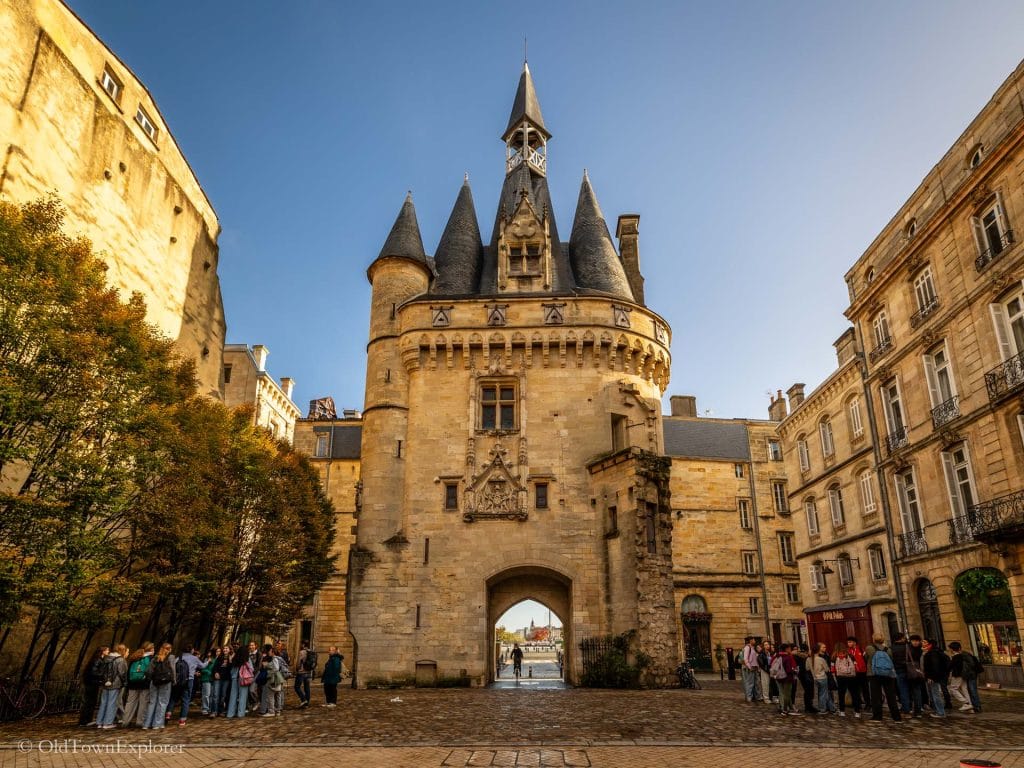
Porte Cailhau
- Architect / Builder: Municipal; possibly Raymond Macip
- Style: Gothic with Renaissance detailing
- Date Built: 1493–1496
- Address: Place du Palais, Bordeaux
Built to honor Charles VIII’s victory at Fornovo, this city gate once marked the entrance to the ducal palace and features ornate statuary and defenses.
Porte Saint-Éloi (Grosse Cloche)
- Architect / Builder: Medieval civic builders
- Style: Gothic / Beffroi
- Date Built: 15th century (bell cast 1775)
- Address: Rue Saint-James, Bordeaux
The Grosse Cloche is one of Bordeaux’s oldest civic monuments and features a 7,800 kg bell that rang during ceremonial events and emergencies.
Porte Dijeaux
- Architect / Builder: Rebuilt under Intendant Tourny
- Style: Neoclassical triumphal gate
- Date Built: 1750s
- Address: Near Place Gambetta, Bordeaux
A grand neoclassical arch marking the western entrance to the old city, this gate symbolized Bordeaux’s transformation under royal patronage.
Porte de Bourgogne
- Architect / Builder: 14ᵗʰ-century origins; later reworked under Louis XV's urban reforms
- Style: Classical gate with medieval foundations
- Date Built: Medieval core (14ᵗʰ c.); remodeled 1750s
- Address: Quay side near Pont de Pierre, Bordeaux
Once the eastern entrance to Bordeaux, this gate was rebuilt as part of Intendant Tourny’s urban renewal, aligning with the Pont de Pierre. It retains its function as a monumental river gateway, blending classical proportions with its original defensive siting. Today, it serves as a symbolic passage into the old city from the Garonne.
Porte d’Aquitaine (Porte Saint-Julien)
- Architect / Builder: neoclassical redesign by Tourny's urban team
- Style: Triumphal arch (neoclassical)
- Date Built: 1753 (on older medieval site)
- Address: Place de la Victoire, Bordeaux
This triumphal gate replaced the older Saint-Julien gate and marks the southern axis of Bordeaux. It frames the obelisk and square at Place de la Victoire and symbolizes Bordeaux’s shift from medieval fortifications to ceremonial urbanism during the Enlightenment. Carvings and inscriptions reflect civic pride and connectivity with the Aquitaine region.
Porte de la Monnaie
- Style: 18ᵗʰ-century neoclassical
- Date Built: Mid‑18ᵗʰ century
- Address: Quai de la Monnaie, Bordeaux
This lesser-known riverside gate was named for its proximity to the former Royal Mint (Monnaie de Bordeaux). Though modest in scale, its arched form and proximity to the Garonne made it a functional entry point for goods and trade. Today, it remains a discreet but historically meaningful part of Bordeaux’s quayside architectural legacy.
City Walls
- Architect / Builder: Roman engineers; medieval civic builders
- Style: Fortified curtain walls
- Date Built: Roman origins; major expansions 12ᵗʰ–15ᵗʰ centuries
- Address: Remnants throughout central Bordeaux
Bordeaux's fortifications evolved over centuries: from Roman ramparts to medieval curtain walls enclosing the old city. Though most walls were dismantled during modernization, fragments survive near Porte Cailhau, Rue des Bahutiers, and incorporated into later buildings. These remnants trace the city's historic boundaries and offer insight into its layered urban defense strategies.
Bridges and Infrastructure in Bordeaux
Bordeaux’s growth across both banks of the Garonne has been shaped by its evolving infrastructure. From early 19th-century stone arches to 21st-century lift bridges, the city’s crossings reflect ambition and adaptation.
Pont de Pierre
- Architect / Builder: Claude Deschamps, Jean-Baptiste Basilide Billaudel
- Style: Masonry arch bridge
- Date Built: 1810–1822
- Address: Connects Cours Victor Hugo (left bank) to Avenue Thiers (right bank)
Commissioned under Napoleon and constructed between 1819–1822, Pont de Pierre was the first permanent bridge linking Bordeaux’s left and right banks. Its 17 arches span 487 m, built over a challenging river with strong currents and tidal variation. The bridge’s hollow structure houses internal galleries used for maintenance and utilities.
Pont Saint-Jean
- Architect / Builder: Jean-Louis Fayeton
- Style: Prestressed concrete girder bridge
- Date Built: 1963–1965
- Address: Connects Quai Deschamps (right bank) to Quai de Paludate (left bank)
Built in the mid-1960s, Pont Saint‑Jean relieved congestion from Bordeaux’s older bridges by providing a practical, modern crossing aligned with the main train station.
Historical Squares in Bordeaux
Bordeaux’s public squares have long served as focal points of civic life, power, and architectural expression. Each square reflects a layer of the city’s urban and political history.
Place de la Bourse
- Architect / Builder: Jacques Gabriel and Ange-Jacques Gabriel
- Style: French neoclassical
- Date Built: 1730–1775
- Address: Quai de la Douane, Bordeaux
This iconic square along the Garonne was designed to embody royal power and commercial prestige. Originally named Place Royale, its symmetrical classical façades frame the Palais de la Bourse and Hôtel des Douanes. The 18ᵗʰ-century design introduced urban openness along the waterfront, later complemented by the Mirroir d’Eau installation in the 21st century.
Place des Quinconces
- Architect / Builder: Commissioned after Château Trompette demolition
- Style: Monumental urban square
- Date Built: Planned 1816; completed in stages through 1850s
- Address: Esplanade des Quinconces, Bordeaux
One of Europe’s largest city squares, Quinconces covers over 25 hectares. Its name comes from the quincunx planting pattern of trees. The square features allegorical statues, the Girondins Monument (1895–1902), and monumental fountains. It was created as both civic space and symbolic erasure of royal military power.
Place de la Comédie
- Architect / Builder: Victor Louis (Grand Théâtre); urban designers under Tourny
- Style: Neoclassical
- Date Built: Square formed mid-18ᵗʰ century
- Address: Facing Grand Théâtre, Bordeaux
Anchored by the Grand Théâtre, Place de la Comédie is the ceremonial heart of Enlightenment Bordeaux. The space connects key urban axes and showcases Victor Louis’s 1770s colonnaded masterpiece. It reflects the harmony of neoclassical city planning and remains a focal point of cultural life.
Place du Parlement
- Architect / Builder: 18ᵗʰ-century Bordeaux architects
- Style: Classical façades; 19ᵗʰ-century fountain
- Date Built: Square layout 1760s; fountain added 1865
- Address: Bordeaux, Saint-Pierre quarter
Originally named Place du Marché Royal, this square was renamed in 1790 in honor of Bordeaux’s Parlement. Surrounded by 18ᵗʰ-century buildings with ornate balconies and façades, the space centers on a neo-Renaissance fountain installed under Napoleon III. It typifies Bordeaux’s blend of civic pride and urban elegance.
Place de la Victoire
- Architect / Builder: Various; obelisk by Ivan Theimer
- Style: Mixed historical
- Date Built: Open space since medieval era; current layout from late 20ᵗʰ century
- Address: South end of Rue Sainte-Catherine, Bordeaux
Once a medieval fairground and city gate area, this square evolved into a university and transit hub. The 2005 obelisk and turtle sculptures by Ivan Theimer anchor its contemporary identity, while the surrounding facades reflect centuries of adaptation and public use.
Place Gambetta
- Architect / Builder: 18ᵗʰ-century urban planners
- Style: Circular neoclassical square
- Date Built: Mid–late 18ᵗʰ century
- Address: Rue Judaïque / Cours Georges Clemenceau, Bordeaux
Originally Place Dauphine, this round square was laid out during Bordeaux’s Enlightenment-era expansions. It features symmetrical stone buildings with arcades and provides a leafy, quieter counterpart to more ceremonial urban spaces.
Place Camille-Jullian
- Architect / Builder: Urban redevelopment (1930s, 2000s)
- Style: Contemporary square with historical anchors
- Date Built: Created 1934; redesigned 2000
- Address: Rue du Pas-Saint-Georges, Bordeaux
This intimate square overlays a demolished block once considered unsanitary. Named for archaeologist Camille Jullian, it integrates cafés, terraces, and the repurposed Church of Saint-Siméon (now Utopia Cinema), blending historical layers with a relaxed urban feel.
Place de la République
- Architect / Builder: Various municipal engineers
- Style: Institutional civic square
- Date Built: 18ᵗʰ–19ᵗʰ century transitions
- Address: Between Palais de Justice and Saint-André Hospital, Bordeaux
Formerly Place d’Armes, this square has long served judicial and civic functions. Today it features a war memorial and opens onto major institutions, retaining a solemn, formal atmosphere anchored in republican symbolism.
Place du Palais
- Architect / Builder: Evolved organically from medieval city plan
- Style: Vernacular medieval-to-modern mix
- Date Built: Centered on 15ᵗʰ-century Porte Cailhau
- Address: Place du Palais, Bordeaux
Bordering the Garonne and framed by narrow streets, this triangular square links the river with old Bordeaux. Its name recalls the former ducal palace, while its restaurants and pedestrian space blend civic heritage with daily life.
Historical Streets in Bordeaux
Bordeaux’s architectural legacy extends along its historic streets—thoroughfares that shaped the city’s commercial, religious, and civic evolution.
Streets like Rue Sainte‑Catherine, one of Europe’s longest pedestrian shopping avenues, trace ancient Roman paths while adapting to modern rhythms. Rue Saint‑James led pilgrims to Santiago de Compostela and still houses medieval gates like the Grosse Cloche. In contrast, Cours de l’Intendance and Rue du Palais Gallien reflect aristocratic life and Roman heritage, respectively. From tight medieval alleys in Old Lormont to neoclassical promenades like the Allées de Tourny, each corridor narrates Bordeaux’s architectural and social past.
Sainte Catherine Street
Rue Sainte‑Catherine
- Type / Builder: Historic urban thoroughfare, evolved over centuries
- Style / Character: Pedestrian high street with mixed historic façade styles (Gothic, Renaissance, 18ᵗʰ–19ᵗʰ)
- Date Development: Ancient axis (Roman / medieval) → pedestrianization in 1976–1984 → renovation 2000–2003 (Jean‑Michel Wilmotte)
- Address / Route: Runs from Place de la Comédie to Place de la Victoire, central Bordeaux
As the principal pedestrian shopping street in Bordeaux (about 1.2 km long), Rue Sainte‑Catherine runs along a historic north–south axis that echoes the city’s Roman cardo.
Cours de l’Intendance
- Architect / Builder: Royal planners under Intendant Tourny
- Style / Character: 18th-century neoclassical urban boulevard
- Date Built: Mid-18th century
- Address: Runs from Place de la Comédie to Place Gambetta, Bordeaux
Part of Bordeaux’s “Golden Triangle,” Cours de l’Intendance exemplifies Enlightenment-era urban renewal. Flanked by symmetrical stone façades, wrought-iron balconies, and hôtel particuliers, this broad avenue linked the new civic quarter with commercial and aristocratic districts. It continues to function as a high-end commercial spine and walking axis within the city center.
Rue Saint-James
- Architect / Builder: Medieval street alignment
- Style / Character: Medieval-scale street with Gothic and 18th-century infill
- Date Built: Originates in the Middle Ages; rebuilt over centuries
- Address: Extends from Grosse Cloche to Place Fernand Lafargue, Bordeaux
One of the oldest streets in Bordeaux, Rue Saint-James traces a historic pilgrimage route to Santiago de Compostela. It retains narrow proportions, irregular building lines, and direct alignment with the Grosse Cloche gate. Today, it's a blend of independent shops, cafes, and restored façades, maintaining medieval character in the modern cityscape.
Rue du Pas-Saint-Georges
- Architect / Builder: Mixed medieval and early modern contributors
- Style / Character: Pedestrian-scale historic commercial street
- Date Built: Medieval origins
- Address: Connects Place Camille Jullian to Rue Saint-Rémi, Saint-Pierre district, Bordeaux
A quieter yet atmospheric lane in the historic core, Rue du Pas-Saint-Georges exemplifies the texture of the Saint-Pierre district. It curves gently through densely packed 17th–19th century buildings and opens onto smaller squares. Its mix of galleries, antique dealers, and low shopfronts makes it architecturally intimate and visually layered.
Rue Fondaudège
- Architect / Builder: 18th–19th century civic expansion
- Style / Character: Mixed bourgeois residential and commercial
- Date Built: 18th–19th centuries
- Address: Extends northwest from Place Tourny to Boulevard Wilson
Located just outside the historic core, Rue Fondaudège developed alongside Bordeaux’s 18th-century growth. It blends neoclassical and eclectic residential buildings, often with shopfronts at ground level. Ongoing renovation projects have modernized the tram corridor while preserving the historic urban fabric.
Monuments and Fountains in Bordeaux
Bordeaux’s public spaces are animated by monumental sculptures and fountains that reflect centuries of political change, civic pride, and artistic innovation.
Monument aux Girondins
- Architect / Builder: Achille Dumilâtre & Félix Charpentier (sculptors)
- Style: Republican monumental fountain
- Date Built: 1894–1902
- Address: Esplanade des Quinconces, Bordeaux
Commissioned to honor the Girondin deputies lost during the French Revolution, this 43-meter-high monument includes a rostral column, allegorical sculptures of liberty and the Republic, and two large fountain basins with bronze horses. It dominates Quinconces and reflects the civic ideals of the Third Republic.
Fontaine des Trois Grâces
- Architect / Builder: Visconti (design); Gumery (sculptor)
- Style: Neoclassical bronze sculpture fountain
- Date Built: Installed 1869
- Address: Center of Place de la Bourse, Bordeaux
Replacing a former statue of Louis XV, this fountain features the Three Graces—Aglaea, Euphrosyne, and Thalia—standing atop a stone base surrounded by lions and aquatic motifs. It harmonizes with the surrounding neoclassical architecture and became part of Bordeaux’s iconic riverfront ensemble.
Miroir d’Eau
- Architect / Builder: Michel Corajoud (landscape architect); Jean-Max Llorca (engineer)
- Style: Contemporary reflecting surface
- Date Built: 2006
- Address: Quay in front of Place de la Bourse, Bordeaux
The world’s largest reflecting pool (3,450 m²), this surface alternates between mirror and mist effects. Designed to echo the grandeur of Place de la Bourse, it has become a contemporary landmark and popular public gathering space, merging historic setting with modern landscape design.
Fondaudège Fountain
Fontaine de la place Charles-Gruet
- Architect / Builder: Louis de Coëffard de Mazerolles (architect); Louis Garros (engineer)
- Style: Small temple-form pavilion with statue
- Date Built: 1865
- Address: Place Charles-Gruet, Bordeaux (Fondaudège district)
This petite circular fountain is topped with a domed canopy supported by Corinthian columns. Within, a classical female figure (nymph or muse) holds a water jug, forming the central jet. It served both aesthetic and utilitarian functions in the 19ᵗʰ-century urban fabric.
Wallace Fountains
(Various Locations)
- Architect / Builder: Charles-Auguste Lebourg (sculptor)
- Style: Cast-iron public drinking fountains
- Date Built: Installed late 19ᵗʰ century
- Address: Scattered throughout central Bordeaux
A philanthropic initiative by Sir Richard Wallace, these green cast-iron fountains blend utility and public art. Four caryatids support a domed canopy from which potable water once flowed. Though not unique to Bordeaux, they remain heritage objects emblematic of 19ᵗ-century urban reform.
Ancient and Archaeological Sites in Bordeaux
Bordeaux’s architectural history extends beyond medieval churches and Enlightenment façades—into layers of Roman infrastructure and even prehistoric habitation.
Palais Gallien
(Roman Amphitheatre)
- Architect / Builder: Roman provincial engineers
- Style: Gallo‑Roman amphitheatre
- Date Built: 2nd century CE
- Address: 126 Rue du Dr Albert Barraud, 33000 Bordeaux
Once capable of seating up to 20,000 spectators, Bordeaux’s Roman amphitheatre is the city’s most prominent ancient structure. Though only fragments remain—arches, outer walls, and sections of the arena—its elliptical footprint and preserved masonry provide rare insight into civic entertainment during the Roman period. Today, its integration into the urban fabric reveals both the endurance and loss of Bordeaux’s classical past.
Archaeological Site of Saint-Seurin
- Architect / Builder: Early Christian and Gallo-Roman contributors
- Style: Subterranean necropolis
- Date Built: 4th–6th centuries CE (with earlier Roman graves)
- Address: Under Basilica of Saint-Seurin, Place des Martyrs de la Résistance, Bordeaux
Beneath the Basilica of Saint-Seurin lies one of Bordeaux’s oldest archaeological layers—a late Roman and Merovingian cemetery with over 400 sarcophagi, mosaics, and liturgical features. The site includes early Christian inscriptions and relics, making it a significant testimony to Bordeaux’s religious and funerary transition from pagan antiquity to Christian late antiquity.
Other Attractions
Beyond Bordeaux’s core typologies lie buildings and urban spaces that defy easy classification. These include former convents, industrial complexes reimagined for public use, and distinctive civic projects like the Arcachon Winter Town, Darwin Écosystème, and Beauval’s Éolienne Bollée.
Darwin / Niel Barracks
(Darwin Écosystème)
- Architect / Builder: 19ᵗʰ-century military engineers; restored by Evolution Group and Brochet‑Lajus‑Pueyo
- Style: Industrial / military reuse
- Date Built: 1874 (barracks); adaptive reuse from 2011
- Address: Quai des Queyries, Bordeaux
Established in former military hangars on Bordeaux’s right bank, Darwin is a flagship project of adaptive reuse. The 19ᵗʰ-century Niel Barracks were transformed into a cultural and ecological complex with coworking spaces, cafés, art walls, and public installations. The architecture preserves structural elements while integrating green technologies and contemporary design.
Things to Know Before You Go
Central Bordeaux Minimizes Walking
Saint-Pierre, Place de la Bourse, the Golden Triangle, Place Pey-Berland, and the Grosse Cloche form the most concentrated architecture area. Stay within or near this zone when short walks between medieval and classical sites matter more than contemporary riverfront buildings.
Limestone and Paving Need Stable Shoes
Central Bordeaux includes smooth pedestrian streets, uneven historic paving, curbs, tram tracks, and occasional cobbled surfaces. Stable walking shoes are more useful than formal footwear, especially in rain.
Morning and Evening Reduce Crowding
Major squares and commercial streets are generally quieter early in the morning and later in the day. Church interiors, towers, museums, and civic buildings follow separate access schedules, so quieter streets do not necessarily mean open interiors.
Many Exteriors Are Free to See
Squares, streets, gates, bridges, church façades, and riverfront ensembles can be examined without tickets. Towers, museums, performance interiors, archaeological areas, and scheduled civic visits may require reservations or admission.
Rain and Summer Heat Change Long Walks
Rain makes limestone paving and metal surfaces slippery, while hot summer afternoons can make exposed squares and quays uncomfortable. Use shorter outdoor periods when conditions are poor and check indoor access before relying on churches or museums for shelter.
Evening Light Works Along the Garonne
Late-day light reaches the riverfront façades around Place de la Bourse and changes the appearance of the pale stone. Illuminated gates, towers, bridges, and monuments can also be seen after dark, but interior architecture normally requires daytime or scheduled access.
Towers and Historic Surfaces Limit Step-Free Access
Tour Pey-Berland, the Flèche Saint-Michel, and gate interiors involve stairs and confined historic spaces. Street-level façades and squares are more accessible, although paving, curbs, construction, and tram crossings can still create obstacles.
Two Hours: Concentrate on the Classical Core
With two hours, prioritize Place Pey-Berland or Place de la Bourse rather than attempting the full city inventory. Add the Grand Théâtre, one medieval gate, and nearby streets only if walking time permits.
Half Day: Add the Medieval Center
A half day is enough to compare the cathedral quarter, Saint-Pierre, Place de la Bourse, the Grand Théâtre area, and either Porte Cailhau or the Grosse Cloche. Choose one tower or interior rather than assuming several ticketed sites will fit.
Full Day: Add One Outlying Architecture Cluster
A full day can combine the historic center with one additional cluster such as Chartrons and Bacalan, Saint-Jean and MÉCA, or La Bastide and Darwin. Adding every modern bridge and riverside district would turn the day into a transport exercise rather than a focused architecture visit.
Architecture Tours in Bordeaux
A guided tour is most useful when you want help distinguishing medieval street boundaries from the coordinated 18th-century center or interpreting details that are easy to miss from outside. It is less necessary when the priority is simply photographing the major façades and squares.
Guided Tours
The official Bordeaux visitor service lists guided city walks and monument visits. Compare the stated area, language, duration, interior access, and group size before booking, because a general historic-center tour may not provide the same architectural depth as a specialist walk.
Where to Stay for Architecture Walks
Central Bordeaux is the most practical base for repeated architecture walks, but the best neighborhood depends on whether you prioritize medieval streets, classical façades, riverfront conversions, or station access.
Saint-Pierre and Place de la Bourse: Choose this area for short walks to the riverfront ensemble, Porte Cailhau, medieval lanes, the Grosse Cloche, and restaurant squares.
Golden Triangle and Place Pey-Berland: This area suits the Grand Théâtre, Allées de Tourny, Cours de l’Intendance, Bordeaux Cathedral, Tour Pey-Berland, Palais Rohan, and the courthouse district.
Chartrons: Stay here for Saint-Louis-des-Chartrons, CAPC, the market square, former port buildings, and easier access toward Bacalan and La Cité du Vin.
Saint-Michel and Saint-Jean: This area is convenient for the basilica and Flèche Saint-Michel, Sainte-Croix, Bordeaux Saint-Jean station, MÉCA, and onward train travel.
Hotels and Apartments in Bordeaux
Use the map below to compare hotels and apartments near the historic center, Chartrons, Saint-Michel, Bordeaux Saint-Jean, and the tram network. Check the exact walking distance to your preferred architecture cluster rather than relying only on a general “central Bordeaux” label.
FAQs About Bordeaux Architecture
What architecture is Bordeaux known for?
Bordeaux is best known for its coordinated 18th-century limestone center and riverfront façades. The city also preserves Roman remains, Romanesque and Gothic churches, Baroque religious buildings, 19th-century revival architecture, industrial structures, and contemporary cultural buildings.
Why is Bordeaux a UNESCO World Heritage Site?
Bordeaux, Port of the Moon was inscribed for its historic urban and architectural ensemble and its role in the exchange of cultural values. The designated area includes much of the historic center and its planned relationship with the Garonne.
What stone is used in Bordeaux buildings?
Many historic Bordeaux buildings use pale local limestone from quarries around the wider region. Its color changes with light and weather, while carved details, joints, stains, and restored surfaces reveal differences in age and maintenance.
How has Bordeaux preserved its historic architecture?
Protection comes from national monument designations, the UNESCO framework, local planning controls, façade restoration, and reuse of older structures. Preservation does not mean the city is unchanged; warehouses, barracks, religious buildings, and industrial sites have been adapted for new purposes.
Can you visit castles and estates from Bordeaux?
Yes, but castles, vineyard estates, and rural châteaux lie outside the City Architecture page’s main scope. Use the Bordeaux Wine Region guide when choosing vineyard areas and arranging transport.
Are there Roman ruins in Bordeaux?
Yes. Palais Gallien preserves the most visible Roman architectural remains, while the archaeological site at Saint-Seurin contains late Roman and early Christian burial evidence.
What architecture is Bordeaux known for?
Bordeaux is best known for its coordinated 18th-century limestone center and riverfront façades. The city also preserves Roman remains, Romanesque and Gothic churches, Baroque religious buildings, 19th-century revival architecture, industrial structures, and contemporary cultural buildings.
What should you see if you have limited time?
Choose either Place Pey-Berland for the cathedral, detached tower, and civic buildings or Place de la Bourse for the classical riverfront. Add the Grand Théâtre and one medieval gate if you have roughly two hours.
Can you see Bordeaux’s architecture without entering buildings?
Yes. The principal squares, streets, façades, gates, bridges, quays, and church exteriors can be appreciated without tickets. Tower viewpoints, museums, archaeological spaces, theater interiors, and some civic buildings require separate access.
What is the best architecture viewpoint in Bordeaux?
Tour Pey-Berland gives a central view over the cathedral and historic rooftops, while the Flèche Saint-Michel looks across the southern center and Garonne corridor. Both involve substantial stair climbs and should be checked for current ticket and access arrangements.
Where should you stay for Bordeaux architecture?
Stay near Saint-Pierre, Place de la Bourse, the Golden Triangle, or Place Pey-Berland for the highest concentration of historic buildings. Choose Chartrons, Saint-Michel, or Saint-Jean when port architecture, religious buildings, railway structures, or contemporary southern riverfront projects matter more.
Architecture walks pair naturally with Bordeaux’s other specialties. Use our Bordeaux Wine guide to find urban tasting venues and plan vineyard trips, or continue with our Bordeaux Food guide for traditional dishes, markets, restaurants, and specialist shops.