
Budapest Architecture
Explore Budapest Architecture: Top Buildings & What to See
Budapest architecture reflects two different urban settings: Buda’s hills and Pest’s flat riverbank. Medieval remains and Baroque rebuilding shape the Castle Quarter, while nineteenth-century expansion gave Pest its broad avenues, civic palaces, and continuous apartment façades.
Gothic Revival landmarks share the skyline with domes and bridges. Closer to street level, Art Nouveau ironwork and glazed ceramics distinguish buildings such as Gresham Palace and the Postal Savings Bank. Wartime destruction and later reconstruction also explain why an old-looking building may contain much newer fabric.
We spent a month in Budapest, walking its riverbanks and architecture districts. Alongside those walks, further research informs the wider coverage. This page compares riverfront landmarks, churches, and palace façades to help you choose areas and interior visits.
This page contains affiliate links. We may earn a small commission at no extra cost to you.
Budapest Architecture at a Glance
Choose an area before choosing individual interiors. Budapest’s principal architecture districts reward different amounts of time and different kinds of walking.
- For the skyline: The Danube banks offer long views of Parliament, Buda Castle, and the central bridges. Stay on one bank if time is short
- For older street patterns: The Buda Castle Quarter combines medieval remains with Baroque houses and later reconstructions. Expect slopes and some uneven paving
- For nineteenth-century planning: Andrássy Avenue changes from dense blocks near the Opera to villas toward Heroes’ Square. M1 helps connect its longer stretches
- For decorative detail: Gresham Palace and the Postal Savings Bank introduce Art Nouveau ironwork and ceramics. The Liszt Academy adds a concert-building interior
- For residential architecture: The Palace Quarter around the National Museum concentrates former noble homes and apartment palaces. Many are exterior stops, so choose any interior visit separately
Castle Hill and Andrássy Avenue are separate outings on a short visit. Give one of them a half day rather than dividing limited time between both.
What to See in Budapest
The river, Castle Hill, and Pest’s avenues show different stages of the city’s development. Choose the architecture you most want to examine, then leave time for details at street level.
Choose the Danube for monumental buildings and bridge forms
Parliament and the Royal Palace are designed to register across the water. A riverbank view shows their full silhouettes; a closer approach reveals entrances and sculpture. The Chain, Elisabeth, and Liberty bridges then make the difference between suspended cables and truss construction visible without entering a building.
Choose Castle Hill for medieval remains and later reconstruction
Look at the surviving Mary Magdalene tower, the Dominican remains, and the street pattern around Matthias Church. Then compare them with Fisherman’s Bastion and the rebuilt palace structures. Rounded arches or a defensive-looking tower do not, by themselves, establish a medieval construction date.
Choose Pest for palace fronts and Art Nouveau decoration
Andrássy Avenue shows the scale of nineteenth-century expansion, while the Palace Quarter brings individual residences into narrower streets. For a closer look at decoration, prioritise the ceramics at Thonet House, the ironwork at Gresham Palace, or the former Postal Savings Bank’s roofline. For national context beyond the capital, see Hungary architecture.
Attractions on the Banks of the Danube
The Pest embankment brings Roman foundations, nineteenth-century public buildings, and modern memorials into one riverfront setting. Look across the water for the palace skyline, then turn inland to compare the shorter façades and street openings along the promenade.
Ruins of Roman Fort
- Style: Roman military architecture
- Built: Late Roman period
- Address: Március 15. tér, Budapest
The Roman fort remains on Március 15 Square preserve a fortified crossing on the Pest bank. Traditionally called Contra Aquincum, the site is identified by the Aquincum Museum as Castellum contra Teutanum. Exposed foundations beside the Inner City Parish Church reveal an earlier settlement beneath the present riverfront.
Inner City Parish Church
- Style: Gothic and Baroque
- Address: Március 15. tér 2, Budapest
The Inner City Parish Church stands beside Elisabeth Bridge, with a Baroque twin-towered front and an older Gothic eastern end. Inside, the Gothic sanctuary and archaeological remains reveal successive phases of rebuilding. The change between the two ends is more apparent at close range than in the riverfront skyline.
Vigadó Concert Hall
- Architect: Frigyes Feszl
- Style: Romantic
- Built: Opened in 1865; reconstructed after damage in the Second World War
- Address: Vigadó tér 2, Budapest
Feszl's concert hall combines broad arched openings with sculptural decoration and patterned surfaces. Compare its richly articulated front with the plainer hotel blocks along the promenade. An interior visit adds ceremonial stairs and painted halls to the exterior view.
Gresham Palace
- Architect: Zsigmond Quittner and József Vágó
- Style: Art Nouveau
- Address: Széchenyi István tér 5–6, Budapest
Facing the Chain Bridge, Gresham Palace uses curved ironwork, mosaics, and stained glass to distinguish itself from the square's classical buildings. It is now a Four Seasons hotel; its decorative entrance is the main feature to notice from the square.
Hungarian Academy of Sciences
- Architect: Friedrich August Stüler
- Style: Neo-Renaissance
- Built: Inaugurated 1865
- Address: Széchenyi István tér 9, Budapest
The Academy's symmetrical façade uses columns, sculpture, and a strongly defined cornice to give a learned society the presence of a public palace. View it obliquely from the square to see how its river-facing side completes the northern edge.
József Eötvös Sculpture
- Sculptor: Adolf Huszár
- Built: Unveiled 1879
- Address: Eötvös tér, Budapest
The József Eötvös monument combines Adolf Huszár’s standing bronze with a pedestal designed by Miklós Ybl. The raised position and steps give the figure a formal presence on the open riverfront. It commemorates the writer and statesman at the square bearing his name.
József Nádor Statue
- Sculptor: Johann Halbig
- Built: Unveiled 1869
- Address: József nádor tér, Budapest
This monument stands inland from the Danube in József nádor tér. The bronze figure and high pedestal commemorate Palatine Joseph, whose support for Pest's development connects the statue to the square's nineteenth-century civic setting.
Little Princess Sculpture
- Sculptor: László Marton
- Built: Large promenade version created in 1989; based on a 1972 statuette
- Address: Vigadó tér, Danube Promenade, Budapest
The Little Princess sculpture places a seated child with a paper crown directly on the promenade railing. The small figure, bent knees, and relaxed pose bring the work down to the scale of pedestrians. The Danube and Castle Hill remain visible behind it.
Attila József Sculpture
- Designers: László Marton and György Vadász
- Built: Installed 1980
- Address: Kossuth Lajos tér, river-facing promenade, Budapest
The seated poet looks toward the Danube below Parliament's much larger façade. The low position and inward-looking pose distinguish it from the ceremonial monuments in the square; allow space for others to pause beside this literary memorial.
Shoes on the Danube Bank
- Designers: Can Togay and Gyula Pauer
- Built: 2005
- Address: Id. Antall József rakpart, south of Parliament, Budapest
Pairs of iron shoes commemorate people murdered on the riverbank by the Arrow Cross during the Holocaust. Their placement at pavement level makes the river edge itself part of the memorial. Approach quietly and keep the shoes clear for other visitors.
Attractions in the Buda Castle Quarter
Castle Hill combines medieval street patterns with Baroque houses, nineteenth-century redesigns, and later reconstruction. The palace precinct and the residential streets have different scales. Compare both, and distinguish surviving medieval fabric from buildings recreated in historical forms.
Buda Castle
- Style: Medieval, Baroque, and later reconstruction
- Built: Medieval origins; successive enlargements and rebuilding
- Address: Szent György tér 2, Budapest
The Royal Palace occupies the southern end of Castle Hill above terraces and defensive walls. Its long wings and central dome belong to successive enlargements and reconstructions. The courtyards explain the complex's scale; museum interiors reveal surviving medieval spaces beneath it.
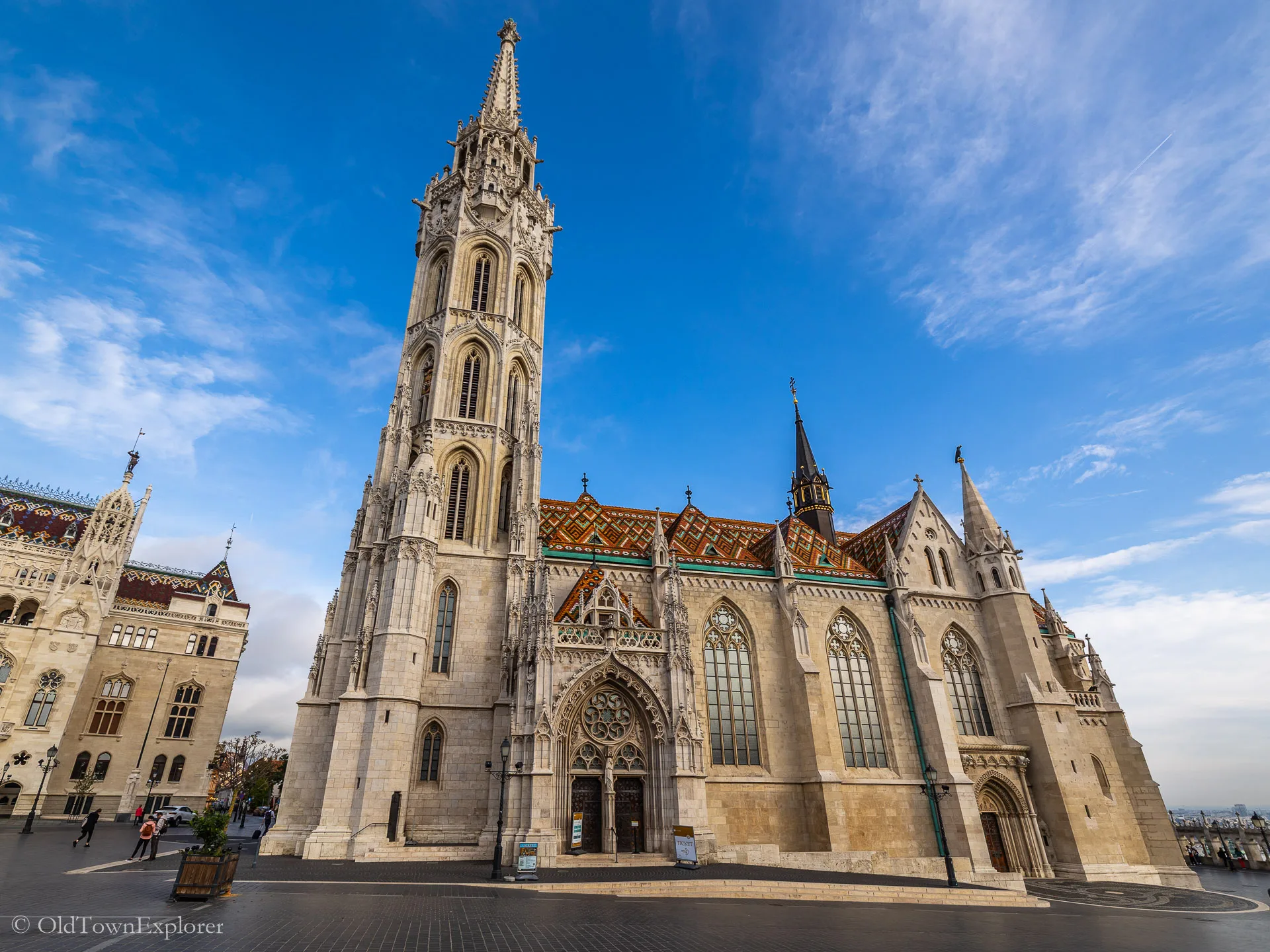
Matthias Church
- Architect: Frigyes Schulek (nineteenth-century restoration)
- Style: Gothic and Gothic Revival
- Address: Szentháromság tér 2, Budapest
The patterned roof and openwork spire dominate the northern Castle Quarter. Medieval elements coexist with Schulek's extensive nineteenth-century restoration. Inside, painted walls and decorative patterns add a different emphasis from the pale stone and coloured tiles seen outside.
Viennese Gate
- Built: Present gate reconstructed in 1936
- Address: Bécsi kapu tér, Budapest
The gate marks the northern entrance to the Castle Quarter. Its broad arch frames the approach into the hilltop streets, but the standing structure is a twentieth-century reconstruction. Compare its ceremonial appearance with the surviving defensive walls around the district.
Fisherman’s Bastion
- Architect: Frigyes Schulek
- Style: Neo-Romanesque
- Built: Present viewing ensemble constructed in 1899–1902
- Address: Szentháromság tér, Budapest
Schulek's terraces, arcades, and conical towers form a viewing ensemble beside Matthias Church. The rounded arches deliberately evoke medieval architecture, although the bastion was built around the turn of the twentieth century. Look back toward the church as well as across the Danube.
Dísz Square
- Built: Medieval origins; later rebuilding
- Address: Dísz tér, Budapest
Dísz Square links the palace precinct with the Castle Quarter’s residential streets. Narrow-fronted houses meet larger institutional buildings around an open space inherited from medieval Buda. Batthyány Palace at number 3 preserves the lower scale of the square’s eighteenth-century rebuilding.
Church of Mary Magdalene
- Style: Gothic
- Built: Medieval church; surviving tower built in the late fifteenth century
- Address: Kapisztrán tér 6, Budapest
The surviving tower and the outline of the former church occupy the northern end of the Castle Quarter. The church was damaged in the Second World War and subsequently demolished. Study the footprint at ground level to understand the building that once extended behind the tower.
Dominican Monastery of Saint Nicholas
- Style: Gothic remains with later restoration
- Built: Medieval origins
- Address: Hess András tér 1–2, Budapest
The former monastery survives in fragments incorporated into the Hilton complex. The restored tower and exposed masonry interrupt the modern hotel frontage, making this a particularly clear place to compare medieval remains with twentieth-century construction on Castle Hill.
Lutheran Church of Budavár
- Architect: Mór Kallina
- Built: 1895; rebuilt after wartime damage
- Address: Táncsics Mihály utca 28, Budapest
The Lutheran Church of Budavár stands beside Vienna Gate with a compact central tower and symmetrical frontage. Mór Kallina’s nineteenth-century church was rebuilt in a simplified form after wartime damage. Its small footprint and restrained elevation contrast with the long Archives building across the square.
National Archives of Hungary
- Architect: Samu Pecz
- Style: Neo-Romanesque
- Built: Construction began in 1913; occupied in 1923; interior decoration continued through the 1920s
- Address: Bécsi kapu tér 2–4, Budapest
The Archives' brickwork, stone detailing, and patterned roof give an administrative building the presence of a historical monument. Its long façade anchors Vienna Gate Square. Look at the repetitive windows as well as the decorative roof to see its institutional purpose.
Hospital in the Rock
- Built: Hospital constructed in 1941–1943 and opened in 1944; nuclear-bunker adaptations in 1958–1962
- Address: Lovas út 4/c, Budapest
Beneath Castle Hill, the hospital adapts the cave system into wards, corridors, and technical rooms. Its architectural interest lies in constrained underground spaces and later protective infrastructure. The modest entrance on Lovas út gives little indication of the complex behind it.
Carmelite Monastery
- Style: Baroque
- Built: Monastery completed by 1734; later remodelling and adaptations
- Address: Színház utca 1–3, Budapest
The former Carmelite complex stands along the eastern edge of the palace precinct. Its church was adapted as a theatre after the religious order was dissolved. The former church volume contrasts with the repeated windows of the adjoining monastery wing.
Sándor Palace
- Style: Neoclassical
- Built: Completed in 1806; subsequently restored and reconstructed
- Address: Szent György tér 1, Budapest
Sándor Palace faces the open square beside the Royal Palace. Its restrained proportions, shallow reliefs, and horizontal lines contrast with the larger palace complex. The exterior is the principal architecture stop; consult the presidential office for any announced public access.
Palace Chapel
- Style: Gothic
- Built: Medieval lower chapel
- Address: Szent György tér 2, Budapest, Budapest History Museum
The surviving lower chapel lies within the Royal Palace's museum spaces. Ribbed vaulting and the compact enclosure bring visitors closer to the medieval palace than the monumental exterior does. Plan it as part of a museum visit, rather than as a separate street entrance.
Buda Castle Tunnel
- Architect: Adam Clark, drawing on earlier plans by William Tierney Clark
- Built: Construction began in 1853; ceremonially opened in 1857
- Location: beneath Castle Hill, between Clark Ádám tér and Alagút utca, Budapest
The tunnel carries the road beneath Castle Hill from the Chain Bridge approach toward Krisztinaváros. Its monumental eastern portal turns a transport structure into an architectural counterpart to the bridge. Observe the entrance from the square rather than stopping near the traffic lanes.
Royal Riding Hall (Lovarda)
- Architect: Alajos Hauszmann (original Riding Hall)
- Built: Original Riding Hall, 1899–1901; reconstructed in 2016–2019 and opened as an event venue in 2021
- Address: Szent György tér 2, Budapest, Csikós Courtyard
The rebuilt Royal Riding Hall, known as the Lovarda, stands in the Csikós Courtyard below the palace. Its tall hall volume, roof structure, and ceremonial detailing recreate the equestrian building designed by Alajos Hauszmann. The adjoining Stöckl Stair connects this lower courtyard with the palace level.
Castle Garden Bazaar
- Architect: Miklós Ybl
- Style: Neo-Renaissance
- Built: 1875–1883
- Address: Ybl Miklós tér 2–6, Budapest
Ybl's arcades, pavilions, and terraces form a designed transition between the riverbank and Castle Hill. Look for the repeated arches and the stairs rising through the gardens. The ensemble frames the palace hillside when viewed from the Pest bank.
Attractions on Andrássy Avenue
Andrássy Avenue changes from dense commercial frontages near the centre to larger plots and villas toward City Park. Its architecture extends into adjoining theatre streets and music institutions. At the outer end, Heroes’ Square shifts the scale again, from residential avenue to ceremonial space.
Hungarian State Opera House
- Architect: Miklós Ybl
- Style: Neo-Renaissance
- Built: Opened 1884
- Address: Andrássy út 22, Budapest
The Opera's arcaded entrance, sculptural programme, and recessed upper loggia make it the avenue's principal theatre façade. The auditorium and ceremonial staircase require an interior visit. From outside, compare its freestanding composition with the continuous apartment-house fronts nearby.
Drechsler Palace
- Architect: Ödön Lechner and Gyula Pártos
- Style: Neo-Renaissance
- Built: 1883–1886
- Address: Andrássy út 25, Budapest
Drechsler Palace faces the Opera across Andrássy Avenue. Its ground-floor arcade supports a substantial residential block with steep roof forms, dormers, and elaborate upper-storey decoration. Designed by Lechner and Pártos, the building later housed the ballet institute and now accommodates W Budapest.
The “Pest Broadway”
- Built: Nineteenth- and twentieth-century streetscape
- Location: Nagymező utca around its intersection with Andrássy út, Budapest
Nagymező utca concentrates theatre entrances and cultural buildings in a narrower setting than Andrássy Avenue. Look at how canopies, signs, and sculptural details distinguish performance venues from neighbouring apartment houses. Mai Manó House adds a purpose-built photographer's studio to the street.
Franz Liszt Square
- Address: Liszt Ferenc tér, Budapest
The square creates a pedestrian opening beside Andrássy Avenue, with the Music Academy forming its main architectural destination. View the academy from farther back to appreciate its upper façade. Café terraces occupy much of the foreground, so allow time to find an unobstructed angle.
Oktogon
- Built: Nineteenth-century junction
- Address: Oktogon, Budapest
Oktogon takes its name from the eight-sided space created by the junction’s cut-back building corners. The corner blocks maintain a consistent height and strongly marked horizontal divisions across the two intersecting roads. Their angled fronts open views along both Andrássy Avenue and the Grand Boulevard.
Kodály körönd
- Built: Nineteenth-century residential ensemble
- Address: Kodály körönd, Budapest
Kodály körönd is enclosed by four curved residential fronts, with planted forecourts set between the buildings and the roadway. Painted decoration and repeated arcades soften the large blocks. The circular arrangement gives this stretch of Andrássy Avenue a broader, more residential setting than the dense blocks near the Opera.
House of Terror
- Built: Historic apartment building; museum adaptation opened 2002
- Address: Andrássy út 60, Budapest
The museum's projecting dark roof frame sharply alters the outline of the older apartment house. The building's use by fascist and communist security organisations gives that intervention its meaning. Separate the memorial architecture visible outside from the historical exhibition encountered inside.
Franz Liszt Memorial House
- Architect: Adolf Láng
- Built: Old Academy building, 1877–1879; Liszt apartment occupied from 1881
- Address: Vörösmarty utca 35, Budapest
The Franz Liszt Memorial Museum occupies Liszt’s former apartment within the Old Academy of Music. The preserved rooms include the composer’s study and salon, with instruments and furnishings arranged at a domestic scale. The corner location ties his home to the institution in which he taught.
Franz Liszt Academy of Music
- Architect: Flóris Korb and Kálmán Giergl
- Style: Art Nouveau
- Built: 1907
- Address: Liszt Ferenc tér 8, Budapest
The academy combines a monumental front with mosaics, sculptural decoration, and carefully designed concert interiors. Its entrance façade rewards close inspection, but the halls reveal the fuller relationship between architecture and music. Check the academy's own programme for a suitable interior visit.
Zoltán Kodály Memorial House
- Address: Andrássy út 87–89, Budapest
The Kodály Memorial Museum preserves the composer’s apartment on the outer stretch of Andrássy Avenue. His study, library, and domestic rooms retain the arrangement of a working home. The apartment offers an interior view of the residential buildings surrounding Kodály körönd.
Museum of Fine Arts
- Architect: Albert Schickedanz and Fülöp Herzog
- Style: Classical Revival
- Built: Opened 1906
- Address: Dózsa György út 41, Budapest
A broad classical portico faces Heroes’ Square, while large interior halls recreate historical architectural settings. Compare the museum's massing with the Kunsthalle opposite. Its position makes the museum part of the ceremonial ensemble at the avenue’s end.
Hungarian University of Fine Arts
- Built: Art-school building occupied in 1876; former Kunsthalle built in 1875–1877
- Address: Andrássy út 69–71, Budapest
The Hungarian University of Fine Arts occupies nineteenth-century art-school buildings near the Old Academy of Music. The former Kunsthalle wing contains Neo-Renaissance interiors with wall and ceiling paintings by Károly Lotz. Its studios and teaching spaces belong to a working university, so interior access depends on university arrangements.
Ferenc Hopp East‑Asian Art Museum
- Built: Historic villa; later museum conversion
- Address: Andrássy út 103, Budapest
The museum occupies Ferenc Hopp's former home on the avenue's villa-lined outer stretch. The setback and garden distinguish it from the dense commercial buildings closer to the centre. Compare the domestic exterior with the museum use inside and the objects placed through the garden.
Heroes’ Square
- Address: Hősök tere, Budapest
The avenue ends in a broad paved space between two museum buildings. The Millennium Monument creates the central focus, while the opposing classical façades frame the sides. Stand near the square's edge to see how the open ground changes the scale of the avenue.
Paris Department Store
- Architect: Zsigmond Sziklai
- Style: Art Nouveau
- Built: Opened 1911
- Address: Andrássy út 39, Budapest
The former Párizsi Nagyáruház uses large windows and a conspicuous upper façade to express its commercial purpose. The surviving Lotz Hall belongs to an earlier casino incorporated into the store. Compare this retail frontage with the more regular residential façades along the avenue.
Mai Manó House
- Architect: Rezső Nay and Muki Strausz
- Style: Neo-Renaissance
- Built: 1893–1894
- Address: Nagymező utca 20, Budapest
Mai Manó House was designed to combine a photographer’s family home, business premises, and daylight studio. Decorative figures and painted panels enliven the narrow façade on Nagymező Street. The large glazed studio shows how access to natural light shaped the building’s working spaces.
Millennium Underground (M1 Line) Stations
- Built: Opened 1896
- Location: beneath central Pest and Andrássy út, including Opera, Oktogon, and Kodály körönd stations, Budapest
Short stairs descend to shallow platforms with tiled walls and repeated structural columns. These small-scale station spaces contrast with later, deeper metro lines. The historic central stations add a transport interior to an architecture walk along the avenue; use BKK's information for travel arrangements.
Religious Buildings in Budapest
Budapest’s religious buildings differ in plan as well as decoration. Compare Baroque altars and towers with Protestant preaching spaces, Orthodox iconostases, and synagogue interiors. Churches and synagogues remain places of worship; check individual visiting arrangements before planning an interior stop.
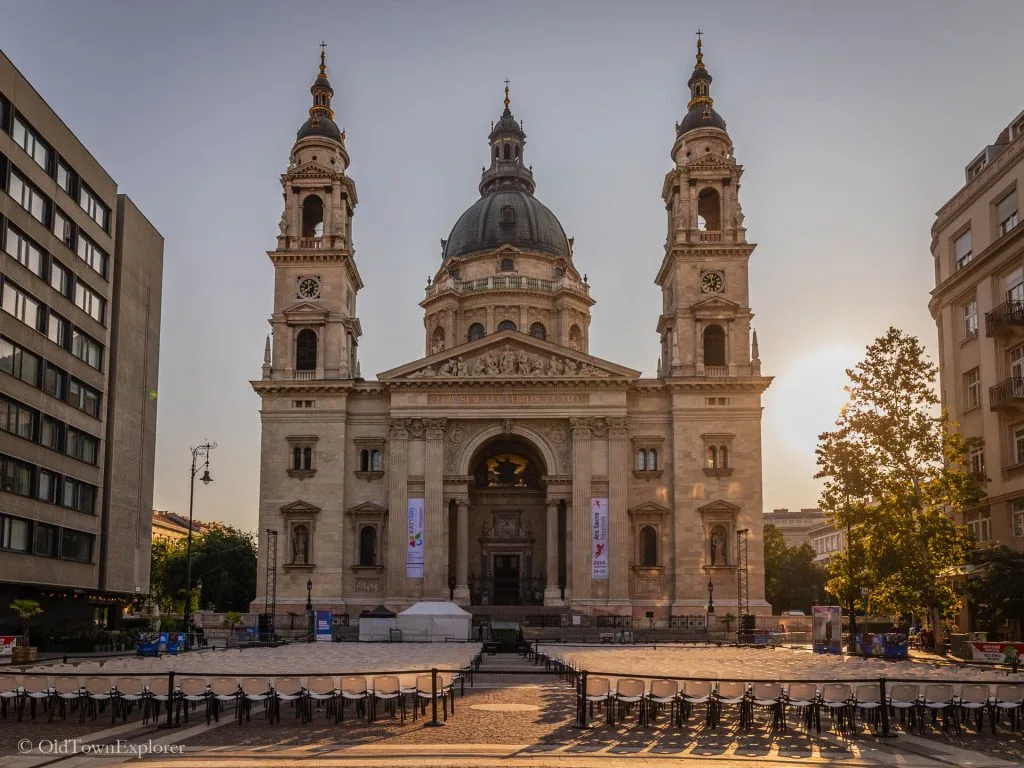
Saint Stephen's Basilica
- Architect: József Hild, Miklós Ybl, and József Kauser
- Style: Neoclassical and Neo-Renaissance
- Built: 1851–1905
- Address: Szent István tér 1, Budapest
The basilica's dome and twin towers dominate the square at the end of Zrínyi utca. Columns and a pediment give the entrance a classical emphasis. The decorated interior and elevated viewpoint are separate reasons to allow more time than an exterior look.
Deák Square Lutheran Church
- Architect: Mihály Pollack
- Style: Neoclassical
- Built: Foundation stone laid in 1799; consecrated in 1811
- Address: Deák tér 4, Budapest
Deák Square Lutheran Church has a low, columned façade capped by a triangular pediment. It has no tall tower to compete with the surrounding city blocks. Pollack’s compact church places the emphasis on classical proportion and a restrained preaching interior.
Serbian Orthodox Church of Saint George the Great Martyr
- Style: Baroque
- Address: Szerb utca 4, Budapest
Set behind a boundary wall, this church is less exposed to the street than the larger churches on open squares. Its iconostasis is a principal interior feature. The enclosed setting makes the entrance and churchyard important parts of the architectural experience.
Kálvin Square Reformed Church
- Style: Neoclassical
- Built: 1816–1830; later work by József Hild
- Address: Kálvin tér 7, Budapest
The projecting classical portico and single tower distinguish this church at a major Pest junction. Inside, galleries and the arrangement around the pulpit reflect Reformed worship. Compare that emphasis with the altar-centred interiors of the nearby University and Franciscan churches.
Church of St. Anne
- Style: Baroque
- Built: Construction began in 1740; subsequently restored
- Address: Batthyány tér 7, Budapest
St. Anne’s Church faces Batthyány Square with twin towers, sculptural niches, and a curved Baroque upper façade. The towers frame the central entrance and rise above the surrounding lower buildings. Inside, the high altar and painted decoration continue the emphasis on a strongly articulated sanctuary.
Hungarian Orthodox Cathedral of Our Lady
- Built: Consecrated in 1801; interior completed by 1809; tower roofs and façade altered in 1873
- Address: Petőfi tér 2, Budapest
The cathedral stands on Petőfi Square beside the Pest riverfront. Its two towers contribute to the skyline, while the iconostasis gives the interior its Orthodox character. Compare the building from the square and the promenade to see its different urban settings.
Fasori Reformed Church
- Architect: Aladár Árkay
- Style: Hungarian Art Nouveau
- Built: 1911–1913
- Address: Városligeti fasor 5–7, Budapest
The broad entrance arch, ceramic ornament, and substantial tower distinguish this church from the Gothic Revival buildings elsewhere in the city. The enclosed forecourt changes the approach from street to worship space. Look closely at the geometric decoration around the entrance.
Rock Church
- Built: Cave chapel adapted in 1926; lower church added in 1930–1931
- Address: Szent Gellért rakpart 1, Budapest
The church occupies a cave at the southern foot of Gellért Hill near Liberty Bridge. Rock surfaces and irregular chambers replace the regular bays of a conventional church. The interior reveals the cave adaptation, while the street view explains its hillside setting.
Szilágyi Dezső-tér Reformed Church
- Architect: Samu Pecz
- Style: Gothic Revival
- Built: Consecrated 1896
- Address: Szilágyi Dezső tér 3, Budapest
Red brick, pointed openings, and a patterned roof distinguish the church on the Buda embankment. Its centralised plan was designed around Protestant worship. Walk around the exterior to see how its projecting volumes differ from the long nave of a conventional parish church.
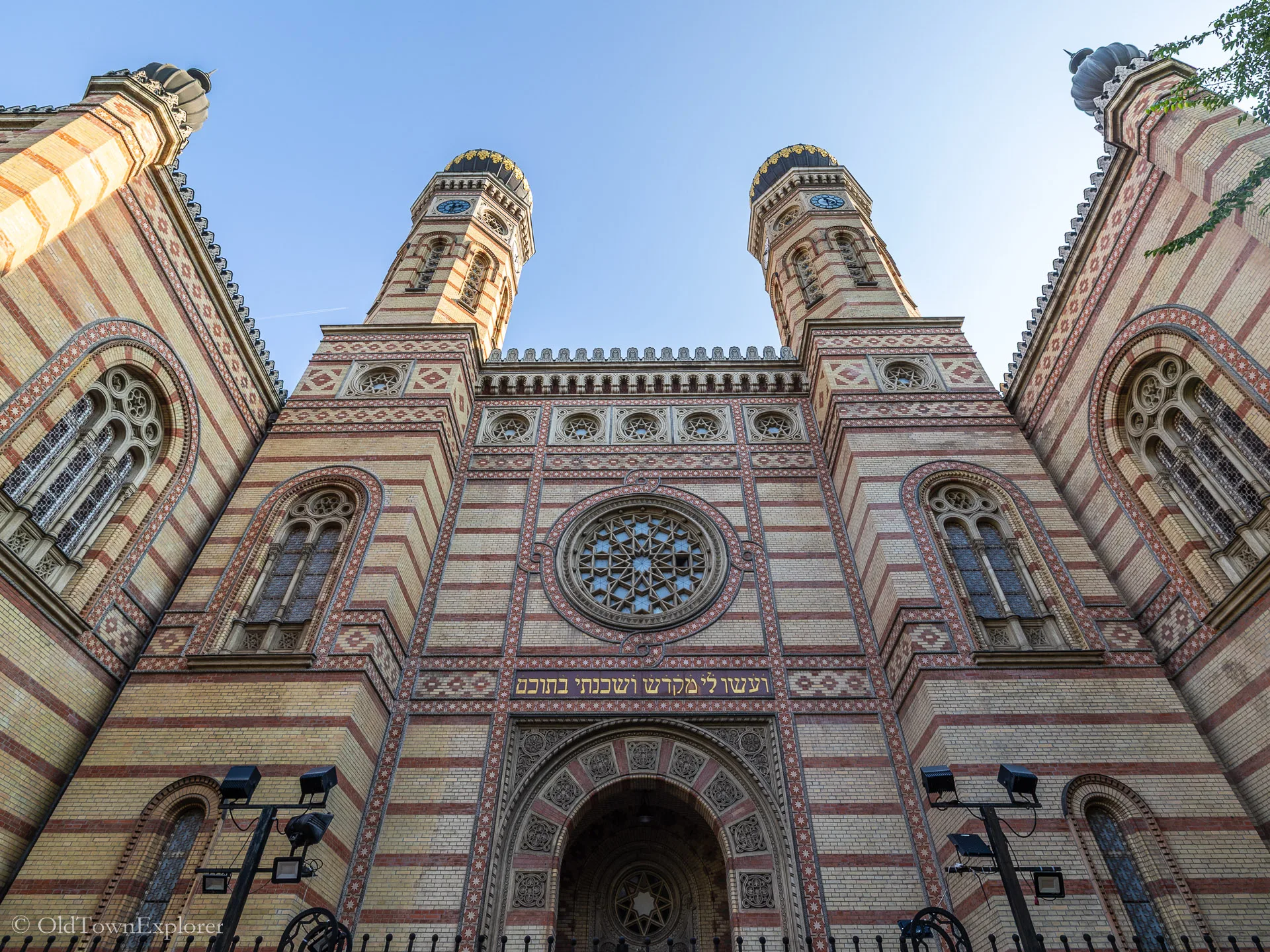
Dohany Street Synagogue
- Architect: Ludwig Förster
- Style: Moorish Revival
- Built: 1854–1859
- Address: Dohány utca 2, Budapest
Twin towers, striped masonry, and horseshoe-arch motifs identify the synagogue from the street. Inside, galleries and the long central space show a different arrangement from the smaller Rumbach synagogue. The surrounding memorial spaces deserve time beyond an architectural inspection of the main hall.
Rumbach Sebestyén Street Synagogue
- Architect: Otto Wagner
- Style: Moorish Revival
- Built: Inaugurated 1873
- Address: Rumbach Sebestyén utca 11–13, Budapest
A relatively narrow street front leads to a richly patterned octagonal prayer hall. The centralised interior is the strongest architectural reason to visit. Compare its proportions and galleries with Dohány's longer hall and Kazinczy's later Art Nouveau decoration.
Kazinczy Orthodox Synagogue
- Architect: Sándor and Béla Löffler
- Style: Art Nouveau
- Built: 1912–1913
- Address: Kazinczy utca 29–31, Budapest
The brick façade and geometric decoration distinguish this Orthodox synagogue from the Moorish Revival examples nearby. Inside, painted patterns and galleries contribute to a closely coordinated design. It belongs to a larger community complex whose courtyards and adjoining buildings shape the approach.
Chapel of Saint Roch
- Style: Baroque
- Built: Enlarged to its present size in 1741; later restoration
- Address: Rákóczi út 27/a, Budapest
The small church stands beside the former hospital on a busy Pest road. Its compact tower and modest frontage are easy to overlook among larger buildings. Compare the scale of this devotional chapel with the monumental religious buildings on the city's main squares.
University Church
- Style: Baroque
- Built: Foundation stone laid in 1725; consecrated in 1742; towers completed in 1768 and 1771
- Address: Papnövelde utca 5, Budapest
The twin-towered front opens onto Egyetem tér, while the adjoining former monastery became a seminary. Inside, carved fittings and a strongly articulated sanctuary give the compact church considerable depth. View the church and neighbouring institutional block together to understand the original religious complex.
Tomb of Gül Baba
- Style: Ottoman funerary architecture
- Built: Sixteenth century
- Address: Türbe tér 1, Budapest, entrance from Mecset utca
The octagonal, domed tomb preserves an Ottoman architectural form on the Buda hillside. Its small enclosed volume contrasts with the surrounding terraces and gardens. Allow for the uphill approach, and distinguish the historical tomb from the later landscape and visitor facilities around it.
Saint Peter of Alcantara Franciscan Church
- Style: Baroque
- Address: Ferenciek tere 9, Budapest
The church gives Ferenciek Square its religious landmark amid much larger commercial façades. Sculptural niches and a curved upper front distinguish it from the surrounding apartment blocks. The interior's altars and furnishings add more architectural detail than the square's traffic-dominated approach suggests.
St. Catherine of Alexandria Church
- Style: Baroque
- Built: Nave built in 1728–1736; tower added in 1750
- Address: Attila út 11, Budapest
The church stands at the foot of Castle Hill in the former Tabán neighbourhood. Its single tower and compact façade contrast with the open landscape around it. The surviving building helps locate a parish community within an area whose former dense streets have largely disappeared.
St. Elizabeth of the House of Árpád Parish Church
- Architect: Imre Steindl
- Style: Gothic Revival
- Built: 1893–1901
- Address: Rózsák tere 8, Budapest
Twin spires rise above the garden setting of Rózsák tere. Pointed arches, tracery, and the long church body make this a useful comparison with Steindl's Parliament. Walk around the square to see the building's full length as well as its principal front.
Our Lady of the Snows Parish Church
- Style: Late Baroque
- Built: Consecrated in 1797; enlarged in 1944
- Address: Krisztina tér 2, Budapest
The church faces a square west of Castle Hill, near the tunnel's outer end. Its broad, restrained front and single tower belong to a different urban setting from the hilltop churches. Pair the exterior with the surrounding lower-Buda streets rather than treating it as a Castle Quarter interior.
Church of Stigmatisation of Saint Francis
- Style: Baroque
- Built: 1731–1757
- Address: Fő utca 43, Budapest
The Church of the Wounds of Saint Francis stands within Fő Street’s continuous frontage. Its single tower rises above a decorated Baroque façade with sculptural niches. The church and adjoining former convent buildings preserve the scale of the eighteenth-century religious institutions in Víziváros.
St. Teresa of Avila Parish Church
- Architect: Fidél Kasselik; later interior work by Mihály Pollack and tower roof by Miklós Ybl
- Style: Late Baroque and classical details
- Built: 1801–1809; interior work in 1824–1831; tower roof added in 1871
- Address: Pethő Sándor utca 1, Budapest
At the Király Street end of Nagymező utca, the church marks an older religious focus in the theatre neighbourhood. Its tower and comparatively restrained façade contrast with the later entertainment buildings. The interior includes nineteenth-century work associated with Mihály Pollack.
Assisi St. Francis Church
- Architect: Miklós Ybl
- Style: Neo-Romanesque
- Built: 1867–1879
- Address: Bakáts tér, Budapest
The church occupies the centre of Bakáts Square in Ferencváros. Rounded arches, brickwork, and carved details distinguish it from Budapest's Gothic Revival churches. Inside, paintings and carefully worked stone and wood fittings make it worth considering beyond a façade-only stop.
St. Margaret of Árpád House Church
- Architect: István Möller
- Style: Neo-Romanesque
- Built: Consecrated in 1933
- Address: Lehel tér 1, Budapest
Dedicated to Saint Margaret of the House of Árpád, this church draws on the medieval church at Zsámbék. Twin towers and rounded openings give it an intentionally historical appearance. Its position beside Lehel Market offers a strong contrast between religious revival architecture and modern commercial design.
Our Lady of Mount Carmel Church
- Architect: Antal Hofhauser
- Style: Gothic Revival
- Built: Foundation stone laid in 1898; consecrated in 1899
- Address: Huba utca 12, Budapest
The Carmelite church stands north of the central visitor districts in Angyalföld. Its pointed openings and tall tower distinguish it from the smaller monastery building beside it. Consider it for a focused church-architecture outing rather than adding it casually to an inner-Pest walk.
Palaces and Houses in Budapest
In Budapest, a palace name can identify a noble residence, a mixed residential building, or a commercial headquarters. Several families owned more than one property. Compare the address and building type as well as the surname; most smaller houses are best approached as exterior stops, with access checked individually.
Erdődy-Hatvany Palace
- Style: Baroque
- Built: Begun in 1750; substantially remodelled in 1913
- Address: Táncsics Mihály utca 7, Budapest
Erdődy-Hatvany Palace occupies a broad but relatively low frontage on Táncsics Mihály Street. Baroque window surrounds and an emphasised gateway distinguish it from the smaller neighbouring houses. The Museum of Music History occupies the former palace rooms around its courtyard.
Saxlehner Palace
- Architect: Győző Czigler
- Style: Neo-Renaissance
- Built: 1884–1886
- Address: Andrássy út 3, Budapest
Saxlehner Palace combines a decorated Andrássy Avenue frontage with reception rooms painted by Károly Lotz. Its ornamental ceilings and ceremonial interiors reflect the wealth of the Saxlehner mineral-water business. The entrance and upper façade are visible from the street; the painted rooms require a separate interior visit.
Batthyány Palace
- Style: Baroque
- Built: Commissioned in 1744; restored in 1951–1953
- Address: Dísz tér 3, Budapest
Batthyány Palace occupies former medieval house plots on Dísz Square. Its Baroque reconstruction produced a unified frontage with an emphasised entrance and framed windows. The low building height preserves the domestic scale of the Castle Quarter beside the more monumental palace precinct.
New York Palace
- Architect: Alajos Hauszmann, Flóris Korb, and Kálmán Giergl
- Built: Opened 1894
- Address: Erzsébet körút 9–11, Budapest
Built for an insurance company, the palace uses sculpture, columns, and an emphatic corner to command the Grand Boulevard. The New York Café's decorated interior is a distinct attraction within the building. Compare the public café frontage with the upper floors of the former headquarters.
The Pálffy Palace Budapest
- Architect: Miklós Ybl
- Built: 1867–1869
- Style: Neo-Renaissance
- Address: Ötpacsirta utca 4, Budapest, corner of Reviczky utca
The Pálffy Palace was built for the widowed Countess Geraldine Pálffy and her children. Ybl combined the family residence with rental accommodation and placed a garden at the street corner. The setback breaks the otherwise continuous building line at Ötpacsirta and Reviczky streets. It now forms part of the Metropolitan Ervin Szabó Library complex and houses its Music Collection.
Thonet House
- Architect: Ödön Lechner and Gyula Pártos
- Built: 1888–1889
- Address: Váci utca 11/a, Budapest
Blue glazed ceramic facing sets this commercial and residential building apart from Váci Street's more conventional plaster and stone fronts. Look upward beyond the shop windows to see the decorative surface and shaped openings. It is a useful early comparison for Lechner's later public buildings.
Schossberger Palace
- Architect: Adolf Feszty
- Style: Neo-Renaissance
- Built: 1880–1882
- Address: Andrássy út 8, Budapest
Schossberger Palace stands near the inner end of Andrássy Avenue and now houses Hotel Moments. The former courtyard forms the building’s central interior space, enclosed by the surrounding residential wings. From the avenue, the tall entrance and regular upper windows preserve the appearance of a nineteenth-century urban palace.
The Baron Fechtig House
- Architect: Antal Szkalnitzky
- Style: Historicism
- Built: 1874–1875
- Address: Bródy Sándor utca 2, Budapest
The Baron Fechtig House turns the corner between Bródy Sándor Street and Múzeum Boulevard. Large arched ground-floor openings recall its café premises, while a balcony and enclosed bays emphasise the corner above. The building also used Zsolnay terracotta decoration on its historicist façade.
The Gottgeb House
- Architect: Antal Gottgeb
- Built: 1870
- Address: Gyulai Pál utca 13, Budapest
The Gottgeb House was built by Antal Gottgeb as his own residence in 1870. Its two upper storeys turn the junction of Gyulai Pál and Kőfaragó streets through a diagonally cut, three-window corner bay. The building later contained rented rooms and now houses the National Cultural Fund.
The Bókay Palace
- Architect: Miklós Ybl
- Built: 1870–1871
- Address: Múzeum utca 9, Budapest
The Bókay building was designed by Ybl for physician János Bókay. Its restrained, classically ordered façade differs from the more sculptural palace fronts nearby. Much of the building was intended for rental accommodation, making it a residential investment as well as a house associated with its owner.
The Bánffy apartment building
- Built: 1881
- Address: Reviczky utca 7, Budapest
The Bánffy apartment building at number 7 carries the family’s heraldic decoration above the entrance. Poet Mihály Babits lived in an upper-floor apartment here. The taller residential frontage belongs to an income-producing property beside the separate Bánffy residence at number 5.
The Kauser House
- Architect: Károly Gerster, signatory of the plans; stonework by János Kauser
- Style: Romantic
- Built: Around 1860
- Address: Gyulai Pál utca 5, Budapest
The Kauser House was built around 1860 for master stonemason János Kauser, with plans signed by his brother-in-law Károly Gerster. Small figures support a Gothic-inspired niche above the entrance, where an armoured knight watches over the doorway. The carved details connect the Romantic design with the owner’s stoneworking profession.
The Keglevich Palace
- Architect: Ferenc Dötzer
- Built: 1871
- Address: Bródy Sándor utca 9, Budapest
The Keglevich Palace was designed by Ferenc Dötzer for Count István Keglevich in 1871. It stands opposite the National Museum garden on Bródy Sándor Street, among the city residences built around the museum. Its street-bound plot places the main façade directly on the pavement rather than behind a forecourt.
The Zichy House
- Architect: Antal Szkalnitzky and Henrik Koch
- Built: 1869–1871
- Address: Múzeum utca 15/a–b, Budapest
The Zichy House occupies a long frontage beside Károlyi-Csekonics Palace on Múzeum Street. Designed by Szkalnitzky and Koch, it was built for Count János Zichy. The residential wings and interior courtyards fit a substantial aristocratic property into the continuous street wall behind the National Museum.
Károlyi-Csekonics Palace
- Architect: Ferdinand Fellner and Hermann Helmer
- Style: Neo-Baroque
- Built: 1881–1885
- Address: Reviczky utca 6, Budapest; also fronts Múzeum utca 17
Associated with István Károlyi and Margit Csekonics, the palace includes an elaborate carved timber staircase and ceremonial rooms. The complex spans two street fronts, so its scale is not obvious from one doorway. Consult Károli University's information before planning an interior visit.
The Almassy House
- Architect: Antal Gottgeb
- Built: 1877–1878
- Address: Ötpacsirta utca 2, Budapest
The Almássy House fits a small palace around a sheltered courtyard at the corner of Ötpacsirta and Múzeum streets. Its principal living rooms occupy a raised ground floor, while service spaces were arranged around the inner plot. An iron-and-glass canopy covers the courtyard stair.
The Festetics Palace
- Architect: Miklós Ybl
- Style: Neo-Renaissance
- Built: 1862–1865
- Address: Pollack Mihály tér 3, Budapest
Festetics Palace faces the National Museum with a symmetrical Neo-Renaissance façade and a carriage entrance. Ybl arranged the residence around a courtyard, with ceremonial rooms and a staircase reflecting its aristocratic use. The building now houses Andrássy University; visits to its historical rooms depend on announced access.
Wenckheim Palace
- Architect: Artúr Meinig
- Style: Neo-Baroque
- Built: 1886–1889
- Address: Szabó Ervin tér 1, Budapest
Count Frigyes Wenckheim's palace forms part of the Metropolitan Ervin Szabó Library. Former reception rooms now serve library functions, offering a direct comparison between aristocratic decoration and public reuse. Consult the library's visitor information for the historical rooms rather than assuming ordinary reading-room access covers everything.
The Bánffy Palace
- Built: 1896
- Address: Reviczky utca 5, Budapest
The Bánffy Palace at number 5 presents a lower residential frontage beside the family’s taller apartment building. Heraldic decoration identifies the owners above the gateway. Its scale and entrance emphasise a private city residence within the close-set palaces of Reviczky Street.
Károlyi Palace
- Style: Neoclassical
- Built: Principal neoclassical reconstruction, 1832–1847
- Address: Károlyi utca 16, Budapest
Károlyi Palace encloses a columned courtyard and opens toward Károlyi Garden. Its Neoclassical rebuilding gives the street front a restrained, symmetrical appearance. The Petőfi Literary Museum occupies the former residential rooms, linking the palace interior with the garden setting behind it.
The Eszterházy Palace
- Architect: Antal Baumgarten
- Built: 1871–1873
- Address: Pollack Mihály tér 8, Budapest
The Eszterházy Palace stands on the eastern side of Pollack Mihály Square, facing the National Museum garden. Built as an aristocratic city residence, it later became part of the Hungarian Radio complex. Its historical palace frontage belongs to the square’s nineteenth-century group of noble residences.
Wenckheim Apartment Building
- Architect: Artúr Meinig
- Built: 1889–1891
- Address: Reviczky utca 4, Budapest
The Wenckheim apartment building at Reviczky Street 4 has a tall, continuous frontage and heraldic decoration associated with the family. It was built as a separate residential property beside the more ceremonial Wenckheim palace. Its later university use continues the district’s conversion of large houses into educational premises.
The Pulszky Palace
- Architect: Győző Czigler
- Style: Neo-Renaissance
- Built: 1893–1894
- Address: Puskin utca 12, Budapest, corner of Trefort utca
The Pulszky Palace was built for Ágost Pulszky in 1893–1894. Czigler used an Italian Renaissance vocabulary, with a raised principal floor above a high basement and a pronounced attic storey. The corner position exposes two elevations at the junction of Puskin and Trefort streets.
Hasenfeld House
- Architect: Vilmos Freund; construction by János Kauser the younger
- Style: Early Historicism
- Built: 1872
- Address: Múzeum utca 5, Budapest
Hasenfeld House was built for physician Manó Hasenfeld and his wife as an apartment building in 1872. Its decorated frontage forms part of the continuous residential street behind the National Museum. The building at number 5 is separate from the Hadik-Barkóczy residence at number 7.
Hadik-Barkóczy Palace
- Architect: Győző Czigler (1900 enlargement)
- Built: House documented by the 1860s; enlarged in 1900
- Address: Múzeum utca 7, Budapest
The Hadik-Barkóczy residence occupies an older house enlarged for Countess Klára Zichy, wife of Endre Hadik-Barkóczy, in 1900. Czigler added another storey for the family’s use rather than replacing the building. Its later association with the Kossuth Klub reflects the conversion of former residential rooms to cultural uses.
The Hunyady Palace
- Architect: Artúr Meinig
- Style: Neo-Renaissance
- Built: 1892
- Address: Trefort utca 3, Budapest
Hunyady Palace has a two-storey Neo-Renaissance elevation above its ground floor, with six window axes facing Trefort Street. A vaulted entrance passage leads toward the ceremonial staircase. Rusticated masonry and substantial window framing distinguish the house from the plainer residential fronts nearby.
The Prónay Palace
- Built: 1890
- Address: Trefort utca 2, Budapest
Prónay Palace houses the Museum Hotel Budapest. Its façade combines coloured brickwork with ceramic decoration, including circular relief panels above the upper windows. The building’s restored decorative surfaces make it a distinctive exterior stop on the short Trefort Street.
The Tauffer Palace
- Architect: Ernő Schannen
- Built: 1892–1894
- Address: Bródy Sándor utca 10, Budapest
The Tauffer Palace was both a family home and the workplace of physician Vilmos Tauffer. Owl and child-head motifs on the façade refer to learning and his medical profession. The original arrangement placed consulting and waiting rooms below the family’s residential floor.
The Törley Palace
- Architect: Rezső Ray
- Style: Historicism with Neo-Baroque decoration
- Built: 1893–1894
- Address: Bródy Sándor utca 16, Budapest
The Törley Palace presents a narrow street front with a broad enclosed central bay and Neo-Baroque ornament. Behind it, five wings extend deep into the plot. The difference between the compact façade and the much larger interior plan reflects the constraints of building a city palace on this street.
Liebner or Darányi Palace
- Architect: Sándor Staerk
- Built: 1894
- Address: Lőrinc pap tér 3, Budapest
The Liebner-Darányi Palace turns a corner on Lőrinc pap Square, with projecting bays and richly decorated upper floors. Inside, terrazzo floors and an ornate staircase add details that cannot be seen from the pavement. The square provides enough distance to appreciate the building’s full corner elevation.
The Emich Palace
- Architect: Ferenc Novák
- Built: 1896
- Address: Horánszky utca 16, Budapest
The Emich Palace was built in 1896 for Gusztáv Emich the younger, son of the publisher who founded the family business. Decorative ironwork, carved doors, and the principal staircase distinguish its interior circulation spaces. The apartment building stands on Horánszky Street, away from the larger open spaces beside the National Museum.
The Keszlerffy Palace
- Built: 1897–c. 1898
- Address: Bródy Sándor utca 6, Budapest
The Keszlerffy Palace occupies a deep plot on Bródy Sándor Street. A substantial entrance passage leads to the courtyard, where open galleries connect the residential wings and a rear staircase rises above them. These internal circulation spaces explain more of the house than its relatively narrow street front.
Zichy Palace
- Address: Lőrinc pap tér 2, Budapest
The Zichy Palace at Lőrinc pap Square was built for Count Nándor Zichy’s family and later adapted as a hotel. Its Neo-Baroque façade preserves the character of the former residence, while a glass dome covers the entrance interior. The open square gives a clear view of the palace frontage.
Count Henrik Reusz-Ráthonyi
- Built: 1898–1899
- Address: Krúdy Gyula utca 11, Budapest
The Reusz-Ráthonyi residence is marked by a winged lion above its main-floor balcony and a family coat of arms over the entrance. These decorations identify the principal apartment within the taller building. An ornate staircase occupies the interior behind the narrow Krúdy Gyula Street frontage.
Zichy Palace
- Architect: Gyula Kauser
- Built: 1898
- Address: Szentkirályi utca 16, Budapest
The Zichy property on Szentkirályi Street displays the crowned Serényi-Zichy coat of arms above its decorated residential façade. The heraldry is the most direct feature to seek from the pavement. This is a separate family property from the houses on Múzeum Street and Lőrinc pap Square.
Gschwindt Palace
- Built: 1900–1901
- Address: Bródy Sándor utca 12, Budapest
The Gschwindt Palace turns the corner of Bródy Sándor and Puskin streets with Gothic-looking window recesses and an animated roofline. A sundial decorates the balcony parapet on the Bródy Sándor side. Sculptures and family symbols connect its elaborate exterior with the businessman who commissioned it.
The Márffy-Mantuano Palace
- Architect: Antal Gottgeb
- Style: Historicism
- Built: 1871; rear apartment building added 1912
- Address: Horánszky utca 4, Budapest
The Márffy-Mantuano Palace has a low, two-level historicist front designed by Antal Gottgeb in 1871. A taller apartment building was added at the rear in 1912. The different heights reveal how a small city palace expanded into a denser residential property.
The Dessewffy Palace
- Architect: Antal Wéber
- Style: Venetian-inspired historicism
- Built: 1875–1876
- Address: Bródy Sándor utca 4, Budapest
The Dessewffy Palace, also known as Ádám Palace, draws on Venetian palace architecture. Its decorated openings and strongly marked principal floor rise above a substantial entrance passage. Built for textile merchant Károly Ádám and his wife, the residence adds a commercial family’s palace to Bródy Sándor Street.
The Pejacsevich Palace
- Architect: Elek Hofhauser
- Built: 1895–c. 1896
- Address: Reviczky utca 3, Budapest
The Pejacsevich Palace stands on the short Reviczky Street frontage between the neighbouring Bánffy and Wenckheim properties. Also known as the Berczik residence, the house was designed by Elek Hofhauser and built in 1895–c. 1896. Its street elevation belongs to the close-set residential palaces behind the National Museum.
Károlyi Palace
- Built: 1869–1871
- Address: Múzeum utca 11, Budapest
The Károlyi residence associated with Count Sándor occupies the corner of Múzeum and Ötpacsirta streets. The main palace rooms and adjoining residential accommodation formed a larger family property behind the National Museum. Its corner frontage belongs to a different site from the Károlyi-Csekonics palace farther along Múzeum Street.
Odescalchi or Degenfeld-Schomburg Palace
- Architect: Miklós Ybl
- Built: 1872–1873
- Address: Bródy Sándor utca 14, Budapest
The Odescalchi or Degenfeld-Schomburg Palace combines a family residence with rental apartments on a deep corner plot. Inside, a broad entrance hall and ceremonial staircase lead toward a courtyard with cast-iron loggias. Ybl’s design gave the private rooms and rented accommodation different circulation within the same building.
Wekerle Estate Houses (Wekerletelep)
- Style: Folk-inspired garden-city architecture
- Built: 1909–1928, in successive phases
- Location: Wekerletelep, District XIX, centred on Kós Károly tér, Budapest
Wekerletelep replaces central Budapest's tall street walls with low houses, gardens, and a planned network of streets. Around Kós Károly tér, gateways and steep roofs give the centre a recognisable form. Allow a separate outing to Kispest for this comparison with the inner city's apartment blocks.
Bridges in Budapest
Budapest’s bridges show the difference between structural form and decorative style. The Chain Bridge’s suspended roadway, Liberty Bridge’s trusses, and the lower profiles of later crossings make useful comparisons. View the structures from an embankment as well as from their decks.
Árpád Bridge
- Style: Steel girder bridge
- Built: Opened 1950; later widened
- Location: across the Danube between Óbuda and the Róbert Károly körút approach in northern Pest, Budapest
The broad, low-profile crossing serves northern Budapest and the northern end of Margaret Island. Its horizontal deck is a contrast to the towers and arches of the central bridges. Include it when exploring Óbuda or the island rather than prioritising it for a short central walk.
Margaret Bridge
- Engineer: Ernest Goüin
- Style: Steel arch bridge
- Built: First opened 1876; later reconstruction
- Location: between the Margit körút approach in Buda and Jászai Mari tér in Pest, with a branch to Margaret Island, Budapest
The angled crossing and island branch distinguish Margaret Bridge from the straight central bridges. Observe the arches and decorated piers from the embankment, then the changing views along the deck. Its bend provides an unusually broad view toward Parliament and Castle Hill.
Széchenyi Chain Bridge
- Engineer: William Tierney Clark; construction supervised by Adam Clark
- Style: Chain suspension bridge
- Built: Opened 1849
- Location: between Clark Ádám tér in Buda and Széchenyi István tér in Pest, Budapest
Stone towers, suspended chains, and the approach lions give the bridge its recognisable outline. The structure links two deliberately monumental spaces at the riverbanks. Compare the chains and hangers with the more visibly triangulated steelwork of Liberty Bridge.
Elisabeth Bridge
- Engineer: Pál Sávoly
- Style: Suspension bridge
- Built: Present bridge opened 1964
- Location: between Döbrentei tér in Buda and Március 15. tér in Pest, Budapest
The white pylons, sweeping cables, and slender deck create a markedly different silhouette from the lost ornate bridge that preceded it. This is a suspension structure, with vertical hangers supporting the roadway. View it from either embankment to see the cable profile clearly.
Liberty Bridge
- Engineer: János Feketeházy
- Style: Steel cantilever truss bridge
- Built: Opened 1896
- Location: between Szent Gellért tér in Buda and Fővám tér in Pest, Budapest
Green latticework, tall decorative portals, and turul birds give the bridge an elaborate appearance. Its outline resembles a suspended bridge, but the structure is a cantilever truss. The Fővám Square end also connects it visually with the Great Market Hall.
Petőfi Bridge
- Style: Steel girder bridge
- Built: First opened in 1937; rebuilt and reopened in 1952
- Location: between the university district at Goldmann György tér in Buda and Boráros tér in Pest, Budapest
The bridge's comparatively plain deck places the emphasis on transport rather than monumental gateways. It joins the Grand Boulevard to the southern Buda university area. Look at it from the riverbank to compare its low structural profile with Liberty Bridge upstream.
Rákóczi Bridge
- Style: Steel girder bridge
- Built: Opened 1995
- Location: between Lágymányos in Buda and the National Theatre and Müpa area in Pest, Budapest
The red lighting towers are the crossing's most conspicuous vertical elements; they are not cable-stayed bridge pylons. The low deck belongs to a later generation of river crossings. Pair the view with the neighbouring railway bridge for a comparison of road and rail structures.
Connection Rail Bridge
- Style: Steel truss railway bridge
- Built: Crossing first opened in 1877; latest major bridge replacement completed in 2022
- Location: across the Danube immediately south of Rákóczi Bridge, Budapest
The parallel steel truss spans carry the railway across southern Budapest. Their repeated diagonals express a different structural system from the neighbouring road bridge. View the crossing from the riverbanks; it is a working railway structure rather than an architecture walk across a road bridge.
Historical Streets in Budapest
Street width and building height change the architectural experience as much as individual landmarks. Pest’s boulevards allow long views of repeated façades, while its smaller streets reveal entrances and courtyards at closer range. Buda’s Fő utca follows the river below Castle Hill.
Andrássy Avenue
- Built: Nineteenth-century avenue development
- Location: between Bajcsy-Zsilinszky út and Heroes’ Square, Budapest
The avenue progresses from dense commercial and residential blocks to planted setbacks and villas. Notice how the changing plot sizes alter the street's scale before it reaches Heroes’ Square. The Opera and Kodály körönd give two particularly clear examples of its planned urban form.
Váci Street
- Location: between Vörösmarty tér and Fővám tér, Budapest
Váci utca is narrow enough for upper-floor decoration to be easily missed beneath shop signs. Look above the retail level for bay windows, cornices, and the blue ceramic front of Thonet House. The southern stretch also brings older parish and institutional buildings into the surrounding streets.
The Danube Promenade
- Location: Pest riverfront between Elisabeth Bridge and the Chain Bridge, Budapest
The promenade combines the skyline across the river with a varied city edge behind it. Historical concert and palace buildings stand near much later hotel blocks. Turn away from the water periodically to compare those fronts rather than treating the walk solely as a viewpoint.
Bartók Béla Boulevard
- Built: Late nineteenth- and twentieth-century streetscape
- Location: Bartók Béla út, beginning at Szent Gellért tér and continuing through southern Buda, Budapest
The inner stretch links Gellért Square with Móricz Zsigmond körtér through substantial apartment blocks and street-level cultural premises. Look at entrance doors and upper-floor ornament above the cafés. This is a useful comparison with Pest's residential boulevards on a southern-Buda outing.
Kazinczy Street
- Location: Kazinczy utca, District VII, Budapest
The Orthodox synagogue supplies the strongest architectural destination, while gates and passages reveal the neighbourhood's dense plots. Look for differences between the synagogue's designed frontage and surrounding apartment houses. Nightlife occupies many ground floors, but the upper storeys preserve another layer of the street's character.
Király Street
- Location: between the inner-city junction at Deák Ferenc tér and Lövölde tér, Budapest
Király utca runs along the boundary between Terézváros and Erzsébetváros. Its shops sit below a long sequence of historical apartment façades and entrances. Around Nagymező utca, St. Teresa's Church adds an older religious landmark to the surrounding commercial street.
Ráday Street
- Built: Nineteenth-century streetscape
- Location: between Kálvin tér and Boráros tér, Budapest
Ráday utca links central Pest with Ferencváros and the side approach to Bakáts Square. Restaurant terraces occupy the pavement, so look upward for the residential architecture. The nearby Assisi St. Francis Church provides a larger-scale contrast with the street's continuous apartment fronts.
Grand Boulevard (Nagykörút)
- Built: Late nineteenth-century boulevard development
- Location: the Pest arc formed by Szent István, Teréz, Erzsébet, József, and Ferenc körút, Budapest
The Grand Boulevard links Margaret and Petőfi bridges through a sequence of large apartment blocks. Corner buildings receive particular emphasis at major junctions. Compare the New York Palace's elaborate insurance-company frontage with the more repetitive residential elevations along the same boulevard.
Main Street in Buda
- Location: Fő utca, Víziváros, below Castle Hill on the Buda bank, Budapest
Fő utca runs below the Castle Quarter rather than through its hilltop centre. Churches, older houses, and larger later buildings occupy its frontage. St. Anne's and the Church of the Wounds of Saint Francis provide two distinct Baroque landmarks along the wider Víziváros setting.
Falk Miksa Street
- Built: Late nineteenth- and early twentieth-century streetscape
- Location: between Kossuth Lajos tér and Szent István körút, Budapest
Falk Miksa Street concentrates antique shops and galleries below substantial apartment façades near Parliament. Balconies, projecting corner bays, and decorated entrances belong to the expansion of Lipótváros around the turn of the twentieth century. Looking above the shopfronts reveals the residential scale of the street.
Historical Squares in Budapest
Budapest’s squares range from traffic junctions to deliberately monumental spaces. Look at which building supplies the main façade, how entrances face the open ground, and whether the square was shaped around a church, a civic institution, or a commercial street.
Liberty Square
- Address: Szabadság tér, Budapest
Liberty Square is framed by large institutional façades, including the former Stock Exchange Palace and the Hungarian National Bank. Their broad fronts and emphatic entrances give the open space a civic scale. Monuments added in different political periods occupy the landscaped ground between them.
Elizabeth Square
- Address: Erzsébet tér, Budapest
Elizabeth Square provides a broad planted opening beside the dense blocks around Deák Square. The Danubius Fountain supplies a historical sculptural focus, while later pavilions and underground premises occupy the park edges. The varied building heights around it distinguish the space from a uniform ceremonial square.
Jókai Square
- Built: Nineteenth-century surrounding buildings
- Address: Jókai tér, District VI, Budapest
Jókai Square forms a small opening beside Andrássy Avenue, enclosed by historical apartment façades. Compare the buildings’ cornices, window surrounds, and entrances from the square’s open ground. Across the avenue, Liszt Ferenc Square extends toward the Music Academy, making the two spaces a useful comparison of different proportions within the same neighbourhood.
Kossuth Lajos Square
- Address: Kossuth Lajos tér, Budapest
Parliament supplies the principal façade, but the opposite side contains substantial civic and administrative buildings. Move far enough back to see how they enclose the square. The riverside monuments and broad paved approaches add a commemorative landscape around the legislative building.
Batthyány Square
- Address: Batthyány tér, Budapest
St. Anne's twin towers anchor the square's inland edge, while the river side opens toward Parliament. Compare the church's scale with the larger buildings around the transport interchange. The square works both as a setting for Buda architecture and as a viewpoint across the Danube.
Clark Ádám Square
- Address: Clark Ádám tér, Budapest
The Chain Bridge, tunnel portal, and hillside funicular meet around a compact transport space. The zero-kilometre stone adds a small monument among much larger engineering works. Compare the bridge and tunnel entrances from the pedestrian areas rather than from the roadway.
Vörösmarty Square
- Address: Vörösmarty tér, Budapest
Vörösmarty Square centres on the poet’s stone monument at the northern end of Váci Street. The Gerbeaud building supplies a historical café frontage, while later commercial buildings introduce glass and larger openings around the square. The open ground allows longer views of these elevations than the adjoining shopping street.
Ferenciek Square
- Address: Ferenciek tere, Budapest
The Franciscan church sits among the much larger façades near the approach to Elisabeth Bridge. Párizsi Udvar adds a highly decorated commercial building to the ensemble. Compare the different scales around the square and use the pedestrian crossings to inspect the fronts safely.
Other Architectural Attractions in Budapest
Budapest’s civic buildings, transport halls, monuments, and commercial interiors extend the comparison beyond palaces and churches. Several of these are major architecture stops in their own right. Others are useful for a focused outing to City Park, Gellért Hill, or the Fiumei Road Cemetery.
House of Parliament
- Architect: Imre Steindl
- Style: Gothic Revival exterior
- Built: 1885–1904
- Address: Kossuth Lajos tér 1–3, Budapest
Parliament's long riverfront façade combines pointed arches, pinnacles, and a central dome. The embankment opposite gives the clearest overall view, while Kossuth Square reveals entrances and sculptural detail. An interior visit adds ceremonial stairs and halls that cannot be judged from the river alone.
Budapest City Hall
- Style: Baroque
- Built: Construction began in 1716; later extension and conversion to City Hall
- Address: Városház utca 9–11, Budapest
The long City Hall frontage originated as a military hospital rather than a purpose-built nineteenth-century civic palace. Repeated windows and a substantial central entrance express that institutional scale. Compare it with the later commercial buildings near Deák Square and Ferenciek Square.
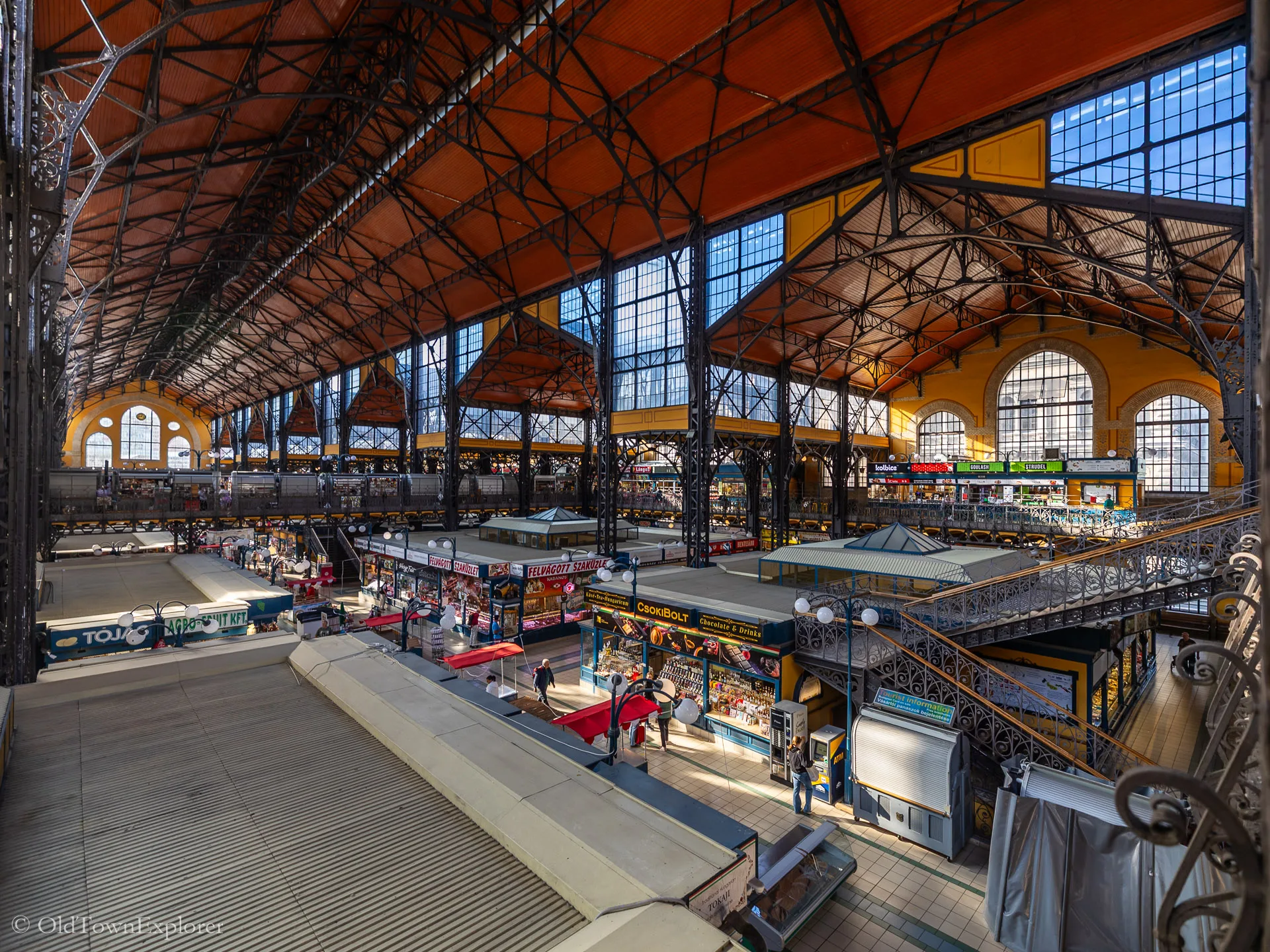
Great Market Hall
- Architect: Samu Pecz
- Built: Opened 1897
- Address: Vámház körút 1–3, Budapest
The patterned tiled roof and brick exterior give the market a monumental street presence. Inside, the long iron-framed hall explains the building's commercial function. Look upward above the stalls to see the roof structure and compare it with the masonry frontage outside.
Mária Magdolna Tower
- Style: Gothic
- Built: Late fifteenth-century tower
- Address: Kapisztrán tér 6, Budapest
The tower is the surviving vertical remnant of the Church of Mary Magdalene on Kapisztrán Square. Look closely at its successive openings and upper-storey stonework. A tower visit, when offered, adds a higher viewpoint to the church remains visible at ground level.
Gatehouse Tower
- Style: Historicism
- Built: Turn of the twentieth century
- Address: Városliget, Vajdahunyadvár, Budapest
The gate tower marks the entrance to Vajdahunyad Castle in City Park. Its pointed forms and defensive-looking details belong to a deliberately historical ensemble. It is an architectural quotation of a castle entrance, rather than a surviving medieval gateway in the Buda Castle walls.
Citadella
- Built: Completed in 1854
- Address: Citadella sétány 1, Budapest
The fortress's long, low defensive walls occupy the summit above the Danube. Its broad horizontal form differs from the towers and palace domes visible across the city. The hillside setting is central to its architecture, so allow for the climb as well as time around the walls.
Millennium Monument
- Architect: Albert Schickedanz
- Sculptor: György Zala
- Built: Begun for the 1896 millennium
- Address: Hősök tere, Budapest
The central column and two curved colonnades organise the monument as an ensemble rather than a single statue. Horsemen occupy the base, with historical figures arranged along the sides. Examine those layers after viewing the whole composition within Heroes' Square.
Liberty Statue
- Sculptor: Zsigmond Kisfaludi Strobl
- Built: Unveiled 1947
- Address: Citadella sétány 1, Budapest, Gellért Hill summit
The standing bronze figure raises a palm branch above a tall pedestal near the Citadella. The sculpture's silhouette was designed to register across the city. Compare that distant skyline role with the smaller scale of its supporting figures and base when viewed on the hill.
The Old Tigris Szálló
- Architect: József Hild
- Style: Neoclassical
- Built: 1839–1840, incorporating an earlier building
- Address: Nádor utca 5, Budapest
The tiger sculpture above the entrance recalls the building's hotel name. Its restrained façade and courtyard arrangement belong to Hild's Pest rather than the later, more elaborate boulevard hotels. Its public rooms hosted concerts and meetings, including Veres Pálné’s 1867 gathering in support of women’s education. The building became residential after its sale to the Trieste Insurance Company in 1899; interior access should not be assumed.
Nyugati Railway Station
- Architect: August de Serres and the Eiffel company
- Built: Opened 1877
- Address: Teréz körút 55, Budapest
The large glazed front reveals the railway hall as a public engineering structure. Brick side pavilions frame the much lighter-looking iron and glass. View the building from across the boulevard before inspecting the roof structure from the station's public areas.
Comedy Theatre of Budapest
- Architect: Ferdinand Fellner and Hermann Helmer
- Built: Opened 1896
- Address: Szent István körút 14, Budapest
The Comedy Theatre occupies a prominent Grand Boulevard site with a projecting entrance, curved forms, and a heavily articulated roofline. Fellner and Helmer designed the building as a purpose-built theatre. The auditorium adds a different scale of interior decoration to the exterior’s broad urban composition.
Kossuth Mausoleum at the Fiumei Road Cemetery
- Architect: Kálmán Gerster
- Sculptor: Alajos Stróbl
- Built: Completed in 1909
- Address: Fiumei út 16–18, Budapest
The monumental tomb gives Kossuth a commemorative setting on a scale closer to a public building than an ordinary grave. The raised structure and ceremonial approach should be viewed within the cemetery landscape. Interior decoration provides an additional reason to consult the cemetery's visiting information.
Vajdahunyad Castle
- Architect: Ignác Alpár
- Style: Romanesque, Gothic, Renaissance, and Baroque Revival
- Built: Originated in 1896; later rebuilt in permanent materials
- Address: Városliget, Vajdahunyadvár, Budapest
The City Park ensemble places Romanesque, Gothic, Renaissance, and Baroque references beside one another. Changes in windows, roof forms, and gateways are the point of the design. Compare the different wings rather than interpreting the complex as a single medieval castle.
Párizsi Udvar
- Architect: Henrik Schmahl
- Built: 1909–1913
- Address: Petőfi Sándor utca 2, Budapest, beside Ferenciek tere
The former shopping arcade combines patterned ceramics, stained glass, and elaborate historical motifs. Its interior volume is central to the building's character, beyond the decorated street front. It now forms part of a hotel; consult the operator for arrangements before planning an interior visit.
Postal Savings Bank
- Architect: Ödön Lechner
- Style: Hungarian Art Nouveau
- Built: Completed 1901
- Address: Hold utca 4, Budapest
The former bank uses ceramic ornament and a shaped roofline in place of a conventional classical façade. Look for the bee motifs associated with thrift and saving. Some roof details are difficult to see from the narrow pavement, so step back where the street permits.
Kőrössy Villa
- Architect: Albert Kálmán Kőrössy
- Style: Art Nouveau
- Built: Designed in 1899; occupied in 1900
- Address: Városligeti fasor 47, Budapest
Designed as the architect’s own villa, the house uses curved forms and nature-inspired decoration in a garden setting. It differs from the continuous apartment fronts of central Pest. The building now houses the ResoArt Zsolnay collection, with interior visits arranged through the museum.
Modern & Breitner Building
- Architect: Sámuel Révész and József Kollár
- Style: Art Nouveau
- Built: Completed in 1913
- Address: Deák Ferenc utca 23, Budapest
The former department-store and residential building turns a prominent corner near Deák Square. Its broad windows and emphatic upper forms distinguish it from smaller shopfront buildings. Look above the retail level to see how the commercial base and residential floors were combined.
Things to Know About Budapest Architecture
Distances, hills, and interior access affect an architecture visit as much as the number of buildings on your list. Plan by area and allow extra time for the particular interiors you want to see.
Choose a base near the buildings you want to revisit
Inner Pest suits repeated walks around the Basilica, riverfront, and southern Andrássy Avenue. The Castle Quarter suits hilltop streets and early views from the bastion, but requires a descent or transport for most Pest buildings. The Palace Quarter puts smaller residences close together.
With two hours, stay in one compact area
Choose either the central Pest riverfront or the streets around Matthias Church. Two hours allows exterior viewing and pauses for detail in one of these areas. Adding a long interior visit or crossing repeatedly between banks leaves much less time to look at buildings.
With a half day, add one substantial interior
Pair Castle Quarter streets with Matthias Church or the History Museum, or combine the Opera area with an available interior visit nearby. Keep a second paid interior optional. Waiting, admission procedures, and time inside can take a larger share of the outing than the map suggests.
With a full day, combine two areas
Choose Castle Hill and central Pest for a broad comparison, or Andrássy Avenue and City Park for nineteenth-century planning. Include a meal break and use public transport for the longer connection. The full length of the avenue plus multiple museum interiors is a substantial day by itself.
Separate exterior viewing from interior access
Street façades and public squares can supply much of the architectural comparison. Parliament, the Opera, synagogues, museums, and library palace rooms have their own visiting arrangements. Check the relevant official website; a hotel, university, office, or residential conversion does not automatically provide public access.
Allow for hills, steps, and paving
Castle Hill and Gellért Hill involve changes in level, while several historic streets and terraces have uneven surfaces. Wear shoes suited to sustained walking. A short distance on the map may include stairs or a steep approach, particularly between the riverbank and hilltop viewpoints.
Use quieter periods for façade photographs
Matthias Church, Fisherman’s Bastion, and the principal river viewpoints attract concentrated visitor traffic. Earlier visits can make it easier to pause and step back for a photograph, although clear views are never guaranteed. Leave entrances and narrow pavements clear when looking upward at decoration.
Keep an indoor alternative for bad weather
Rain makes exposed terraces less comfortable, and wind is more noticeable on bridges and hilltops. The Great Market Hall offers a large covered structure to examine; a museum or concert-building visit requires its own opening and admission checks. In summer, allow breaks from the exposed riverfront.
Use evening walks for silhouettes
The riverbanks provide broad outlines of Parliament, the palace, and the bridges after dark. Daylight is better for carved details, roof patterns, and the smaller Palace Quarter fronts. Choose an evening river view as a separate experience rather than relying on it for close façade inspection.
Check step-free connections individually
Historic metro stations, hillside approaches, and older interiors differ in accessibility. Consult BKK’s travel information for suitable transport and each venue for its entrance arrangements. Do not assume the M1 stations or a building’s principal historic staircase provide a step-free route.
City Tours in Budapest
Independent walks work well for riverfront views, avenue façades, and public squares. A guided visit can add value where access, architectural history, or the distinction between original fabric and reconstruction is central to what you want to see.
Guided Tours
Choose a tour by its stated area and interior access. A Castle Quarter walk, a Parliament visit, and an Art Nouveau tour answer different questions. Check the operator’s current description for the actual buildings, meeting point, walking demands, and any admission included.
Best Places to Stay in Budapest
For architecture walks, choose accommodation by the district you expect to visit repeatedly. A central address reduces travel, but each side of the river offers a different starting point.
- Inner Pest around the Basilica and Váci utca: Convenient for the riverfront, central squares, and the inner end of Andrássy Avenue. The most commercial streets can be busy; check the room’s position within the building.
- Terézváros near the Opera or Oktogon: Suits avenue façades, theatres, and music buildings. It is farther from the southern riverfront, but useful for dividing Andrássy Avenue into shorter outings.
- The Buda Castle Quarter: Suits hilltop streets and repeated views over Pest. Slopes and the river crossing add effort when most of your planned interiors are on the Pest side.
- The Palace Quarter around the National Museum: Suits the concentrated residential palaces and nearby central-Pest streets. It is less convenient for returning briefly to accommodation during a Castle Hill outing.
If most of your planned interiors are on the Pest side, a Pest base saves repeated river crossings. Choose the Castle Quarter when the hilltop setting is a priority in itself.
Hotels and Apartments in Budapest
Use the interactive map below to compare hotels and apartments near the Basilica, the Opera, the Buda Castle Quarter, and the National Museum. Select your travel dates to check availability and prices, then review the property’s exact address and access arrangements.
FAQs About Budapest Architecture
These answers help narrow the choice between Budapest’s riverfront landmarks, historical districts, and individual interiors.
What architecture is Budapest known for?
Budapest is known for nineteenth-century civic and residential architecture, Gothic Revival landmarks, and Art Nouveau decoration. Parliament, Andrássy Avenue, and Gresham Palace are strong examples. The Castle Quarter adds medieval remains and Baroque houses to that picture.
What is the iconic building in Budapest?
The Hungarian Parliament Building is a defining riverfront landmark. Its long Gothic Revival façade and central dome are best appreciated from across the Danube. A closer view from Kossuth Square reveals entrances, pinnacles, and sculpture.
Is Budapest a UNESCO World Heritage Site?
Budapest’s World Heritage property includes the Banks of the Danube, the Buda Castle Quarter, and Andrássy Avenue. The designation concerns the defined historical urban ensemble; it does not mean every Budapest building or district is individually inscribed.
Where should architecture-focused visitors start in Budapest?
Choose the Danube banks for the overall skyline, or the Matthias Church area for a compact district of historical buildings. For Art Nouveau decoration, begin in Pest around Gresham Palace and the Postal Savings Bank. Choose one emphasis before adding interior visits.
Can you tour Budapest architecture on foot?
Yes, within individual central districts. Castle Hill, the Palace Quarter, and inner Andrássy Avenue each support focused walks. Public transport helps connect them, and is particularly useful when adding City Park, Wekerletelep, or the outer religious buildings.
Is Fisherman’s Bastion medieval?
The visible arcaded terraces and towers were designed by Frigyes Schulek around the turn of the twentieth century in a Neo-Romanesque style. They stand in a historical defensive setting, but their medieval-looking forms should not be confused with surviving medieval construction.
Which interiors add the most to an exterior architecture walk?
Consider the Opera for theatre spaces, Rumbach Synagogue for a centralised prayer hall, or the Wenckheim library palace for former reception rooms. Choose according to your interests and check each venue’s current access; the main architectural reason for entering differs at each.
Where can I compare Art Nouveau buildings in Budapest?
Compare Gresham Palace’s ironwork and glazed decoration with the Postal Savings Bank’s ceramic roof and the Liszt Academy’s coordinated decorative programme. Kazinczy Synagogue and Kőrössy Villa add religious and domestic examples beyond commercial and civic buildings.
Can I see the main architecture in one day?
One day is enough for a selective comparison, such as Castle Hill and the central Pest riverfront. It is not enough for the full range of palaces, churches, and museums. Choose one or two interiors and leave the more distant residential estates for another outing.
Where should I stay for architecture walks?
Inner Pest offers convenient access to the riverfront and central civic buildings. Terézváros suits Andrássy Avenue, the Castle Quarter suits hilltop streets, and the Palace Quarter suits former aristocratic residences. Pick the area containing the buildings you expect to revisit.
For broader timing and transport planning, return to the Budapest guide. For the architectural styles found elsewhere in the country, continue with Hungary architecture. For meals and drinks between walks, see Budapest food and Budapest wine.