
Turin Architecture
Explore Turin Architecture: Churches, Palaces & More
Turin architecture reflects Roman origins, the House of Savoy, Baroque court planning, Neoclassical squares, covered arcades, Art Nouveau façades, and modern civic landmarks. The city is especially useful for seeing how a former royal capital was planned around palaces, straight streets, formal squares, and ceremonial routes.
We spent a month in Turin researching churches, palaces, squares, arcades, Roman remains, museums, bridges, and public buildings. This guide organizes the main architecture sites so you can understand what to see and how the city’s royal, civic, and residential architecture fits together.
This page contains affiliate links. We may earn a small commission at no extra cost to you.
Religious Buildings in Turin
Turin’s religious buildings show several important periods, including early Christian foundations, Baroque court architecture, Neoclassical planning, and later parish development. The Cathedral of Saint John the Baptist, the Holy Shroud Chapel, San Lorenzo Royal Church, and Basilica of Corpus Christi are useful starting points because they connect religion, dynastic history, and city planning.
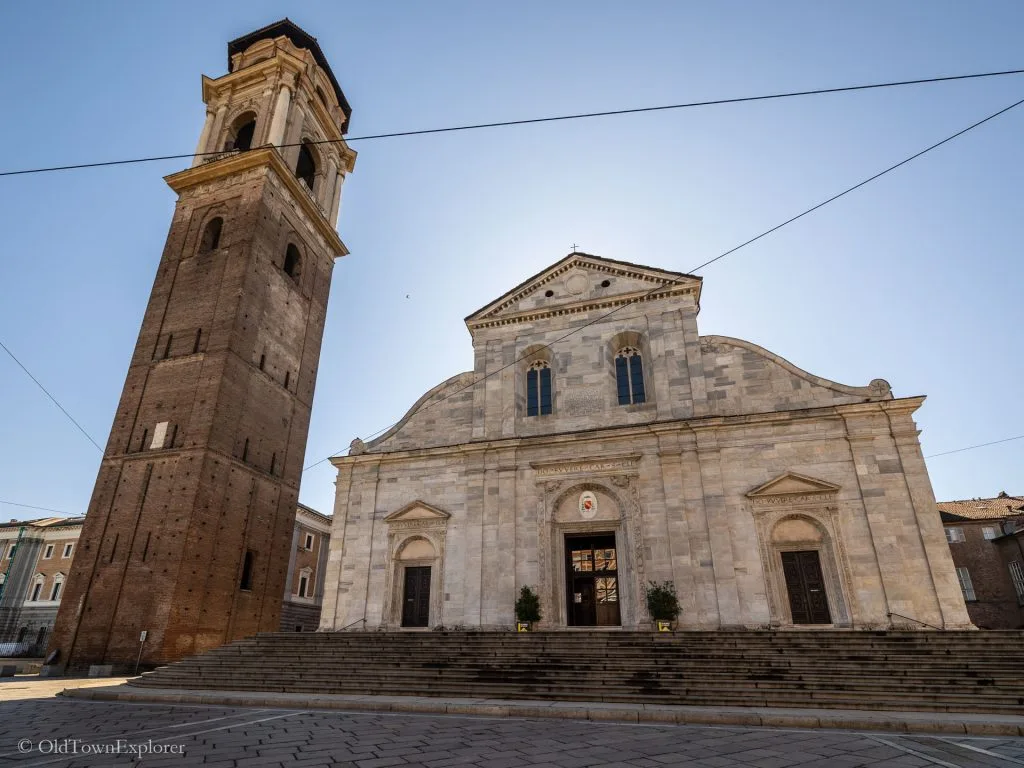
Cathedral of Saint John the Baptist
Duomo di Torino
- Architect: Amedeo di Castellamonte (Latin cross plan around 1491); renovations by Carlo di Castellamonte and Juvarra
- Style: Renaissance exterior with Baroque interior elements
- Built: 1491–1498; dome 16th century; interior refurbishments 17th–18th centuries
- Address: Piazza San Giovanni, Turin
Turin’s cathedral houses the Holy Shroud Chapel and blends Renaissance proportions with later Baroque ornamentation. The sober external façade contrasts the dramatic interior scenes.
Holy Shroud Chapel
Cappella della Sacra Sindone
- Architect: Guarino Guarini (originally Amedeo di Castellamonte and Bernardino Quadri began the design in early 1600s; Guarini took over in 1668)
- Style: Piedmontese Baroque
- Built: Begun 1668, completed 1694; altar added in 1694; gutted by fire in 1997 and restored, reopening in 2018
- Address: Piazza San Giovanni, adjacent to the apse of Turin Cathedral
A daring architectural feat—a black-marble, elevated rotunda with a self-supporting, multi-tiered dome infused with geometric and symbolic motifs. Built to house the Shroud of Turin in a reliquary at its center, this gem links the Cathedral and Royal Palace. The restoration honored Guarini’s original design, using matching marble and restoring its celestial structure.
San Lorenzo Royal Church
- Architect: Guarino Guarini
- Style: Piedmontese Baroque
- Built: 1664–1680
- Address: Via Palazzo di Città / Largo Pietro Micca, near Piazza Castello, Turin
Commissioned by Duke Carlo Emanuele II as his private royal chapel, this church is famed for its swirling, mathematically complex dome, interlacing arches, and twisted columns. The interior is dramatic and richly decorative, showcasing Guarini’s architectural genius in blending structure, light, and ornate detail.
Church of the Most Holy Annunciation
Chiesa dell’Annunziata
- Architect: Benedetto Vittone (completed façade; original design by Antonio Bertola)
- Style: Baroque–Neoclassical
- Built: Begun 1650s; Vittone worked on it mid‑1700s, completed circa 1761
- Address: Via XX Settembre 101, Turin
The church’s façade by Vittone balances Baroque drama with Neoclassical restraint. The interior features a serene oval nave, stucco decoration, and a choir loft illuminated by high windows.
Basilica of Corpus Christi
Santuario della Madonna del Corpus Domini
- Architect: Roehrig & Ricca (Neo‑Baroque enlargement over an older shrine)
- Style: Neo‑Baroque
- Built: 1898–1918
- Address: Piazza della Consolata 9, Turin
Built around a smaller Marian shrine, it features an imposing dome and richly decorated façades. Its interior is filled with vibrant mosaics and painted panels honoring the Eucharist and the Virgin Mary.
Basilica of Mary Help of Christians
Santuario di Maria Ausiliatrice
- Architect: Antonio Spezia
- Style: Neo‑Renaissance
- Built: 1865–1868
- Address: Via Maria Ausiliatrice 32, Valdocco district
Established by Saint John Bosco for the Salesians, its harmonious Renaissance forms, twin bell towers, and Marian iconography celebrate Don Bosco’s devotion.
Basilica of Superga
- Architect: Filippo Juvarra
- Style: Italian Baroque / Palladian
- Built: 1717–1731
- Address: Strada Basilica di Superga 73, Superga Hill
This hilltop basilica overlooks Turin—its Doric portico and giant dome recall Palladio. It houses the tombs of Savoy dynasty members and offers sweeping panoramic views.
Mauritian Basilica
Basilica Mauriziana
- Architect: Guarino Guarini (planned); Filippo Juvarra (completion)
- Style: Baroque
- Built: 1674–1677 (Guarini began it; later extended)
- Address: Via Maria Vittoria 5, Turin
Conceived for the Knights of the Order of Saints Maurice and Lazarus, its sumptuous interior displays royal funerary monuments and Baroque grandeur.
Church of Holy Martyrs
Chiesa dei Santi Martiri
- Architect: Carlo Tancredi Falletti (patron); rebuilt by Antonio Bettini and Luigi Cereda
- Style: Baroque
- Built: 1679–1687
- Address: Piazza San Carlo 12, Turin
Located near Piazza San Carlo, the church honors the Four Holy Crowned Martyrs. It features a crisp Baroque façade with Corinthian pilasters and a richly decorated interior with frescoes and gilded stuccoes.
Chapel of the Pious Congregation of Bankers and Merchants
Cappella dell’Arciconfraternita dei Mercanti
- Architect: Benedetto Alfieri
- Style: Late-Baroque
- Built: 1727–1734
- Address: Via Santa Teresa 23, inside the Palazzo della Compagnia di San Paolo
Created for the lay confraternity of local financiers, it displays elegant Baroque design with ornate stuccoes and religious paintings, exuding discreet elegance.
Church of Santissimo Sudario
Chiesa del Santissimo Sudario dei Piemontesi
- Architect: Carlo di Castellamonte
- Style: Early Baroque
- Built: 1605–1606
- Address: Via dell’Arcivescovado, Turin
Built for the Sabaudian confraternity, the façade is sober but internally it features Baroque ornamentation, stuccoes, and paintings centered on the Veil of Veronica relic.
Church of Gran Madre di Dio
- Architect: Ferdinando Bonsignore (with contributions from Formento & Bordino; later Giovanni Ricci for crypt)
- Style: Neoclassical
- Built: 1818–1831 (crypt added 1932)
- Address: Piazza Gran Madre di Dio 4, Turin
Inspired by Rome’s Pantheon, this circular temple sits atop a grand staircase with allegorical statues (Fede & Religione). Its crypt serves as a WWI ossuary. Powerful symbolism and esoteric legends surround it.
Church of Madonna del Carmine
Chiesa della Madonna del Carmine
- Architect: Filippo Juvarra (overall design); Giacomo Pella (completion of work)
- Style: Baroque
- Built: 1732–1736
- Address: Via del Carmine / Via Bligny, Turin
Commissioned under King Charles Emmanuel III for the Carmelite Order, this church features Baroque richness. Its design suffered WWII damage but was fully restored and reopened in 1955.
Church of Misericordia
Chiesa della Misericordia
- Architect: Nicolis di Robilant (18th-century rebuild); façade by Gaetano & Lorenzo Lombardi (1828)
- Style: Baroque
- Built/Rebuild: Rebuilt 1751–1753; façade in 1828
- Address: Via Barbaroux 41, Turin
Evolving from a monastic to confraternal church, it contains single nave richly adorned with marble, paintings (e.g., Zuccari, Beaumont), and Baroque sculptures and altar work.
Church of the Holy Trinity
Chiesa della Santissima Trinità
- Architect: Ascanio Vitozzi
- Style: Baroque architecture
- Built: 1598
- Address: Via Giuseppe Garibaldi, 6, 10122 Torino TO, Italy
The July 13, 1943 bombings severely damaged the apse and the eighteenth-century altar, crafted by artisans from Lugano, which now lacks decorations and Ignazio Perucca's wooden statues.
Church of Visitation
Chiesa della Visitazione
- Architect: Francesco Lanfranchi
- Style: Greek-cross Baroque-plan church
- Built: 18th century (exact dates not specified)
- Address: Via XX Settembre 23, Turin
Served the Vincentian Fathers; noted for its centralized cross-plan and artistic altarpieces, the church is popular among office workers and art enthusiasts.
Church of San Carlo
Chiesa di San Carlo Borromeo / Chiesa del “Carlino” – twin in Piazza San Carlo
- Architect: Carlo di Castellamonte (initial); façade by Filippo Juvarra/others; twin by Carlo Busso and Alfieri
- Style: Baroque with Neoclassical façade
- Built: Original built 1619–1649; current façades completed in mid-17th to 18th century
- Address: Piazza San Carlo, Turin
One of two twin churches flanking the square, San Carlo Borromeo is known locally as "il Carlino." The pair create a symmetric, elegant forecourt echoing Roman prototypes.
Church of San Dalmazzo
Chiesa di San Dalmazzo
- Architect: Original medieval foundation; major restorations in 1702, Neogothic overhaul in 1885
- Style: Neogothic interior, 17th-century façade
- Built: Origins from 11th century; façade and interior work in 1702, neo-Gothic transformation in 1885
- Address: Via delle Orfane 3 (Via Garibaldi), Turin
One of Turin’s oldest churches, featuring three aisles, Baroque façade, and richly frescoed Gothic-Revival interiors including marble pulpit and canopy.
Church and Convent of Saint Dominic
Chiesa di San Domenico
- Architects: Unknown
- Style: Gothic
- Built: first half of the 13th century; façade of the building was erected in 1334; and the bell tower in 1451
- Address: Via San Domenico, 0, 10122 Torino TO, Italy
Throughout its history, the church has served as a church, as an inquisition tribunal, and as a masonic lodge. It is currently the only surviving Gothic building in Turin.
Church of San Filippo Neri
Chiesa di San Filippo Neri
- Architects: Antonio Bettino; dome rebuilt by Guarini; completed/modified by Filippo Juvarra; façade by Giuseppe Maria Talucchi
- Style: Baroque with Neoclassical façade
- Built: Began 1675; dome collapsed 1714; rebuilt 1715–1730; façade finished 1823
- Address: Via Maria Vittoria 5, Turin
The city’s largest church (69 m), famous for its barrel-vaulted nave, rich stuccoes, Piffetti altar frontal, and housing the tomb of Blessed Valfrè.
Church of San Francesco d’Assisi
- Architects: Unknown
- Style: Baroque
- Built: 1608 to 1761
- Address: Via San Francesco D'Assisi, 11, 10122 Torino TO, Italy
The Church of San Francesco d'Assisi suffered minor damage during the bombardments of July 13, 1943.
Church of San Francesco of Paola
- Architect: Pellegrino Pellegrini
- Style: Baroque
- Built: 1632
- Address: Via Po, 16, 10123 Torino TO, Italy
San Francesco da Paola is a Baroque style, Roman Catholic church.
Church of Santa Cristina
- Architect: Carlo di Castellamonte (initial); façade by Filippo Juvarra
- Style: Baroque
- Built: Begun 1639; completed façade in 18th century
- Address: Piazza San Carlo, Turin
Twin of San Carlo, built under Regent Marie Christine. A Baroque gem admired for its elegant façade and central square presence.
Church of Santa Maria del Monte (Capuchins)
Santa Maria al Monte dei Cappuccini
- Architect: Ascanio Vitozzi; completed by Carlo & Amedeo di Castellamonte
- Style: Late Renaissance / Mannerist with Baroque updates
- Built: Begun 1583/84, consecrated 1656
- Address: Piazzale Monte dei Cappuccini 3, Turin
Overlooks the Po river; central Greek-cross plan and dome; houses important frescoes and the relics of Saint Ignatius of Santhià.
Church of Santa Teresa
Chiesa di Santa Teresa
- Architects: Andrea Costaguta; façade by Carlo Filippo Alberti; transept chapels by Filippo Juvarra
- Style: Baroque
- Built: 1642–1674; façade added 1764; chapels 1733
- Address: Via Santa Teresa 5, Turin
Built at the request of Madame Christine; the church retains Juvarra’s refined chapels and is the resting place of the Regent herself.
Sanctuary of Consolata
Santuario della Consolata
- Architects: Guarino Guarini; completion by Filippo Juvarra; façade/crypt and later updates by Pietro Anselmetti & Carlo Ceppi
- Style: Baroque, with Neoclassical façade and Rococo interior
- Built: Elliptical nave begun 1678; Juvarra’s additions 1729–1740; façade/crypt 1845–1860; final additions 1899–1904
- Address: Intersection of Via Consolata & Via Carlo Ignazio Giulio, Turin
The city’s Marian shrine, merging Guarini’s dynamic architecture with Juvarra’s chapel. Its colorful interiors and historic icon earned minor basilica status in 1906.
Chiesa di Santa Giulia
- Architect: Giovanni Battista Ferrante
- Style: Gothic Revival architecture
- Built: 1862 to 1866
- Address: Oratorio, Piazza Santa Giulia, 7bis, Piazza Santa Giulia, 7L, 10124 Torino TO, Italy
The Church of Saint Julia is a Roman Catholic place of worship located in the city of Turin, Italy.
Synagogue of Turin
Israelite Temple (Tempio Israelitico di Torino) aka Comunità Ebraica di Torino
- Architect: Enrico Petiti
- Style: Moorish Revival
- Built: 1880 to 1884
- Address: Piazzetta Primo Levi, 12, 10125 Torino TO, Italy
On November 20, 1942, Allied bombardments devastated the city, leaving only the exterior walls of the synagogue intact. It was rebuilt between 1945 and 1949 to its current condition.
Chiesa Valdese
aka Waldensian Temple (Tempio Valdese di Torino)
- Architect: Luigi Formento
- Architectural style: Romanesque Revival architecture
- Built: 1851 to 1853
- Address: C.so Vittorio Emanuele II, 23, 10125 Torino TO, Italy
The chapel was for the exclusive use of diplomatic personnel, foreigners, and Waldensians in the city - Catholics were excluded.
Church of Santa Croce
- Architect: Unknown
- Architectural Style: Baroque with Gothic origins
- Year Built: Originally 13th century; rebuilt and modified extensively in the 17th century
- Address: Piazza Santa Croce, Turin
A historic church originally built in the Gothic style, later remodeled in Baroque. It features a striking façade and significant artworks inside, reflecting Turin’s religious art heritage.
Church of San Giuseppe
- Architect: Unknown
- Architectural Style: Baroque
- Year Built: 17th century
- Address: Via San Giuseppe 8, Turin
Known for its richly decorated Baroque interior, this church was built by the Discalced Carmelites and is a fine example of Baroque religious architecture in Turin.
Church of Santa Barbara
- Architect: Unknown
- Architectural Style: Baroque
- Year Built: 17th century
- Address: Via Santa Barbara, Turin
A smaller Baroque church notable for its intimate interior and historical significance to the local community.
Church of San Tommaso Apostolo
- Architect: Unknown
- Architectural Style: Baroque
- Year Built: 17th century
- Address: Via San Tommaso, Turin
This church features classic Baroque elements and serves as a parish church with a rich history in the city.
Palaces in Turin
Turin’s palaces are central to understanding the city because the House of Savoy shaped much of the urban plan. Royal residences, court buildings, and aristocratic palaces define major squares, axes, and ceremonial spaces across the center.
For an overview of the UNESCO-listed Residences of the Royal House of Savoy in and around Turin, including key palaces such as the Royal Palace and Venaria Reale, see the official UNESCO site. For practical visitor information and descriptions of the Savoy royal residences in Turin and Piedmont, visit Italy’s official tourism portal.
Palazzo Bellia
- Architect: Carlo Ceppi
- Style: Liberty (Italian Art Nouveau)
- Year Built: 1892–1898
- Address: Via Pietro Micca 4, 10122 Torino
One of Turin’s early examples of Liberty style, notable for its decorative litho-cement details and reinforced concrete structure using the Hennebique system.
Palazzo Benso di Cavour
- Architect: Unknown
- Style: Neoclassical
- Year Built: 18th century (expanded later)
- Address: Via Accademia delle Scienze 5, Turin
Historic residence of Camillo Benso, Count of Cavour, an important figure in Italian unification. The palace houses offices today and preserves neoclassical interiors.
Palazzo Carignano
- Architect: Guarino Guarini
- Style: Baroque
- Year Built: 1679–1685
- Address: Via Accademia delle Scienze 5, Turin
Famous for its unique undulating facade, it was the residence of the Princes of Carignano and the first Italian Parliament met here. Now houses the Museum of the Risorgimento.
Palazzo Ceriana
- Architect: Unknown
- Style: Late Baroque / Rococo
- Year Built: 18th century
- Address: Via Ceriana 8, Turin
A residential palace known for its refined decorations, typical of Baroque palaces in Turin.
Palazzo Chiablese
- Architect: Unknown (modified by Benedetto Alfieri)
- Style: Baroque
- Year Built: 18th century (renovated 1750s)
- Address: Piazza San Giovanni 2, Turin
Former residence of the Dukes of Chablais, notable for its interiors by Alfieri. Today it is part of the Royal Museums.
Palazzo dell'Università
- Architect: Michelangelo Garove; facade by Filippo Juvarra
- Style: Baroque
- Year Built: 1713–1720
- Address: Via Po 17, Turin
Headquarters of the University of Turin featuring Baroque facades by Juvarra and elegant arcades.
Palazzo della Vittoria
- Architect: Unknown
- Style: Early 20th century, possibly Liberty or Eclectic
- Year Built: Early 1900s
- Address: Via della Vittoria, Turin
Residential palace notable for its decorative style reflective of early 20th-century architecture.
Palazzo Falletti di Barolo
- Architect: Giuseppe Talucchi
- Style: Eclectic with Neo-Gothic influences
- Year Built: 1830s
- Address: Via Corte d’Appello 20, Turin
Famous for its Gothic Revival style; currently houses the Museum of the Risorgimento.
Palazzo Madama
- Architect: Medieval core; Baroque façade by Filippo Juvarra
- Style: Medieval and Baroque
- Year Built: Medieval origins; Baroque façade 1716–1721
- Address: Piazza Castello, Turin
Originally a Roman gate and medieval castle, renovated into a palace with Juvarra’s Baroque additions. It is now the Museum of Ancient Art.
Palazzo Solaro del Borgo
- Architect: Carlo di Castellamonte; Benedetto Alfieri
- Style: Baroque with Rococo interiors
- Year Built: Mid-17th century with 18th-century renovations
- Address: Piazza San Carlo 183, Turin
A noble residence now hosting cultural events, featuring Rococo interiors and a neoclassical concert hall.
Royal Palace of Turin
- Architect: Ascanio Vitozzi, Carlo and Amedeo di Castellamonte, Filippo Juvarra
- Style: Baroque and Neoclassical
- Year Built: 16th century onwards, major 17th-18th-century expansions
- Address: Piazzetta Reale 1, Turin
The main residence of the House of Savoy with opulent Baroque interiors and the Chapel of the Holy Shroud.
Casa Fenoglio – La Fleur
- Architect: Pietro Fenoglio
- Style: Liberty (Art Nouveau)
- Year Built: 1902
- Address: Corso Francia 8, Turin
One of Turin’s most iconic Art Nouveau buildings, with floral motifs and wrought-iron details.
Castello del Valentino
- Architect: Carlo di Castellamonte; Filippo Juvarra; Benedetto Alfieri
- Style: Baroque and Renaissance Revival
- Year Built: 17th century; major 18th-century renovations
- Address: Parco del Valentino, Turin
A royal hunting lodge turned university faculty, known for its park location and picturesque façade.
Villa della Regina
- Architect: Ascanio Vitozzi; Filippo Juvarra
- Style: Baroque
- Year Built: 1615–1619; expanded 1720s
- Address: Strada Comunale Santa Margherita 79, Turin
Elegant hillside villa with formal gardens, originally built for Savoy princesses.
La Venaria Reale
- Architect: Amedeo di Castellamonte; Filippo Juvarra; Benedetto Alfieri
- Style: Baroque
- Year Built: Begun 1658, completed mid-18th century
- Address: Piazza della Repubblica 4, Venaria Reale (near Turin)
Vast royal hunting palace known as the Piedmontese Versailles, with grand gardens and interiors.
Castello di Moncalieri
- Architect: Carlo di Castellamonte; Filippo Juvarra
- Style: Baroque and Renaissance
- Year Built: 12th century origins; 17th-century expansion
- Address: Piazza Baden Baden 2, Moncalieri (near Turin)
A fortified castle turned royal palace, now hosting municipal offices and exhibitions.
Villa Scott
- Architect: Pietro Fenoglio
- Style: Art Nouveau / Liberty
- Year Built: 1905
- Address: Corso Francia 8, Turin
Private villa exemplifying Liberty style, known for elegant decorative details.
Casa Scaccabarozzi
aka Palazzo Fetta di Polenta
- Architect: Unknown
- Style: Baroque
- Year Built: 18th century
- Address: Via Accademia delle Scienze 6, Turin
Nicknamed "Fetta di Polenta" for its wedge shape, this narrow building is a famous Turin landmark.
Villino Raby
- Architect: Pietro Fenoglio
- Style: Liberty / Art Nouveau
- Year Built: Early 20th century
- Address: Via Maria Vittoria 23, Turin
Elegant Liberty villa, with floral and natural motifs typical of Fenoglio’s style.
Palazzo Bricherasio
- Architect: Pietro Fenoglio
- Style: Liberty / Art Nouveau
- Year Built: Early 1900s
- Address: Via San Francesco da Paola 10, Turin
Residential building featuring characteristic wrought iron and floral decoration.
Palazzo Asinari di San Marzano
- Architect: Unknown
- Style: Baroque
- Year Built: 18th century
- Address: Via Po 24, Turin
Historic noble palace near the river, currently offices and cultural venues.
Casa Romagnano
- Architect: Unknown
- Style: Liberty / Art Nouveau
- Year Built: Early 1900s
- Address: Via Giuseppe Romagnano 7, Turin
A residential building showcasing Liberty decorative motifs.
Palazzo Cisterna
- Architect: Probably Guarino Guarini (attributed)
- Architectural Style: Baroque
- Year Built: Mid-17th century
- Address: Piazza San Secondo 11, Turin
Originally a fortress, this palace was transformed into a noble residence with a characteristic Baroque courtyard. It’s now a cultural center hosting exhibitions and events.
Palazzo Taffini d’Acceglio
- Architect: Unknown
- Architectural Style: Baroque
- Year Built: 17th-18th century
- Address: Via delle Orfane 7, Turin
A stately Baroque palace in the city center, known for its elegant façade and historic interiors.
Palazzo Valperga Galleani
- Architect: Unknown
- Architectural Style: Baroque
- Year Built: 17th century
- Address: Via della Consolata 15, Turin
A noble residence near the Basilica of the Consolata, notable for its frescoed interiors and classic Baroque elements.
Palazzo Lascaris di Ventimiglia
- Architect: Unknown
- Architectural Style: Baroque
- Year Built: 17th century
- Address: Via Alfieri 15, Turin
Currently houses the Piedmont Regional Council; it features a Baroque courtyard and period decorations.
Palazzo Graneri della Roccia
- Architect: Unknown
- Architectural Style: Baroque
- Year Built: Late 17th century
- Address: Via Garibaldi 4, Turin
A baroque palace with notable frescoes and decorative stucco work. Now part of the Civic Museums.
Historical Streets in Turin
Turin’s historical streets offer a fascinating glimpse into the city’s layered past, where medieval origins meet Baroque grandeur and modern urban planning. These streets are lined with elegant palaces, arcades, and vibrant public spaces that together tell the story of Turin’s evolution as a cultural and political center.
Via Giuseppe Garibaldi
- Architect: No single architect; developed over centuries
- Architectural Style: Mix of Medieval and Renaissance elements
- Year Built: Origin dates back to medieval times, originally known as “Via della Fontana”
- Address: Runs through Turin’s historic center, starting near Piazza Castello
One of Turin’s oldest streets, Via Garibaldi is a lively pedestrian street lined with medieval arcades, shops, and cafes. It retains much of its historic character with narrow cobblestone lanes and well-preserved buildings from the Renaissance and later periods. It’s a vibrant artery connecting key city landmarks.
Via Po
- Architect: Designed by Amedeo di Castellamonte (17th century)
- Architectural Style: Baroque
- Year Built: Laid out in 1650s
- Address: Runs from Piazza Castello to the Po River, passing the University of Turin
Via Po is one of Turin’s most iconic Baroque streets, notable for its long, arcaded sidewalks and uniform architectural rhythm. It was planned to connect the Royal Palace to the river and the university, reflecting the urban design ideals of the 17th century.
Via Roma
- Architect: Designed by Carlo Ceppi and others during early 20th-century redevelopment
- Architectural Style: Eclectic with Art Nouveau and Neo-Classical influences
- Year Built: Constructed in the early 1900s, opened in 1916
- Address: Runs from Piazza Castello to Piazza Carlo Felice (near Porta Nuova railway station)
Via Roma is a prestigious shopping and commercial street created during Turin’s modernization in the early 20th century. It features wide sidewalks with arcades, elegant façades, and a mix of architectural styles including Art Nouveau, blending historic grandeur with modern urban needs.
Via Pietro Micca
- Architect: No single architect; named after Pietro Micca, a local hero
- Architectural Style: Primarily Baroque and 18th-19th century urban design
- Year Built: Developed mainly in the 18th century during the expansion of Turin
- Address: Runs from Piazza Castello towards Piazza Solferino
A key street named in honor of the Piedmontese soldier Pietro Micca, it features elegant buildings reflecting Baroque influences. The street connects major squares and is close to important historical and military sites in Turin.
Via Carlo Alberto
- Architect: Originally designed by architect Benedetto Alfieri (18th century) and later developed
- Architectural Style: Baroque with Neoclassical elements
- Year Built: Mid-18th century
- Address: Runs from Piazza Carlo Alberto to Piazza Vittorio Veneto
Via Carlo Alberto is a grand, elegant street lined with historic buildings, many housing cultural institutions like the Museo Nazionale del Risorgimento Italiano. The street reflects Turin’s 18th-century urban expansion and is known for its harmonious Baroque façades.
Via Accademia Albertina
- Architect: Developed during 18th century, linked to Benedetto Alfieri’s urban planning
- Architectural Style: Baroque and Neoclassical
- Year Built: 18th century
- Address: Near Piazza Castello, leading towards the Accademia Albertina art school
This street connects key cultural landmarks and features elegant palaces and academic institutions. It exemplifies the city’s artistic and intellectual heritage within its architectural layout.
Via San Tommaso
- Architect: No specific architect; evolved over centuries
- Architectural Style: Mix of Renaissance and Baroque
- Year Built: Medieval origins, developed through Renaissance and Baroque periods
- Address: Runs in the historic center near Piazza Castello
A narrow street known for its historic atmosphere, Via San Tommaso is lined with well-preserved buildings showcasing a blend of Renaissance and Baroque architectural features. It’s part of the old city fabric that retains Turin’s medieval street pattern.
Via Monte di Pietà
- Architect: No specific architect known
- Architectural Style: Baroque and later modifications
- Year Built: 17th-18th centuries
- Address: Historic center, connecting Piazza Castello and Via Garibaldi
This street is known for its historic palaces and churches, reflecting the Baroque grandeur of Turin’s urban core. It’s part of the city’s network of streets that radiate from Piazza Castello.
Historical Squares in Turin
Turin’s historical squares are vibrant centers where the city’s rich past and architectural grandeur come alive. From Baroque masterpieces to Neoclassical open spaces, these piazzas have long been the heart of social, political, and cultural life, reflecting Turin’s evolution through the centuries.
Quadrilatero Romano
- Architect: Not a single architect; area evolved from Roman times
- Architectural Style: Mix of Roman, Medieval, Renaissance, and Baroque
- Year Built: Origins in Roman era (~1st century BC); developed through Middle Ages and Renaissance
- Address: Historic district bounded by Via Garibaldi, Via XX Settembre, Via Porta Palatina, and Via Cavour
The Quadrilatero Romano is the oldest district of Turin, originally the Roman city’s core. It’s a lively neighborhood with narrow streets, ancient ruins (like Porta Palatina), medieval buildings, and vibrant cafes. It offers a layered historical experience from Roman urbanism to modern life.
Piazza Carignano
- Architect: Designed by Guarino Guarini
- Architectural Style: Baroque
- Year Built: Mid-17th century (completed c. 1679)
- Address: Piazza Carignano, Turin
This elegant square is dominated by Palazzo Carignano, an architectural masterpiece of Baroque style. The square is a cultural and historical hub, hosting the Museo Risorgimento and showcasing ornate façades and harmonious proportions.
Piazza Carlo Emanuele II
- Architect: Originally designed by Benedetto Alfieri and others
- Architectural Style: Baroque and Neoclassical elements
- Year Built: 18th century
- Address: Piazza Carlo Emanuele II, Turin
Also known as Piazza Carlina, this square features arcaded buildings and a central statue of Carlo Emanuele II. It has a refined atmosphere and serves as a popular gathering place with historic cafes and shops.
Piazza Carlo Felice
- Architect: Developed by Carlo Ceppi and others during early 20th-century redevelopment
- Architectural Style: Eclectic with Art Nouveau influences
- Year Built: Early 1900s
- Address: Piazza Carlo Felice, near Porta Nuova railway station
A formal square in front of Turin’s main train station, featuring elegant buildings and wide avenues. It marks the gateway between the historic city center and the modern railway district.
Piazza Castello
- Architect: Urban layout evolved over centuries; major buildings by Carlo and Amedeo di Castellamonte, Filippo Juvarra, Guarino Guarini
- Architectural Style: Baroque and Renaissance elements
- Year Built: Developed from 16th century onward
- Address: Central square, Turin
The heart of Turin, Piazza Castello is surrounded by the Royal Palace, Palazzo Madama, and the Teatro Regio. It is the focal point of the city’s political and cultural life, blending grand architecture with lively public space.
Piazza della Repubblica – Porta Palazzo
- Architect: Urban development over time; no single architect
- Architectural Style: Eclectic, with 19th-century market buildings
- Year Built: Market origins date to Middle Ages; current form mainly 19th century
- Address: Piazza della Repubblica, Turin
Known primarily for the Porta Palazzo market, Europe’s largest open-air market, this square is a vibrant, multicultural hub. It combines historic market halls with lively street stalls and urban life.
Piazza Palazzo di Città
- Architect: No single architect; associated with Palazzo Civico (City Hall) by Giuseppe Frizzi and Amedeo D’Andrade
- Architectural Style: Eclectic with Neo-Renaissance details
- Year Built: Palazzo Civico built between 1867–1871
- Address: Piazza Palazzo di Città, Turin
This square hosts Turin’s City Hall and serves as a political and administrative center. The palace is an ornate 19th-century building with impressive façades and interiors.
Piazza San Carlo
- Architect: Designed by Carlo di Castellamonte; completed by his son Amedeo di Castellamonte
- Architectural Style: Baroque
- Year Built: Completed early 17th century (1639)
- Address: Piazza San Carlo, Turin
Known as “Turin’s living room,” this grand Baroque square is framed by twin churches (Santa Cristina and San Carlo Borromeo) and elegant arcades. It is a social and cultural focal point with cafes, statues, and historic buildings.
Piazza Savoia
- Architect: Urban layout evolved; specific architects unknown
- Architectural Style: 19th-century urban style
- Year Built: Developed in the 19th century
- Address: Piazza Savoia, near the city center
A smaller square associated with the Savoia family, featuring 19th-century residential and institutional buildings, blending historic charm with quieter urban life.
Piazza Solferino
- Architect: Designed by Carlo Ceppi (19th century)
- Architectural Style: Eclectic with Renaissance Revival details
- Year Built: 19th century
- Address: Piazza Solferino, Turin
A lively square near the river Po, featuring cafes and theaters. It is characterized by elegant buildings and is a popular spot for both locals and visitors.
Piazza Statuto
- Architect: Urban development in 19th century; architect details vary
- Architectural Style: Eclectic and Neoclassical influences
- Year Built: 19th century
- Address: Piazza Statuto, Turin
Known for its monumental Arch of Peace (Arco di Trionfo), this square serves as a major traffic and urban hub, blending grandeur with modern city life.
Piazza Vittorio Veneto
- Architect: Designed by Carlo Ceppi and Giuseppe Pistoni
- Architectural Style: Neoclassical and Eclectic
- Year Built: Early 19th century (circa 1820s)
- Address: Piazza Vittorio Veneto, alongside the Po River
One of the largest squares in Europe, it features symmetrical porticoes, open spaces, and views of the Po River and the hills. It’s a central social hub known for nightlife, cafes, and events.
Piazza XVIII Dicembre
- Architect: Urban design by Carlo Ceppi (19th century)
- Architectural Style: Eclectic and Neoclassical
- Year Built: 19th century
- Address: Piazza XVIII Dicembre, Turin
This square is located near Porta Susa railway station and is notable for its large open space and stately buildings. It serves as a gateway to the city center and features classical urban planning elements.
Piazza della Consolata
- Architect: No single architect; surrounding buildings developed over centuries
- Architectural Style: Mix of Baroque and Renaissance
- Year Built: Developed mainly 17th-18th centuries
- Address: Piazza della Consolata, Turin
Named after the Sanctuary of the Madonna della Consolata, this small but important square holds great religious and historical significance. The Sanctuary is a key pilgrimage site with notable Baroque architecture.
Piazza Emanuele Filiberto
- Architect: No specific architect; urban development from 19th century
- Architectural Style: Eclectic and Neoclassical
- Year Built: 19th century
- Address: Piazza Emanuele Filiberto, Turin
This square is a quiet, residential area with elegant 19th-century buildings. It reflects the expansion of Turin during the Savoy monarchy and offers a glimpse into the city’s bourgeois past.
Other Architectural Attractions in Turin
Beyond its famous palaces and religious sites, Turin boasts a diverse array of architectural landmarks. From striking Baroque villas and elegant Art Nouveau residences to iconic bridges and historic fortifications, these attractions showcase the city’s rich architectural heritage and evolving urban landscape.
Mole Antonelliana
- Architect: Alessandro Antonelli
- Architectural Style: Eclectic with Neo-Gothic influences
- Year Built: Construction began in 1863, completed in 1889
- Address: Via Montebello, 20, 10124 Torino TO, Italy
The Mole Antonelliana is Turin’s iconic landmark, originally conceived as a synagogue but completed as a monument dedicated to national unity. Its towering spire makes it one of the tallest brick buildings in Europe. It now houses the National Museum of Cinema.
To learn more about the Mole Antonelliana and the National Museum of Cinema housed inside Turin’s iconic tower, see the official museum page.
Umberto I Bridge
Ponte Umberto I
- Architect: Not specifically attributed; designed by engineers in late 19th century
- Architectural Style: Functional with decorative ironwork typical of the period
- Year Built: Completed in 1895
- Address: Spans the Po River connecting Piazza Vittorio Veneto to Borgo Po
A key bridge over the Po River, Umberto I Bridge links central Turin to the northern districts. It features elegant iron railings and stone details, reflecting the industrial-era engineering combined with decorative art.
Porta Palatina
- Architect: Roman-era construction; no specific architect recorded
- Architectural Style: Ancient Roman military architecture
- Year Built: 1st century AD (Roman Imperial period)
- Address: Via Porta Palatina, 10122 Torino TO, Italy
Porta Palatina is one of the best-preserved Roman gates in the world and the main entrance to the ancient Roman city of Augusta Taurinorum (ancient Turin). It features twin towers and defensive walls and stands as a symbol of Turin’s Roman origins.
Twelve Months Fountain
Fontana dei Dodici Mesi
- Architect: Pietro Canonica (sculptor)
- Architectural Style: Early 20th-century decorative fountain
- Year Built: 1927
- Address: Piazza Statuto, Turin
This ornate fountain represents the twelve months through allegorical figures and reliefs, symbolizing the passage of time and the cycles of nature. It is a fine example of Turin’s artistic and urban embellishments during the early 20th century.
Citadel Keep
Mastio della Cittadella
- Architect: Designed by Ascanio Vittozzi and others under Emmanuel Philibert, Duke of Savoy
- Architectural Style: Renaissance military architecture
- Year Built: Constructed between 1564 and 1569
- Address: Piazza della Repubblica area, Turin
The Mastio della Cittadella was the central tower of the Turin Citadel, a large Renaissance fortress built to protect the city. Though much of the citadel was demolished in the 19th century, the Mastio remains a significant example of military engineering.
Parco del Valentino
- Architect: Designed by Carlo Ceppi and others during 19th-century urban park development
- Architectural Style: Landscape architecture with Romantic influences
- Year Built: Established mid-19th century, opened 1856
- Address: Lungopo Po, Turin
Parco del Valentino is Turin’s historic public park along the Po River, featuring picturesque gardens, pathways, and notable buildings like the Castello del Valentino. It exemplifies 19th-century European Romantic landscape design and serves as a green lung for the city.
Castello del Valentino
- Architect: Carlo di Castellamonte (initial), later renovations by Amedeo di Castellamonte and Filippo Juvarra
- Architectural Style: Baroque with Renaissance influences
- Year Built: Originally 16th century, remodeled in 17th century
- Address: Parco del Valentino, Corso Massimo d’Azeglio, 10126 Torino TO, Italy
Situated within Parco del Valentino, this castle served as a ducal residence. It is a fine example of Baroque architecture blending with Renaissance elements and now hosts the Architecture Faculty of the Polytechnic University of Turin.
City Tours in Turin
City tours in Turin provide an organized way to understand the city’s grid layout, its role as the first capital of unified Italy, and the architectural development that occurred from the Baroque period through the 19th and early 20th centuries. Many tours focus on royal residences, civic buildings, and the portico-lined streets of the historic center.
Best Places to Stay In Turin
Hotels in Turin
There are many great places to stay in Turin. For the best experience, we recommend staying near Centro (the castle marker on the map below). The Centro area is the most pedestrian-friendly, with many restaurants and historical shops, and the main attractions are nearby.
Here’s a map with hotel and apartment options that can be filtered to meet your needs. Select your travel dates to get specific availability and prices.
Things to Know About Turin Architecture
Royal Planning Shapes the Center
Turin’s center is strongly shaped by the House of Savoy. Formal squares, straight streets, arcades, palaces, and royal residences show how the city developed as a planned capital rather than an irregular medieval town.
Baroque Architecture Is Central
Baroque architecture is one of Turin’s main strengths. Guarino Guarini, Filippo Juvarra, and other architects shaped churches, chapels, palaces, staircases, domes, and court spaces across the city.
Arcades Matter
Turin’s covered arcades are not just practical shelter from weather. They also shape the city’s street life, shopfronts, cafés, and movement between major squares.
Art Nouveau Appears in Residential Districts
Turin was an important Italian center for Stile Liberty, the local form of Art Nouveau. Look for curved ironwork, floral decoration, ceramic details, balconies, and decorative façades in residential areas outside the main royal core.
FAQs About Turin Architecture
What architecture is Turin known for?
Turin is known for Baroque churches, Savoy palaces, Neoclassical squares, covered arcades, Roman remains, Stile Liberty buildings, and planned streets shaped by its role as a former royal capital.
Why does Turin look planned?
Turin’s center was shaped by royal and military planning under the House of Savoy. Straight streets, formal squares, arcades, and palace axes make the city feel more orderly than many older Italian centers.
What is the most iconic building in Turin?
The Mole Antonelliana is Turin’s most recognizable building. It was originally designed as a synagogue and now houses the National Museum of Cinema.
What are the most important architecture sites in Turin?
Important sites include the Royal Palace, Palazzo Madama, Mole Antonelliana, Turin Cathedral, Holy Shroud Chapel, San Lorenzo Royal Church, Piazza Castello, Piazza San Carlo, Porta Palatina, and the city’s covered arcades.
Can you see Turin architecture on foot?
Yes. Many of Turin’s main churches, palaces, squares, arcades, and Roman remains are walkable in the center. Public transport helps for sites farther from the core, such as some Stile Liberty areas and riverfront stops.