
San Sebastian Architecture
Explore San Sebastian Architecture: Religious Buildings & More
San Sebastián’s architecture tells the story of a city that has continually rebuilt itself while embracing the sea. Founded as a fortified medieval port, it evolved through neoclassical reconstruction after the fire of 1813 and reached its peak of elegance during the Belle Époque, when royal patronage transformed it into Spain’s most refined coastal resort.
The city preserves a remarkable architectural continuity: Gothic and Baroque churches in the Parte Vieja, neoclassical squares born from Enlightenment urban ideals, and seafront promenades lined with Belle Époque villas and civic monuments. From the Basilica of Santa María del Coro beneath Mount Urgull to the Miramar Palace overlooking La Concha Bay, each district contributes to a unified landscape of history, architecture, and light.
We spent a month in San Sebastián studying its churches, fortifications, bridges, and civic landmarks — from medieval walls to contemporary works like the Kursaal Congress Centre. This guide brings together those observations to help you explore the city’s architecture with clarity and context, tracing how centuries of reconstruction and design have created one of Europe’s most harmonious seaside skylines.
For the wider national context, see Spain Architecture, which connects San Sebastian’s neoclassical planning, Belle Époque landmarks, and contemporary sites with architectural styles across the country.
This page contains affiliate links. We may earn a small commission at no extra cost to you.
The Belle Époque in San Sebastián
San Sebastián’s Belle Époque era marked the city’s transformation from a fortified provincial town into a cosmopolitan seaside resort. Between the 1880s and the outbreak of the First World War, the arrival of Queen María Cristina and the summer court at Miramar Palace attracted aristocrats, politicians, and artists from across Europe. Their presence spurred the construction of grand hotels, theatres, casinos, promenades, and civic buildings that blended Beaux-Arts symmetry, Spanish Renaissance ornament, and seafront leisure planning.
Today, the architecture of this period defines the city’s visual identity — elegant façades along the Urumea River, curved promenades on La Concha Bay, and parks framed by domed pavilions and balustrades. Together they form one of the finest Belle Époque ensembles in Spain, a landscape of glamour, symmetry, and seaside light.
The official San Sebastián Tourism architecture guide gives additional context for Belle Époque landmarks such as Miramar Palace, City Hall, Hotel María Cristina, Victoria Eugenia Theatre, María Cristina Bridge, and La Perla.
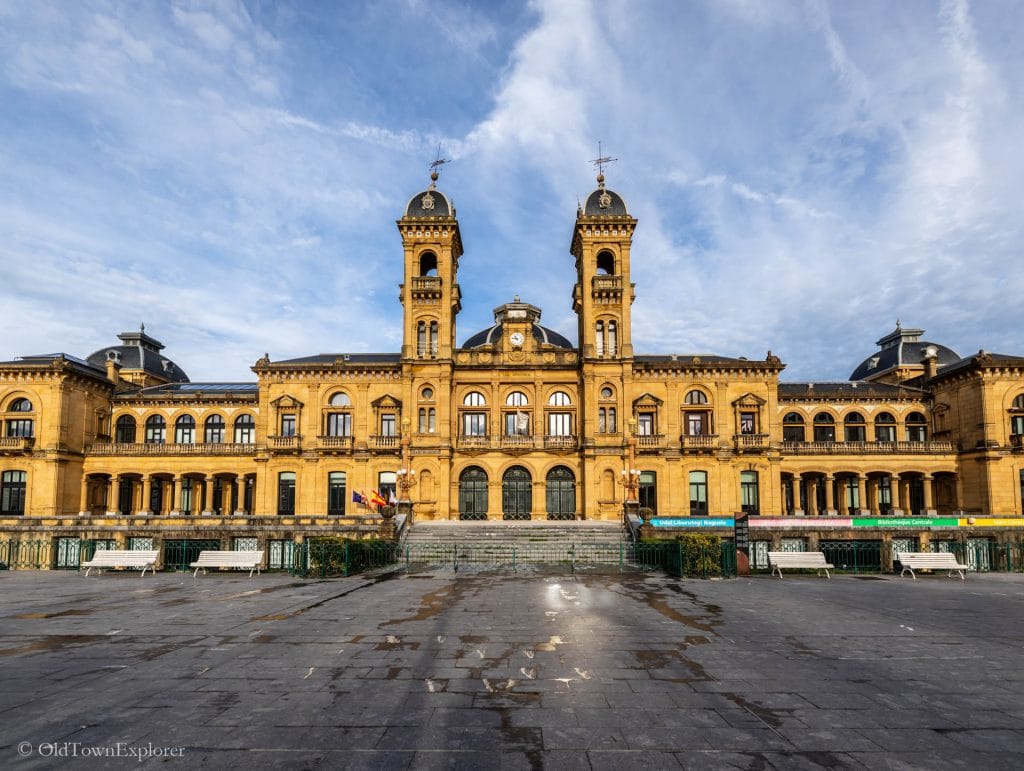
City Hall
Ayuntamiento de San Sebastián (former Grand Casino Kursaal)
- Architects: Luis Aladrén Mendizábal and Adolfo Moreno López
- Style: Eclectic / Beaux-Arts Public Architecture
- Year Built: 1882 – 1887 (as Casino Kursaal) • Became City Hall in 1947
- Address / Location: Alderdi Eder Gardens, La Concha Bay, San Sebastián, Spain
Inaugurated in 1887 as the Grand Casino, this building hosted the glittering society of San Sebastián’s Belle Époque — politicians, writers, and artists who gathered under its ornate ceilings for balls and roulette tables. Gambling was banned in 1924, and on January 20, 1947, the city council moved here from Plaza de la Constitución, transforming the former casino into City Hall. Its elegant twin towers and sandstone façade overlook the tranquil Alderdi Eder gardens and the waves of La Concha Bay — a setting that still captures the spirit of San Sebastián’s golden age.
Victoria Eugenia Theatre
Teatro Victoria Eugenia
- Architect: Francisco de Urcola
- Style: Spanish Renaissance Revival with Plateresque decoration
- Year Built: 1912 • Renovated 2007
- Address / Location: Paseo de la República Argentina 2, Urumea River bank, San Sebastián, Spain
A hallmark of the Belle Époque and a centennial landmark of the city, the Victoria Eugenia Theatre combines classical order with Spanish ornament. Its sandstone façade is decorated with Plateresque motifs and four sculptural groups symbolizing Opera, Tragedy, Comedy, and Drama above the Doric portico. Since its opening in 1912, the theatre has been a cultural epicenter — today serving as a principal venue of the San Sebastián International Film Festival. A comprehensive restoration in 2007 modernized its interior while preserving its Belle Époque character.
Hotel María Cristina
- Architect: Charles Mewès (designer of the Ritz Hotels in Paris and Madrid)
- Style: Beaux-Arts Luxury Hotel Architecture
- Year Built: 1912 • Expanded 1950s • Renovated 2012
- Address / Location: Paseo de la República Argentina 4, Urumea River bank, San Sebastián, Spain
The Hotel María Cristina, facing the Victoria Eugenia Theatre across the Urumea, was conceived as the jewel of the city’s aristocratic hospitality. Its Beaux-Arts façade curves around the riverfront with grand balconies and sculpted cornices. Originally L-shaped, it was extended in the 1950s to a U-plan, and following a meticulous 2012 restoration, the interiors recaptured their 1912 splendor. Since the mid-20th century it has hosted Film Festival guests — the red carpet linking the hotel and the theatre remains one of the festival’s most famous scenes.
La Perla Spa and Baths
La Perla del Océano – Balneario La Perla
- Architect: Luis Aladrén Mendizábal (original wooden spa 1890s); reconstructed 1912
- Style: Seaside Resort Architecture / Belle Époque Reform of La Concha
- Year Built: Wooden spa c. 1890 • New complex 1912 • Rebuilt 1994
- Address / Location: Paseo de la Concha, San Sebastián, Spain
When Queen María Cristina made San Sebastián the royal summer residence, a fashionable seaside spa became essential. The first wooden structure was replaced in 1912 by La Perla, a monumental thermal-bath complex praised as “one of the most beautiful in the world.” The project formed part of the wider re-planning of La Concha — widening the promenade, creating covered galleries, installing bathing cabins, and adding the now-iconic white railing. A 1994 reconstruction adapted it for modern use while retaining its historic Belle Époque silhouette.
General Council of Gipuzkoa
Diputación Foral de Gipuzkoa
- Architect: José de Goicoa
- Style: Eclectic / Neo-Renaissance Civic Architecture
- Year Built: 1878 – 1890 • Rebuilt after fire in 1885
- Address / Location: Plaza de Gipuzkoa, San Sebastián, Spain
The Palace of the Provincial Council anchors Gipuzkoa Square with its arched portico and monumental façade. Designed by José de Goicoa in 1878 and completed in 1890 after a fire destroyed the interior, the building illustrates the institutional grandeur of the period. Busts of Basque explorers Urdaneta, Elcano, Oquendo, Lezo, and Legazpi decorate the façade beneath the coat of arms of Gipuzkoa, linking provincial identity to imperial heritage.
Rack Railway Station
Estación del Monte Igueldo – Funicular Station
- Architect: Unknown
- Style: Early 20th-century vernacular / rustic Belle Époque
- Year Built: 1912
- Address / Location: Paseo del Faro 56, Mount Igeldo, San Sebastián, Spain
Built to serve the funicular ascending Mount Igeldo, this station combines public dignity with rustic charm. Its arched entrance and former canopy announced a new era of leisure travel, while the rubble-masonry walls and timber-framed dormers echoed mountain architecture. From here, visitors departed for the amusement park and panoramic views that became integral to the Belle Époque experience.
Koldo Mitxelena Library and Cultural Centre
Koldo Mitxelena Kulturunea
- Architect: Originally for the Provincial Institute of Secondary Education (1900)
- Style: Neoclassical Academic Architecture adapted to Modern Use
- Year Built: 1900 • Renovated 1993 (preserving façades)
- Address / Location: Urdaneta Kalea 9, San Sebastián, Spain
Constructed in 1900 to house the Provincial Institute of Secondary Education, this building illustrates the educational and cultural ambitions of the turn of the century. Its austere Neoclassical façade was retained in the 1993 conversion to the Koldo Mitxelena Cultural Centre, which now hosts libraries, exhibitions, and conferences under the Regional Council of Gipuzkoa. The renovation maintained the Belle Époque urban scale while adapting its purpose for a modern civic audience.
Together these monuments — from the casino-turned-city hall and the seaside spa to the palaces, hotels, and theatres — embody the elegance of a city that reinvented itself through architecture. The Belle Époque not only shaped San Sebastián’s skyline but also defined its enduring reputation as Spain’s most refined coastal resort.
Attractions in Plaza de la Constitución
At the heart of San Sebastian’s Old Town, Plaza de la Constitución is the city’s principal civic square and the focal point of its neoclassical urban design. Built after the devastating fire of 1813, it served as the administrative and social center of the rebuilt city. Its uniform façades with numbered balconies recall its early use as a bullring, while arcaded ground floors house long-standing cafés and bars. Today, the square remains a key gathering space for festivals such as the Tamborrada and an architectural anchor linking the Parte Vieja with the 19th-century expansion.
Former City Hall
Casa Consistorial Antigua
- Architect: Unknown
- Style: Neoclassical civic architecture
- Year Built: 1817–1822
- Address / Location: North side of Plaza de la Constitución, San Sebastian, Spain
The north side of the square originally housed the city’s main administrative building, the Casa Consistorial. Its central balcony was used for proclamations and ceremonies. After the municipal offices moved to the former casino by La Concha Bay in 1945, the structure was adapted for cultural use but retains its formal classical composition, symmetrical plan, and arched gallery facing the square.
Town Hall Balcony Façades
- Architect: Pedro Manuel de Ugartemendia
- Style: Neoclassical
- Year Built: 1817–1820
- Address / Location: Plaza de la Constitución, Parte Vieja, San Sebastian, Spain
The uniform façades that frame the square were designed under Ugartemendia’s direction as part of the city’s post-war reconstruction. Each of the three-storey buildings features identical arcades at ground level and numbered balconies above — a remnant from when the balconies were rented to spectators during bullfights. Their rhythm and proportion define the square’s sense of order and civic elegance.
Arcaded Ground Level
- Architect: Pedro Manuel de Ugartemendia
- Style: Neoclassical with civic arcade typology
- Year Built: 1817–1820
- Address / Location: Surrounding perimeter of Plaza de la Constitución, Parte Vieja, San Sebastián
Each façade around the square incorporates a continuous ground-floor arcade, designed to protect pedestrians from the coastal weather while maintaining visual harmony. The regular arches unify the perimeter façades and mark one of the earliest consistent applications of neoclassical urban planning in post-Napoleonic Spain. Many arcades still house long-standing cafés and taverns that preserve their original proportions and pilasters.
Central Flag Balcony and Clock Pavilion
- Architect: Unknown (integrated into the neoclassical reconstruction)
- Style: Neoclassical civic feature
- Year Built: Circa 1820
- Address / Location: Northern façade, above former Casa Consistorial, Plaza de la Constitución, San Sebastián
At the center of the north façade, a projecting balcony and clock pavilion serve as the ceremonial focus of the square. Historically used for municipal announcements and festival openings, it retains symbolic importance during the Tamborrada celebrations. Its restrained classical detailing complements the surrounding façades while marking the civic axis of the plaza.
Religious Buildings in San Sebastian
San Sebastian’s religious architecture reflects the city’s long history as a coastal parish, fortified stronghold, and later, royal resort. The oldest surviving monuments belong to the Gothic and Baroque periods, when the city grew within its medieval walls and expanded along the Urumea River. These churches remain central to the Old Town’s urban form, their towers marking key points in the historic skyline. From the late Gothic vaults of San Vicente to the Baroque façade of Santa María del Coro, the city’s churches illustrate the transition from medieval craftsmanship to the civic refinement of the 18th and 19th centuries.
Basilica of Santa María del Coro
Basílica de Santa María del Coro
- Architect: Pedro Ignacio de Lizardi and Sebastián de Lecuona
- Style: Baroque with Churrigueresque façade
- Year Built: 1743–1774
- Address / Location: Calle 31 de Agosto / Calle Mayor, Parte Vieja, San Sebastián, Spain
Overlooking Calle Mayor in the Old Town, this basilica is one of San Sebastián’s most accomplished Baroque structures. Its richly ornamented Churrigueresque façade centers on a sculpture of Saint Sebastian Martyr and rises between twin towers. Inside, the main altarpiece is dedicated to the Virgin of the Coro, the city’s patron saint. A cross-shaped sculpture by Eduardo Chillida near the baptismal font links modern Basque art to the city’s sacred heritage. Built on the foundations of an earlier sanctuary, the basilica stands on an axis directly opposite the Cathedral of the Good Shepherd. The adjoining Santa Marta nave houses the Diocesan Museum of San Sebastián, which exhibits more than 150 works of medieval, modern, and contemporary art.
Capilla de la Virgen del Coro
- Architect: Unknown (incorporated into the larger structure of the Basilica de Nuestra Señora del Coro)
- Style: Baroque façade and interior (mid-18th century)
- Year Built: 1743–1774 (within the basilica’s build years)
- Address / Location: Calle Mayor, Parte Vieja, San Sebastián, Spain
Although part of the Basilica of Our Lady of the Choir, this specific chapel within the larger building merits separate mention: its façade and altarpiece richly display Baroque/churrigueresque style and form a distinct devotional space within the church’s architecture.
Church of San Vicente Mártir
Iglesia de San Vicente
- Architect: Unknown
- Style: Late Gothic
- Year Built: Early 16th century
- Address / Location: Calle San Vicente, Parte Vieja, San Sebastián, Spain
The oldest sanctuary in the city, San Vicente Mártir preserves its original Gothic structure of heavy buttresses and traceried windows. Its Romanesque-style altarpiece—crafted by Ambrosio de Bengoechea and Juan de Iriarte—is among the finest in the Basque Country. The interior also features a celebrated French Cavaillé-Coll organ (1868) and stained-glass windows that filter colored light into the nave. On the exterior side façade stands La Piété, a modern sculpture by Jorge Oteiza that bridges the church’s medieval origin with contemporary Basque art.
Cathedral of the Good Shepherd
Catedral del Buen Pastor de San Sebastián
- Architect: Manuel de Echave
- Style: Neo-Gothic
- Year Built: 1887–1897
- Address / Location: Plaza del Buen Pastor, Centro, San Sebastian, Spain
Built during the city’s late 19th-century expansion, the Cathedral of the Good Shepherd represents the culmination of San Sebastian’s transformation from fortress town to modern resort. Inspired by German Gothic cathedrals, its design includes pointed arches, rose windows, and an 80-meter spire that dominates the city’s skyline. Constructed from sandstone quarried in Mount Igeldo, the cathedral anchors the 19th-century Ensanche district and contrasts with the medieval density of the Old Town. It remains the largest church in Gipuzkoa and the seat of the local diocese.
Church of San Ignacio de Loyola
Iglesia de San Ignacio de Loyola
- Architect: José Goicoa
- Style: Neo-Gothic
- Year Built: 1892
- Address / Location: Calle San Ignacio, Gros district, San Sebastian, Spain
Located in the Gros neighborhood east of the river, this late-19th-century church reflects the city’s expansion beyond its medieval core. Its tall spire and lancet windows align stylistically with the Cathedral of the Good Shepherd but on a more modest scale. The façade incorporates twin towers and a rose window, while the interior is distinguished by ribbed vaults and light filtering through stained glass. The church served as a spiritual anchor for the growing working-class district during San Sebastian’s industrialization.
Parroquia de Iesu
Riberas de Loyola
- Architect: Rafael Moneo
- Style: Contemporary ecclesiastical architecture
- Year Built: Early 2000s (exact year unspecified)
- Address / Location: Riberas de Loyola district, San Sebastián, Spain
This parish church was designed by the prominent Spanish architect Rafael Moneo and serves the expanding Riberas de Loyola neighbourhood. Its modern design departs from traditional Basque church typologies, using light, geometry and materials to create a focal point for the district.
Iglesia de Lourdes Txiki
- Architect: Unknown
- Style: Grotto-style Marian shrine within an early 20th-century devotional complex
- Year Built / Major Phase: Present layout dating to 1933
- Address / Location: Road to Mount Igeldo, San Sebastián, Spain
Situated on the slopes of Igeldo, Lourdes Txiki is a replica of the Lourdes grotto and includes devotional architecture rather than a large church structure. While more modest in scale, it reflects the religious landscape of San Sebastián beyond major parish churches.
Capilla de la Virgen de Lourdes (Junto al Igeldo)
- Architect: Unknown
- Style: 20th-century religious grotto architecture
- Year Built: 1904 (initial site), present layout 1933
- Address / Location: Road to Mount Igeldo, San Sebastián, Spain
Though modest, the chapel/grotto built by Capuchin friars is notable for its devotional architecture on the city fringe, providing an example of how religious architectural expression extends beyond grand churches into smaller, local settings.
Monasterio de San Telmo
(Former Dominican Convent / Church)
- Architect / Builder: Fray Martín de Santiago (collaborator of Gil de Hontañón)
- Style: Transitional Gothic–Renaissance monastic architecture
- Year Built / Major Phases: Founded mid‑16th century (around 1544) on earlier site; later modifications; major renovation into Museo.
- Address / Location: Plaza Zuloaga, Parte Vieja, San Sebastián.
Originally a Dominican monastery dedicated to Saint Elmo, the site includes the church of classic monastic plan with rib‑vaulted roof, sillar stonework and cloisters. Now repurposed as the San Telmo Museum, it traces the ecclesiastical architecture of an earlier era.
Iglesia de Nuestra Señora del Rosario (Parish)
- Architect: Not documented in available sources (so use “unknown” or “not specified”)
- Style: Modern parish church (20th century)
- Year Built: Exact year not specified in sources; active parish listed in Amara district.
- Address / Location: Ferrerías Kalea 2, Donostia/San Sebastián – Postal code 20011.
Serves the Amara neighbourhood; represents the ongoing ecclesiastical infrastructure growth of the city beyond the historic core.
Iglesia de San José (Parish)
- Architect: Unknown / Not widely documented
- Style: 20th‑century parish church
- Year Built: Not specified in sources found
- Address / Location:
A further example of parish architecture beyond the landmark edifices, useful for completeness.
Orthodox Church of St. Martyr Sebastian
- Architect: Not specified in available source
- Style: Orthodox ecclesiastical architecture (21st‑century parish)
- Year Built / Major Phases: Not specified
- Address / Location: Plaza Nuestra Señora de Uva, 20001 San Sebastián, Gipuzkoa
Reflects the presence of non‑Catholic religious architecture in the city, expanding the narrative of religious diversity.
Palaces and Castles in San Sebastian
San Sebastián’s palaces and castles trace the city’s evolution from a royal summer retreat to a civic and cultural capital. During the late 19th century, as the Spanish court and European aristocracy gathered on La Concha Bay, new residences were commissioned in styles ranging from English country-house revival to French Neoclassicism. Older defensive sites, like Mount Urgull, meanwhile preserved the memory of the city’s medieval origins.
Miramar Palace
Palacio de Miramar
- Architect: Selden Wornum (English architect)
- Landscape Designer: Pierre Ducasse
- Style: English Queen Anne / Tudor Revival
- Year Built: 1889–1893
- Address / Location: Paseo Miraconcha, between La Concha and Ondarreta beaches, San Sebastián, Spain
Commissioned for Queen María Cristina after the royal family chose San Sebastián as their summer residence in 1847, the Miramar Palace anchors the bay with views toward Santa Clara Island and both beaches. Designed by the English architect Selden Wornum, it combines brick and sandstone with timber framing in the Queen Anne style, evoking the atmosphere of a British seaside manor.
Its terraced gardens, created by Pierre Ducasse—who also landscaped the Aiete Palace and Gipuzkoa Square—descend gently toward the sea. The palace now hosts the University of the Basque Country’s Summer Courses and serves as a venue for cultural and academic events.
Palace of the Duke of Mandas
Palacio del Duque de Mandas
- Architect: José de Osinalde
- Style: Eclectic / Historicist Mansion
- Year Built: 1890
- Address / Location: Cristina Enea Park, San Sebastián, Spain
Set within the wooded landscape of Cristina Enea Park, the Palace of the Duke of Mandas was completed in 1890 and now houses the Cristina Enea Foundation, dedicated to environmental education and sustainability.
The building’s symmetrical façade, high rooflines, and decorative balconies reflect the eclectic taste of late-19th-century aristocratic architecture. Inside, a grand wooden staircase connects the reception hall to the upper-floor offices and exhibition spaces, while a restored gallery links the main building to the former chapel, now used for cultural programming.
Aiete Palace
Palacio de Aiete
- Architect: Adolphe Ombrecht (French architect)
- Style: Neoclassical with French influence
- Year Built: 1878
- Address / Location: Paseo de Aiete 63, San Sebastián, Spain
Built for the Dukes of Bailén in 1878, Aiete Palace introduced the refined Neoclassical vocabulary of French Second Empire architecture to San Sebastián. Its balanced façade, columned portico, and landscaped park set the pattern for subsequent aristocratic villas.
The palace later served as a residence for royal guests and, in the 20th century, as Franco’s official summer home. Today it houses the House of Peace and Human Rights (Casa de la Paz y los Derechos Humanos) and the House of Culture, combining administrative offices with civic and educational functions.
Castle of La Mota (Mount Urgull)
Castillo de la Mota
- Architect: Unknown (medieval origins)
- Style: Medieval fortress with later bastioned additions
- Year Built: c. 1150 – 18th century (modifications)
- Address / Location: Summit of Mount Urgull, Old Town, San Sebastián, Spain
Mount Urgull forms the natural citadel of San Sebastián, crowned by the Castle of La Mota. Built around 1150 under Sancho the Wise of Navarre, it began as a square fortress with four corner towers and a keep cut into the rock. Expanded over centuries of military conflict, it became the core of the city’s defensive system until the 19th century.
The castle’s walls and batteries still ring the hill, overlooked today by the 1950 statue of the Sacred Heart. Its terraces and pathways offer panoramic views of the bay and illustrate the continuity between San Sebastián’s medieval fortifications and its modern urban landscape.
San Sebastián’s palaces and fortresses reflect both royal leisure and strategic necessity. From the hilltop walls of Mount Urgull to the seafront gardens of Miramar, they trace an architectural continuum linking defense, power, and elegance — a heritage that continues to define the city’s cultural identity today.
Municipal Buildings in San Sebastian
San Sebastián’s municipal architecture reflects the city’s rise from a fortified port to a model of late-19th-century civic planning. After the demolition of its city walls in 1863, new public buildings were constructed to express order, stability, and progress — qualities associated with the liberal urban reforms of the period.
Architects such as José de Goicoa and Luis Aladrén introduced eclectic and neoclassical vocabularies adapted to the local sandstone, while later projects incorporated the decorative exuberance of the Belle Époque. The result is a coherent ensemble of town halls, administrative palaces, and educational institutions that mirror the city’s transformation from royal resort to modern municipality.
Palace of the Provincial Council of Gipuzkoa
Diputación Foral de Gipuzkoa
- Architect: José de Goicoa
- Style: Neo-Renaissance / Eclectic Civic Architecture
- Year Built: 1878–1890 (rebuilt after 1885 fire)
- Address / Location: Plaza de Gipuzkoa, San Sebastián, Spain
Designed by José de Goicoa and completed in 1890, the Palace of the Provincial Council is one of the earliest grand civic buildings in post-wall San Sebastián. Its sandstone façade is adorned with busts of Gipuzkoan explorers — Urdaneta, Elcano, Oquendo, Lezo, and Legazpi — and crowned by the provincial coat of arms. The building’s rhythmic arches connect visually to the landscaped gardens of Plaza de Gipuzkoa, creating one of the most elegant civic squares in the Basque Country.
Koldo Mitxelena Cultural Centre
Koldo Mitxelena Kulturunea (Former Provincial Institute)
- Architect: Unknown (Provincial Public Works Office, late 19th century)
- Style: Neoclassical Academic Architecture
- Year Built: 1900 • Adapted 1993
- Address / Location: Urdaneta Kalea 9, San Sebastián, Spain
This sober neoclassical building was inaugurated in 1900 to house the Provincial Institute of Secondary Education. Its symmetrical façade and restrained classical ornament reflect the educational architecture of the turn of the century. In 1993, the building was converted into the Koldo Mitxelena Cultural Centre, preserving the historic façades while reconfiguring the interior for exhibitions, archives, and conferences under the administration of the Gipuzkoa Provincial Council.
Courthouse of San Sebastián
Palacio de Justicia
- Architect: Ramón Cortázar y Echavarría
- Style: Neoclassical with Eclectic Elements
- Year Built: 1908–1914
- Address / Location: Calle San Roque 2, San Sebastián, Spain
Built to consolidate the city’s judicial institutions, the Courthouse demonstrates the city’s early-20th-century move toward monumental administrative architecture. Its neoclassical façade, large entrance portico, and central dome communicate civic dignity and legal authority. The building remains in use today as the main judicial headquarters of San Sebastián.
Post and Telegraph Building
Edificio de Correos y Telégrafos
- Architect: Joaquín Rucoba
- Style: Eclectic with Neo-Baroque ornament
- Year Built: 1916
- Address / Location: Urdaneta Kalea, San Sebastián, Spain
One of the last major public works of the Belle Époque period, the Post and Telegraph Building combines administrative function with decorative exuberance. Its dome, carved stone façades, and corner towers mark it as a statement of progress during the early communications age. The design by Joaquín Rucoba reflects his experience with civic monuments in Bilbao and Málaga, blending functional modernity with civic grandeur.
Fire Station of San Sebastián
Parque de Bomberos de San Sebastián
- Architect: Luis Aladrén Mendizábal
- Style: Industrial / Civic Functionalism with Belle Époque façade treatment
- Year Built: 1904
- Address / Location: Calle Easo 27, San Sebastián, Spain
This early-20th-century fire station reflects a transitional phase in municipal architecture — balancing practical function with formal composition. Built of sandstone and brick, its arched vehicle bays and decorative cornices demonstrate how even utilitarian buildings were conceived as civic monuments during the city’s urban expansion.
Central Market of San Martín
Mercado de San Martín
- Architects: José de Goicoa (original 1884 market), later rebuilt mid-20th century and renovated 2005
- Style: Cast-Iron Market Hall (original); Modern Commercial Adaptation
- Year Built: 1884 (original) • Rebuilt 1943 • Renovated 2005
- Address / Location: Calle Urbieta 9, San Sebastián, Spain
The San Martín Market, first opened in 1884, represented the city’s modernization of public services in the late 19th century. Its original cast-iron structure, designed by José de Goicoa, was typical of industrial-era market halls, combining iron, glass, and masonry. Although replaced by a modern building in the mid-20th century, its site and function remain central to the city’s civic and social life.
San Sebastián’s municipal architecture combines local sandstone craftsmanship with European civic ideals. From the neoclassical order of the Provincial Palace to the decorative façades of the Post Office and City Hall, these buildings define the institutional framework of a city that emerged from its Belle Époque as both elegant and administratively modern.
Medieval Fortifications & City Walls in San Sebastian
Before its Belle Époque expansion, San Sebastián was a fortified coastal town enclosed by defensive walls and guarded by a prominent hilltop citadel. Founded in 1180 under Sancho VI of Navarre, the medieval city developed as a strategic port facing the Bay of Biscay and required fortifications to defend against both naval and land attacks.
Although most of these structures were demolished in the 19th century to open the city for urban growth, traces remain on Mount Urgull and in the Old Town’s street plan.
City Walls of San Sebastián
Murallas de San Sebastián
- Architect / Builder: Medieval and early modern engineers under Navarrese and Castilian rule
- Style: Medieval / early bastioned fortifications
- Year Built: 12th century origins • Modified 16th–18th centuries
- Address / Location: Perimeter of the Old Town (Parte Vieja), San Sebastián, Spain
The original medieval walls enclosed the Old Town between Mount Urgull and the Urumea River. Reinforced in the 16th century against artillery attacks, they included bastions, gates, and a moat along what is now Boulevard and Alameda del Boulevard. In 1863, the city council ordered their demolition to facilitate urban expansion. Archaeological remains can still be seen in several basements along Boulevard and at Plaza Zuloaga near the San Telmo Museum.
Mount Urgull Fortress
Castillo de la Mota
- Architect: Unknown medieval builders; later works by military engineers under Philip II and Charles III
- Style: Medieval core with Renaissance and 18th-century military additions
- Year Built: 12th century (origins) • Strengthened 16th–18th centuries
- Address / Location: Mount Urgull, Old Town, San Sebastián, Spain
Rising above the Old Town, Mount Urgull was the core of San Sebastián’s defenses. The fortress, known as the Castillo de la Mota, was repeatedly expanded — from its medieval origins through the War of the Spanish Succession and the Peninsular War. Its ramparts and gun positions overlook the harbor and La Concha Bay. The summit now features the 12-meter statue of the Sacred Heart (Cristo de la Mota), installed in 1950 atop the old citadel keep. The lower batteries and curtain walls remain among the city’s best-preserved fortification structures.
Portaletas Gate
Puerta de las Portaletas
- Architect: Unknown
- Style: 16th-century city gate, part of the southern fortification line
- Year Built: 16th century
- Address / Location: At the western edge of the Old Port, near the fishing docks, San Sebastián, Spain
One of the few surviving city gates, the Portaletas linked the walled city to the port and beach. It served both commercial and defensive purposes, controlling access between the harbor and the Old Town. The arched gate and adjoining masonry reflect later 16th-century reconstructions, while the surrounding bastions were removed during 19th-century urban reforms.
San Telmo Bastion
Baluarte de San Telmo
- Architect: Military engineers of the 16th century
- Style: Renaissance military fortification
- Year Built: 16th century
- Address / Location: Base of Mount Urgull, adjacent to San Telmo Museum, San Sebastián, Spain
This bastion guarded the entrance to the old harbor and the northeastern approach to the walled city. It formed part of the 16th-century modernization of San Sebastián’s defenses. Though the upper structure is lost, its foundations survive within the site of the San Telmo Museum, which integrates portions of the original masonry into its architecture.
San Sebastián City Bastions
(Archaeological remains)
- Style: Renaissance and 18th-century fortifications
- Date: 16th–18th centuries
- Visible at: Plaza Zuloaga and beneath the Boulevard
Archaeological investigations have revealed segments of the bastioned walls beneath modern streets. These remains demonstrate the extent of the fortified perimeter before its demolition in 1863. Some are preserved in situ or displayed in interpretive exhibits within the Old Town and the San Telmo Museum.
The surviving fortifications of San Sebastián — from the medieval Castillo de la Mota to the reconstructed fragments at San Telmo — reveal a city shaped by conflict and reconstruction. Though largely hidden beneath the modern urban fabric, their outlines still define the contours of the Old Town and the symbolic rise of Mount Urgull above the bay.
Bridges in San Sebastián
San Sebastián’s bridges span the Urumea River, connecting the city’s historic core with its 19th-century expansions and modern districts. These elegant crossings — built between the late 19th and early 20th centuries — combine functional engineering with ornamental design, reflecting the Belle Époque character that still defines much of the city’s waterfront.
María Cristina Bridge
- Architects / Engineers: José Eugenio Ribera (engineer); Luis Aladrén Mendivil (architectural design)
- Style: Beaux-Arts / early 20th-century monumental bridge architecture
- Year Built: 1903–1905
- Address / Location: Connects the city center (Calle de Reyes Católicos) with the Estación del Norte and the Amara district
Inaugurated in 1905, the María Cristina Bridge is the most ornate of San Sebastián’s crossings. It was inspired by the Pont Alexandre III in Paris, featuring richly decorated pylons crowned by winged sculptures and wrought-iron detailing. The bridge’s structure rests on reinforced concrete — a modern innovation at the time — while its façade is clad in carved stone and marble.
Originally built to link the central city to the train station and bullring, it became a ceremonial gateway during the city’s Belle Époque, welcoming royal processions and elegant promenades. Today, it remains one of the city’s architectural icons and a key link between the old center and the Amara neighborhood.
Kursaal Bridge
Puente del Kursaal
- Architect: José Eugenio Ribera
- Style: Functional modern with Art Deco and sculptural elements
- Year Built: 1921
- Address / Location: At the mouth of the Urumea River, connecting the Old Town (Parte Vieja) to the Gros district
Standing at the river’s mouth, the Kursaal Bridge (formerly Zurriola Bridge) connects the Boulevard to the Gros district, just opposite the modern Kursaal Congress Centre. Built in 1921, the bridge is famous for its sculptural green-and-white lampposts topped with globes, designed in an early Art Deco style that has since become an emblem of San Sebastián.
The structure itself is utilitarian and robust, built to withstand the Atlantic swells that surge into the estuary. Its decorative lamps, however, provide a theatrical counterpoint — day and night — linking the Belle Époque seafront with the modernist geometry of the Kursaal.
Santa Catalina Bridge
- Engineer: Antonio Cortázar (original 1872 design; later reinforced in the 20th century)
- Style: 19th-century masonry bridge, later reinforced with modern materials
- Year Built: 1872 (reconstructed several times since)
- Address / Location: Connects the city center with the Egia district
The Santa Catalina Bridge is the oldest crossing of the Urumea still in use. First constructed in 1872, it replaced an earlier wooden bridge destroyed by flooding. Its simple arches and stone balustrades exemplify 19th-century civic engineering, blending restraint and utility.
Over time, the bridge has been reinforced to carry modern traffic, but its historical proportions and position — near the confluence of the old town and the modern quarter — continue to make it a key artery in the city’s layout.
Mundaiz Bridge
Puente de Mundaiz
- Architect / Engineer: Unknown
- Style: Modern functional bridge
- Year Built: Mid-20th century
- Address / Location: Upper Urumea, linking Amara with the Riberas de Loyola district
The Mundaiz Bridge connects the southern neighborhoods of San Sebastián and provides access to newer residential and university zones. Although more utilitarian than its Belle Époque counterparts, it plays an important urban role, sustaining the city’s expansion along the river. Its clean lines and reinforced-concrete structure mark the transition from decorative historicism to modern engineering minimalism.
Lehendakari Agirre Bridge
Puente de Lehendakari Agirre
- Architect / Engineer: Unknown (municipal engineers)
- Style: Late 20th-century contemporary design
- Year Built: 1970s
- Address / Location: Connects the Riberas de Loyola area with the university zone and southern districts
The Lehendakari Agirre Bridge represents San Sebastián’s modern growth beyond its historical core. Built in the 1970s, it carries both road and pedestrian traffic and incorporates wider spans for navigation and flood management. Although its design is plain compared to the ornamental bridges downstream, its wide deck and sleek parapets embody the city’s evolution toward contemporary functionality and urban integration.
Real Sociedad Bridge
- Architect / Engineer: Municipal Engineering Department of San Sebastián; partial reuse of the former Pont de Fer (Iron Bridge)
- Style: Contemporary pedestrian bridge with industrial heritage elements
- Year Built: 2010
- Address / Location: Urumea River, linking the Riberas de Loyola district with the city center near the former Estación del Norte rail corridor
Built in 2010, the Real Sociedad Bridge replaced the historic Iron Bridge (Pont de Fer), which had served the railway line entering San Sebastián from the south. When the railway infrastructure was modernized, parts of the original metal trusses were reused to create this new pedestrian crossing, providing access to the growing Riberas de Loyola district.
Its design combines structural efficiency with a subtle nod to industrial heritage — a slender steel deck, restrained parapets, and lighting that emphasizes the bridge’s horizontal lines at night. The bridge not only reconnects neighborhoods divided by the Urumea but also preserves a tangible link to the city’s 19th-century engineering legacy.
Mikel Laboa Footbridge
- Architect / Engineer: LKS Ingeniería
- Style: Contemporary pedestrian bridge / minimalist design
- Year Built: 2009
- Address / Location: Spanning the Urumea River between the Riberas de Loyola district and Cristina Enea Park, San Sebastián
- Inaugurated in 2009, the Mikel Laboa Footbridge provides a graceful pedestrian link between the Riberas de Loyola neighborhood and Cristina Enea Park. Designed with clean lines and a light structural profile, it allows users to cross the Urumea without interrupting the natural setting of the park’s riverbank.
The bridge’s slim steel deck and cable supports give it an elegant silhouette, while integrated lighting ensures visibility at night without visual intrusion. Together with the nearby Mundaiz Bridge, it completes a continuous pedestrian route from Riberas de Loyola to Amara Viejo, enhancing both urban connectivity and the riverside experience.
Historical Squares & Promenades in San Sebastián
San Sebastián’s squares and promenades embody the city’s transformation from a fortified port into a modern seaside capital. After the demolition of its walls in 1863, the city expanded across newly planned boulevards and civic gardens, opening wide vistas toward the sea. Urban planners drew inspiration from Parisian and Madrid models, yet adapted them to San Sebastián’s bayfront setting and coastal light.
The result was a network of plazas — civic, religious, and recreational — unified by arcades, symmetrical façades, and ornamental ironwork. From the neoclassical formality of Plaza de la Constitución to the landscaped grace of Alderdi Eder and the curving La Concha Promenade, these spaces remain central to the city’s architectural and social life.
Plaza de Gipuzkoa
- Architect: José de Goicoa (square layout and Provincial Palace)
- Style: 19th-century formal garden square / Neo-Renaissance civic ensemble
- Year Built: 1878–1890
- Address / Location: Central district, San Sebastián, Spain
Plaza de Gipuzkoa represents the new urban order of the post-wall expansion. Designed by José de Goicoa, it combines a landscaped park with surrounding neoclassical and neo-Renaissance façades, the most prominent being the Palace of the Provincial Council. The square’s pond, small bridge, and busts of local figures lend it a serene atmosphere, contrasting with the dense Old Town nearby. It is one of the city’s finest examples of 19th-century civic landscaping integrated with administrative architecture.
Alderdi Eder Gardens & La Concha Promenade
- Architects: Municipal engineers under Luis Aladrén Mendizábal; promenade improvements by municipal architect Juan Ramón Curbelo
- Style: Belle Époque urban park and seaside promenade
- Year Built: Late 19th century – early 20th century (railings completed 1910)
- Address / Location: Bay of La Concha, between the City Hall and La Perla Spa, San Sebastián, Spain
Facing the bay and bordered by the former Casino (now City Hall), the Alderdi Eder Gardens are the city’s primary green space. Palm trees, ornamental lamps, and seaside pavilions evoke the leisure culture of the Belle Époque. The adjacent La Concha Promenade, with its iconic white cast-iron railings designed in 1910, curves along the bay linking the Old Town to Ondarreta Beach. Together, the gardens and promenade form the visual and emotional core of San Sebastián — an enduring symbol of its architectural refinement and maritime charm.
Boulevard (Alameda del Boulevard)
- Architect: Municipal engineers, post-wall expansion plan (1863–1872)
- Style: 19th-century urban boulevard
- Year Built: 1863–1872
- Address / Location: Between the Old Town and new city center, San Sebastián, Spain
The Alameda del Boulevard was laid out immediately after the demolition of the city walls, serving as the hinge between the medieval Old Town and the modern Ensanche district. Lined with trees, cafés, and civic buildings, it became the city’s principal promenade and a stage for public life. The boulevard’s linear form and wide avenues illustrate the city’s adaptation of 19th-century European urban models to a compact coastal setting.
Plaza del Buen Pastor
- Architect: Manuel de Echave (square layout)
- Style: 19th-century ecclesiastical square
- Year Built: c. 1897–1905
- Address / Location: Ensanche district, centered on the Cathedral of the Good Shepherd, San Sebastián, Spain
Created to highlight the Cathedral of the Good Shepherd, this square exemplifies the ceremonial planning of the late 19th century. The rectangular plaza, framed by residential blocks with classical façades, provides clear axial views toward the cathedral’s spire. The surrounding streets — Loiola, Urbieta, and San Martín — define the elegant geometry of the Ensanche, the new city that arose beyond the demolished walls.
Ondarreta Gardens and Miramar Terraces
- Architect: Selden Wornum (Miramar Palace) with landscape designers for royal estate
- Style: English Landscape Garden / Belle Époque public adaptation
- Year Built: 1889–1893 (palace and gardens)
- Address / Location: Western end of La Concha Bay, San Sebastián, Spain
Originally designed as private gardens for Queen María Cristina’s summer residence, the Miramar terraces and the adjoining Ondarreta gardens were gradually integrated into public use. Their terraced lawns, stone balustrades, and bay views combine English garden informality with coastal grandeur. The ensemble forms the western boundary of the Belle Époque seafront and remains one of the city’s most scenic promenades.
Paseo Nuevo and the Port
- Architect / Engineer: Municipal Works Department of San Sebastián
- Style: Early 20th-century coastal promenade / engineering landscape
- Year Built: 1916 (official inauguration)
- Address / Location: From the Port of San Sebastián to Calle Salamanca, circling Mount Urgull, Spain
Inaugurated in 1916, the Paseo Nuevo curves around the base of Mount Urgull, linking the Old Port to the mouth of the Urumea River. Conceived as both an engineering project and a scenic promenade, it opened new public access to the rocky Atlantic coast. The broad walkway offers dramatic views of the Cantabrian Sea, the cliffs of Mount Urgull, and the skyline of the Old Town.
Famous for the spectacle of waves crashing against its sea wall, the promenade remains a favorite vantage point for photographers and walkers alike. Points of interest include the site of the Photographic Society of Gipuzkoa and the viewpoint at the corner of Zuloaga Square and Calle San Juan, where the city’s maritime character is most powerfully felt.
Plaza Easo
- Architect / Urban Designer: Municipal Planning Office, Amara District Expansion Plan
- Style: 19th-century urban square / neighborhood civic space
- Year Built: Late 19th century (urbanization of Amara district)
- Address / Location: Amara neighborhood, intersection of Calle Easo and Calle Amara, San Sebastián, Spain
Plaza Easo forms the central public space of the Amara neighborhood, the district that absorbed much of San Sebastián’s late-19th-century growth. The square occupies the site of the former Amara farmstead, whose name was adopted for both the neighborhood and the adjoining street. Its open plan, tree-lined perimeter, and surrounding residential façades reflect the pragmatic, community-oriented design of the city’s expansion beyond its old walls.
The name Easo evokes the poetic 19th-century nickname “La Belle Easo,” drawn from the belief that a Roman city called Oeaso once stood here. Although later research placed the Roman settlement elsewhere, the name endures as a symbol of San Sebastián’s classical heritage and enduring urban grace.
From the neoclassical order of Plaza de la Constitución to the curved elegance of La Concha Promenade, San Sebastián’s squares and boulevards illustrate how architecture and urban planning merged to create one of Europe’s most balanced seaside cityscapes. These public spaces — civic, social, and ceremonial — continue to define the rhythm of daily life along the bay.
Historical Streets in San Sebastián
San Sebastián’s historic streets trace the city’s growth from its medieval port origins to its Belle Époque and modern expansions. The old grid of the Parte Vieja (Old Town) preserves the post-1813 reconstruction plan, while the 19th-century Ensanche and early 20th-century boulevards showcase urban rationalism and refined façades in stone, iron, and glass. Together, they illustrate how a once-fortified Atlantic port evolved into one of Spain’s most elegant coastal cities.
Calle Mayor
(Kale Nagusia)
- Style: Neoclassical urban grid; 19th-century façades with Baroque remnants
- Year Built / Major Phases: Laid out after the 1813 reconstruction of the Old Town
- Address / Location: Runs east–west through the Parte Vieja, connecting the Basilica of Santa María del Coro with the former city walls
Calle Mayor forms the ceremonial spine of the Old Town. After the fire of 1813 destroyed most of the medieval city, the street was rebuilt according to neoclassical principles — straight alignment, uniform heights, and arcaded ground floors. At its western end rises the Baroque façade of the Basilica of Santa María, framing a dramatic vista toward the Cathedral of the Good Shepherd in the Ensanche. Today, its rhythm of balconies, cafés, and traditional shops preserves the civic elegance of the city’s 19th-century rebirth.
Calle 31 de Agosto
- Style: 19th-century reconstruction on medieval footprint; restrained Classicism
- Year Built / Major Phases: Rebuilt after the 1813 fire; named for that date
- Address / Location: Northern edge of the Parte Vieja, parallel to Mount Urgull
Calle 31 de Agosto is the only street that survived the devastating 1813 fire that leveled San Sebastián. Its name commemorates that day, and many façades retain the modest scale and stonework of the pre-modern town. The rhythm of arcades and wrought-iron balconies reflects reconstruction that respected its original line while upgrading materials and alignments. The street’s human scale and continuity make it a key example of early-19th-century urban resilience.
El Boulevard
(Avenida del Boulevard)
- Style: 19th-century civic avenue; eclectic façades, landscaped median
- Year Built / Major Phases: 1860s urban expansion after demolition of city walls
- Address / Location: Boundary between the Old Town and the 19th-century Ensanche
The Boulevard marks the transition between the medieval city and the modern one. Created after the old walls were demolished, it was designed as a civic promenade linking the Urumea River bridges with La Concha Bay. Lined with cafés, theaters, and banks, its façades blend neoclassical order and Belle Époque ornamentation. The avenue’s central promenade, shaded by plane trees, became the favored setting for social life at the turn of the 20th century.
Calle Reyes Católicos
- Style: 19th-century eclecticism; continuous balconies and neoclassical façades
- Year Built / Major Phases: Late 19th century; modernized for pedestrian use in the 21st century
- Address / Location: Extends north of Plaza del Buen Pastor, Centro Romántico district
Calle Reyes Católicos typifies the architectural elegance of the Centro Romántico. Its stone façades with wrought-iron balconies and sculpted cornices reflect the prosperity of late-19th-century San Sebastián. The street’s conversion into a pedestrian axis has highlighted its decorative coherence and restored its role as a lively link between the Cathedral of the Good Shepherd and the Alameda del Boulevard.
Calle Hernani
- Style: Belle Époque commercial architecture; arcaded storefronts, ornamental balconies
- Year Built / Major Phases: Late 19th century
- Address / Location: Between Avenida Libertad and Alameda del Boulevard, city center
Calle Hernani developed as a prestigious shopping and business street during San Sebastián’s Belle Époque. Its regular façades display ornamental plasterwork, pilasters, and continuous balconies typical of turn-of-the-century architecture. The integration of arcaded walkways and shopfronts emphasizes its urban function as a civic passage, bridging the city’s seafront promenades with its administrative core.
Paseo de Francia (Frantzia Pasealekua)
- Style: 20th-century urban landscaping; classical symmetry, wrought-iron street furniture
- Year Built / Major Phases: Early 20th century (1900–1910)
- Address / Location: Along the east bank of the Urumea River, from María Cristina Bridge to the Gros district
Running parallel to the Urumea, the Paseo de Francia reflects the city’s early-20th-century taste for French urban design — hence its name. Its symmetrical plane-tree alleys, elegant lampposts, and uniform façades recall the Parisian boulevards admired by local planners. Many of its buildings feature sculpted sandstone façades, mansard roofs, and iron balconies, marking the height of San Sebastián’s Belle Époque refinement.
Neighborhoods in San Sebastian
San Sebastián’s neighborhoods reveal a city shaped by defense, reconstruction, and Belle Époque expansion. From the medieval grid of the Old Town to the rational planning of the Centro Romántico and the modern developments along the Urumea River, each district expresses a distinct phase in the city’s architectural and social evolution.
Parte Vieja (Old Town)
- Architect: Various municipal engineers; post-1813 reconstruction directed by Pedro Manuel de Ugartemendia
- Style: Neoclassical reconstruction on medieval layout; uniform façades, arcades, and iron balconies
- Year Built / Major Phases: Rebuilt 1813–1820 after destruction of the original medieval town
- Address / Location: Between Mount Urgull and the Urumea River
The Parte Vieja is the historic heart of San Sebastián, rebuilt after the city was burned in 1813. Its grid plan reflects Enlightenment ideals of order and fire safety, replacing the earlier medieval labyrinth. Buildings rise three or four stories, with continuous balconies and arcaded ground floors. The area’s focal points — Plaza de la Constitución, the Basilica of Santa María del Coro, and Calle Mayor — combine civic order with baroque religious architecture. Despite its rational plan, the district retains its dense, lived-in character, animated by markets, bars, and narrow stone streets.
Centro Romántico (Romantic Center)
- Architect / Planner: Antonio Cortázar (principal urban planner, 1864 Ensanche Plan)
- Style: 19th-century eclecticism; neoclassical and Belle Époque façades
- Year Built / Major Phases: Developed between 1864 and 1912 following demolition of the city walls
- Address / Location: Between the Urumea River and La Concha Bay
The Centro Romántico embodies San Sebastián’s 19th-century transformation into a seaside resort. Built on reclaimed land after the demolition of the defensive walls, the district follows a rectilinear plan centered on the Cathedral of the Good Shepherd. Its sandstone façades, wrought-iron balconies, and decorative cornices reflect the optimism of the Belle Époque, when the city hosted royalty and Europe’s leisure class. Notable streets such as Reyes Católicos and Hernani retain their original façades and cafés, preserving the civic harmony of this elegant urban core.
Antiguo
- Architect / Planner: Developed through private estates and municipal plans, late 19th–early 20th century
- Style: Eclectic residential; villas, palaces, and early modern apartment buildings
- Year Built / Major Phases: Expansion 1870s–1930s
- Address / Location: West of La Concha Bay, near Ondarreta Beach
The Antiguo district, once a separate village, became part of San Sebastián’s western expansion during the Belle Époque. Its architecture blends seaside villas, historicist mansions, and early 20th-century apartments. Landmarks include the Miramar Palace, built in English Queen Anne style for the royal family, and the neo-Gothic Aiete Palace further inland. The district’s gardened avenues and proximity to Ondarreta Beach made it one of the city’s most desirable residential zones.
Gros
- Architect / Planner: 19th-century municipal planning; expanded with modern redevelopment after 1990
- Style: 19th-century residential grid with modern additions; functionalist and contemporary architecture
- Year Built / Major Phases: Developed mid-19th century; redeveloped around Kursaal Center (1999)
- Address / Location: East of the Urumea River, across the Zurriola Bridge
Originally a working-class extension of the city, the Gros district evolved from industrial warehouses to a vibrant mixed-use neighborhood. Its 19th-century grid and modest façades contrast with the striking modernist Kursaal Congress Centre by Rafael Moneo, completed in 1999. Today, Gros represents the contemporary face of San Sebastián — dynamic, youthful, and architecturally diverse, with wide avenues, beach promenades, and a strong surf culture along Zurriola Beach.
Amara
- Architect / Planner: Antonio Cortázar (initial concept, 19th century); later modern expansions
- Style: 20th-century functional urban planning; modern residential architecture
- Year Built / Major Phases: 1890s foundation; major expansion 1960s–1980s
- Address / Location: South of the city center, along the Urumea River
The Amara district developed on former marshland south of the historic core. Early plans followed a rational grid similar to the Centro Romántico, but 20th-century growth introduced wider avenues and mid-rise apartment blocks. The district’s center is Plaza Easo, a reference to San Sebastián’s poetic nickname “La Belle Easo.” Today, Amara combines modern housing, sports facilities, and civic institutions, including the Anoeta Stadium, reflecting the city’s evolution into a modern metropolitan area.
Egia
- Architect / Planner: Progressive 19th- and 20th-century urban development
- Style: Varied — from industrial warehouses to contemporary housing
- Year Built / Major Phases: 19th-century origins; renewed late 20th century
- Address / Location: East bank of the Urumea River, near the Cristina Enea Park
Egia began as an industrial and railway zone and has transformed into one of San Sebastián’s most dynamic cultural areas. The adaptation of former factories and rail facilities into modern housing and public spaces reflects a model of urban reuse. Cristina Enea Park, the city’s largest green area, serves as its architectural and environmental centerpiece — a 19th-century landscaped park designed for the Duke of Mandas, now surrounded by contemporary residential development.
Other Attractions in San Sebastian
Beyond its historic churches, palaces, and Belle Époque façades, San Sebastián continues to evolve architecturally. The city has embraced adaptive reuse and contemporary design while maintaining harmony with its coastal setting. From 16th-century convents transformed into museums to cutting-edge cultural venues, these sites reflect the dialogue between heritage and innovation that defines the city today.
Kursaal Congress Centre and Auditorium
- Architect: Rafael Moneo
- Style: Contemporary / minimalist; glass-clad “beached rocks” concept
- Year Built: 1999
- Address / Location: Zurriola Avenue, at the mouth of the Urumea River, San Sebastián, Spain
Opened in 1999, the Kursaal Congress Centre marked San Sebastián’s architectural leap into the 21st century. Designed by Pritzker Prize–winning architect Rafael Moneo, the building consists of two translucent glass cubes — “two beached rocks” — emerging from a stone podium. By day, the façades filter coastal light; by night, they glow from within.
Situated opposite the Zurriola Beach, the Kursaal serves as the principal venue of the San Sebastián International Film Festival and a landmark of contemporary Spanish architecture, bridging the city’s modern cultural identity with its maritime landscape.
The official Kursaal site explains the design and cultural role of Rafael Moneo’s Kursaal Congress Centre, San Sebastián’s best-known contemporary architectural landmark.
San Telmo Museoa
- Architects: Nieto Sobejano Arquitectos (renovation and extension)
- Style: 16th-century convent with contemporary aluminium-clad addition
- Year Built / Major Phases: Original Dominican convent (16th century); major renovation 2011
- Address / Location: Plaza Zuloaga, Old Town, San Sebastián, Spain
San Telmo Museoa occupies a former Dominican convent beneath Mount Urgull, integrating heritage and modern design. The renovation by Nieto Sobejano Arquitectos enveloped the historic cloister with a discreet, perforated aluminium façade that merges with the surrounding rock face.
Inside, medieval stone vaults coexist with minimalist galleries dedicated to Basque culture and history. This dialogue between old and new exemplifies San Sebastián’s approach to preservation — where architectural history remains visible yet open to reinterpretation.
The official San Telmo Museoa building history outlines the convent’s mid-16th-century origins, later military use, and 1932 reopening as a municipal museum.
Basque Culinary Center
- Architect: VA Architects / BIG – Bjarke Ingels Group (new campus)
- Style: Contemporary / modular with corten steel and organic geometry
- Year Built: 2011 (original center) • Expansion 2025
- Address / Location: Miramón Technology Park, San Sebastián, Spain
The Basque Culinary Center is both a university and an architectural experiment. Its stacked, terraced volumes — clad in weathered steel — resemble layers of cultivated terraces, echoing the hills that frame the city. The design emphasizes sustainability and innovation, integrating natural light and green roofs into an educational environment devoted to gastronomy and research.
The upcoming expansion by Bjarke Ingels Group reinterprets this concept as an open “culinary ecosystem,” consolidating San Sebastián’s reputation as a world capital of food and design.
Aqua Art Space
Aqua Espacio de Arte
- Architect: Peña Ganchegui & Asociados (rehabilitation of an industrial structure)
- Style: Adaptive reuse / industrial minimalism
- Year Built / Major Phases: Original factory early 20th century; conversion 2000s
- Address / Location: Egia district, near Tabakalera Cultural Centre, San Sebastián, Spain
Housed in a former industrial building near the railway lines of Egia, Aqua Espacio de Arte exemplifies the city’s creative adaptation of utilitarian structures. Retaining exposed brick walls and steel trusses, the conversion introduced polished concrete floors, skylights, and modular exhibition spaces.
Together with nearby Tabakalera, the city’s main contemporary art center, Aqua Art Space contributes to San Sebastián’s emerging identity as a laboratory for cultural and architectural renewal.
Tabakalera – International Centre for Contemporary Culture
- Architect / Firm: Vaíllo + Irigaray Architects (rehabilitation)
- Style: Industrial heritage / contemporary cultural complex
- Year Built / Major Phases: 1913 (tobacco factory); renovated 2015
- Address / Location: Plaza de las Cigarreras 1, Egia district, San Sebastián, Spain
The former Tabacalera tobacco factory, built in 1913, has been reborn as a multidisciplinary cultural center. The rehabilitation preserved its monumental façade and internal structure while inserting flexible contemporary spaces for exhibitions, cinema, and digital creation.
The project demonstrates how industrial architecture — once marginal to the city’s image — now plays a central role in its cultural and urban renewal.
Tabakalera’s official history outlines how the former tobacco factory was transformed and reopened as a major contemporary cultural complex.
San Sebastián’s contemporary architecture balances heritage and innovation. From the luminous geometry of the Kursaal to the adaptive reuse of convents and factories, these works reveal a city that continually reinterprets its architectural landscape while remaining faithful to its setting between the mountains and the sea.
Things to Know About San Sebastián Architecture
San Sebastián’s architecture tells the story of a city that has continually rebuilt and refined itself while maintaining harmony with the sea. From its medieval fortifications to its Belle Époque elegance and contemporary coastal landmarks, the city’s built heritage reflects both resilience and grace. Understanding its evolution reveals why San Sebastián remains one of Europe’s most architecturally cohesive seaside cities.
A City Reborn After 1813
The defining event in San Sebastián’s architectural history was the great fire of 1813, which destroyed nearly all of the medieval town during the Peninsular War. The rebuilding that followed created an entirely new urban plan — a neoclassical grid with orderly streets, symmetrical façades, and civic squares that remain the backbone of the Old Town (Parte Vieja). This transformation established the city’s enduring character of clarity and balance.
From Fortified Port to Royal Resort
The removal of the city walls in 1863 opened San Sebastián to the sea and ushered in its Belle Époque golden age. Royal patronage — especially by Queen María Cristina — brought elegant promenades, palaces, and gardens. The Miramar Palace, La Concha Promenade, and Hotel María Cristina all reflect this period, when the city was redesigned as a cosmopolitan resort comparable to Biarritz or Nice.
Belle Époque and Neoclassical Harmony
San Sebastián’s architectural unity owes much to its late-19th-century planning. The Centro Romántico, developed between the Urumea River and La Concha Bay, features sandstone façades, iron balconies, and ornamental cornices that evoke Parisian and Viennese influences. Public buildings such as the City Hall, Victoria Eugenia Theatre, and General Council Palace showcase the confidence of this civic era, blending classicism with modern leisure.
Modern Innovation on the Bay
Contemporary architects have continued to reinterpret San Sebastián’s relationship with its landscape. Rafael Moneo’s Kursaal Congress Centre (1999) stands as a beacon of minimalist modernism — two translucent “beached rocks” facing the Cantabrian Sea. Projects such as the Basque Culinary Center and the San Telmo Museoa extension demonstrate how 21st-century design integrates sustainability and heritage within the city’s compact urban frame.
Materials and Style Continuity
San Sebastián’s architecture is unified by its materials and proportions. Local sandstone, quarried from nearby hills, gives the city its golden hue, softened by the Atlantic light. Decorative ironwork, slate roofing, and timber framing add refinement without excess. Even contemporary structures maintain this sensitivity to texture and tone, ensuring harmony between historic and modern buildings.
Preservation and Urban Balance
Heritage preservation in San Sebastián emphasizes continuity rather than reconstruction. Restoration efforts focus on maintaining façades, cornices, and alignments, while adapting interiors for modern use. Urban regulations protect skyline views toward Mount Urgull and Santa Clara Island, maintaining the city’s distinctive balance between built form and natural setting.
An Architectural Identity by the Sea
Few European cities integrate architecture and geography as seamlessly as San Sebastián. The Bay of La Concha, framed by promenades, bridges, and Belle Époque façades, forms a natural amphitheater where urban design meets the ocean. From the medieval bastions of Mount Urgull to the glowing glass cubes of the Kursaal, every era has contributed to a skyline that is both elegant and unmistakably maritime.
City Tours in San Sebastian
Exploring San Sebastián through guided city tours is one of the best ways to appreciate its architecture, from the Baroque churches of the Old Town to the Belle Époque façades along the Urumea River and the modern forms of the Kursaal. Walking tours highlight key sites such as the Basilica of Santa María, the City Hall, and the Miramar Palace, while thematic routes focus on Belle Époque landmarks, coastal promenades, or contemporary design. Many tours begin in the historic quarter around Plaza de la Constitución and extend along La Concha Promenade or across the bridges of the Urumea, offering visitors an accessible way to understand how San Sebastián’s architecture unites history, landscape, and sea.
Best Places to Stay In San Sebastian
Hotels in San Sebastian
For the best access to architectural landmarks, we recommend staying in the Parte Vieja (Old Town) or the adjacent Centro Romántico district. The Parte Vieja, the city’s historic core beneath Mount Urgull, preserves its neoclassical street grid and arcaded plazas from the early 19th century. It also places you near many of the pintxo bars and wine bars covered in San Sebastian Food and San Sebastian Wine.
The Centro Romántico, developed after the demolition of the city walls in 1863, features elegant early-20th-century façades, wide avenues, and a mix of small hotels and apartments. It offers easy walking access to La Concha Promenade, the cathedral, and many of the city’s dining and shopping streets.
For a quieter base, the Gros neighborhood east of the Urumea River offers a contemporary contrast — modern apartments, cafés, and access to Zurriola Beach and the Kursaal Congress Centre. It’s an ideal choice if you prefer a more residential setting while remaining within a short walk of the Old Town’s wine bars and restaurants.
Use the interactive map below to explore accommodations by date, budget, and amenities.
FAQs About San Sebastian Architecture
What is the architectural style of San Sebastián?
San Sebastián’s architecture blends neoclassical order, Belle Époque elegance, and contemporary coastal design. The city was largely rebuilt after 1813 in a neoclassical grid, expanded during the late 19th century with royal resorts and promenades, and later complemented by modern works such as Rafael Moneo’s Kursaal Congress Centre and the Basque Culinary Center.
What makes San Sebastián architecturally unique?
Few European cities display such a unified relationship between architecture and landscape. San Sebastián’s golden sandstone façades, curved bay, and consistent scale create harmony between its historic core and the sea. Its Belle Époque buildings, bridges, and gardens form a complete ensemble that reflects both civic refinement and maritime identity.
What period defines most of San Sebastián’s urban character?
The city’s visual identity was shaped during the late 19th and early 20th centuries, when royal patronage and tourism transformed it into Spain’s premier seaside resort. This Belle Époque period introduced landmarks such as the City Hall, Victoria Eugenia Theatre, and Hotel María Cristina, which still define the skyline today.
Which buildings best represent San Sebastián’s architectural heritage?
Key landmarks include the Basilica of Santa María, Church of San Vicente, Miramar Palace, City Hall, and Victoria Eugenia Theatre, alongside modern icons such as the Kursaal Congress Centre and Tabakalera Cultural Centre. Together, they trace the city’s evolution from fortified town to cultural destination.
Is San Sebastián a UNESCO World Heritage Site?
No, San Sebastián itself is not a UNESCO-listed city. However, its historic center and seaside promenade are recognized nationally for their architectural and urban value, and its careful preservation practices follow UNESCO heritage principles applied elsewhere in Spain’s historic coastal towns.
What are the best areas to explore for architecture in San Sebastián?
Start in the Old Town (Parte Vieja) for Gothic and Baroque churches, continue through the Centro Romántico for Belle Époque civic buildings, and finish along La Concha Promenade for 20th-century and modern landmarks. This route provides a clear view of how the city evolved from its 12th-century foundations to its contemporary identity.
What materials define San Sebastián’s architecture?
Most buildings are constructed of local sandstone, giving the city its distinctive warm tone. This is complemented by iron balconies, slate roofs, and decorative tilework. Modern architects continue to use neutral palettes and natural textures to preserve the city’s harmony with the coastal landscape.
San Sebastián’s architecture reflects a city shaped by rebuilding and restraint. From the Gothic and Baroque churches of the Old Town to the Belle Époque façades along La Concha and the modern geometry of the Kursaal, each era adds to a unified coastal skyline.
The neoclassical plan drawn after 1813 gave San Sebastián its enduring order — measured façades, golden sandstone, and open views to the sea. Later, royal patronage and modern design refined that framework rather than replacing it.
Today, the city’s architecture remains inseparable from its landscape: elegant, cohesive, and defined by the light and rhythm of the bay.