
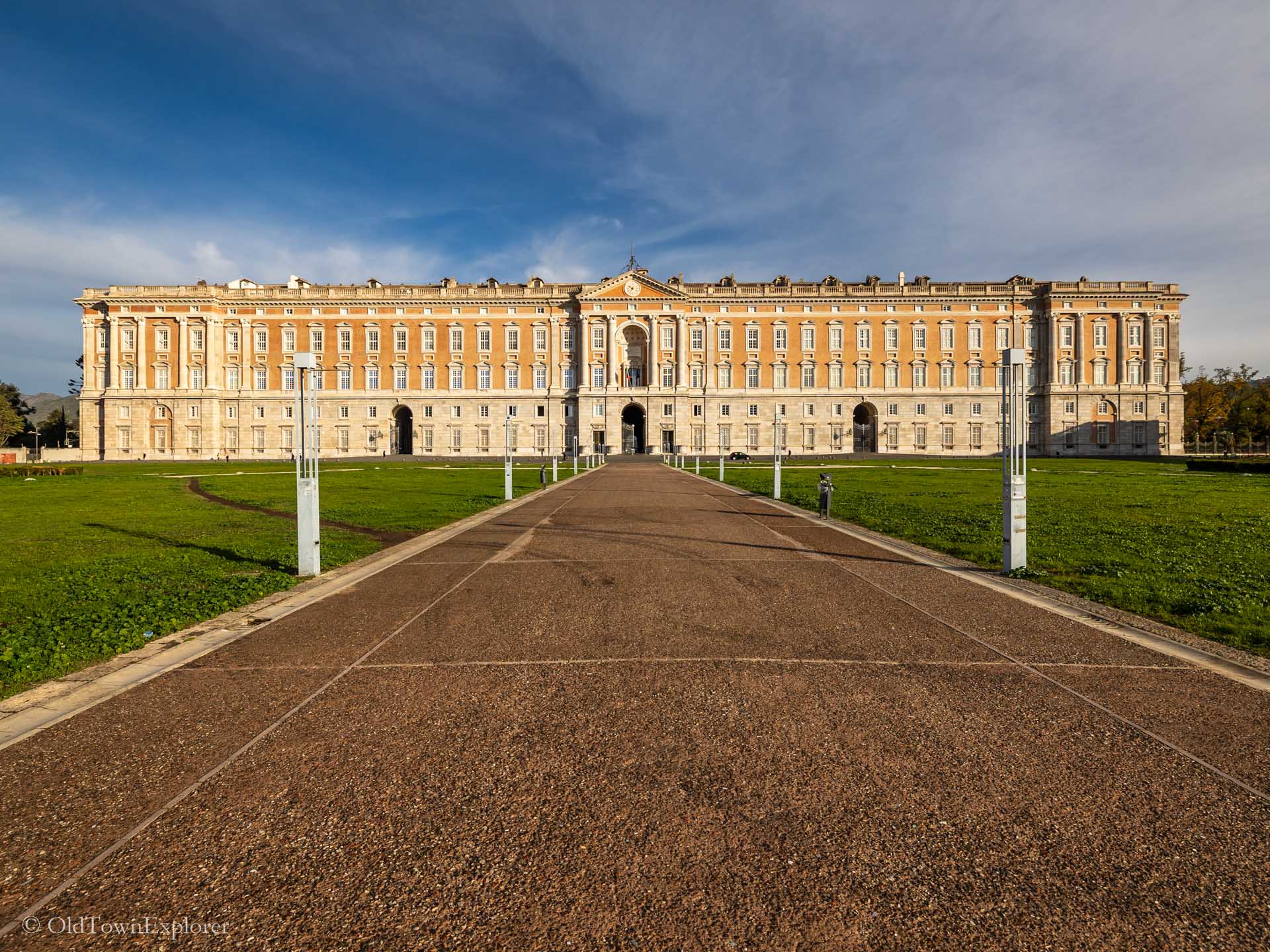
Discover Royal Palace of Caserta: History, Architecture & Must-See Attractions
The Royal Palace of Caserta sits in Caserta, Italy about 35 km north of Naples in Campania. It was planned as an inland Bourbon royal center, built to concentrate government, court life, and ceremony in one controlled setting. The palace, park, and related works are part of the UNESCO World Heritage property “18th-Century Royal Palace at Caserta with the Park, the Aqueduct of Vanvitelli, and the San Leucio Complex.”
What stands out is how the site controls movement. The palace is laid out on straight lines and long views. Most visits follow a clear flow: palace interiors first, then a long walk through the formal gardens, finishing in the English Garden before heading back to the train station.
We visited Royal Palace of Caserta during our month-long stay in Naples. In this post, we’ll cover what to see and how to plan a day trip.
This post contains affiliate links that may earn us a small commission at no additional cost to you.
Royal Palace of Caserta at a Glance
The Royal Palace of Caserta is an 18th-century royal palace and park complex built as a planned seat of Bourbon power.
- Location: Caserta, about 35 km north of Naples, easy day trip by train
- UNESCO: part of the UNESCO World Heritage site inscribed in 1997 (palace + park + aqueduct + San Leucio)
- Architectural character: 18th-century palace design on a monumental scale, with a long formal park axis
- Walkability: simple routes, but very long distances indoors and across the gardens
- Typical time required: 4–6 hours for palace + gardens (longer if you move slowly)
- Key landmarks: Grand Staircase, Royal Apartments, Palatine Chapel, Great Cascade, English Garden
- Food and wine role: minor for most visits (this is a palace-and-park day, not a food/wine stop)
Next, the history explains why the complex was built, then the architecture explains how its plan shapes what you see.
History of Royal Palace of Caserta
The palace was built to concentrate royal authority in a single, planned complex. Its size and layout were political tools as much as architectural choices.
Mid-18th Century: Bourbon Decision and Groundbreaking
Charles of Bourbon ordered a new royal center at Caserta, away from Naples’ waterfront risks. The plan paired a huge palace with an engineered landscape to show stability and control.
Late 18th Century: Park Construction and Water System
The formal park’s long axis and fountains depended on an engineered water supply. This period shaped the long, straight garden route that defines how visitors move today.
1780s: The English Garden and Changing Taste
A separate English-style garden was added in a more naturalistic layout. This created a second “mode” of visiting: formal straight lines first, then winding paths later.
19th Century: Continued Court Use and Maintenance
The complex remained a working royal site, so the main circulation patterns stayed intact. Interiors and finishes evolved, but the core plan did not change.
20th Century to Today: Preservation and Public Access
As the palace shifted into public and state use, preservation became the priority. Visitors today experience the complex largely as a designed sequence of rooms and landscape routes.
Architecture of Royal Palace of Caserta
Caserta’s architecture is easiest to understand as a designed route. The palace plan controls how you enter, rise, cross, and exit into the gardens.
Massing and Scale
Massing means a building’s overall size and shape when you see it from a distance. Caserta’s massing is block-like and repetitive, so the palace feels more like a planned machine than a single façade.
Axes and Long Sightlines
An axis is a straight line that organizes what you see and where you walk. At Caserta, the main axis runs from the palace through the entire park, so you always feel pulled toward the next landmark.
Repetition and Façade Rhythm
The exterior repeats windows, bays, and levels with minimal variation. That repetition makes the building read as one continuous system, not a collection of separate wings.
Ceremonial Vertical Movement
The main interior rise is staged, not rushed. The Grand Staircase is sized for processions and visibility, so “going upstairs” becomes part of the experience.
Courtyards and Internal Order
The palace uses internal courtyards to organize circulation and light. These courtyards make the palace legible once you understand the grid.
Garden Geometry and Forward Motion
The formal gardens are built around straight paths and aligned fountains. Even without a map, the layout keeps you oriented and moving in one direction.
The Great Cascade as a Visual Endpoint
The upper waterfall and final fountain create a hard stop to the long walk. This gives the park a clear finish line before you turn into the English Garden.
The English Garden Contrast
The English Garden replaces straight lines with curved paths and planted scenes. This change is intentional: it shifts you from “procession” to slower wandering.
Architectural Attractions in Royal Palace of Caserta
The main sights fit together as a single route: palace interiors → central exit → straight garden axis → upper fountains → English Garden. If you follow that sequence, you avoid backtracking and understand the design logic.
Grand Staircase
Scalone d’Onore
- Architect: Luigi Vanvitelli
- Style: Baroque
- Built: 18th century
- Address: Piazza Carlo di Borbone, 81100 Caserta CE, Italy
This is the palace’s main ceremonial staircase and the transition into the state rooms. It matters because it turns circulation into a public display of power. Notice the wide ramps, tall vaults, and how the space frames your view forward and up. It sits near the center of the palace’s main visitor route.
Palatine Chapel
Cappella Palatina
- Architect: Luigi Vanvitelli
- Style: Baroque
- Built: 18th century
- Address: Piazza Carlo di Borbone, 81100 Caserta CE, Italy
The chapel served court worship and formal ceremonies within the palace complex. It matters because it shows how religion was built into royal daily life and state spectacle. Look for the strong symmetry and the vertical emphasis that pulls your eyes toward the altar zone. It sits inside the palace, close to the primary circulation spine.
Royal Apartments
Appartamenti Reali
- Architect: Luigi Vanvitelli
- Style: Baroque / Neoclassical
- Built: 18th–19th centuries
- Address: Piazza Carlo di Borbone, 81100 Caserta CE, Italy
These rooms are the core of the public-facing royal interior. They matter because they show how the palace was designed for audiences, not privacy. Notice the sequence of spaces, the changing ceiling heights, and how doorways align to control sightlines. They sit in the palace’s main wings along the visitor circuit.
Throne Room
Sala del Trono
- Architect: Unknown
- Style: Neoclassical (interior program)
- Built: Unknown
- Address: Piazza Carlo di Borbone, 81100 Caserta CE, Italy
This is the symbolic center of royal authority inside the apartments. It matters because the room’s layout and scale are designed to focus attention on one end of the space. Notice the long rectangular shape and the clear hierarchy from entrance to focal wall. It sits within the main state-room sequence.
Court Theatre
Teatro di Corte
- Architect: Unknown
- Style: 18th-century court theatre
- Built: Unknown
- Address: Piazza Carlo di Borbone, 81100 Caserta CE, Italy
This small court theatre reflects how performance was part of court life. It matters because it compresses grandeur into a contained interior volume. Look for the stacked seating levels and the stage-to-audience proportions typical of court theatres. It sits inside the palace complex, accessible on the interior route.
Royal Park Main Axis
Viale d’Acqua
- Architect: Luigi Vanvitelli
- Style: Baroque formal garden design
- Built: 1753–late 18th century
- Address: Piazza Carlo di Borbone, 81100 Caserta CE, Italy (within the Royal Park)
This is the straight, central spine of the park, lined with basins and fountains. It matters because it extends the palace’s authority into the landscape. Notice how the canal and paths align with the palace openings and keep the horizon locked in place. It begins directly behind the palace façade and runs uphill through the park.
Fountain of Aeolus
Fontana di Eolo
- Architect: Luigi Vanvitelli
- Style: Baroque fountain ensemble
- Built: 18th century
- Address: Piazza Carlo di Borbone, 81100 Caserta CE, Italy (within the Royal Park)
This fountain is one of the major “stations” along the garden route. It matters because the park is designed as a sequence of stops, not one single view. Look for how the fountain sits on the axis and frames the next section uphill. It lies along the main garden spine, between the palace and the upper cascade.
Fountain of Ceres
Fontana di Cerere
- Architect: Luigi Vanvitelli
- Style: Baroque fountain ensemble
- Built: 18th century
- Address: Piazza Carlo di Borbone, 81100 Caserta CE, Italy (within the Royal Park)
This is another staged stop on the water axis, built to pace the long walk. It matters because it breaks the distance into manageable visual chapters. Notice the basin placement and how the paths keep you moving forward rather than sideways. It sits on the central route as you climb toward the upper waterfall.
Great Cascade and Upper Waterfall
La Grande Cascata
- Architect: Luigi Vanvitelli
- Style: Engineered landscape feature
- Built: 18th century
- Address: Piazza Carlo di Borbone, 81100 Caserta CE, Italy (upper end of the Royal Park)
This waterfall is the park’s main visual and physical endpoint. It matters because it gives the axis a clear finish and adds sound and motion after a long, straight walk. Look for the stepped water drops and how the slope behind it closes the view. It sits at the upper end of the formal park, just before the English Garden turnoff.
Fountain of Diana and Actaeon
Fontana di Diana e Atteone
- Architect: Luigi Vanvitelli
- Style: Baroque fountain ensemble
- Built: 18th century
- Address: Piazza Carlo di Borbone, 81100 Caserta CE, Italy (upper end of the Royal Park)
This fountain marks the end of the formal axis and anchors the final viewpoint. It matters because it functions as the “capstone” to the long approach from the palace. Notice how the basin and sculpture group are positioned to be seen from far downhill. It sits beside the Great Cascade at the upper end of the straight garden route.
English Garden
Giardino Inglese
- Architect: Carlo Vanvitelli and John Graefer
- Style: English landscape garden
- Built: 1780s
- Address: Piazza Carlo di Borbone, 81100 Caserta CE, Italy (within the Royal Park)
This garden shifts the visit from straight lines to winding paths and planted scenes. It matters because it shows a late-18th-century change in landscape taste and use. Notice the curved routes, varied plantings, and how views appear in shorter intervals. It sits beyond the formal axis, near the upper end of the park.
Bath of Venus
Bagno di Venere
- Architect: Unknown
- Style: Landscape garden feature
- Built: Unknown
- Address: Piazza Carlo di Borbone, 81100 Caserta CE, Italy (within the English Garden)
This is a secluded water feature designed for a quieter, enclosed experience. It matters because it contrasts with the exposed scale of the formal axis. Notice the stone edges, the contained basin, and how the surrounding planting closes the space. It sits inside the English Garden, reached by side paths away from the main axis.
Aqueduct of Vanvitelli
Acquedotto Carolino aka Valle di Maddaloni
- Architect: Luigi Vanvitelli
- Style: 18th-century aqueduct engineering
- Built: 1753–1762
- Address: SS265, 81020 Valle di Maddaloni CE, Italy
This aqueduct supplied water to the palace fountains and the wider estate. It matters because the gardens only work if the hydraulics work. Notice the multi-tier arches spanning the valley, built as a visible bridge section of a mostly underground system. It sits outside Caserta and is best treated as an optional add-on, not part of the palace walking route.
Walking Tour of Royal Palace of Caserta
Start: Palace entrance (Piazza Carlo di Borbone) → Grand Staircase → Royal Apartments → Throne Room → Palatine Chapel → Court Theatre → exit to the Royal Park → Royal Park Main Axis → Fountain of Aeolus → Fountain of Ceres → Great Cascade → Fountain of Diana and Actaeon → English Garden → Bath of Venus → end at the park exit and return toward Caserta station.
Realistic total time: 4–6 hours (longer if you move slowly or spend extra time in the English Garden).
How to Get to Royal Palace of Caserta from Naples
Getting to the Royal Palace of Caserta from Naples is straightforward and does not require a car. Most visitors arrive by train and walk from Caserta station, which sits close to the palace entrance.
By Train
Departure station(s): Napoli Centrale
Arrival station: Caserta
Typical travel-time range: about 40–60 minutes
Once you arrive: the palace is a short walk from the station, and the approach is direct and easy to follow
By Bus
When it makes sense vs train: useful if you are already in northern Naples suburbs or if train timing does not fit your day
In practice: trains are usually simpler because the station-to-palace walk is short
By Car
Parking strategy: park near the palace perimeter and walk in, rather than trying to drive “closer” once you reach central Caserta
ZTL cautions: treat the city center like many Italian centers and assume restrictions can exist; avoid unnecessary inner-center driving if you do not know the rules
By Taxi
When it’s practical: if you are traveling with mobility constraints, or you want a door-to-door option on a tight schedule
When it’s unnecessary: if you are starting near Napoli Centrale and can take the train
Making the Most of Your Day Trip to Royal Palace of Caserta
The Royal Palace of Caserta is large enough that order matters. Following the site’s natural layout—from interiors to gardens—keeps the visit efficient and prevents unnecessary backtracking.
Morning – palace interiors
Start with the palace interiors while energy and attention are high. The Grand Staircase, Palatine Chapel, and Royal Apartments set the scale of the complex and are easier to take in before visitor numbers increase.
Midday – transition to the gardens
Exit the palace from the central rear façade and pause before committing to the garden walk. This moment marks the shift from enclosed rooms to open distance and helps reset expectations for the long outdoor route ahead.
Late afternoon – English Garden and return
Finish in the English Garden, where paths soften and the pace naturally slows. From here, turn back toward the exit and Caserta station without repeating the full formal route.
Late afternoon / evening – wrap-up back in Naples
Head back to Naples for dinner once you finish at Herculaneum Archaeological Park. This works because you avoid rushing the ruins and keep your meal for a place with more options and easier pacing.
Tips for Visiting Royal Palace of Caserta
Start early
Start early because the palace rooms can bottleneck later in the day. You also want enough daylight for the full garden walk.
Choose shoes for distance, not style
Wear supportive shoes because you will cover a lot of ground on hard surfaces. The gardens add real mileage to the visit.
Treat the gardens as a second destination
Plan the park like it is its own attraction. Many visitors underestimate the time from the palace to the upper cascade.
Use the axis to stay oriented
Stay on the main canal route when you want speed and clarity. Save side paths for the English Garden when you want slower wandering.
Time your English Garden for later
The English Garden works well later because it breaks the straight-line walking pattern. It also feels calmer after the main axis.
Build in a turn-around buffer
Plan extra time for the walk back toward the exit and station. The distances make “just one more stop” add up fast.
Use the train unless you have a strong reason not to
The train works well because Caserta station is close to the palace. Driving adds parking decisions and more variables.
If you add the aqueduct, treat it as a separate stop
The aqueduct is outside Caserta, so it is not a “quick detour” from the palace. Add it only if you have a longer day and a clear transport plan.
Visit in cooler months if you can
Cooler weather makes the long garden axis easier and more comfortable. In hot months, the same walk can feel much harder.
FAQs About Royal Palace of Caserta
Is Royal Palace of Caserta worth visiting as a day trip?
Yes. It’s one of Italy’s biggest palace-and-park visits, and it works well from Naples by train.
How long should I spend in Royal Palace of Caserta?
Plan 4–6 hours for a balanced visit. If you want both the apartments and the full garden axis, anything under four hours feels rushed.
Is Royal Palace of Caserta walkable?
Yes, but it’s “long-distance walkable.” The routes are easy to follow, yet the palace-to-cascade-and-back distance adds up fast.
What’s the best order: palace first or gardens first?
Do the palace interiors first, then the gardens. Interiors get crowded earlier, and the gardens are easier once you’re already oriented and committed to the long walk.
Do I need to see the English Garden, or can I skip it?
See it if you have time. It changes the feel of the visit because it shifts you from straight axes to winding paths and smaller scenes.
How is Royal Palace of Caserta different from Capodimonte in Naples?
Caserta is a purpose-built royal complex with a long, engineered park route. Capodimonte is a museum-first visit inside a city, with a park that’s less structured.
How is Royal Palace of Caserta different from Pompeii or Herculaneum?
Caserta is a planned royal palace and landscape. Pompeii and Herculaneum are archaeological towns where the street grid and building fragments tell the story.
Is it easy to do Royal Palace of Caserta without a lot of planning?
Yes. Train to Caserta, walk to the entrance, then follow the main interior route and the garden axis.
What’s the best time of year to visit Royal Palace of Caserta?
Cooler months are easier because the gardens involve long, exposed walking. November works well if you want comfortable temperatures for the park.
Should I add the Aqueduct of Vanvitelli on the same day?
Only if you have extra time and a clear transport plan. It’s outside the palace walking route, so it works best as a separate stop, not a quick add-on.
I only have 3 hours at Royal Palace of Caserta — what should I prioritize?
Start with the Grand Staircase, Palatine Chapel, and main Royal Apartments, then exit to the lower section of the formal garden and walk only partway along the main axis. This gives you the clearest sense of scale and design without committing to the full garden distance. Skip the English Garden and the upper cascade unless you have more time.
