
Lucca Architecture
Explore Lucca Architecture: Walls, Churches, Palaces & More
Lucca architecture is shaped by its Renaissance walls, medieval street plan, Romanesque churches, civic palaces, towers, piazzas, and later Neoclassical infrastructure. The historic center is compact, so visitors can compare military, religious, civic, and domestic architecture on foot.
We spent two weeks in Lucca walking the walls, gates, churches, palaces, towers, and piazzas. This guide organizes the main sites by building type so you can understand what to see, where it sits in the old town, and how each place fits into Lucca’s architectural development.
This page contains affiliate links. We may earn a small commission at no extra cost to you.
City Walls of Lucca
The City Walls of Lucca form one of the clearest introductions to the city’s architecture. The current walls were built mainly between the 16th and 17th centuries as a Renaissance defensive system, then later adapted into an elevated tree-lined promenade. For an overview of their construction and evolution, see the official history of the Walls of Lucca on the Lucca Tourism website.
The walls are useful because they show Lucca’s military planning before you enter the denser medieval and Renaissance street network inside the old town. The bastions, gates, platforms, and walking route also make the city’s shape easy to understand.
Bulwark San Martino
Baluardo San Martino
- Architect: Unknown (part of the collective 16th–17th century wall works)
- Style: Renaissance military bastion
- Built: Late 16th century; restored 1833 by Lorenzo Balocchi
- Address: Viale delle Mura Urbane, 55100 Lucca LU, Italy
One of the 11 bastions along Lucca’s famous Renaissance walls, San Martino was later refurbished as part of 19th-century urban beautification. Today it serves as a green public space on the city promenade.
Bulwark San Pietro
Baluardo San Pietro
- Architect: Unknown
- Style: Renaissance military bastion
- Built: 16th century
- Address: Viale delle Mura Urbane, 55100 Lucca LU, Italy
This bastion faces south toward Porta San Pietro, forming part of the city’s defensive perimeter. Now landscaped, it provides elevated walking paths.
Bulwark San Salvatore
Baluardo San Salvatore
- Architect: Ginese Bresciani
- Style: Renaissance military bastion
- Built: Began 1592
- Address: Viale delle Mura Urbane, 55100 Lucca LU, Italy
Known for construction problems due to poor materials, San Salvatore nonetheless remains an integral part of Lucca’s defensive ring, now enjoyed as part of the tree-lined walls walk.
Bulwark Cairoli
Baluardo Cairoli aka Bulwark of Freedom (Baluardo della Libertà)
- Architect: Unknown
- Style: Late adaptation of Renaissance bastion
- Built: 1883 (modified to allow tramway passage)
- Address: Viale delle Mura Urbane, 55100 Lucca LU, Italy
Originally part of the 16th-century fortifications, this bastion was reworked in the late 19th century to accommodate the Lucca–Ponte a Moriano tram line.
Bulwark San Regolo
Baluardo San Regolo
- Architect: Unknown
- Style: Renaissance military bastion
- Built: 16th century
- Address: Viale delle Mura Urbane, 1, 55100 Lucca LU, Italy
Positioned near Porta Santa Maria, this bastion helped defend the northern entrance to Lucca and is now part of the city’s elevated green promenade.
Bulwark San Colombano
Baluardo San Colombano
- Architect: Unknown
- Style: Renaissance military bastion
- Built: 16th century
- Address: 55100 Lucca, Province of Lucca, Italy
Located near the northwestern curve of the walls, this bastion once housed artillery positions and now offers panoramic views of the city and countryside.
Bulwark Santa Maria
- Architect: Baldassarre Lanci; coordinated by Vincenzo Civitali
- Style: Renaissance military bastion
- Built: Completed 1557
- Address: Viale delle Mura Urbane, 55100 Lucca LU, Italy
Among the earliest completed bastions, Santa Maria is notable for its refined design and strategic position defending the north side of Lucca.
Bulwark San Paolino
Baluardo San Paolino
- Architect: Unknown
- Style: Renaissance military bastion
- Built: 16th century
- Address: Via Pallone, 2, 55100 Lucca LU, Italy
Located near Porta San Donato, this bastion protected Lucca’s western approaches and now forms part of the city’s pedestrian circuit.
Bulwark San Donato
Baluardo San Donato
- Architect: Alessandro Farnese; initial supervision by Vincenzo Civitali; later by Ginese Bresciani
- Style: Renaissance military bastion
- Built: Begun 1513; collapsed 1589; rebuilt late 16th century
- Address: Via delle Mura Urbane, 55100 Lucca LU, Italy
Constructed on the site of the demolished church of San Donato, this bastion suffered a collapse in 1589 due to poor materials and heavy rain, prompting reconstruction under Ginese Bresciani.
Platform San Frediano
- Architect: Unknown
- Style: Renaissance artillery platform
- Built: 16th century
- Address: Viale delle Mura Urbane, 6, 55100 Lucca LU, Italy
A large gun platform integrated into the northern walls, designed for heavy artillery coverage toward the north and northwest approaches.
Bulwark Santa Croce
Baluardo Santa Croce aka Holy Cross Bastion
- Architect: Likely Vincenzo Civitali (attributed); possibly linked to Baluardo San Donato’s design
- Style: Renaissance military bastion
- Built: 16th century
- Address: Viale delle Mura Urbane, 55100 Lucca LU, Italy
Sometimes confused with San Donato due to similarities in design and location; Santa Croce guarded the southwestern flank of Lucca’s walls.
Gates of Lucca
The gates of Lucca mark the main historic entry points through the city walls. Some were built as part of the Renaissance fortification system, while others were added later as the city’s transport needs changed. They are useful landmarks for orienting walks between the wall circuit and the streets inside the old town.
Porta Santa Maria
- Architect: Unknown (16th-century military engineers)
- Style: Renaissance city gate
- Built: 1549 (opened)
- Address: Piazza Santa Maria, 42, 55100 Lucca LU, Italy
This grand north-facing gate features three passageways and a marble statue of the Virgin Mary, serving as a ceremonial entrance to the city.
Porta San Jacopo
- Architect: Unknown
- Style: Early 20th-century gateway with Fascist-era details
- Built: 1930 (opened)
- Address: Viale Cavour, 55100 Lucca LU, Italy
The newest gate in the walls, San Jacopo faces north and still bears faint, weathered Fascist inscriptions from its construction era.
Porta Elisa
- Architect: Giovanni Lazzarini
- Style: Neoclassical
- Built: 1809 (opened)
- Address: Via Elisa, 55100 Lucca LU, Italy
Named after Elisa Bonaparte Baciocchi, Napoleon’s sister and ruler of Lucca, this elegant arched gate provides a stately eastern entry to the city.
Porta San Pietro
- Architect: Alessandro Resta
- Style: Renaissance
- Built: 1565 (opened)
- Address: Sortita Porta S. Pietro, 55100 Lucca LU, Italy
A southern gate with three arched passages, flanked by sculpted lions and crowned by statues of St. Peter and Libertas.
Porta San Donato
- Architect: Unknown
- Style: Renaissance
- Built: 1590 (opened); completed 1639
- Address: Piazzale S. Donato, 55100 Lucca LU, Italy
West-facing gate originally equipped with a drawbridge, adorned with statues of San Paolino and San Donato.
Porta Santa Anna
Porta Sant'Anna
- Architect: Unknown
- Style: Early 20th-century functional gateway
- Built: 1910 (opened)
- Address: Piazzale Boccherini, 55100 Lucca LU, Italy
Located at Verdi Square, this gate was named after the nearby St. Anne Church outside Lucca’s walls and was built to ease traffic flow into the city’s western side.
Porta San Gervasio
- Architect: Unknown (13th-century builders)
- Style: Medieval Romanesque
- Built: 13th century
- Address: Via Santa Croce, 90, 55100 Lucca LU, Italy
One of the few surviving gates from Lucca’s medieval walls before the Renaissance fortifications, it features two sturdy stone towers and a central arch.
Churches in Lucca
Lucca, known as the “City of 100 Churches,” preserves an exceptional collection of medieval religious buildings across its historic center.

Duomo di San Martino
aka Lucca Cathedral
- Architect: Founded under Bishop Anselm (1060); later work by Guidetto da Como (12th–13th century)
- Style: Romanesque façade with Gothic elements
- Built: 1060 (consecrated 1070); expanded 12th–14th centuries
- Address: Piazza Antelminelli, 55100 Lucca LU, Italy
Dedicated to Saint Martin of Tours, the cathedral is famed for its ornate polychrome façade, the Volto Santo relic, and Ilaria del Carretto’s Renaissance tomb by Jacopo della Quercia.
Basilica di San Frediano
- Architect: Unknown
- Style: Romanesque
- Built: 1112 (opened)
- Address: Piazza S. Frediano, 55100 Lucca LU, Italy
Notable for its striking golden mosaic façade and intact Romanesque interior, this basilica preserves an early medieval font and frescoes from the 13th century.
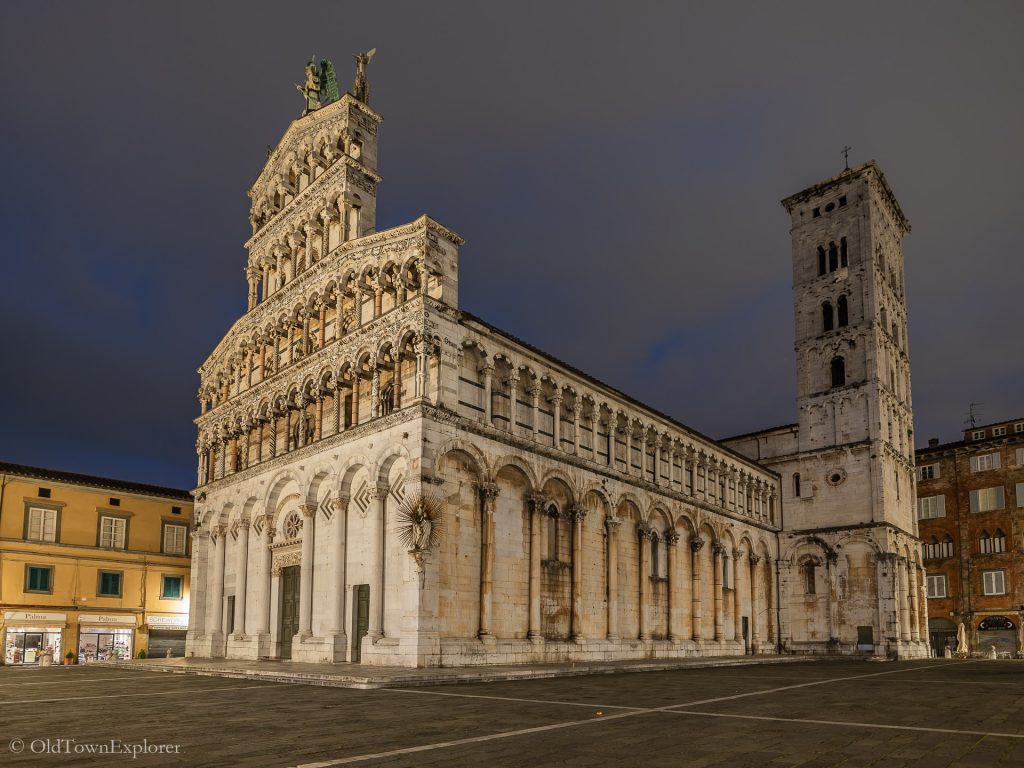
Church of San Michele in Foro
- Architect: Attributed to Diotisalvi (façade begun 13th century)
- Style: Pisan Romanesque
- Built: Begun 11th century; façade completed 14th century
- Address: Piazza San Michele, 55100 Lucca LU, Italy
Built on the site of the Roman forum, the church features a dramatically tall façade with layered loggias, crowned by a statue of Archangel Michael slaying a dragon.
Church of Saints Giovanni and Reparata
Chiesa dei Santi Giovanni e Reparata
- Architect: Unknown (early medieval origins)
- Style: Romanesque with earlier Paleo-Christian foundations
- Built: Original 5th century; rebuilt 12th century
- Address: Piazza S. Giovanni, 55100 Lucca LU, Italy
Beneath the church lie archaeological remains of earlier basilicas and Roman structures; it once served as Lucca’s cathedral before San Martino.
Church of Santa Maria Forisportam
Chiesa di Santa Maria Foris Portam
- Architect: Unknown
- Style: Pisan Romanesque
- Built: 12th century
- Address: Piazza Santa Maria Foris Portam, 55100 Lucca LU, Italy
Called “outside the gate” for its original location beyond the early medieval walls, it is known for its white limestone façade and simple, austere design.
Church Of San Romano
- Architect: Savonarola family patronage
- Style: Gothic with Romanesque elements
- Built: Founded 1281
- Address: Piazza San Romano, Lucca LU, Italy
Once a major Dominican convent, the church played a central role in Lucca’s civic and religious life.
Church of San Cristoforo
Chiesa di San Cristoforo
- Architect: Unknown
- Style: Romanesque with Gothic modifications
- Built: 11th–12th century origin; Gothic updates in 14th century
- Address: Via Fillungo, 6, 55100 Lucca LU, Italy
Originally a parish church, it features a mix of rounded Romanesque arches and pointed Gothic windows. Deconsecrated, it now serves as a memorial space for war victims.
Church Santa Maria Della Rosa
Chiesa di Santa Maria della Rosa
- Architect: Unknown
- Style: Gothic
- Built: 14th century
- Address: Via della Rosa, 25, 55100 Lucca LU, Italy
This small, intimate church is known for its pointed Gothic arches and local devotional traditions centered on the Virgin Mary.
Church Of Sant'alessandro
Chiesa di Sant'Alessandro
- Architect: Unknown
- Style: Romanesque
- Built: 11th century
- Address: Piazza Sant’Alessandro, 3, 55100 Lucca LU, Italy
Notable for its pure Romanesque façade in white limestone, it stands as one of Lucca’s most architecturally harmonious medieval churches.
Church of San Francesco
Chiesa di San Francesco
- Architect: Unknown
- Style: Gothic with Romanesque elements
- Built: Founded in 1228; rebuilt in later centuries
- Address: Piazza S. Francesco, 55100 Lucca LU, Italy
Originally part of a Franciscan convent, it now houses the IMT School for Advanced Studies after extensive restoration. The church retains its pointed Gothic windows and simple friary design.
Palaces in Lucca
Lucca preserves a wide range of Renaissance, Baroque, Neoclassical, and early modern palaces that reflect the city’s political, civic, and aristocratic history. Many of these residences retain their original façades, interior layouts, and decorative programs.
Palazzo Pfanner
- Architect: Filippo Juvarra (garden design attribution)
- Style: Baroque with Renaissance influences
- Built: 1667 (opened)
- Address: Via degli Asili, 33, 55100 Lucca LU, Italy
Originally built for the Moriconi family and later owned by the Pfanners, this palace is famed for its elegant gardens, ornate staircase, and frescoed interiors. Now a museum, it preserves historical furnishings and medical instruments from Dr. Pfanner’s collection.
Villa Bottini
- Architect: Possibly commissioned by Paolina Bonaparte during French rule
- Style: Renaissance
- Built: 16th century
- Address: Via Elisa, 9, 55100 Lucca LU, Italy
A refined villa surrounded by gardens, Villa Bottini offers a quiet retreat in the city. It is one of Lucca’s best-preserved Renaissance suburban villas and often hosts cultural events.
Palazzo Bernardini
- Architect: Unknown
- Style: Renaissance
- Built: 16th century
- Address: Piazza Bernardini, 41, 55100 Lucca LU, Italy
This Renaissance palace is noted for its unfinished stone façade and its location opposite San Benedetto in Gotella Church. It is tied to one of Lucca’s oldest noble families.
Palazzo Ducale di Lucca
- Architects: Lorenzo Nottolini, Bartolomeo Ammannati, Filippo Juvarra
- Style: Renaissance with later Neoclassical additions
- Built: 16th–19th centuries
- Address: Cortile Carrara, 1, 55100 Lucca LU, Italy
Once the seat of Lucca’s rulers, this palace underwent centuries of expansions. It now houses provincial government offices and cultural exhibitions.
Palazzo Massoni
- Architect: Unknown
- Style: Baroque
- Built: 17th century
- Address: Via dell’Angelo Custode, 24, 55100 Lucca LU, Italy
Distinguished by its ornate stucco work and entrance, this palace represents the opulence of Lucca’s aristocracy in the Baroque era.
Villa Ducloz-Dianola
- Architect: Gaetano Orzali
- Style: Art Nouveau
- Built: Early 20th century
- Address: Via Matteo Civitali, 234, 55100 Lucca LU, Italy
This elegant villa features decorative Art Nouveau details, curving lines, and floral motifs. Once a private residence, it is a fine example of Lucca’s early 1900s architectural expansion outside the medieval walls.
Villa Simonini
- Architect: Unknown
- Style: Eclectic 19th-century villa style
- Built: 19th century
- Address: Viale Giuseppe Giusti, 373, 55100 Lucca LU, Italy
Set in a tree-lined avenue, Villa Simonini reflects the blend of traditional Tuscan villa design with influences from 19th-century romantic architecture.
Villa Gioiosa
- Architect: Lelio Menesini
- Style: Early 20th-century eclectic
- Built: 1915–1917
- Address: Viale Giosuè Carducci, 7, 55100 Lucca LU, Italy
Designed with spacious interiors and landscaped gardens, Villa Gioiosa blends modern comforts with period elegance. It is known for its symmetrical façade and refined detailing.
Orsetti Palace
Palazzo Orsetti
- Architect: Unknown
- Style: Baroque
- Built: 17th century
- Address: Via Santa Giustina, 17, 55100 Lucca LU, Italy
Now the seat of Lucca’s municipal government, this palace features frescoed halls, grand staircases, and a detailed decorative program typical of the Baroque aristocratic residences.
Santini Palace
- Architect: Unknown
- Style: Baroque with Renaissance elements
- Built: 17th century
- Address: Via del Moro, 20, 55100 Lucca LU, Italy
An elegant noble residence in Lucca’s historic center, the Santini Palace is recognized for its decorative façade and preserved interior salons.
Palazzo Pretorio
- Architect: Unknown
- Style: Renaissance
- Built: 15th century (completed in the 16th century)
- Address: P.za San Michele, 45, 55100 Lucca LU, Italy
Located in Piazza San Michele, this former seat of Lucca’s magistrates is distinguished by its loggia, elegant stone arches, and decorative coats of arms representing the city’s ruling families.
Mazzarosa Palace
- Architect: Unknown
- Style: Neoclassical
- Built: 18th–19th century
- Address: Via Santa Croce, 64, Lucca LU, Italy
A refined example of Lucca’s Neoclassical architecture, the Mazzarosa Palace features clean lines, symmetrical proportions, and an understated elegance typical of the period.
Micheletti Palace
- Architect: Unknown
- Style: Renaissance
- Built: 16th century
- Address: Piazza S. Martino, 55100 Lucca LU, Italy
This historic palace stands prominently near the cathedral. It is noted for its ornate stone doorways, decorative window frames, and its role in Lucca’s civic and social history.
Gigli Palace
- Architect: Unknown
- Style: Renaissance with later modifications
- Built: 16th century
- Address: Piazza S. Giusto, Lucca LU, Italy
Overlooking Piazza San Giusto, this palace combines Renaissance symmetry with later architectural updates, giving it a layered historical character.
Cenami Palace
- Architect: Nicolao Civitali
- Style: Renaissance
- Built: 1530
- Address: Via Cenami, 4, 55100 Lucca LU, Italy
Designed by Nicolao Civitali, the Cenami Palace showcases elegant Florentine-inspired Renaissance features, including a refined stone façade and balanced proportions.
Brancoli Palace
- Architect: Unknown
- Style: Renaissance
- Built: 16th century
- Address: Via Fillungo, 178, 55100 Lucca LU, Italy
Situated on Lucca’s main shopping street, the Brancoli Palace features a harmonious Renaissance façade with finely proportioned windows and subtle decorative stonework.
San Luca Palace Hotel
- Architect: Unknown
- Style: Renaissance
- Built: 16th century
- Address: Via S. Paolino, 103, 55100 Lucca LU, Italy
Originally a noble residence, this Renaissance palace has been converted into a hotel while preserving its historic charm, including grand stone archways and period interiors.
Towers in Lucca
Lucca preserves several medieval towers that illustrate the city’s defensive strategies, civic identity, and private family wealth. These towers, once prominent markers in the skyline, remain important architectural landmarks.
Guinigi Tower
Torre Guinigi
- Architect: Unknown
- Style: Romanesque-Gothic
- Built: Late 14th century
- Address: Via Guinigi, 29, 55100 Lucca LU, Italy
One of Lucca’s most iconic landmarks, the 45-meter-high Guinigi Tower is unique for the holm oak trees growing on its summit, symbolizing rebirth and renewal. It offers panoramic views of the city.
Clock Tower
Torre delle Ore
- Architect: Unknown
- Style: Medieval with Renaissance modifications
- Built: 13th century (modified 18th century)
- Address: Via Fillungo, 55100 Lucca LU, Italy
The tallest tower in Lucca, Torre delle Ore houses a still-functioning 18th-century mechanical clock. Visitors can climb its 207 wooden steps for sweeping city views.
Piazzas in Lucca
Lucca’s piazzas reflect the city’s long urban history, evolving from Roman foundations to medieval market spaces and later civic squares. Each piazza shows a different stage of the city’s architectural and social development.
Piazza Anfiteatro
aka Amphitheatre Square
- Architect: Likely designed by Lorenzo Nottolini during restoration in the 19th century
- Style: Roman foundations with 19th-century Neoclassical modifications
- Built: Original Roman amphitheater 1st–2nd century AD; transformed into a piazza in the Middle Ages
- Address: 55100 Lucca, Province of Lucca, Italy
This oval-shaped piazza preserves the footprint of an ancient Roman amphitheater, now enclosed by medieval buildings. Today it is a lively hub for cafés, restaurants, and events.
Piazza Napoleone
aka Piazza Grande
- Architect: Elisa Bonaparte Baciocchi’s court architects, early 19th century
- Style: Neoclassical
- Built: Redesigned 1806–1809
- Address: P.za Napoleone, 55100 Lucca LU, Italy
Created during Napoleonic rule, this spacious square was designed to reflect imperial grandeur and is now home to concerts, markets, and public events.
Piazza San Michele
aka San Michele Square
- Architect: Evolved organically around the Church of San Michele in Foro
- Style: Medieval
- Built: Dating back to Roman times (originally the Roman forum)
- Address: P.za San Michele, 55100 Lucca LU, Italy
Once the political center of Roman Lucca, the square is dominated by the ornate Church of San Michele, with shops and cafés adding to its lively atmosphere.
Piazza San Martino
- Architect: Developed around Lucca Cathedral
- Style: Medieval civic and religious square
- Built: Developed from the Middle Ages onward
- Address: Piazza San Martino, 55100 Lucca LU, Italy
Piazza San Martino is the square in front of Lucca Cathedral. It works as one of the city’s main architecture stops because the cathedral façade, nearby palaces, and surrounding streets show how religious and civic space meet in the historic center.
Piazza Antelminelli
- Architect: Antelminelli family; fountain by Lorenzo Nottolini
- Style: Medieval layout with 19th-century Neoclassical additions
- Built: Square created 1301; fountain 1832–1835
- Address: Piazza Antelminelli, 55100 Lucca LU, Italy
Located next to the cathedral, this small square features a striking neoclassical fountain by Nottolini and offers a peaceful spot amidst the historic center.
Piazza Cittadella
- Architect: Organic medieval urban development
- Style: Medieval with modern commemorative elements
- Built: Evolved over centuries; Puccini statue installed 20th century
- Address: Piazza Cittadella, 55100 Lucca LU, Italy
Famous as the birthplace of composer Giacomo Puccini, the square includes his childhood home (now a museum) and a bronze statue in his honor.
Piazza Del Carmine
- Architect: Developed organically; market structures by local builders
- Style: Medieval civic square
- Built: Evolved during the Middle Ages; market established centuries later
- Address: Piazza del Carmine, 55100 Lucca LU, Italy
This lively square hosts one of Lucca’s main produce markets, offering fresh fruit, vegetables, and local products in a historic setting.
Piazza San Giusto
- Architect: Evolved around the Church of San Giusto
- Style: Romanesque ecclesiastical with surrounding medieval architecture
- Built: 12th century onward
- Address: Piazza San Giusto, 55100 Lucca LU, Italy
A small square dominated by the Romanesque Church of San Giusto, known for its distinctive façade and serene atmosphere.
Other Attractions in Lucca
Beyond its major churches, palaces, and piazzas, Lucca features additional sites that illustrate the city’s medieval street network, 19th-century infrastructure, and cultural institutions. These places offer further insight into Lucca’s urban development.
Via Fillungo
- Architect: Developed by medieval city planners and local guilds
- Style: Medieval urban street layout with Renaissance and Baroque façades
- Built: Evolved from the Middle Ages onward
- Address: Via Fillungo, 55100 Lucca LU, Italy
The main thoroughfare in Lucca’s historic center, Via Fillungo stretches for 700 meters, lined with shops, cafés, and artisan boutiques within well-preserved historic buildings.
Aqueduct of Nottolini
- Architect: Lorenzo Nottolini
- Style: Neoclassical engineering
- Built: 1823 (opened)
- Address: Via Tempietto, 388, 55100 Lucca LU, Italy
A 19th-century aqueduct designed to supply Lucca with fresh water from nearby mountains, it features over 400 graceful arches spanning more than 3 kilometers.
Teatro Del Giglio
- Architect: Original by Francesco Buonamici; later restorations by Lorenzo Nottolini
- Style: Neoclassical theater
- Built: 1675 (opened), rebuilt in the 19th century
- Address: Piazza del Giglio, 13/15, 55100 Lucca LU, Italy
Lucca’s historic opera house, Teatro del Giglio has hosted performances since the 17th century and remains an important venue for music, drama, and cultural events.
City Tours in Lucca
City tours in Lucca provide an organized way to understand the city’s medieval layout, defensive structures, and the architectural changes introduced over several centuries. Many tours focus on the preserved city walls, the historic center, and the network of churches and civic buildings.
Best Places to Stay In Lucca
Hotels in Lucca
There are many great places to stay in Lucca. For the best experience, we recommend staying near Piazza dell'Anfiteatro (the castle marker on the map below). The area around Piazza dell'Anfiteatro is the most pedestrian-friendly, surrounded by restaurants and historical shops, and the main attractions are nearby.
Here’s a map with hotel and apartment options that can be filtered to meet your needs. Select your travel dates to get specific availability and prices.
FAQs About Lucca Architecture
What is Lucca known for architecturally?
Lucca is known for its Renaissance city walls, Romanesque churches, medieval street plan, towers, palaces, and piazzas. The walls are the easiest place to start because they show the city’s historic outline before you enter the old town.
Why is Lucca surrounded by walls?
Lucca’s walls were built as a defensive system when Italian city-states needed stronger fortifications. The walls later lost their military role and became a public promenade around the historic center.
What are the most important architecture sites in Lucca?
The main architecture sites include the City Walls of Lucca, Lucca Cathedral, San Michele in Foro, Basilica di San Frediano, Piazza dell’Anfiteatro, Guinigi Tower, Torre delle Ore, and Palazzo Pfanner.
How old are the walls of Lucca?
The current Renaissance walls were built mainly between the 16th and 17th centuries. Older medieval walls existed before them, but the broad wall circuit visible today belongs to the later fortification system.
Can you see Lucca architecture on foot?
Yes. Lucca is one of the easiest Italian cities to explore on foot because the walls, gates, churches, towers, and piazzas sit within a compact historic center.