
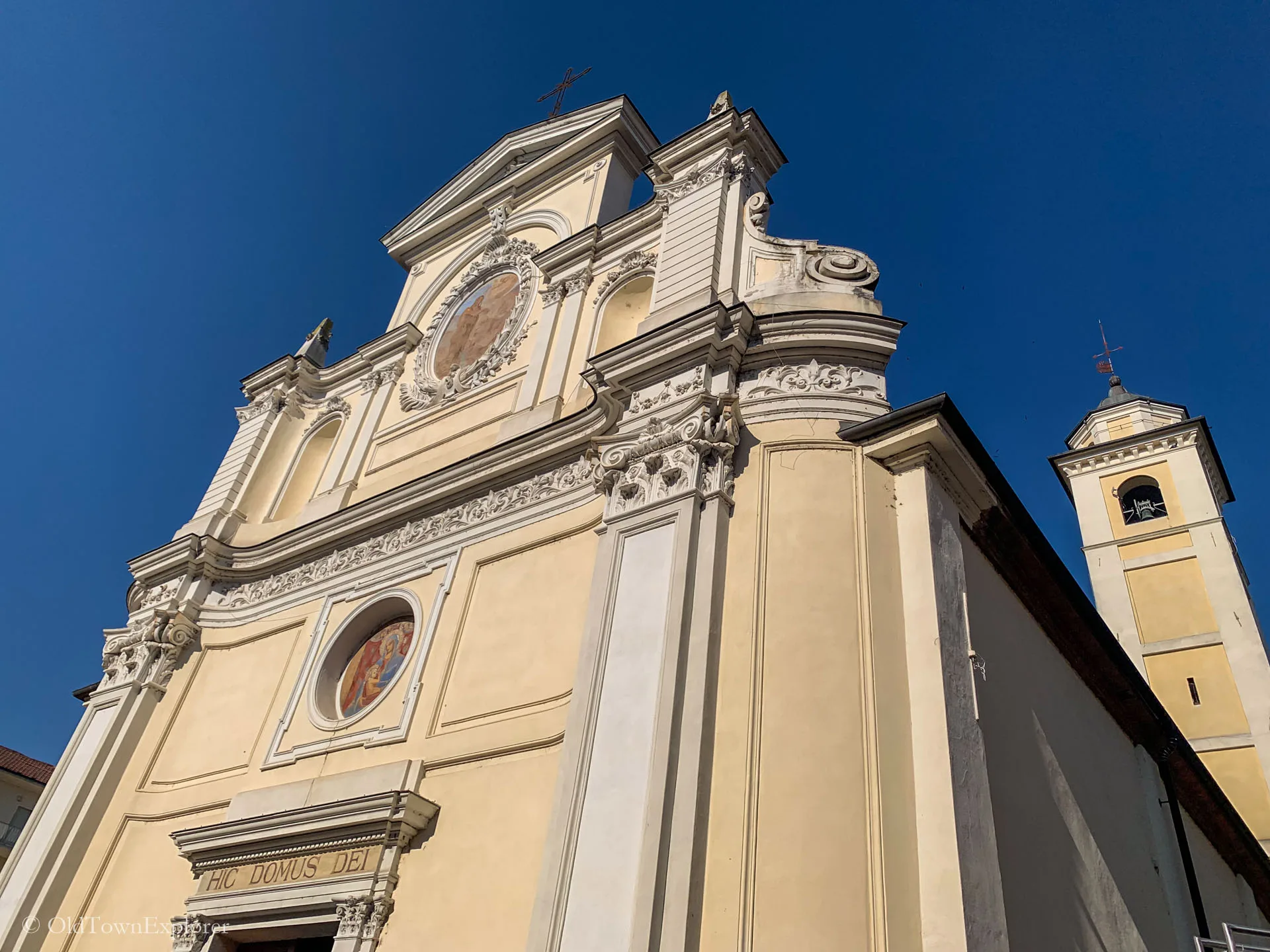
Discover Alba: History, Architecture & Must-See Attractions
Alba, Italy is a historic town in the Piedmont region, located along the Tanaro River and long established as a regional market center linking surrounding agricultural areas with urban trade. Its historical importance comes less from political dominance and more from continuity—serving as a stable civic, religious, and commercial hub for the Langhe and Roero areas.
Architecturally, Alba is defined by a compact medieval core with brick towers, enclosed streets, and a dominant cathedral that anchors the historic center. The town’s layout reflects incremental growth rather than large-scale redesign, which makes its street pattern, building density, and landmarks easy to understand on foot.
We visited Alba during our month-long stay in Turin. In this guide, we’ll map out the key architectural sights, a walkable route through the historic center, and how to fit wine tasting into a single day.
This post contains affiliate links that may earn us a small commission at no additional cost to you.
Alba at a Glance
Alba is a compact cathedral town that combines medieval urban form with strong ties to nearby wine-growing areas.
- Located in southern Piedmont, about 55 km southeast of Turin
- Historic core shaped mainly during the Middle Ages
- Brick and stone construction with surviving towers and churches
- Very walkable within the historic center
- Typical visit time: 4–6 hours
- Key landmarks include Alba Cathedral, Piazza Risorgimento, and medieval tower streets
- Functions as an in-town base for wine tasting tied to the Langhe and Roero
The guide below moves from Alba’s history to its architecture, then into specific sights and a practical walking plan.
History of Alba
Alba’s history explains why the town remains compact and focused inward, with religious and civic power concentrated in a small core rather than spread across multiple districts.
Roman Foundations (1st century BC – 5th century)
Alba originated as a Roman settlement, establishing an early urban footprint and road connections. While little Roman fabric is visible today, the continuity of settlement helped anchor later medieval growth in the same location.
Medieval Commune and Tower Culture (11th–13th centuries)
During the Middle Ages, Alba developed as a free commune with a skyline marked by private family towers. These structures introduced vertical emphasis into a dense townscape and shaped the pattern of narrow streets and enclosed squares still visible today.
Cathedral Expansion and Civic Consolidation (13th–15th centuries)
The growth of the cathedral complex reinforced Alba’s role as a religious center. Civic buildings and residences were added within existing blocks, strengthening density rather than expanding outward.
Early Modern Stability (16th–18th centuries)
Alba experienced relatively limited urban restructuring. Buildings were modified and reused, allowing medieval street alignments and parcel divisions to remain legible.
Modern Period and Regional Role (19th–20th centuries)
Rail connections and improved roads reinforced Alba’s function as a service town for the surrounding countryside. Modern growth occurred largely outside the historic core, preserving its walkable center.
Architecture of Alba
Alba’s architecture reflects continuity and adaptation rather than dramatic transformation.
Medieval Towers and Vertical Accents
Surviving towers punctuate the historic center and signal Alba’s medieval social structure. Even where towers no longer stand, their former presence shaped block proportions and sightlines.
Building Materials and Construction
Brick is the dominant material, often paired with stone details. Facades tend to be restrained, emphasizing massing and alignment over ornament.
Street Pattern and Density
Narrow streets and tightly packed blocks create short sightlines and frequent transitions between squares, reinforcing a pedestrian experience.
Religious Architecture as Anchors
Churches sit at key nodes in the street network, often terminating views or defining central squares.
Civic Buildings and Palazzi
Civic structures and noble residences were inserted into existing fabric, creating layered facades and mixed periods within single blocks.
Squares as Enclosed Urban Rooms
Alba’s squares function as compact civic spaces rather than monumental plazas, shaped by surrounding buildings.
Architecture and Walkability
Because the medieval fabric remains largely intact, walking is the most effective way to understand Alba’s architectural structure.
Architectural Attractions in Alba
Alba’s key sights are concentrated in and around the historic core, where the cathedral district, civic square, and surviving medieval towers sit within a short walking radius. The most useful way to “read” the town is to move between the main square, the tower streets (Via Cavour / Via Vittorio Emanuele II), and the secondary church nodes just off the central axis.
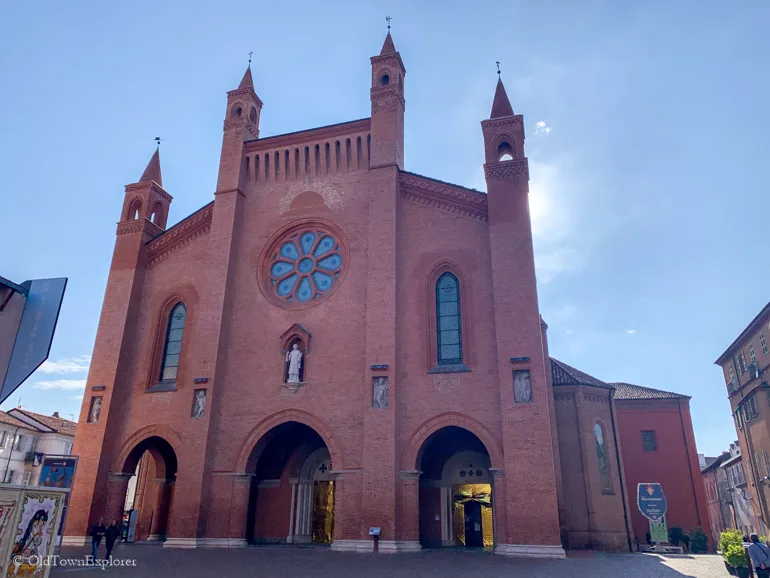
Alba Cathedral (Cattedrale di San Lorenzo / Duomo di Alba)
- Style: Romanesque core with later Gothic / Neo-Gothic elements
- Built: 12th century onward (major later phases)
- Address: Piazza Duomo, Alba (CN), Italy
The cathedral is the dominant mass in the center and sets the scale for Piazza Duomo/Piazza Risorgimento. Architecturally, focus on the brick construction, vertical proportions, and how the cathedral defines the civic square edge. It sits at the center of the historic core and works as the best “orientation point” for the rest of the walk.
MuDi – Diocesan Museum (access via the cathedral area)
- Style: Museum installation within the cathedral complex
- Address: Piazza Rossetti, Alba (CN), Italy
This is a practical add-on if you want one indoor stop tied directly to the cathedral district. Its value is less about one façade and more about how it reinforces the cathedral complex as a multi-use node within the core. It sits immediately adjacent to the cathedral zone.
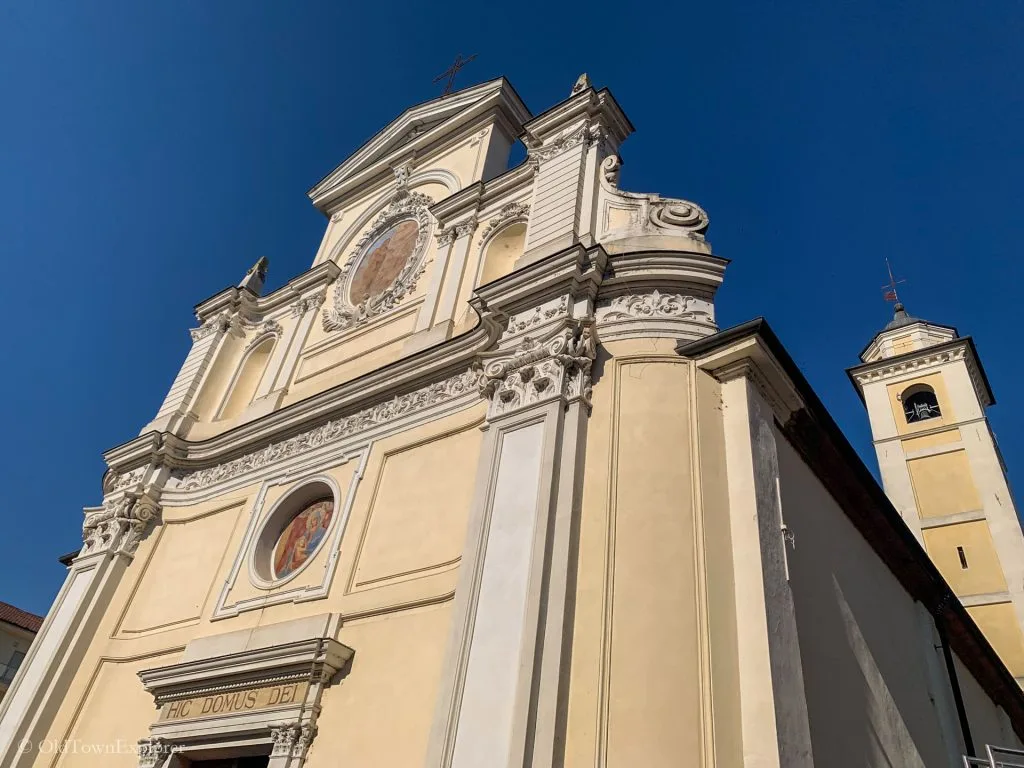
Chiesa di San Giovanni Battista
- Style: Medieval origins with later rebuilds (details vary by phase)
- Built: Early medieval origins; later restorations
- Address: Piazza Elvio Pertinace, 4, Alba (CN), Italy
San Giovanni is useful for understanding Alba beyond the cathedral square: it’s a secondary religious anchor embedded in a tight urban node. Pay attention to scale and placement—how the church fronts a small square rather than opening onto a large plaza. It sits within the historic center, a short walk from Piazza Risorgimento.
Chiesa di San Domenico
- Style: Gothic (mendicant church typology)
- Built: 13th–14th centuries
- Address: Via Teobaldo Calissano, Alba (CN), Italy
San Domenico is one of the clearest medieval church volumes in Alba and helps balance the cathedral-focused part of the day. Architecturally, look for the restrained exterior and the long, hall-like massing typical of mendicant churches. It sits just off the main pedestrian network, easy to reach without detouring far from the core.
Chiesa di Santa Maria Maddalena
- Architect: Bernardo Vittone
- Style: Late Baroque
- Built: Completed 1749
- Address: Via Vittorio Emanuele II, 19, Alba (CN), Italy
This is the most useful “contrast stop” in Alba: a later-period church inserted into the same dense street fabric. Focus on the street-facing brick façade treatment and how the building occupies a narrow frontage on the main axis. It sits directly on Via Vittorio Emanuele II, making it easy to include without changing your route.
Percorso Archeologico e Campanile – Chiesa di San Giuseppe
- Style: Multi-layered site (Roman remains + medieval tower/bell elements + later church fabric)
- Built: Roman-era remains; medieval tower elements
- Address: Via Vernazza, 6 (Piazzetta area), Alba (CN), Italy
This stop matters because it shows Alba’s layering: archaeology beneath later construction, and a vertical bell element tied to earlier phases. Architecturally, the key is the relationship between underground remains and the later tower/bell profile. It sits within the historic center and works best as a late-loop stop after you’ve already understood the cathedral square.
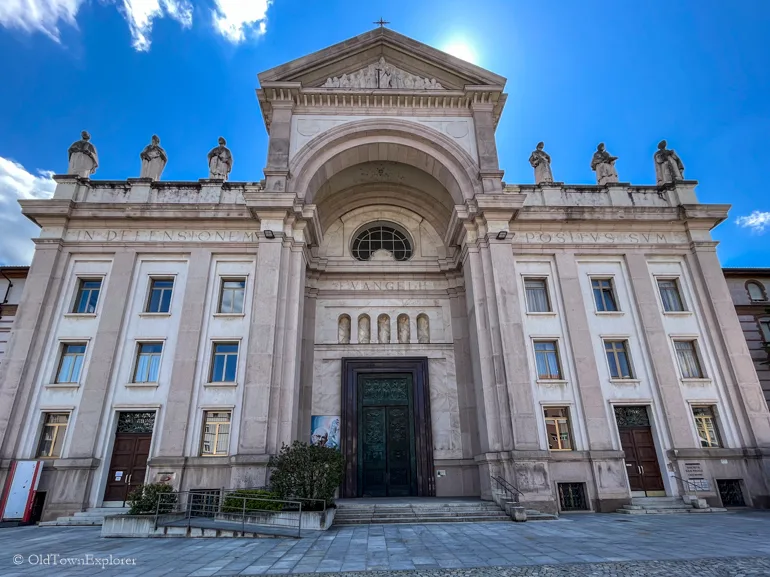
Temple of St. Paul
Tempio di San Paolo
- Architect: Unknown
- Style: Baroque (church architecture)
- Built: 17th century (exact date Unknown)
- Address: Via Cavour, 3, 12051 Alba CN, Italy
The Temple of St. Paul is a church set directly within Alba’s dense historic core, making it a useful “street-fabric” stop rather than a standalone monument. Architecturally, focus on how the building presents itself on a narrow street frontage—its massing reads at close range, and the façade works as part of a continuous street wall. It sits along the Via Cavour corridor, so it fits naturally into the tower-street segment of an Alba walking loop.
Piazza Risorgimento (Piazza Duomo)
- Style: Historic civic square
- Address: Piazza Risorgimento, Alba (CN), Italy
This is Alba’s main civic room and the most important “structural” place to start. Architecturally, it’s about enclosure and hierarchy: cathedral + civic buildings shaping a compact square rather than an open monumental plaza. It sits at the center of the historic core and connects directly to the main street corridors.
Palazzo Comunale (Town Hall)
- Style: Medieval civic building with later modifications
- Address: Piazza Risorgimento, 1, Alba (CN), Italy
The town hall reinforces the cathedral/civic pairing on the same square, which is a key part of how Alba’s core is organized. Focus on massing and frontage—how a civic building holds the edge of a small square rather than presenting as a freestanding monument. It sits directly on Piazza Risorgimento beside the cathedral zone.
Teatro Sociale “Giorgio Busca”
- Style: Historic theatre building
- Address: Piazza Vittorio Veneto, 3, Alba (CN), Italy
This is a useful civic stop because it shows Alba’s later public-building layer beyond the medieval square. Architecturally, treat it as a node for the “working town” function—events, performances, and public life—rather than a purely tourist landmark. It sits a short walk from the core and fits naturally near the end of a loop before returning toward the station.
Torre Sineo (Casa-torre Sineo)
- Style: Medieval tower-house
- Built: Medieval period
- Address: Via Camillo Benso Conte di Cavour, 1, Alba (CN), Italy
Torre Sineo is one of the clearest surviving vertical markers and is best read from street level as you move along Via Cavour. Look for the tower-house proportions and how later buildings press tightly around it. It sits on one of the core cross-streets that helps explain Alba’s “dense block” logic.
Torre Astesiano
- Style: Medieval tower
- Built: Medieval period
- Address: Via Camillo Benso Conte di Cavour, 6, Alba (CN), Italy
This tower is easiest to appreciate as part of the “tower street” sequence rather than as a standalone destination. Architecturally, focus on the tall, narrow profile and how it punctuates a street wall of lower-rise façades. It sits along Via Cavour, keeping it inside the main walking loop.
Torre Ravinale
- Style: Medieval tower
- Built: Medieval period
- Address: Via Camillo Benso Conte di Cavour, 7, Alba (CN), Italy
Torre Ravinale helps demonstrate that towers in Alba are not confined to one square—they appear within everyday circulation corridors. Pay attention to how it emerges above adjacent roofs and how street width affects sightlines upward. It sits on Via Cavour, making it a natural continuation after Torre Sineo/Astesiano.
Casa-torre Riva
- Style: Medieval tower-house with later residential layers
- Built: Medieval period with later accretions (dates vary by component)
- Address: Via Camillo Benso Conte di Cavour, 13, Alba (CN), Italy
This is a good example of how a tower-house becomes part of a larger composite building over time. Architecturally, read it as stratified massing: a vertical medieval core with later residential additions alongside and behind. It sits near the Via Cavour axis and works well as a “capstone” tower stop before heading back toward the main square.
Torre Bonino
- Style: Medieval tower
- Built: 12th century
- Address: Via Vittorio Emanuele II, 4e, Alba (CN), Italy
Torre Bonino is valuable because it ties tower architecture directly to the main pedestrian axis rather than a back street. Look for how the tower is embedded within later street-front buildings—evidence of reuse and tight parcelization. It sits on Via Vittorio Emanuele II, so it fits naturally into the most walkable part of the center.
Torre Demagistris
- Style: Medieval tower
- Built: Medieval period
- Address: Via Coppa, Alba (CN), Italy
This tower works as a “texture stop”—not necessarily the headline landmark, but part of the distributed tower network that defines Alba’s skyline. Architecturally, focus on simple geometry and how the tower’s height reads differently depending on nearby rooflines. It sits within the historic center a short walk off the main corridors.
Walking Tour in Alba
Both loops start and end at Alba railway station and are built to minimize backtracking. The short loop covers the cathedral district + main tower street. The full loop adds the remaining churches, towers, archaeology stop, and theatre.
Short Loop (core historic center, ~2.5–4 hours)
Alba railway station → Via Vittorio Emanuele II (Torre Bonino) → Piazza Risorgimento / Piazza Duomo → Alba Cathedral (Cattedrale di San Lorenzo) → Palazzo Comunale (Town Hall) → Chiesa di Santa Maria Maddalena → Via Cavour tower cluster (Torre Sineo + Torre Astesiano + Torre Ravinale + Casa-torre Riva) → Chiesa di San Domenico → Piazza Risorgimento → Alba railway station
This loop works best if you want a clean architectural sequence: civic square and cathedral first, then the tower streets, then a single secondary church stop before returning.
Full Loop (all major sights listed, ~4–6 hours)
Alba railway station → Via Vittorio Emanuele II (Torre Bonino + Chiesa di Santa Maria Maddalena) → Piazza Risorgimento / Piazza Duomo → Alba Cathedral + Palazzo Comunale → MuDi – Diocesan Museum (Piazza Rossetti) → Chiesa di San Giovanni Battista (Piazza Elvio Pertinace) → Via Cavour tower cluster (Torre Sineo + Torre Astesiano + Torre Ravinale + Casa-torre Riva) → Torre Demagistris (Via Coppa) → Percorso Archeologico e Campanile – Chiesa di San Giuseppe (Via Vernazza area) → Teatro Sociale “Giorgio Busca” (Piazza Vittorio Veneto) → Alba railway station
This loop keeps the day coherent by grouping the towers into one continuous segment and placing the archaeology/theatre stops after the tower streets, when you’re already moving away from the cathedral square.
Alba Wine (Langhe and Roero gateway)
Alba’s wine identity is shaped by its role as a walkable base at the edge of the Langhe and Roero zones rather than by vineyards inside town. For a day trip from Turin, the most practical approach is tasting in town (enotecas and producer spaces within the historic center) and keeping countryside winery visits as a separate itinerary type, since transport and reservations can quickly replace most of your time on foot.
Wine Tasting in Alba
Wine tasting is available in Alba without leaving the historic center, which makes it practical for a day trip arriving by train. For this page, keep tasting “urban”: use it as a structured break after the cathedral district or after the Via Cavour tower loop, then finish the walk and return to the station. If you plan countryside wineries, treat that as a separate itinerary type, since travel time and reservations can easily replace most of the town walk.
Pio Cesare
- Winery and tasting space
- Address: Via Cesare Balbo, 4, 12051 Alba CN, Italy
Pio Cesare is a long-established Alba producer with a visitable cellar located within the town. It works well for a producer-led tasting without requiring a car or countryside travel. The site is within walking distance of the cathedral district and fits cleanly into a historic-center itinerary.
Roberto Sarotto Wine Bar & Shop
- Wine bar and retail shop
- Address: Piazza Michele Ferrero, 3/A, 12051 Alba CN, Italy
This wine bar and shop offers walk-in tastings and by-the-glass pours in a central location. It’s practical for a mid-afternoon stop after the cathedral or tower loop and suits visitors who want flexibility rather than a scheduled tasting.
Enoteca Vineria Cichin Vin e Crije Alba
- Enoteca / wine bar
- Address: Piazza Senatore Osvaldo Cagnasso, 6, 12051 Alba CN, Italy
Cichin Vin e Crije works well as a later tasting or aperitivo-style stop within the historic core. Its location makes it easy to insert toward the end of the walking loop before heading back toward Piazza Risorgimento or the station.
How to Get to Alba from Turin
Alba is a straightforward day trip from Turin because you can arrive by train and walk into the historic center. Driving also works, but you’ll want a clear parking/ZTL strategy.
By Train
Best option for most visitors. Trains from Torino Porta Nuova → Alba run frequently, with roughly 19 trains per day and an average journey time of about 1h 30m (varies by service/day).
What’s helpful to know in practice:
Where to depart in Turin: Start your search from Torino Porta Nuova (the most common departure for visitors staying central).
What you’ll see when booking: Many itineraries include a change depending on the departure time; don’t assume every train is direct.
Arrival point: Alba station is close enough to reach the historic core on foot, so you don’t need local transport for a day trip.
On arrival (walk plan): Treat the station as your start point, then walk into the center toward Piazza Risorgimento and the cathedral zone. (Walking time depends on route/pace, but the center is within an easy walk.)
Ticket practicality: If you’re using regional trains, read the ticket conditions at purchase and follow the validation rules for your ticket type (this changes depending on whether you bought a specific-train ticket vs flexible regional ticket)
By Bus
Bus can make sense if:
- the timetable matches your preferred departure/return better than the train
- you’re staying outside central Turin and the bus pick-up is closer
- Otherwise, the train is usually simpler. (Bus schedules vary by operator/day, so check the exact service for your travel date.)
By Car
Driving can be efficient, but Alba’s center has access restrictions.
Plan to park outside the historic core and walk in
Assume you’ll encounter restricted traffic (ZTL) streets in the center; do not “test your luck” with signage at the last second
ZTL coverage commonly includes streets such as Via Vittorio Emanuele II, Via Mazzini, Piazza Risorgimento, Via Cavour and others in the historic center
Use the ring-road approach: park, then enter the center on foot
By Taxi
Taxi is usually unnecessary for a day trip if you arrive by train because Alba is walkable. Use a taxi only if:
- you have limited mobility
- weather is poor and you want a short transfer from the station to the center
- you’re continuing onward to countryside stops after town sightseeing
Making the Most of Your Day Trip to Alba
This plan keeps the highest-value walking segments early (when your pace is faster) and leaves wine tasting for later (when a longer seated stop fits naturally).
Morning – Architectural spine (orientation + anchors)
Walk from Alba station into the center via Via Vittorio Emanuele II
Start at Piazza Risorgimento to get your bearings
Visit Alba Cathedral first, while your energy and attention are highest
Quick exterior read of the Palazzo Comunale beside the cathedral
Why this works: the cathedral + main square are Alba’s clearest “map key.” Once you’ve seen them, the rest of the center becomes easy to navigate without constantly checking directions.
Midday – Civic core and street structure (towers + density)
Move outward into the tower streets and tightly packed blocks of the historic core
Focus on how towers appear within everyday streets (not as isolated monuments)
Keep the walking loop compact so you don’t burn time doubling back
Why this works: Alba’s best architectural payoff comes from sequence—short streets, quick transitions, and repeated tower sightlines. A tight loop captures that better than a long zigzag.
Afternoon (Secondary Landmark + wine tasting)
Visit the Church of San Domenico as your “second anchor” after the cathedral
Choose one tasting anchor in town: Pio Cesare if you want a producer-led visit, or Roberto Sarotto Wine Bar & Shop / Cichin Vin e Crije if you want a flexible enoteca-style stop. Placing tasting after you’ve covered the cathedral district and tower streets keeps the walking loop efficient and prevents the day from turning into stop-start backtracking.
Why this works: San Domenico gives you a second major medieval religious structure without turning the day into a church crawl. Putting wine tasting after this point lets the day slow down naturally.
Late afternoon / early evening – Wrap-up + easy return
Return through the center toward Piazza Risorgimento for a final pass
Walk back to Alba station with buffer time before departure
Why this works: ending near the square gives you a clean visual “closure,” and returning via the main axis prevents last-minute navigation stress.
Tips for Visiting Alba
Start early
Alba can feel calm or extremely busy depending on the calendar. If you arrive early, you can cover the cathedral, towers, and main streets before day-trippers and tour groups compress the narrow streets.
Know the peak crowd season (and plan around it)
If your trip falls during the International Alba White Truffle Fair season (Oct 10 – Dec 6, 2026), expect heavier weekend crowds and slower walking through the center. Even if you’re not attending the market, the town’s rhythm changes during this period.
Use a “cathedral-first” walk so the town makes sense
Start at Piazza Risorgimento and the cathedral zone to get your bearings, then work outward into the streets and remaining towers. Alba is easiest when you treat it as a compact loop rather than a scattered checklist.
Footwear matters here more than you think
Even if Alba isn’t a steep hill town, you’ll be on uneven paving and cobbles for long stretches. The historic core rewards slow walking and frequent stops, which is much easier with supportive shoes.
Don’t drive into the center
Alba’s historic center includes ZTL/restricted streets; plan to park outside and walk in. Streets commonly included in the restricted zone include Via Vittorio Emanuele II, Via Mazzini, Piazza Risorgimento, Via Cavour, and other center-streets.
Plan wine tasting as “urban-first” unless you’ve built a countryside plan
If you’re doing Alba as a day trip from Turin, the cleanest approach is in-town wine tasting (walkable, no logistics). Countryside tastings are possible, but they require more planning and transport — and they can eat the entire day if you try to do both town + hills at full intensity.
Keep the midday window flexible
Alba works best when you leave slack time between your architecture loop and wine tasting. The center invites pauses (squares, short streets, tower viewpoints if open), and rushing reduces the payoff.
Buffer your return trip
Aim to finish wine tasting with enough time to walk back to the station calmly. This keeps the end of the day clean, especially if you’re trying to catch a specific train and the center is busy.
Use the station-to-center walk as your “bookends”
Treat the walk from Alba station into the historic core as the start of your loop and the same route (or a parallel one) as your exit. It makes the day more coherent and prevents backtracking.
FAQs About Alba
Is Alba worth visiting as a day trip from Turin?
Yes — Alba is one of the better Turin day trips because you can arrive by train and walk the historic center without needing local transport. It’s especially worthwhile if you want a compact architecture-focused walk plus wine tasting in town.
How long should I spend in Alba?
Plan 4–6 hours for the historic center at a comfortable pace, plus additional time if you’re doing a sit-down tasting or a long wine-bar stop. If you only have 2–3 hours, prioritize Piazza Risorgimento, the cathedral zone, and one main street loop.
Is Alba walkable?
Yes. Alba’s core is compact and works best on foot. Streets are narrow, sightlines are short, and the key landmarks cluster around the cathedral and main pedestrian corridors.
Can I do wine tasting in Alba without a car?
Yes — you can do in-town wine tasting on foot. A car becomes important only if you plan to visit wineries outside the town, which turns the day into a different kind of itinerary.
What’s the best way to get to Alba from Turin?
For most visitors, it’s the train: Torino Porta Nuova → Alba, with frequent service (about 19 trains/day) and an average travel time around 1h 30m depending on the departure.
Is it better to visit Alba on a weekday or weekend?
Weekdays are usually easier for walking and photos because the center is less compressed. Weekends can be great for atmosphere, but they’re more likely to feel crowded — especially during major seasonal events.
When is the best time to visit Alba?
Spring and fall are strong choices for walking conditions. If you’re considering autumn, note that the International Alba White Truffle Fair runs Oct 10 – Dec 6, 2026, which can increase weekend crowds.
Is Alba very different from Asti?
Alba and Asti both work well as day trips from Turin and both offer wine tasting in town, but they feel different on the ground. Alba is more cathedral-centered and functions as a walkable base tied closely to the surrounding Langhe and Roero landscape, so the town visit often reads as “historic core + tasting + gateway.” Asti leans more urban in character, with a denser medieval core and multiple towers and civic spaces that structure the walk, and it also supports easy in-town tasting.
If you’re planning both, use Alba for a cathedral-and-tower walking loop with a tasting stop, and Asti for a more tower-forward historic-center walk with tasting integrated into the core. For the Asti itinerary and sights, see our Explore Asti, Italy guide.
Do I need to worry about ZTL restrictions if I drive?
Yes. Alba has restricted center streets (ZTL), so your safest strategy is to park outside the core and walk in. The restricted area commonly includes streets such as Via Vittorio Emanuele II, Via Mazzini, Piazza Risorgimento, Via Cavour and others in the historic center.
What’s the easiest way to structure the day?
Do architecture first (cathedral + historic core loop), then place wine tasting later when you naturally slow your pace. It prevents stop-start backtracking and keeps your return to Turin simple.
