
Berat Architecture
Explore Berat Architecture: Castle, Churches & What to See
Berat architecture is shaped by the Osum River, the castle hill, and the old quarters of Mangalem, Gorica, and Kala. The UNESCO World Heritage Centre identifies Berat and Gjirokastër as rare examples of Ottoman-period architectural character.
The city’s main architecture layers are hillside Ottoman houses, Byzantine churches, Ottoman mosques, castle walls, stone lanes, bridges, and river views. Berat is compact, but the old town is steep, so architecture walks depend on where you start and how much climbing you want.
We spent the entire month of February in Berat. The main architecture decisions are what to see first, how to group the buildings by area, what can be understood from outside, and where to stay for easier walks.
This page contains affiliate links. We may earn a small commission at no extra cost to you.
Berat Architecture at a Glance
Berat is strongest when its architecture is read as a compact historic landscape: castle above, river below, Mangalem and Gorica facing each other, and religious buildings spread through the castle and lower town.
Key architecture points:
- Core identity: Ottoman houses, Byzantine churches, Ottoman mosques, castle walls, stone lanes, and riverfront views define the city’s historic center.
- First buildings to notice: Start with Berat Castle, Holy Trinity Church, the Onufri Museum, Gorica Bridge, the King Mosque, and the hillside houses of Mangalem.
- Strongest starting area: Mangalem is the easiest first base because it keeps the riverfront, old-town views, restaurants, and the castle route close together.
- Key features: Look for white house façades, stacked windows, stone retaining walls, tile roofs, fortress walls, church domes, mosque remains, and river crossings.
- Main trade-off: Berat looks compact from the river, but the castle district requires an uphill walk on stone lanes and uneven surfaces.
For a short visit, focus on Mangalem, Gorica Bridge, and the castle approach. With more time, add the churches and mosques inside the Kala district and the religious buildings in the lower town.
What to See in Berat
Berat’s architecture is easiest to understand through its old quarters, not through isolated monuments. Mangalem gives the classic hillside view of Ottoman-period houses below the castle, Gorica shows the quieter cross-river quarter, and Kala concentrates the castle walls, churches, mosque remains, homes, and viewpoints above the Osum River.
Old Quarters, Religious Buildings, and River Views
The city’s main visual pattern comes from the contrast between white hillside houses, stone lanes, fortress walls, Byzantine churches, Ottoman mosques, and river crossings. The UNESCO World Heritage Centre identifies Berat and Gjirokastër as rare examples of Ottoman-period architectural character, but Berat is best read on foot through the relationship between its quarters, slopes, religious buildings, and river views.
The main Berat architecture categories are:
- Castle, walls, and Kala district: Berat Castle, inhabited lanes, fortress walls, mosque remains, churches, and viewpoints above the Osum River.
- Byzantine churches and icon museum: Holy Trinity Church, St. Mary of Blachernae, the Onufri Museum, and smaller churches inside or near the castle.
- Ottoman mosques and Sufi buildings: King Mosque, Lead Mosque, Bachelor’s Mosque, Halveti Teqe, dervish lodges, and related lower-town religious buildings.
- Houses, quarters, and urban form: Mangalem, Gorica, Kala, hillside houses, stone lanes, stacked windows, and the cross-river views that shape Berat’s image.
- Bridges, boulevard, and civic edges: Gorica Bridge, the New Bridge, Bulevardi Republika, and the lower-town spaces that connect the old quarters to modern Berat.
With those patterns in mind, the first decision is where to spend your time: Mangalem and the riverfront for the fastest old-town view, Kala for the castle and church layer, Gorica for cross-river perspective, or a longer walk that connects all three historic quarters.
Attractions in Berat Castle
Berat Castle is the upper architectural core of the city. It combines fortress walls, inhabited lanes, Byzantine churches, mosque remains, houses, and viewpoints above the Osum River.

Citadel
- Architect: Unknown
- Style: Fortification architecture with Byzantine and Ottoman layers
- Built: Origins in the 4th century BC; present structures mainly medieval and later
- Address: Berat Castle, Kala district, Berat
The Citadel is the castle district itself, not only a single fortress ruin. It remains a lived-in upper town with houses, religious buildings, stone lanes, walls, and views over the Osum River valley. Its architecture is strongest when read as a fortified neighborhood rather than as a separate monument.

Holy Trinity Church
- Architect: Unknown
- Style: Byzantine church architecture
- Built: Medieval period
- Address: Berat Castle, Kala district, Berat
Holy Trinity Church is one of the clearest church silhouettes inside Berat Castle. Its compact form, dome, stonework, and position near the slope make it one of the easiest castle churches to recognize from outside. It also gives the upper town a strong visual marker beyond the fortress walls.

The Cathedral of the Assumption of Saint Mary (Onufri Museum)
- Architect: Unknown
- Style: Orthodox church and museum setting
- Built: Historic church fabric; exact date not stated here
- Address: Rrugica Shën Triadha, Berat Castle, Berat
The Cathedral of the Assumption of Saint Mary houses the Onufri Iconographic Museum. The museum’s collection includes icons and liturgical objects from churches and monasteries in the region, dated from the 14th to the 20th century. This is the main interior stop when the architecture walk should include religious art, icon painting, and carved church furnishings.
The Church of St. Constandine and Helen
- Architect: Unknown
- Style: Byzantine church architecture
- Built: Medieval period
- Address: Berat Castle area
Church of Saints Constantine and Helen belongs to the dense church group inside the castle area. Its value on this page is the cumulative pattern: several small Orthodox churches embedded inside a fortified residential district. It helps show why Kala should be explored slowly rather than treated as one viewpoint.

St. Mary of Blachernae Church
- Architect: Unknown
- Style: Byzantine church architecture
- Built: 13th century
- Address: Berat Castle, Kala district, Berat
St. Mary of Blachernae Church is one of the castle churches named in the ICOMOS evaluation for Berat and Gjirokastër. It belongs to the small medieval church layer that gives the castle district much of its architectural depth. Look at how the church sits within the stone lanes and enclosure of the upper town.

Church of St. Nicholas
- Architect: Unknown
- Style: Byzantine church architecture
- Built: Medieval period
- Address: Berat Castle, Kala district, Berat
Church of St. Nicholas is another castle church named in the ICOMOS evaluation. It reinforces the density of religious buildings inside the fortification and helps explain why Berat Castle is not only a military site. Its scale makes it a supporting stop within the wider Kala church group.

White Mosque
- Architect: Unknown
- Style: Ottoman mosque remains
- Built: Ottoman period
- Address: Berat Castle, Kala district, Berat
The White Mosque survives as a mosque ruin inside the castle area. It gives the Kala district an Islamic architectural layer beside the Byzantine churches and residential lanes. Read it with the Red Mosque rather than as a standalone mosque visit.

Red Mosque
- Architect: Unknown
- Style: Ottoman mosque remains
- Built: 15th century
- Address: Berat Castle, Kala district, Berat
The ICOMOS evaluation identifies the Red Mosque as an early Ottoman mosque in Berat, now in ruins. Its location inside the castle shows how the upper town carried both Christian and Muslim religious architecture. The remaining structure is most useful for understanding the castle’s layered religious landscape.

Church of St. Sophia
- Architect: Unknown
- Style: Byzantine church architecture
- Built: Unknown
- Address: Berat Castle area
Church of St. Sophia is a smaller castle-area church. It should be read as part of the wider church network in Kala rather than as a first-priority standalone stop. Its presence adds to the religious density of the fortified upper town.

Church of St. George
- Architect: Unknown
- Style: Byzantine church architecture
- Built: Unknown
- Address: Berat Castle area
Church of St. George adds another small Orthodox building to the castle district. It helps fill in the pattern of compact religious sites set among houses, stone lanes, and fortification walls. Keep attention on its role within Kala rather than treating it as a major separate attraction.
Church of St. Vangelistra
- Architect: Unknown
- Style: Orthodox church architecture
- Built: Unknown
- Address: Rruga Gjon Muzaka, Berat Castle area
Church of St. Vangelistra sits in the lower part of the castle quarter. Its position helps connect the upper castle area with the routes descending toward the old town. It is most relevant when walking through Kala rather than only visiting the main castle viewpoints.
St. Theodore's Church
- Architect: Unknown
- Style: Byzantine church architecture
- Built: Medieval or later Orthodox church layer
- Address: Berat Castle area
St. Theodore’s Church belongs to the castle’s smaller church group. It adds another religious stop to the upper-town pattern of churches, homes, walls, and lanes. Its value is strongest as part of the cumulative Kala district rather than as a long individual visit.
Gallery Wall
- Architect: Unknown
- Style: Fortification architecture
- Built: Unknown
- Address: Part of Berat Castle, Kala district, Berat
The Gallery Wall belongs to the defensive edge of Berat Castle. It helps explain how the fortified district relates to the hill, the valley, and the lower town. The wall is also useful for reading the castle as a complete enclosure rather than only a collection of religious buildings.
Religious Buildings in Berat
Religious buildings in Berat appear in both the castle and the lower town, but this section focuses on the main sites outside the castle inventory. Together, mosques, tekkes, lodges, churches, and monasteries show how religious architecture sits inside the everyday city.

Bachelor's Mosque
- Architect: Unknown
- Style: Ottoman mosque architecture
- Built: 1827
- Address: PX32+V24, Berat
Bachelor’s Mosque sits in the Mangalem quarter near the lower-town walking area. Berat Tourism describes the mosque as built for unmarried craftsmen and noted for paintings and floral frescoes. Its scale and location make it one of the easiest Ottoman religious buildings to add to a short old-town walk.

King Mosque
- Architect: Unknown
- Style: Ottoman mosque architecture
- Built: Ottoman period
- Address: PX42+7V2, Berat
King Mosque, also known as Xhamia Mbret, is one of the main lower-town mosque sites. It works best architecturally when read with the Halveti Teqe and nearby religious buildings rather than as an isolated stop. Its position helps shift the page beyond the castle and into the Ottoman religious layer of central Berat.

Lead Mosque
- Architect: Unknown
- Style: Ottoman mosque architecture
- Built: 16th century
- Address: Rruga Gaqi Gjika, Berat
The ICOMOS evaluation identifies the Lead Mosque as a 16th-century mosque in Berat. Its dome and lower-town position make it a useful counterpoint to the ruined mosque remains inside the castle. It belongs to the Ottoman religious layer visitors encounter below Kala.

Church of St. Demetrius
- Architect: Unknown
- Style: Orthodox church architecture
- Built: Unknown
- Address: Rruga Rilindja, Berat
Church of St. Demetrius, also associated with the Orthodox Cathedral of St. Dimitri name, belongs to the lower-town religious landscape. It helps show that Berat’s Orthodox architecture is not limited to the castle churches. Read it as part of the continuing religious fabric of the modern city.

Halveti Teqe
- Architect: Unknown
- Style: Ottoman Sufi architecture
- Built: late 18th century
- Address: PX42+CW5, Berat
The ICOMOS evaluation identifies the Halveti Teqe as one of Berat’s important Islamic monuments. It is especially relevant because it shows Sufi religious architecture, not only mosque architecture. Its lower-town setting makes it one of the most important religious stops outside the castle.

Dervish Lodges
- Architect: Unknown
- Style: Ottoman Sufi-related buildings
- Built: Unknown
- Address: PX42+8X9, Berat
The dervish lodges belong to the Sufi religious layer around the lower-town religious group. They matter because Berat’s Islamic architecture includes social and residential religious buildings as well as mosques. They should be read with the Halveti Teqe rather than separated from it.
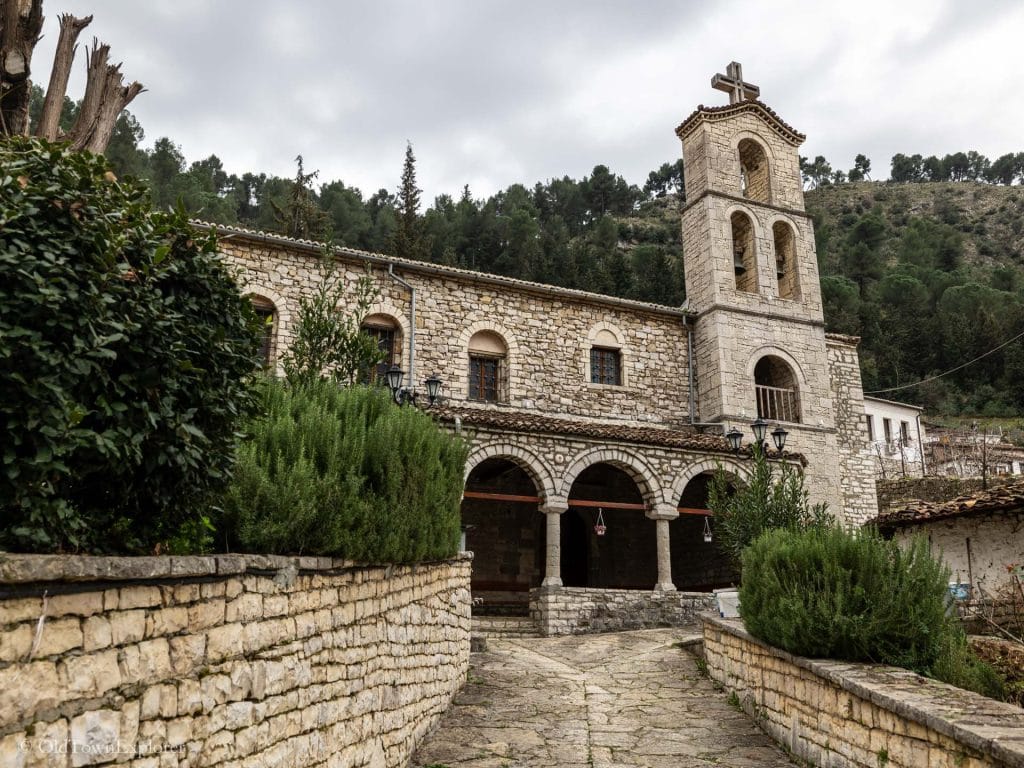
The Saint Spyridon Monastery
- Architect: Unknown
- Style: Orthodox church architecture
- Built: Unknown
- Address: Rruga Nikolla Buhuri, Gorica, Berat
Church of St. Spiridon helps explain Gorica’s religious and residential character. Its position across the river from Mangalem makes it part of a different architecture walk than the castle churches. It is most relevant when the visit includes the quieter Gorica side of the old town.

Church of St. Thomas
- Architect: Unknown
- Style: Orthodox church architecture
- Built: Unknown
- Address: Rruga Kristaq Tutulani, Berat
Church of St. Thomas sits across the Osum River from the main Mangalem approach. It adds another Orthodox building to the cross-river religious landscape. Use it to understand how Gorica’s architecture extends beyond houses and views back toward the castle.
St. Michael's Church
- Architect: Unknown
- Style: Byzantine church architecture
- Built: Medieval period
- Address: Slope above the Osum River, Berat
St. Michael’s Church is one of Berat’s most visually important small churches because of its slope-side position. It connects religious architecture with the rocky terrain and river valley rather than with the main castle cluster. The setting matters as much as the building.
Hysen Pasha Mosque
- Architect: Unknown
- Style: Ottoman mosque architecture
- Built: Unknown
- Address: Rruga Xhamia e Sahatit, Berat
Hysen Pasha Mosque, also associated with the Clock Mosque name, adds another Ottoman mosque layer outside the main castle route. It is a supporting stop for readers who want to extend the religious-building walk beyond Mangalem, Gorica, and Kala.
Telelka Mosque
- Architect: Unknown
- Style: Ottoman mosque architecture
- Built: Unknown
- Address: Rruga Veri Zaloshnja, Berat
Telelka Mosque is a smaller mosque site in the northern part of town. It should be treated as a supporting Ottoman religious building rather than a first-priority architecture stop. Its value is in extending the map of Berat’s mosque architecture beyond the central cluster.
Rüfai Teqe
- Architect: Unknown
- Style: Ottoman Sufi architecture
- Built: Unknown
- Address: Berat
Rüfai Teqe adds another Sufi building to Berat’s religious architecture. It is most relevant for readers who want to understand the city’s tekke tradition beyond the better-known Halveti Teqe. Keep it as a supporting religious-building entry unless stronger site-level detail becomes available.
Palaces in Berat
Berat does not have a large palace inventory on this page, but the surviving elite-house layer matters because the city’s Ottoman-period architecture was not limited to religious buildings and small houses.
Sarajet e Vrionasve
- Architect: Unknown
- Style: Ottoman-period residential architecture
- Built: Unknown
- Address: PX42+58C, Berat
Sarajet e Vrionasve represents the larger elite-house layer of Berat’s Ottoman-period urban fabric. It should be read with the city’s domestic and civic architecture rather than with the castle churches or mosque ruins. Its value is in showing how larger residences could carry social status inside the historic town.
Bridges in Berat
Bridges are central to reading Berat because the Osum River divides Mangalem and Gorica while also creating the best lower-town views of the castle hill and old quarters.

Gorica Bridge
- Architect: Unknown
- Style: Stone bridge architecture with Ottoman-period associations
- Built: Ottoman-period bridge; present form later reconstructed
- Address: Spans the Osum River between Mangalem and Gorica
Gorica Bridge is the key crossing between Mangalem and Gorica. The ICOMOS evaluation identifies the Gorica Bridge over the Osum as a notable bridge associated with the town’s remarkable properties. It frames the river view and gives one of the simplest ways to understand Berat’s old-town layout.

The New Bridge
- Architect: Unknown
- Style: Modern road bridge
- Built: Unknown
- Address: Main vehicle crossing into Berat
The New Bridge is less important architecturally than Gorica Bridge, but it explains modern movement into the city. It belongs to the practical edge of Berat’s historic center, where road access and old-town views meet. Keep it as a supporting entry rather than a primary architecture stop.
Neighborhoods in Berat
Berat’s neighborhoods are not background scenery. Mangalem, Gorica, and Kalaja explain the city’s old-town architecture more clearly than any single monument.

Mangalem District
- Style: Ottoman-period vernacular housing and hillside urban form
- Built: Housing mainly from the 18th and 19th centuries
- Address: North side of the Osum River below Berat Castle
The ICOMOS evaluation describes Mangalem as the quarter at the foot of the castle hill, with houses built on terraces rising from the river. This is the classic Berat view: white houses stacked on the slope below the castle. It is the strongest first area for understanding the city’s hillside form.
Gorica District
- Style: Ottoman-period vernacular housing and cross-river urban form
- Built: Housing mainly from the 18th and 19th centuries
- Address: South side of the Osum River opposite Mangalem
Gorica faces Mangalem across the river and gives some of the clearest views back toward the castle slope. The ICOMOS evaluation identifies Gorica as a separate quarter on the south bank of the river. Its quieter lanes and cross-river views help readers understand Berat as a two-bank historic town, not only as a castle hill.
Kalaja District
- Style: Fortified residential district
- Built: Developed across multiple periods
- Address: Castle hill, Berat
Kalaja is the inhabited castle district above Mangalem. It contains fortress walls, homes, churches, mosque remains, stone lanes, and viewpoints. It is the best area for seeing how defensive architecture, religious buildings, and daily residential life overlap in Berat.
Other Attractions in Berat
Other architecture stops in Berat are most useful when they explain the transition between the historic quarters and the lower modern city.

Bulevardi Republika
- Architect: Unknown
- Style: Civic boulevard and promenade
- Built: Unknown
- Address: Central Berat
Bulevardi Republika adds a lower-town civic layer to Berat’s architecture. Its cafés, park edge, and mountain views create a contrast with the stone lanes of Mangalem, Gorica, and Kalaja. It is most relevant as a modern promenade rather than a first-priority historic monument.
Things to Know Before You Go
Berat architecture is easy to start but harder to cover thoroughly because the old town is compact, steep, and divided between the riverfront, Mangalem, Gorica, and the castle hill.
Start in Mangalem for the Easiest First View
Mangalem is the best first area for most architecture walks because it gives immediate views of the hillside houses, the river, the castle slope, and the route toward Kala. It also keeps restaurants, cafés, and the bridge close by if you do not want to commit to the castle climb immediately.
Plan the Castle as an Uphill Architecture Walk
The castle district is close to the lower town, but the climb changes the visit. Treat Kala as a separate architecture layer with stone lanes, churches, mosque remains, homes, and viewpoints rather than as a quick monument stop.
Wear Shoes for Stone Lanes and Uneven Surfaces
Berat’s old-town lanes, castle approaches, and Gorica streets include stone paving, slopes, and uneven surfaces. Shoes matter more here than the short distances suggest.
Use Gorica Bridge for Orientation
Gorica Bridge is one of the easiest places to understand Berat’s layout. From the bridge and riverfront, Mangalem, Gorica, the castle hill, and the Osum River fit into one view.
Separate Exterior Views from Interior Visits
Much of Berat’s architecture can be understood from outside: houses, bridges, lanes, walls, mosque remains, and district views. Some churches, mosques, museums, and religious interiors may require tickets, seasonal checks, service awareness, or separate planning.
Avoid the Hottest Part of the Day in Summer
The exposed castle climb and stone lanes can feel demanding in summer heat. Start early or save the steeper architecture walk for later in the day when the goal is photography, viewpoints, or a slower evening descent.
Use Evening Light for River and House Views
Evening light works well along the river, Gorica Bridge, and the lower parts of Mangalem. The castle district can be atmospheric later in the day, but the return downhill requires more care after dark.
Plan Two Hours Around Mangalem and the Bridge
With two hours, focus on Mangalem, the riverside, Gorica Bridge, and views toward the castle. This gives the clearest first read of Berat’s houses, river setting, and old-town layout without forcing a rushed castle visit.
Plan a Half Day Around the Castle and River
With a half day, add the castle district, Holy Trinity Church, the Onufri Museum area, mosque remains, and the descent back toward Mangalem. This is the strongest single architecture plan for most first-time visitors.
Use a Full Day for Mangalem, Kala, and Gorica
A full day lets you move more slowly between Mangalem, the castle, Gorica Bridge, and Gorica. It also leaves space for interiors, museum time, photography, and breaks between the uphill and cross-river parts of the walk.
Architecture Tours in Berat
An independent walk works well for exterior views, Mangalem, Gorica Bridge, and general orientation. A guided tour is stronger when the priority is context: why churches and mosques sit so close together, how the castle district developed, and how the old quarters relate to the Osum River.
Guided Tours
Architecture tours in Berat make the most sense when you want help connecting the castle, religious buildings, Ottoman houses, UNESCO historic quarters, and river layout in one visit.
Where to Stay for Architecture Walks
For architecture walks, the best place to stay in Berat depends on how much climbing you want, how often you want to return to your room, and whether views or convenience matter more.
Best stay areas for architecture:
- Mangalem: The easiest first base for old-town views, restaurants, the riverfront, Gorica Bridge, and the walking route toward the castle.
- Kala district: The most atmospheric base for sleeping inside the castle area, but it requires steeper lanes, more luggage planning, and fewer quick returns to the lower town.
- Gorica: A quieter cross-river base with views back toward Mangalem and the castle slope, but slightly less central for first-time orientation.
- Lower central Berat: Practical for easier road access, Bulevardi Republika, and flatter movement, but less atmospheric than the historic quarters.
Mangalem is the safest first choice for most architecture-focused stays. Choose Kala when the castle setting matters most, and choose Gorica when quieter evenings and views across the river matter more than immediate access to the main walking route.
Hotels and Apartments in Berat
Use the interactive map below to compare hotels and apartments in Mangalem, Gorica, the Kala district, and lower central Berat.
FAQs About Berat Architecture
What architecture is Berat known for?
Berat is known for Ottoman-period houses, the castle district, Byzantine churches, Ottoman mosques, stone lanes, Gorica Bridge, and the old quarters of Mangalem, Gorica, and Kala.
Why is Berat a UNESCO World Heritage Site?
The UNESCO World Heritage Centre identifies Berat and Gjirokastër as rare examples of Ottoman-period architectural character. In Berat, that value is visible in the castle, historic quarters, religious buildings, and hillside housing.
Which buildings should I see first in Berat?
Start with Berat Castle, Holy Trinity Church, the Onufri Museum, Gorica Bridge, Mangalem, the King Mosque, and the Halveti Teqe. These sites give the fastest overview of the city’s defensive, religious, residential, and riverfront architecture.
Is Berat architecture easy to see with limited time?
Yes, Berat architecture is easy to start with limited time because Mangalem, Gorica Bridge, the riverfront, and the castle route sit close together. The main constraint is the uphill walk to the Kala district.
Can you understand Berat architecture from outside?
Much of Berat’s architecture can be understood from outside, especially the hillside houses, castle walls, bridges, stone lanes, and district views. Interior visits matter most for the Onufri Museum, selected churches, mosques, and religious buildings.
What styles will I see in Berat?
The main visible layers are Ottoman-period residential architecture, Byzantine church architecture, Ottoman mosque and tekke architecture, fortification architecture, and later civic additions around the lower town.
Where is the best view of Berat architecture?
The easiest first views are from Gorica Bridge and the riverside, where Mangalem, the castle hill, and the Osum River fit together. Higher views from the castle area show how the old town sits between the river and surrounding hills.
Is Berat architecture walkable?
Berat is walkable in the main old-town areas, but it is not flat. Mangalem, Gorica, and the riverfront are easier, while the Kala district requires a steeper climb on stone lanes.
How much time do I need for architecture in Berat?
Two hours is enough for Mangalem, the riverfront, and Gorica Bridge. A half day is better for the castle district and church area, while a full day lets you add Gorica, interiors, viewpoints, and slower photography stops.
Where should I stay in Berat for architecture walks?
Mangalem is usually the easiest base for architecture walks because it keeps the riverfront, bridge, restaurants, views, and castle route close together. Kala is more atmospheric but steeper, while Gorica is quieter and better for cross-river views.
For broader trip planning, start with our Berat page. For national style context and UNESCO-listed historic centers, use Albania Architecture. For same-day planning around restaurants and local wine, use Berat Food and Berat Wine.