
Discover Herculaneum Archaeological Park: History, Architecture & Must-See Attractions
Herculaneum Archaeological Park is the preserved Roman town of Herculaneum, excavated in modern Ercolano on the Bay of Naples, just southeast of Naples, Italy. The town was buried during Mount Vesuvius’ eruption in AD 79, and later excavated starting in the 18th century. Today, it’s a common Herculaneum day trip from Naples because the core ruins are compact and easy to cover in a few hours.
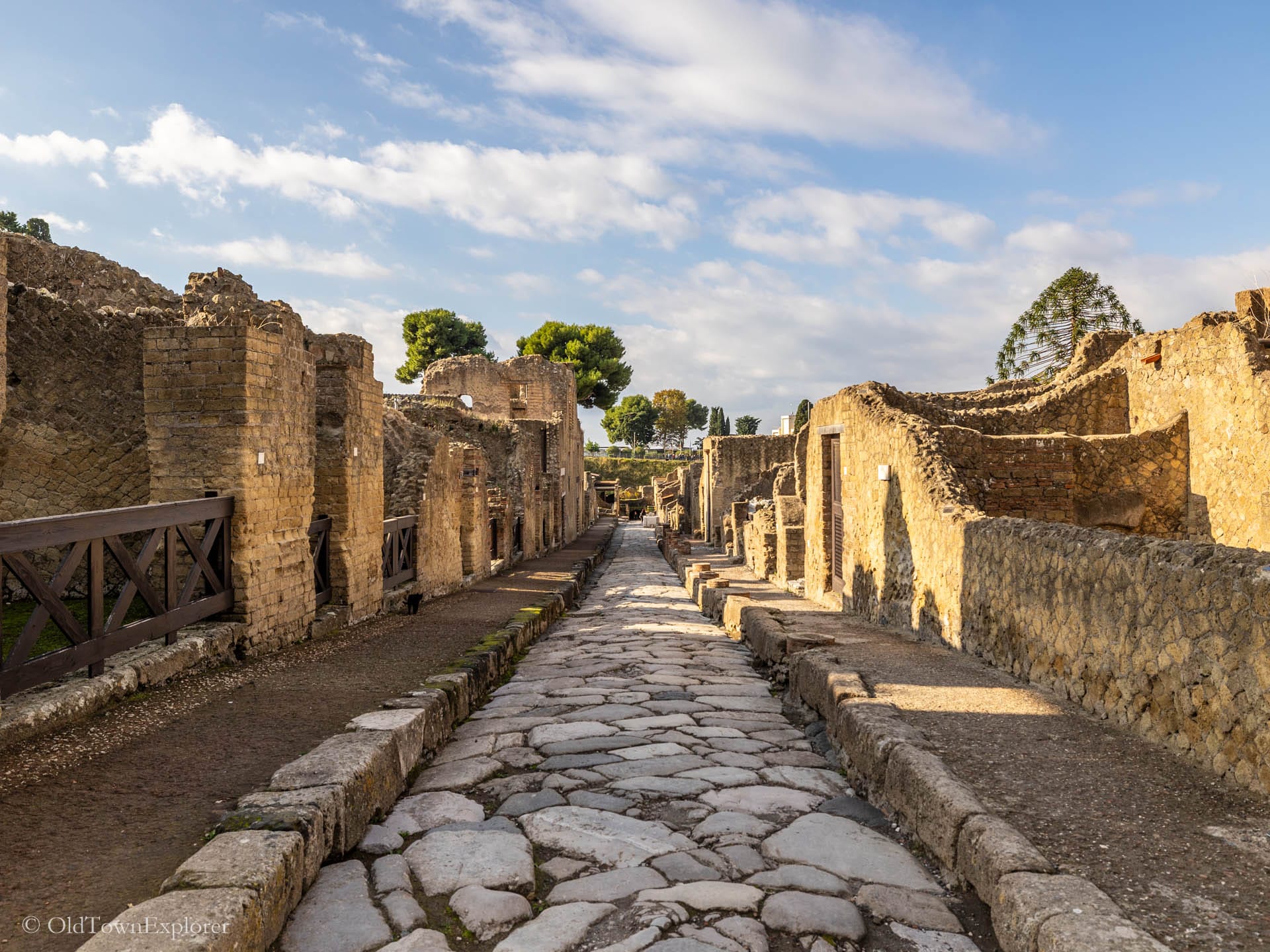
What stands out is how clearly the place still works as a town. You can follow the main street, step into houses and bath buildings, and see how shops and civic spaces sit right on the routes people used every day. Most visitors focus on Herculaneum Archaeological Park, using the main east–west street as a backbone and taking short detours into the best-preserved buildings.
We visited Herculaneum during our month-long stay in Naples. In this post, we’ll cover what to see and how to plan a day trip.
This post contains affiliate links that may earn us a small commission at no additional cost to you.
Herculaneum Archaeological Park at a Glance
Herculaneum Archaeological Park is a compact Roman archaeological site with streets, houses, and public buildings preserved under volcanic deposits.
- Location: Ercolano, near Naples on the Bay of Naples
- Architectural character: Roman streets, insulae (city blocks), houses, baths, and civic halls
- Walkability: Very walkable once inside, but expect uneven stone and steps
- Typical time required: 2–4 hours for the main highlights
- Key landmarks: Herculaneum Archaeological Park, House of Neptune and Amphitrite, House of the Deer, College of the Augustales, Central Baths, Villa of the Papyri
- Food plan: Mostly a sightseeing stop; plan a meal before or after the visit in Naples or Ercolano
- Seasonality: November is cooler and can mean shorter daylight and occasional rain
Next, it helps to understand the history, then the site’s layout, and then how to connect the best stops into one loop.
Herculaneum vs Pompeii: which one fits your day?
If you want a shorter visit with major highlights close together, Herculaneum usually fits better. The site is smaller, and the best houses, baths, and civic buildings sit within short walking jumps. Pompeii covers a much larger area, so it often takes more time and more walking to feel complete.
If you only have a half day from Naples, choose Herculaneum. If you have a full day and want broader variety across neighborhoods and big public spaces, Pompeii is often the better pick.
History of Herculaneum Archaeological Park
Herculaneum’s political and economic life shaped a tight street grid with dense housing, civic buildings, and shops near the main routes.
Early settlement and Greek influence (pre-Roman era)
Herculaneum likely began as a small settlement before Roman rule (exact founding details are Unknown). Its early phases set the town’s position on a slope above the ancient shoreline. That hillside location later pushed buildings into terraces and stepped streets.
Roman town and seaside living (1st century BC–1st century AD)
Under Rome, Herculaneum developed as a densely constructed town with paved streets, houses organized by blocks, and public baths. You can still see how daily life clustered around the main east–west street and the north–south lanes feeding into it. The result is a compact urban plan that’s easy to read on foot today.
The AD 79 eruption and burial
In AD 79, Vesuvius buried Herculaneum under deep volcanic deposits (exact depth varies by area; often reported as many meters). That burial sealed rooms and surfaces in place, which is why you can still see wall finishes and, in some areas, evidence of wood elements that survived as carbonized remains. The eruption froze the town’s street level and many interiors in a way that feels unusually direct.
Rediscovery and tunnel digging (18th century)
The site was rediscovered in the early 1700s (exact dates and sequence vary by account; many sources point to early 18th-century discoveries). Early work often used tunnels to reach walls, sculptures, and decorated rooms. That approach removed objects but did not expose the urban layout in a visitor-friendly way.
Modern excavations and preservation (19th–21st centuries)
Later excavations opened streets and buildings so visitors could move through the town like a real place. Today, the park emphasizes stabilizing walls, managing rain damage, and controlling visitor flow. That focus affects what areas are accessible at any given time, and why some zones may be blocked off for conservation.
Architecture of Herculaneum Archaeological Park
Herculaneum’s architecture is easiest to understand as a working town: a street grid, dense blocks, and public buildings placed where foot traffic was highest.
Cardo and decumanus streets
The site uses the classic Roman pattern of main streets: cardines run north–south, and decumani run east–west. This matters because it creates clear “spines” for walking. If you keep returning to the main decumanus, it’s hard to get lost.
Insulae and block density
Insulae are city blocks bounded by streets. In Herculaneum, the blocks feel tight and practical, with houses, shops, and small workshops pressed together. That density tells you the town was built for daily movement, not grand open space.
Terraces and the ancient shoreline edge
Parts of the town were built toward the sea on terraces, because the ground drops away. A retaining wall is a wall that holds back soil on a slope. Once you notice retaining walls, you’ll start seeing how the town managed height changes and protected streets from erosion.
House layouts: atrium and peristyle
Many houses follow familiar Roman planning, with an atrium near the entrance and, in larger homes, a peristyle courtyard deeper inside. The atrium is a central hall that brought light into the house. This sequence helps you read social space: public-facing rooms near the street, more private rooms deeper inside.
Baths and water infrastructure
Bath buildings appear where they could serve a lot of people and connect to street flow. You’ll often see thick masonry, service corridors, and rooms organized by function. Even without full access, the footprint shows how bathing was a routine, organized part of town life.
Shops and street frontage
Tabernae (shops) open right onto the sidewalks, often with wide doorways. This placement turns the main streets into commercial corridors. It also explains why certain streets feel busier than others, even in ruins.
Materials and surface finishes
You’ll see stone paving underfoot, masonry walls, plaster finishes, and surviving decorative surfaces. In some areas, the volcanic burial preserved details that are rare at other sites. The result is less about “style” and more about how construction methods supported dense urban living.
Walkability and visitor flow today
Herculaneum is compact, but movement is controlled by steps, narrow lanes, and occasional closures. The layout naturally creates a loop: enter, follow the main street, branch into key buildings, then return to the spine to move on. Planning your stops around that spine saves time and reduces backtracking.
Architectural Attractions in Herculaneum Archaeological Park
The easiest way to see Herculaneum is to use the main streets as your backbone, then detour into a few high-impact houses and public buildings that sit right off those routes.
Decumanus Maximus
- Architect: Unknown
- Style: Roman street (paved urban route)
- Built: Unknown (in use by the early Imperial period)
- Address: Inside Herculaneum Archaeological Park, Corso Resina 187, 80056 Ercolano (NA), Italy
This is the main east–west street through the excavated area. It matters because it anchors wayfinding and shows where shops and public-facing rooms clustered. Look for the stone paving, curb edges, and how doorways open directly to the street. It runs through the center of the site, acting as the main walking spine.
Cardo V
- Architect: Unknown
- Style: Roman street (north–south lane)
- Built: Unknown (in use by the early Imperial period)
- Address: Inside Herculaneum Archaeological Park, Corso Resina 187, 80056 Ercolano (NA), Italy
This is a key north–south street that intersects the main decumanus. It matters because it shows how steepness and access shaped movement between blocks. Look for the narrow width, the tight building edges, and the way sightlines pull you along the lane. It sits just off the central corridor and connects several major houses.
Palaestra (exercise courtyard area)
- Architect: Unknown
- Style: Roman civic space
- Built: Unknown (likely early Imperial period; exact date Unknown)
- Address: Inside Herculaneum Archaeological Park, Corso Resina 187, 80056 Ercolano (NA), Italy
This was a public exercise and gathering space connected to civic life. It matters because it breaks the dense street pattern with a more open footprint. Look for the edges that define the space and how surrounding buildings frame the courtyard-like area. It sits within the excavated core, reachable via the main street network.
College of the Augustales (Hall of the Augustales)
- Architect: Unknown
- Style: Roman civic/religious building
- Built: 1st century AD (exact range Unknown)
- Address: Inside Herculaneum Archaeological Park, Corso Resina 187, 80056 Ercolano (NA), Italy
This was a meeting place associated with the imperial cult and local civic groups. It matters because it shows organized civic life beyond private houses. Look for the building’s formal room shape and wall surfaces that signal a public interior rather than domestic space. It sits close to the central walking routes, not far from the main street spine.
Central Baths
- Architect: Unknown
- Style: Roman bath complex
- Built: 1st century AD (exact range Unknown)
- Address: Inside Herculaneum Archaeological Park, Corso Resina 187, 80056 Ercolano (NA), Italy
These are public baths that served daily routines like washing and socializing. They matter because bath buildings show how the town managed water, heat, and circulation in a structured plan. Look for thick walls, room sequences, and service zones that separate public rooms from utility areas. They sit within the town core, reached by short detours from the main street.
Suburban Baths
- Architect: Unknown
- Style: Roman bath complex
- Built: 1st century AD (exact range Unknown)
- Address: Inside Herculaneum Archaeological Park, Corso Resina 187, 80056 Ercolano (NA), Italy
These baths sit closer to the town’s edge and help explain how facilities served different parts of the settlement. They matter because they show similar bath planning in a slightly different position and scale. Look for how the footprint relates to the town boundary and changes in ground level. They sit toward the perimeter of the excavated zone compared with the Central Baths.
Samnite House
Casa Samnitica
- Architect: Unknown
- Style: Roman house (with earlier elements; details Unknown)
- Built: Unknown (often discussed as early in the visible sequence; exact date Unknown)
- Address: Inside Herculaneum Archaeological Park, Corso Resina 187, 80056 Ercolano (NA), Italy
This is one of the best-known houses for understanding basic Roman domestic planning. It matters because it helps you spot the atrium layout and how rooms connect from the entrance. Look for the atrium space and how the house presents itself to the street. It sits within the core blocks, close to the main circulation routes.
House of the Wooden Partition
Casa del Tramezzo di Legno
- Architect: Unknown
- Style: Roman house
- Built: 1st century AD (exact range Unknown)
- Address: Inside Herculaneum Archaeological Park, Corso Resina 187, 80056 Ercolano (NA), Italy
This house is known for evidence of interior features preserved by the eruption (exact elements visible can vary by access). It matters because it illustrates how rooms were divided and controlled within a house. Look for how interior thresholds shape movement from public to private space. It sits in the excavated residential blocks near the main streets.
House of Neptune and Amphitrite
Casa di Nettuno e Anfitrite
- Architect: Unknown
- Style: Roman house
- Built: 1st century AD (exact range Unknown)
- Address: Inside Herculaneum Archaeological Park, Corso Resina 187, 80056 Ercolano (NA), Italy
This is a compact house celebrated for its decorative surfaces, including a well-known courtyard mosaic. It matters because it shows how even smaller urban houses invested in visible decoration. Look for wall decoration and how the courtyard acts as a light well and display space. It sits inside the town blocks just off the main walking routes.
House of the Deer
Casa dei Cervi aka House of the Stags
- Architect: Unknown
- Style: Roman house (large seaside residence)
- Built: 1st century AD (exact range Unknown)
- Address: Inside Herculaneum Archaeological Park, Corso Resina 187, 80056 Ercolano (NA), Italy
This is one of the larger houses, positioned toward the former sea edge. It matters because it shows how elite houses used terraces and outward-facing spaces. Look for the relationship between rooms and the terrace edge, which signals views and status. It sits toward the seaward side of the excavated area, farther from the entrance than some central houses.
Villa of the Papyri
Villa dei Papiri
- Architect: Unknown
- Style: Roman villa
- Built: 1st century BC–1st century AD (exact range Unknown)
- Address: Near the Herculaneum Archaeological Park; exact visitor access points vary
This was a large villa complex known for the library of carbonized papyrus scrolls found there. It matters because it connects Herculaneum to elite coastal villa culture and major archaeological discoveries. Look for how the villa concept differs from dense town houses, with terracing and a more expansive footprint. It sits outside or at the edge of the main excavated town area, closer to the ancient coastline.
Walking Tour in Herculaneum Archaeological Park
Realistic total time: 2.5–4.5 hours, depending on pace, closures, and how many houses you enter.
Start: Ercolano Scavi area (near the Circumvesuviana stop)
- Herculaneum Archaeological Park entrance (orientation)
- Decumanus Maximus (main spine)
- Cardo V (north–south lane and street feel)
- Samnite House
- House of the Wooden Partition
- College of the Augustales
- Central Baths
- House of Neptune and Amphitrite
- House of the Deer (edge/terrace feel)
- Return via the main streets toward the exit
End: Back at the park entrance (optional add-on: MAV after the ruins)
How to Get to Herculaneum Archaeological Park from Naples
Herculaneum Archaeological Park is one of the easiest archaeology day trips from Naples because it sits in modern Ercolano and is well-connected by local transit. The key planning point is choosing a route that drops you near the park entrance, then budgeting a little extra time for the short walk and any station-area navigation. Below are the main ways to get there, with notes on what to expect once you arrive.
By Train
Departure station(s): Napoli Centrale / Napoli Piazza Garibaldi (Circumvesuviana level)
Arrival station: Ercolano Scavi (Circumvesuviana)
Typical travel-time range: about 15–25 minutes on the local line (service patterns can vary)
What to do once you arrive: Walk from Ercolano Scavi to the park entrance on Corso Resina. The route is short and direct, but expect normal city sidewalks and traffic at crossings.
By Bus
When this makes sense vs train: A bus can work if you are already on a route heading toward Ercolano and want fewer transfers. In practice, most day-trippers find the Circumvesuviana simpler because it drops you close to the site.
By Car
Parking strategy: Plan to park outside the immediate entrance zone and walk, since streets can be busy around key attractions.
ZTL or restricted-area cautions: Expect limited-access rules in parts of towns around Naples and the Vesuvian coast. If you drive, check local restrictions and signage on the day.
By Taxi
When it’s practical vs unnecessary: It can be practical if you’re short on time, traveling with limited mobility, or visiting very early. For most travelers staying near central Naples, the train is usually the more predictable choice.
Making the Most of Your Day Trip to Herculaneum Archaeological Park
Herculaneum Archaeological Park is compact, so you’ll get the best visit by following the main streets first and saving detours for the buildings that add the most context. This plan uses a simple backbone route, keeps walking jumps short, and groups stops so you’re not doubling back. Use it as a flexible order, since some rooms or paths can be closed for conservation.
Morning – architectural spine
Start with the Herculaneum Archaeological Park and build your visit around the Decumanus Maximus. This works because it gives you a clear route first, then you can take short detours into houses without losing your bearings.
Midday – civic core / street structure
Shift to civic buildings like the College of the Augustales and the Central Baths around the middle of your visit. This sequence works because these buildings explain how the town functioned beyond private homes, and they usually sit close to the main walking lines.
Afternoon – cathedral + optional add-on in Ercolano
If you want one more architecture stop after the ruins, consider a Vesuvian villa (like Villa Campolieto) or a quick walk through central Ercolano. This works well because it adds variety without turning the day into a long transit plan. Keep it flexible so you can adjust based on energy, weather, and any site closures.
Late afternoon / evening – wrap-up back in Naples
Head back to Naples for dinner once you finish at Herculaneum Archaeological Park. This works because you avoid rushing the ruins and keep your meal for a place with more options and easier pacing.
Tips for Visiting Herculaneum Archaeological Park
Start early to keep your route simple
Arriving earlier usually means fewer groups at the narrow house entries. It also helps if parts of the site close temporarily for safety or conservation.
Wear shoes that handle stone and steps
Expect uneven paving, worn thresholds, and changes in level. Choose shoes with solid grip so you’re not thinking about your feet the whole time.
Use the main decumanus as your “reset point”
If you feel turned around, return to the main east–west street. From there, you can pick your next stop with minimal backtracking.
Expect a few bottlenecks in popular houses
Some houses have narrow entry points and small courtyards. If a space feels crowded, swap the order and come back later.
Don’t overpack your stop list inside the park
It’s easy to try to see everything, but fatigue builds fast on stone. Pick a handful of houses plus one or two public buildings for a balanced visit.
Keep your food plan outside the ruins
Food options can be limited right at the moment you need a break. A simple plan is to eat before you enter or after you exit in Ercolano or back in Naples.
Plan your meal before or after the site
Herculaneum Archaeological Park is a walking-focused visit, and breaks inside the ruins can be limited. Eat before you enter or plan a simple meal after you exit in Ercolano or back in Naples.
Build in time for transit and the short walk
Even though the station-to-entrance walk is short, you’ll want a buffer for tickets, crossings, and orienting yourself. A small buffer makes the whole day feel less rushed.
Check access changes on the day
Archaeological sites can close single rooms or paths for maintenance or safety. Plan your must-sees as a priority list, not a fixed script.
FAQs About Herculaneum Archaeological Park
Is Herculaneum Archaeological Park worth visiting as a day trip?
Yes, if you want a compact Roman site you can cover without a full-day commitment. The main highlights sit close together, so it’s easier to see a lot in a few hours.
How long should I spend at Herculaneum Archaeological Park?
Plan 2–4 hours for the core ruins. Add time if you like to read signage closely or prefer a slower pace.
How is Herculaneum Archaeological Park different from Pompeii?
Herculaneum is smaller and more concentrated, with shorter walking gaps between major stops. Pompeii is much larger and usually takes more time to feel complete.
Is Herculaneum Archaeological Park walkable?
Yes, but expect uneven stone, steps, and narrow lanes. The site is compact, so distances are short even when footing is rough.
Can I visit Herculaneum Archaeological Park without a guide?
Yes, many people do. It helps to follow the main east–west street first, then take short detours into houses and baths.
Can I combine Herculaneum Archaeological Park with another stop in the same half day?
Yes, as long as you keep the second stop close by, like a Vesuvian villa in Ercolano or a short visit in central Naples. The site itself can take 2–4 hours, so leave buffer time for transit and breaks.
When is the best time to visit Herculaneum Archaeological Park?
Earlier in the day is often better because narrow spaces can bottleneck later. In November, cooler temperatures can make walking more comfortable, but rain can make stone surfaces slick.
Is Herculaneum Archaeological Park a good fit for a half-day from Naples?
Yes, because the site is compact and the Naples-to-Ercolano trip is relatively short. It’s one of the easiest archaeology outings to fit into a Naples stay.
Can I visit Herculaneum Archaeological Park and Pompeii in one day?
It’s possible, but it often feels rushed. Most travelers get a better visit by choosing one site and doing it well.
