
France Food
Explore France Food: Local Food Products & Traditional Dishes
France food changes sharply by region. Butter, cream, apples, and Atlantic seafood shape much of the north and west, while olive oil, vegetables, herbs, and fish matter more along the Mediterranean. Inland wine regions add cheese, charcuterie, poultry, and dishes cooked with local wine.
Lyon is a strong food-first base for bouchon cooking and charcuterie. Strasbourg brings Alsatian dishes into the trip, while Dijon and Beaune put Burgundy at the center. Bordeaux works for Atlantic and southwest food, and Avignon for Provençal cooking. Paris gives you broad national variety rather than one regional cuisine.
We have spent extended time in France, including month-long stays in Avignon, Bordeaux, Dijon, Lyon, and Strasbourg, plus two weeks in Beaune. Drawing on those stays and further research, we compare France’s main food regions, local and protected products, traditional dishes, and food destinations to help you decide where to base yourself, what to eat, and which regions to combine on a wider trip.
France Food at a Glance
French food makes more sense when you choose a region first. The dishes, cheeses, charcuterie, seafood, fats, and seasonings change enough that Strasbourg, Lyon, Burgundy, Provence, and Bordeaux lead to very different meals.
Key food-planning points:
- Best starting points: Lyon for bouchon cooking; Strasbourg for Alsace; Dijon and Beaune for Burgundy; Bordeaux for Atlantic and southwest food; and Avignon for Provence.
- Core pattern: Butter and cream become more important in the north and west, olive oil dominates more of the Mediterranean south, and wine regions often tie local cooking closely to cheese, meat, and sauces.
- Key food regions: Alsace, Burgundy, Lyon and the Rhône corridor, Provence, the Southwest, Normandy, Brittany, the Loire Valley, the Alps and Jura, Auvergne, Northern France, and Corsica.
- Products to recognize: Regional cheeses, cured meats, butter, lentils, olives, peppers, mustard, bread, pastry, oysters, and other seafood.
- Dishes to recognize: Tarte flambée, bœuf bourguignon, cassoulet, bouillabaisse, ratatouille, tartiflette, Breton galettes, and regional pastries.
- Main planning choice: A city such as Lyon, Strasbourg, Dijon, or Avignon can introduce one food region well, while Normandy, Brittany, Corsica, and the Southwest usually make more sense as wider regional trips.
Choose the food region that fits the rest of your route rather than trying to build one trip around a national checklist of French dishes.
Food Regions in France
France changes from dairy- and apple-based cooking in the northwest to wine-country dishes inland and olive oil, vegetables, and seafood near the Mediterranean. Some regions work well from one city base; others need a wider road or rail trip to understand the difference.
Lyon and the Rhône Corridor
Lyon is the clearest food-first city along the Rhône, with bouchons, charcuterie, sausages, quenelles, and rich meat dishes forming much of its traditional restaurant vocabulary. Beaujolais lies to the north, while the Rhône Valley continues south toward very different Provençal cooking. Start with Lyon Food if bouchons, markets, and city-level eating are your priority.
Burgundy
Burgundy ties food closely to wine, mustard, cheese, charcuterie, and dishes such as bœuf bourguignon, œufs en meurette, escargots, and gougères. Dijon Food suits a larger city stay with markets and restaurants, while Beaune Food fits a smaller wine-town trip.
Alsace
Alsace combines French and Germanic borderland traditions through pork, sausages, cabbage, onions, cream, bread, and aromatic white wine. Tarte flambée, choucroute garnie, baeckeoffe, kougelhopf, and Munster are useful names to recognize. Strasbourg Food is the practical next step for eating in the region's largest historic city.
Provence and the Mediterranean
Olive oil, tomatoes, garlic, herbs, olives, peppers, and seasonal vegetables shape Provençal cooking, while fish and shellfish become more important toward Marseille and the Mediterranean coast. Ratatouille, tapenade, soupe au pistou, and bouillabaisse point toward different parts of the southern food tradition. Avignon Food works well for an inland Provençal base.
Bordeaux and Southwest France
Bordeaux combines Atlantic products and a major wine culture, with oysters from the nearby Arcachon area and canelés strongly associated with the city. Farther through the Southwest, duck, confit, foie gras, beans, walnuts, prunes, cured ham, and peppers become more important. Bordeaux Food covers the city-level choices, but Gascony, Dordogne, the Basque Country, and Toulouse need separate regional travel decisions.
Normandy
Normandy leans heavily on butter, cream, apples, cider, soft cow's-milk cheeses, and seafood. Camembert de Normandie, Livarot, Pont-l'Évêque, scallops, mussels, and apple desserts make this a particularly clear contrast with Mediterranean France. A Normandy food trip works best when coastal towns and inland dairy country are both part of the route.
Brittany
Brittany shares the Atlantic with Normandy but has its own strong food vocabulary: buckwheat galettes, wheat crêpes, salted butter, cider, shellfish, oysters, and kouign-amann. Coastal seafood towns and inland crêperies make Brittany worth treating separately rather than folding it into a generic northwest France category.
Loire Valley
The Loire Valley pairs goat cheeses, rillettes, freshwater fish, orchard fruit, and market cooking with one of France's broadest wine corridors. Crottin de Chavignol and other Loire cheeses appear alongside dishes based on river fish and local produce. This region works especially well when food is combined with château visits and wine towns rather than planned as a single-city eating trip.
French Alps and Savoie
Mountain dairy and potatoes dominate many of the foods travelers associate with Savoie and the French Alps. Reblochon, Beaufort, Abondance, Tomme de Savoie, fondue, raclette, and tartiflette fit cold-weather and mountain travel particularly well. The food is quite different from nearby Lyon despite the relatively short distance between them.
Jura and Franche-Comté
Comté, Morbier, Morteau sausage, freshwater fish, and Jura wine give this eastern region a food tradition distinct from both Burgundy and the Alps. Cheese matters especially here, and dishes tend to make more sense alongside the region's farms, small towns, mountains, and vineyards than as part of a quick city stop.
Auvergne and Aubrac
Central France brings some of the country's strongest mountain and upland foods into the route. Cantal, Saint-Nectaire, Bleu d'Auvergne, Laguiole, lentils from Le Puy, and dishes such as aligot reflect cattle farming, dairy production, and colder inland landscapes.
Northern France
Northern France shifts toward beer, beef, cheese, potatoes, waffles, and dishes with Flemish influence. Maroilles, carbonade flamande, welsh, and regional pâtisserie give Lille and the surrounding north a food profile that differs markedly from Paris, Normandy, or Alsace.
Corsica
Corsican food combines mountain and Mediterranean ingredients, including Brocciu, cured pork, chestnut flour, sheep and goat cheeses, herbs, fish, and seafood. The island's roads and geography make food part of a dedicated Corsica route rather than an easy extension of a mainland city stay.
Protected Food Products in France
Protected food products are one of the clearest ways to understand France food. French labels such as AOC, AOP, IGP, STG, Label Rouge, and organic certification protect products tied to origin, production methods, traditional recipes, or quality standards.
When exploring French markets, shops, or restaurant menus, you’ll often notice food labels like AOC, AOP, or IGP. These certifications guarantee authenticity and protect traditional products tied to specific regions.
- AOC (Appellation d’Origine Contrôlée) - A French national label created in the 1930s to protect products linked to their region of origin. It ensures strict production methods, traditional know-how, and geographic authenticity. Examples include Roquefort cheese and Poulet de Bresse.
- AOP (Appellation d’Origine Protégée) / PDO (Protected Designation of Origin) - The European Union’s version of AOC, introduced in 1992. All French AOC products have also been recognized as AOP/PDO at the European level. Today, you’ll often see both logos side by side on packaging, confirming the product’s protected status across the EU.
- IGP (Indication Géographique Protégée) / PGI (Protected Geographical Indication) - A step below AOP. This label protects products that are closely tied to a region but with slightly more flexibility in production methods. For example, Tomme de Savoie cheese and Jambon de Bayonne carry IGP status.
The French Ministry of Agriculture explains the main official labels of quality and origin, including PDO, AOC, PGI, TSG, organic farming, and Label Rouge. The INAO product search is the strongest source for checking individual protected French product names and their official status.
Appellation d’Origine Protégée (AOP) / Protected Designation of Origin (PDO)
Abondance Cheese
A semi‑hard, raw‑milk cheese from Haute‑Savoie in the French Alps, Abondance was granted PDO (AOP) status in 1996. Made exclusively with milk from the Abondance, Montbéliarde, and Tarine cattle, it is shaped into large wheels (~7–12 kg) and aged for at least 100 days—often longer—on spruce boards. It has a fragrant, nutty aroma with creamy, melt‑in‑the‑mouth texture and a complex flavor often described as fruity with hazelnut and barnyard notes.
Beaufort Cheese
A raw cow’s milk cheese from Savoie in the French Alps, Beaufort is known for its smooth, firm texture and concave rind. Aged for at least 5 months, it offers floral, buttery, and slightly tangy notes. It’s a key ingredient in Alpine dishes like fondue.
Beurre d’Isigny
This Normandy butter is made from cream sourced from cows in the Isigny region. Rich in beta-carotene and with a naturally golden color, it’s prized for its smooth texture and sweet, slightly nutty flavor.
Bleu d’Auvergne
A cow’s milk blue cheese from the Auvergne region, it has a moist, creamy texture and a bold, salty tang. Its flavor intensifies with aging but remains less sharp than Roquefort.
Boudin Blanc de Rethel
A delicate white sausage made from pork, milk, and eggs, originating from Rethel in the Ardennes. It is gently spiced (no breadcrumbs) and usually pan-fried or grilled, offering a mild, creamy flavor.
Bresse Chicken
The only chicken in the world with PDO status, this breed is raised under strict conditions in Bresse. Known for its tender, flavorful meat and distinctive blue feet, it’s often roasted or served in cream-based sauces.
Brie (various)
"Brie" is a style of soft, bloomy-rind cheese from the Île-de-France region. Only Brie de Meaux and Brie de Melun hold PDO status. Mild, creamy, and mushroomy, it’s best eaten at room temperature.
Brie de Meaux
A soft-ripened cow’s milk cheese from Île-de-France. Larger and milder than Brie de Melun, it has a pale interior, earthy flavor, and edible white rind. Often called the “King of Cheeses.”
Brocciu
A Corsican fresh whey cheese made from goat’s or ewe’s milk. Mild and creamy when young, it’s used in both sweet and savory dishes. Aged versions develop a tangier flavor.
Camembert de Normandie
A soft, bloomy-rind cheese made from raw cow’s milk in Normandy. Creamy and earthy with a white rind, it matures in wooden boxes and is protected under AOP rules—distinct from mass-market "Camembert."
Cantal Cheese
One of France’s oldest cheeses, Cantal comes from the Auvergne region and is made from cow’s milk. It ranges from young (Cantal jeune) to well-aged (Cantal vieux), with flavors evolving from mild and milky to sharp and nutty.
Chabichou du Poitou
A cylindrical goat’s cheese from western France, with a wrinkled white rind and a dense, creamy center. Mild when young, it becomes tangy and earthy as it ripens.
Chaource Cheese
A soft-ripened cow’s milk cheese from Champagne and Burgundy. It has a bloomy rind, creamy texture, and subtle mushroom and tangy dairy flavors. Typically sold in drum-shaped forms.
Chevrotin
A raw goat’s milk cheese from Savoie with a washed rind and semi-soft interior. Aged for a few weeks, it has floral aromas and a mild, slightly nutty taste.
Comté Cheese
A cooked, pressed cow’s milk cheese from the Jura mountains. Made in large wheels and aged 4 months to 2 years, it develops complex notes of nuts, fruit, and browned butter.
Crottin de Chavignol
A small goat’s milk cheese from the Loire Valley. It starts off firm and nutty, then hardens and intensifies as it ages. Commonly served warm on salads or with wine.
Époisses
A pungent washed-rind cheese from Burgundy, made from cow’s milk and washed in Marc de Bourgogne. Orange-rinded and creamy, it’s known for its strong aroma and smooth, intense flavor.
Espelette Pepper
Known as Piment d’Espelette, this mild Basque chili pepper is air-dried and ground into bright red powder. Used in regional dishes as a flavorful, slightly spicy alternative to black pepper.
Fourme de Montbrison
A cylindrical blue cheese from the Auvergne region, made with cow’s milk. Less salty and more subtle than other French blues, it has a creamy texture and mild, nutty flavor with hints of mushroom.
Laguiole Cheese
A firm, uncooked, pressed cow’s milk cheese from the Aubrac plateau in southern France. Typically aged 4–12 months, it has a smooth, dense texture and earthy, buttery flavor.
Langres Cheese
A soft, washed-rind cheese from Champagne-Ardenne, made from cow’s milk. It has a sunken top (never turned during ripening) and a pungent aroma. Creamy inside with tangy, salty notes.
Lautrec Pink Garlic
Ail Rose de Lautrec is a pink-skinned garlic variety from the Tarn region. It is prized for its sweet, delicate flavor and long shelf life, and is grown using traditional methods.
Le Puy Green Lentil
Lentille Verte du Puy comes from volcanic soils in the Haute-Loire. Small and slate-green with a speckled surface, they hold their shape well when cooked and have a peppery flavor.
Livarot Cheese
A washed-rind cow’s milk cheese from Normandy, often wrapped in strips of paper or reed. Strong in aroma and flavor, with a smooth, supple interior and a pungent, salty taste.
Maroilles Cheese
A square-shaped, washed-rind cheese from northern France, made from cow’s milk. It has a sticky orange rind, assertive aroma, and a rich, tangy flavor that intensifies with age.
Miel d’Alsace
This honey from the Alsace region includes varieties such as fir, chestnut, and acacia. It’s known for its purity, floral complexity, and expression of the region’s unique flora.
Morbier Cheese
A semi-soft cow’s milk cheese from Franche-Comté, easily identified by its dark line of ash in the center. Smooth and elastic in texture with a mild, slightly tangy flavor.
Morteau Sausage
A smoked pork sausage from the Jura Mountains, made using traditional methods and smoked over conifer wood. It has a robust, smoky flavor and is typically poached or grilled.
Munster Cheese
A strong-smelling washed-rind cheese from Alsace and Lorraine, made from cow’s milk. It has a creamy texture and a tangy, slightly spicy flavor that becomes more pronounced with age.
Neufchâtel Cheese
A soft, bloomy-rind cow’s milk cheese from Normandy, traditionally shaped like a heart. Similar in texture to Camembert but slightly saltier with mushroomy and lactic notes.
Olive de Nice
These small, dark olives come from the Alpes-Maritimes area near Nice. Grown using traditional methods, they’re known for their mild bitterness and are often preserved in brine or made into olive oil.
Ossau-Iraty
A firm sheep’s milk cheese from the Basque and Béarn regions of the Pyrenees. It has a smooth, dense texture with nutty, grassy, and buttery flavors that intensify with aging.
Pélardon
A small round goat’s cheese from Languedoc-Roussillon. It has a soft, white rind and a creamy, tangy interior with herbal and nutty undertones, often eaten young or slightly aged.
Picodon
A small, flat disc-shaped goat’s cheese from the Drôme and Ardèche regions. It has a natural rind, a firm texture, and a sharp, slightly spicy flavor that intensifies over time.
Pont-l’Évêque Cheese
A soft washed-rind cow’s milk cheese from Normandy, square in shape with a creamy interior and a mild, slightly tangy taste. It’s one of the oldest cheeses in France.
Pouligny-Saint-Pierre Cheese
A pyramid-shaped goat’s milk cheese from the Loire Valley. Covered in a natural rind, it has a dense, white paste and a flavor profile ranging from citrusy and lactic to nutty and earthy.
Reblochon
A soft washed-rind cheese from the Savoie region, made from raw cow’s milk. Creamy with a delicate, nutty flavor, it’s a key ingredient in the Alpine dish tartiflette.
Rocamadour Cheese
A small, round goat’s cheese from the Lot department. Soft and creamy with a thin edible rind, it has a fresh, tangy flavor when young and becomes richer as it ripens.
Roquefort
A blue-veined sheep’s milk cheese aged in the natural caves of Roquefort-sur-Soulzon. It has a crumbly, moist texture with a sharp, salty flavor and is one of France’s most iconic cheeses.
Saint-Nectaire
A semi-soft cow’s milk cheese from Auvergne, with a washed rind and creamy, supple interior. It offers earthy, hay-like aromas and a mellow, nutty taste.
Selles-sur-Cher Cheese
A soft goat’s cheese from the Loire Valley, coated in ash and ripened with a bloomy rind. It has a chalky core, creamy edge, and a tangy, slightly earthy flavor.
Valençay Cheese
A pyramid-shaped goat’s cheese from the Berry region, traditionally coated in ash. It has a dense, slightly crumbly texture and a citrusy, fresh flavor that becomes more complex with age.
Indication Géographique Protégée (IGP) / Protected Geographical Indication (PGI)
Bayonne Ham
Bayonne ham (Jambon de Bayonne) is a cured ham from the Adour basin in Southwest France. It holds PGI (Protected Geographical Indication), not PDO. Known for its delicate, melt‑in‑the‑mouth texture and balanced saltiness, it’s dry‑cured using local salt from Salies‑de‑Béarn and aged for at least 12 months under strict regional regulations.
Alsace honey
Alsace honey (Miel d’Alsace) carries PGI status, covering varieties like chestnut, acacia, and fir honey produced in specified zones of Alsace.
Brillat-Savarin
A rich, triple‑creme cow’s milk cheese named after the famous gastronome Jean‑Anthelme Brillat‑Savarin. It earned PGI status in 2017.
Emmental de Savoie
A Swiss‑style Emmental made in the French Savoie region. Holds PGI protection since 1996.
Emmental français est-central
A French Emmental variety produced in central France; also PGI‑protected since 1996.
French Gruyère
A Gruyère‑style cheese produced in France rather than Switzerland—protected under PGI since 2013.
Raclette de Savoie
The French version of raclette cheese produced in Savoie, with PGI protection granted in 2017.
Saint-Marcellin
A soft, creamy cheese from the Rhône‑Alpes region. Recognized with PGI status in 2013.
Soumaintrain
A washed‑rind cow’s milk cheese from Burgundy, protected by PGI since 2016.
Tomme de Savoie
A mild alpine cheese from Savoie, PGI‑protected since 1996.
Tomme des Pyrénées
A cheese from the Pyrenees region, granted PGI protection in 1996.
Tomme fraîche de l'Aubrac
Fresh tomme cheese from Aubrac, with PGI status recognized in 2023.
Other Local Food Products in France
Not every important French food product needs to appear in the protected-products section. Many everyday products still shape how France food appears in markets, bakeries, bistros, cafés, brasseries, and regional restaurants.
Bread, Pastry, and Bakery Staples
- Baguette: Daily bread used for breakfast, sandwiches, cheese, charcuterie, and table service
- Croissant and pain au chocolat: Laminated breakfast pastries found in bakeries across the country
- Brioche: Enriched bread used for breakfast, snacks, desserts, and regional preparations
- Country loaves and rye breads: Common with cheese, soup, seafood, charcuterie, and market meals
Bakeries are one of the easiest places to see daily French food habits, especially in the morning and around market shopping.
Market Products and Pantry Staples
- Mustard: Closely tied to Burgundy and used in sauces, vinaigrettes, marinades, and table condiments
- Vinegars: Used in dressings, reductions, sauces, and preserved foods
- Herbes de Provence: Herb blends associated with southern cooking, especially grilled meats, vegetables, and stews
- Walnuts, chestnuts, almonds, and hazelnuts: Used in sweets, oils, salads, sauces, and regional baking
These pantry products explain why French food often changes from region to region before the main dish even arrives.
Seafood, River Fish, and Shellfish
- Oysters: Important along the Atlantic coast, Normandy, Brittany, and the Arcachon Basin
- Mussels: Common in coastal dishes, especially in Brittany, Normandy, and northern France
- Scallops: Used in starters and seafood plates, especially in coastal regions
- Freshwater fish: Important in river and lake regions, including Burgundy, the Alps, and eastern France
Seafood and freshwater fish add a major coastal and river-valley dimension to French food beyond cheese, pastry, and bistro dishes.
Traditional Dishes in France
Traditional French dishes vary strongly by region. Burgundy is known for wine-based sauces and braises, Provence for olive oil and vegetables, Alsace for winstub dishes and German-influenced cooking, Lyon for bouchons and charcuterie, the southwest for duck and beans, and the coasts for seafood.
Starters, Soups, and Cold Plates
- Soupe à l’oignon: Onion soup topped with toasted bread and melted cheese
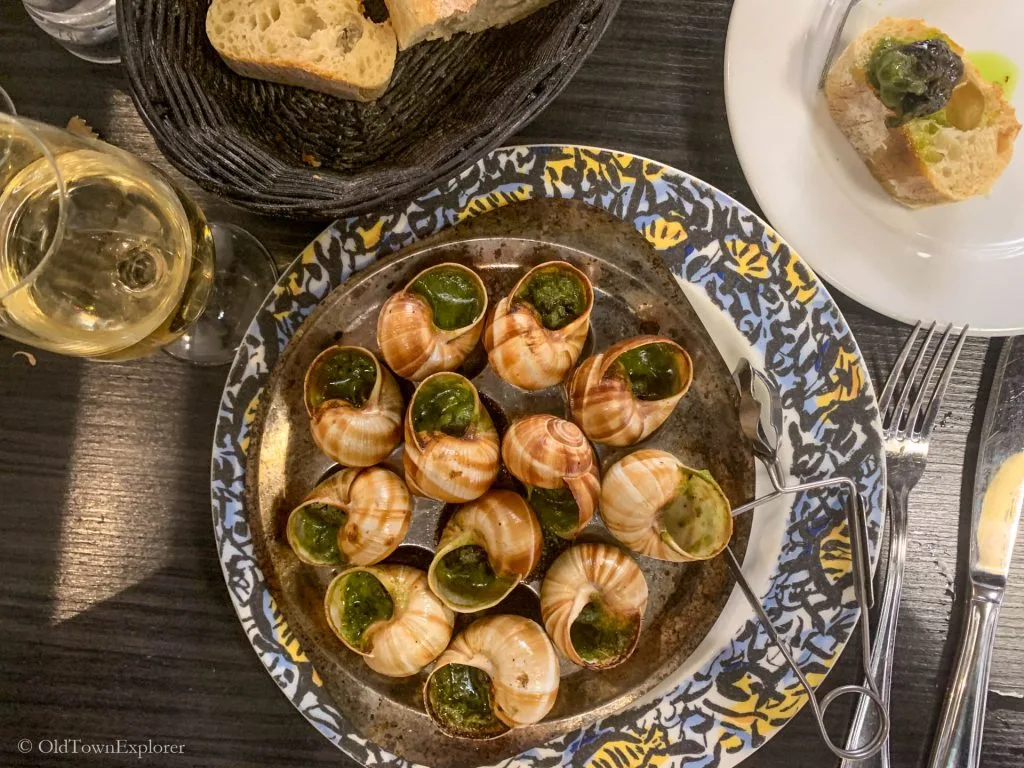
- Escargots de Bourgogne: Snails baked with garlic-parsley butter, especially associated with Burgundy
- Salade Niçoise: A composed salad from Nice with tuna, eggs, olives, tomatoes, and seasonal vegetables
- Steak tartare: Finely chopped raw beef mixed with seasonings and often served with fries or salad
- Coquilles Saint-Jacques: Scallop preparation often served as a starter or festive seafood dish
Starters show the range of French food quickly, from Burgundy butter dishes to Mediterranean salads and coastal seafood.
Meat, Poultry, and Stews
- Boeuf bourguignon: Beef braised in red wine with onions, carrots, mushrooms, and herbs
- Coq au vin: Chicken braised in wine with bacon, mushrooms, and onions
- Cassoulet: A southwest casserole of white beans, duck confit, pork, and sausage
- Confit de canard: Duck leg cured in salt and cooked slowly in duck fat
- Pot-au-feu: Beef and vegetable dish served with broth, meat, vegetables, and condiments
These dishes show the slow-cooked side of French food, especially in Burgundy, the southwest, Lyon, and colder inland regions.
Seafood and Coastal Dishes
- Bouillabaisse: Provençal fish stew from Marseille, served with rouille and bread
- Moules marinières: Mussels cooked with white wine, shallots, herbs, and butter
- Sole meunière: Fish cooked in butter with lemon and parsley
- Oysters: Served raw with lemon, vinegar-shallot sauce, rye bread, or butter in many coastal regions
Seafood is central to French regional food along the Atlantic coast, Brittany, Normandy, Provence, the Mediterranean, and the Arcachon Basin.
Vegetables, Potatoes, and Alpine Dishes
- Ratatouille: Provençal vegetable dish made with eggplant, zucchini, peppers, tomatoes, onions, and herbs
- Tartiflette: Alpine potato gratin made with Reblochon, lardons, onions, and cream
- Gratin dauphinois: Sliced potatoes baked with cream and garlic
- Haricots verts amandine: Green beans served with butter and almonds
- Pommes purée: Smooth mashed potatoes made with butter and sometimes cream
Vegetable and potato dishes show the contrast between Provence, the Alps, Burgundy, and central French restaurant cooking.
Desserts, Pastries, and Bakery Sweets
- Crème brûlée: Custard topped with caramelized sugar
- Tarte Tatin: Upside-down caramelized apple tart
- Clafoutis: Baked fruit dessert, often made with cherries
- Crêpes Suzette: Thin pancakes served with citrus-butter sauce
- Mille-feuille: Layered puff pastry with pastry cream
- Macarons: Almond meringue sandwich cookies with fillings
- Éclair: Choux pastry filled with cream and topped with glaze
- Brioche and croissant: Bakery staples tied to breakfast, cafés, and pastry shops
French desserts and pastries are strongest when connected to bakeries, cafés, regional fruit, butter, cream, and pastry technique rather than treated as a single national sweets list.
FAQs About France Food
What food is France known for?
France is known for regional cheeses, bread and pastry, charcuterie, seafood, wine-based cooking, butter-rich northern dishes, and Mediterranean cooking with olive oil and vegetables. The important point is that the balance changes sharply between places such as Alsace, Burgundy, Brittany, Provence, Lyon, and the Southwest.
What traditional dishes should I try in France?
Choose dishes that match the route: tarte flambée or choucroute in Alsace, bœuf bourguignon or escargots in Burgundy, quenelles in Lyon, cassoulet or duck confit in the Southwest, bouillabaisse around Marseille, and buckwheat galettes in Brittany. That gives you a better picture of French food than ordering the same national classics everywhere.
What local products is France known for?
Cheese is the largest category to learn first, with Camembert de Normandie, Comté, Époisses, Reblochon, Roquefort, Ossau-Iraty, Munster, and Brocciu pointing toward very different regions. Other useful names include Jambon de Bayonne, Morteau sausage, Piment d'Espelette, Lentille Verte du Puy, Dijon-style mustard, regional butter, olives, bread, and coastal seafood.
How does food vary by region in France?
Northwestern France relies more on butter, cream, apples, cider, and Atlantic seafood; Alsace uses pork, cabbage, onions, and borderland dishes; Burgundy and Lyon lean toward cheese, charcuterie, wine sauces, and rich meat cooking; Provence uses more olive oil, herbs, vegetables, and Mediterranean fish; and the Southwest brings duck, beans, cured ham, peppers, and walnuts into the picture.
Which cities are good bases for food in France?
Lyon works well for bouchons and Rhône-area food, Strasbourg for Alsace, Dijon and Beaune for Burgundy, Bordeaux for Atlantic and southwest products, and Avignon for Provence. Paris has the widest national restaurant choice, but it does not replace traveling to the regions where these food traditions developed.
Are food tours worth taking in France?
A food tour can be worthwhile when you want help understanding a large market, comparing regional products, or finding several specialist shops in a short time. In compact centers such as Dijon or Beaune, you can also build a good independent food day around a market, bakery, cheese shop, and regional lunch once you know which local names to look for.
Food and wine overlap closely in Burgundy, Bordeaux, Alsace, the Rhône, and the Loire Valley. See France Wine to compare those wine regions, or return to France for the wider route, seasons, architecture, and transport choices.