

Discover the Best Things to See in Split: Architectural Attractions, Walking Tours & Travel Tips
The best things to see in Split center on Diocletian’s Palace, where Roman gates, ceremonial spaces, medieval churches, noble houses, and later civic squares form one walkable historic center. The Peristyle, Cathedral of St. Domnius, palace substructures, Riva, Pjaca, and Fruit Square should come first on a short visit.
The sights below include the main palace landmarks, smaller churches and palaces, public squares, monuments, defensive remains, and later streets beyond the Roman core. Prioritize the palace interiors that interest you, then treat the smaller façades, statues, and churches as shorter stops along the route.
We spent the entire month of November in Split photographing and researching these sights. The self-guided route connects all 29 stops on foot, and the accompanying map follows the same sequence.
This post contains affiliate links that may earn us a small commission at no additional cost to you.
Best Things to See in Split at a Glance
Split’s main sights form a compact architectural walk through Diocletian’s Palace and the medieval and later city that grew beyond its western wall.
Key sightseeing decisions:
- See first: Prioritize the Peristyle, Cathedral of St. Domnius, Diocletian’s Cellars, Vestibule, Temple of Jupiter, Golden Gate, Iron Gate, Riva, and Pjaca.
- Best starting area: Begin outside the Golden Gate, where the Roman palace plan, Gregory of Nin statue, and surviving northern religious buildings are easiest to understand together.
- Quick exterior stops: The palace gates, Venetian Tower, noble-house façades, statues, Marmontova, Riva, Fruit Square, Pjaca, and Prokurative can be appreciated without a long interior visit.
- Sights needing more time: Allow extra time for the Cathedral of St. Domnius complex, Temple of Jupiter, palace substructures, Split City Museum or Ethnographic Museum when open, and any other interior you choose.
- Walking logic: Most stops sit inside or immediately outside the palace. Marmontova, the Sulphur Spa, Prokurative, and St. Francis extend the walk westward.
- One-day trade-off: You can see all 29 locations from outside in one long walk, but you cannot examine every church, museum, cellar, courtyard, and architectural detail properly in the same day.
With limited time, choose the major Roman spaces and one or two interiors. Add the smaller palaces and religious buildings when architectural detail is a central reason for visiting.
Best Things to See in Split
The first entries are Split’s main first-visit priorities. The later churches, palaces, statues, and streets add detail to the walking route and show how the city expanded from a Roman imperial complex into a medieval and modern civic center. For deeper building histories and a wider architectural inventory, use our Split Architecture guide.

Split Peristyle
- Location: Central Diocletian’s Palace
The Peristyle was the palace’s ceremonial center and remains the clearest place to understand its imperial scale. Notice the red granite columns, the Protyron at the southern end, the entrance to the former mausoleum, and the noble houses built against the ancient colonnade. See it first because the cathedral, Vestibule, Temple of Jupiter, and substructures all connect with this space.
Cathedral of St. Domnius
- Location: Peristyle
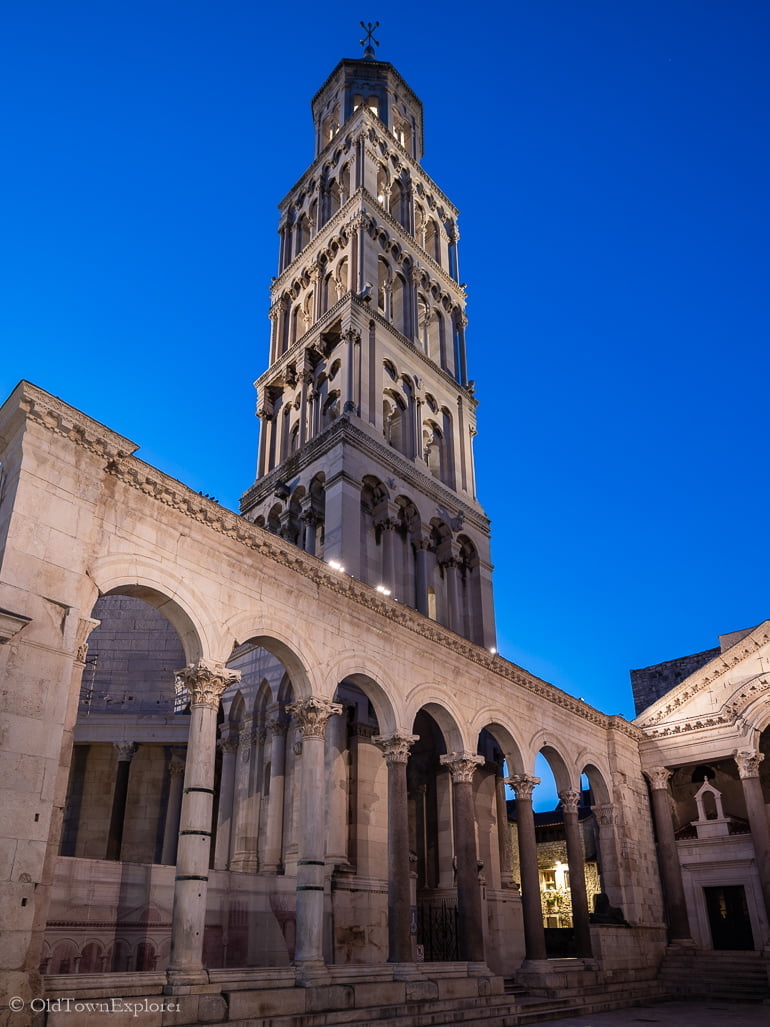
The cathedral occupies Diocletian’s former mausoleum, making it the strongest example of a Roman imperial building reused for medieval Christian worship. Its octagonal core and surrounding columns can be read from the Peristyle, while the interior, treasury, crypt, and bell tower require more time. Choose this as one of your main interior visits rather than treating it as another quick church stop.

Split Riva
- Location: Southern side of Diocletian’s Palace
The Riva is the broad waterfront promenade beneath the palace’s southern façade. Walk it to see how the former imperial residence meets the harbor and how later buildings extend west toward St. Francis and Prokurative. The architectural value comes from the full relationship between waterfront, palace wall, Bronze Gate area, and later civic façades rather than one isolated monument.

Diocletian's Cellars
- Location: Beneath the southern palace quarters
The palace substructures supported Diocletian’s private apartments and preserve much of the plan of the rooms once above them. The central passage connects the Riva with the steps to the Peristyle, while the larger underground halls reveal the scale and engineering of the imperial residence. Give the interior more time when Roman construction is one of your main interests.

Vestibule
- Location: South of the Peristyle
The circular Vestibule formed part of the ceremonial approach from the Peristyle to Diocletian’s private apartments. Its open roof, high masonry, and acoustics make it a short but essential stop between the imperial square and the southern palace quarter. Stand inside and look upward rather than viewing it only from the adjoining lane.

Golden Gate
- Location: Northern wall of Diocletian’s Palace
The Golden Gate was the palace’s principal northern entrance and led toward Salona. The surviving niches, arches, masonry, and remains of defensive structures make it the clearest gate for imagining the fortified Roman complex. View it from outside the walls before entering along the former Cardo toward the Peristyle.

Papalic Palace
- Location: Papalićeva 1
Papalić Palace, sometimes called the Large Papalić Palace, is one of the strongest late Gothic and Renaissance houses inside the palace. Its courtyard, external staircase, portal, loggia, and carved stonework show how noble families adapted the Roman street plan to later residential life. The exterior and courtyard deserve attention even when you do not plan a museum visit.

Temple of Jupiter
- Location: West of the Peristyle
The former Roman temple later became the Baptistery of St. John. Its richly carved doorway, coffered barrel vault, Egyptian sphinx, medieval baptismal font, and Ivan Meštrović sculpture condense several periods into a very small interior. Choose it when you want one compact visit that connects Roman religion, medieval Christianity, and modern Croatian sculpture.

Church of St. Roch
- Location: Poljana kraljice Jelene
The Renaissance Church of St. Roch incorporates part of a medieval house and elements of the palace’s Roman colonnade. Its value is less about a long interior visit than seeing how a small later church was fitted into the surviving Decumanus frontage. It works as a quick stop between the Silver Gate and Peristyle.

Venetian Tower
- Location: Fruit Square
The octagonal Venetian Tower survives from a fifteenth-century defensive complex built outside the Roman palace. It anchors one side of Fruit Square and contrasts with the Baroque Milesi Palace opposite it. View the tower together with the square, palace, and Marko Marulić statue rather than as a separate destination.

Silver Gate
- Location: Eastern wall of Diocletian’s Palace
The Silver Gate opens onto the former Decumanus, the Roman street running west toward the Iron Gate. Its simpler design and surviving tower bases make it easier to read as a defended working entrance than the more ceremonial Golden Gate. The nearby Pazar market makes it a practical eastern entrance to the palace.

Ciprianis-Benedetti Palace
- Location: Marulićeva 6, beside the Iron Gate
Ciprianis-Benedetti Palace is a medieval noble house whose upper façade is marked by two rows of six-arched windows and a relief of St. Anthony. Look upward while passing between the Iron Gate and Pjaca; most of its sightseeing value lies in the exterior stonework and its position against the palace’s western edge.

Church of Our Lady of the Bell Tower
- Location: Above the Iron Gate
This small church occupies part of the former Roman guard passage above the western gate. The early Romanesque bell tower, adjoining city clock, and Roman wall show several phases stacked vertically in one place. The clearest view comes from Pjaca, where the gate, clock, church, and later square can be read together.
Grisogono-Cipci Palace
- Location: Ulica kralja Petra Krešimira IV 8
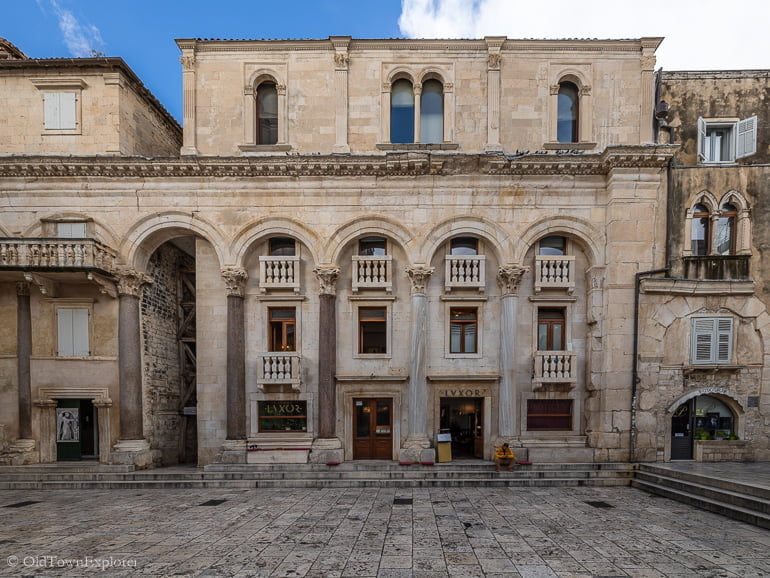
The Grisogono-Cipci Palace stands at the edge of the Peristyle and incorporates Romanesque and later Gothic residential work into the palace fabric. It belongs on the route because its façade demonstrates how noble houses filled the ancient ceremonial center. Compare its windows and masonry with the Roman columns beside it.

Pjaca
- Location: Narodni trg
Pjaca, or People’s Square, became Split’s main civic square outside the palace’s western wall. The Old Town Hall, city clock, and noble façades mark the transition from the Roman enclosure to the medieval city. Spend time looking around the full perimeter rather than crossing it only as a route between the Iron Gate and Marmontova.

Old Town Hall
- Location: Pjaca
The Gothic loggia and surviving parts of the Old Town Hall recall the civic complex that once occupied the northern side of Pjaca. Its present façade reflects later reconstruction, so the attraction lies in the combination of surviving medieval elements and the building’s role in the square. It is a quick exterior stop unless a current exhibition interests you.

Marmontova
- Location: Between the Riva and Croatian National Theatre
Marmontova is Split’s main nineteenth-century pedestrian axis west of the old town. Walk it to compare the compact medieval lanes with a broader planned street lined by later civic and Secession-era buildings. The Fish Market and the route toward Prokurative give the street more sightseeing value than an ordinary shopping corridor.

Prokurative
- Location: Trg Republike
Prokurative, officially Republic Square, is enclosed on three sides by arcaded neo-Renaissance buildings and opens south toward the harbor. It shows Split’s nineteenth-century civic ambitions more clearly than the palace lanes. Visit it with Marmontova and the western Riva to understand the city beyond its Roman and medieval core.

Milesi Palace
- Location: Fruit Square
Milesi Palace provides the Baroque counterpoint to the defensive Venetian Tower across Fruit Square. Its broad façade, balconies, and prominent position make it more important to the square than a quick reading of the doorway alone would suggest. Compare the palace with the tower and Marko Marulić statue from the center of the square.

Iron Gate
- Location: Western wall of Diocletian’s Palace
The Iron Gate links the Roman Decumanus with Pjaca and has remained embedded in the city’s daily movement for centuries. Look for the Roman structure, the cross replacing an earlier pagan relief, the church and bell tower above, and the nearby 24-hour clock. It is the clearest point for seeing the Roman palace open directly into the medieval civic city.

Church and Monastery of St. Francis
- Location: Western end of the Riva
St. Francis marks the western end of the central waterfront route. The church and cloister stand on an early Christian site and contain the tomb of writer Marko Marulić. Add it after Prokurative when you want a religious and literary stop beyond the main palace cluster.

Former Convent of the Poor Clares of St. Nicholas
- Location: Iza Vestibula 4
The former convent occupies part of the southern palace quarter and now forms part of the Ethnographic Museum complex. Its importance lies in the layered site beneath and around the later convent, including Roman, medieval, and early modern remains. Choose it for a deeper interior visit rather than as a necessary stop on a very short walk.

Bell Tower and Chapel of St. Arnir
- Location: Ulica kralja Tomislava 15
The surviving bell tower and chapel are remnants of a religious complex outside the palace’s northern wall. They give the start of the walking route a medieval layer before the Gregory of Nin statue and Golden Gate. This is a short exterior stop whose value comes from its location within the northern approach.

Statue of Gregory of Nin
- Location: Outside the Golden Gate
Ivan Meštrović’s large statue of the medieval bishop Gregory of Nin creates the main modern monument on the approach to the palace. Its scale deliberately competes with the ancient gate behind it. See the statue as part of the northern entrance composition rather than only stopping to touch its polished toe.
Dominican Church and Monastery of St. Catherine of Alexandria
- Location: Hrvojeva 2
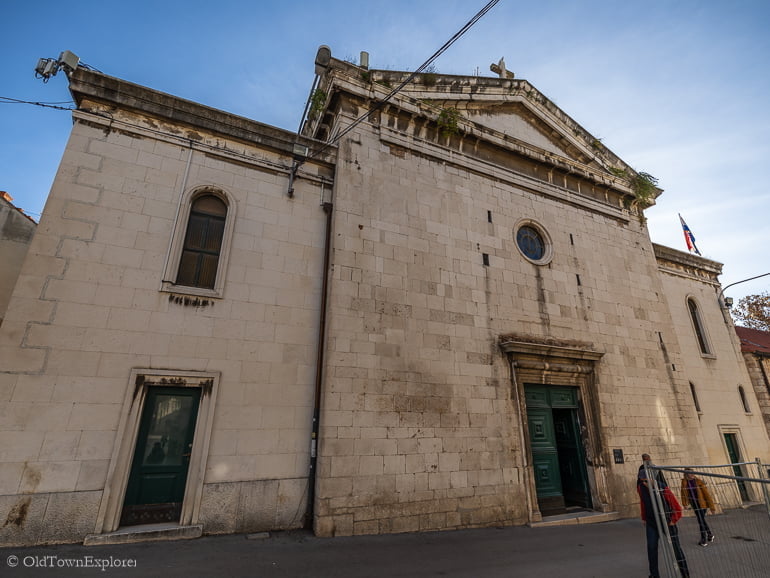
The Dominican complex stands between the Silver Gate and Pazar. Its religious history reaches back to the medieval city, while later rebuilding shaped the present appearance. It functions best as a route stop that connects the eastern palace wall, market, and Church of St. Roch.

Pavlović Palace
- Location: Southern side of Pjaca
Pavlović Palace helps define the southern edge of Pjaca. Its Renaissance origins and later Baroque alterations show how noble houses changed while retaining their role in the city’s principal square. Look at the façade and courtyard entrance while making a circuit of Pjaca.

Marko Marulić Statue
- Location: Fruit Square
Ivan Meštrović’s statue honors Split-born writer and humanist Marko Marulić. Its position between Milesi Palace and the Venetian Tower turns the monument into part of the square’s architectural composition. View it from several sides so the figure, palace façade, and defensive tower remain in the same frame.
Nakić Palace
- Location: Narodni trg 3
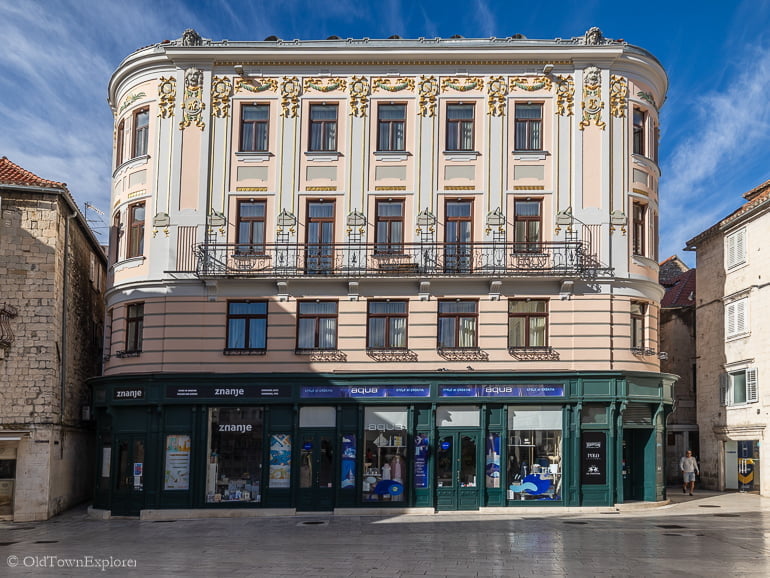
Nakić Palace is one of the noble façades lining Pjaca. It belongs on the route because the square’s character depends on the group of civic and residential buildings around it rather than the Old Town Hall alone. Treat it as a façade-detail stop while examining the full square.
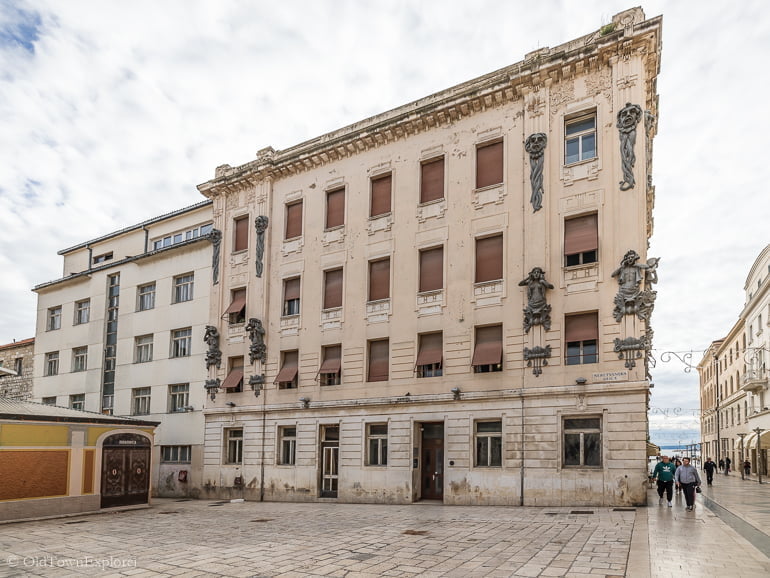
Sulphur Spa
- Location: West of the Fish Market, near Marmontova
The historic sulphur spa connects Split’s natural springs with its later civic architecture. Its Art Nouveau or Secession-era exterior differs sharply from the Roman, Gothic, Renaissance, and Baroque buildings in the old town. It works as a western route detail between Marmontova and Prokurative rather than a principal first-visit attraction.
If you're still on the fence after reading about the best things to see, check out "Is Split Worth Visiting." We review a long list of factors you should consider before reserving a room and booking your flight.
Self-Guided Walking Tour of Split
The walking route connects the 29 sights through Diocletian’s Palace, the Riva, medieval squares, Marmontova, Prokurative, and the western waterfront. Follow the sequence below and use the map to see how the palace connects with the later city.
Split Walking Tour Route and Map
Begin north of Diocletian’s Palace at the Bell Tower and Chapel of St. Arnir. Enter through the Golden Gate area, cross the palace from east to west and north to south, then continue through the Riva, Fruit Square, Pjaca, Marmontova, Prokurative, and St. Francis.
- Bell Tower and Chapel of St. Arnir
- Statue of Gregory of Nin
- Golden Gate
- Papalić Palace
- Silver Gate
- Dominican Church and Monastery of St. Catherine of Alexandria
- Church of St. Roch
- Grisogono-Cipci Palace
- Cathedral of St. Domnius
- Split Peristyle
- Temple of Jupiter
- Vestibule
- Former Convent of the Poor Clares of St. Nicholas
- Diocletian’s Cellars
- Split Riva
- Venetian Tower
- Marko Marulić Statue
- Milesi Palace
- Ciprianis-Benedetti Palace
- Iron Gate
- Church of Our Lady of the Bell Tower
- Pjaca
- Old Town Hall
- Pavlović Palace
- Nakić Palace
- Marmontova
- Sulphur Spa
- Prokurative
- Church and Monastery of St. Francis
The route includes every sight in the attraction list, but it does not assume a full interior visit at each stop. Choose the cathedral complex, Temple of Jupiter, palace substructures, or one museum for deeper time, then view most smaller churches, palaces, statues, and gates from outside.
Use the map below to follow the same stop order and see where the palace cluster gives way to Fruit Square, Pjaca, Marmontova, Prokurative, and the western Riva.
One Day in Split
One day is enough to understand the palace and see the main exterior sights, but it is not enough for every museum, church interior, underground hall, courtyard, and architectural detail. Choose one or two deeper visits and keep the remaining stops short.
Morning: The Palace Core
Start at the Gregory of Nin statue and Golden Gate, then walk to the Peristyle. Prioritize the Cathedral of St. Domnius, Temple of Jupiter, Vestibule, and Diocletian’s Cellars. These sights explain the imperial palace and its later religious reuse more clearly than the smaller buildings elsewhere on the route.
Midday: The Riva and Fruit Square
Leave the palace through the substructures and walk along the Riva. Continue to Fruit Square for the Venetian Tower, Milesi Palace, and Marko Marulić statue. This cluster adds Venetian defense, Baroque architecture, and modern sculpture without requiring another long interior visit.
Afternoon: Pjaca and the Western City
Pass through the Iron Gate to Pjaca, where the Old Town Hall and noble façades show the medieval civic city outside the Roman wall. Continue along Marmontova to the Sulphur Spa, Prokurative, and St. Francis.
What to Skip With Limited Time
Do not try to enter every religious building or museum. The smaller palaces, Church of St. Roch, Dominican complex, St. Arnir remains, and Sulphur Spa work as quick route stops. Save the Ethnographic Museum or other collections for a longer stay unless one is a particular priority.
Split Information and Travel Tips
The main planning challenge is not distance but density. Roman remains, medieval churches, noble houses, squares, museums, and later streets sit close together, making it easy to mistake a long list of nearby sights for a short sightseeing day.
Start Outside the Golden Gate
The northern approach gives you a clear view of the palace wall before later buildings obscure its form. See the Gregory of Nin statue and surviving religious structures outside the gate, then enter along the former Roman north–south street.
See the Palace Core Before the Smaller Façades
Prioritize the Peristyle, Cathedral of St. Domnius, Temple of Jupiter, Vestibule, palace substructures, and major gates. The smaller palaces and churches make more sense after you understand the Roman plan into which they were inserted.
Choose Interior Visits Before You Start
The cathedral complex, Temple of Jupiter, palace substructures, and museums require more time than the exterior route. Select one or two according to your interests rather than deciding at every doorway.
Use Exterior Stops to Keep the Route Manageable
The Golden, Silver, and Iron gates, Riva, Venetian Tower, statues, Pjaca, noble façades, Marmontova, and Prokurative all provide strong sightseeing value outside. Treating these as shorter stops leaves time for the interiors that matter most.
Use the Route Map Without Backtracking
The map follows the firsthand stop order from the northern palace entrance through the palace, waterfront, Fruit Square, Pjaca, Marmontova, and Prokurative. Follow the sequence when you want to see all 29 sights, or leave the route after Pjaca when your priority is only the historic core.
Plan Around Crowded Palace Spaces
The Golden Gate, Peristyle, narrow lanes near the Temple of Jupiter, substructure passage, and Riva can become congested. See the main palace spaces earlier or later in the day when clear views of columns, gates, paving, and façades matter to you.
Expect Polished Stone and Steps
The palace contains polished paving, uneven surfaces, narrow passages, and steps. Wear shoes suited to stone streets and allow more time when mobility, rain, or summer heat will slow the route.
Check Current Interior Access Directly
Museums, church spaces, towers, exhibitions, and archaeological interiors do not all follow the same schedule or access rules. Confirm the current details with the individual attraction before building the day around an interior visit.
Where to Stay to See the Best Things in Split
Stay inside Diocletian’s Palace or along its western edge near Pjaca, Marmontova, Prokurative, or Veli Varoš when sightseeing efficiency is the priority. These areas keep every attraction in the 29-stop route within a practical walk.
Inside the palace gives you the shortest distances to the Peristyle, cathedral, Temple of Jupiter, Vestibule, and substructures, but historic buildings may involve stairs, pedestrian access, and evening noise. The western edge gives you easier access to both the palace and the later sights around Marmontova, Prokurative, and St. Francis.
Hotels and Apartments in Split
The palace edge provides the best balance for most first-time sightseeing trips. For wider accommodation, neighborhood, transport, and length-of-stay decisions, use the main Split travel guide.
Use the interactive map below to compare hotels and apartments in Split near Diocletian’s Palace, Pjaca, Marmontova, Prokurative, Veli Varoš, and the Riva.
FAQs About the Best Things to See in Split
The main decisions are what to see first, which interiors deserve time, and whether to follow the complete 29-stop route or concentrate on the palace core.
What Are the Best Things to See in Split?
The main sights are the Peristyle, Cathedral of St. Domnius, Diocletian’s Cellars, Temple of Jupiter, Vestibule, Golden Gate, Iron Gate, Riva, Fruit Square, and Pjaca. These places explain the Roman palace and the medieval and later city built through and beyond it.
What Should I See First in Split?
Start at the Golden Gate and walk to the Peristyle. See the cathedral, Temple of Jupiter, Vestibule, and palace substructures before moving to the Riva, Fruit Square, Iron Gate, and Pjaca.
Is One Day Enough to See Split?
One day is enough for the main exterior sights and one or two interiors. It is not enough to examine all 29 stops closely or visit every museum, church, tower, cellar, and courtyard.
Can You See the Main Split Sights on Foot?
Yes. All 29 attractions on this list connect through one central walking route. The palace cluster is especially compact, while Marmontova, the Sulphur Spa, Prokurative, and St. Francis extend the route westward.
Which Split Sights Can You See From Outside?
The palace gates, Riva, Peristyle, Vestibule, Fruit Square, Venetian Tower, statues, Pjaca, noble-palace façades, Marmontova, Prokurative, and St. Francis all provide worthwhile exterior views. The cathedral complex, Temple of Jupiter, substructures, and museums need more time when you choose to enter.
Which Split Attraction Deserves the Most Interior Time?
Choose the Cathedral of St. Domnius complex when you want the strongest combination of Roman structure and later religious history. Choose the palace substructures when Roman engineering and the former imperial apartments are the priority.
What Is the Best Short Walking Route in Split?
Walk from the Golden Gate to the Peristyle, Cathedral of St. Domnius, Temple of Jupiter, Vestibule, Diocletian’s Cellars, Riva, Fruit Square, Iron Gate, and Pjaca. This shorter route covers the main Roman, medieval, waterfront, and civic layers.
Are All the Main Sights Inside Diocletian’s Palace?
No. The main Roman sights sit inside or along the palace walls, but the Riva, Fruit Square, Pjaca, Marmontova, Prokurative, Sulphur Spa, and St. Francis extend the sightseeing area beyond the ancient enclosure.
What Should I Skip With Limited Time?
Skip the smaller noble-house façades and secondary religious stops before cutting the Peristyle, cathedral area, Temple of Jupiter, Vestibule, substructures, major gates, Riva, Fruit Square, or Pjaca. The smaller sights add depth but do not replace the palace core.
Where Should I Stay to See the Main Split Attractions?
Stay inside Diocletian’s Palace or immediately west of it near Pjaca, Marmontova, Prokurative, or Veli Varoš. These areas keep the palace and the western route extension within walking distance.
The best things to see in Split reveal more than a collection of old buildings. The route shows how Diocletian’s Roman palace became a medieval religious center, civic city, waterfront, and later western district. Prioritize the palace core first, then use the smaller churches, palaces, monuments, and squares to understand how each period changed the city.
Use Split Architecture for deeper building histories and architectural categories. The main Split travel guide covers seasons, transport, neighborhoods, and trip length, while Is Split Worth Visiting? helps you decide whether the city belongs on your itinerary.
