
Mostar Architecture
Explore Mostar Architecture: Bridges, Mosques & More
Mostar architecture developed around a river crossing in the narrow Neretva valley. Ottoman builders concentrated the bridge, defensive towers, bazaar streets, mosques, and stone houses near the water, while later Austro-Hungarian and modern buildings expanded west and north of the Old Town.
Stari Most dominates the river view, but the surrounding streets contain smaller structures that explain how the city worked: bridge towers controlled the crossing, mosques served individual neighborhoods, and houses combined stone ground floors with projecting upper rooms and enclosed courtyards.
We spent a month in Mostar photographing historic buildings on both sides of the Neretva. Begin around Stari Most when time is limited, then add Karađoz Bey Mosque, an Ottoman house, or the Christian buildings west and east of the Old Town.
This page contains affiliate links. We may earn a small commission at no extra cost to you.
Mostar Architecture at a Glance
Mostar’s architecture is concentrated enough for a short walk, but the city becomes more varied when you continue beyond Stari Most and the busiest bazaar lanes.
- Core identity: Ottoman bridges, stone towers, domed mosques, bazaar streets, and courtyard houses beside the Neretva River.
- First buildings to notice: Stari Most, Tara and Halebija Towers, Koski Mehmed Pasha Mosque, and the houses lining the river slopes.
- Strongest starting area: The Old Bridge and the approaches through Kujundžiluk, Mala Tepa, Onešćukova, and Jusovina.
- Best wider contrast: Karađoz Bey Mosque, the Cathedral of the Holy Trinity, and the Church of Saints Peter and Paul show how Mostar extends beyond the bridge ensemble.
- Key features: Pale stone walls, slate roofs, timber projections, single domes, slender minarets, arched bridge spans, courtyards, and steep cobbled lanes.
- Main trade-off: The Old Bridge area is compact but crowded and steep; several important religious and residential buildings require detours beyond the main pedestrian route.
Allow two hours for the bridge, towers, bazaar, and one mosque. A half or full day gives you time to compare Ottoman houses with Mostar’s Orthodox, Catholic, and later urban architecture.
What to See in Mostar
The Old Bridge ensemble should come first because it joins Mostar’s river, defenses, market streets, and religious buildings in one compact area. UNESCO’s Old Bridge Area of the Old City of Mostar includes more than the bridge alone: the protected urban setting also contains towers, mosques, houses, bazaar streets, and the Neretva valley.
The Old Bridge, Towers and Bazaar
Stari Most forms the center of the historic composition. Look at the single stone arch from river level or a nearby terrace before crossing it, then compare the Tara and Halebija Towers at either end. Kujundžiluk and the adjoining lanes show how shops and public streets grew around the crossing.
Mosques and Ottoman Neighborhoods
Koski Mehmed Pasha Mosque provides the closest mosque-and-river composition, while Karađoz Bey Mosque gives a clearer view of a larger classical Ottoman complex. Smaller mosques such as Tabačica and Nezir-Aga retain the scale of neighborhood religious buildings rather than monumental imperial structures.
Houses, Churches and the Wider City
Biščević House and Muslibegović House show how wealthy households used courtyards, stone walls, timber, and projecting upper floors. The Cathedral of the Holy Trinity and the Church of Saints Peter and Paul add the larger Christian buildings that rose beyond the Ottoman commercial center.
Bridges in Mostar
Mostar’s bridges are part of the city’s street plan rather than isolated monuments. Their stone arches connect steep riverbanks, frame views along the Neretva and Radobolja, and lead directly into market lanes, towers, mosques, and houses.
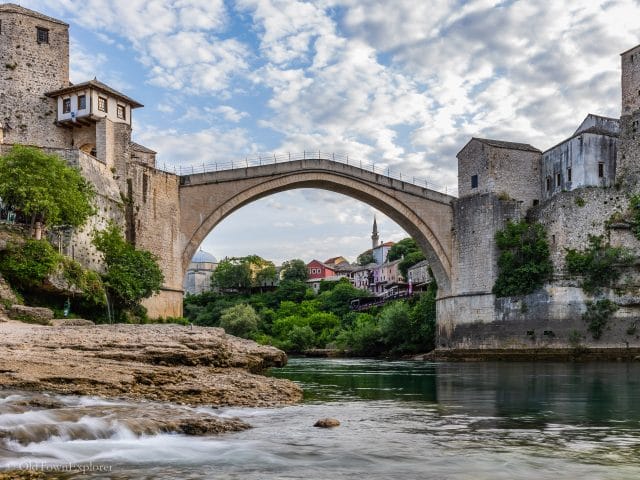
Stari Most
- Architect: Mimar Hayruddin
- Style: Ottoman stone bridge
- Built: 1557–1566; reconstructed 2001–2004
- Address: Stari Most, 88000 Mostar, Bosnia and Herzegovina
Stari Most crosses the Neretva in one high stone arch between the Tara and Halebija Towers. Walk down toward river level to see the full curve of the span and the way the bridge rises from the rock on each bank.
The original 16th-century bridge was destroyed in 1993. The reconstructed bridge reopened in 2004, and the Old Bridge Area entered the UNESCO World Heritage List in 2005. The designation covers the surrounding Old City ensemble rather than the bridge as a separate object.

Kriva Ćuprija
- Architect: Traditionally attributed to Ćejvan Ketoda
- Style: Ottoman stone bridge
- Built: 16th century
- Address: Jusovina, beside the Radobolja River, Mostar
Kriva Ćuprija, or the Crooked Bridge, crosses the smaller Radobolja River near Jusovina. Its single arch, stone parapets, and intimate scale provide a useful comparison with Stari Most without repeating the larger bridge’s dramatic height.
View it from the riverbank and adjoining terraces as well as from the bridge deck. The surrounding stone buildings make this a compact architectural ensemble rather than a bridge seen in isolation.
Mosques in Mostar
Mostar’s mosques range from large domed complexes to small neighborhood prayer buildings with hipped roofs and stone minarets. Compare their scale, roof form, porch, courtyard, and relationship with the surrounding streets rather than treating every mosque as the same type.

Karađoz Bey Mosque
- Architect: Attributed to Mimar Sinan or his architectural circle
- Style: Classical Ottoman
- Built: 1557–1558
- Address: Braće Fejića, Mostar
Karađoz Bey Mosque uses a large central dome, a tall stone minaret, a columned entrance porch, and a walled courtyard. Its position on Braće Fejića separates it from the most crowded bridge approaches and allows more space to view the full composition.
Focus on the transition from the square prayer hall to the dome and on the smaller domed bays above the entrance porch. The surrounding complex historically included educational and charitable buildings.

Koski Mehmed Pasha Mosque
- Architect: Unknown
- Style: Classical Ottoman
- Built: Early 17th century
- Address: Mala Tepa, above the Neretva River
Koski Mehmed Pasha Mosque stands close to the river above Stari Most. Its single dome, slender minaret, courtyard, and elevated position make the relationship between mosque architecture and the Neretva especially clear.
The exterior and courtyard provide strong river-and-bridge views even when you do not plan an interior or minaret visit. Check current visitor arrangements before relying on interior or tower access.

Nesuh-Aga Vučjaković Mosque
- Architect: Unknown
- Style: Ottoman mosque with regional stonework
- Built: Mid-16th century
- Address: Maršala Tita, Mostar
Nesuh-Aga Vučjaković Mosque is a compact domed mosque set away from the riverfront visitor route. Its dressed-stone walls, low entrance porch, central dome, and minaret create a smaller composition than Karađoz Bey Mosque.
Add it when you want to see how Ottoman religious architecture continued into the neighborhoods beyond Stari Most. The quieter street setting also makes its proportions easier to compare with nearby houses.

Hadži-Kurt Mosque
- Architect: Unknown
- Style: Ottoman neighborhood mosque
- Built: 16th or 17th century
- Address: Rade Bitange, near the western approach to Stari Most
Hadži-Kurt Mosque, widely called Tabačica Mosque, stands close to the Old Bridge in the former leatherworkers’ area. Its hipped roof and slender stone minaret distinguish it from Mostar’s larger domed mosques.
Look at how tightly the mosque fits between the pedestrian lanes and adjoining commercial buildings. It demonstrates the smaller neighborhood scale of religious architecture within the bazaar area.

Ćejvan-Ćehaja Mosque
- Architect: Unknown
- Style: Ottoman neighborhood mosque
- Built: Mid-16th century
- Address: Ramića, Mostar
Ćejvan-Ćehaja Mosque belongs to one of Mostar’s early Ottoman religious complexes. Its stone prayer hall, hipped roof, minaret, courtyard, and relationship with the surrounding residential streets matter more than decorative monumentality.
Visit it as part of a walk beyond the bridge rather than expecting the visual scale of Karađoz Bey Mosque. The compact complex helps explain how mosques organized individual urban neighborhoods.

Hadži Tere Jahja Mosque
- Architect: Unknown
- Style: Ottoman neighborhood mosque
- Built: Early 17th century
- Address: Kresina, Mostar
Hadži Tere Jahja Mosque is a small stone prayer building with a hipped roof and a narrow minaret. Its modest scale and residential setting provide a useful counterpoint to the domed mosques closer to the main visitor route.
Notice the simple rectangular form, limited ornament, and way the mosque sits within the street rather than dominating a large open square.

Nezir-Aga Mosque
- Architect: Unknown
- Style: Ottoman neighborhood mosque
- Built: 16th century
- Address: Above Kriva Ćuprija on the west side of the Neretva
Nezir-Aga Mosque occupies a raised position above the Crooked Bridge area. The stone prayer hall, porch, hipped roof, and slender minaret fit the steep residential terrain rather than a monumental civic space.
Add this mosque while exploring Jusovina and Kriva Ćuprija. The climb provides a clearer sense of how Mostar’s Ottoman neighborhoods rose above the rivers and commercial lanes.

Sultan Selim Mesdžid
- Architect: Unknown
- Style: Small Ottoman prayer building
- Built: Traditionally associated with the early Ottoman period in Mostar
- Address: Beside the eastern approach to Stari Most
Sultan Selim Mesdžid is a small prayer structure beside the Old Bridge complex. Rebuilding and later alterations make its original appearance difficult to reconstruct, so its location beside the historic crossing is more important than decorative detail.
Notice it as part of the dense group of religious, defensive, and commercial buildings around Stari Most rather than as a separate destination requiring a long visit.
Towers and Fortifications in Mostar
Mostar’s surviving towers explain how the bridge crossing was defended and controlled. The bridge towers stand directly against the Neretva, while the clock tower belongs to the civic rhythm of the Ottoman town beyond the river crossing.

Tara and Halebija Towers
- Architect: Unknown
- Style: Medieval and Ottoman defensive architecture
- Built: Developed and altered over several periods
- Address: At the east and west ends of Stari Most
The Tara Tower on the east bank and Halebija Tower on the west bank close the approaches to Stari Most. Their thick stone walls, small openings, and irregular forms contrast with the bridge’s clean arch.
Look back at both towers after crossing the bridge. Their different shapes make clear that the crossing developed as a fortified complex rather than as one bridge designed all at once. UNESCO’s nomination material treats the bridge and its fortifications as one historic ensemble.

Mostar Clock Tower
- Architect: Unknown
- Style: Ottoman clock tower
- Built: Ottoman period; commonly dated to the 17th century
- Address: Near the east side of the historic center
The Mostar Clock Tower, or Sahat Kula, is a tall square stone structure with restrained openings and a clock stage near the top. Its plain vertical form differs from both the slender mosque minarets and the heavy bridge towers.
Notice it as part of the Old Town skyline rather than expecting an elaborate façade. The tower’s value comes from its height, civic function, and position among lower roofs.
Christian Religious Buildings in Mostar
Mostar’s major Christian buildings stand beyond the tight bridge-and-bazaar ensemble. Their larger footprints, tall bell towers, domes, and open church grounds show how the city expanded during the 19th century and after the destruction of the 1990s.

Cathedral of the Holy Trinity
- Architect: Andreja Damjanov, with earlier work associated with Spasoje Vulić
- Style: Serbo-Byzantine Revival with eclectic 19th-century details
- Built: 1863–1873; destroyed in 1992 and subsequently reconstructed
- Address: Bjelušine, Mostar
The Cathedral of the Holy Trinity rises on the hillside east of the Neretva. Multiple domes, drums, arched openings, and a tall bell tower give it a mass and skyline presence unlike the smaller Ottoman mosques below.
The cathedral was destroyed during the war and has undergone a long reconstruction. Treat the exterior and grounds as the reliable architecture stop, and check current official information before planning an interior visit or assuming that all work is complete.
Church of Saints Peter and Paul and Peace Bell Tower
- Architect: Original 19th-century church associated with Matteo Lorenzoni; present complex rebuilt after wartime destruction
- Style: Contemporary Catholic church and modern bell tower
- Built: Original church completed in the 19th century; present complex largely postwar
- Address: Franjevačka, Mostar
The Church of Saints Peter and Paul has a broad contemporary façade beside the narrow, 107-meter Peace Bell Tower. The tower’s concrete-and-stone vertical form is visible from many parts of central Mostar and provides a strong modern counterpoint to the Old Town minarets. The official Mostar Pass site provides current visitor information for the Peace Bell Tower.
View the complex from Franjevačka and from the river approaches to understand its skyline role. Check current opening and lift access before planning around the tower viewpoint.
Other Attractions in Mostar
Mostar’s smaller architecture stops include Ottoman houses, a compact wartime cemetery, adapted buildings in the Old Town, and structures that still carry visible conflict damage. These places are secondary to Stari Most and the major religious buildings, but they show how people lived, traded, remembered the dead, and reused damaged buildings across the city.

Biščević House Museum
- Architect: Unknown
- Style: Ottoman residential architecture
- Built: Traditionally dated to about 1635
- Address: Biščevića bb, 88000 Mostar, Bosnia and Herzegovina
Biščević House is part of a multilevel Ottoman residential complex built against the slope above the Neretva. Stone walls, timber construction, projecting upper rooms, enclosed domestic spaces, and views toward the river show how Mostar’s houses responded to steep ground and hot summers.
The museum rooms contain carpets, metalwork, ceramics, and traditional furnishings. Look beyond the objects to the contrast between the plain street entrance, the enclosed courtyard, and the more open upper rooms inside the property.

Muslibegović House
- Architect: Unknown
- Style: Ottoman residential architecture
- Built: Developed after 1750, with later additions
- Address: Osmana Džikića 41, 88000 Mostar, Bosnia and Herzegovina
Muslibegović House is a protected residential complex that now operates as a hotel and museum. High stone boundary walls lead into two courtyards, while timber details, projecting upper floors, furnished rooms, and garden spaces reveal the private side of a prosperous Ottoman household.
We stayed here during our first visit to Mostar. Sleeping inside the complex gave us more time to notice the transition from the restrained exterior walls to the courtyards and decorated rooms within. It is a strong accommodation choice for travelers who want to spend the night inside a historic building rather than visit one briefly.

Šehitluci Martyrs’ Cemetery
- Architect: Unknown
- Style: Commemorative cemetery landscape
- Built: Established after the 1992–1995 war
- Location: Brankovac, near central Mostar
Šehitluci Martyrs’ Cemetery contains closely spaced white grave markers for people killed during the war of the 1990s. Repetition, limited ornament, narrow spacing, and the contrast between white stone and the surrounding city give the cemetery its visual force.
This is a place of mourning rather than a conventional architecture attraction. Walk quietly, avoid treating the graves as decorative objects, and focus on how the compact cemetery occupies an ordinary urban neighborhood rather than a separate monumental park.

Old Town Cafés and Galleries
- Architect: Not applicable
- Style: Adapted Ottoman bazaar buildings
- Built: Historic fabric with later reconstruction and commercial alterations
- Location: Kujundžiluk, Mala Tepa, Onešćukova, Jusovina, and the lanes around Stari Most
Many cafés, galleries, workshops, and shops around Stari Most occupy low stone buildings that follow the narrow lines of the former bazaar. Timber shopfronts, small doorways, projecting signs, roof terraces, cobbled passages, and rooms adapted to steep slopes preserve the close scale of the Old Town even where the interiors serve modern businesses.
Look at the buildings early in the morning or after the busiest daytime period, when tables, merchandise, and crowds are less likely to hide the façades. The strongest details are often above eye level: timber framing, roof edges, upper windows, stone arches, and the uneven line of adjoining buildings.

War-Damaged and Abandoned Buildings
- Architect: Varies by building
- Style: Austro-Hungarian, Yugoslav, modern, and vernacular urban architecture
- Built: Various periods
- Location: Scattered through central Mostar beyond the restored Old Town
Buildings with roof loss, exposed interiors, damaged façades, empty window openings, and impact marks remain visible beyond the restored streets around Stari Most. These structures create a sharp contrast with the reconstructed bridge ensemble and show that Mostar’s postwar rebuilding has not affected every street equally.
Observe these buildings from public streets. Do not enter fenced, unstable, or abandoned structures, and do not assume that an empty building is publicly accessible. Concentrate on visible construction details such as masonry walls, floor plates, stair openings, patched façades, and the way newer buildings have developed around the damaged shells.
Things to Know Before You Go
Stari Most Is the Best Short-Visit Base
The bridge, towers, bazaar, Tabačica Mosque, Koski Mehmed Pasha Mosque, and Kriva Ćuprija fit into a compact central area. Stay near the Old Bridge when you have only two hours, but continue beyond it when Ottoman houses and Christian buildings matter.
Cobbles, Steps and Slopes Slow the Walk
The bridge approaches use polished cobbles, uneven stones, steps, and steep slopes. Wear shoes with secure soles, especially after rain, and avoid treating short map distances as flat walking routes.
Early Morning Gives Clearer Building Views
The lanes around Stari Most receive their heaviest pedestrian traffic during popular day-trip hours. Early morning gives you more room to see bridge parapets, tower walls, shopfronts, and rooflines without continuous crowds.
Many Buildings Are Worth Seeing from Outside
Stari Most, the bridge towers, Kujundžiluk, the clock tower, mosque exteriors, and the major church skylines can all be understood without an interior visit. Mosque, museum-house, bell-tower, and cathedral access may vary, so check current information before building the day around an interior.
Summer Heat Favors Shorter Walking Blocks
Mostar’s stone lanes and bridge approaches can become hot during summer afternoons. Walk the exposed Old Town early, then save shaded courtyards, museums, cafés, or less exposed streets for later.
Evening Light Works Well Along the Neretva
Late light reaches the bridge, towers, mosque minarets, and stone houses from different angles on the two riverbanks. Walk both sides rather than remaining at one terrace, and stay after sunset when you want the illuminated bridge and skyline.
Mobility Constraints Matter Around the Old Town
Steep cobbles, steps, narrow passages, and bridge gradients can make the historic center difficult for wheelchairs, walkers, and heavy luggage. The wider streets west and north of the Old Town are easier, but they do not remove all slopes from the main architecture route.
A Two-Hour Visit Should Remain Near the Bridge
Prioritize Stari Most, Tara and Halebija Towers, Kujundžiluk, Koski Mehmed Pasha Mosque, Tabačica Mosque, and Kriva Ćuprija. Do not spend the limited time crossing the wider city for one distant building.
A Half Day Adds a Mosque and Ottoman House
After the bridge area, continue to Karađoz Bey Mosque and either Biščević House or Muslibegović House. This adds a large mosque complex and domestic architecture without turning the walk into a full-city route.
A Full Day Reaches the Christian Buildings
A full day allows the Old Bridge ensemble, one or two Ottoman houses, Karađoz Bey Mosque, the Cathedral of the Holy Trinity, and the Church of Saints Peter and Paul. Allow extra time for slopes and interior visits rather than treating the sites as a checklist.
Architecture Tours in Mostar
An independent walk is enough for the bridge, towers, bazaar streets, and major exterior views. A guided tour becomes more useful when you want help separating Ottoman, Austro-Hungarian, Yugoslav, wartime, and reconstruction layers or understanding how buildings on both sides of the Neretva relate to one another.
Guided Tours
Compare tours by the areas covered, walking distance, historical focus, group size, interior visits, meeting point, and whether the route continues beyond Stari Most. Check current inclusions and access rules before booking because many general Mostar tours focus more on political history than on individual buildings.
Where to Stay for Architecture Walks
Choose accommodation according to whether you want the Old Bridge ensemble outside your door or easier access to buildings beyond the pedestrian center.
- Near Stari Most: Shortest walk to the bridge, towers, bazaar, Tabačica Mosque, Koski Mehmed Pasha Mosque, and Kriva Ćuprija. Expect steep cobbles and heavy daytime foot traffic.
- Near Braće Fejića and Musala: Convenient for Karađoz Bey Mosque, the clock tower, Muslibegović House, and a level approach from the newer city before entering the Old Town.
- West of the Neretva: Better for the Church of Saints Peter and Paul, vehicle access, and properties outside the busiest pedestrian lanes while keeping Stari Most within walking distance.
- East of the Old Town: Useful for the Cathedral of the Holy Trinity and quieter hillside streets, but the slopes add effort to repeated walks across the river.
Stari Most is the most efficient base for a short architecture visit. Braće Fejića, Musala, or the streets just west of the pedestrian core provide a better balance for a longer stay that includes buildings outside the Old Town.
Hotels and Apartments in Mostar
Use the interactive map below to compare hotels and apartments near Stari Most, Braće Fejića, Musala, the western city, and the eastern hillside. Check the exact walking route for cobbles, stairs, slopes, parking, and luggage access before booking.
FAQs About Mostar Architecture
What Architecture Is Mostar Known For?
Mostar is known for Stari Most, Ottoman bridge towers, domed and hipped-roof mosques, stone courtyard houses, and the narrow bazaar streets beside the Neretva. The wider city adds 19th-century Christian buildings and prominent postwar reconstruction.
Which Mostar Buildings Should I See First?
See Stari Most, Tara and Halebija Towers, Koski Mehmed Pasha Mosque, Karađoz Bey Mosque, and either Biščević House or Muslibegović House first. These stops cover the bridge, defenses, religious architecture, and residential architecture.
Can I See Mostar Architecture in Two Hours?
Yes. Keep a two-hour visit around Stari Most, Kujundžiluk, the bridge towers, Koski Mehmed Pasha Mosque, Tabačica Mosque, and Kriva Ćuprija. A half or full day is needed for houses and churches beyond the central lanes.
Are Mostar’s Main Buildings Inside the Old Town?
Many of the most recognizable sites are in or beside the Old Town, including Stari Most, the towers, bazaar, several mosques, and Kriva Ćuprija. Karađoz Bey Mosque, Muslibegović House, the Orthodox cathedral, and the Franciscan church require walks beyond the bridge area.
What Architectural Styles Will I See in Mostar?
The Old Town is dominated by Ottoman bridges, mosques, houses, and commercial streets. Beyond it, you will see Austro-Hungarian-era urban development, Orthodox and Catholic revival architecture, Yugoslav buildings, modern religious architecture, and postwar reconstruction.
Can I Understand Mostar’s Architecture from the Outside?
Yes. The bridge arches, towers, mosque domes and minarets, courtyard walls, projecting house rooms, church towers, and street patterns are visible from public routes. Interiors add detail but are not required for a useful architecture walk.
What Is the Best Viewpoint for Mostar’s Architecture?
River-level viewpoints near Stari Most show the bridge, towers, houses, and valley together. The Koski Mehmed Pasha Mosque area provides a higher view over the bridge, while the Peace Bell Tower may provide a wider city panorama when visitor access is operating.
Is Mostar Architecture Easy to Explore on Foot?
The main Old Town architecture is compact and walkable, but polished cobbles, steep gradients, and steps make the route more demanding than the distances suggest. Christian buildings and hillside neighborhoods add longer climbs and road crossings.
How Much Time Do I Need for Mostar Architecture?
Allow two hours for the Old Bridge ensemble, half a day for the bridge plus mosques and an Ottoman house, or a full day for the wider city’s Christian buildings and additional neighborhoods.
Where Should I Stay for Architecture Walks?
Stay near Stari Most for the shortest walk to the central Ottoman ensemble. Choose Braće Fejića, Musala, or the western edge of the Old Town when you want easier access to both the historic center and buildings beyond it.
Use Bosnia Architecture for the country’s Ottoman, Austro-Hungarian, religious, and Yugoslav building traditions. Return to the Mostar city guide for timing and transportation, then plan meals with Mostar Food or local wine stops with Mostar Wine.