
Bulgaria Architecture
Explore Bulgaria Architecture: Architectural Styles & UNESCO World Heritage Sites
Bulgaria architecture combines Thracian burial monuments, Roman urban remains, medieval Orthodox complexes, and National Revival houses. Stone tomb chambers, fortress walls, frescoed churches, and projecting timber upper floors make those periods visible across the country.
Plovdiv is the clearest base for Roman and Revival layers. Veliko Tarnovo centers on medieval fortresses, while Sofia adds later civic architecture.
We spent a month in Plovdiv and several days in Veliko Tarnovo while traveling in Bulgaria. For a first architecture trip, pair city walks with one outlying monastery, tomb, or fortress rather than trying to fit every period into one route.
This page contains affiliate links. We may earn a small commission at no extra cost to you.
Bulgaria Architecture at a Glance
Bulgaria is easiest to explore architecturally through Plovdiv and Veliko Tarnovo, then one additional city or heritage route. Plovdiv puts Roman remains beside National Revival houses, while Veliko Tarnovo shifts the focus to medieval fortifications and hillside architecture.
Key architecture points:
- Best starting points: Plovdiv for Roman public buildings and National Revival houses; Veliko Tarnovo for medieval fortresses and hillside neighborhoods; Sofia for Roman Serdica, post-Liberation civic buildings, Orthodox landmarks, and socialist architecture.
- Core architecture identity: Thracian tombs, Roman urban remains, medieval fortresses and Orthodox buildings, National Revival houses, and later civic architecture.
- Main styles or periods: Thracian, Greek and Roman; medieval Bulgarian and Orthodox; Ottoman and National Revival; post-Liberation Historicist and socialist-era architecture.
- UNESCO anchors: Nessebar for a layered Black Sea town, Rila Monastery and Boyana Church for Orthodox architecture, and Kazanlak and Sveshtari for Thracian funerary architecture.
- How to see it: Walk the historic centers first, then plan separate trips for monasteries, tombs, cliff sites, and fortresses outside the main cities.
A first route through Plovdiv and Veliko Tarnovo covers the strongest Roman, medieval, Ottoman, Orthodox, and National Revival contrasts before you decide whether Sofia, Nessebar, Rila, or another outlying site belongs on the trip.
Architectural Styles in Bulgaria
Bulgarian architecture developed through ancient Balkan cultures, the Roman Empire, medieval Bulgarian states, Ottoman rule, the National Revival, post-1878 nation-building, and socialist urban expansion. The surviving architecture ranges from underground tomb chambers and fortified hills to painted churches, merchant houses, civic boulevards, and reinforced-concrete districts.
Thracian, Greek, and Roman Architecture
Thracian architecture survives most clearly in burial complexes. The tombs at Kazanlak and Sveshtari use carefully cut masonry, vaulted chambers, painted surfaces, sculpted figures, and controlled ceremonial approaches rather than large urban ensembles.
Greek and Roman remains are more visible in towns. Plovdiv preserves a theater, stadium, forum, streets, and sections of defensive construction, while central Sofia contains remains of Roman Serdica. Nessebar combines ancient settlement traces with later medieval and Revival-period architecture.
Medieval Bulgarian and Orthodox Architecture
Medieval architecture includes fortified capitals, palace and patriarchal compounds, monasteries, parish churches, cliff monasteries, and carved reliefs. Tsarevets and Trapezitsa in Veliko Tarnovo retain walls, gates, towers, church foundations, and the topography of the Second Bulgarian Empire’s capital.
Orthodox buildings range from compact medieval churches to large monastery ensembles. Alternating stone and brick, cross-domed plans, apses, barrel vaults, fresco cycles, arcaded residential wings, and enclosed courtyards appear at Boyana Church, Rila Monastery, the Rock-Hewn Churches of Ivanovo, and other surviving sites.
Ottoman Urban Form and Bulgarian National Revival
Ottoman-period towns developed around market streets, mosques, baths, inns, workshops, fountains, and residential quarters. Although many Ottoman buildings were lost after independence and during later urban redevelopment, surviving street patterns and individual monuments remain visible in Sofia, Plovdiv, Shumen, and other towns.
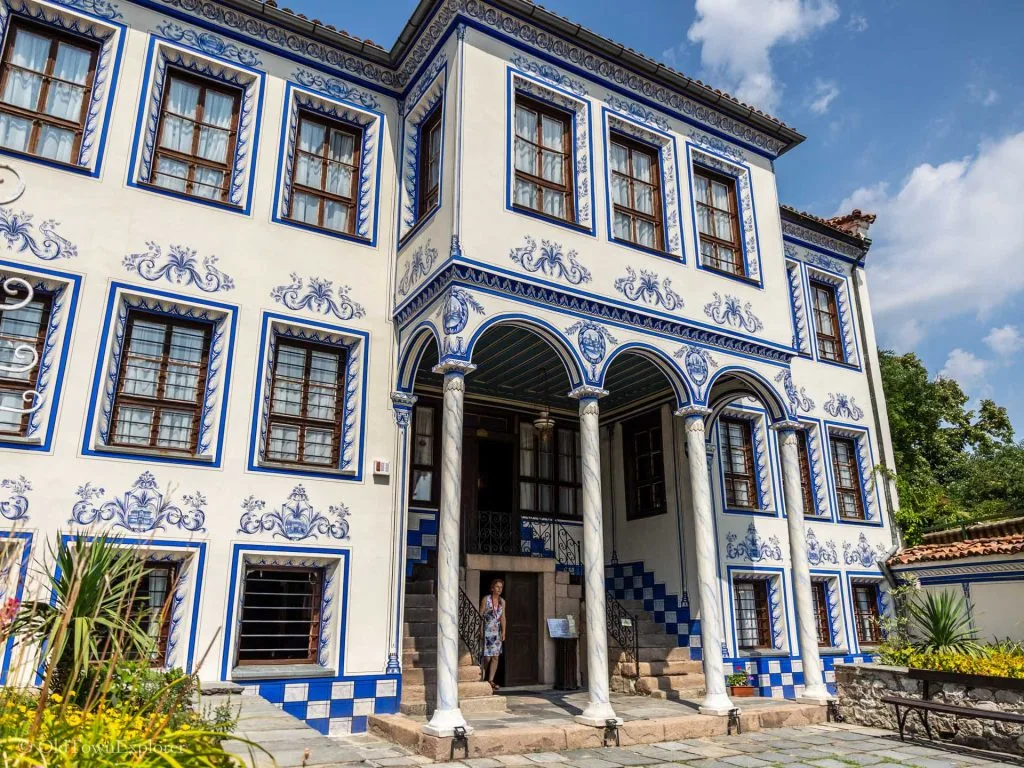
National Revival architecture expanded during the late 18th and 19th centuries. Houses commonly use masonry lower floors, timber-framed upper stories, projecting bays, deep eaves, tiled roofs, enclosed courtyards, central reception halls, carved ceilings, cupboards, wall paintings, and decorated façades.
Plovdiv is known for large symmetrical merchant houses sometimes described as Plovdiv Baroque. Arbanasi has more defensive merchant compounds with high stone walls, while mountain settlements adapt the same period’s domestic forms to steeper terrain and heavier stone construction.
Post-Liberation Historicism and Socialist-Era Architecture
After 1878, Sofia and other expanding cities gained ministries, courts, schools, railway stations, banks, theaters, apartment buildings, and Orthodox landmarks. Neo-Renaissance, Neoclassical, Neo-Byzantine, eclectic, and Secession design reshaped streets and civic centers.
After 1944, monumental state buildings, broad squares, cultural halls, housing estates, transport infrastructure, memorials, and prefabricated apartment districts changed the scale of Bulgarian cities. Central Sofia’s government quarter contrasts with the Roman remains below it and the late 19th- and early 20th-century streets around it.
Architecture by Region in Bulgaria
Architecture changes across Bulgaria with terrain, trade routes, former political centers, and local construction materials. The main route choices are Sofia and the southwest, the Thracian Lowland around Plovdiv, north-central Bulgaria around Veliko Tarnovo, and the Black Sea and northeast.
Sofia and Southwest Bulgaria
Sofia combines Roman Serdica, medieval Boyana Church, Ottoman remnants, post-Liberation government buildings, Orthodox churches, apartment streets, and socialist state architecture. Rila Monastery is the principal southwest extension, with an enclosed courtyard, arcaded residential wings, a painted main church, and the surviving medieval Hrelyo Tower.
Plovdiv and the Thracian Lowland
Plovdiv provides the country’s clearest urban sequence from antiquity to the 19th century. Roman public buildings occupy the center and surrounding hills, while the Old Town contains merchant houses, churches, street walls, gates, and later museums. Asen’s Fortress adds a medieval fortified site in the Rhodope foothills, while Kazanlak extends the route into Thracian funerary architecture.
Veliko Tarnovo and North-Central Bulgaria
Veliko Tarnovo centers on Tsarevets, Trapezitsa, medieval church sites, hillside houses, and later civic streets. Arbanasi adds fortified merchant houses and painted churches, while the Rock-Hewn Churches of Ivanovo combine medieval interiors with a cliff landscape farther north.
Black Sea and Northeast Bulgaria
Nessebar is the principal coastal architecture stop, combining ancient settlement remains, medieval churches, fortifications, and timber houses. Farther inland, the northeast adds the Madara Rider, early Bulgarian fortified landscapes, Ottoman monuments in Shumen, and the sculpted Thracian burial chamber at Sveshtari.
UNESCO World Heritage Sites in Bulgaria
Bulgaria has ten properties on the UNESCO World Heritage List: seven cultural and three natural. The cultural properties range from Thracian tombs and early Bulgarian monuments to Orthodox churches, monastic complexes, and a layered Black Sea town.
Ancient City of Nessebar
The Ancient City of Nessebar occupies a small Black Sea peninsula with traces of Thracian settlement, Greek and Roman urban development, medieval fortifications, churches, and 19th-century houses. Notice the alternating stone and brick in medieval church façades, ceramic ornament, narrow streets, timber upper floors, and the settlement’s compressed relationship with the shoreline.
Boyana Church
Boyana Church consists of three connected building phases. The eastern church dates from the medieval period, the central section was added in the 13th century, and the western extension followed in the early 19th century. The 1259 frescoes are the principal interior feature, but the compact masonry volumes also make the building sequence visible from outside.
Madara Rider
The Madara Rider is a monumental relief carved into a high cliff rather than a conventional building. The horseman, lion, dog, and nearby inscriptions are tied to the early Bulgarian state. View the carving together with the plateau, caves, archaeological remains, and former fortified landscape.
Rila Monastery
Rila Monastery was founded in the 10th century, although much of the present ensemble dates from rebuilding in the 19th century. Arcaded residential wings enclose a large courtyard around the main church and the medieval Hrelyo Tower. Painted façades, domes, timber galleries, stone lower levels, and the mountain setting define the approach.
Rock-Hewn Churches of Ivanovo
The Rock-Hewn Churches of Ivanovo form a monastic complex carved into cliffs above the Rusenski Lom valley. Churches, chapels, cells, and passages developed from the 12th century onward, with surviving 14th-century murals. The architecture is defined by excavated interiors and their relationship to the rock face rather than exterior façades.
Thracian Tomb of Kazanlak
The Thracian Tomb of Kazanlak dates from the late 4th century BC. A narrow corridor leads to a circular vaulted chamber decorated with painted figures, horses, processions, and a funerary banquet. The original tomb has restricted conservation access, while a nearby replica presents the chamber arrangement and painted program.
Thracian Tomb of Sveshtari
The Thracian Tomb of Sveshtari dates from the 3rd century BC. Its central chamber contains ten sculpted female figures supporting the upper wall zone, along with traces of painted decoration and carefully shaped vaulting. The remote northeastern location requires more transport planning than Bulgaria’s city-based World Heritage properties.
How to See Bulgaria Architecture
City Architecture Routes
Plovdiv Architecture is easiest to follow from the Roman theatre and stadium toward the forum area and then uphill into the Old Town houses. The center is compact, but cobbles and steep streets slow the walk between the pedestrian area and the historic hills.
Veliko Tarnovo Architecture needs a different approach. Divide the visit between the historic streets and the fortified hills, then add Arbanasi when merchant houses and painted churches justify another stop outside the center.
Sofia spreads its architecture across a larger area. Group the Roman remains and central civic buildings together, then treat Boyana Church and other outer districts as separate stops.
Guided Architecture Tours
A guide adds the most context at places where several periods overlap or where ruins are difficult to read on their own. Plovdiv, central Sofia, medieval fortress sites, archaeological remains, and frescoed religious buildings are the strongest candidates. Before booking, check whether the route includes interiors, transport to outlying sites, or time inside churches and museums.
Independent Architecture Walks
Independent walks work well in central Plovdiv, Sofia, and Veliko Tarnovo because much of the architecture can be read from streets, squares, fortress approaches, and public viewpoints. Look at masonry, rooflines, projecting upper floors, gates, church forms, street plans, and the way buildings respond to hills and defensive terrain.
Plovdiv and Veliko Tarnovo involve more cobbles, slopes, stairs, and uneven paving than a flat city-center walk. Allow more time when the route climbs into an Old Town or fortress area.
Interiors, Landscapes, and Route Planning
Fortresses and religious complexes need more time than façade-based city walks. The Tsarevets Fortress route covers medieval walls and palace and patriarchal areas, while Arbanasi adds merchant houses and painted churches near Veliko Tarnovo.
From Plovdiv, Asen’s Fortress adds a medieval church and defensive site above the Asenitsa valley. Bachkovo Monastery lies farther along the same general route south of Plovdiv, so the two sites can fit the same architecture-focused outing. Rila Monastery, Kazanlak, Sveshtari, Ivanovo, Madara, and Nessebar need separate day trips or longer regional routes.
For current museum and monument information, check the official Visit Plovdiv and Regional Museum of History Veliko Tarnovo websites before departure.
FAQs About Bulgaria Architecture
What architectural styles define Bulgaria?
Bulgaria’s main architectural layers include Thracian funerary monuments, Greek and Roman urban remains, medieval Bulgarian fortresses, Orthodox churches and monasteries, Ottoman urban forms, National Revival houses, post-Liberation Historicism, and socialist civic and residential architecture.
What is Bulgarian National Revival architecture?
Bulgarian National Revival architecture developed mainly during the late 18th and 19th centuries. Houses often have stone lower floors, timber-framed upper stories, projecting bays, deep eaves, tiled roofs, courtyards, central halls, carved ceilings, wall paintings, and decorative façades. Plovdiv, Arbanasi, Koprivshtitsa, and several mountain towns preserve major examples.
Which city is the strongest base for architecture?
Plovdiv has the clearest combination of Roman remains and National Revival houses. Veliko Tarnovo is the stronger base for medieval Bulgarian architecture, while Sofia has the broadest range of Roman, post-Liberation, Orthodox, and socialist civic design.
Which UNESCO sites in Bulgaria are most important for architecture?
Start with Nessebar for medieval churches and Black Sea vernacular houses, Rila Monastery for a large Orthodox monastic ensemble, and Boyana Church for compact medieval church architecture and frescoes. Kazanlak and Sveshtari add Thracian burial architecture, while Ivanovo is the strongest contrast if you want to see religious spaces cut directly into rock.
Can Bulgaria architecture be seen without a car?
Yes for the main city routes. Central Plovdiv, Sofia, and Veliko Tarnovo can be explored largely on foot. Rila Monastery, Ivanovo, Sveshtari, Madara, Arbanasi, and outlying fortress sites need separate transport planning, so decide which of those places matters before adding them to the route.