
Germany Wine
Explore Germany Wine: Wine Regions & Grape Varieties
German vineyards produce Riesling, Spätburgunder, Silvaner, Weißburgunder, Grauburgunder, Sekt, and wines ranging from trocken to noble-sweet. River valleys dominate much of the wine map, but warmer areas in the southwest give Pinot varieties and red grapes a much larger role.
Start with the Mosel for steep-slope Riesling, Rheingau for Riesling and Spätburgunder along the Rhine, Pfalz for a broader range of dry whites and reds, and Franconia for Silvaner and the distinctive Bocksbeutel bottle. Ahr, Baden, and Württemberg become more important when red wine is a priority.
We spent a month in Lübeck researching Germany. Lübeck is not a vineyard base, but its wine shops, bars, and Rotspon tradition gave us a northern view of German wine. For a first bottle, region, grape, dryness term, and origin level matter more than memorizing every vineyard name.
Germany Wine at a Glance
Germany's 13 official wine-growing regions range from steep Riesling valleys to warmer southern areas where Pinot varieties and local red grapes play a much larger role.
Key wine and tasting points:
- Best starting points: Choose Mosel or Rheingau for Riesling, Pfalz for a broad dry-wine range, Franconia for Silvaner, and Ahr or Baden when Spätburgunder is the priority.
- Core wine identity: High-acid white wines remain central, but Germany also produces important Pinot-based whites and reds, Sekt, rosé, and sweet Prädikat wines.
- Main wine regions: The 13 regions are Ahr, Baden, Franconia, Hessische Bergstraße, Mittelrhein, Mosel, Nahe, Pfalz, Rheingau, Rheinhessen, Saale-Unstrut, Saxony, and Württemberg.
- Main grapes: Learn Riesling first, then Spätburgunder, Silvaner, Weißburgunder, Grauburgunder, Müller-Thurgau, Scheurebe, Dornfelder, Trollinger, and Lemberger.
- Key wine styles: Look for trocken Riesling, lighter Kabinett, Franconian Silvaner, Spätburgunder, Sekt, and the sweeter Prädikat categories when you want to compare the country's main styles.
- Tasting notes: Mosel and Rhine routes work well around wine towns and river valleys. Lübeck is better for Rotspon, wine bars, and bottle shopping than vineyard visits.
A first tasting of Riesling, Silvaner, Spätburgunder, and Sekt gives a much clearer picture of German wine than Riesling alone.
Wine Regions in Germany
Germany has 13 official wine-growing regions, with most vineyards concentrated in the west and southwest. Mosel, Rheingau, Nahe, and Mittelrhein are the main Riesling-led river valleys. Pfalz and Rheinhessen offer broader grape ranges, while Ahr, Baden, and Württemberg give red grapes a larger role. Franconia is the clearest region for Silvaner, and Saale-Unstrut and Saxony form the smaller eastern pair. Hessische Bergstraße provides a compact wine area between the Rhine and the Odenwald.
The German Wine Institute region map lists the 13 official wine regions and gives a reference point for region names, vineyard areas, and wine-route geography.
Ahr
The Ahr is one of Germany’s smallest wine regions and one of its clearest red-wine areas. Spätburgunder is the main grape, often grown on steep slopes above the Ahr River, with Frühburgunder and smaller amounts of white wine also appearing on labels.
Ahr wine is a strong choice for travelers who want German red wine first, especially Spätburgunder with duck, pork, mushrooms, roast dishes, sausages, and aged cheese.
Baden
Baden is Germany’s long southern wine region near Alsace, Switzerland, the Black Forest, Kaiserstuhl, and Lake Constance. It is important for Spätburgunder, Grauburgunder, Weissburgunder, Müller-Thurgau, Chardonnay, and fuller southern German styles.
Baden is one of the clearest regions for comparing German Pinot-family wines, especially Spätburgunder for red wine and Grauburgunder or Weissburgunder for dry white wine.
Franconia
Franconia, or Franken, follows the Main River in northern Bavaria. Silvaner is the first grape to know, often bottled in the flat, rounded Bocksbeutel, with Riesling, Müller-Thurgau, Weissburgunder, Grauburgunder, and Spätburgunder also present.
Franconia is a strong region for dry whites with asparagus, river fish, pork, onion tart, potato dishes, tavern food, and regional dishes from northern Bavaria.
Hessische Bergstraße
Hessische Bergstraße is a small wine region east of the Rhine near the Odenwald. Riesling, Silvaner, Weissburgunder, Grauburgunder, and Spätburgunder are the main bottle cues, with a quieter wine route than the Mosel, Rheingau, Pfalz, or Rheinhessen.
This region is best read as a small-scale western German wine route, especially for dry whites, Pinot-family grapes, and town-based tasting between the Rhine and the Odenwald.
Mittelrhein
The Mittelrhein follows the Rhine between Bingen and Bonn, where steep slopes, river towns, castles, Riesling, and some Spätburgunder shape the main tasting route. The landscape is narrow, dramatic, and closely tied to river travel.
Mittelrhein wine is a strong choice for Riesling with train or river-route travel, especially when the trip already follows the Rhine corridor.
Mosel
The Mosel wine region follows the Mosel, Saar, and Ruwer valleys and remains one of Germany's clearest starting points for Riesling. Steep slate slopes dominate many famous vineyard areas, but the Southern Mosel shifts toward limestone ground, Elbling, and Pinot varieties.
Start with Riesling from the Middle Mosel, Saar, or Ruwer for dry, feinherb, Kabinett, and Spätlese styles. The Terrassenmosel adds extreme terraced slopes farther downstream, while the Southern Mosel gives the strongest contrast through Elbling and limestone vineyards.
Nahe
The Nahe sits between the Mosel and Rheingau stylistically, with Riesling, Pinot-family grapes, Silvaner, and mixed soils that make it a strong region for comparing dry and off-dry whites. It is smaller than Rheinhessen or Pfalz but has a wide range of styles.
Nahe wine works well when the goal is Riesling with more variety in soil, texture, and producer style than a single river-valley comparison.
Palatinate
The Pfalz, also called the Palatinate, stretches along the Haardt Mountains and the German Wine Route. It is one of Germany’s clearest regions for dry Riesling, Weissburgunder, Grauburgunder, Spätburgunder, Dornfelder, aromatic whites, wine festivals, and food-friendly tavern wines.
Pfalz is a strong choice for dry wines, broader grape variety, red and white comparisons, and wine routes that pair well with regional food.
Rheingau
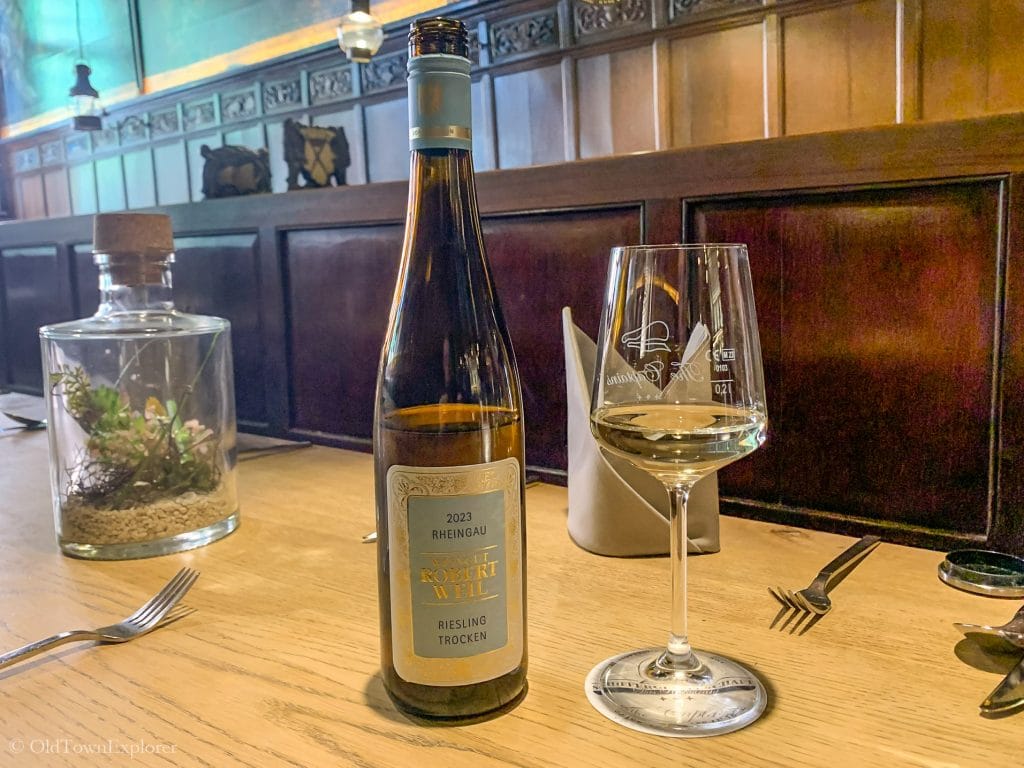
The Rheingau runs along the Rhine near Wiesbaden, Rüdesheim, and the river villages. Riesling is the main grape, with Spätburgunder also important, especially around Assmannshausen and nearby red-wine sites.
Rheingau is one of the clearest first regions for dry Riesling, age-worthy Riesling, Prädikat wines, estate tastings, river villages, and a compact wine route near the Rhine.
Rheinhessen
Rheinhessen is Germany’s largest wine region and gives a broad range of styles. Riesling, Silvaner, Müller-Thurgau, Weissburgunder, Grauburgunder, Chardonnay, Sauvignon Blanc, Dornfelder, and Spätburgunder all appear here.
Rheinhessen is a good region for comparing everyday dry whites, modern producer styles, red wines, and a wider grape range than many smaller German regions.
Saale‑Unstrut
Saale-Unstrut is a cooler eastern wine region along the Saale and Unstrut rivers. Müller-Thurgau, Riesling, Weissburgunder, Grauburgunder, Silvaner, and Spätburgunder are the main label names, with smaller-scale tasting routes and river-valley vineyards.
Saale-Unstrut is best for travelers who want a cooler eastern German wine route with dry whites, small producers, river towns, and a different feel from the Rhine and Mosel regions.
Saxony
Saxony, or Sachsen, follows the Elbe near Dresden and Meissen. It is one of Germany’s smallest wine regions, with Riesling, Müller-Thurgau, Weissburgunder, Grauburgunder, Traminer, and Spätburgunder among the main bottle cues.
Saxony works well with trips to Dresden or Meissen, especially for Elbe River wine, smaller vineyard sites, white wines, and regional tasting rooms.
Württemberg
Württemberg is centered around the Neckar and Stuttgart area, with red grapes playing a major role. Trollinger, Lemberger, Spätburgunder, Schwarzriesling, Riesling, and regional tavern wines are the main names to know.
Württemberg is one of the clearest German regions for local red wine with sausages, roast meats, pork, lentils, Spätzle, mushrooms, and tavern plates.
Wine Styles in Germany
German wine ranges from dry Riesling and Silvaner to Spätburgunder, traditional-method sparkling wine, low-alcohol fruit-sweet Riesling, and rare dessert wines. The easiest way to choose is to separate dryness and wine style from the grape name.

Dry White Wines
Dry whites range from high-acid Riesling to broader Pinot-family wines and Franconian Silvaner.
- Trocken Riesling: Mosel, Rheingau, Nahe, and Pfalz all produce dry Riesling, but the weight, acidity, vineyard slopes, and soils differ considerably between regions.
- Silvaner: Franconia is the first region to choose, especially for dry bottles served with asparagus, river fish, pork, onion tart, and other Franconian dishes.
- Weißburgunder and Grauburgunder: Pinot Blanc and Pinot Gris are particularly useful in Baden, Pfalz, and Rheinhessen when you want dry whites with more body than many Rieslings.
- Müller-Thurgau and Scheurebe: Müller-Thurgau often gives a lighter everyday white, while Scheurebe produces more aromatic dry, off-dry, and sweet wines.
Compare Mosel or Rheingau Riesling with Franconian Silvaner first. Add Baden or Pfalz Grauburgunder when you want a fuller dry white.
Red Wines
Red wine matters most in Ahr, Baden, Württemberg, Pfalz, Rheinhessen, and selected Rheingau sites.
- Spätburgunder: Germany's main Pinot Noir appears in lighter and more structured styles, with Ahr and Baden among the clearest regions to try first.
- Trollinger: Württemberg produces light, fresh reds commonly served with Swabian sausages, lentils, Spätzle, and cold plates.
- Lemberger: Württemberg's name for Blaufränkisch gives more structure and tannin than Trollinger and works well with roast meat, sausages, mushrooms, and aged cheese.
- Dornfelder and Portugieser: Pfalz and Rheinhessen are useful places to encounter these fruit-forward or lighter everyday red styles.
Start with Spätburgunder before moving to Württemberg's Trollinger and Lemberger or the lighter red styles of Pfalz and Rheinhessen.
Sparkling and Rosé Wines
Germany's sparkling and pink wines provide a useful break from still Riesling and Spätburgunder.
- Sekt: German sparkling wine can be made from Riesling, Pinot varieties, Chardonnay, and other grapes. Riesling Sekt keeps the grape's acidity, while Pinot-based bottles can give a broader style.
- Winzersekt: This grower-produced sparkling category uses the vintner's own grapes and traditional bottle fermentation.
- Rosé and Weissherbst: Spätburgunder, Portugieser, Schwarzriesling, and Trollinger can all appear in pink wines for warm-weather drinking and lighter meals.
- Blanc de Noir: Red grapes such as Spätburgunder can be pressed to make a white wine, giving another way to compare Pinot without moving directly into red wine.
Try a Riesling Sekt beside a Pinot-based Sekt or rosé when you want to compare grape character without leaving sparkling and lighter styles.
Off-Dry, Sweet, and Seasonal Wines
German Riesling can move from lightly off-dry to intensely sweet without losing the acidity that keeps these wines from tasting heavy.
- Kabinett and Spätlese: Fruit-sweet versions can combine residual sugar with low or moderate alcohol and firm acidity, especially in Riesling regions such as the Mosel.
- Auslese: Richer examples use very ripe selected grapes and can move toward dessert-wine territory, although the Prädikat word alone does not guarantee one fixed sweetness level.
- Beerenauslese, Trockenbeerenauslese, and Eiswein: These rare sweet wines are produced only when grape and weather conditions allow the required concentration.
- Federweißer: Partially fermented young wine appears around harvest season and is traditionally served with foods such as Zwiebelkuchen.
Do not use Kabinett, Spätlese, or Auslese alone as a sweetness guide. Check the complete label for trocken, halbtrocken, feinherb, or other sweetness information.
For a first style comparison, try one trocken Riesling, one Kabinett Riesling, one Spätburgunder, and one Sekt. Add Silvaner when Franconia is part of the trip.
How to Choose and Taste Germany Wine
Choosing Germany wine is usually easiest by reading grape, region, dryness, quality category, and producer before worrying about every village or vineyard name. A first tasting can compare Mosel Riesling, Rheingau or Pfalz trocken Riesling, Franconian Silvaner, Baden or Ahr Spätburgunder, and one Sekt.
Wine Labels, Quality Categories, and Origin Terms
German labels are easier to read from broad to narrow. Start with the wine-growing region, grape, vintage, producer, and dryness wording, then look for a village or individual vineyard name.
For wines from the 2026 vintage, Germany's new origin hierarchy for Qualitätswein and Prädikatswein uses increasingly specific geographic levels: wine-growing area, Region, Ortswein, and Lagenwein. Single-vineyard wines can also use the statutory terms Erstes Gewächs or Großes Gewächs when they meet the applicable requirements. Wines through the 2025 vintage may still carry labels made under the previous rules and can remain on sale until those stocks are exhausted.
Qualitätswein and Prädikatswein remain important label terms. The six Prädikat categories are Kabinett, Spätlese, Auslese, Beerenauslese, Eiswein, and Trockenbeerenauslese. They relate to grape ripeness and minimum must weight rather than giving a simple sweetness scale, so a Spätlese should not automatically be treated as a sweet wine.
Trocken means dry and halbtrocken means off-dry. Feinherb also commonly appears on wines with some residual sweetness, while süß identifies a sweet wine. Check these words alongside the Prädikat term rather than using Kabinett, Spätlese, or Auslese alone to predict how sweet the bottle will taste.
Wine Tasting in Germany
German wine tasting often works through wine bars, vinotheks, cellar doors, wine taverns, seasonal festivals, river towns, and vineyard walks. Mosel, Rheingau, Pfalz, Franconia, Baden, Württemberg, Ahr, Nahe, and Mittelrhein routes often need train planning, a car, a driver, a bike route, or a town-based overnight stay.
Lübeck works differently because it is a wine-trade city rather than a major vineyard area. Lübeck Wine gives the current city path through Rotspon, wine bars, wine shops, German bottles, and nearby Schleswig-Holstein producers.
For wine-region trips, pick one river valley or one southern region at a time. Mosel, Rheingau, Franconia, Ahr, Pfalz, Baden, Württemberg, and the Mittelrhein all reward slower route planning more than a rushed multi-region day.
Food Pairings with Germany Wine
Start with dry Riesling, sweeter Riesling, Silvaner, Spätburgunder, or Sekt, then match the dish to the wine's acidity, sweetness, and weight.
- Riesling trocken: Pork, sausages, schnitzel, fish, asparagus, salads, spicy dishes, and cheese
- Riesling Kabinett and Spätlese: Spicy dishes, pork, poultry, smoked fish, pâté, blue cheese, fruit desserts, and lightly sweet courses
- Silvaner: Asparagus, Franconian fish, pork, onion tart, potato dishes, and vegetable plates
- Weissburgunder: Fish, poultry, soft cheese, vegetables, salads, and lighter tavern meals
- Grauburgunder: Pork, roast poultry, mushrooms, cream sauces, dumplings, and autumn dishes
- Spätburgunder: Duck, pork, mushrooms, roast chicken, sausages, cheese, and lighter red-meat dishes
- Trollinger and Lemberger: Swabian sausages, lentils with Spätzle, roast meats, mushrooms, and tavern plates
- Sekt: Fried foods, fish, cheese, smoked fish, appetizers, and salty snacks
- Federweisser: Zwiebelkuchen, harvest-season snacks, onion tart, and simple autumn foods
Food makes Germany wine easier to choose: Riesling fits acidity and spice, Silvaner fits asparagus and Franconian dishes, Grauburgunder fits pork and mushrooms, Spätburgunder fits poultry and roast dishes, and Sekt fits salty or fried foods. Germany Food covers the dishes and regional products that shape those pairings.
FAQs About Germany Wine
What wine is Germany known for?
Germany is known first for Riesling, especially from the Mosel, Rheingau, Nahe, Pfalz, Rheinhessen, and Mittelrhein. The country is also important for Spätburgunder, Silvaner, Müller-Thurgau, Weissburgunder, Grauburgunder, Scheurebe, Dornfelder, Trollinger, Lemberger, Sekt, and sweet Prädikat wines.
What are the main Germany wine regions?
Germany has 13 official wine regions: Ahr, Baden, Franconia, Hessische Bergstraße, Mittelrhein, Mosel, Nahe, Pfalz, Rheingau, Rheinhessen, Saale-Unstrut, Saxony, and Württemberg. The clearest first regions for most travelers are Mosel, Rheingau, Pfalz, Baden, Franconia, Württemberg, Ahr, and Rheinhessen.
Where should I start with German wine?
Start with Mosel Riesling, dry Riesling from Rheingau or Pfalz, Silvaner from Franconia, Spätburgunder from Baden or Ahr, and one Sekt. That tasting set gives a clear first comparison between dry, off-dry, sparkling, white, and red German wines.
What does trocken mean on German wine?
Trocken means dry. On German wine labels, it tells you about the finished wine’s dryness, not the grape’s ripeness at harvest.
What is the difference between Kabinett, Spätlese, and Auslese?
Kabinett, Spätlese, and Auslese are Prädikat terms tied to grape ripeness at harvest. Kabinett starts with fully ripened grapes, Spätlese uses riper grapes, and Auslese uses selected very ripe grapes. These wines can vary in sweetness, so check whether the label also says trocken, halbtrocken, feinherb, or süß.
What German red wine should I try first?
Start with Spätburgunder, especially from Ahr, Baden, Rheingau, Pfalz, or Württemberg. Add Trollinger or Lemberger in Württemberg, Dornfelder or Portugieser in Pfalz or Rheinhessen, and Schwarzriesling when you want a lighter red or rosé-style option.
What German white wine should I try first?
Start with Riesling, then compare Silvaner, Weissburgunder, Grauburgunder, Müller-Thurgau, and Scheurebe. Mosel Riesling, Rheingau Riesling, Franconian Silvaner, Pfalz Weissburgunder, and Baden Grauburgunder give a strong first range.
What wine styles is Germany known for?
Germany is known for dry and off-dry Riesling, lower-alcohol fruit-sweet Riesling, Spätburgunder, dry Silvaner and Pinot-family whites, Sekt, and rare sweet Prädikat wines. A trocken Riesling, Kabinett Riesling, Spätburgunder, and Sekt give a useful first comparison.
Is German wine always sweet?
No. Germany produces dry, off-dry, sweet, sparkling, red, white, and rosé wines. Trocken Riesling, Silvaner, Weissburgunder, Grauburgunder, Spätburgunder, and Sekt are common dry or dry-leaning choices.
Where should I taste wine in Germany?
For vineyard regions, start with the Mosel, Rheingau, Pfalz, Franconia, Baden, Württemberg, Ahr, Nahe, Mittelrhein, or Rheinhessen. For the current OldTownExplorer Germany city path, Lübeck gives wine bars, shops, Rotspon, German bottles, and nearby Schleswig-Holstein producers.
Do I need a car for wine tasting in Germany?
Not always. Some river towns and city wine bars work by train and on foot, especially when the tasting plan stays inside town. A car, driver, bike route, or guided tasting makes many vineyard areas easier, especially when visiting several producers in one day.
What food pairs with Germany wine?
Riesling pairs well with pork, sausages, fish, asparagus, spicy dishes, and cheese. Silvaner fits asparagus, fish, pork, and onion tart. Grauburgunder fits mushrooms, poultry, and cream sauces. Spätburgunder fits duck, pork, mushrooms, and roast dishes. Sekt fits fried foods, smoked fish, cheese, and salty snacks.
Start with the Mosel wine region when steep vineyard slopes, named Riesling sites, and river-based wine travel are the reason for the trip. Lübeck Wine is better for Rotspon, wine bars, and bottle shopping in a city, while Germany Food covers the regional dishes behind the pairings above. For historic towns, transport, seasons, and the wider itinerary, continue with Germany.