
France Architecture
Explore France Architecture: Architectural Styles & UNESCO World Heritage Sites
France’s architecture is shaped by Roman engineering, medieval church building, royal design, and modern urban planning. Local stone, timber framing, vaulted interiors, and formal squares make those layers visible across the country.
Paris gives you the widest range, from medieval churches and royal monuments to Haussmannian boulevards and modern landmarks. Lyon combines Roman remains with Renaissance streets and later urban development, while Strasbourg pairs Gothic and timber-framed architecture with the German-planned Neustadt.
We have spent extended time in France, including month-long stays in Avignon, Bordeaux, Dijon, Lyon, and Strasbourg, plus two weeks in Beaune. Drawing on those stays and further research, we compare architectural styles, regional differences, UNESCO sites, and ways to see them to help you choose a base, know what to look for, and combine places.
France Architecture at a Glance
France’s architecture changes as much by region as by period. Roman monuments shape many southern routes, Gothic cathedrals dominate several northern cities, the Loire is defined by château landscapes, and eastern France adds timber framing, sandstone, limestone, and later Franco-German urban layers.
Key architecture points:
- Best starting points: Paris for the broadest architectural sequence; Lyon for Roman, Renaissance, industrial, and later urban layers; and Strasbourg for Gothic, timber-framed, French, and German-period architecture in one compact city.
- Core architecture identity: Roman engineering, medieval churches and fortifications, royal palaces and châteaux, regional domestic building traditions, nineteenth-century city planning, and modern concrete all form major parts of the French built landscape.
- Main styles and periods: Look for Roman masonry and arches, Romanesque round arches, Gothic rib vaults and flying buttresses, Renaissance château façades, Classical squares and palaces, Haussmannian boulevards, Art Nouveau ironwork, and twentieth-century reinforced concrete.
- UNESCO and heritage anchors: Nîmes and the Pont du Gard show Roman construction; Chartres, Amiens, Reims, and Bourges show Gothic cathedral building; Versailles and the Loire Valley show royal architecture; Avignon and Carcassonne show medieval power; and Le Havre and Le Corbusier mark the modern period.
- Main regional differences: Northern and eastern France emphasize cathedrals, timber framing, sandstone, granite, and slate; Burgundy adds pale limestone and glazed roofs; the Loire centers on châteaux and designed landscapes; southern France adds Roman monuments, pale stone, brick, terracotta roofs, and fortified towns.
- How to see it: Walk major historic centers to compare several periods at once, then plan separate excursions for rural châteaux, abbeys, Roman engineering works, fortifications, and modern sites outside the main city cores.
Choose Paris for the widest chronological range, Lyon or Strasbourg for compact multi-period city walks, or Avignon with Nîmes, Orange, and the Pont du Gard for a southern route built around Roman and medieval architecture.
Architectural Styles in France
French architecture developed through Roman urban construction, medieval monastic and cathedral building, royal patronage, industrial growth, and modern planning. Local limestone, brick, granite, timber, slate, terracotta, iron, glass, and reinforced concrete create marked regional differences.
Roman and Romanesque Architecture
Roman architecture is concentrated most clearly in southern cities and former provincial centers. Nîmes, Arles, Orange, Saint-Rémy-de-Provence, and Lyon preserve theaters, amphitheaters, temples, gates, arches, baths, and urban foundations. The Pont du Gard shows large-scale aqueduct engineering through stacked stone arcades and carefully controlled gradients.
Romanesque architecture developed across Burgundy, Auvergne, Occitanie, Provence, and pilgrimage routes. Thick walls, round arches, barrel and groin vaults, radiating chapels, apses, cloisters, carved capitals, and sculpted portals appear at Vézelay, Fontenay, Saint-Sernin in Toulouse, Conques, and many smaller churches.
Gothic Architecture
Gothic construction developed in and around Île-de-France before spreading across the country. Pointed arches, ribbed vaults, flying buttresses, tall clerestories, traceried windows, stained glass, sculpted portals, and tower façades allowed churches to reach greater height while opening the walls to light.
Chartres, Amiens, Reims, Paris, Bourges, and Beauvais show different solutions to height, vaulting, structure, and façade composition. Southern Gothic developed a heavier regional form through brick construction, broad naves, fortified outlines, and fewer large window openings, with Albi Cathedral as the principal example.
Renaissance, Classical, and Baroque Architecture
Renaissance design entered through royal courts, Italian contacts, and château construction. Loire Valley residences and Fontainebleau combine defensive forms with classical orders, symmetrical façades, monumental staircases, decorated galleries, courtyards, roof lanterns, and planned gardens.
Seventeenth- and 18th-century royal and civic architecture placed stronger emphasis on axes, balanced façades, cour d’honneur arrangements, domes, formal gardens, and coordinated public squares. Versailles provides the largest royal ensemble, while Nancy, Bordeaux, Paris, and regional capitals show how Classical and Baroque planning shaped civic space.
Regional Domestic Architecture and Nineteenth-Century Urbanism
Domestic architecture changes sharply by region. Alsace retains timber-framed houses with plaster infill and steep roofs; Normandy and Brittany combine timber, granite, slate, and enclosed courtyards; Burgundy uses local limestone and glazed tile roofs; southern towns rely more heavily on pale stone, stucco, shutters, tiled roofs, arcades, and shaded passages.
Nineteenth-century redevelopment changed the scale of Paris through broad boulevards, aligned limestone apartment blocks, continuous balconies, mansard roofs, interior courtyards, parks, stations, sewers, and public monuments. Similar periods of expansion reshaped Lyon, Bordeaux, Marseille, Lille, and other growing cities without producing an identical street pattern.
Modern and Contemporary Architecture
Industrial construction introduced iron, glass, larger spans, railway halls, covered markets, exhibition buildings, bridges, factories, and department stores. Art Nouveau and Art Deco added curved metalwork, ceramic decoration, geometric façades, stained glass, apartment buildings, cinemas, hotels, and transport interiors.
Twentieth-century architecture expanded through reinforced concrete, open plans, standardized housing, civic complexes, and post-war reconstruction. Le Havre records Auguste Perret’s coordinated concrete rebuilding, while the French components of Le Corbusier’s transnational World Heritage property include houses, housing, religious buildings, factories, and civic projects.
Architecture by Region in France
Architecture changes across France with local stone, timber supplies, climate, former political borders, trade routes, and patterns of royal and civic investment. The clearest contrasts appear between Paris and the north, the timber-framed and stone cities of the east, the château and Atlantic routes of the west, and the Roman and fortified landscapes of the south.
Paris, Île-de-France, and Northern France
Paris contains Roman remains, medieval churches, royal institutions, Classical squares, Haussmannian boulevards, iron-and-glass structures, Art Nouveau façades, modern housing, and later civic projects. The surrounding region adds Saint-Denis, Versailles, Fontainebleau, and planned royal landscapes.
Northern cathedral cities such as Amiens, Reims, Chartres, and Beauvais emphasize Gothic height, vaulting, portals, and stained glass. Normandy adds abbeys, fortified towns, timber framing, granite churches, seaside resort architecture, and the post-war reconstruction of Le Havre.
Alsace, Burgundy, and Eastern France
Alsace combines timber-framed houses, sandstone churches, defensive streets, French civic buildings, and German-period urban planning. Strasbourg provides the broadest sequence, while Colmar and smaller towns concentrate domestic timber framing and merchant architecture.
Burgundy is marked by limestone towns, Romanesque abbeys, medieval hospitals, wine estates, glazed tile roofs, and later civic buildings. Dijon and Beaune are practical bases for town architecture, while Vézelay, Fontenay, Cluny, and rural churches require separate regional routes.
Loire Valley, Atlantic France, and the West
The Loire Valley connects castles, manor houses, churches, bridges, formal gardens, estate villages, and river landscapes. Château architecture ranges from fortified medieval compounds to Renaissance residences and later Classical additions.
Atlantic France adds major port cities, shipbuilding and trading infrastructure, coastal defenses, lighthouses, warehouses, and eighteenth-century civic planning. Bordeaux is the largest urban ensemble, while Brittany and western Normandy add granite towns, parish enclosures, timber construction, and maritime fortifications.
Occitanie, Provence, and the Rhône Corridor
Southern routes contain the country’s strongest concentration of Roman architecture, including theaters, arenas, temples, aqueduct works, gates, and archaeological remains. Medieval layers add abbeys, fortified settlements, Romanesque churches, Gothic cathedrals, bridges, and papal construction.
Avignon, Arles, Nîmes, Orange, Carcassonne, Albi, Toulouse, and Lyon provide distinct city bases. Pale limestone and terracotta dominate many Mediterranean areas, while Toulouse and Albi rely heavily on brick and Lyon combines stone, plaster, courtyards, passages, riverfronts, and industrial districts.
UNESCO World Heritage Sites in France
France has 56 properties on the UNESCO World Heritage List: 47 cultural, seven natural, and two mixed. The architecture-focused properties range from Neolithic monuments and Roman engineering to Gothic cathedrals, royal residences, fortified towns, planned cities, post-war reconstruction, and modern architecture.
The sites below are selected for their direct contribution to architecture, engineering, urban planning, and landscape design in France. Together they extend the story from prehistoric monumental construction through Roman Gaul, medieval church building, royal patronage, military fortification, industrial development, and the Modern Movement.
Roman Architecture
Megaliths of Carnac and of the shores of Morbihan
The Megaliths of Carnac and of the shores of Morbihan form a large Neolithic landscape in Brittany built over more than two millennia. Standing stones, long alignments, stone circles, cairns, passage tombs, and other funerary structures were positioned in relation to one another and to the surrounding terrain and waterways.
Look beyond individual stones to the scale of the ensemble. The relationship between alignments, burial monuments, sightlines, slopes, and water is what makes Carnac an architectural landscape rather than simply a collection of isolated monuments.
The Maison Carrée of Nîmes
The Maison Carrée of Nîmes is a first-century Roman temple constructed in the forum of ancient Nemausus. It was dedicated to Gaius and Lucius Caesar, the adopted heirs of Augustus, and formed part of the imperial cult that connected provincial cities to the ruling dynasty.
The temple uses a high podium, a deep frontal portico, six Corinthian columns across the façade, and engaged columns along the side walls. This pseudoperipteral arrangement creates the appearance of a freestanding colonnade while tying most of the columns directly to the cella walls.
Walk around the complete exterior before entering the surrounding square. Compare the broad entrance stair, column proportions, carved capitals, entablature, deep portico shadow, and the difference between the freestanding front columns and the side columns embedded in the masonry.
Pont du Gard
The Pont du Gard carried the Roman aqueduct supplying Nîmes across the Gardon River. Constructed in the middle of the first century, it was the principal bridge structure on a water system extending slightly more than 50 kilometers from the Eure spring near Uzès.
The bridge rises to nearly 49 meters through three levels of arches. Large masonry blocks form the lower piers and arches, while the upper arcade uses smaller spans to support the water channel. The repeated openings reduce weight while maintaining the height needed to preserve the aqueduct’s gradual slope.
View the bridge from both riverbanks and from the paths leading above the upper level. Compare the changing arch widths, pier thicknesses, projecting stone blocks, masonry joints, and the relationship between the bridge and the river channel below.
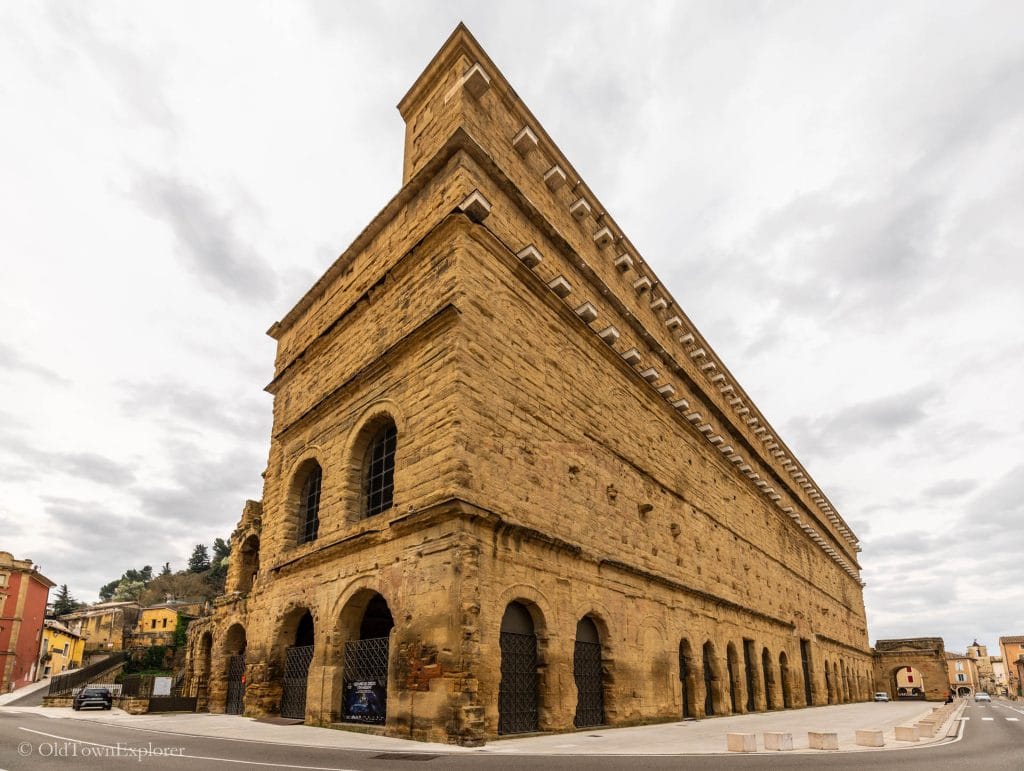
Roman Theatre and its Surroundings and the “Triumphal Arch” of Orange
The Roman Theatre and Triumphal Arch of Orange preserve two major forms of Roman public and commemorative architecture. The theater was constructed during the reign of Augustus and retains its seating structure, side walls, performance area, and unusually complete stage wall.
The tall stage wall enclosed the performance space and supported multiple levels of columns, niches, statuary, doors, and architectural decoration. Although much of the original ornament has disappeared, the surviving masonry still shows how the Roman theater created a controlled interior rather than opening the audience toward a landscape.
The nearby arch uses three openings framed by engaged columns, an attic level, and carved military scenes. Examine how its sculptural panels and architectural divisions turn a road monument into a statement about Roman authority and military power.
Arles, Roman and Romanesque Monuments
The Roman and Romanesque Monuments of Arles record the transformation of an ancient provincial city into a medieval religious center. The Roman components include the amphitheater, theater, cryptoporticus, Baths of Constantine, remains of the forum, and the Alyscamps burial ground.
The amphitheater uses two superimposed levels of arches around an oval arena. Medieval residents later inserted towers and houses into the structure, showing how a Roman entertainment building became a fortified settlement before later restoration removed most of those additions.
The Romanesque Church and Cloister of Saint-Trophime extend the property into the medieval period. The carved western portal, barrel-vaulted church, cloister arcades, capitals, and sculpted figures provide a direct comparison with the earlier Roman masonry elsewhere in the city.
Gothic Cathedrals and Monastic Architecture
Chartres Cathedral
Chartres Cathedral was partly constructed beginning in 1145 and extensively rebuilt after a fire in 1194. The resulting church established a major model for French Gothic cathedral design through its nave elevation, ribbed vaults, flying buttresses, sculpted porches, towers, and extensive stained-glass program.
The western façade preserves earlier 12th-century work, including the Royal Portal and the unequal towers. The later nave and choir use a three-part elevation of arcade, triforium, and clerestory, with external buttresses carrying the thrust of the vaults away from the upper walls.
Walk around the exterior before entering. Compare the western towers, the north and south transept porches, the changing buttress forms, and the way the exterior structure corresponds to the interior bays. Inside, the blue-dominant stained glass, tall nave, choir enclosure, and stone floor labyrinth require separate attention.
Amiens Cathedral
Amiens Cathedral is one of the largest 13th-century Gothic churches in France. Its plan is noted for its consistency, while the interior uses a three-tier elevation and closely repeated bays to create a long, uninterrupted progression from the western entrance to the choir.
The western façade is organized through three deeply recessed portals, multiple sculpture zones, a gallery of kings, an open arcade, rose window, and two towers. The portals contain an extensive program of saints, biblical figures, virtues, vices, and scenes connected to salvation and judgment.
Inside, compare the proportions of the nave arcade, triforium, and clerestory. Continue into the transepts and choir to examine later screens, stalls, chapels, and the change from the open nave to the more enclosed eastern end.
Cathedral of Notre-Dame, Former Abbey of Saint-Rémi and Palace of Tau in Reims
The Reims World Heritage property connects three buildings associated with medieval religion and the coronation of French kings. Notre-Dame Cathedral combines 13th-century structural techniques with an extensive sculptural program integrated into its portals, buttresses, galleries, and upper elevations.
The western façade places sculpture within deep portals and across several horizontal levels rather than treating statues as separate decoration. Inside, the long nave, ribbed vaults, stained glass, and processional route reflect the cathedral’s ceremonial role.
The former Abbey Church of Saint-Rémi preserves an earlier nave combined with Gothic additions, while the Palace of Tau served the archbishops and supported coronation ceremonies. Taken together, the three buildings show how religious architecture, political ritual, and residential administration occupied connected but distinct spaces.
Bourges Cathedral
Bourges Cathedral was constructed mainly from the late 12th through the late 13th century. Unlike many major Gothic cathedrals, it has no projecting transept, allowing the nave and choir to form a continuous volume beneath a unified exterior roofline.
The interior has five aisles arranged at different heights. This stepped section creates layered views across the arcade, inner aisle, outer aisle, triforium, and clerestory while allowing light to enter at several levels. Flying buttresses support the high vaults without interrupting the continuous plan.
At the western façade, compare the five portals with the five interior aisles. Inside, examine the changes in elevation, the 13th-century stained glass, the steep perspective toward the choir, and the way the absence of a transept affects movement through the church.
Mont-Saint-Michel and Its Bay
Mont-Saint-Michel and Its Bay combine a Benedictine abbey, fortified village, walls, gates, and tidal setting on a rocky islet. Construction from the 11th through the 16th century required builders to stack religious, residential, defensive, and service spaces across sharply sloping ground.
The abbey church occupies the summit, supported by crypts and lower masonry. The Gothic complex known as the Merveille contains the cloister, refectory, guest hall, almonry, and other spaces arranged vertically rather than around a broad level precinct.
Approach from the causeway to examine the complete silhouette before entering the village. Inside, follow the ascent through gates, narrow streets, stairs, defensive walls, lower abbey rooms, the church, cloister, and upper terraces. The route shows how circulation was adapted to the limited footprint of the rock.
Vézelay, Church and Hill
The Basilica and Hill of Vézelay center on the Romanesque monastic church of Sainte-Marie-Madeleine. The church became a major pilgrimage destination and a starting point for routes toward Santiago de Compostela.
The long nave uses alternating stone tones across its transverse arches, compound piers, and groin vaults. Carved capitals line the nave, while the central tympanum in the narthex presents an extensive sculptural composition associated with the mission of the apostles.
Compare the darker narthex with the lighter nave and eastern end. The hilltop approach, forecourt, western towers, interior light, carved portals, and views over the surrounding countryside form one connected architectural sequence.
Cistercian Abbey of Fontenay
The Cistercian Abbey of Fontenay was founded in Burgundy in 1119. Its church, cloister, chapter house, dormitory, bakery, service buildings, and ironworks reflect the Cistercian preference for disciplined proportions, limited ornament, and economic self-sufficiency.
The abbey church uses a Latin-cross plan, a blind nave, pointed barrel vault, plain capitals, and a transept without a tower. Carefully cut ashlar appears beside rougher rubble masonry, showing how visual restraint did not exclude precise construction.
The cloister connects worship, administration, work, and sleeping areas. Continue beyond the church to the chapter house, dormitory, garden, water channels, and ironworks; these spaces show how the abbey operated as a complete residential, agricultural, and industrial complex.
Royal Residences, Landscapes and Historic Cities
Palace and Park of Versailles
The Palace and Park of Versailles served as the principal royal residence from Louis XIV through Louis XVI. Successive architects, decorators, sculptors, engineers, and landscape designers expanded an earlier hunting residence into a coordinated complex of courts, apartments, galleries, chapels, service wings, gardens, fountains, canals, and satellite residences.
The entrance sequence moves from the forecourt through increasingly controlled ceremonial spaces. Inside, the State Apartments and Hall of Mirrors use painted ceilings, marble, gilded decoration, mirrors, sculpture, and framed views to reinforce the palace’s political and ceremonial functions.
The gardens continue the palace’s central axes through terraces, parterres, fountains, groves, canals, and long sightlines. The Grand Trianon, Petit Trianon, estate buildings, and service areas show that Versailles functioned as a court, government center, residence, workplace, and managed landscape.
Palace and Park of Fontainebleau
The Palace and Park of Fontainebleau developed from a medieval royal hunting residence used by French monarchs from the 12th century. François I transformed it during the 16th century with Italian artists and architects, creating an influential combination of French palace traditions and Italian Renaissance design.
The complex grew through irregular courtyards, galleries, chapels, staircases, apartments, service wings, gardens, and later additions rather than through one unified building campaign. The horseshoe staircase, Galerie François I, ballroom, royal apartments, and Chapel of the Trinity record different phases of court architecture and decoration.
Compare the varied rooflines, brick-and-stone façades, enclosed courts, formal gardens, and transitions between Renaissance, Classical, and later imperial rooms. Fontainebleau is especially valuable for seeing how one royal residence was repeatedly altered without erasing its earlier fabric.
The Loire Valley Between Sully-sur-Loire and Chalonnes
The Loire Valley World Heritage property extends for approximately 280 kilometers along the middle Loire. It includes historic towns, villages, cultivated land, river engineering, churches, manor houses, gardens, and châteaux developed through centuries of interaction between settlement and the river.
The châteaux do not represent one uniform type. Chambord combines a compact keep-like mass with Renaissance planning and an elaborate roofscape; Blois records several architectural periods around one courtyard; Amboise occupies a fortified river terrace; and Chenonceau extends across the Cher through a bridge and later gallery.
A complete route should compare the residences with their approaches, estate villages, walls, service courts, stables, gardens, canals, forests, and river views. Distances are substantial, so the Loire Valley is better treated as several local circuits rather than a single continuous day trip.

Historic Centre of Avignon
The Historic Centre of Avignon contains the Palais des Papes, Notre-Dame des Doms Cathedral, the Petit Palais, surviving ramparts, and the remains of the medieval bridge across the Rhône. The arrival of the papal court in the 14th century transformed the city into a major ecclesiastical and administrative center.
The Palais des Papes combines fortress construction with ceremonial and residential functions. High walls, towers, narrow lower openings, courtyards, halls, chapels, service rooms, and circulation passages create an exterior associated with defense and an interior organized around court life.
Continue from the palace precinct to the cathedral terrace, Petit Palais, city walls, gates, streets, and Pont Saint-Bénézet. These elements show how papal institutions, existing urban fabric, river crossings, and defensive construction were integrated within one compact center.
Historic Fortified City of Carcassonne
The Historic Fortified City of Carcassonne preserves a fortified settlement with foundations dating from late antiquity and major medieval additions. Its defensive system contains inner and outer walls, towers, gates, open ground between the circuits, the Château Comtal, and the Basilica of Saint-Nazaire.
The fortifications record several building periods through differences in masonry, tower form, openings, battlements, and wall alignment. Gate approaches were designed to slow entry and expose attackers to fire from towers and adjoining walls.
Nineteenth-century restoration led by Eugène Viollet-le-Duc strongly shaped the current rooflines and defensive details. Compare restored sections with earlier masonry and examine the site from both inside and outside the walls to understand the relationship between the fortifications, lower town, river, and surrounding terrain.
Paris, Banks of the Seine
The Paris, Banks of the Seine property follows the river through the historic center and includes major monuments, public spaces, bridges, quays, gardens, and institutional buildings. The sequence records the city’s development from the medieval islands through royal, imperial, industrial, and modern phases.
Île de la Cité contains Notre-Dame, the Sainte-Chapelle precinct, and the former royal palace. Farther west, the Louvre, Tuileries, Place de la Concorde, Invalides, Grand Palais, bridges, exhibition structures, and Eiffel Tower trace changes in state architecture, transport, engineering, and public ceremony.
Walking one bank provides only part of the architectural sequence. Cross the river repeatedly to compare bridge alignments, monument axes, quay walls, institutional façades, garden boundaries, rooflines, and the way large public buildings frame the Seine.

Historic Site of Lyon
The Historic Site of Lyon records more than two thousand years of urban growth across several connected districts. Roman theaters and remains occupy Fourvière; medieval and Renaissance streets fill Vieux Lyon; Classical squares and civic buildings spread across the Presqu’île; and former silk-workers’ districts climb Croix-Rousse.
Vieux Lyon contains narrow streets, internal courtyards, spiral stairs, galleries, and passageways linking buildings and slopes. The Presqu’île shifts to planned streets, formal squares, continuous façades, churches, commercial buildings, and riverfront development.
Croix-Rousse adds tall workshop buildings with high ceilings and large windows designed for silk looms. A complete route should compare the districts rather than concentrating only on the Renaissance old town.
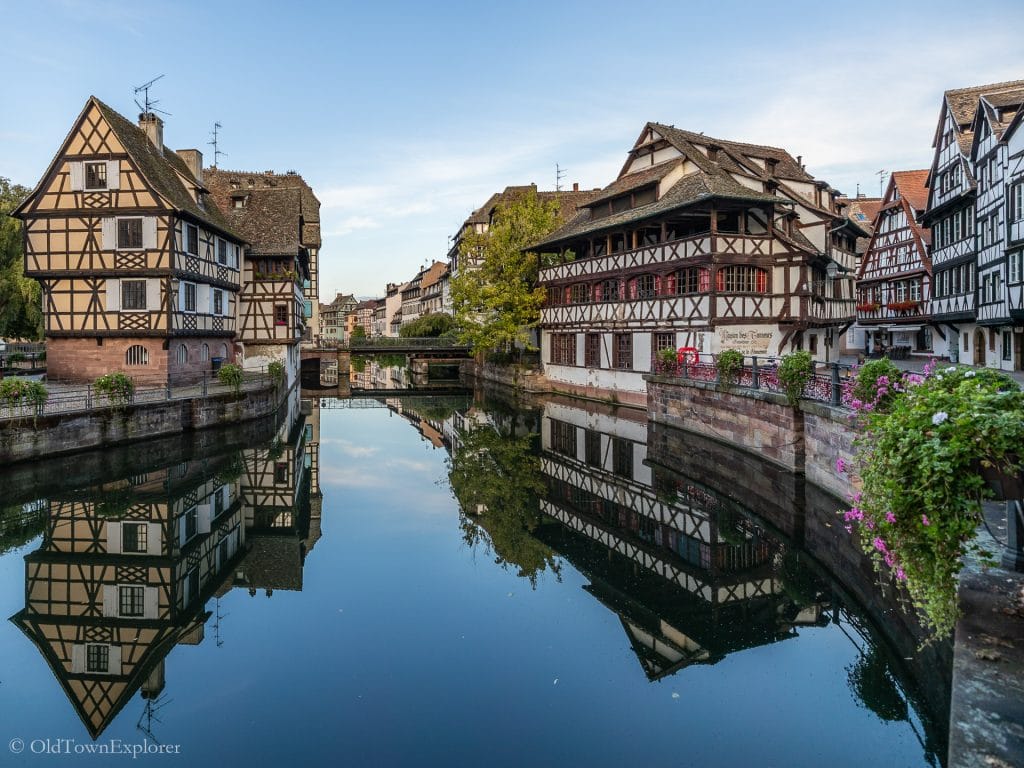
Strasbourg, Grande-Île and Neustadt
Strasbourg, Grande-Île and Neustadt join a historic island center with a planned German-period extension. Grande-Île developed around the sandstone cathedral and includes medieval streets, timber-framed houses, churches, civic buildings, canals, bridges, and later French additions.
The cathedral dominates the older district through its west façade, sculpted portals, rose window, tower, nave, stained glass, and astronomical clock. Nearby streets shift rapidly in scale between religious monuments, merchant houses, narrow plots, internal courtyards, and waterside buildings.
Neustadt was planned after 1871 with broad avenues, formal vistas, gardens, apartment buildings, university facilities, government institutions, and major public monuments. The contrast between the dense Grande-Île and the more expansive Neustadt is central to the property.

Bordeaux, Port of the Moon
Bordeaux, Port of the Moon occupies a crescent-shaped bend of the Garonne and records more than two thousand years of urban development. Its strongest architectural transformation occurred during the 18th century, when coordinated quays, squares, gates, streets, warehouses, and pale limestone façades reshaped the port.
Place de la Bourse forms part of a long riverfront composition rather than an isolated square. Its balanced elevations, central pavilion, arcaded ground floor, roofline, and relationship with the quay demonstrate how civic architecture was used to present the city to arriving ships.
Continue behind the riverfront to compare monumental gates, churches, mansions, courtyards, market buildings, commercial streets, and 19th-century extensions. The contrast between formal public elevations and narrower interior streets is a defining part of the urban plan.
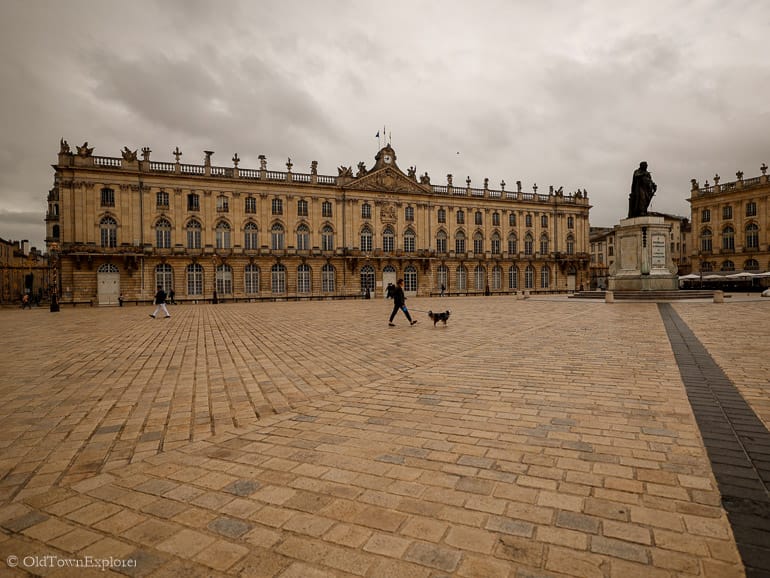
Place Stanislas, Place de la Carrière and Place d’Alliance in Nancy
The three UNESCO-listed squares in Nancy were constructed from 1752 to 1756 under Stanislas Leszczynski, Duke of Lorraine. Architect Emmanuel Héré designed the ensemble to connect the medieval old town with the newer administrative city.
Place Stanislas is enclosed by coordinated Classical façades, pavilions, arcades, and gilded wrought-iron gates. Openings in the enclosure align the square with surrounding streets and neighboring Place de la Carrière rather than creating a sealed court.
Place de la Carrière forms a long ceremonial axis leading toward the former government palace, while Place d’Alliance provides a smaller residential composition around a central fountain. Walking through all three squares reveals how architecture, gates, street openings, sculpture, and planting create a connected urban sequence.
Fortifications and Modern Architecture
Royal Capetian Fortresses of Languedoc
The Royal Capetian Fortresses of Languedoc, inscribed in 2026, link the castle and ramparts of Carcassonne with Aguilar, Lastours, Montségur, Peyrepertuse, Puilaurens, Quéribus, and Termes. Together they show how thirteenth- and fourteenth-century defensive architecture was adapted to steep terrain as royal power expanded across Languedoc.
Carcassonne shows the urban side of that defensive system, while the other fortresses make the relationship between walls, towers, approach routes, and rocky ridges much clearer. They fit a regional fortification route rather than a single-city architecture visit.
Fortifications of Vauban
The Fortifications of Vauban comprise twelve groups of fortified buildings and settlements along France’s western, northern, and eastern borders. They represent different aspects of the work of Sébastien Le Prestre de Vauban, military engineer under Louis XIV.
The components include planned towns, citadels, bastioned urban walls, sea forts, mountain forts, towers, batteries, communication structures, and defenses adapted to sharply different landscapes. Neuf-Brisach demonstrates geometric town planning, while Briançon and Mont-Dauphin show how fortified systems were adjusted to mountain terrain.
Other components include the Besançon citadel, Saint-Martin-de-Ré, Longwy, Camaret-sur-Mer, and coastal or frontier defenses. At each location, examine fields of fire, ditch systems, angled bastions, gates, ramps, troop circulation, storage areas, and the relationship between the walls and surrounding ground.
Le Havre, the City Rebuilt by Auguste Perret
Le Havre was extensively rebuilt between 1945 and 1964 after wartime destruction. A team directed by Auguste Perret reconstructed the administrative, commercial, cultural, and residential center through a coordinated reinforced-concrete system.
The plan retained elements of the earlier street layout while introducing broad avenues, regular blocks, public squares, standardized structural bays, and controlled building heights. Repetition provided overall coherence, but differences in balconies, infill panels, windows, entrances, and surface treatment prevented the blocks from becoming identical.
Saint-Joseph Church uses a tall lantern tower, colored glass, and exposed concrete to create a vertical landmark. The town hall, Avenue Foch, apartment blocks, shops, and public spaces show how the shared structural system operated from the scale of an individual room to the scale of the city center.
The Architectural Work of Le Corbusier
The Architectural Work of Le Corbusier is a transnational property of 17 sites across seven countries. The French components record several stages of his work, from Purist houses and standardized housing concepts to large residential blocks, religious buildings, factories, and civic projects.
Maison La Roche and Maison Jeanneret in Paris develop movement through ramps, stairs, double-height spaces, framed views, and roof terraces. Villa Savoye at Poissy organizes its white upper volume above pilotis and uses a ramp to connect the entrance level, living spaces, terrace, and roof.
Later French components include the Unité d’Habitation in Marseille, the Chapel of Notre-Dame-du-Haut at Ronchamp, the Dominican monastery of La Tourette, the factory at Saint-Dié, and buildings at Firminy. Compare the changing treatment of concrete, color, light, circulation, communal space, structure, and landscape across the different commissions.
How to See France Architecture
Major French cities let you compare several architectural periods on foot, while châteaux, abbeys, Roman engineering works, fortresses, and rural heritage sites often need a separate regional day. Choose a city or corridor that matches the periods you most want to see, then add individual sites around that base.
City Architecture Routes
Paris has the broadest chronological range, but smaller cities can make architectural changes easier to read. Lyon Architecture moves from Roman Fourvière through Renaissance Vieux Lyon and the later urban layers of Presqu’île and Croix-Rousse. Strasbourg Architecture contrasts the medieval Grande-Île with the planned German-period Neustadt.
Avignon Architecture centers on papal, religious, and defensive construction, while Bordeaux Architecture is strongest for coordinated eighteenth-century riverfront and civic planning. In Burgundy, Dijon Architecture and Beaune Architecture make a useful pair for ducal buildings, churches, hospitals, historic houses, and wine-town architecture.
Independent Architecture Walks
Historic centers are easiest to understand when you pay attention to the streets between the monuments. Compare street width, building height, roof form, masonry, window shape, arcades, courtyards, balconies, gates, walls, and the way major buildings face squares, rivers, or processional streets.
Exterior walking is enough for many urban comparisons. A cathedral façade, a sequence of eighteenth-century townhouses, a fortified wall, or the change from a medieval street plan to a planned nineteenth-century district can often be understood without turning the day into a series of interior visits.
Guided Architecture Tours
Guided interpretation adds the most value when the architecture depends on construction history, iconography, restoration, archaeology, or a complicated site plan. Gothic cathedrals, Roman sites, fortified systems, royal palaces, monasteries, and layered historic centers are easier to read when structural changes and later alterations are explained in context.
For streets, squares, façades, rooflines, bridges, gates, and riverfronts, independent walking is often enough. Save guided time for the sites where interior space, symbolism, archaeological layers, or several building campaigns are central to what you are seeing.
Interiors, Landscapes, and Regional Routes
Some of France’s strongest architecture only makes sense in its wider setting. Loire châteaux depend on their courts, gardens, service buildings, river approaches, and estate landscapes. The Pont du Gard is engineering across a river valley, Mont-Saint-Michel depends on the relationship between abbey, village, fortifications, rock, and bay, and the Languedoc fortresses use steep ridges as part of their defensive design.
Separate city walking days from rural architecture days. Decide which buildings require an interior visit and which routes depend mainly on streets, landscapes, ruins, and exterior views before setting the sequence for the day.
FAQs About France Architecture
What defines France architecture?
France architecture is defined by Roman engineering, Romanesque monasteries, Gothic cathedrals, Renaissance châteaux, Classical royal planning, regional domestic traditions, Haussmannian urbanism, industrial construction, and modern architecture.
Which French city has the broadest range of architecture?
Paris has the broadest sequence, from Roman remains and medieval churches to royal palaces, nineteenth-century boulevards, iron-and-glass structures, Art Nouveau buildings, modern housing, and contemporary civic projects.
Where should I start with France architecture?
Start with Paris if you want the widest architectural sequence in one city. Choose Lyon or Strasbourg for compact multi-period urban routes, Avignon for a southern route that can extend to Nîmes, Orange, Arles, and the Pont du Gard, or Dijon and Beaune when Burgundy’s stone towns, churches, monastic heritage, and wine architecture are the main focus.
What is Haussmannian architecture?
Haussmannian architecture refers to the nineteenth-century redevelopment associated with broad Paris boulevards and aligned apartment blocks. Common features include pale stone façades, regular window spacing, continuous balconies, mansard roofs, interior courtyards, shops at street level, and standardized street proportions.
How many UNESCO World Heritage properties does France have?
France has 56 World Heritage properties: 47 cultural, seven natural, and two mixed. Architecture-focused entries include Roman monuments, cathedrals, abbeys, palaces, historic cities, fortifications, industrial landscapes, modern architecture, the Megaliths of Carnac, and the Royal Capetian Fortresses of Languedoc.
Can France architecture be explored without a car?
Yes. Paris, Lyon, Strasbourg, Bordeaux, Avignon, Dijon, and many cathedral cities have rail connections and walkable centers. A car or organized excursion provides more control for Loire châteaux, rural abbeys, fortified villages, wine-region architecture, and dispersed military sites.