
Strasbourg Architecture
Explore Strasbourg Architecture: Top Buildings & What to See
Strasbourg architecture follows the River Ill. On Grande Île, streets converge on the cathedral, while the canals of Petite France run past houses once used by tanners and other tradespeople. The river also formed part of the city’s defenses, from the towers of the Covered Bridges to the Vauban Dam.
Across the water, Neustadt shows what changed when the city expanded under German administration. Broad avenues and formal squares set off the new public buildings. Together, Grande Île and Neustadt form one UNESCO World Heritage property.
We spent a month in Strasbourg walking these districts. Drawing on that stay, our wider travels in France, and further research, this page compares the cathedral quarter, the canal defenses, and Neustadt to help you decide which buildings to see and where to spend more time.
This page contains affiliate links. We may earn a small commission at no extra cost to you.
Strasbourg Architecture at a Glance
Strasbourg’s most revealing contrast is between the narrow lanes around the cathedral and the broad avenues of Neustadt. Both are easy to see on foot, but the cathedral and palace interiors can take up much of a short visit.
- First stop. Start at Place de la Cathédrale for Notre-Dame Cathedral and the carved timber façade of Kammerzell House.
- Canal walk. Head to Petite France for the tanners’ houses, then continue to the Covered Bridges and Vauban Dam.
- Best view of the defenses. Look back toward the bridge towers from the Vauban Dam terrace.
- Best contrast with the old town. Walk to Place de la République in Neustadt, where the square gives the palace, library, and theater room to be seen from a distance.
If you only have two hours, stay on the cathedral-to-canals side of the city. If you have half a day, add Neustadt or choose a longer interior visit, depending on what interests you most.
What to See in Strasbourg
Strasbourg’s architecture is easiest to understand in three parts. The cathedral quarter grew around a religious and commercial center. Petite France shows how trades and defenses made use of the river. Neustadt shows how an imperial administration laid out a new district beside the old one.
The Cathedral Quarter
Approach Notre-Dame along Rue Mercière for a view of its west front framed by the street. In the square, compare the depth of the cathedral’s carved stonework with the carved timber and projecting upper floors of Kammerzell House. Then walk around to Place du Château to see how the regular windows and horizontal lines of Rohan Palace contrast with the cathedral.
Petite France and the River Defenses
On Rue du Bain-aux-Plantes, look up at the overhanging floors and steep roofs. Maison des Tanneurs has open roof spaces that were used for drying hides. At the western end of Petite France, the Covered Bridges and Vauban Dam show how Strasbourg guarded the river channels that enter the old town.
Neustadt and Place de la République
Stand in Place de la République to see the Palais du Rhin, National and University Library, and National Theater across the open square. Continue toward the University Palace to see how the avenues frame buildings at a distance. Near the river, Saint-Paul Church brings Gothic forms into this later district.
Half-Timbered Houses in Strasbourg
Strasbourg’s half-timbered houses are concentrated around the Grande Île and Petite France. Many were connected to trades such as tanning, milling, brewing, and commerce, and their projecting upper floors, carved beams, steep roofs, and street-facing façades show how domestic and commercial architecture worked in the historic center.
When walking these attractions, focus on the timber frames, corbelled upper floors, oriels, rooflines, carved decoration, and relationship between the houses, canals, bridges, and former trade streets.
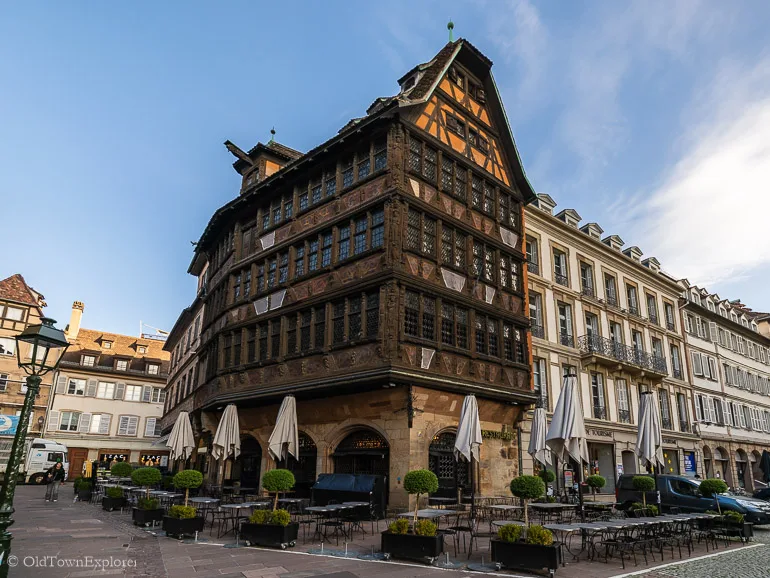
Kammerzell House
Maison Kammerzell
- Architect: Unknown
- Style: Late Gothic civil architecture with Rhineland timber-framing, extensively remodeled during the German Renaissance
- Built: Originally constructed in 1427; transformed in 1467 and again circa 1589
- Location: Place de la Cathédrale, Grande-Île
- Monument historique: Classified 1929
One of Strasbourg’s most ornate and best-preserved medieval civil buildings. Its distinctive overhanging timber frames and elaborate frescoed interiors (by Léo Schnug) make it a landmark. Today, it operates as a themed restaurant blending heritage and modern hospitality.
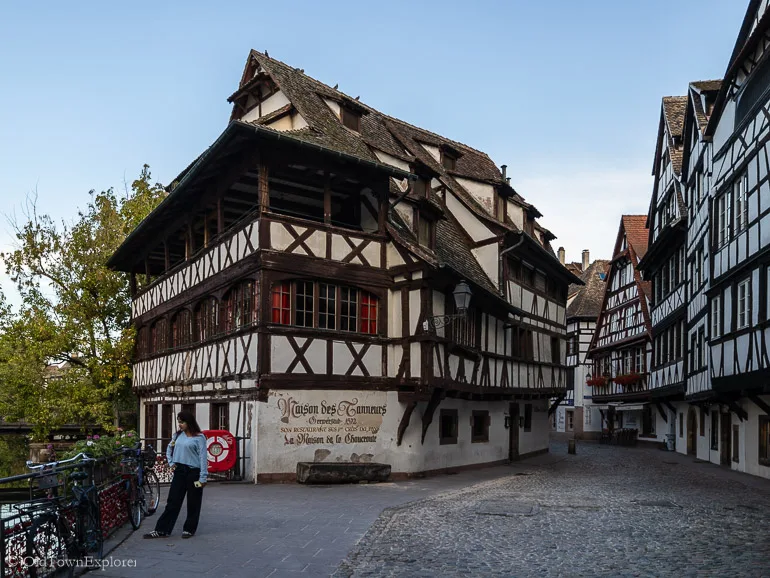
Tanners’ House
Maison des Tanneurs
- Architect: built in two phases by tanner Christmann Roederer
- Style: Renaissance-era timber structure with corbelled floors typical of medieval craftsmen’s buildings
- Built: 1572
- Location: Petite France district
- Monument historique: Classified 1927
A functional yet picturesque building, originally serving as a tannery with upper floors designed for leather drying. Its overhanging galleries and historic setting embody Petite France's medieval character.
House at 25, rue du Bain-aux-Plantes
Maison Lohkäs
- Monument historique: Classified (facades and roofs) since 14 December 1927
- Built: Renaissance timber-framed Alsatian style, around 1580 (inscription “1676” over the doorway)
Iconic Renaissance house with overhanging floor, decorative relief of coopers, and historical beer tavern setting “Taverne des Tanneurs.” Well-preserved example of Petite France vernacular
Houses on rue du Bain-aux-Plantes (Nos. 27, 29, 31, 33)
- Monument historique: Classified 1927 (façades and roofs)
- Built: 16th–17th centuries
- Location: Petite France district
An ensemble of timber-framed houses, these dwellings formed part of the medieval tanning quarter. Their classification in 1927 recognized the preservation of authentic Alsatian half-timbered domestic architecture.
House at 40, rue du Bain-aux-Plantes
- Monument historique: Yes — classified on 10 November 1927
- Built: 1566, by tanner Michel Wittich
An Alsatian timber-framed Renaissance house with a projecting oriel, sculpted beams, and distinct street‑corner inscription; iconic location adjacent to the Pont du Faisan and Maison des Tanneurs.
House at 2, rue Mercière / 54, rue du Vieux-Marché-aux-Poissons
- Monument historique: Inscribed (façades and roof) since 1929
- Built: 3rd quarter of 17th century (around 1650–1675)
A sizeable Renaissance-era timber-framed house at a prominent corner. Architectural documentation is limited, although it's recognized as an important historic dwelling.
Building at 8, Rue d’Austerlitz
- Monument historique: Yes — Inscribed in 2015 (façades and roofs), with earlier inscription in 1929 (later canceled in 1952, restored in 2015)
- Built: Circa 1621; transformed in 1752
A Renaissance-style half-timbered urbane building—characteristic Alsatian structure with later 18th-century modifications and rich heritage detailing.
Building at 1, quai des Moulins
- Monument historique: Yes—classified in 1928 (façades and roofs)
- Built: Not specified, but likely Renaissance or medieval heritage structure.
Timber-framed historic residence on Petite France canal; recognized for preserving historic street façade.
House at 11, Place Saint-Étienne
- Built: 1605, by master mason Hans Hammer
- Monument historique: Inscribed 1931
A timber-framed Alsatian residence reflecting early modern domestic architecture. Its construction date and builder are documented, making it one of the square’s best-studied houses.
House at 8, rue des Poules
- Monument historique: Inscribed (façade and roof) since 1978
- Built: Not precisely dated; vernacular half-timbered structure
A classic timbered Alsatian residence, its façade notable for maintaining authentic heritage character.
Religious Buildings in Strasbourg
Strasbourg’s religious architecture reflects the city’s position at the crossroads of European faith and culture. From the towering Gothic Cathedral of Notre-Dame to medieval parish churches, Protestant landmarks of the Reformation, and even a contemporary mosque, these sacred spaces trace the city’s history across centuries. Many remain active places of worship, offering visitors not only architectural beauty but also a living connection to Strasbourg’s diverse spiritual heritage.
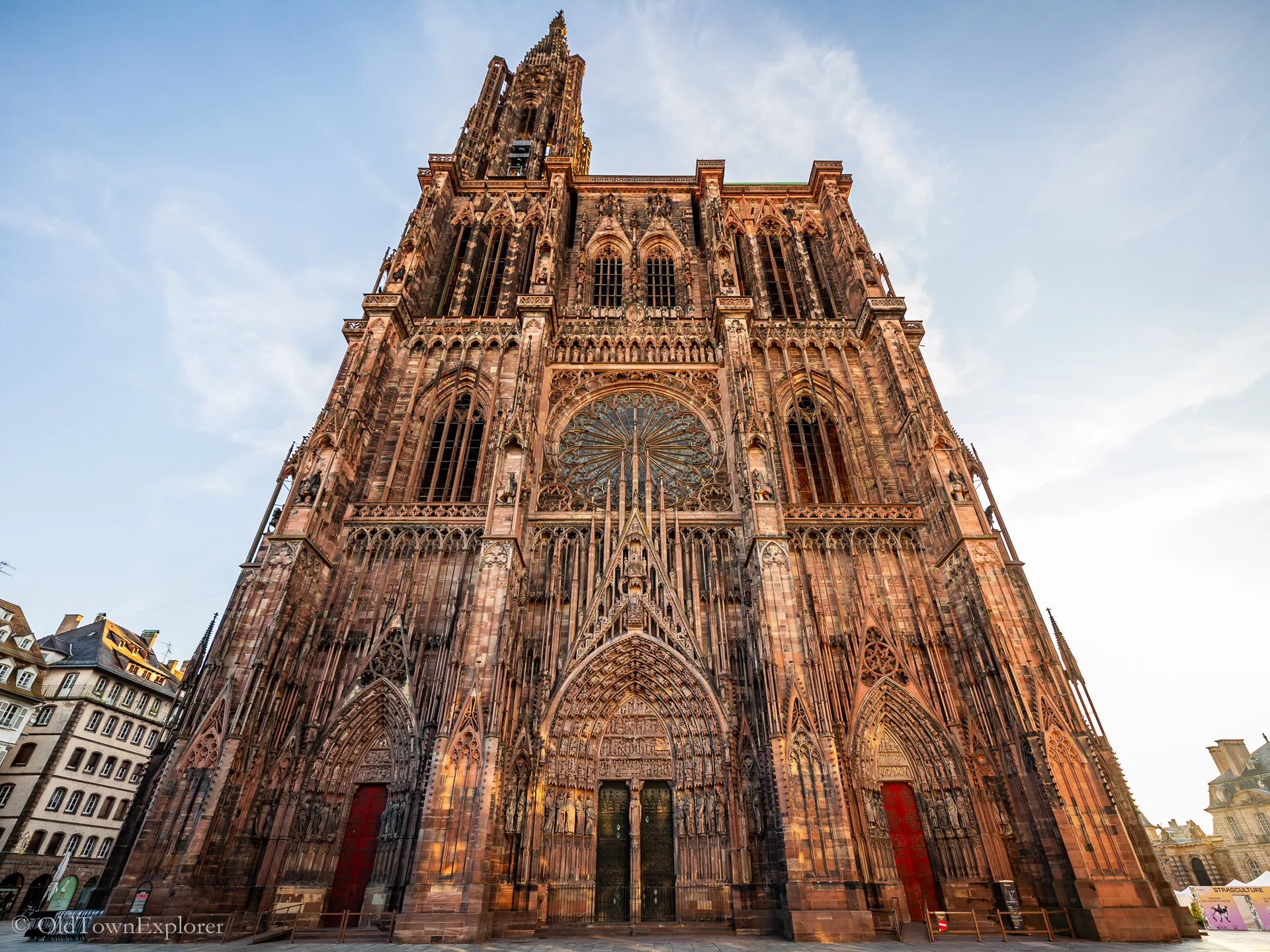
Notre-Dame Cathedral
Cathédrale de Strasbourg
- Architect: Erwin von Steinbach (major contributions from 1277–1318), continued by his son and grandson; spire by Ulrich Ensingen and Johannes Hültz
- Style: Rayonnant Gothic with Romanesque elements
- Built: Construction began 1015, largely resumed 1190, completed 1439; spire finished 1439
- Location: Place de la Cathédrale, Grande‑Île, Strasbourg
An iconic Gothic masterpiece reaching 142 m—the tallest building from 1647 to 1874, and still the tallest medieval structure in Europe. It features a single octagonal spire, richly ornamented façade, and houses the famed astronomical clock and a platform view at ~66 m altitude.
For current visiting hours, ticket information, and events, consult the official Strasbourg Cathedral site.
Saint-Aurelia Church
Église Sainte-Aurélie
- Architect: Rebuilt under Michel Hatzung and Georges Frédéric Hüttner c. 1765
- Style: Baroque interior with remnants of Romanesque and Gothic exterior details
- Built: Earlier medieval origins; current building erected 1765; organ added 1713; restoration 2002–2015
- Location: Rue Martin Bucer, Gare district, Strasbourg
One of Strasbourg’s oldest church sites, closely tied to Martin Bucer and the Reformation (1524). It features a white-and-gold Baroque interior with an André Silbermann organ from 1713. The oldest bell in the city (1410) and Schwilgué’s 1845 clock are significant features.
Sainte-Madeleine Church
- Architect: Rebuilt by Fritz Beblo, 1907 design faithful to Gothic style
- Style: Original Gothic from 1478 (only choir survives), reconstructed in Jugendstil-inspired early 20th-century form
- Built: Gothic church built 1478, destroyed by fire in 1904, rebuilt 1907, reconstructed post‑WWII in 1958
- Location: Krutenau district, Strasbourg
The last Gothic structure built in Strasbourg—rebuilt in Art Nouveau style post-fire. The original choir now serves as chapel, and fragments of frescoes and stained glass survive in the Musée de l’Œuvre Notre‑Dame. The current church bears Beblo’s early‑20th‑century architectural character.
Saint-Guillaume Church
Église Saint-Guillaume
- Architect: Unknown
- Style: Predominantly Gothic. Classified as a Monument historique (1985)
- Built: Medieval, no precise construction dates provided
- Location: Krutenau district, Strasbourg
A Gothic Lutheran church notable for its rich musical tradition—home to the Choir of Saint‑Guillaume (founded 1885). The building possesses a characteristic Gothic façade and bell tower and remains central to liturgical and musical life in the community.
Saint-Thomas Church
Église Saint-Thomas
- Architect: Unknown
- Style: Hall church combining Romanesque and late Gothic elements, a rare Protestant example in Alsace
- Built: Origins from 1196 (Romanesque facade), later completed in late Gothic style around 1521
- Location: Near Quai Saint-Thomas, Grande‑Île, Strasbourg
Known as the “Protestant Cathedral” of the region, this five-aisled hall church stands out for its historic Silbermann organ (1741, played by Mozart in 1778), Baroque mausoleum of Marshal Saxe, and medieval tombs including Bishop Adelochus’ sarcophagus.
Saint-Pierre-le-Jeune Protestant Church
- Architect: Originally medieval construction; significant Neo‑Gothic renovations by Carl Schäfer (1897–1901)
- Style: Combination of Romanesque, Gothic, and Neo‑Gothic
- Built: Original church from the 7th century; cloister fragments 11th–14th centuries; major Gothic expansions in the 14th century; renovation by Schäfer 1897–1901
- Location: Place Saint‑Pierre‑le‑Jeune, central historic district (Grande‑Île), Strasbourg
One of Strasbourg’s most significant ecclesiastical buildings. It features an ancient burial crypt, medieval cloister galleries, frescoes, a choir screen unique to Alsace, and the 1780 Johann Andreas Silbermann organ. The 19th-century restoration by Schäfer relocated the entrance and added a new Neo‑Gothic portal inspired by Strasbourg Cathedral.
Saint-Pierre-le-Jeune Catholic Church
- Architects: Skjold Neckelmann and August Hartel
- Style: Neo‑Romanesque and Neo‑Byzantine
- Built: Constructed 1889–1893
- Location: Neustadt district, angle of Rue Finkmatt and Rue du Général de Castelnau, Strasbourg
A prominent Catholic church featuring a commanding dome—the largest of its kind in Alsace—with an interior height of ~50 m and 18.5 m diameter. Decorated with rich mosaics, a large circular chandelier, and an organ by Yves Koenig. The interior reflects the eclectic architectural tastes of the late 19th century in the German-annexed Neustadt.
Great Mosque of Strasbourg
Grande Mosquée de Strasbourg
- Architect: Paolo Portoghesi
- Style: Contemporary Islamic architecture with domed design.
- Built: First stone laid October 29, 2004; inaugurated September 27, 2012; open to worship August 1, 2011
- Location: Heyritz district, southern bank of the Ill river, Strasbourg
A modern, linear mosque with a spacious prayer hall and dome (diameter 17–24 m), seating approximately 1,200–1,500 worshippers. It serves as a cultural and religious hub for Strasbourg’s North African Muslim community, hosting conferences, teaching programs, and interfaith engagements.
Saint-Jean Church
Église Saint-Jean
- Architect / Style: Late Gothic, single nave with convent choir layout
- Built: Late 15th century for the Dominican convent, restored later
- Location: Quai Saint‑Jean, Gare district, Strasbourg
Formerly part of a Dominican convent, it features a long single nave and extended choir typical of convent churches. Now active under the Fraternities of Jerusalem.
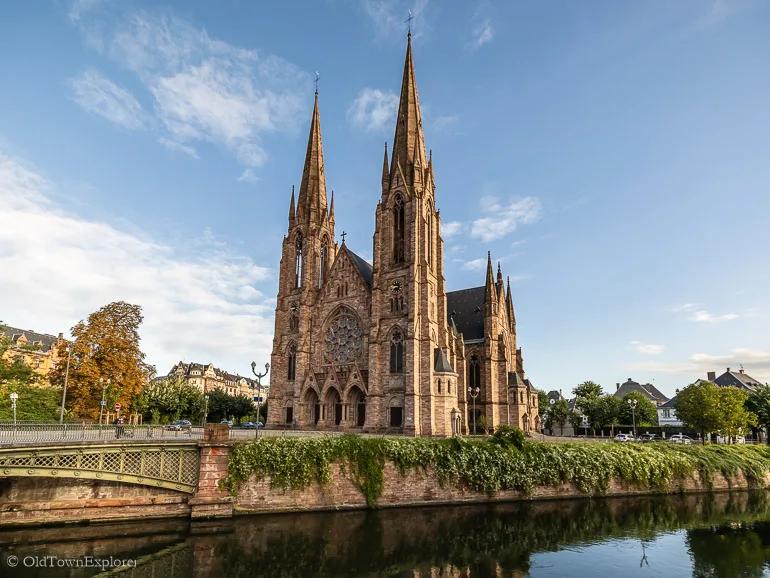
Saint-Paul Church, Neustadt
Église Saint-Paul
- Architect: Ludwig Müller
- Style: Neo‑Gothic, Protestant garrison church
- Built: 1892–1897
- Location: Pointe of Île Sainte-Hélène, Neustadt, Strasbourg
A landmark of Neustadt, situated at a striking riverside location; designed to serve the Protestant military garrison. Features soaring spires and panels of Rhenish Neo-Gothic style.
Grand Seminary
Grand Séminaire de Strasbourg
- Architects: François‑Simon Houlié; Massol and Paulinier
- Style: Neoclassical with historic library and 15th-century well
- Built: 1768–1772
- Location: Rue des Frères, Grande Île, Strasbourg
Seminary with a restrained neoclassical façade, elaborate interior library from the 18th century, and a 15th-century well. It played roles as seminary, prison, and library through history.
Saint-Maurice Church
Église Saint-Maurice
- Architect: Ludwig Becker
- Style: Gothic Revival
- Built: 1895–1898
- Address: Boulevard de la Victoire, Strasbourg
Recognizable by its high spire (65 m), this 19th-century church was part of the Neustadt’s urban expansion. It combines Neo-Gothic architecture with decorative stained glass.
Medieval Mikveh
aka Jewish Ritual Bath
- Architect: Unknown (medieval Jewish builders)
- Style: Romanesque subterranean ritual bath
- Built: Circa 1200–1260
- Address: 20 Rue des Charpentiers, Strasbourg (former Jewish quarter)
A small vaulted stone chamber (~9 m²) built of grey sandstone with a red-brick barrel vault, supported by Romanesque corbels. The mikveh contains a ritual pool of at least 500 liters, fed by groundwater and rainwater through an oculus, with steps leading down and niches for candles. It is the only surviving medieval Jewish structure in Strasbourg, rediscovered in 1985 and now protected as a Monument historique.
Old St. Peter’s Church
Église Saint-Pierre-le-Vieux
- Architect: Unknown (medieval builders)
- Style: Medieval Gothic church adapted as a dual-worship (simultaneum) building
- Built: First documented in 1130; major Gothic construction from 1381–1428, with earlier Merovingian or Romanesque remnants on-site
- Address: Place Saint-Pierre-le-Vieux, Strasbourg (near Rue du 22-Novembre and Grand’Rue)
Old St. Peter’s is one of Strasbourg’s oldest religious buildings and a rare example of an architectural simultaneum—shared by both Protestant and Catholic congregations since 1683, when Louis XIV restored the choir for Catholic use, dividing the church with an internal wall. The Gothic structure largely dates to the late 14th and early 15th centuries (1381–1428) and retains its medieval core. In 1867, architect Jean Geoffroy Conrath designed a perpendicular neo-Gothic Catholic addition at the east end, replacing the earlier choir. The building remains a visible symbol of religious coexistence and architectural layering.
New Temple
Temple Neuf
- Architect: Émile Salomon
- Style: Neo-Romanesque
- Built: 1874, on site of an old Dominican convent destroyed in 1870
- Address: Place du Temple-Neuf, Strasbourg
Built after the Franco-Prussian War, this Protestant church recalls Romanesque forms with its rounded arches and tall bell tower. It serves as an active place of worship and concert venue.
Saint Stephen’s Church
Église Saint-Étienne
- Architect / Style: Romanesque‑Gothic; incorporates Merovingian and medieval elements
- Built: Site originally occupied by a Roman sanctuary; a basilica built c. 5th century; major rebuild in Romanesque‑Gothic style around 1220
- Location: Place Saint‑Étienne, Grande Île, Strasbourg
One of Strasbourg’s oldest religious sites, with a crypt preserving Merovingian and Roman remains. Later repurposed over centuries—as a theatre and seminary—today it serves as a chapel within the Episcopal College. Surviving elements include the medieval transept and the triple-apsed choir.
Saint-Nicholas Church
Église Saint-Nicolas
- Architect / Style: Gothic with medieval foundations
- Built: Originating in the 12th century; active during Reformation and 20th-century revival
- Location: Quai Saint‑Nicolas, historic center (Finkwiller district), Strasbourg
A small Gothic church intimately linked to Strasbourg’s Reformation history—John Calvin preached here in 1538, and Albert Schweitzer served as pastor in the early 1900s and played the organ.
Église réformée du Bouclier
aka Shield Church
- Architect / Style: Early Modern Protestant; simple design with classical restraint
- Built: 1789–1790 under architect Jean Regnard Pfauth
- Location: 4 Rue du Bouclier, historic center, Strasbourg
A reformist Protestant church founded in the Revolutionary era; its minimalist design avoided overt church symbolism by decree. Notable interior furniture includes a neoclassical pulpit and a distinguished organ.
Palaces and Houses in Strasbourg
Strasbourg’s palaces and townhouses reflect the city’s long history as both a seat of power and a thriving merchant hub. From the grand 18th-century palatial residences of bishops and aristocrats to richly decorated Renaissance townhouses and the half-timbered homes of Petite France, these buildings reveal the wealth and tastes of those who shaped the city. Many are still in use today—as museums, civic offices, or even restaurants—offering visitors the chance to step inside centuries of living history.
Baroque and Classical Palatial Residences
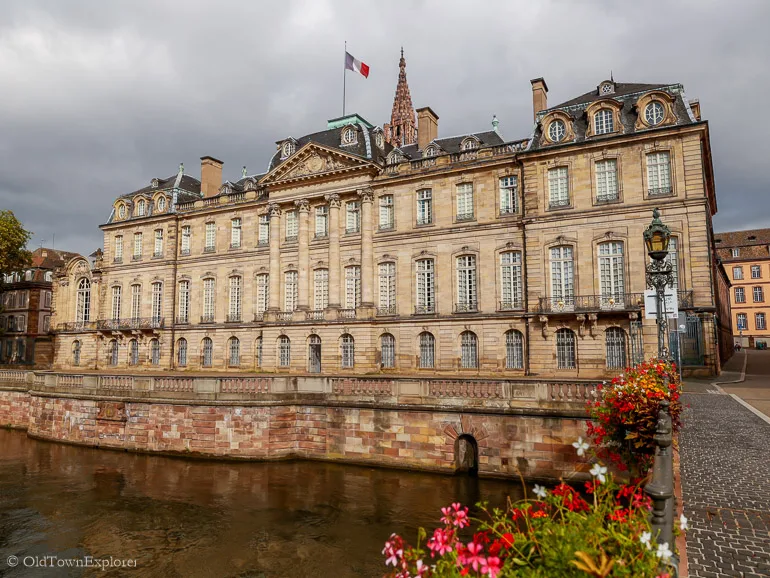
Rohan Palace
Palais Rohan
- Architect: Robert de Cotte (design), with municipal architect Joseph Massol overseeing construction; sculptural details by Robert le Lorrain and others
- Style: French Baroque, hôtel particulier scale
- Built: 1732–1742
- Location: 2 Place du Château, adjacent to the cathedral
- Monument historique: Classified 1921
Built for Cardinal de Rohan, this Baroque masterpiece today houses three major museums (Archaeology, Fine Arts, Decorative Arts). Its elegantly structured façades and richly appointed interiors typify 18th-century French elegance in Strasbourg.
Hôtel de Klinglin
aka Hôtel du Préfet
- Architect: Jean-Pierre Pflug and Joseph Massol; interiors remodeled 1807 by Nicolas Salins de Montfort
- Style: Baroque hôtel particulier with a unique straight and crescent-shaped façade
- Built: 1732–1736
- Location: Grande-Île, near Place Broglie
- Monument historique: Classified 1921
Initially the home of a royal moneylender, this baroque residence now serves as the Prefect’s official residence. Protected as a Monument historique, it was heavily damaged in the 1870 siege but meticulously reconstructed.

Hôtel de Hanau-Lichtenberg (City Hall)
- Architect: Joseph Massol
- Style: Baroque civic residence
- Built: Completed in 1736
- Location: Place Broglie, Grande-Île
- Monument historique: Classified 1921
Originally serving the Count of Hanau-Lichtenberg, this hôtel particulier now houses Strasbourg’s City Hall. Designed by the same architectural circle behind Palais Rohan and Hôtel Klinglin.
Building at 11, quai des Bateliers
- Status: Inscribed as a Monument historique on 21 February 1997
- Built: Around 1598; transformed in 1618
A Renaissance townhouse featuring a remarkable oriel (bay window) and a spiral staircase turret. Includes preserved Renaissance interior elements. A standout example of montage of residential styles across centuries.
Municipal Buildings in Strasbourg
Strasbourg’s civic architecture ranges from Renaissance guildhalls to the monumental administrative palaces of the German Imperial era. These buildings illustrate the city’s role as a center of trade, governance, and culture across the centuries. Today, many remain in public use—housing theaters, libraries, and regional institutions—making them essential stops for travelers interested in how Strasbourg’s civic life has been expressed through architecture.
Renaissance Civic Monuments
Neubau (Neue Bau) – Place Gutenberg
- Architect: Hans Schoch (master carpenter), façade sculpture by Wendel Dietterlin; extended by Eugène Petiti in 1867
- Style: Renaissance civic classicism — Strasbourg’s first fully stone civic building
- Built: 1582–1585; extended 1867
- Address: 10 Place Gutenberg, Grande-Île, Strasbourg
- Monument historique: Classified 1995
Originally constructed as an annex to the medieval town hall, the Neubau later became the Hôtel de Ville. Its façade demonstrates a rigorous application of the classical orders (Tuscan, Ionic, Corinthian), enhanced with sculpted allegories of civic trades. Today it houses the Chamber of Commerce.
Old Butcher’s Shop (Grande Boucherie)
aka Ancienne Boucherie
- Architect: Likely Hans Schoch (attributed)
- Style: Renaissance civic architecture
- Built: 1586–1588, restored after WWII
- Address: 2, rue du Vieux-Marché-aux-Poissons, Strasbourg
- Monument historique: Classified 1983
Originally the guildhall of the Strasbourg butchers, this U-shaped structure organized around a courtyard later served as municipal market halls. Since 1920, it has housed the Strasbourg Historical Museum, showcasing the city’s political, military, and daily life heritage.
17th–18th Century Civic Institutions
Strasbourg Opera
- Architect: Villot, with engineer Robin
- Style: Neoclassical
- Built: Completed in 1821 and restored after damage in 1870
- Address: 19 Place Broglie, 67000 Strasbourg
The former municipal theater, also known as the Théâtre Napoléon, now houses the Opéra national du Rhin. Its columned front faces Place Broglie. Walk around the building to see the curved projection added at the rear during the German period. The façade facing the square was protected as a historic monument in 1921.
Residence of the Military Governor
Hôtel des Deux-Ponts (Palais des Rohanets)
- Architect: Joseph Massol (mid-18th c.)
- Style: Baroque hôtel particulier
- Built: 1754–1755
- Location: Place Broglie
- Monument historique: Classified 1921
Built for the brothers Palatine of Zweibrücken (Deux-Ponts), this residence became Napoleon’s lodging in 1805. Today it serves as the residence of Strasbourg’s Military Governor.
Civil Hospital
Hôpital civil de Strasbourg
- Founded: End of the 14th century, rebuilt after fires and wars, major reconstruction 1716–1725
- Location: Rue Kirschleger, Strasbourg
- Monument historique: Classified 1937
One of Strasbourg’s oldest civic institutions, the Hôpital civil encompasses a complex of medieval to modern buildings. It includes the famous wine cellar (1395), where a 1472 barrel of white wine — the world’s oldest drinkable wine — is still preserved.
Historic Wine Cellar of the Hospital
Cave historique des Hospices de Strasbourg
- Built: 1393–1395
- Style: Medieval vaulted cellar
- Location: Hôpital civil, Strasbourg
- Monument historique: Classified 1994
This vast wine cellar preserves the city’s winemaking legacy. Notable is the 1472 vintage — one of the world’s oldest wines kept in a barrel. Today, it is used by regional winemakers to age prestigious Alsace wines.
Aubette
- Architect: Jacques‑François Blondel
- Style: Neoclassical / Classical
- Built: 1765–1778 (sometimes listed as 1765–1772)
- Address: Place Kléber (north side), Strasbourg
A long neoclassical building forming the northern edge of Place Kléber, originally designed as a military guardhouse ("Aubette"). It later housed the city’s music conservatory and cultural spaces. In the 1920s, avant-garde artists Theo van Doesburg, Sophie Taeuber‑Arp, and Jean Arp transformed its interiors into a Gesamtkunstwerk. Their work introduced bold geometries and primary colors, later nicknamed the ‘Sistine Chapel of abstract art. Restored in the early 2000s, the Aubette now functions as a cultural venue and shopping arcade.
German Imperial Era (1871–1918)
National Theater of Strasbourg
Former Alsace-Lorraine parliament (TNS, former Landtag)
- Architects: August Hartel & Skjold Neckelmann
- Style: German Imperial Historicism (Neo-Renaissance)
- Built: 1888–1899; converted Landtag 1911–1918
- Location: Place de la République, Neustadt
- Monument historique: Classified 1992
Originally constructed as the parliament of Alsace-Lorraine (Landtag), the monumental building now houses France’s only national theatre outside Paris.
National and University Library
Bibliothèque nationale et universitaire
Architects: August Hartel & Skjold Neckelmann
Style: Neo-Renaissance
Built: Inaugurated 1895
Location: Place de la République, Strasbourg
Monument historique: Classified 2004
The second-largest library in France, it was founded under German annexation to replace the municipal library destroyed in 1870. Its façade recalls Italian Renaissance palazzi, while its dome dominates Place de la République.
Prefecture of Grand Est
- Style: Early 20th-century civic architecture
- Built: 1911 as Ministry of Alsace-Lorraine
- Address: Neustadt area
Key administrative building for regional governance.
Main Post Office
Hôtel des Postes
- Architect: Ernst Hake (Prussian Post Office Architect)
- Style: Neo-Gothic
- Built: 1896–1899
- Location: Rue de la Nuée-Bleue, Neustadt
- Monument historique: Classified 1992
The imposing Neo-Gothic Post Office was designed under the German Reichspost. It remains Strasbourg’s main post office and is a key monument of Neustadt’s civic architecture.
Courthouse
Palais de Justice
- Architect: Skjöld Neckelmann
- Style: German Neo-Classical (Wilhelmine civic style)
- Built: 1894–1897
- Location: Place du Tribunal, Neustadt
- Monument historique: Classified 1992
The monumental courthouse, with its grey sandstone façade and Corinthian portico, embodied imperial justice during the German annexation. Today it houses Strasbourg’s court of appeal.
University Palace
Palais universitaire
- Architect: Otto Warth
- Style: Neo-Renaissance
- Built: 1879–1884
- Location: Place de l’Université, Neustadt
- Monument historique: Classified 1998
Commissioned by Kaiser Wilhelm I after annexation, this vast palace for the University of Strasbourg was modeled on Italian Renaissance palaces. Its Aula hosts academic ceremonies beneath monumental frescoes depicting European science and culture.
Early 20th Century to Interwar Period
Municipal Baths
Bains municipaux de Strasbourg
Architect: Fritz Beblo
Style: Neo-Romanesque with Jugendstil interiors
Built: 1905–1908
Location: Boulevard de la Victoire
Monument historique: Classified 2000
A civic health and hygiene facility, notable for its richly decorated swimming halls, saunas, and tiled Jugendstil interiors. It remains one of Strasbourg’s most distinctive early 20th-century public works.
Palais des Fêtes
aka Festival Palace
- Architects: Joseph Müller and Richard Kuder; engineer firm Züblin & Cie
- Style: Eclectic mix—Neo-Gothic pavilions and turrets, Neo-Renaissance gables, Art Nouveau windows and balconies; early use of reinforced concrete.
- Built: 1899–1903; inaugurated 1903
- Location: Neustadt (5 rue Sellénick / 2–4 rue de Phalsbourg / 34 boulevard Clemenceau)
- Monument historique: Classified in 2007
Commissioned by the Straßburger Männergesangverein choir association; served as Strasbourg’s principal concert hall and home of the Philharmonie until 1975, now refurbished as a cultural venue.
Forts, Walls & Gates of Strasbourg
For centuries, Strasbourg’s defenses shaped its growth and identity as a strategic city on the Rhine. From Roman foundations and medieval walls with nearly ninety towers to Vauban’s 17th-century bastions and the German Imperial fort ring, each layer of fortification reflects shifting military technology and political power. While much was dismantled in the 19th century, key structures survive as monuments and parks, offering travelers a chance to walk through the city’s military past.
Roman Foundations
Roman Tower
- Architect: Roman military engineers
- Style: Late Roman defensive masonry
- Built: c. 4th century CE
- Address: 47–49 Rue des Grandes-Arcades, 67000 Strasbourg
Remains of a tower from Roman Strasbourg survive in the cellar beneath this address. They are part of the archaeology of the fortified Roman settlement, below the present street.
Medieval Fortifications (12th–15th centuries)
Medieval City Walls
- Architect: Medieval city builders
- Style: Gothic-medieval urban defenses
- Built: 12th–14th centuries, expanded in phases
- Address: Remnants near Petite France, Quai des Bateliers, rue Finkmatt, and place d’Austerlitz
By the late Middle Ages, Strasbourg was encircled by nearly 90 towers and multiple fortified gates. While much was dismantled in the 19th century, stretches of ramparts and tower bases survive along the Ill River, shaping the Grande Île’s outline today.
Vauban’s French Defenses (17th century)
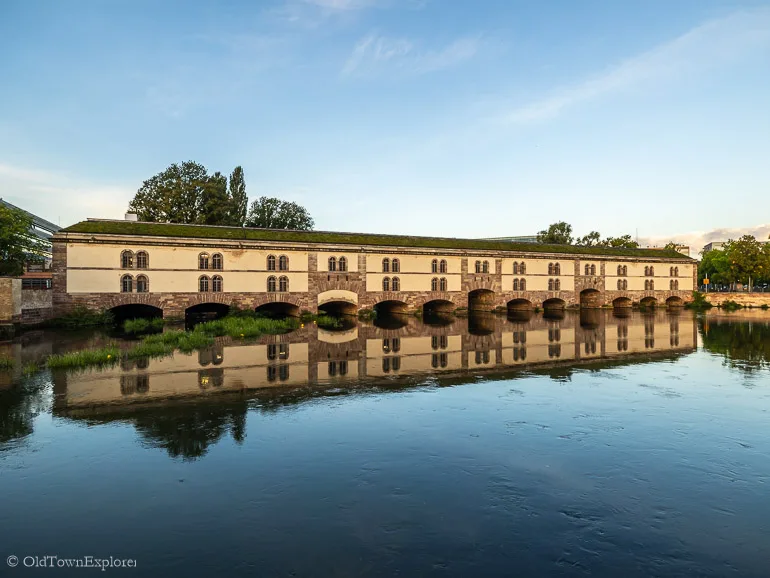
Vauban Dam
Barrage Vauban
Architect: Designed by Sébastien Le Prestre de Vauban, built by Jacques Tarade
Style: Military bridge-dam, pink sandstone
Built: 1686–1690
Address: Ill River, upstream from Ponts Couverts
A defensive weir with 13 arches, capable of flooding the southern plain to repel attacks. It doubled as a bridge and is now a panoramic viewing terrace over Petite France and the cathedral.
Citadel of Strasbourg
- Architect: Vauban; executed by Jacques Tarade
- Style: Star fort with bastions and moats
- Built: 1682–1685
- Address: Parc de la Citadelle, Strasbourg
Built after Strasbourg’s annexation to France in 1681, the Citadel was the keystone of Louis XIV’s Rhine frontier defenses. Though largely dismantled in the 19th century, major walls, bastions, and moats remain in today’s Citadel Park. Monument historique since 1922.
Vauban Bastions
- Architect: Vauban & Tarade
- Style: Star-shaped bastioned fortifications
- Built: 1680s–1690s
- Address: Perimeter near Citadel and Ill River
Vauban reshaped Strasbourg’s defenses with angular bastions, ravelins, and fortified gates adapted to artillery warfare. Though many were later removed, remnants survive at Citadel Park and around the Vauban Dam.
Vauban-era Gates (17th century)
- Architect: Sébastien Le Prestre de Vauban
- Style: French bastioned fortification
- Built: c. 1680s–1690s
- Address: Fortification perimeter near the Citadel and riverfron
When Strasbourg was annexed to France in 1681, Vauban restructured its defenses. New bastioned gates were constructed, strengthening strategic entries. These were part of a larger defensive system that included the Vauban Dam and Citadel. Today, remnants of bastion gates can still be identified in the Citadel Park area.
German-Era Fortifications & Barracks
Kriegstor (War Gate)
- Architect / Period: Built during the late 19th century under German Imperial administration—part of the Prussian military fortifications in Strasbourg (Rue du Rempart)
- Style: Prussian military architecture of the 1880s—robust, defensive, and emblematic of German-century fortification design; specific architectural details are limited in available sources
- Built: Late 19th century (approximately 1880s), aligned with the construction of the Neustadt defensive ring
- Location: Rue du Rempart, near Strasbourg’s main train station (Gare Centrale)
A distinctive war-gate structure, formerly part of a larger fortification system. Today it remains one of the visible architectural traces of Prussian fortification strategies within the German-built Neustadt district. It stands as a physical reminder of Strasbourg’s militarized urban planning during that era.
Industrial & Military Legacy Sites
Former Seegmuller Silo
- Architect: Unknown
- Style: 1930s industrial port architecture
- Built: 1930s
- Address: Bassin d’Austerlitz, Strasbourg
The former grain silo tower on the Malraux peninsula now houses the Maison universitaire internationale. Look for the tall silo tower beside the lower port buildings. The André Malraux media library occupies a separate former warehouse nearby.
Bridges in Strasbourg
Strasbourg’s history is inseparable from its rivers, and its bridges reveal the city’s evolution from medieval stronghold to European crossroads. From the fortified Covered Bridges of the 13th century to elegant Renaissance crossings and contemporary links over the Rhine, these structures combine engineering with symbolism. Today, they not only connect districts but also tell the story of Strasbourg’s role as a defensive outpost, a trading hub, and a bridge—literally and figuratively—between France and Germany.
Covered Bridges
Ponts Couverts
- Architect: Town engineers; later fortified by Daniel Specklin in the 16th century
- Style: Medieval defensive bridges and towers (stone arch bridges with crenelated towers)
- Built: 1230–1250
- Address: River Ill at Petite France, Strasbourg
A complex of three stone arch bridges and four fortified towers, built to control river crossings. Originally roofed to protect defenders; roofs removed in 1784. The bridges and towers remain key medieval defense structures and were classified as Monuments historiques in 1928.
Saint-Thomas Bridge
- Architect: Unknown
- Style: Stone bridge with medieval origins, later Renaissance and 19th-century rebuilds
- Built: First attested in the Middle Ages (likely 13th century); rebuilt in 1841
- Address: Near Église Saint-Thomas, crossing the Ill
This bridge has long connected the Saint-Thomas quarter to central Strasbourg. The current version dates largely from the 19th century but retains the historical alignment of earlier medieval structures, maintaining continuity with the old town’s urban fabric.
Pont Saint-Martin
- Architect: Unknown (medieval builders)
- Style: Medieval half-timbered urban bridge
- Built: Middle Ages (current appearance dates to 16th–17th centuries)
- Address/Location: Petite France, near Rue du Bain-aux-Plantes, Strasbourg
Pont Saint-Martin is an important stop in Petite France because it shows how timber-framed houses, canal crossings, and older working districts sit close together. The bridge area also helps connect the Tanners’ House, canal views, and nearby streets into one short walking route.
Corbeau Bridge
Pont du Corbeau
- Architect: Unknown
- Style: Medieval stone bridge (rebuilt several times)
- Built: First mentioned in the Middle Ages, current form 19th century
- Address/Location: End of Rue du Vieux-Marché-aux-Poissons, near Place du Corbeau
This historic bridge has a dark past — in medieval times, criminals were executed here by drowning, giving it a grim reputation. Today, Pont du Corbeau is a peaceful crossing near the Historical Museum and Old Customs House, linking visitors to the heart of the old town.
Pont de la Fonderie
- Architect: Originally medieval, rebuilt 1780s–1860s; current structure dates to 19th century
- Style: Classical stone bridge (rebuilt in masonry)
- Built: Medieval origin; current version 1782–1784, reconstructed 1861–1863
- Address: Near Quai de la Fonderie, Strasbourg
Named for the Royal Cannon Foundry built nearby in the 18th century. Historically important for industry and transport, the current 19th-century bridge reflects Strasbourg’s transition into a modern industrial hub.
Passerelle de l’Abreuvoir
- Architect: 19th-century municipal engineers
- Style: Simple arched pedestrian bridge in stone
- Built: 1861 (reconstructed on older crossing site)
- Address: Rue de l’Abreuvoir, near the Botanical Garden, Krutenau, Strasbourg
This stone pedestrian bridge crosses an arm of the Ill near the university quarter and Jardin Botanique. It is a smaller crossing than the monumental Rhine bridges, but it helps show how Strasbourg’s canals, side streets, and institutional districts connect outside the main cathedral-and-Petite-France route.
Ports in Strasbourg
For centuries, Strasbourg’s prosperity was tied to the Ill River and the Rhine, and its ports played a central role in trade and civic life. From the medieval Old Customs House, where goods were taxed and stored, to the industrial quays and warehouses of the 19th and 20th centuries, the city’s port architecture reflects its commercial heritage. Many of these sites, once purely functional, have since been restored or repurposed, blending historic riverfronts with new cultural and residential uses.
Old Customs House
Ancienne Douane
- Architect: Originally city master builders; reconstruction by Robert Will (1910–1998)
- Style: Gothic medieval warehouse, restored to original form
- Built: 1358 (extension in 1389); destroyed 1944; reconstructed 1956–1965
- Address: 6 rue de la Douane, Grande-Île, Strasbourg
The Ancienne Douane is one of Strasbourg’s oldest surviving civic buildings, originally serving as the city’s customs house for goods transported by river. Severely damaged during WWII bombings in 1944, it was faithfully restored in 1956. Today, it houses a traditional Alsatian restaurant and local shops, while its riverside terraces make it a lively part of the Old Town.
Former Seegmuller Pier
Quai Seegmuller
- Architect: Unknown (industrial engineers of the Port of Strasbourg)
- Style: Functionalist industrial port architecture, with preserved cranes
- Built: 1930s
- Address: Bassin d’Austerlitz, near Place de l’Étoile, Strasbourg
This grain storage pier is a rare survivor of Strasbourg’s 20th-century port infrastructure. Its monumental concrete warehouse and river cranes illustrate the modernization of trade between the wars. Since the 2000s, the site has been redeveloped as part of the Rivetoile and Malraux district, blending cultural venues, housing, student residences, and the André Malraux Media Library, while preserving its industrial heritage.
Historic Streets in Strasbourg
Strasbourg’s historic streets reveal the city’s layered past, from narrow medieval lanes to elegant 18th-century boulevards. Walking these streets offers a direct connection to centuries of daily life—lined with half-timbered houses, guildhalls, shops, and squares tied to markets and civic traditions. Each street has its own identity, whether shaped by trade, religion, or urban renewal, and together they form one of Europe’s most distinctive historic centers.
Major Historic Thoroughfares
Grand’Rue
- Architect: Various medieval builders
- Style: Half-timbered medieval and Renaissance houses
- Built: 14th–17th centuries
- Address: Grand’Rue, extending west from Place Kléber
One of Strasbourg’s oldest thoroughfares, linking the city center to the western gates. It preserves numerous Renaissance timber-framed houses alongside 18th–19th-century townhouses. Today, it remains a lively commercial street.
Rue d’Austerlitz
- Architect: Associated with 18th–19th-century urban development
- Style: Eclectic residential and commercial townhouses
- Built: Mostly 18th–19th centuries
- Address: Rue d’Austerlitz, Strasbourg
Named after Napoleon’s Battle of Austerlitz (1805), this street reflects Strasbourg’s transition from medieval town to garrison-administrative center. Today it connects the historic core to Place d’Austerlitz and is lined with cafés and shops.
Rue Gutenberg
- Architect: Various medieval and early modern builders
- Style: Gothic and Renaissance urban architecture
- Built: 15th–17th centuries (with later modifications)
- Address: Near Place Gutenberg, Strasbourg
Named after Johannes Gutenberg, who perfected movable-type printing in Strasbourg in the 15th century. The street is closely tied to Strasbourg’s printing heritage and connects to Place Gutenberg, home to the statue of Gutenberg.
Cathedral Approaches
Rue des Hallebardes
- Architect: Various
- Style: Medieval and Renaissance houses
- Built: 15th–17th centuries
- Address: Near Strasbourg Cathedral
Named after the halberdiers (armed guards) who once patrolled the city, this street is notable for its proximity to the Cathedral of Notre-Dame and its role in medieval civic life.
Rue Mercière
- Architect: Various
- Style: Medieval Gothic and Renaissance houses
- Built: 14th–16th centuries
- Address: Directly aligned with the cathedral façade
One of Strasbourg’s most iconic views, Rue Mercière offers a direct perspective of the cathedral. Historically lined with merchants’ houses, it remains a commercial hub.
Rue du Maroquin
- Architect: Various
- Style: Medieval houses and shops
- Built: 15th–17th centuries
- Address: Near Strasbourg Cathedral
Named after morocco leather, historically home to leather workers. Today, Rue du Maroquin is a busy pedestrian street filled with restaurants and cafés, leading directly to the cathedral square.
Trade & Community Heritage Streets
Rue des Juifs
- Architect: Various
- Style: Medieval residential and commercial houses
- Built: Origins in the Middle Ages
- Address: Rue des Juifs, Grande Île, Strasbourg
This street was at the center of Strasbourg’s medieval Jewish quarter, documented since the 12th century. It remains closely tied to the memory of Strasbourg’s Jewish community, tragically impacted by the 1349 pogrom.
Rue des Tonneliers
- Architect: Various
- Style: Medieval tradesmen’s houses
- Built: 15th–17th centuries
- Address: Rue des Tonneliers, Strasbourg
Meaning “Coopers’ Street,” this lane once housed barrel makers and wine merchants. Its narrow scale recalls Strasbourg’s guild-based trades and wine economy.
Picturesque & Local Lanes
Rue du Bain-aux-Plantes
- Architect: Various
- Style: 16th–17th century half-timbered houses
- Built: Late Renaissance period
- Address: Petite France district, Strasbourg
A picturesque street in Petite France, lined with historic half-timbered houses once inhabited by tanners and mill workers. Among the most photographed streets in Strasbourg.
Rue Sainte-Hélène
- Architect: Various
- Style: Medieval with 18th–19th-century rebuilds
- Built: Origins in the Middle Ages
- Address: Rue Sainte-Hélène, Strasbourg
Named after a church demolished in the 19th century, this street preserves a mix of medieval and later urban fabric.
Historic Squares and Public Spaces in Strasbourg
The squares and open spaces of Strasbourg have long been the stages of its civic and cultural life. From the Gothic heart of Place du Château beside the cathedral to the monumental 19th-century Place de la République, each square reflects the city’s changing role in European history. Today, these public spaces remain gathering points for markets, festivals, and daily life, linking architectural landmarks with the rhythm of the modern city.
Cathedral-Centered Squares
Place du Château
- Architect: Medieval urban builders (evolved over centuries)
- Style: Open Gothic plaza
- Built: Origins in the 13th century; reconfigured over time
- Address: Beside Strasbourg Cathedral and Palais Rohan
The principal square adjacent to Strasbourg Cathedral, Place du Château was historically the construction site for the cathedral and later a civic market area. Framed by the cathedral and the 18th-century Palais Rohan, it remains one of the city’s most atmospheric public spaces, layered with Roman, medieval, and early modern history.
Place Gutenberg
- Architect: Jacques-François Blondel (Neubau, 1582–1585)
- Style: Renaissance urban square
- Built: Neubau 1582; square formalized in early modern period
- Address: Place Gutenberg, Grande Île, Strasbourg
One of Strasbourg’s oldest squares, anchored by the Renaissance Neubau (former town hall, now Chamber of Commerce). At its center stands the statue of Johannes Gutenberg, unveiled in 1840, honoring the inventor who lived and worked in Strasbourg.
18th-Century Civic Squares
Place Broglie
- Architects: Jean-Pierre Pflug (Hôtel de Klinglin), Joseph Massol (Hôtel de Hanau), Villot (Municipal Theatre)
- Style: Baroque and Neoclassical (18th–19th century)
- Built: 18th century, with later additions
- Address: Place Broglie, Strasbourg
A grand boulevard-like square, Place Broglie hosts several of Strasbourg’s most important civic buildings, including the Hôtel de Hanau (City Hall), Hôtel de Klinglin (now Prefect’s residence), and the Municipal Theatre (Opéra national du Rhin). It remains a cultural and political focal point.
Place du Marché-Gayot
- Architect: Jacques-François Blondel
- Style: Neoclassical urban planning
- Built: 1769
- Address: Near Strasbourg Cathedral
Conceived by Blondel as part of his 18th-century urban renewal program, this elegant residential square is enclosed by uniform façades. Today it forms a quiet enclave just steps away from the bustling cathedral district.
Neustadt and Modern Squares
Place Kléber
- Architect: Jacques‑François Blondel (for Aubette)
- Style: Neoclassical core and 19th-century additions
- Built: 18th–19th centuries (statue 1838)
Strasbourg’s largest square, anchored by the Aubette and the statue of General Kléber whose tomb lies beneath it. It also hosts Strasbourg’s iconic Christmas tree and remains a bustling modern and holiday gathering spot.
Place de la République
(former Kaiserplatz)
- Architects: Hermann Eggert; Hartel & Neckelmann; Otto Warth
- Style: Wilhelminian monumentalism / Neo-Renaissance
- Built: 1880s–1890s (German Neustadt development)
- Address: Neustadt, Strasbourg
The monumental heart of the Neustadt, Place de la République was designed as Kaiserplatz under German rule. Surrounded by grand Wilhelminian institutions—including the Palais du Rhin, National Theater, and National & University Library—it exemplifies imperial urban planning. The 1936 War Memorial stands at its center, symbolizing Strasbourg’s Franco-German dual heritage.
Raven Square
Place du Corbeau
- Architect: Medieval civic development
- Style: Medieval square with Renaissance surroundings
- Built: Medieval origins; named in 1849
- Address: Adjacent to Pont du Corbeau, Strasbourg
Close to the Corbeau Bridge, this square recalls Strasbourg’s darker past—its name evokes executions by drowning carried out at the bridge. Today, it is better known for its historic taverns, including Café du Canon, where Kronenbourg beer was first brewed.
Parks and Gardens
Parc de l’Orangerie
- Architect: Developed gradually from 17th–19th centuries
- Style: French and English landscape garden traditions
- Built: Origins 17th century; expanded during Napoleonic period
- Address: Avenue de l’Europe, Strasbourg
Strasbourg’s oldest public park, the Orangerie features a pavilion, ornamental gardens, a boating lake, and even a small zoo. It became a favored promenade during the 19th century and remains one of the city’s most important green spaces.
Jardin Botanique de l’Université de Strasbourg
- Architect: University of Strasbourg
- Style: Scientific and botanical garden
- Built: Established 1619; relocated and expanded 1884
- Address: 28 Rue Goethe, Strasbourg
Home to over 6,000 plant species, the university’s botanical garden is one of the oldest in France. Created for scientific research and teaching, it is still a working academic garden while also open to the public.
Fountains in Strasbourg
Strasbourg’s fountains are more than decorative—they commemorate alliances, honor local figures, and mark milestones in the city’s history. From 19th-century monuments celebrating poets and statesmen to modern works of art like the Janus Fountain, they add layers of meaning to the city’s streets and squares. Exploring these fountains offers travelers small but memorable insights into Strasbourg’s civic identity and cultural heritage.
Fontaine des Zurichois
- Architect: Émile Salomon
- Style: Neo-Renaissance (pink Vosges sandstone, belfry-like crown)
- Built: 1884
- Location: Place du Pont-aux-Chats, Krutenau district, Strasbourg
The oldest surviving fountain in Strasbourg, the Zurich Fountain commemorates the aid given by the city of Zurich during Strasbourg’s famine of 1576, when envoys brought millet porridge to feed the starving population. The 19th-century monument features Gothic-Renaissance forms, busts of Alsatian poets, and bilingual inscriptions, symbolizing both civic gratitude and Franco-German cultural ties.
Fontaine Stoeber
Stœberbrunnen
- Architects: Julius Berninger & Gustave Krafft
- Sculptor: Walter Eberbach
- Style: Art Nouveau-inspired memorial fountain with obelisk form
- Built: 1898
- Location: Place du Vieux-Marché-aux-Vins (Stœberplätzel), Strasbourg
This memorial fountain honors the Alsatian literary family Stoeber (Daniel-Ehrenfried, Auguste, and Adolphe). Its stone obelisk is decorated with bronze portrait medallions, blending late-19th-century historicist monumentality with emerging Art Nouveau aesthetics. It serves as both a civic memorial and a tribute to Alsace’s cultural heritage.
Meiselocker Fountain
Fontaine du Meiselocker
- Artist: Ernest Weber
- Style: Early 20th-century sculptural fountain (playful Jugendstil influence)
- Built: Designed 1910; installed 1929
- Location: Place Saint-Étienne, Strasbourg
Known as “le Pipeur de mésanges” (the “titmouse charmer”), the Meiselocker depicts a boy whistling to attract songbirds. A gift from Munich to Strasbourg, it replaced a controversial earlier monument. The base bears medallions of local cultural figures. Its lighthearted imagery has made it one of Strasbourg’s most beloved fountains, embodying friendship, exchange, and civic charm.
Statues and Monuments in Strasbourg
Strasbourg’s statues and monuments reflect its role as both a European crossroads and a city of memory. From tributes to revolutionary generals and inventors to powerful war memorials symbolizing Franco-German reconciliation, these works embody the city’s layered past. Scattered across squares and public spaces, they invite travelers to pause and connect with the people and events that shaped Strasbourg’s identity.
Statue of Kléber
- Sculptor: Philippe Grass
- Style: 19th-century realistic bronze sculpture
- Erected: 1838–1840 (placed 1840 on pedestal; 1838 burial)
- Address: Center of Place Kléber, Strasbourg
A bronze statue depicting General Jean‑Baptiste Kléber in military attire, sword in hand—symbolizing military leadership. Sculpted by Philippe Grass and inaugurated in 1840, it stands at the square's heart, above a vault that contains Kléber’s remains. This iconic monument anchors the square’s role as both a civic gathering point and a site of historical memory.
Strasbourg War Memorial
Monument aux Morts
- Sculptor: Léon-Ernest Drivier
- Style: Pacifist allegorical monument in pink sandstone
- Built: 1936 (inaugurated by French President Albert Lebrun)
- Location: Place de la République, Strasbourg
Unlike most French war memorials, Strasbourg’s is strikingly pacifist. It depicts a grieving mother—symbolizing the city—cradling her two dying sons, one German and one French. The sole inscription, “À nos morts” (“To our dead”), avoids nationalist rhetoric and instead reflects Strasbourg’s painful Franco-German history. It remains one of the city’s most powerful monuments of reconciliation.
Statue of Johannes Gutenberg
- Sculptor: David d’Angers
- Style: 19th-century bronze monument
- Built: 1840
- Location: Place Gutenberg, Strasbourg
This bronze statue honors Johannes Gutenberg, who perfected movable-type printing while in Strasbourg around 1440. The figure shows him holding a page of the Bible, symbolizing the transformative power of the press. Standing prominently in Place Gutenberg, the monument is one of Strasbourg’s most visited and photographed civic landmarks.
Monument to General Jean Rapp
- Sculptor: Alfred Marzolff
- Style: Beaux-Arts heroic sculpture
- Built: 1926
- Location: Place de la République, Strasbourg
Dedicated to Strasbourg-born Napoleonic general Jean Rapp (1771–1821), this monument presents him in full military garb, embodying martial valor. Erected during the interwar years, it stands alongside the War Memorial and other Neustadt monuments, reinforcing the square’s identity as a space of memory, patriotism, and civic pride.
Markets in Strasbourg
Markets have been at the heart of Strasbourg’s civic life since the Middle Ages, shaping many of the city’s streets and squares. From historic piglet and fish markets to today’s bustling produce stalls, these spaces reflect traditions of trade and community that continue across centuries. Most famous is the Christkindelsmärik, Europe’s oldest Christmas market, which transforms the city each winter into a festive landmark of lights, crafts, and Alsatian food.
Place du Marché-aux-Cochons-de-Lait
- Architect / Style: Unknown (medieval civic square)
- Built: Medieval origins
- Address: Place du Marché-aux-Cochons-de-Lait, Strasbourg
Once the piglet market of Strasbourg, this small square hosted farmers from the Alsatian countryside who came to sell livestock. Its medieval atmosphere remains intact, framed by narrow lanes and historic houses—several, including Nos. 1 and 8, are now classified as Monuments historiques. The square preserves the memory of Strasbourg’s medieval food economy.
Place du Marché-Neuf
- Architect / Style: 18th-century civic redesign
- Built: 1738
- Address: Place du Marché-Neuf, Strasbourg
Created to relieve congestion in older market squares, Place du Marché-Neuf became a hub for vegetable and dairy stalls in the 18th century. Its rational proportions and surrounding façades reflect Enlightenment-era urban planning. Today, it is a quieter square but retains its connection to the city’s market tradition.
Place Broglie Market
- Architect / Style: 18th-century urban square
- Built: 18th century
- Address: Place Broglie, Strasbourg
One of Strasbourg’s most important civic squares, Place Broglie continues to host weekly open-air markets selling fresh produce, flowers, and artisanal goods. Since 1871, it has also been the site of the Christkindelsmärik, the city’s iconic Christmas Market. The square is framed by notable buildings including the Municipal Theatre and the Hôtel de Klinglin.
Neighborhoods in Strasbourg
Each neighborhood in Strasbourg tells a different story of the city’s evolution. The medieval Grande Île and Petite France preserve half-timbered houses and winding lanes, while the Neustadt showcases grand boulevards and monumental buildings from the German Imperial era. Other districts, from Robertsau’s aristocratic villas to Koenigshoffen’s Roman roots, reveal layers of history that make exploring Strasbourg’s neighborhoods as rewarding as visiting its individual monuments.
Grande Île
(Historic Center of Strasbourg)
- Architect / Style: Medieval and Renaissance urban fabric
- Built: Origins in the 12th century, developed through the 18th century
The Grande Île is Strasbourg’s historic heart, inscribed as a UNESCO World Heritage Site in 1988. Surrounded by the River Ill, it contains a dense network of medieval streets, squares, guild houses, and monumental churches. Dominated by the Cathedral of Notre-Dame, the island preserves an exceptional ensemble of Romanesque, Gothic, and Renaissance architecture.
Key sub-districts within the Grande Île:
Petite France – The city’s most picturesque quarter, with cobblestone streets, canals, and 16th–17th century half-timbered houses once inhabited by tanners, millers, and fishermen. Notable buildings include the Tanners’ House (1572) and the Haderer House.
Krutenau – A historic neighborhood south of the cathedral, traditionally home to boatmen, craftsmen, and brewers. Today it blends student life, cafés, and historic housing, retaining its working-class character.
Neustadt
(German Imperial District)
- Architect / Style: Wilhelminian planning with Neo-Renaissance, Neo-Gothic, and Beaux-Arts monumentalism
- Built: 1871–1918, during German annexation of Alsace
Added to the UNESCO World Heritage Site in 2017, the Neustadt reflects the German Empire’s ambition to transform Strasbourg into a modern capital. Laid out with grand boulevards and monumental civic buildings, it contrasts with the medieval Grande Île.
Key landmarks:
Place de la République (Kaiserplatz) – The monumental centerpiece, surrounded by the Palais du Rhin, the National and University Library, and the National Theater.
University Palace (Palais Universitaire) – Symbol of Strasbourg’s academic prestige.
St. Paul’s Church (Église Saint-Paul) – A striking Neo-Gothic garrison church with twin spires, visible across the Ill.
The Neustadt exemplifies Strasbourg’s dual identity, shaped by French medieval heritage and German imperial urbanism.
Koenigshoffen
- Architect / Style: Roman necropolis, medieval parish, later modern suburb
- Built: Roman origins, developed through the Middle Ages
Located west of the historic center, Koenigshoffen is one of Strasbourg’s oldest continuously inhabited districts. Archaeological finds include the Allée des Tombeaux (Alley of Tombs) along the ancient Roman road. In the Middle Ages, it developed as a parish suburb, and today it is a primarily residential neighborhood with layered historical depth.
La Robertsau
- Architect / Style: 18th–20th century villas, landscaped parks, aristocratic estates
- Built: Origins in the 18th century, expanded in the 19th–20th centuries
To the north of Strasbourg, La Robertsau began as a semi-rural retreat favored by the city’s aristocracy. Its centerpiece is the Château de Pourtalès, an 18th-century residence remodeled in the 19th century and surrounded by an English-style park. The neighborhood preserves elegant villas and green spaces, while today also housing diplomatic missions and European institutions, reflecting Strasbourg’s international role.
Other Attractions in Strasbourg
Beyond its cathedrals, palaces, and half-timbered houses, Strasbourg also preserves sites tied to its industrial and civic past. Former factories, warehouses, and unique heritage buildings reflect the city’s role as a center of trade, production, and innovation. These lesser-known landmarks add another layer to Strasbourg’s story, offering travelers a broader view of how the city grew and adapted over time.
Strasbourg Tobacco Factory
(Manufacture des Tabacs)
- Architect / Style: 19th-century industrial architecture (brick factory complex)
- Built: 1849; expanded throughout the 19th century
- Address: Near the Krutenau district, Strasbourg
The Strasbourg Tobacco Factory is a landmark of the city’s industrial heritage. Established under the state tobacco monopoly, the vast red-brick complex symbolizes Strasbourg’s economic modernization in the 19th century. It was once one of the region’s largest employers, reflecting the industrial and social transformation of the city. Though no longer functioning as a production site, the building remains architecturally significant and is currently being integrated into urban redevelopment projects, balancing heritage conservation with new cultural and commercial uses.
Things to Know About Strasbourg Architecture
Grande Île and Neustadt are close enough to combine on foot. Decide early whether you want to go inside the cathedral, climb to its platform, or visit the palace museums, since each changes how much you can see in the same outing.
Base Your First Walk on Grande Île
Stay near the cathedral or Place Kléber to start close to the main sights and split the old town into shorter walks. From Petite France, it’s easy to reach the canal defenses first.
Wear Shoes for Cobbles and Bridges
Much of the center is level, but the lanes around the cathedral and Petite France include uneven paving. Shoes with good grip help on the bridges and along the quays after rain.
See the Cathedral Square Early
Go early if you want time to look at the west front and Kammerzell House before the square gets busier. Check the cathedral’s visitor information if you’re planning to go inside around services.
Plan the Interiors Separately
You can see the cathedral façade, the Covered Bridges, and the buildings around Place de la République from public streets and squares. Set aside time for the museums in Rohan Palace or the cathedral platform, and check their visiting arrangements before you go.
Keep an Indoor Stop for Rain
Save the canal and bridge views for a dry spell if rain is forecast. Rohan Palace or the Musée de l’Œuvre Notre-Dame gives you an indoor option without leaving the cathedral quarter.
Return to the Quays in the Evening
After dinner, walk along Quai des Bateliers for views across the Ill toward Rohan Palace. Pont Saint-Martin is another good evening stop, with views along the canal and back toward the timber houses.
Choose a Viewpoint That Suits Your Mobility
The cathedral platform requires a climb of 332 steps. For a view of the Covered Bridges without a tower climb, stay at quay level around the Vauban Dam.
Two Hours for the Cathedral and Canals
See the cathedral façade and Kammerzell House, then head to Petite France and the Covered Bridges. Keep the visit mostly outdoors if you want time to stop and look along the way.
Half a Day for an Interior or Neustadt
Add the cathedral interior or a museum visit at Rohan Palace if you want more time in the old town. For a contrast in street layout, spend that time walking to Place de la République and the University Palace.
A Full Day for Both Sides of the Ill
Spend the morning around the cathedral and Petite France, with time for one interior. After lunch, continue through Neustadt to Place de la République, Saint-Paul Church, and the University Palace.
Where to Stay for Architecture Walks in Strasbourg
Choose your base by the walk you most want to make from your door. Grande Île puts you between the cathedral and the canals, while Neustadt gives you a head start on the imperial district.
Cathedral quarter. Stay here for early walks around Notre-Dame, Kammerzell House, and Rohan Palace. The lanes near the cathedral get busier later in the day.
Petite France. This is the most convenient base for the canal houses, Covered Bridges, and Vauban Dam. Allow a longer walk to Place de la République and the university buildings.
Neustadt. Stay near Place de la République if the Palais du Rhin, library, and broad avenues are the focus of your visit. You’ll cross back into Grande Île for the medieval streets and canals.
Hotels and Apartments in Strasbourg
Use the interactive map below to compare hotels and apartments near the cathedral, Place Kléber, Petite France, and Place de la République.
Architecture Tours in Strasbourg
You can walk from the cathedral through Petite France to the Covered Bridges on your own. A guided tour is worth considering if you want to understand how the canals and defenses worked or why Neustadt’s broad avenues look so different from the lanes of Grande Île.
Guided Tours
Compare the tours below by route. Choose a walk around Grande Île for the cathedral, timber-framed houses, and canals, or look for one that continues into Neustadt to see the imperial district. If an interior visit matters to you, check whether admission is included before booking.
FAQs About Strasbourg Architecture
These questions help you choose a first walk, decide which interiors are worth setting aside time for, and pick a base.
What Architecture Is Strasbourg Known For?
Strasbourg is known for its Gothic cathedral, the half-timbered houses of Petite France, and the imperial district of Neustadt. The change from narrow lanes to broad avenues is as distinctive as any individual building.
Which Buildings Should You See First?
See Notre-Dame Cathedral and Kammerzell House first. Rohan Palace is just around the corner, where you can compare an eighteenth-century palace with the cathedral’s Gothic stonework.
Can You See Strasbourg’s Architecture in Two Hours?
Yes. Walk from the cathedral through Petite France to the Covered Bridges and Vauban Dam. Two hours works well for exterior viewing if you leave longer interior visits for another day.
Are the Main Sights All on Grande Île?
Many are on Grande Île, including the cathedral, Kammerzell House, and Rohan Palace. Cross the Ill for the public buildings around Place de la République and the avenues of Neustadt.
What Architectural Styles Will You See in Strasbourg?
You’ll see Gothic stonework at the cathedral, Renaissance timber framing on the old houses, and eighteenth-century French palace architecture at Rohan Palace. Neustadt adds nineteenth-century buildings that draw on several earlier styles.
Can You See the Main Architecture from Outside?
Yes. The timber façades, bridges, canal defenses, and layout of Neustadt are all visible from public streets. Go inside the cathedral for the astronomical clock or visit Rohan Palace if you want to see its rooms and museum collections.
Where Can You Get a Good View of Strasbourg’s Skyline?
Choose the cathedral platform for a high view over the roofs. Choose the Vauban Dam terrace for a closer view of the canals, Covered Bridges, and cathedral spire together.
Why Are Grande Île and Neustadt on the UNESCO List Together?
They show two distinct stages of the same city. Grande Île was inscribed in 1988 for its historic center around the cathedral. The property was extended in 2017 to include Neustadt, the district laid out under German administration.
Where Should You Stay for Architecture Walks?
Stay near the cathedral for the shortest walk to the greatest concentration of historic buildings. Petite France puts the canals outside your door, while Place de la République makes sense if you want more time in Neustadt.
After a walk through Grande Île, find a winstub near the cathedral in our Strasbourg Food guide, or see Strasbourg Wine for places to try Alsace wines in town.