
Discover Colmar: History, Architecture & Must-See Attractions
Colmar is a straightforward day trip from Strasbourg. A direct train brings you within walking distance of an old town where you can see the Gothic church of Saint-Martin, Renaissance merchant houses, and the canals of Little Venice in one outing.
We visited Colmar during our month-long stay in Strasbourg. For a first visit, allow time to look closely at the painted façades around Maison Pfister and walk along the Lauch. Add the Unterlinden Museum if you want to spend part of the day indoors.
This website contains affiliate links that may earn us a small commission at no additional cost to you.
Colmar at a Glance
Colmar works well as a day trip from Strasbourg because the historic center is compact. The main choice is how much of the day to spend inside a museum and how much to leave for the streets and canals.
- Best way to get there. Take a direct train from Strasbourg and walk into the old town from Colmar station.
- First buildings to see. Start with Saint-Martin, Maison Pfister, and the Koïfhus to see three different sides of Colmar’s history in a few blocks.
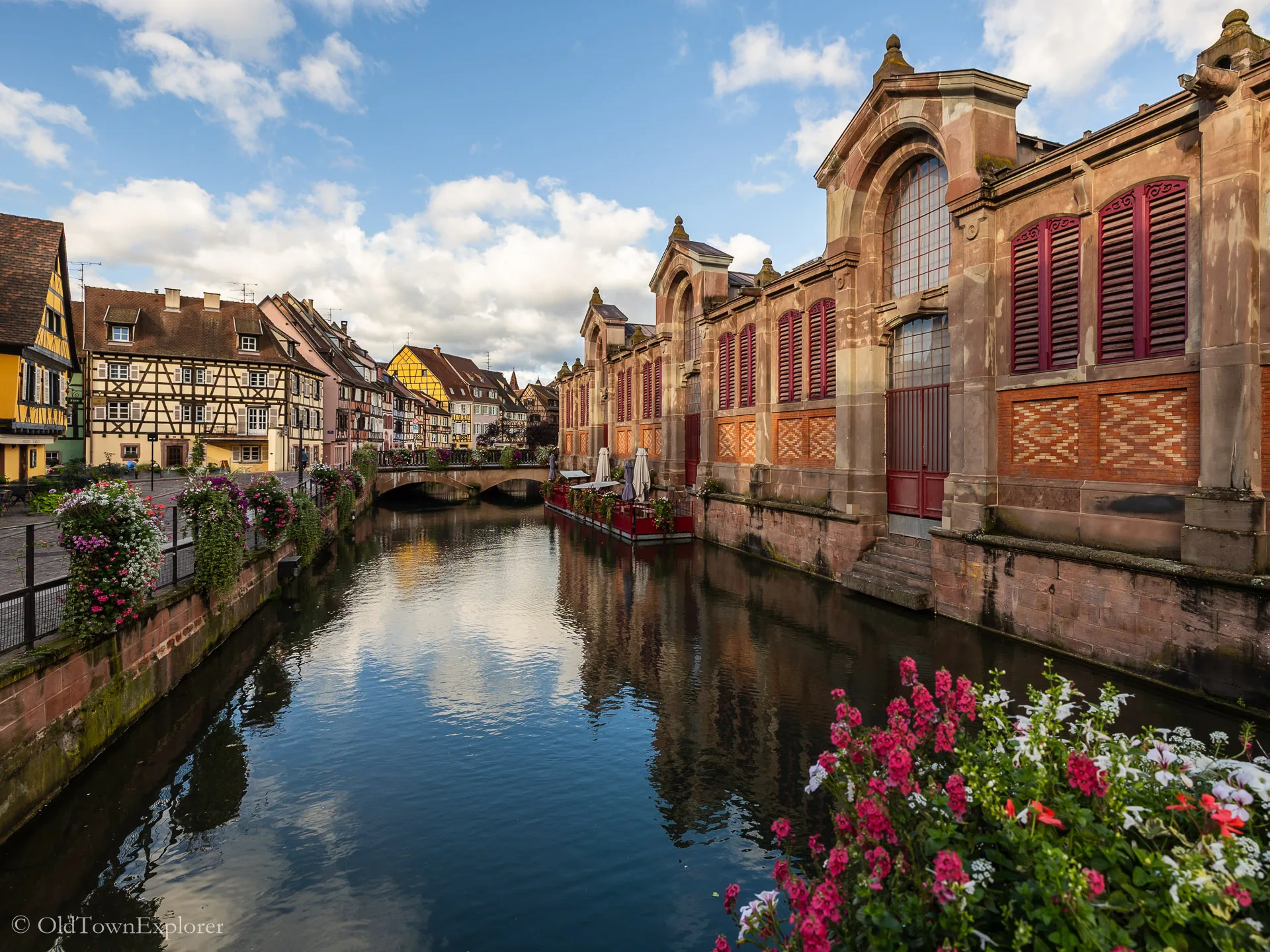
- Best canal stretch. Walk from the covered market along Quai de la Poissonnerie toward Little Venice.
- Time to allow. A half day works for the main exteriors. Allow a full day if you want lunch and a museum visit.
- Best indoor stop. Choose the Unterlinden Museum for the Isenheim Altarpiece and the former Dominican cloister.
If you’re going mainly for the Unterlinden, choose your travel day around the museum. If the canals are your priority, arrive early and visit Little Venice before lunch.
History of Colmar
Colmar’s history reflects centuries of shifting empires, commercial growth, and cultural exchange. From its origins in the early Middle Ages to its role in regional politics and Franco-German transitions, the city’s past is preserved in its architecture and urban layout.
Early Origins (9th–12th Century)
Colmar is first recorded in 823 as Columbarium in a decree by Emperor Louis the Pious. During this period, the settlement was largely rural, with wooden structures and agricultural estates shaping its layout.
Imperial City and the Décapole (13th–15th Century)
Colmar was elevated to the status of Imperial Free City in the 13th century, giving it autonomy within the Holy Roman Empire. In 1354, it joined the Décapole, a defensive and economic alliance of ten Alsatian cities. Religious orders such as the Dominicans and Franciscans established monasteries and churches that still stand today.
Commercial and Architectural Flourishing (15th–16th Century)
This was Colmar’s golden age, marked by prosperity in viticulture, textile production, and regional trade. Major civic buildings were constructed during this time, including the Koïfhus (Old Customs House, 1480) and Maison Pfister (1537). Many wealthy merchant families commissioned richly decorated homes that now define the city’s architectural profile.
French Rule and Baroque Influence (17th–18th Century)
French forces took Colmar in 1673, and it became a French royal city in 1679 while retaining its administrative privileges. In 1698 it became the judicial capital of Alsace. The Maison des Têtes, completed before the takeover, shows the earlier German Renaissance tradition. Later civic buildings, such as the former hospital, show a more restrained French classical approach.
Franco-German Transitions (19th–20th Century)
Following the Franco-Prussian War, Colmar was annexed by the German Empire in 1871 and remained so until the end of World War I, when it returned to France. During World War II, it was occupied by Nazi Germany until its liberation in February 1945 after the Battle of the Colmar Pocket.
Preservation and Modern Identity
Despite multiple regime changes and wartime occupations, Colmar’s medieval and Renaissance core remained largely intact. Today, it is celebrated for its layered history, German-French cultural fusion, and remarkably preserved architectural heritage.
Architecture of Colmar
Colmar’s old town changes character within a few streets. Around Saint-Martin, churches and civic buildings are set close to merchant houses. Farther south, the covered market and houses along the Lauch show how trades used the canals. Around Unterlinden, a former convent and public baths now form part of the same museum.
Gothic Churches and Civic Buildings
At Saint-Martin, look for pointed arches and tracery, then look up at the later tower roof. At the Koïfhus, the broad ground-floor openings and prominent roof give you a different view of late medieval Colmar. This was a customs and commercial building, with space to handle goods as well as rooms for civic business.
Renaissance Merchant Houses
Maison Pfister is easiest to read from the corner, where you can see the painted façades, projecting oriel, and wooden gallery together. Compare it with the carved stone heads on Maison des Têtes and the arched gallery at the House of the St. John’s Knights. Each uses a different feature to draw attention to the façade.
French Classical Civic Buildings
Look at the regular window spacing and symmetry of the former hospital, then compare the Town Hall with the more varied rooflines and projecting windows of the earlier merchant houses. These buildings show how public architecture changed while the older street layout remained.
Timber Frames and Canal-Side Trades
In the Tanners’ District, look above the painted walls to the upper levels, where open spaces under the roofs helped hides dry. Along Quai de la Poissonnerie and in Little Venice, step back onto a bridge to see how narrow houses line the water. The view from across the canal makes the building shapes easier to pick out.
Nineteenth-Century Public Buildings
Near Place Unterlinden, the Théâtre Municipal and the former public baths show how later public buildings expanded beyond the medieval core. The theater has a formal street front, while the baths have a more ornamental exterior. You can compare both on the approach to the museum.
Old and New at the Unterlinden Museum
The Unterlinden Museum joins a former Dominican convent to the converted baths and a contemporary extension by Herzog & de Meuron. If you go inside, notice how the scale changes from the enclosed cloister to the larger galleries. The visit gives you a chance to see how Colmar has adapted historic buildings for new uses.
Architectural Attractions in Colmar
From medieval guildhalls to Neo-Baroque markets, Colmar’s Old Town is dense with architectural landmarks. This section highlights the city’s most significant civic, religious, and residential structures—each reflecting the layered history of Alsace.
Historic Houses
Maison zur Grünen Hüs ("Zum grüenen Hüs")
- Architect: Not documented
- Style: 15th-century half-timbered house
- Year Built: 1435
- Address: 34 Rue des Marchands, 68000 Colmar
This medieval timber-framed residence once belonged to the painter Caspar Isenmann, who likely taught Martin Schongauer and created works still displayed in the Unterlinden Museum. It stands as one of Colmar’s oldest preserved domestic structures.
Maison Schongauer (Zum Schwan)
- Architect: Unknown
- Style: Late‑Gothic/early Renaissance Alsatian half‑timbered house, featuring arched entrances and overhanging upper floors
- Year Built: Late 15th century, with modifications in the 17th and 18th centuries
- Address: 36 Rue des Marchands (at the corner with Rue Schongauer), 68000 Colmar
The Maison Schongauer is one of Colmar’s oldest preserved buildings. It originally belonged to the family of the famed painter and engraver Martin Schongauer, who acquired it in 1477 to establish his workshop, though he did not reside there. The building features a ground-floor arcade, three overhanging upper storeys, a double-gabled roof, and richly carved Gothic elements—especially on the Rue Schongauer façade, where two ornate entrance portals—one with intricate foliage and a floral finial—testify to its craftsmanship.
Maison zum Kragen
- Architect: Built by Claus Sattmann; partially rebuilt after collapse in 1586
- Style: Half-timbered medieval townhouse with carved detail
- Year: Reconstructed in 1588; corner post from 1609
- Address: 9 Rue des Marchands, 68000 Colmar
Renovated after collapse, this timber-framed house is noted for a sculpted corner post depicting a draper holding a cloth-measuring rod. It connects to the cathedral square via a narrow historic passage.
Maison Sandherr
- Architect: André Sandherr
- Style: 17th-century townhouse with Baroque elements
- Year Built: Rebuilt in 1668 (date on the oriel)
- Address: 36 Grand-Rue, 68000 Colmar
Built on the site of “Au Lion Rouge,” the house features an ornate corner oriel supported by sculpted consoles and a unique stylized roof decoration—a whimsical faîtage sculpture—indicative of mid‑17th‑century bourgeois design.
Maison Wildungshof
- Architect: Not specified
- Style: Renaissance townhouse with sculptural courtyard elements
- Year Built: 1566
- Address: 12 Rue Berthe-Molly (formerly Rue des Juifs), 68000 Colmar
Featuring a richly carved Renaissance portal and an octagonal turret, this home once hosted Voltaire for over a year in the mid-18th century. Its gallery on the courtyard and stone embellishments highlight the craftsmanship of the period.
Religious Buildings
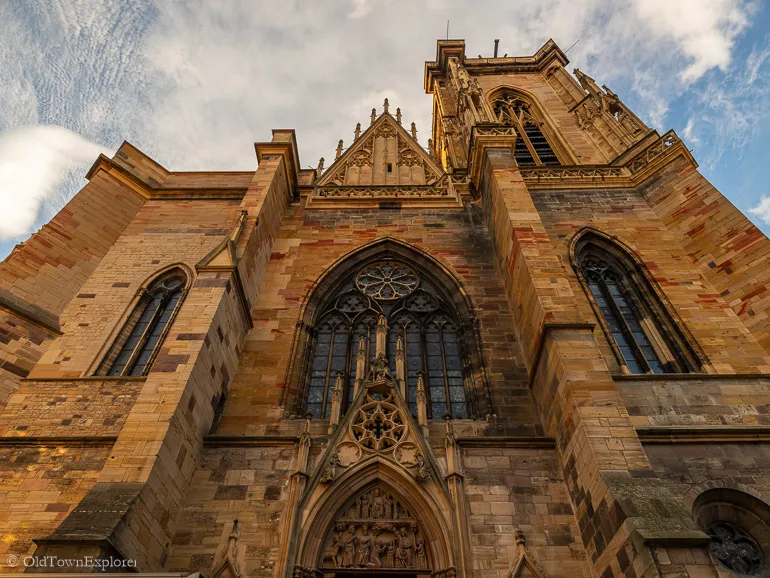
Église Saint‑Martin
aka Collégiale Saint‑Martin
- Architects: Master Humbret (initial construction), completed by Guillaume de Marbourg (d. 1366)
- Style: Gothic with a Renaissance steeple; features a Baroque organ
- Years Built: Between 1235 and 1365; lantern-style steeple added after a fire in 1572
- Address: 18 Pl. de la Cathédrale, 68000 Colmar
Colmar’s principal Gothic church, built on earlier Carolingian and Romanesque foundations found during 1972 excavations. Its multi-colored Vosges sandstone façade and distinctive tiled roof make it a landmark. Inside, visitors find an ambulatory choir, richly sculpted tympana, and a historic Baroque organ case.
Dominican Church
Église des Dominicains
- Architect: Rodolphe de Habsbourg
- Style: Gothic, with 14th-century stained glass and Baroque choir stalls
- Years Built: Began circa 1289; chœur before 1300; nave completed by 1346
- Address: 3 Pl. des Dominicains, 68000 Colmar
Former Dominican convent and church, now housing the municipal library and heritage exhibits. The church contains Martin Schongauer’s "Madonna of the Rose Bower" and an original Gothic cloister.
Église Saint‑Matthieu
- Architect: Unknown
- Style: Gothic–Renaissance with murals and stained glass
- Years Built: 13th century
- Address: 3 Grand Rue, 68000 Colmar
Features a mix of Gothic and Renaissance artistry in its stained glass and mural paintings, complemented by a wooden and painted ceiling.
Unterlinden Museum Cloister
Couvent des Antonins
- Architect: Unknown
- Style: Gothic cloister and convent architecture
- Years Built: 13th century
- Address: Pl. des Unterlinden, 68000 Colmar
Originally a convent complex, the cloister now forms part of the Unterlinden Museum, home to the famous Isenheim Altarpiece. The museum blends medieval and modern design, including an extension by Herzog & de Meuron.
Église Sainte‑Catherine
aka Couvent Sainte‑Catherine
- Architect: Not specified
- Style: Gothic with a unique openwork spire
- Year Built: Completed in 1371 (nave finalized in 1436)
- Address: 1 Pl. Sainte-Catherine, 68000 Colmar
Once a Dominican convent, now repurposed for cultural uses including as a festival venue and office space. The spire and chapel retain Gothic architectural character.
Chapelle Saint‑Pierre
- Architect: Not specified
- Style: Classicist (Jesuit chapel)
- Years Built: 1742–1750
- Address: 6 Bd du Général Leclerc, 68000 Colmar
A former Jesuit college chapel, reflecting restrained classical design from the mid-18th century.
Synagogue of Colmar
- Architect: Unknown
- Style: Neoclassical
- Year Built: 1843
- Address: 3 Rue de la Cigogne, 68000 Colmar
Still functioning as a synagogue, this mid-19th-century building contributes to the religious architectural diversity of Colmar’s historical center.
Civic Architecture
Grenier Médiéval
- Architect: Not specified
- Style: Medieval vault architecture—robust, functional design typical of 14th-century granaries.
- Year Built: 14th century (medieval period)
- Address: Rue des Marchands, Old Town, Colmar
Originally built to serve the Unterlinden convent as a large granary (~1,000 m²), it was later used by the city as storage for firefighting equipment. Now recognized as a protected historical monument since 1991, the structure remains visible from the street and evokes Colmar’s medieval urban fabric.
Koïfhus
Ancienne Douane
- Architect: Not documented
- Style: Gothic–Renaissance
- Year Built: 1480; expanded added in 16th–17th centuries
- Address: 29 Grand‑Rue, Place de l’Ancienne Douane, 68000 Colmar
Colmar’s oldest public building, used historically as customs warehouse at ground level and meeting hall for the Décapole at the upper floor. Notable for its ornate portals and glazed tile roof; restored in the late 19th century and again in 2002.
Maison des Têtes
- Architect: Albrecht (Albert) Schmidt
- Style: German Renaissance
- Year Built: 1609
- Address: 19 Rue des Têtes, 68000 Colmar
Commissioned by merchant Anton Burger, the house is distinguished by 106 sculpted grotesque heads on its façade and a three‑storey oriel. A bronze cooper statue by Bartholdi was added in 1902.
Maison Pfister
- Architect: Not available
- Style: German Renaissance
- Year Built: 1537
- Address: 11 Rue des Marchands, 68000 Colmar
Famous for its frescoed façade, timber-framed oriel, and turret; an early example of Renaissance civic architecture in Colmar.
Maison Adolph
- Architect: Unknown
- Style: German Gothic
- Year Built: 14th century
- Address: 16 Pl. de la Cathédrale, 68000 Colmar
One of the oldest surviving residences in Colmar—typifies early German Gothic domestic architecture.
Ancien Corps de Garde
- Architect: Unknown
- Style: Renaissance
- Year Built: 1575
- Address: 17 Pl. de la Cathédrale, 68000 Colmar
Former guardhouse, emblematic of Renaissance civic architecture.
The House of the St. John's Knights
Maison des Chevaliers de Saint‑Jean
- Architect: Unknown
- Style: Renaissance
- Year Built: 1608
- Address: 3 Rue Saint-Jean, 68000 Colmar
The house takes its familiar name from an old association with the Knights of Saint John, although the order never owned it. Look for the stacked arches of the Renaissance gallery, which give the façade a Venetian character.
Poêle des Laboureurs (Guildhall)
- Architect: Unknown
- Style: Baroque
- Year Built: 1626
- Address: 7 Rue Vauban, 68000 Colmar
Guildhall of the Ploughmen’s Guild; a fine example of Baroque civic architecture.
Ancien Hôpital
(now Médiathèque)
- Architect: Unknown
- Style: French Classicism
- Year Built: 1736–1744
- Address: Pl. du 2 Février, 68000 Colmar
Former hospital built in classical French style, repurposed as Colmar’s municipal library.
Town Hall
Hôtel de Ville
- Architect: Unknown
- Style: French Classicism
- Year Built: 1790 (some sources note 1782)
- Address: 48 Rue des Clefs, 68000 Colmar
Neoclassical municipal building, signifying French civic order and local government.
Law Court
Tribunal de Grande Instance
- Architect: Unknown
- Style: French Classicism
- Year Built: 1771
- Address: 58 Grand Rue, 68000 Colmar
Regional law court under classical French design.
Théâtre Municipal
- Architect: Unknown
- Style: French Neoclassical
- Year Built: 1849
- Address: 3 Rue des Unterlinden, 68000 Colmar
Town theatre designed in a classical idiom, restored around 2000.
Covered Market Hall
Marché Couvert
- Architect: Unknown
- Style: French Neo-Baroque
- Year Built: 1865
- Address: 13 Rue des Écoles, 68000 Colmar
Cast-iron market hall still in active use—a 19th-century commercial structure.
Railway Station
Gare SNCF
- Architect: Unknown
- Style: German Neo-Baroque
- Year Built: 1905
- Address: 9 Pl. de la Gare, 68000 Colmar
Railway station from early 20th century with Neo-Baroque architectural elements.
Court of Appeal
Cour d’Appel
- Architect: Unknown
- Style: German Neo-Baroque
- Year Built: 1906
- Address: 9 Av. Raymond Poincaré, 68000 Colmar
Appellate court building reflecting German Neo-Baroque civic style.
House of Arcades
Former Protestant Presbytery
- Architect: Albert Schmidt
- Style: Renaissance (implied)
- Year Built: Unknown
- Address: 13 Grand Rue, 68000 Colmar
Associated with Albert Schmidt (also architect of Maison des Têtes), this presbytery includes arcaded elements and historic relevance.
Historic Neighborhoods
Little Venice
Petite Venise
- Style & Period: Cluster of picturesque half-timbered canal‑side houses built between the 14th and 18th centuries, painted in Alsatian colors
- Setting: Located in the Krutenau district, extending from the covered market along the Quai de la Poissonnerie toward the Saint‑Pierre bridge
Named for its canal-lined streets and vibrant façades, it’s where medieval merchants lived and transported goods via boat. Today, it's a popular picturesque area with traditional boat tours and cafés reflecting both utility and charm.
Tanner’s District
Quartier des Tanneurs
- Style & Period: Cluster of tall half‑timbered houses dating largely from the 17th and 18th centuries
- Restoration: Meticulously restored between 1968 and 1974 under the general heritage inventory, with 33 properties addressed and 27 fully restored
- Location: Central Old Town; includes Rue des Tanneurs and Petite Rue des Tanneurs alongside the Lauch river
Originally home to tanning families who used the ventilated upper stories to dry hides. Today, the district’s exposed timber framing, steep roofs, colorful façades, and artisan-filled streets offer a vivid, lived-in glimpse into Colmar's past.
Fishmonger’s District
- Style & Period: Half-timbered houses lining the canals, historically linked to trade in fish and maritime produce
- Restoration: Much of the district's historic character was restored in the late 20th century—particularly following a destructive fire in 1706
- Location: Situated between the Tanner’s District and Little Venice, around the Quai de la Poissonnerie
A quaint quarter of cobbled streets and canals, the Fishmonger’s District reflects the functional and communal architecture central to the medieval trade economy.
Other Attractions
Water Tower
Château d’Eau
- Architect: Victor Huen (City Architect)
- Engineer: Heinrich Grüner (Swiss engineer)
- Style: German Neo‑Gothic, featuring pointed arches, machicolations, corbels, rusticated stonework, and ornamented façades typical of late 19th‑century industrial architecture
- Years Built: 1884–1886
- Address: Avenue Raymond Poincaré, 68000 Colmar
Height & Capacity: Approximately 53 meters tall with a shaft diameter around 12.3 meters; held approximately 1,200 m³ of water
This imposing Neo‑Gothic structure stands upon one of Colmar’s highest points and served crucially in supplying regulated drinking water from 1886 until decommissioning in 1984. Its exterior features remarkable Gothic detailing—including pointed arches and corbels—over rusticated masonry. During its period of disuse, the tower temporarily housed collections from the Natural History and Ethnography Museum (1959–1985). Declared a monument historique in 1993, it remains the oldest preserved water tower in Alsace.
Musée Bartholdi
- Architect: Not specified; originally an 18th-century townhouse with earlier Renaissance arcades found during restoration
- Style: Georgian townhouse with Renaissance remnants
- Year Established as Museum: Since 1922
- Address: 30 rue des Marchands, 68000 Colmar
The childhood home of sculptor Auguste Bartholdi, transformed into a museum dedicated to his life and work. Exhibits include personal memorabilia, works, and a section on Jewish heritage. It retains architectural elements like Renaissance arcades beneath later classical veneers.
Walking Tour in Colmar
A self-guided walking tour is the best way to explore Colmar’s compact Old Town. In just a few hours, you can visit Gothic churches, Renaissance houses, canal-side districts, and key civic buildings—all within a short distance of each other.
The Route
This route follows the town’s historical development, with stops at major landmarks and lesser-known sites that highlight the architectural diversity of Alsace.
Colmar is easily walkable. If you have limited time, we suggest visiting the recommended sites in the following order:
- Court of Appeal
- Water Tower
- The House of the St. John's Knights
- Law Court
- Koïfhus
- Maison Schongauer
- Maison Pfister
- Maison zum Kragen
- Ancien Corps de Garde
- Musée Bartholdi
- Maison Adolph
- Église Saint‑Martin
- Grenier Médiéval
- Maison Wildungshof
- Dominican Church
- Maison des Têtes
- Église Sainte‑Catherine
- Théâtre Municipal
- Unterlinden Museum Cloister
- Town Hall
- Poêle des Laboureurs (Guildhall)
- Synagogue of Colmar
- Ancien Hôpital
- Église Saint‑Matthieu
- House of Arcades
- Maison Sandherr
- Tanner’s District
- Covered Market Hall
- Fishmonger’s District
- Little Venice
- Chapelle Saint‑Pierre
Below is a map of this walking tour that starts and ends at the Colmar Train Station.
How to Get to Colmar from Strasbourg
Take the train if Colmar’s old town is the main stop. The station is within walking distance of the center, and you can cover the main sights on foot once you arrive. A car makes more sense if you’re continuing into the wine villages.
By Train
Direct trains run from Strasbourg station to Colmar. Check the SNCF timetable for your date and look at return options before deciding how late to stay. From Colmar station, head toward the Court of Appeal if you’re following the walking route, or walk straight to the old town if you’re starting at Saint-Martin.
By Bus
FlixBus runs coaches between Strasbourg and Colmar. Compare the departure times and stop locations with the train. A coach can work if it suits your schedule, but check the return before relying on it for a day trip.
By Car
Drive if you’re combining Colmar with stops in the surrounding villages or already have a car for a wider Alsace trip. The main road from Strasbourg is the A35. Choose a car park near the center, such as Rapp or Montagne Verte, and finish the trip on foot.
Making the Most of Your Day Trip to Colmar
For a shorter alternative to the full walking tour, spend the morning around Saint-Martin and the merchant houses, then follow the canals south. Leave the afternoon for one indoor visit or a slower walk.
Morning Around Saint-Martin and Maison Pfister
Start at Place de la Cathédrale for Saint-Martin, then walk over to Maison Pfister and Maison Adolph. The buildings are close together, so you can take your time with the painted façades and projecting windows before continuing to the Koïfhus.
Midday at the Covered Market and Little Venice
From the Koïfhus, walk through the Tanners’ District to the covered market. Stop for lunch in this part of town, then follow Quai de la Poissonnerie toward Little Venice. Cross a bridge for a view back along the houses and the Lauch.
Afternoon at the Unterlinden Museum
Head back through the center, passing Maison des Têtes on the way to the museum. If the Unterlinden is a priority, allow time for both the Isenheim Altarpiece and the cloister. When the museum is closed, spend longer around the old town or check whether the Musée Bartholdi is open.
Late Afternoon Before the Train
Leave a buffer for the walk back to Colmar station. If you have time, take one last pass through the old town or stop for a glass of Alsace wine before leaving. If you only have half a day, finish after Little Venice and save the museum for another visit.
Tips for Visiting Colmar
A little planning helps if you want to fit a museum visit and the canals into one day. Check your main indoor stop first, then leave the rest of the walk flexible.
Start at the Canals If You Want Quiet
Go to Little Venice early if your priority is taking photographs or pausing on the bridges. You can then work back toward Saint-Martin once the center starts filling up.
Choose a Weekday That Fits Your Plans
A weekday can be a good choice if you want more room on the narrow streets. Avoid building the day around the Unterlinden on a Tuesday, when the museum is normally closed.
Wear Shoes for Uneven Paving
Much of the old town is easy to cover on foot, but the paving around older buildings and canal crossings can be uneven. Choose shoes with good grip if the streets are wet.
Pick One Interior for a Short Visit
Choose the Unterlinden if you want the Isenheim Altarpiece and a former cloister, or the Musée Bartholdi if you’re more interested in Colmar’s sculptor. With only a few hours, one interior leaves time for Saint-Martin, Maison Pfister, and the canals.
Compare the City Pass With Individual Tickets
Check the Colmar City Pass against the places you actually plan to enter. If your day is mostly a walk with one museum, compare the individual admission before buying a pass.
Plan Lunch Near the Canals
The covered market area is a practical place to pause between the merchant houses and Little Venice. If you want a sit-down Alsatian lunch with choucroute or tarte flambée and a glass of local wine, allow time for it before setting your museum plans.
Keep an Indoor Option for Rain
In wet weather, use a dry spell for the bridges and half-timbered streets. Save a museum for the wetter part of the day, and check that it’s open before relying on it.
Leave Time to Get Back to the Station
Check your return train before adding a last stop near the canals. Allow time to walk back from wherever you finish, especially if you need to collect luggage or buy a ticket.
Stay in the Old Town If You Extend the Trip
If you decide to stay overnight, the old town lets you revisit the canals in the evening and start near the main sights the next morning. A base nearer the station can be more convenient if Colmar is one stop on a longer rail trip.
FAQs About Colmar, France
Colmar is easy to visit from Strasbourg. The main decisions are how much time to allow, whether to go inside a museum, and whether to add a wine stop.
Is Colmar worth visiting as a day trip from Strasbourg?
Yes. A direct train and a walkable center make it easy to see Saint-Martin, the Renaissance houses, and Little Venice in one day, with time for lunch and a museum if you start early.
How long should you spend in Colmar?
Allow a half day for the main exteriors or a full day for the old town, lunch, and the Unterlinden Museum. Stay overnight if you want to see the center early and late or give the surrounding wine villages a separate day.
How is Colmar different from nearby Alsace towns?
Colmar combines canal-side streets with major churches, merchant houses, and museums. A nearby village such as Eguisheim is a better fit if you want a smaller place where the lanes and vineyards are the main focus.
Is Colmar walkable?
Yes. You can walk from the station to the old town and see the main sights on foot. Some older streets have uneven paving, so leave a little extra time if that affects how you get around.
Can you taste Alsace wine in Colmar without a car?
Yes. You can order Alsace wines in town or arrange a tasting at Domaine Robert Karcher & Fils on Rue de l’Ours. Check availability if you want to fit a cellar visit between lunch and a museum.
When is the best time to visit Colmar?
Choose a spring or early autumn weekday if your priority is walking the center and visiting a museum. Go during the Christmas market season if the markets are the reason for your trip, and allow more time around the central squares.
What should you see first in Colmar?
Start with Saint-Martin and Maison Pfister if you’re interested in architecture. If you arrive early and want the canal views first, head to Little Venice and work back toward the cathedral quarter.
Why is part of Colmar called Little Venice?
The name refers to the canal-side views along the Lauch, where houses stand close to the water and bridges look down the channel. You can see the effect on foot from the quays and bridges.
Can you combine Colmar and an Alsace wine village in one day?
Yes, if you keep Colmar to a short exterior walk and arrange the onward connection in advance. If you want lunch and the Unterlinden Museum, give Colmar the day and visit the wine villages separately. Our Alsace Wine guide can help you choose a village.
