
Discover Karlovy Vary Springs & Colonnades: Drinking the Mineral Water
Karlovy Vary springs and colonnades turn the city’s thermal water into a walk through the historic spa center. Along the Teplá River in Karlovy Vary, western Czechia, spring outlets sit inside stone, timber, cast-iron, and modern colonnades. Most are close enough to explore on foot with a spa cup.
Tasting the water as a visitor is different from starting a therapeutic drinking cure. The mineral water is highly concentrated. A therapeutic drinking cure should be prescribed by a qualified spa physician, including the spring, quantity, and timing. If you are tasting, compare locations and temperatures rather than trying to match a spring to a diagnosis.
We spent a month in Karlovy Vary, which gave us time to get to know the spa center and the springs and colonnades that shape it. We’ve combined that time in the city with current research on the spring system, access, and drinking guidance to explain what you’ll encounter and how to explore it responsibly.
This post contains affiliate links that may earn us a small commission at no additional cost to you.
Karlovy Vary Springs and Colonnades at a Glance
The central spring route is compact, free to walk, and easy to combine with the historic spa center. Most travelers can experience the main colonnades without booking a treatment or entering a spa hotel.
These are the decisions that matter before you start:
- What it is: A chain of public mineral-spring outlets, colonnades, and small spring pavilions along the Teplá River and nearby slopes.
- Best place to start: Vřídlo, the Hot Spring, because its geyser makes the thermal system easiest to understand before you compare the smaller outlets.
- Core route: Hot Spring Colonnade → Market Colonnade → Upper Castle Spring if you want the short climb → Mill Colonnade → Freedom Spring → Park Colonnade.
- Water temperatures: The main numbered sources range from cold mineral water at roughly 12–14°C to Vřídlo at about 73°C. Vřídlo’s drinking outlets cool the water before it reaches your cup.
- Time needed: Allow about 1½–2 hours for the central route if you want to stop, look at the buildings, and taste several outlets rather than simply walk past them.
- Cost and access: Most spring outlets are free. Hot Spring Colonnade and the public Park Spring outlet have building hours, while parts of Castle Colonnade belong to Castle Spa and are not open to general visitors.
- Medical note: Do not use a travel guide to choose a therapeutic spring, dose, or schedule. Karlovy Vary’s balneology specialists specifically recommend physician guidance for a drinking cure.
If your time is limited, stay with the central Hot Spring-to-Park sequence. Štěpánka adds a longer southern extension. Ferrous Spring is farther north and is currently closed for technical reasons, so check its status before adding that walk.
History of Drinking the Springs in Karlovy Vary
Karlovy Vary grew around hot mineral water long before its grand 19th-century colonnades appeared. The history that matters most on this walk is the shift from using the springs mainly for bathing to drinking the water at the source while moving through a purpose-built spa landscape.
From the Founding Legend to the Drinking Cure
Karlovy Vary’s founding story is tied to Emperor Charles IV and the discovery of hot springs during a hunt in the 14th century. It remains a legend rather than a documented discovery account, and Market Colonnade preserves the story in a relief above Charles IV Spring.
By the 16th century, springs such as Vřídlo and Mill Spring were already being captured and used. Mill Spring became one of the first local waters recommended for drinking cures in 1705. In the 18th century, physician David Becher pushed the practice further by emphasizing drinking the water directly at the source. A Hot Spring Hall built in 1774 reflected that change in treatment.
Why Karlovy Vary Built Colonnades
Drinking at the source created a practical problem: patients needed somewhere to collect hot mineral water and continue the prescribed walk in bad weather. A wooden promenade hall built over the spring then known as New Spring, now Rusalka, in 1792–1793 was the first structure of its kind in Karlovy Vary.
That basic idea still explains the city today. A colonnade is not simply a decorative backdrop. It shelters spring outlets and gives people room to sip the water, walk slowly, stop, and continue to the next spring.
The 19th- and 20th-Century Spring Corridor
The spring walk took on its present architectural variety during the spa boom. Mill Colonnade was built from 1871 to 1881, Market Colonnade followed in 1882–1883, and the surviving Park Colonnade dates from the same late-19th-century period. Castle Colonnade was added in 1910–1912. The current Hot Spring Colonnade dates from 1975, after several earlier structures over Vřídlo had been replaced.
These buildings were created at different moments, but they all answer the same practical need: bring people to the mineral water and give the drinking cure a protected promenade.
Karlovy Vary and the Great Spa Towns of Europe
Karlovy Vary was inscribed on the UNESCO World Heritage List in 2021 as one of the eleven Great Spa Towns of Europe. UNESCO specifically identifies drinking halls, colonnades, galleries, baths, parks, and promenades as parts of the European spa-town system built around mineral springs.
That makes the spring route more than a line of fountains. Drinking the water, walking between outlets, and moving through colonnades and landscaped promenades are surviving parts of the historic spa-town pattern.
How the Springs and Colonnades Fit Together
Karlovy Vary’s spring system makes more sense when you think of it as a sequence rather than a collection of separate monuments. Most of the famous outlets sit in a narrow corridor beside the Teplá, while a few springs require a climb or a longer extension beyond the main promenade. For the building styles, architects, and visual details, see our Karlovy Vary Architecture guide.
One Mineral-Water System, Many Drinking Outlets
Karlovy Vary’s mineral water forms at a depth of roughly 2,500 meters. The main thermal outlets share broadly similar basic chemistry, but their temperatures, dissolved carbon dioxide, and smaller trace components differ. The public spring walk is therefore many outlets from one complex hydrogeological system rather than fifteen unrelated kinds of water.
The differences are still obvious in the cup. Some outlets are hot enough that you need to sip carefully, while Snake, Štěpánka, and Ferrous Spring are far cooler. For therapeutic drinking, a spa physician should interpret those differences rather than a lay guide.
Hot Spring Colonnade: The Southern Anchor
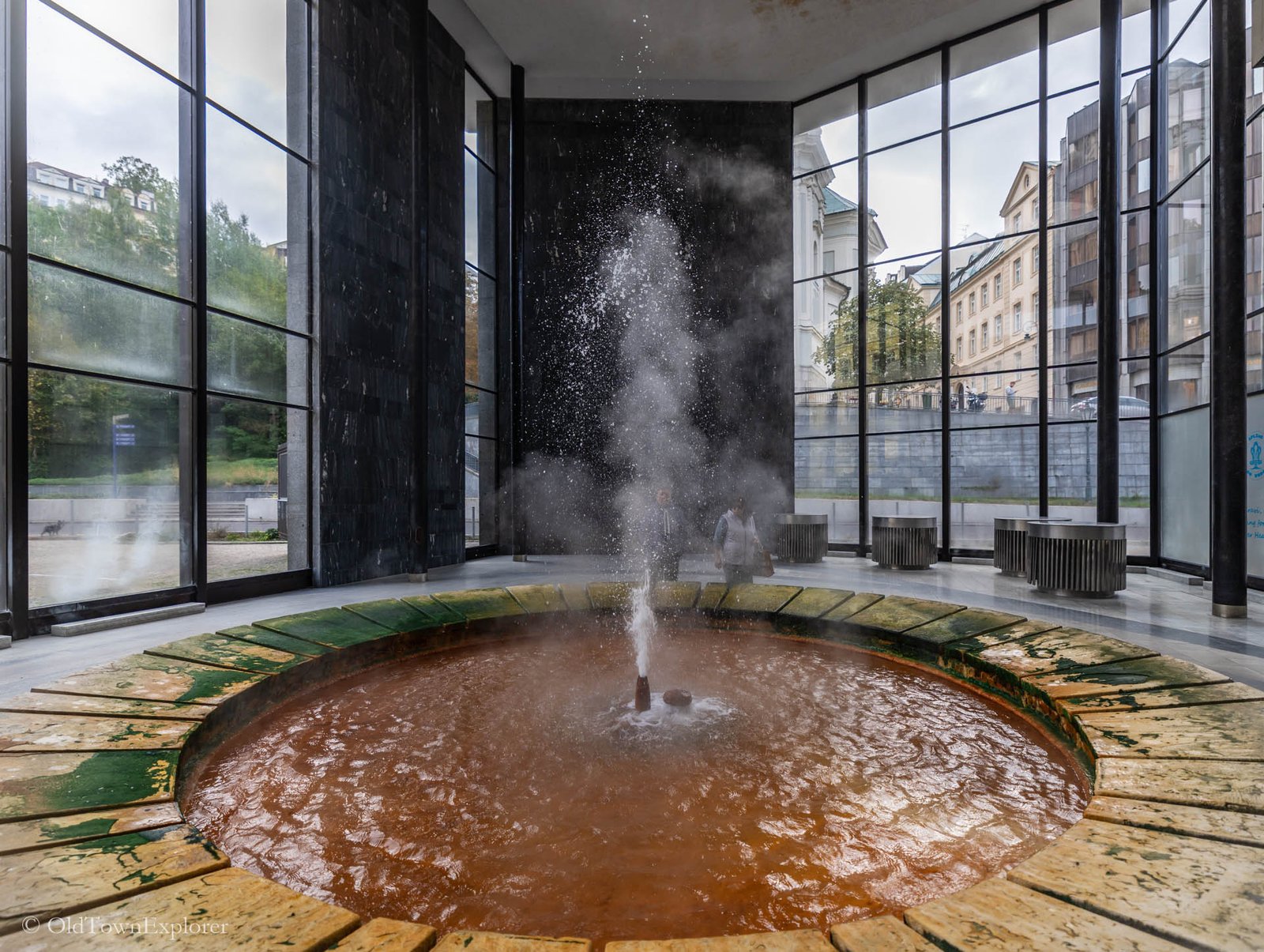
Vřídlo is the strongest starting point because you can see the thermal system working at scale. The source reaches about 73°C and produces the geyser that rises inside a separate pavilion. Drinking outlets in the promenade hall cool the water before it reaches the cup, so you are not meant to drink directly from the geyser.
Market Colonnade is only a short walk across the river from the modern Hot Spring Colonnade, and the rest of the central spring route continues north through the spa center.
Market and Castle: One Spring Area on Two Levels
Market Colonnade sits below Castle Hill and concentrates three public outlets under one carved wooden roof: Charles IV Spring, Lower Castle Spring, and Market Spring. Upper Castle Spring is nearby but higher on the slope.
The original Castle Colonnade was designed to connect the upper and lower spring areas. Much of it is now incorporated into Castle Spa and is not open to the general public. You can still reach the Upper Castle Spring arbour, while Lower Castle Spring has a public outlet in Market Colonnade.
Mill Colonnade: The Main Drinking Cluster
Mill Colonnade contains the densest group of public thermal outlets. Five named springs rise here: Mill, Rusalka, Prince Wenceslas, Libuše, and Rock. Prince Wenceslas Spring reaches two separate drinking bowls at different temperatures, so you will encounter six outlets while the spring number remains #8.
This is the place to slow down rather than treat every bowl as another box to tick. The outlets sit close together, making temperature differences much easier to notice than when you cross the whole city between springs.
Freedom and Park: Smaller Stops Toward Dvořák Park
Freedom Spring sits in its own small wooden arbour between Mill Colonnade and Spa III. Continue toward Dvořák Park for Park Colonnade, where Snake Spring is directly accessible.
Park Spring is the exception that is easy to miss. Its public bowl is reached in the basement of the Army Spa Institution beside Park Colonnade rather than from the obvious outdoor fountain. Because that access follows building hours, check it before planning an early-morning or evening visit.
Outer Springs: Štěpánka, Dorotka, and Ferrous Spring
The central colonnades do not contain every numbered source. Štěpánka Spring stands south of the main spa corridor in Alois Klein’s Arbour near Parkhotel Richmond. Dorotka Spring is also south of the center, but its pavilion is closed and the spring is not a public drinking stop.
Ferrous Spring is in the opposite direction, north of the core spring route on a hillside above the Teplá. At about 12°C, it is the coldest numbered mineral spring in Karlovy Vary. The spring is currently closed for technical reasons, so treat it as an inventory stop until access resumes rather than part of the standard colonnade walk.
Every Numbered Karlovy Vary Spring and Drinking Outlet
Karlovy Vary’s spring count is easy to misunderstand. The healing-spring list contains 15 drinking outlets, but the numbering is not a simple 1-to-15 checklist: Prince Wenceslas Spring (#8) reaches two public bowls, Dorotka (#13) is not accessible, and Ferrous Spring is separately numbered #16. For a visit, the spring names and locations are clearer than trying to force every outlet into one total.
Spring temperatures can vary slightly, so the rounded figures below are best treated as practical comparisons rather than fixed laboratory values.
Vřídlo (Hot Spring) — Spring #1
Temperature at source: about 73°C. Vřídlo is the hottest spring in the visitor circuit. It yields roughly 2,000 liters per minute and its geyser rises to almost 12 meters inside Hot Spring Colonnade, but the drinking cure uses separate outlets where the water is cooled before serving. Start here if you want to understand why Karlovy Vary needed special infrastructure simply to handle its thermal water.
Access depends on the Hot Spring Colonnade being open, so this is one of the few central springs worth checking before a very early or late walk.
Market Colonnade — Springs #2, #3, and #5
Charles IV Spring (#2), about 66°C. This outlet carries Karlovy Vary’s foundation legend. A relief above the spring depicts Charles IV and the discovery of the thermal water, giving the stop more historical context than most of the other drinking bowls.
Lower Castle Spring (#3), about 49°C. The Castle Spring divides into upper and lower branches. The main lower seep lies within Castle Spa, but mineral water is diverted to a public bowl in Market Colonnade. That makes this the practical place to taste the Lower Castle water without entering the private spa complex.
Market Spring (#5), about 64°C. Discovered beneath the old marketplace in 1838, the spring repeatedly vanished and reappeared. It is the third public spring under Market Colonnade, where three outlets sit within a very small space.
Upper Castle Spring — Spring #4
Temperature: about 51°C. Upper Castle Spring sits above Market Colonnade in the surviving public arbour associated with Castle Colonnade. Reaching it adds a short uphill detour on Castle Hill, so it is the first spring to skip if you want a level, compact route.
The detour is worthwhile if you are trying to complete the numbered thermal springs or want to see how Karlovy Vary handled spring outlets at different elevations. Much of the historic Castle Colonnade now forms part of Castle Spa and is not open to the general public.
Mill Colonnade — Springs #6 to #10
Mill Spring (#6), about 58°C. One of Karlovy Vary’s oldest captured thermal springs, Mill Spring was among the first waters recommended for a drinking cure in 1705. Its place in the history of drinking at the source makes it one of the most important stops even though Vřídlo is more dramatic.
Rusalka Spring (#7), about 61°C. Rusalka was once known as New Spring. The first wooden promenade hall in Karlovy Vary was built over it in 1792–1793, an early step toward the sheltered colonnade culture you see today.
Prince Wenceslas Spring (#8), two outlets at about 65°C and 59°C. This is one numbered spring with two drinking bowls, usually identified as Prince Wenceslas I and II. The two temperatures are one reason simple spring counts can be confusing: you encounter two distinct drinking points without gaining another spring number.
Libuše Spring (#9), about 62°C. Water was supplied to this bowl from four smaller seeps beneath the orchestra pit. It sits within the same dense sequence as Mill, Rusalka, and Prince Wenceslas, so location rather than distance is what distinguishes the stop.
Rock Spring (#10), about 45°C. Rock Spring originally rose from the bed of the Teplá before works around Bernard’s Rock allowed it to be captured. Its lower temperature makes it an easy comparison with the hotter outlets only a few steps away.
Freedom Spring — Spring #11
Temperature: about 62°C. Freedom Spring rises in a small octagonal wooden arbour between Mill Colonnade and Spa III. It is a single-spring stop rather than a grand colonnade, a sharp contrast with the monumental Mill Colonnade only a short distance away.
The arbour sits directly on the route toward Dvořák Park, so there is little reason to miss it on a central walk.
Park Spring and Snake Spring — Springs #12 and #15
Park Spring (#12), about 39°C. The public outlet is accessed from Park Colonnade in the basement of the Army Spa Institution. Park Spring has relatively high dissolved carbon dioxide and a pleasantly sour taste. Because its public access has set hours, this spring needs more planning than the outdoor bowls.
Snake Spring (#15), about 28°C. Snake Spring has been open to the public at Park Colonnade since 2001. It is cooler and more carbonated than many of the classic hot outlets, so you can compare two very different temperatures in the Park area without walking far.
Dorotka Spring — Spring #13
Not publicly accessible. Dorotka is the real numbered spring #13, but its pavilion is closed to the public. It is unusual even among Karlovy Vary springs: the site is mainly a strong dry-carbon-dioxide emission accompanied by only a small volume of slightly mineralized water.
The number has a second local meaning. Becherovka is traditionally nicknamed Karlovy Vary’s “thirteenth spring”. The liqueur nickname and the genuine Dorotka #13 are separate things.
There is no drinking decision to make at Dorotka. Do not build a route around it simply to complete the numbers; the accessible southern extension is Štěpánka.
Štěpánka Spring — Spring #14
Temperature: about 14°C. Štěpánka is a cold mineral spring in Alois Klein’s Arbour, in the park in front of Parkhotel Richmond. The walk from Vřídlo is roughly 1.5 kilometers and about half an hour, so this is not part of the compact central circuit.
The spring was first captured in 1884, disappeared in the early 20th century, and reappeared in a new well drilled in 1993. Since 1997, the recaptured spring has stood beneath the octagonal wooden Alois Klein’s Arbour.
Add Štěpánka if you want the southernmost public spring stop or if your walk already continues toward Richmond and the parks beyond the central spa buildings.
Ferrous Spring — Spring #16
Temperature: about 12°C. Ferrous Spring is a cold mineral source in a small colonnade on a slope north of the central spa corridor. Karlovy Vary numbers it #16, but it is not included in the same 15-outlet healing-spring list.
Access: The spring is currently closed for technical reasons. When it reopens, the walk from Vřídlo is roughly 1.5 kilometers and about half an hour. Until then, do not make the northern extension solely to drink from #16.
How to Drink the Mineral Water in Karlovy Vary
Visitors often approach the spring bowls as if they were ordinary drinking fountains, but Karlovy Vary still treats the mineral water as a medical resource. The thermal mineral water is highly concentrated and is not intended for continuous or uncontrolled consumption. That distinction matters even if you are only curious about the taste.
Use the Spa Cup for the Traditional Experience
The long-spouted spa cup is one of Karlovy Vary’s most recognizable objects. Spa drinking vessels were already in use by the 17th century, with the familiar built-in spout developing in the 19th century. The narrow spout helped people sip hot water while walking and gave the cup a practical role, not just a souvenir value.
Traditionally shaped porcelain or glass cups are recommended for a prescribed drinking cure. You do not need to buy a collector’s cup simply to see the springs, but carrying one makes it easier to take small tastes while moving between outlets.
Read the Temperature Before You Sip
The spring number tells you where you are; the temperature tells you what your mouth is about to encounter. Vřídlo reaches about 73°C at source, while many Mill and Market outlets are around 50–65°C. Snake, Štěpánka, and Ferrous Spring are much cooler.
At Vřídlo, use the designated drinking bowls rather than the geyser. The Hot Spring Colonnade cools water for drinking, which is why the cup outlets are a different experience from watching the main jet.
Do Not Self-Prescribe a Therapeutic Drinking Cure
In 2025, Karlovy Vary’s Balneological Institute, spa-facility association, and natural-resource administration jointly stated that an experienced spa doctor should choose the spring and method for therapeutic drinking. The basic chemistry of the thermal outlets is broadly similar, while temperature, dissolved carbon dioxide, and trace components differ.
Do not match a spring to your stomach, liver, metabolism, or another condition from a travel article. A casual taste while sightseeing and a physician-prescribed drinking schedule are different activities.
Walk Slowly and Respect the Colonnades
The traditional drinking cure combines mineral water with slow walking. Drinking-cure etiquette also asks people not to touch the spring stands or outlet tubes, not to pour unwanted water onto the colonnade floor or plants, and not to disturb people who are following a prescribed cure.
Even without treatment, that etiquette improves the visit. Fill your cup without blocking the outlet, step away before drinking, and leave room for people who use the springs as part of a medical routine.
Expect Similar Mineral Water, Not Fifteen Completely Different Drinks
The thermal outlets belong to the same hydrogeological system and share broadly similar basic chemistry. What changes most obviously to a casual visitor is temperature and carbonation. Park Spring has a pleasantly sour taste associated with its higher dissolved carbon dioxide.
Taste is subjective, so there is little value in chasing a supposedly “best tasting” spring. Compare a few temperatures and locations instead of forcing yourself to finish water at every bowl.
How to Visit the Karlovy Vary Springs and Colonnades
The best visit is a one-way walk through the central spa corridor, not a series of separate trips to individual springs. You can cover the major colonnades on foot and then decide whether the outer springs justify extra distance.
Best Central Route: Vřídlo to Park Colonnade
Start at Hot Spring Colonnade and watch Vřídlo before using the drinking outlets. Cross to Market Colonnade for Charles IV, Lower Castle, and Market springs. If you do not mind a short climb, go up Castle Hill for Upper Castle Spring before returning to the river.
Continue along Lázeňská toward Mill Colonnade, where the largest cluster of outlets sits under one roof. From there, stop at Freedom Spring, then finish at Park Colonnade for Snake Spring and the less obvious public entrance to Park Spring.
The walk from Vřídlo to the Park Colonnade area is about 800 meters, but that straight movement time is not a realistic visit length. Allow roughly 1½–2 hours if you plan to stop at the geyser, read the spring names, taste several outlets, and make the Castle detour.
Short Route When You Have Less Than an Hour
Concentrate on Hot Spring, Market, and Mill colonnades. That gives you the geyser, the carved timber pavilion, the largest spring cluster, and a broad range of temperatures without stretching the walk to the outer parks.
Skip Upper Castle Spring if the climb does not appeal, and leave Park Spring for another time if its indoor access does not fit your schedule. The spring route is more satisfying when you stop to look than when you rush through every numbered outlet.
Southern Extension to Štěpánka Spring
From the Vřídlo area, continue upstream past the Grandhotel Pupp area and follow Goethe’s Path toward the park in front of Parkhotel Richmond. The walk to Štěpánka Spring is roughly 1.5 kilometers and about 30 minutes on foot from the Hot Spring.
Dorotka Spring lies in the same broad southern direction, but its pavilion is closed. Unless the building itself interests you, there is no reason to make a separate detour to an inaccessible drinking source.
Ferrous Spring: Check Access Before the Northern Extension
Ferrous Spring sits north of the main spa corridor on a slope above the right bank of the Teplá. The walk from Vřídlo is roughly 1.5 kilometers and about 30 minutes.
The spring is currently closed for technical reasons. If it reopens, the cold #16 source makes a useful northern extension for comparing the widest temperature range. While the closure remains, finish the drinking route in the central spa corridor or add Štěpánka to the south instead.
How to Get to the Karlovy Vary Springs and Colonnades
Once you reach the spa center, the springs are primarily a walking experience. The main choice is whether to enter the corridor at its southern end near Vřídlo or its northern end near Mill and Park colonnades.
From Tržnice: Start at Vřídlo
Tržnice is Karlovy Vary’s main city-bus hub. Bus 2 links Tržnice with Divadelní náměstí. From the Divadelní náměstí stop, Hot Spring Colonnade is only a short walk.
This is the simplest public-transport approach if you want to follow the spring route in the order described above, from Vřídlo toward Park Colonnade.
From Karlovy Vary Horní Nádraží: Enter Near Lázně III
Bus 4 links Horní nádraží with Lázně III. That brings you close to the Mill Colonnade, Freedom Spring, and Park Colonnade end of the spring corridor.
If you arrive this way, you can walk the route in reverse toward Market Colonnade and Vřídlo. Check the DPKV timetable before travel because local bus routes and service patterns can change.
On Foot Through the Spa Center
The central promenade is the easiest way to move between springs. Hot Spring, Market, Mill, Freedom, and Park are all close enough that taking transport between them would usually make the visit more complicated, not easier.
The main exception is mobility. Castle Hill adds an uphill section to Upper Castle Spring, while Štěpánka and Ferrous Spring each add a much longer extension beyond the core route. If those distances are a problem, keep the visit to the river-level spring corridor.
Tips for Exploring the Springs and Colonnades
A few Karlovy Vary-specific choices make the spring walk much easier. The goal is not to collect every number as quickly as possible; it is to understand how the water, buildings, and promenade fit together.
Prioritize the Springs with Building Access
Most outdoor spring bowls are freely accessible, but Vřídlo depends on Hot Spring Colonnade being open and Park Spring uses an indoor public outlet beside Park Colonnade. If you are walking early or late, check those two first rather than assuming every spring follows the same schedule.
Do Not Turn Fifteen Outlets into Fifteen Full Cups
Karlovy Vary’s drinking-cure rules warn against uncontrolled consumption. If you are sightseeing rather than following a physician’s prescription, there is no reason to treat every public bowl as a required serving.
Compare a few different temperatures, pay attention to the spring names, and spend the rest of the time looking at how each outlet is set into the colonnade.
Make Upper Castle Spring an Optional Climb
Upper Castle Spring is close to Market Colonnade on the map but higher on the slope. The detour is short, yet it changes an otherwise easy river walk into an uphill section.
If you have limited mobility, skip the climb and use the public Lower Castle Spring outlet in Market Colonnade for the Castle Spring area.
Treat Štěpánka and Ferrous Spring as Extensions
Neither outer spring is necessary to understand the central Karlovy Vary drinking tradition. Add Štěpánka when you are already walking south toward Richmond. Ferrous Spring belongs on the northern extension only after its current technical closure ends.
Even when both ends are accessible, trying to include them in a quick visit adds distance without adding another major historic colonnade.
Use the Colonnades in Bad Weather
Rain does not cancel the central spring walk. Mill, Market, Park, and Hot Spring colonnades were built around the practical need to shelter spa guests as they moved between the water and the promenade.
You will still spend time outdoors between structures, so a wet day favors the compact central route rather than the longer walks to Štěpánka or Ferrous Spring.
Separate Spring Drinking from Spa Treatment Planning
The same mineral water supports Karlovy Vary’s wider spa tradition, but choosing a hotel spa, medical program, bath, massage, hydrotherapy treatment, or wellness center is a different travel decision. Our Karlovy Vary Spas & Wellness Centers guide compares medical treatment, balneology, public spas, hotel spas, pools, saunas, and relaxation facilities. Keep this walk focused on the public springs and colonnades rather than trying to judge treatment facilities from the fountain route.
FAQs About Karlovy Vary Springs and Colonnades
These questions cover the points that most often cause confusion when you first encounter Karlovy Vary’s numbered springs and drinking-cure tradition.
Can Tourists Drink the Spring Water in Karlovy Vary?
Yes. Public drinking outlets are part of the Karlovy Vary spring experience. However, the city warns that the thermal mineral water is strongly concentrated and should not be consumed continuously or without control. A therapeutic drinking cure should be prescribed by a qualified spa physician.
How Many Springs Are There in Karlovy Vary?
The main Karlovy Vary healing-spring list contains 15 drinking outlets. The numbering is more complicated: Prince Wenceslas is one spring (#8) with two public bowls, Dorotka is numbered #13 but is not accessible, and Ferrous Spring is separately numbered #16. That is why different guides can appear to give different totals.
Why Do Some Guides Say Karlovy Vary Has 13 Springs?
“13 springs” is an older and still common shorthand for the principal thermal drinking sources, and Becherovka is also traditionally nicknamed Karlovy Vary’s “thirteenth spring.” The actual numbering is more complicated because Prince Wenceslas has two public bowls, Dorotka is the genuine #13 but is inaccessible, and Ferrous Spring is numbered #16. For an actual visit, follow names and locations rather than trying to force every outlet into one total.
What Is the Hottest Spring in Karlovy Vary?
Vřídlo, the Hot Spring, is the hottest major source at roughly 73°C. You watch the geyser in Hot Spring Colonnade, but drink from designated outlets where the water is cooled rather than from the main jet.
What Is the Coldest Numbered Mineral Spring?
Ferrous Spring (#16) is about 12°C. Among the spring outlets on the city’s main 15-outlet healing-spring list, Štěpánka is one of the coldest at about 14°C.
Which Karlovy Vary Spring Should I Drink for My Health?
That choice belongs with a qualified spa physician. Karlovy Vary’s balneology specialists advise against non-professional recommendations that match a particular spring to a diagnosis. The route, temperatures, history, and access can help you explore the springs, but they cannot tell you which treatment is appropriate for you.
Do I Need a Special Spa Cup?
No special cup is required simply to walk the colonnades. The traditional long-spouted porcelain or glass cup is part of Karlovy Vary’s drinking culture and is the recommended form for a prescribed drinking cure. It is also easier to carry between spring bowls than an open cup.
Are the Karlovy Vary Colonnades Free?
The principal spring colonnades and most public drinking outlets can be visited without an admission ticket. Access is not identical everywhere: Hot Spring Colonnade and Park Spring follow building hours, and much of Castle Colonnade is incorporated into Castle Spa and is not open to the general public.
Can I Visit All the Springs in One Walk?
You can cover the central Hot Spring-to-Park sequence comfortably in one walk. Štěpánka adds substantial distance to the south, Dorotka is closed to the public, and Ferrous Spring is currently closed for technical reasons. For most visitors, the central route is the better first experience even when every outer source is accessible.
Which Colonnade Has the Most Springs?
Mill Colonnade has the largest concentration. It contains five named springs—Mill, Rusalka, Prince Wenceslas, Libuše, and Rock—with Prince Wenceslas supplied to two drinking bowls at different temperatures.
What Is the Difference Between Drinking the Springs and Going to a Spa?
The spring walk is a public sightseeing and drinking experience built around the mineral-water outlets and colonnades. A spa stay or balneotherapy program can involve medical consultations, prescribed drinking schedules, baths, hydrotherapy, massage, exercise, pools, saunas, and other treatments. See our Karlovy Vary Spas & Wellness Centers guide to compare those options separately from the public spring route.
For the buildings around the spring route, see our Karlovy Vary Architecture guide. For where to stay, how long to spend in the city, seasons, and wider planning, start with our Karlovy Vary guide. For a wider trip, our Czechia page compares Karlovy Vary with other historic destinations around the country.
