

Discover Peschiera del Garda: History, Architecture & Must-See Attractions
Peschiera del Garda, Italy, makes a straightforward Lake Garda day trip from Verona. The historic center stands where the lake drains into the Mincio River, with bridges, canals, and Venetian fortifications within walking distance of the railway station.
The fortress surrounds the town rather than standing apart from it. Monumental gates lead into streets and squares, while broad bastions rise above the water. Across the Canale di Mezzo, Austrian barracks and officers’ residences surround Parco Catullo.
Allow a half day for the main exterior sights or a full day with lunch, a museum, and a lakeside walk. The Sanctuary of Madonna del Frassino lies outside the fortified center and needs a separate extension.
Peschiera del Garda at a Glance
Peschiera suits a day of fortifications, canal-side streets, and lake views. Its railway connection makes it particularly practical from Verona, while the compact center leaves room for lunch and an afternoon extension.
Key day-trip points:
- Base city: Verona, with direct trains to Peschiera del Garda
- Main sights: Porta Verona, Ponte dei Voltoni, Porta Brescia, San Martino, and the former Austrian military quarter
- Architectural focus: Venetian bastions and gates alongside 19th-century barracks and officers’ residences
- Walking difficulty: Mostly gentle streets, with steps and changes of level on elevated fortification paths
- Time needed: A half day for the central exterior sights; a full day with lunch, museums, or a longer waterfront walk
- Main choice: Stay around the fortress for architecture or reserve additional time for a boat trip or the Frassino sanctuary
The railway station is outside the walls on the eastern side. Starting at Porta Verona puts the former military quarter near the beginning of the walk.
History of Peschiera del Garda
Peschiera’s position at Lake Garda’s outlet made it a place for fishing, transport, and military control. Roman remains, a medieval stronghold, Venetian defenses, and Austrian military buildings survive within a small area.
Roman Arilica
The Roman settlement of Arilica occupied this meeting point between lake and river. Boats carried people and goods across Lake Garda, while fishing supported the settlement. Archaeological remains beside San Martino preserve part of the town beneath today’s streets.
The Medieval Town and Scaliger Stronghold
Under the rulers of Verona, Peschiera became a fortified position controlling the Mincio. The Scaliger rulers strengthened the Rocca at the southern end of the settlement. Later rebuilding changed the complex substantially, so the buildings around Piazza Ferdinando di Savoia contain several periods rather than an intact medieval castle.
Venetian Fortification in the 16th Century
The Republic of Venice rebuilt Peschiera’s defenses for artillery warfare. Earth-backed walls, projecting bastions, and surrounding water formed a pentagonal enclosure. Porta Verona, Porta Brescia, and Ponte dei Voltoni remain prominent parts of this work.
The five bastions are Querini, San Marco, Cantarane, Feltrin, and Tognon. Their angled faces let defenders cover neighboring stretches of wall, while the canals added another obstacle outside the fortress.
French Changes and the Austrian Military Quarter
French and Austrian rule brought further changes to Peschiera’s defenses. During the 19th century, the town became one corner of the Austrian Quadrilateral, alongside Verona, Mantua, and Legnago.
The Austrian period is particularly visible around Parco Catullo. The Francesco I Barracks, Officers’ Pavilion, command building, and Artillery Barracks turned this part of the fortress into a military quarter with accommodation, administrative rooms, and working buildings.
Italian Rule, the First World War, and UNESCO Recognition
Peschiera joined the Kingdom of Italy in 1866. The former Austrian command building later hosted an Allied conference in November 1917, after the Italian defeat at Caporetto, and became known as the Palazzina Storica.
In 2017, the fortified city became part of the UNESCO-listed Venetian Works of Defence. The designation covers a shared defensive system across Italy, Croatia, and Montenegro; Peschiera is one component of that larger property.
Architecture of Peschiera del Garda
Peschiera’s architecture is easiest to recognize through its water defenses and the different buildings inside them. The Venetian walls enclose both the older town and the later Austrian military quarter.
Bastions Built for Artillery
A bastion is a projecting defensive platform whose angled sides allow fire along adjacent walls. Peschiera has five, arranged around its pentagonal enclosure. Look at the broad, sloping faces near Porta Brescia and the raised defenses beside Porta Verona.
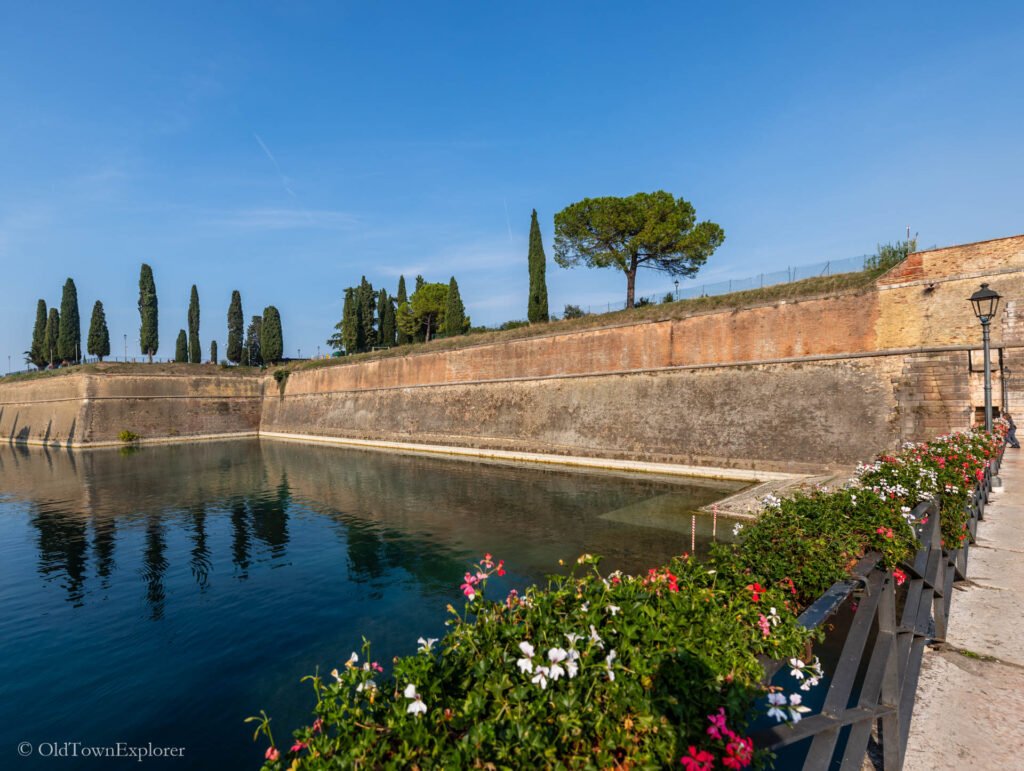
Canals as Defensive Boundaries
Water separates parts of the town and surrounds much of the fortress. From the bridges, you can see how walls descend toward the channels rather than meeting an ordinary street. The Canale di Mezzo also separates the older streets from the former Austrian military quarter.
Two Different Gateways
Porta Verona has a monumental outer façade facing the eastern approach. Porta Brescia is more restrained, with a compact passage and a bridge across the western moat. Visiting both makes the difference between ceremonial display and practical military construction visible.
Brick, Stone, and Earth
Brick appears extensively in the defensive walls, while stone marks arches, gateways, and architectural details. The walls also contain earth embankments, which added thickness behind their outer faces. From ground level, the result is a broad defensive mass rather than a tall, slender wall.
The Austrian Buildings Around Parco Catullo
Long façades, repeated windows, and orderly building lines distinguish the former military quarter. The Officers’ Pavilion faces the canal, while other military buildings surround the park. Their scale differs from the smaller streets and closely spaced buildings across the water.
Churches and Earlier Buildings
San Martino stands beside Roman remains in Piazza Ferdinando di Savoia. Its present church was completed in 1822, but the façade was rebuilt in 1930–1933. At the Frassino sanctuary outside town, a Renaissance church and convent introduce a different kind of architecture from the military center.
Streets, Bridges, and Walking Routes
Bridges determine how you move between Peschiera’s main areas. The street walk is generally gentle, but elevated bastion paths involve additional steps and changes of level. Follow the public paths between viewpoints rather than expecting an uninterrupted walk along the top of every wall.
For broader comparisons with Roman monuments, medieval towns, and Renaissance buildings elsewhere in the country, see Italy Architecture.
Architectural Attractions in Peschiera del Garda
The main sights fall into three connected parts of the fortified center: the perimeter defenses, the former military quarter, and the streets around Piazza Ferdinando di Savoia. The Frassino sanctuary is a separate outing beyond the walls.
Gates and Bastions Around the Fortress
Porta Verona
- Architect: Guidobaldo II della Rovere and G. Gotti
- Style: Renaissance military architecture
- Built: 1553–1554, with later alterations
- Address: Eastern entrance to the fortress beside Parco Catullo
Porta Verona is the monumental entrance on the side facing Verona. Its outer façade gives the gateway greater architectural emphasis than the simpler Porta Brescia. Walk through the passage and look back from the bridge to see the façade in relation to the water and adjoining defenses.
Porta Brescia and Its Bridge
- Architect: Unknown for the gate; Anton Maria Lorna for the 18th-century bridge
- Style: Venetian military architecture
- Built: Gate, 1551–1558; bridge designed in 1760
- Address: Western entrance to the historic center between Bastione Tognon and Bastione Feltrin
Porta Brescia opens onto the western moat, known as the Fossa Reale. The compact gate has little of Porta Verona’s decorative treatment. Its bridge is a particularly good place to compare the height of the walls, the width of the water, and the adjoining bastions.
Bastione San Marco
- Architect: Unknown
- Style: Renaissance bastioned fortification
- Built: 1553
- Address: Eastern side of the fortress beside Porta Verona and the Artillery Barracks
Bastione San Marco stands beside the eastern gateway and former artillery buildings. The raised platform and adjoining wall passages explain how soldiers moved above the entrance. A staircase from the barracks courtyard leads toward the elevated defenses; take this branch if you want a higher view of the eastern front.
Bastione Querini
- Architect: Unknown
- Style: Renaissance bastioned fortification
- Built: 1552
- Address: Lake-facing side of the fortress behind the Palazzina Storica
Bastione Querini guarded one side of the entrance from the lake. A counterpart on the opposite side was later demolished, changing the appearance of the water approach. Look toward the harbor from this side of the fortress to understand how boats entered the defended town.
Bastione Tognon
- Architect: Unknown
- Style: Renaissance bastioned fortification
- Built: 1552
- Address: Western side of the fortress north of Porta Brescia
Bastione Tognon rises between the western gate and the lake-facing part of town. Remains of a Venetian lion survive on the structure. Include it with Porta Brescia to see the gate, moat, and projecting defenses together.
Bastione Feltrin
- Architect: Unknown
- Style: Renaissance bastioned fortification, subsequently altered
- Built: 1550–1551; altered after a partial collapse in 1934
- Address: Western side of the fortress south of Porta Brescia
Bastione Feltrin was among the earliest parts of the Venetian rebuilding. Later buildings partly conceal it, but the bridge at Porta Brescia gives a clear view of its position beside the canal. The surviving form also includes changes made after part of the wall collapsed in the 20th century.
Bastione Cantarane
- Architect: Unknown
- Style: Renaissance bastioned fortification
- Built: 1551
- Address: Southern end of the fortress beside the Mincio
Bastione Cantarane occupies the southern point of the defensive enclosure. The exterior path beside the walls gives a different view from the streets inside the fortress. Add this stretch when you want to follow more of the perimeter; it extends the central walk toward the river.
Military and Administrative Buildings
Caserma Francesco I
- Architect: Unknown
- Style: Neoclassical military architecture
- Built: 1822
- Address: Parco Catullo, near Porta Verona
The Francesco I Barracks is one of the largest buildings around the former military quarter. Its long frontage and repeated windows distinguish it from the smaller buildings across the canal. It now accommodates a State Police school, so include the exterior in the walk without treating it as a visitor interior.
Caserma d’Artiglieria di Porta Verona
- Architect: Unknown
- Style: Austrian military architecture
- Built: 1854–1857
- Address: Parco Catullo 4, beside Porta Verona
The Artillery Barracks stands against the eastern defenses near Bastione San Marco. Its courtyard and substantial masonry distinguish a working military building from the nearby officers’ residences. The complex now includes municipal facilities, while the associated Sala Radetzky houses the Museum of Fishing and Lake Traditions.
Padiglione degli Ufficiali
- Architect: Unknown
- Style: Neoclassical
- Built: Completed in 1856
- Address: Along Canale di Mezzo beside Parco Catullo
The Officers’ Pavilion was built as accommodation for Austrian officers and their families. Its long canal-facing elevation, regular windows, and central clock distinguish it from the fortress walls beside it. View the building from across the water as well as from the park to appreciate its length.
Palazzina Storica
- Architect: Unknown
- Style: Neoclassical
- Built: 1852–1854
- Address: Parco Catullo, at the western end of the former military quarter
The Palazzina Storica was the fortress command building and the commander’s residence. It closes one end of the former military square, with gardens behind it toward the defenses. Its museum adds a First World War visit to the walk, particularly for travelers interested in the Allied conference held here in 1917.
Palazzo del Provveditore
- Architect: Unknown
- Style: Venetian administrative architecture
- Built: Unknown
- Address: Piazza San Marco, beside Canale di Mezzo
The Palazzo del Provveditore housed the Venetian officials appointed to govern the fortress. It stands beside a small square marked by two 16th-century obelisks. Stop here to compare the Venetian administrative building with the larger Austrian military buildings across the canal.
Bridges, Churches, and Earlier Remains
Ponte dei Voltoni
- Architect: Unknown
- Style: Renaissance defensive bridge
- Built: 1556
- Address: Across Canale di Mezzo beside Piazza Ferdinando di Savoia
Ponte dei Voltoni crosses the canal through five low stone arches. The structure also formed part of the fortress defenses, limiting the size of boats that could pass underneath. View the arches from the canal-side paths before crossing between the older town and the military quarter.
Chiesa di San Martino Vescovo
- Architect: Unknown
- Style: Classical church architecture with later alterations
- Built: Present church completed in 1822; current façade constructed in 1930–1933
- Address: Piazza Ferdinando di Savoia
San Martino occupies an older religious site, but the present building dates from the 19th century. Its façade belongs to a later rebuilding, so the exterior and main church should not be assigned a single construction date. The church stands beside the archaeological remains, making the square a practical stop for both architecture and earlier settlement history.
Roman Archaeological Area
- Architect: Unknown
- Style: Roman settlement remains
- Built: Roman period, including structures dated to the 1st–3rd centuries CE, with later occupation
- Address: Beside San Martino in Piazza Ferdinando di Savoia
The archaeological area preserves remains of Roman Arilica near the parish church. Low walls and exposed building traces contrast with the standing buildings around the square. Include it as a short stop rather than expecting an extensive archaeological park or a reconstructed Roman monument.
Rocca Complex
- Architect: Unknown; multiple building campaigns
- Style: Medieval stronghold with Venetian and Austrian military alterations
- Built: Medieval origins; substantially altered during later military occupation
- Address: Southern side of Piazza Ferdinando di Savoia
The Rocca complex occupies the southern side of the former military square. Its history includes Scaliger fortification followed by extensive Venetian and Austrian changes. Look at it as a repeatedly adapted military site; the standing frontage does not present an untouched medieval castle.
Beyond the Walls: Madonna del Frassino
Santuario della Madonna del Frassino
- Architect: Unknown
- Style: Renaissance church and Franciscan convent
- Built: 1511–1514, with later additions and alterations
- Address: Località Frassino 4, Peschiera del Garda
The sanctuary developed around a Marian devotion dating to 1510. Its church, chapels, and convent courtyards give the visit a different emphasis from the fortress and barracks. Check the sanctuary’s visiting information before arranging the extension, especially if an interior visit is the main reason for going.
Walking Tour in Peschiera del Garda
Start at the railway station and approach the fortified center through Porta Verona. The suggested walk visits the military quarter first, crosses into the older town, and reaches Porta Brescia before returning toward the harbor and eastern entrance.
Suggested Walking Route
Follow this order for the main exterior walk:
- Peschiera del Garda railway station: Walk toward the center and Porta Verona.
- Porta Verona: Examine the outer façade before entering.
- Artillery Barracks and Bastione San Marco: Visit the courtyard area and take the elevated branch if suitable.
- Parco Catullo: Continue past Caserma Francesco I, the Officers’ Pavilion, and the Palazzina Storica; add the Querini viewpoint from this area.
- Ponte dei Voltoni: Follow the canal to the bridge and cross toward the older town.
- Piazza Ferdinando di Savoia: See San Martino, the Roman archaeological area, and the Rocca frontage.
- Piazza San Marco: Continue through the central streets to the Palazzo del Provveditore.
- Porta Brescia: Cross the bridge for views of the moat and Bastione Feltrin, then return through the gate.
- Bastione Tognon and Piazzale Betteloni: Continue toward the lake-facing side and harbor.
- Return toward Porta Verona and the railway station: Cross back to the military-quarter side of the center.
Allow roughly two to three hours for an exterior walk with photo stops. Lunch, museum visits, and longer waterfront branches will extend it; this is a suggested route rather than a timed or personally tested walk.
Shorter Walk and Optional Extensions
For a shorter visit, prioritize Porta Verona, Parco Catullo, Ponte dei Voltoni, Piazza Ferdinando di Savoia, and Porta Brescia. These stops show the main differences between the Venetian defenses, Austrian buildings, and older town.
For more of the fortress exterior, add the public path toward Bastione Cantarane. For a longer lake walk, continue west along Lungolago Mazzini. Keep the Frassino sanctuary separate from the central loop because it requires an inland journey.
How to Get to Peschiera del Garda from Verona
The train is the clearest starting choice for a visit focused on Peschiera’s historic center. Buses provide another connection from Verona, while driving is more relevant when the day also includes places outside town.
By Train
Take a direct train from Verona Porta Nuova to Peschiera del Garda. The town is on the Verona–Brescia–Milan railway corridor, and direct journeys can take approximately 13–25 minutes depending on the service.
Check the Trenord RE6 route and timetable for your date, including any engineering work or replacement buses. Choose the return journey before leaving Verona so museum visits or an afternoon extension fit around it.
Peschiera’s station is outside the fortified center. Walk toward Porta Verona for the military quarter; the train journey itself does not include this final walk.
By Bus
ATV route 164 connects Verona with Peschiera and continues toward towns on the eastern side of Lake Garda. It can suit a departure from central Verona, but it involves a longer road journey than the direct train.
Check the official route 164 timetable for the correct stop and operating-day notes. School-day, weekday, and holiday services differ, so choose a specific outward and return departure.
By Car
Driving gives more flexibility for an inland extension such as Madonna del Frassino or a prearranged winery visit. For the fortified center alone, the train avoids finding parking and returning to the vehicle.
Park outside the central walking area and follow the signed pedestrian approach. The Porta Brescia parking area places you beside the western entrance; check local signs for current charges and restrictions.
Making the Most of Your Day Trip to Peschiera del Garda
A full day leaves enough time to examine the defenses, walk the canals, and stop for lunch. Keep one afternoon extension in reserve so the day follows your interests and the weather.
Morning: Porta Verona and the Military Quarter
Begin with the outer face of Porta Verona, then visit the Artillery Barracks area and Bastione San Marco. Continue around Parco Catullo to compare the barracks, Officers’ Pavilion, and command building.
Add the Querini viewpoint before following the Canale di Mezzo toward Ponte dei Voltoni. This keeps the buildings on the same side of the canal together.
Midday: San Martino and the Older Town
Cross Ponte dei Voltoni and explore Piazza Ferdinando di Savoia. San Martino, the Roman remains, and the Rocca frontage sit close enough to examine before continuing through the central streets.
Stop for lunch in the historic center, then walk toward Piazza San Marco and Porta Brescia. If you want a regional white wine with the meal, look for Lugana DOC, whose production area includes part of Peschiera’s municipality.
Afternoon: Western Defenses and the Harbor
Cross the bridge at Porta Brescia to see the western moat and Bastione Feltrin. Return through the gate and continue toward Bastione Tognon and the lake-facing streets.
From the harbor, choose a longer waterfront walk or a museum visit. A lake boat trip needs its own timetable check; consult Navigazione Laghi before choosing a sailing or planning a connection to another town.
Late Afternoon: Finish Locally or Visit Frassino
Finish beside the lake if you want an unhurried return to Verona. Leave enough time to walk back to the station rather than using the train’s short journey time as your departure buffer.
If Renaissance religious architecture is a priority, reserve the afternoon for Madonna del Frassino instead of a lake excursion. Arrange the journey to the sanctuary and back before leaving the fortified center.
Tips for Visiting Peschiera del Garda
Peschiera’s central sights are close together, but elevated defenses, museums, and trips beyond the walls change how much you can fit into the day.
Start With the Gate Nearest Your Arrival Point
Porta Verona is the natural approach from the railway station. Porta Brescia suits an arrival at the western parking area, so reverse the central walk when starting there.
Wear Shoes for Paving and Steps
The main streets are generally gentle, but bastion visits involve different surfaces and changes of level. Shoes with a secure grip are preferable for the stone steps and bridge approaches.
Choose Spring or Autumn for Longer Walks
Spring and autumn are good choices when walking the walls and waterfront is the main purpose of the trip. In warmer weather, take breaks around the central streets and Parco Catullo rather than spending the whole visit on exposed paths.
Separate Street-Level Walking From Bastion Access
You can see much of Peschiera without taking every elevated branch. If steps are difficult, concentrate on the gate approaches, canal-side views, and public squares, and check individual museum access separately.
Keep Lunch Within the Central Walk
The streets between Piazza Ferdinando di Savoia, Piazza San Marco, and the harbor let you stop for a meal without a separate excursion. Compare menus before sitting down if you want lake fish or a particular regional dish.
Try Lugana Without Turning Lunch Into a Winery Day
Lugana DOC is a regional white wine made mainly from Turbiana, with vineyards in and around Peschiera and neighboring municipalities. Order a glass with lunch if available; a producer tasting requires separate arrangements.
Check Boat Times Before Adding Another Town
A ferry departure, time ashore, and a suitable return must all fit the day. Compare the current sailing times before shortening the Peschiera walk to make room for another destination.
Keep a Station-Walk Buffer
The station is outside the walls, so leave the harbor or western gate with time for the walk back. Build that distance into your return plan even when the train ride to Verona is short.
Treat Frassino as a Separate Extension
The sanctuary lies beyond the fortified center. Check visiting information and arrange transport or a longer walking route before committing the afternoon to it.
Prioritize the Gates and Canal With Limited Time
For a brief visit, see Porta Verona, Ponte dei Voltoni, Piazza Ferdinando di Savoia, and Porta Brescia. Add the military-quarter buildings along the way, then leave the southern perimeter and inland sanctuary for a longer day.
FAQs About Peschiera del Garda
The main choice is whether to spend the day around Peschiera’s fortress or add a separate lake or inland excursion.
Is Peschiera del Garda Worth Visiting as a Day Trip?
Yes, particularly for Venetian fortifications, canal-side walking, and Austrian military architecture. The direct railway connection from Verona makes the historic center practical without a car.
How Long Should I Spend in Peschiera del Garda?
Allow a half day for the main exterior sights or a full day with lunch, a museum, and a longer waterfront walk. A sanctuary visit or boat excursion needs additional time beyond the central walk.
What Is Peschiera del Garda Known For?
Peschiera is known for its fortified historic center where Lake Garda drains into the Mincio River. Its Venetian gates, five bastions, canals, and later Austrian military buildings distinguish it from a lakefront resort built mainly around a promenade.
How Is Peschiera Different From Sirmione?
Peschiera is the stronger choice for a compact fortress-town walk reached directly by train from Verona. Sirmione is more focused on its peninsula, Scaligero Castle, and the Roman villa remains at the Grotte di Catullo, with an additional journey needed from the railway corridor.
Is Peschiera del Garda Walkable?
Yes, the fortified center is compact and the main street walk is generally gentle. Elevated bastion paths have steps and changes of level, and the Frassino sanctuary is outside the central sightseeing area.
Do I Need a Car to Visit Peschiera del Garda?
No, a car is unnecessary for the historic center when arriving by train from Verona. Driving becomes more relevant for inland stops or winery appointments beyond the town.
Can I Do Wine Tasting Without a Car?
You can try regional wines with a meal or at a central venue without driving. A winery tasting is a separate visit: book the appointment and arrange the journey rather than assuming the vineyards are part of the fortress walk.
When Is the Best Time to Visit Peschiera del Garda?
Spring and autumn are good choices for a day centered on walking. Summer suits a visit that also includes time by the lake, while shorter days outside summer make return transport and optional excursions more important to check.
Can I Visit Peschiera and Sirmione on the Same Day?
Yes, if you keep Peschiera to a shorter walk and choose a workable onward and return connection. Spend the full day in Peschiera if you want its museums, more of the fortress perimeter, or Madonna del Frassino.
Is the Sanctuary of Madonna del Frassino Inside the Old Town?
No, it lies inland beyond the fortified center. Plan it as a separate extension, with time for the journey and an interior visit.
For a longer stay with restaurants, wine bars, and more Roman and medieval monuments, base yourself in Verona. For wine choices before or after the lake trip, Verona Wine explains the nearby tasting areas and drinking options.
