
Prague Architecture
Explore Prague Architecture: Churches, Palaces & More
Prague architecture reflects more than a thousand years of building around the Vltava, from Romanesque churches and Gothic towers to Renaissance houses, Baroque palaces, Art Nouveau civic buildings, Cubist façades, and late-20th-century architecture. The medieval street pattern survived beside later boulevards and major public buildings, which is why several architectural periods often appear within the same short walk.
Old Town and Prague Castle hold many of the medieval and Renaissance landmarks, while Malá Strana is especially strong for Baroque churches and palaces. New Town and the streets around Náměstí Republiky, Wenceslas Square, and Národní add Art Nouveau, Cubism, Rondocubism, Functionalism, and later modern architecture.
We spent a month in Prague, walking its historic districts and looking closely at major landmarks, houses, façades, courtyards, towers, and civic buildings. Further research broadens that firsthand experience here. This page compares the buildings, squares, architectural periods, viewpoints, and walking choices that matter most when deciding what to see and how much time to spend.
This page contains affiliate links. We may earn a small commission at no extra cost to you.
Prague Architecture at a Glance
Prague rewards both a first walk through its medieval core and a second look at the architecture that appeared after the city expanded beyond that core. You can see Gothic, Renaissance, Baroque, Art Nouveau, Cubist, Functionalist, and late-modern buildings without treating the city like an architectural checklist.
- Core identity: Gothic churches and towers, Baroque palaces and domes, decorated historic houses, and unusually strong early-20th-century architecture.
- First area: Old Town Square gives you Gothic religious architecture, the Old Town Hall, Renaissance and Baroque façades, house signs, sgraffito, arcades, and towers in one compact space.
- Castle contrast: Hradčany and Malá Strana add St. Vitus Cathedral, Renaissance and Baroque palaces, monastery buildings, gardens, and the steep streets below Prague Castle.
- Later architecture: Municipal House, the House of the Black Madonna, Adria Palace, the New Stage, and Dancing House show how Prague continued building far beyond its medieval and Baroque periods.
- What to notice: Look above shopfront level for house signs, sgraffito, sculpted portals, corner figures, rooflines, domes, bay windows, ironwork, mosaics, and changes in window shape.
- Main trade-off: Two hours is enough for the Old Town–Charles Bridge core; Prague Castle and the 20th-century buildings deserve additional time rather than being squeezed into the same short walk.
If architecture is a major reason for your trip, separate the medieval and Baroque core from Prague’s Art Nouveau, Cubist, Functionalist, and modern buildings. The contrast between them is one of the strongest reasons this page deserves more than a landmark list.
What to See in Prague
Prague’s first architecture decision is whether you want the historic sequence concentrated around Old Town, Charles Bridge, Malá Strana, and Prague Castle, or whether you also want to follow the city into its 19th- and 20th-century expansion. Both matter, but they reward different amounts of time.
Old Town, Charles Bridge and Prague Castle
Old Town Square is the strongest compact introduction. The Old Town Hall, Church of Our Lady before Týn, merchant houses, Gothic towers, Renaissance sgraffito, and Baroque façades show several periods without leaving the square. From there, Charles Bridge leads into the Baroque streets and palaces of Malá Strana before the climb to Prague Castle and Hradčany.
Focus on the relationships between buildings rather than only the famous monuments. Gothic towers rise behind later façades, Baroque domes close narrow street views, and older houses often carry visible changes from several rebuilding periods.
Art Nouveau, Cubism and Modern Prague
Náměstí Republiky, Na Příkopě, Wenceslas Square, Jungmann Square, and Národní show another Prague. Municipal House brings together architecture and decorative arts in an Art Nouveau civic building, while the House of the Black Madonna introduces the angular forms of Czech Cubism. Adria Palace and Legiobanka show the rounded, monumental forms of Rondocubism.
Later buildings make the contrast sharper. The New Stage uses a façade of glass blocks on Národní, while Dancing House places the curved glass form designed by Vlado Milunić and Frank Gehry directly on the Vltava riverfront. Prague City Tourism gives Cubism and Rondocubism unusually prominent status in the city’s architectural identity. Its architecture overview specifically identifies Prague as a major center for both.
Which Architecture Deserves More Time?
Give Old Town and the Charles Bridge area priority if you have only two hours. Add Malá Strana and Prague Castle for a half day. With a full architecture day, include Náměstí Republiky, Wenceslas Square, and Národní so Gothic and Baroque Prague are not the only periods you see.
For the wider national context behind Romanesque, Gothic, Renaissance, Baroque, Art Nouveau, Cubist, and modern architecture, see our Czechia Architecture guide.
Old Town Square in Prague
Old Town Square developed from a medieval marketplace at the crossroads of important European trade routes into the commercial and civic center of Prague’s Old Town. Many of the houses around the square retain Romanesque or Gothic structures beneath façades that were rebuilt in the Renaissance, Baroque, and later periods.
That long sequence of rebuilding is what makes the square architecturally significant. Gothic churches and the Old Town Hall stand beside medieval houses with Baroque façades, Renaissance gables, Rococo palace architecture, and late-19th-century buildings designed to fit the historic setting.
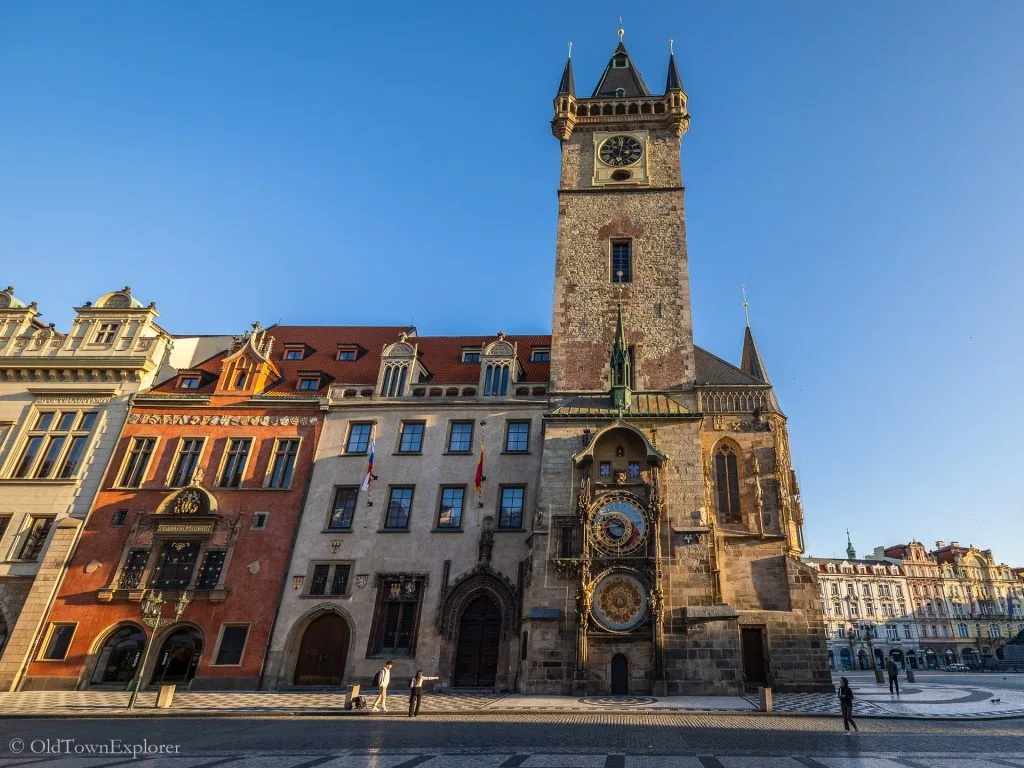
Old Town Hall with Astronomical Clock
Staroměstská radnice s orlojem
- Architect: Multiple builders over several centuries
- Style: Gothic, Renaissance, and later Historicist additions
- Built: Established in 1338; Astronomical Clock installed in 1410
- Address: Staroměstské náměstí 1, 110 00 Praha 1
Old Town Hall was established in 1338 as the administrative seat of Prague’s Old Town and gradually expanded into neighboring medieval houses rather than being built as a single structure. Its Gothic tower and chapel became the architectural anchor of the complex, and the Astronomical Clock was installed on the southern side of the tower in 1410. The eastern Neo-Gothic wing was destroyed during the Prague Uprising in May 1945 and was never rebuilt. The combination of medieval civic buildings, the tower, chapel, clock, and later alterations makes the town hall one of the clearest examples of Prague architecture developing in layers over centuries.
At the Golden Angel House
Dům U Zlatého anděla
- Architect: Unknown
- Style: Baroque with surviving Gothic elements
- Built: Medieval origins; major Baroque reconstruction in the first half of the 18th century
- Address: Staroměstské náměstí 29, 110 00 Praha 1
At the Golden Angel House, also historically called At the Black Angel, was once connected with the neighboring Church of St. Michael. A Gothic chapel stood here in the early 15th century, while the house recorded at the site by the end of the 16th century was extensively rebuilt in the Baroque period. Its present façade includes a bay window above the entrance, an angel painted within a cartouche, and a sandstone statue of St. Florian made by Ignác František Platzer after 1760. The house is significant because its Baroque exterior preserves traces of the much older religious and residential buildings that occupied this side of the square.
Vilímek’s House
Dům Vilímkovský
- Architect: František Ignác Prée probably designed the late-Baroque façade
- Style: Gothic, Renaissance, and late Baroque
- Built: Medieval origins; Gothic reconstruction 1472–1514; Baroque reconstruction in the first half of the 18th century
- Address: Staroměstské náměstí 28, 110 00 Praha 1
Vilímek’s House was recorded in 1462 as the At Christopher House and formed part of the former Servite monastery complex at St. Michael. It was extensively rebuilt in the Gothic period between 1472 and 1514, altered again during the Renaissance, and given its palace-like late-Baroque appearance in the 18th century. A late-Renaissance portal survives on the ground floor. The building shows particularly well how medieval houses around Old Town Square were enlarged and refaced while older architectural elements remained inside.
At the Ox House
Dům U Vola
- Architect: Unknown; Karel Roštík carried out a 1935–1936 alteration
- Style: Medieval, Gothic, Renaissance, and Baroque
- Built: Early medieval origins; major Baroque reconstruction around 1740
- Address: Staroměstské náměstí 27, 110 00 Praha 1
At the Ox House stands at the corner of Old Town Square and Melantrichova Street. Contrary to the suggestion that its name came from an ox-head house sign, the name originated with a 15th-century owner named Ochse; the building was also known as At Smertoš and At the White Lion. Its early medieval structure was rebuilt in Gothic and late-Gothic forms, altered during the Renaissance after 1609, and extensively remodeled around 1740. The surviving Baroque gable and the arches linking it across Melantrichova Street to Štěpánovský House make the building an important part of this corner of the square.
Štěpánovský Corner House
Štěpánovský dům
- Architect: Unknown
- Style: Romanesque, Gothic, Renaissance, and early Baroque
- Built: Romanesque core from about 1170–1200; later medieval and Renaissance rebuilding
- Address: Staroměstské náměstí 26, 110 00 Praha 1
Štěpánovský Corner House, formerly called Na Kamenci, takes its present name from the early-15th-century owner Štěpán of Kladsko. A Romanesque house from around 1170–1200 was rebuilt in the Gothic period and expanded again around the middle of the 16th century. The present façade is largely early Baroque but retains Renaissance gables, while a Gothic arcade and early-16th-century portal survive below. Its unusually long history makes it one of the square’s clearest examples of a medieval plot retaining visible architecture from several rebuilding periods.
The Blue Goose House
Dům U Modré husy
- Architect: Unknown
- Style: Romanesque core, Gothic, Renaissance, and late Baroque
- Built: Romanesque origins; Gothic rebuilding in the second half of the 14th century; Renaissance reconstruction 1546–1571
- Address: Staroměstské náměstí 25, 110 00 Praha 1
The Blue Goose House stands above the remains of a 12th-century Romanesque building and was rebuilt as a two-story Gothic house in the second half of the 14th century. A major early-Renaissance reconstruction between 1546 and 1571 created the arcade, while later alterations produced the late-Baroque façade seen today. The house also has a long association with inns and wine: extensive wine stores were recorded here by the 16th century. Its preserved medieval spaces and later façade illustrate how commercial buildings around the marketplace changed while remaining on the same ancient plots.
At the Red Fox House
Dům U Červené lišky
- Architect: Unknown
- Style: Romanesque and Gothic core with early-Baroque rebuilding
- Built: Medieval origins; present layout and façade largely date from the late 17th century
- Address: Staroměstské náměstí 24, 110 00 Praha 1
At the Red Fox House began as a Romanesque building and went through several Gothic rebuilding phases before being substantially remodeled in the late 17th century. The present layout and early-Baroque façade largely date from that reconstruction and have been compared with the architectural language associated with Jean Baptiste Mathey. The original Red Fox house sign no longer survives on the façade; a gilded relief of the Virgin Mary occupies its place. The building is important as another example of an ancient Old Town house whose outward appearance is much younger than its structural origins.
The Storks House
Dům U Čápů
- Architect: Unknown
- Style: Gothic, Renaissance, and early Baroque
- Built: Medieval origins; Renaissance expansion in the late 16th century; Baroque reconstruction before 1689
- Address: Staroměstské náměstí 23, 110 00 Praha 1
The Storks House has carried a name associated with painted storks since the 14th century. The Gothic building was enlarged during the Renaissance and substantially rebuilt before 1689, when the basic form of its present early-Baroque façade and two-story gable was established. Like its neighbors, it occupies a narrow, deep medieval plot extending toward Kožná Street. Fire damaged the interiors during the fighting of 1945, after which the house was connected internally with No. 22.
House No. 22
- Architect: Unknown
- Style: Medieval structures with late-Baroque exterior
- Built: Two medieval houses combined between 1767 and 1770
- Address: Staroměstské náměstí 22, 110 00 Praha 1
House No. 22 did not begin as a single Renaissance merchant house. It was created by joining two separate medieval properties known as At the Golden Crown and At the Golden Horse. Both had been altered in the early Baroque period before they came under one owner in 1767 and were combined and rebuilt in late-Baroque form by 1770. Fire damaged the building in 1945, leading to reconstruction from 1949 to 1952. Its history is a useful example of how separate medieval plots around the square were sometimes merged into the larger façades seen today.
At the Golden Camel House
Dům U Zlatého velblouda
- Architect: Jan Bělský
- Style: 19th-century Romantic Historicism with surviving Gothic cellar
- Built: Current form dates largely from 1858
- Address: Staroměstské náměstí 21, 110 00 Praha 1
At the Golden Camel House occupies a site that originally held two buildings. A major reconstruction in 1858 demolished the corner structure, widened the entrance to Železná Street, and gave the property a new Romantic appearance designed by Jan Bělský. A substantial Gothic cellar survives beneath part of the later building. For more than a century the Hainz family operated a watchmaking business here and also served as custodians of the Prague Astronomical Clock, giving the house an unusually direct historical connection with the landmark across the square.
At the Unicorn House
Dům U Jednorožce, also known as U Zlatého jednorožce and U Bílého koníčka
- Architect: František Maxmilián Kaňka for major Baroque alterations
- Style: Romanesque and Gothic core with High-Baroque exterior
- Built: Medieval origins; major Baroque work in 1712–1717 and 1731
- Address: Staroměstské náměstí 20/548, 110 00 Praha 1
At the Unicorn House developed from a Romanesque property that was repeatedly enlarged and rebuilt during the Gothic and Renaissance periods. Its present appearance is dominated by the High-Baroque reconstruction associated with František Maxmilián Kaňka in the early 18th century, while medieval masonry and cellar spaces remain within the complex. The building is significant because it preserves substantial evidence of the very early urban development beneath the Baroque façade now facing the square.
The Lazarus House
Dům U Lazara
- Architect: Unknown
- Style: Romanesque and Gothic core with Baroque and Neoclassical alterations
- Built: Romanesque core from the late 12th century; major rebuilding in the late 17th century
- Address: Staroměstské náměstí 19, 110 00 Praha 1
The Lazarus House retains a Romanesque core dating from the late 12th century within a later Gothic building. Its present appearance began to take shape in the last quarter of the 17th century after the property passed to the Carthusian prior at Valdice, while a Neoclassical balcony was added to the façade in 1803. The house is significant less for an association with the biblical Lazarus—which is not supported by the documented history—than for the survival of one of the square’s early medieval structures beneath much later alterations.
At the Stone Table House
Dům U Kamenného stolu, also known as U Měny
- Architect: Unknown
- Style: Gothic core with High-Baroque reconstruction
- Built: Gothic rebuilding in the 14th century; major Baroque reconstruction after 1724
- Address: Staroměstské náměstí 18, 110 00 Praha 1
At the Stone Table House was substantially rebuilt in the Gothic period before 1472, when it was acquired by George of Poděbrady. A currency exchange briefly operated here under his ownership, explaining the historic name U Měny. After 1724 the house was raised by two floors and remodeled in High-Baroque form. In the early 20th century it also housed Berta Fanta’s literary salon, attended by figures including Franz Kafka, adding another important chapter to a building already shaped by medieval and Baroque Prague.
At the Stone Lamb House
Dům U Kamenného beránka
- Architect: Unknown; Renaissance portal probably connected with the workshop of Benedikt Ried
- Style: Romanesque, Gothic, and Renaissance
- Built: Medieval origins; major Renaissance reconstruction around 1530
- Address: Staroměstské náměstí 17, 110 00 Praha 1
At the Stone Lamb House preserves Romanesque masonry and Gothic cellars beneath a house substantially rebuilt in the early Renaissance around 1530. That rebuilding produced the entrance portal, while another expansion in the early 17th century added a floor and a high late-Renaissance gable. The building later housed the White Unicorn pharmacy and Berta Fanta’s salon, where Franz Kafka, Max Brod, Franz Werfel, Egon Erwin Kisch, and Albert Einstein were among the people associated with its intellectual life. Fire destroyed much of the interior in 1945, but the surviving medieval and Renaissance fabric preserves the building’s architectural significance.
Štorch House
Štorchův dům
- Architects: Bedřich Ohmann and Rudolf Krieghammer
- Style: Historicist rebuilding incorporating Gothic elements
- Built: Medieval core; extensively rebuilt in 1896–1897
- Address: Staroměstské náměstí 16/552, 110 00 Praha 1
Štorch House takes its present name from publisher and bookseller Alexandr Štorch, who commissioned a major reconstruction of the older house in 1896–1897. Bedřich Ohmann and Rudolf Krieghammer designed the rebuilding while retaining important earlier elements, including a Gothic bay window. The richly painted façade was created from designs by Czech artist Mikoláš Aleš and includes the prominent equestrian image of St. Wenceslas. The combination of medieval fabric with a highly decorative late-19th-century façade makes Štorch House an important example of Prague’s Historicist approach to rebuilding within the Old Town.
At the White Unicorn House
Dům U Bílého jednorožce, also known as the Trčkovský dům
- Architect: Jan Bělský for major 19th-century alterations
- Style: Romanesque, Gothic, Renaissance, Baroque, and 19th-century Historicist layers
- Built: Medieval origins; Renaissance and Baroque rebuilding; major 19th-century alteration
- Address: Staroměstské náměstí 15, 110 00 Praha 1
At the White Unicorn House was built over the foundations of two Romanesque structures that were extensively reconstructed in the Gothic period. The Trčka family carried out an important Renaissance rebuilding, while a Baroque façade followed in 1770. Jan Bělský altered the house again in the 19th century, when an additional floor replaced the earlier Renaissance gables; later restoration returned the gables to the roofline. The building is significant because its appearance records changing attitudes toward preserving and recreating the architecture of Old Prague.
Týn School
Týnská škola
- Architect: Unknown
- Style: Gothic and Renaissance with later Baroque decoration
- Built: Two Gothic houses united in the early 15th century; expanded during the Renaissance
- Address: Staroměstské náměstí 14, 110 00 Praha 1
Týn School developed from two Gothic burgher houses that were united in the early 15th century and later remodeled during the Renaissance. Its distinctive upper façade and gables date largely from a mid-16th-century expansion, and traces of Renaissance sgraffito survive on the courtyard façades. From the late 14th century until the 19th century, the building housed the parish school associated with the neighboring Týn Church; the late-Gothic architect and sculptor Matěj Rejsek taught here. Its long educational role and mixture of domestic Gothic and Renaissance architecture make it more than simply an annex to the church.
Church of the Virgin Mary before Týn
Chrám Matky Boží před Týnem
- Architect: Construction influenced by the royal workshop of Matthias of Arras and Petr Parléř
- Style: High Gothic with later Baroque interior alterations
- Built: Mid-14th to early 16th centuries
- Address: Staroměstské náměstí 604, 110 00 Praha 1
Church of Our Lady before Týn replaced earlier Romanesque and early-Gothic churches associated with the merchants of the nearby Týn trading court. Construction of the present High-Gothic church began in the mid-14th century and was strongly influenced by the royal building workshops of Matthias of Arras and Petr Parléř, although the church was completed over a much longer period rather than designed by a single architect. Its twin towers became one of the defining features of the Old Town skyline, while the interior was substantially Baroqueized after the Gothic period. The church’s scale and position reflect Old Town Square’s rise from marketplace to the political and religious center of medieval Prague.
At the Stone Bell House
Dům U Kamenného zvonu
- Architect: Unknown
- Style: High Gothic palace architecture
- Built: Major Gothic form dates from the first half of the 14th century
- Address: Staroměstské náměstí 13, 110 00 Praha 1
At the Stone Bell House is a rare surviving example of Gothic palace architecture within Prague’s Old Town. Its medieval façade was hidden for centuries behind later Baroque alterations before restoration work removed those additions and reconstructed the Gothic appearance. The surviving architectural sculpture dates from a period before the mature work of Petr Parléř, so the previous attribution of the house itself to Parléř should not be retained. Its scale, tower-like form, carved stonework, and surviving interior fragments show how sophisticated elite urban residences could be in Prague during the 14th century.
Kinsky Palace (Goltz – Kinsky)
Palác Kinských
- Architect: Anselm Lurago or Kilián Ignác Dientzenhofer; authorship remains disputed
- Style: Rococo
- Built: 1755–1765
- Address: Staroměstské náměstí 12, 110 00 Praha 1
Kinský Palace was built between 1755 and 1765 for Count Jan Arnošt Golz on the sites of two older houses. The exact authorship is disputed between Anselm Lurago and Kilián Ignác Dientzenhofer, so the earlier attribution to Francesco Caratti should be removed. The Kinský family acquired the palace in 1768 and retained it until 1945. Its pale Rococo façade, rich stucco, sculptural decoration, and projecting upper sections distinguish it sharply from the Gothic Stone Bell House and Týn Church beside it, marking the transformation of part of the medieval square into an aristocratic 18th-century setting.
Golden Cross House
Dům U Zlatého kříže
- Architect: Richard Klenk of Vlastimil designed the façade; Václav Romováček built the house
- Style: Historicist architecture with Mannerist-inspired façade
- Built: 1906
- Address: Staroměstské náměstí 10, 110 00 Praha 1
Golden Cross House is much newer than its historic appearance suggests. Two older houses on the site were removed during the redevelopment of Old Town, and the present building was constructed in 1906 by Václav Romováček with a façade designed by Richard Klenk of Vlastimil. The city required the new architecture to respond to the historic character of the square, resulting in a richly decorated Historicist façade with Mannerist references. Its significance lies in showing how early-20th-century Prague tried to reconcile redevelopment with the visual continuity of Old Town Square.
Elephant House
Dům U Slonů, also known as the Golden Elephant or Cukrovský dům
- Architect: František Schlaffer
- Style: Neo-Baroque
- Built: Current building constructed 1905–1906
- Address: Staroměstské náměstí 9, 110 00 Praha 1
Elephant House stands on a site occupied by an inn from the Middle Ages. The earlier building went through Baroque and Rococo rebuilding before it was demolished during the redevelopment of Old Town in 1904–1905. František Schlaffer designed the replacement in 1905–1906 with a Neo-Baroque façade intended to harmonize with the historic square. Rich stucco, painted decoration, and the corner bay supported by an Atlas figure make the present building significant as another example of the sometimes controversial reconstruction of Old Prague around 1900.
The Former Pauline Monastery
Bývalý klášter paulánů
- Architects: Pavel Ignác Bayer with Giovanni Domenico Canevalle
- Style: Baroque with surviving medieval fabric
- Built: Major monastery rebuilding 1688–1696
- Address: Staroměstské náměstí 7, 110 00 Praha 1
The Former Pauline Monastery developed after the Pauline order received the neighboring Church of St. Salvator in 1626. The monks acquired and combined adjacent houses before creating a large convent building between 1688 and 1696 under Pavel Ignác Bayer with Giovanni Domenico Canevalle. Sculptures by Matěj Václav Jäckel were incorporated into the new façade. Emperor Joseph II abolished the monastery in 1784, after which the building served secular functions including use by the mint. It is especially important today because it is the principal surviving remnant of the older northern edge of the square that was largely swept away during the later redevelopment of Josefov and Old Town.
The Palace of the Former Municipal Insurance Company
Palác bývalé Městské pojišťovny
- Architect: Osvald Polívka
- Style: Neo-Baroque and Art Nouveau
- Built: 1899–1901; later courtyard hall completed in 1909
- Address: Staroměstské náměstí 6, 110 00 Praha 1
The Palace of the Former Municipal Insurance Company was built between 1899 and 1901 to designs by Osvald Polívka, replacing older structures while deliberately referring to their Baroque appearance. The exterior combines Neo-Baroque massing with Art Nouveau sculpture, mosaics, allegorical figures, and ornamental stucco by several prominent Czech artists. A new hall with a large cast-iron structure followed in the courtyard in 1909. The building is significant because it shows Prague attempting to insert a modern institutional complex into Old Town Square without abandoning the scale and decorative character of its historic surroundings.
House No. 5 on the Corner of Pařížská Street
- Architects: Otakar Materna and Rudolf Kříženecký; postwar reconstruction by Jaroslav Stránský and Karel Storch
- Style: Neo-Baroque
- Built: 1896–1897
- Address: Staroměstské náměstí 5, at the corner of Pařížská Street, Praha 1
House No. 5 replaced two older buildings demolished in 1895 during the large-scale redevelopment that created the modern entrance to Pařížská Street. Otakar Materna and Rudolf Kříženecký designed the new apartment building in 1896–1897, incorporating decorative Baroque elements salvaged from demolished structures at the city’s request. The building was damaged during the battle for the Old Town Hall in May 1945 and reconstructed after the war. Its Neo-Baroque façade, large corner bay supported by Atlas figures, and reused historic ornament make it one of the clearest architectural records of the transformation of Old Town Square at the end of the 19th century.
Castles in Prague
Prague’s castle architecture is dominated by two large fortified complexes: Prague Castle above Malá Strana and Vyšehrad above the Vltava farther south. Both developed over centuries rather than as single buildings, so their architecture combines churches, palaces, defensive structures, gates, courtyards, and later additions.
Prague Castle is the more architecturally complex of the two and contains some of the city’s most important Gothic, Renaissance, and Baroque buildings. Vyšehrad is quieter and more dispersed, with medieval remains, later fortifications, religious architecture, and strong views over the river.
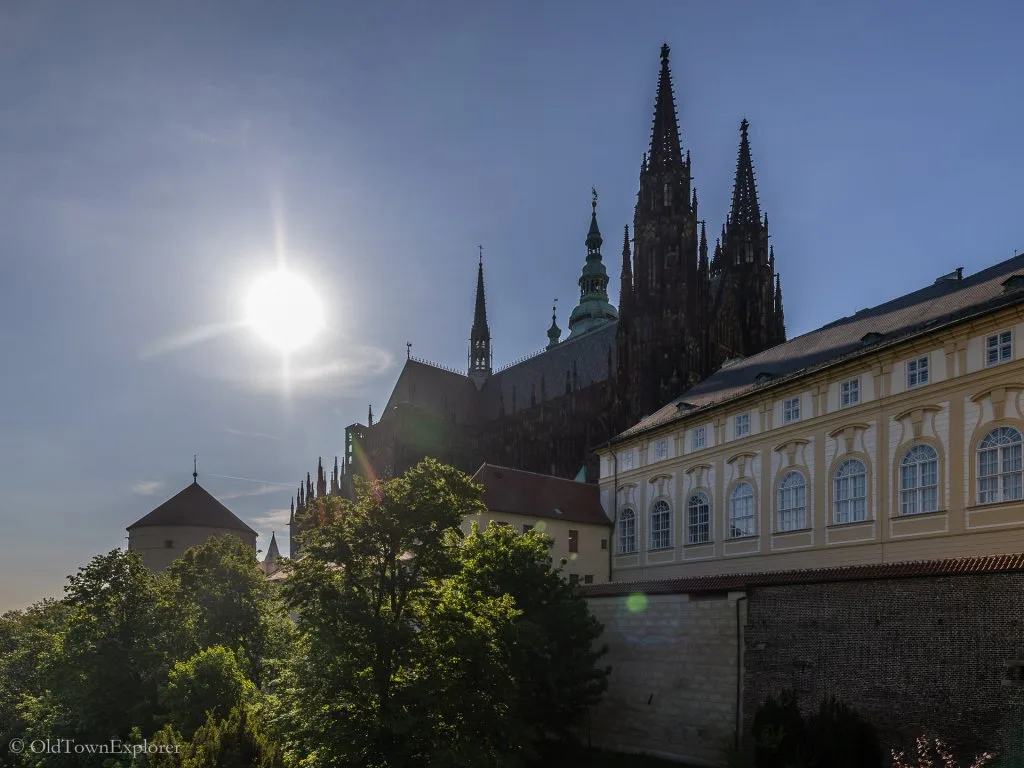
Prague Castle
Pražský hrad
- Architect: Multiple architects contributed over the centuries, including Petr Parléř (notably for parts of St. Vitus Cathedral within the castle complex) and later architects such as Josip Plečnik during 20th-century renovations.
- Architectural Style: A mix of styles due to centuries of construction: primarily Romanesque, Gothic, Renaissance, Baroque, and Modernist (in some parts).
- Year Built: Construction began in the 9th century (around 870 AD) and continued through various expansions and renovations over the following centuries.
- Address: Hradčany, 119 08 Prague 1, Czechia
Prague Castle is the largest ancient castle complex in the world, spanning about 70,000 square meters. It has served as the seat of Czech kings, emperors, and presidents. The castle includes historic palaces, churches (like St. Vitus Cathedral), gardens, and defense towers. Its layered architecture reflects the Czech Republic’s history, from medieval times through the 20th century.
Check out the Explore Prague Castle blog for more information.
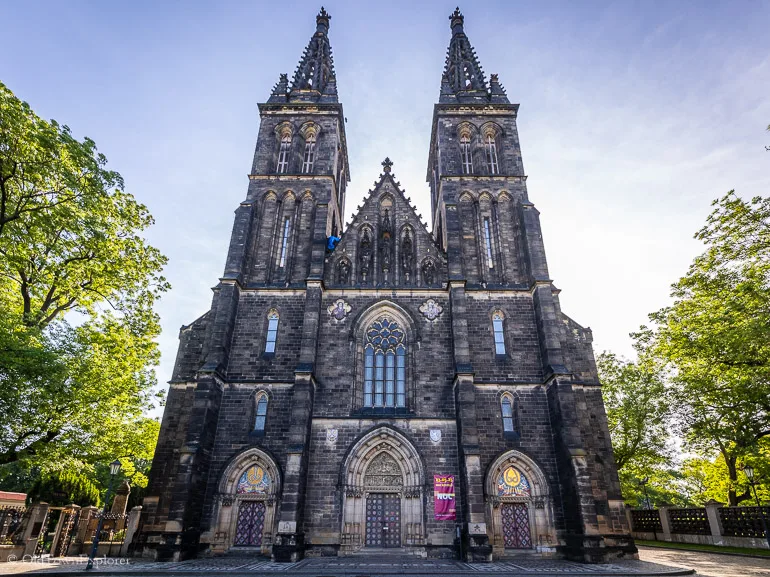
Vyšehrad
- Architect: Various parts were constructed and reconstructed by different rulers and architects throughout the medieval and Baroque periods.
- Architectural Style: A mix of Romanesque, Gothic, Baroque, and Neo-Gothic styles due to the various phases of construction and renovation over centuries.
- Year Built: The origins of Vyšehrad date back to the 10th century. Significant developments occurred in the 11th century under the reign of Vratislav II.
- Address: V Pevnosti 159/5b, 128 00 Praha 2 - Vyšehrad, Czech Republic
Vyšehrad is a historic fortress located on a hill overlooking the Vltava River in Prague. It is known for its history as a royal residence and spiritual center. The complex includes the Basilica of St. Peter and St. Paul, a cemetery where many famous Czechs are buried (including composers like Antonín Dvořák), and the remains of a medieval fortification. Vyšehrad is a place of legend and cultural heritage, offering scenic views and a peaceful park-like atmosphere.
Check out the Explore Vyšehrad blog for more information.
Religious Buildings in Prague
Prague’s churches and synagogues show the city’s architectural history more clearly than almost any other building type. Romanesque rotundas survive beside Gothic parish churches and synagogues, while the Baroque period reshaped both interiors and skylines with domes, sculpted façades, stucco, frescoes, and elaborate altars.
The strongest concentration lies in Old Town, Josefov, Malá Strana, and the Prague Castle area, but New Town adds important medieval foundations and later historicist religious architecture. From outside, compare tower shapes, portals, rooflines, buttresses, domes, and façade sculpture; interiors require a separate time decision and may depend on services, tickets, or current access.
Old Town (Staré Město)
Basilica of St. James
Bazilika sv. Jakuba Většího
- Architect: Jan Šimon Pánek (Baroque reconstruction)
- Architectural Style: Originally Gothic; rebuilt in Baroque style after 1689
- Year Built: 13th century; Baroque reconstruction completed in 1702
- Address: Malá Štupartská 6, 110 00 Prague 1
A significant Baroque church known for its ornate interior, including a decorated nave and the tomb of Count Vratislav of Mitrovice.
Bethlehem Chapel
Betlémská kaple
- Architect: Unknown
- Architectural Style: Gothic
- Year Built: Founded in 1391
- Address: Betlémské náměstí 255/4, 110 00 Prague 1
Historically significant as the preaching site of reformer Jan Hus from 1402 to 1413. Today, it serves as a ceremonial hall.
Cathedral of St. Clement
Katedrála sv. Klimenta
- Architect: František Maxmilián Kaňka; built by Antonio Lurago
- Architectural Style: Baroque
- Year Built: 1711–1715
- Address: Karlova 1, 110 00 Prague 1
A Baroque church featuring statues by M. B. Braun and paintings by I. Raab. It serves the Ruthenian Byzantine Catholic Church.
Church of Our Lady before Týn
Chrám Matky Boží před Týnem
- Architect: Unknown
- Architectural Style: Gothic with Baroque interior elements
- Year Built: Construction began in the mid-14th century; completed in the early 16th century
- Address: Staroměstské náměstí, 110 00 Prague 1
Dominating the Old Town skyline with its twin spires, this church houses the tomb of astronomer Tycho Brahe and features artworks by Karel Škréta.
Church of St. Castulus
Kostel sv. Haštala
- Architect: Paul Ignaz Bayer (Baroque reconstruction)
- Architectural Style: Originally Gothic; rebuilt in Baroque style after 1689
- Year Built: Original construction date not specified; Baroque reconstruction completed in 1695
- Address: Haštalské náměstí, 110 00 Prague 1
The only church in the Czech Republic dedicated to Saint Castulus, featuring a modest interior.
Church of St. Francis Seraph
Kostel sv. Františka Serafinského
- Architect: Unknown
- Architectural Style: Early Baroque
- Year Built: 1679–1685
- Address: Křižovnické náměstí 3, 110 00 Prague 1
Known for its impressive dome adorned with a fresco of the Last Judgment by V. V. Reiner and housing the second oldest organ in Prague.
Church of St. Giles
Kostel sv. Jiljí
- Architect: Unknown
- Architectural Style: Originally Gothic; remodeled in Baroque style
- Year Built: Consecrated in 1371; Baroque remodeling date not specified
- Address: Husova 8, 110 00 Prague 1
A monumental three-aisled church with Baroque frescoes by Wenzel Lorenz Reiner, serving the Dominican order since 1625.
Church of St. Havel
Kostel sv. Havla
- Architect: Unknown
- Architectural Style: Originally Gothic; Baroque façade added between 1723 and 1738
- Year Built: Founded in 1232
- Address: Havelská 1, 110 00 Prague 1
One of the oldest churches in Prague, featuring valuable Baroque furnishings and the tomb of painter Karel Škréta.
Church of St. Martin in the Wall
Kostel sv. Martina ve zdi
- Architect: Unknown
- Architectural Style: Romanesque-Gothic
- Year Built: Built between 1178 and 1187
- Address: Martinská 8, 110 00 Prague 1
The Church of St. Martin in the Wall was constructed between 1178 and 1187. In the 13th century, when the Old Town fortifications were built, the church's south wall became integrated into the city wall, leading to its distinctive name.
After being closed in 1784 and repurposed for secular uses, it was restored in the early 20th century under architect Kamil Hilbert. Today, it serves the Evangelical Church of Czech Brethren and is renowned for its excellent acoustics, hosting regular classical music concerts.
Church of the Holy Saviour — Klementinum
aka St. Salvator Church (Kostel Nejsvětějšího Salvátora)
- Architect: Franciscus Maxmilian Kaňka (1714 modifications)
- Architectural Style: Baroque
- Year Built: Original construction date not specified; towers and cupola added in 1714
- Address: Křižovnické náměstí, 110 00 Prague 1
A Baroque church known for its twin towers and cupola added in 1714. The interior features elaborate decorations and has undergone several restorations over the years.
Church of the Holy Saviour — Salvátorská Street
Kostel U Salvátora
aka St. Salvator Church (Salvátorská Street)
- Architect: Unknown
- Architectural Style: Gothic-Renaissance
- Year Built: 1611–1615
- Address: Salvátorská Street, 110 00 Prague 1
The largest Protestant church in Prague, built by German Lutherans after they were unable to acquire existing churches in the Old Town. The church features a dominant ceiling fresco depicting the Saviour surrounded by angels.
Church of the Holy Spirit
Kostel sv. Ducha
- Architect: Unknown
- Architectural Style: Gothic
- Year Built: First half of the 14th century
- Address: Dlouhá 6, 110 00 Prague 1
A Gothic church built for a Benedictine convent, located near the Jewish Quarter. It suffered damage during the Hussite wars and was destroyed by a fire in 1689.
Minorite Monastery of St. James
Minoritský klášter sv. Jakuba
- Architect: Unknown
- Architectural Style: Gothic
- Year Built: Founded after 1232
- Address: Malá Štupartská 6, 110 00 Prague 1
A historic monastery that enjoyed royal patronage in the 13th and 14th centuries, hosting significant events such as royal wedding feasts. Today, it serves as a cultural, social, and business center.
Rotunda of the Finding of the Holy Cross
Rotunda Nalezení sv. Kříže
- Architect: Original architect unknown; restored by Ignác Ullmann in the 19th century
- Architectural Style: Romanesque
- Year Built: 11th century
- Address: Karoliny Světlé 14, 110 00 Prague 1
One of the oldest Romanesque rotundas in Prague, dating back to the 11th century. It was saved from demolition in the 19th century and restored by architect Ignác Ullmann, who also designed a new altar for the interior.
Nicholas Cathedral — Old Town
Chrám sv. Mikuláše
- Architect: Kilián Ignác Dientzenhofer
- Architectural Style: Baroque
- Year Built: 1732–1737
- Address: Malostranské náměstí, 118 00 Prague 1
A monumental Baroque church featuring a crystal crown chandelier from the Harrachov glassworks, donated by the Russian Tsar to the Orthodox Church. Today, it is used by the Czechoslovak Hussite Church and serves as a concert hall.
Church of St. Clement
Kostel sv. Klimenta
- Architect: Antonio Lurago, based on plans by Franciscus Maxmilian Kaňka
- Architectural Style: Baroque
- Year Built: 1711–1715
- Address: Karlova 1, 110 00 Prague 1
A Baroque church built on the site of a former Gothic church. It features sculptures by Matthias Braun and paintings by Petr Brandl. The church is used by the Greek Catholic Church for masses in Old Church Slavonic and Ukrainian.
Jewish Quarter (Josefov)
Old-New Synagogue
Staronová synagoga
- Architect: Unknown
- Architectural Style: Early Gothic
- Year Built: Completed in 1270
- Address: Červená 250/2, 110 00 Josefov, Prague 1, Czech Republic
The Old-New Synagogue is the oldest active synagogue in Europe and one of the earliest Gothic buildings in Prague. It has served as the main synagogue of Prague's Jewish community for over 700 years.
The building features a rectangular hall with six vaulted bays supported by two central pillars, and narrow windows symbolizing the twelve tribes of Israel.
According to legend, the synagogue was built using stones from the destroyed Temple of Solomon, brought to Prague by angels. Another legend claims that the Golem, created by Rabbi Judah Loew ben Bezalel, rests in the synagogue's attic.
Lesser Town (Malá Strana)
Church of Our Lady beneath the Chain
Kostel Panny Marie pod řetězem
- Architect: Initial Gothic reconstruction likely by Peter Parler’s workshop; Baroque modifications by Carlo Lurago in 1640
- Architectural Style: Originally Romanesque, rebuilt in Gothic style with later Baroque additions
- Year Built: Original Romanesque church completed in 1182; Gothic reconstruction began after 1314; Baroque modifications in 1640
- Address: Lázeňská Street, Malá Strana, Prague 1
Situated near the former Judith Bridge, this church was initially established by the Knights Hospitaller. The name refers to a chain that once closed the monastery gate. Over the centuries, it has undergone significant architectural transformations, reflecting Romanesque, Gothic, and Baroque styles.
Church of Our Lady Victorious
Kostel Panny Marie Vítězné
- Architect: Originally designed by Giovanni Maria Philippi; later Baroque reconstruction by the Carmelite Order
- Architectural Style: Early Baroque
- Year Built: 1611–1613; reconstructed from 1634 to 1669
- Address: Karmelitská 385/9, Malá Strana, Prague 1
Initially built for German-speaking Lutherans, the church became renowned for housing the statue of the Infant Jesus of Prague, a revered religious icon originally from Spain. The church's interior features a museum displaying the statue's ornate vestments.
Church of St. Joseph in the Lesser Town
Kostel sv. Josefa na Malé Straně
- Architect: Possibly designed by Johann Bernard Fischer von Erlach; construction led by Abraham Paris
- Architectural Style: Early Baroque
- Year Built: 1686–1692
- Address: Josefská Street, Malá Strana, Prague 1
Built for the Carmelite Order, this church features a monumental Dutch-style façade. Its decorated interior includes notable paintings, sculptures, and other works of art.
Church of St. Lawrence under Petřín
Kostel sv. Vavřince pod Petříne
- Architect: Reconstruction plans attributed to Kilian Ignaz Dientzenhofer; builder was Ignazio Giovanni Palliardi
- Architectural Style: Baroque
- Year Built: Originally Romanesque; current Baroque appearance from reconstruction between 1739–1745
- Address: Petřín Hill, Malá Strana, Prague 1
Situated near the Petřín Lookout Tower, this church is part of a pilgrimage complex that includes the Way of the Cross. The Baroque reconstruction enhanced its prominence as a spiritual site.
Church of St. Thomas
Kostel sv. Tomáše
- Architect: Baroque reconstruction by Kilián Ignác Dientzenhofer
- Architectural Style: Originally Gothic; current Baroque appearance from early 18th-century reconstruction
- Year Built: Founded in 1228; Baroque reconstruction between 1727–1731
- Address: Josefská 8, Malá Strana, Prague 1
Part of the Augustinian monastery, this church is notable for its impressive Baroque architecture and decorated interior. It remains an active place of worship, offering services in multiple languages.
Church of the Virgin Mary — At the Theatines
Klášterní kostel Panny Marie — U Kajetánů
- Architect: Designed by Jean Baptiste Mathey; completed by Jan Blažej Santini-Aichel
- Architectural Style: Baroque Classical
- Year Built: 1691–1717
- Address: Nerudova Street, Malá Strana, Prague 1
Built by the Theatine Order, this cross-shaped church is renowned for its extraordinary architecture and valuable Baroque sculptures and paintings.
Nicholas Church at Malá Strana
Kostel sv. Mikuláše
- Architect: Initial construction by Kryštof Dientzenhofer; completed by his son Kilián Ignác Dientzenhofer
- Architectural Style: High Baroque
- Year Built: 1704–1755
- Address: Malostranské náměstí, Malá Strana, Prague 1
Considered one of the most significant Baroque buildings in Central Europe, this church features a stunning dome and intricate interior decorations.
Castle District (Hradčany)
Basilica of the Assumption of the Virgin Mary at Strahov
- Architect: Unknown
- Architectural Style: Romanesque core with Gothic transept; Renaissance and Baroque modifications
- Year Built: Founded in 1143; Gothic reconstruction between 1258–1263
- Address: Strahovské nádvoří 1/132, 118 00 Prague 1 – Hradčany
Serving as the monastic church of the Strahov Monastery, this basilica showcases a blend of architectural styles due to various reconstructions over centuries. Notably, it features a Romanesque basilica core, a Gothic transept, and Renaissance chancel, with Baroque elements added later.
Church of St John of Nepomuk
Kostel sv. Jana Nepomuckého
- Architect: Kilian Ignaz Dientzenhofer
- Architectural Style: High Baroque
- Year Built: Consecrated in 1729
- Address: Kanovnická Street, Prague 1 – Hradčany
This church is the first independent work by architect Kilian Ignaz Dientzenhofer. It features an octagonal nave with ceiling vaults adorned by frescoes from V. V. Reiner, depicting episodes from the life of St. John of Nepomuk. The church serves as a place of pastoral care for the Czech military and a site for prayers for fallen soldiers and world peace.
Loreto
Loreta
- Architect: Giovanni Batista Orsi
- Architectural Style: Baroque
- Year Built: Construction began in 1626; the Holy Hut was blessed in 1631
- Address: Loretánské náměstí 7, 118 00 Prague 1 – Hradčany
Inspired by the Italian shrine in Loreto, this pilgrimage site was commissioned by Baroness Bénigne-Catherine de Lobkowitz. It features a replica of the Santa Casa (Holy House) and houses the Loreto Treasure, including the renowned Diamond Monstrance.
Strahov Monastery
Strahovský klášter
- Architect: Anselmo Lurago
- Architectural Style: Romanesque origins with subsequent Gothic and Baroque additions
- Year Built: Opened in 1143
- Address: Strahovské nádvoří 1/132, 118 00 Prague 1 – Hradčany
As one of the oldest Premonstratensian monasteries in the world, Strahov Monastery has been a center of spiritual life, education, and culture for centuries. It encompasses the Basilica of the Assumption, the renowned Strahov Library, and other significant structures.
Strahov Library – Theological Hall and Philosophical Hall
- Architects: Giovanni Domenico Orsi (Theological Hall) and Abbot Václav Mayer (Philosophical Hall)
- Architectural Style: Baroque
- Year Built: 1671–1679 (Theological Hall) and 1791–1797 (Philosophical Hall)
- Address: Strahovské nádvoří 1/132, 118 00 Prague 1 – Hradčany
The Strahov Library is renowned for its two grand halls. The Theological Hall houses approximately 18,000 volumes and features stucco decorations by Orsi. The Philosophical Hall, constructed later, boasts a ceiling fresco painted by Anton Maulbertsch and his student, completed in 1796.
New Town (Nové Město)
Cathedral Church of Sts. Cyril and Methodius
- Architect: Kilian Ignaz Dientzenhofer and Paul Ignaz Bayer
- Architectural Style: Czech Baroque
- Year Built: 1730–1736
- Address: Resslova 9a, 120 00 Prague 2
Originally constructed as a Baroque church, it now serves as the principal Czech and Slovak Orthodox Church. The interior features stucco paintings by Michele Ignazio Palliardi and frescos by Jan Adam Schöpf. The church also houses a memorial to the paratroopers involved in the assassination of Reinhard Heydrich during World War II.
Church of Our Lady of the Snows
- Architect: Unknown
- Architectural Style: Gothic with Baroque additions
- Year Built: Founded in 1347
- Address: Jungmannovo náměstí 753/18, 110 00 Prague 1
Established by Emperor Charles IV, this church was intended to be the largest in Prague but was never completed to its original design. It features the highest altar in Prague, standing at 29 meters, created between 1649 and 1651.
Church of St. Henry and St. Kunhuta
- Architect: Unknown
- Architectural Style: Gothic
- Year Built: Founded in 1348
- Address: Jindřišská 30, 110 00 Prague 1
Consecrated to the royal couple Henry and Kunhuta, this Gothic parish church was established alongside the founding of Prague's New Town. It is associated with the Jindřišská Tower, the tallest free-standing bell tower in Prague.
Church of St. Ignatius
- Architect: Carlo Lurago
- Architectural Style: Early Baroque
- Year Built: 1655–1677
- Address: Karlovo náměstí 500/22, 120 00 Prague 2
Part of the Jesuit complex in Prague, this church is notable for its Baroque decoration and the statue of St. Ignatius of Loyola with a halo, which was controversial at the time of its installation.
Church of St. John of Nepomuk on the Rock
- Architect: Kilian Ignaz Dientzenhofer
- Architectural Style: High Baroque
- Year Built: 1730–1739
- Address: Vyšehradská 49, 128 00 Prague 2
Located near Karlovo Square, this church features an altar with a statue of St. John of Nepomuk from 1682 by Jan Brokoff, which served as the model for the statue on Charles Bridge.
Church of St. Joseph
- Architect: Melichar Mayer
- Architectural Style: Capuchin simplicity
- Year Built: 1636–1653
- Address: Na Poříčí 1041/21, 110 00 Prague 1
Built for the Capuchin order, this church reflects the order's emphasis on simplicity and humility. Notably, two cannonballs from the Prussian siege of 1757 are embedded in its walls.
Church of St. Katherine of Alexandria
- Architect: Kilian Ignaz Dientzenhofer
- Architectural Style: Baroque
- Year Built: 1737–1741
- Address: Kateřinská 466/18, 120 00 Prague 2
Originally founded in the 14th century by Emperor Charles IV, the current Baroque structure was built in the 18th century. It features a unique Baroque hall construction with a transept and interior segmentation.
Church of St. Peter
- Architect: Originally unknown; later rebuilt by Josef Mocker
- Architectural Style: Romanesque origins with Gothic and Neo-Gothic modifications
- Year Built: Originally in the 12th century; rebuilt 1874–1879
- Address: Biskupská 1137/13, 110 00 Prague 1
This church, originally a Romanesque basilica, has undergone several reconstructions. The most significant was in the late 19th century by architect Josef Mocker, who restored it in the Neo-Gothic style.
Church of St. Adalbert
Kostel sv. Vojtěcha
- Architect: Unknown
- Architectural Style: Originally Romanesque; Gothic reconstruction in the late 14th century; Baroque modifications between 1690–1695 and 1871
- Year Built: 13th century (original structure)
- Address: Na Slupi 4, 128 00 Prague 2
This church has undergone several architectural transformations, reflecting Romanesque, Gothic, and Baroque styles. It originally stood amidst a cemetery, remnants of which are still visible today.
Church of the Assumption of the Virgin Mary and St. Charles the Great
Kostel Nanebevzetí Panny Marie a sv. Karla Velikého
- Architect: Matthias of Arras; star-ribbed vaulting likely by Bonifaz Wohlmut
- Architectural Style: Gothic with Baroque elements
- Year Built: Construction began in 1351; completed in 1575
- Address: Ke Karlovu 1, 120 00 Prague 2
Commissioned by Emperor Charles IV as part of an Augustinian monastery, this church is renowned for its unique star-ribbed vaulting.
Church of the Holy Cross
Kostel sv. Kříže
- Architect: Unknown
- Architectural Style: Empire style
- Year Built: 1817–1824
- Address: Na Příkopě 16, 110 00 Prague 1
Built by the Piarist Order, this church features an Empire-style façade with Ionic columns. It houses a life-sized photograph of the Shroud of Turin and offers masses in Italian.
Emmaus Monastery Na Slovanech
Emauzský klášter
- Architect: Original architect unknown; modern reconstruction by František M. Černý
- Architectural Style: Originally Gothic; later Baroque; modern elements added in the 20th century
- Year Built: Founded in 1347
- Address: Vyšehradská 49, 128 00 Prague 2
Established by Charles IV for Slavic Benedictines, this monastery has a long history and features modern architectural additions following damage during World War II.
Holy Trinity Church
Kostel Nejsvětější Trojice
- Architect: Octavian Broggio
- Architectural Style: Baroque
- Year Built: Construction began in 1708; consecrated in 1713
- Address: Spálená 8, 110 00 Prague 1
Built on the site of a former Jewish cemetery, this church's design symbolizes the Holy Trinity, evident in its three entrance portals and three windows above them.
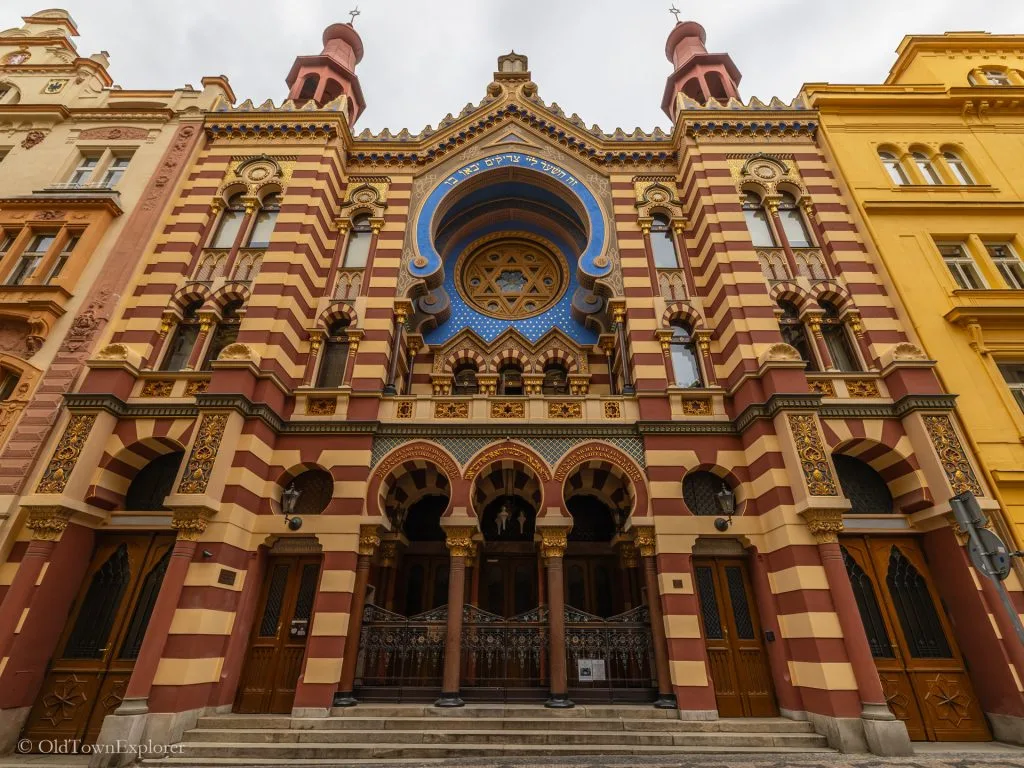
Jerusalem (Jubilee) Synagogue
Jeruzalémská synagoga
- Architect: Wilhelm Stiassny
- Architectural Style: Art Nouveau with Moorish Revival elements
- Year Built: 1905–1906
- Address: Jeruzalémská 1310/7, 110 00 Prague 1
The largest synagogue in Prague, it combines Art Nouveau and Moorish architectural styles and was named in honor of Emperor Franz Joseph I's silver jubilee.
Rotunda of St. Longin
Rotunda sv. Longina
- Architect: Unknown
- Architectural Style: Romanesque
- Year Built: 12th century
- Address: Na Rybníčku, 120 00 Prague 2
One of the oldest surviving Romanesque rotundas in Prague, originally serving as a parish church for the village of Rybníček. It underwent reconstruction between 1929 and 1934 and currently serves the Greek Catholic Church.
Palaces in Prague
Prague’s palace architecture is concentrated on the west side of the Vltava, especially in Malá Strana and Hradčany. Renaissance noble houses were expanded or rebuilt after fires and political change, while the Baroque period produced large courtyard complexes, ceremonial façades, gardens, monumental staircases, and long palace fronts below Prague Castle.
Hradčanské náměstí and Malá Strana give you the strongest palace comparison without crossing the city repeatedly. Look especially at Schwarzenberg Palace for Renaissance sgraffito, Wallenstein Palace for early Baroque scale and garden planning, and the long façades around Hradčany for the shift from Renaissance residences to Baroque state architecture.
Lesser Town (Malá Strana)
Rohan Palace
aka Ministry of Education, Youth and Sports
- Architect: Originally unified by Bonifác Wohlmut; later reconstructed by Josef Zobel and Vincenc Kulhánek
- Architectural Style: Late Classicism
- Year Built: Unified in 1571; major reconstructions in 1796 and 1838–1841
- Address: Karmelitská 8, 118 12 Prague 1
The Rohan Palace, now housing the Ministry of Education, Youth and Sports, was formed by unifying three older houses in 1571 by architect Bonifác Wohlmut. It underwent significant reconstructions in 1796 under Josef Zobel and between 1838 and 1841 by Vincenc Kulhánek, giving it its current late Classicist appearance. The building is protected as a cultural monument of the Czech Republic.
Grömling Palace
Grömlingovský palác
- Architect: Josef Jäger
- Architectural Style: Rococo
- Year Built: 1786
- Address: Malostranské náměstí, Prague 1
Commissioned by lawyer Karel of Grömling, this palace was constructed on the site of several townhouses. It's considered one of Prague's most artistically significant Rococo buildings. In 1874, a renowned café opened on the ground floor, becoming a gathering place for Czech cultural figures.
Liechtenstein Palace — Kampa
- Architect: Unknown
- Architectural Style: Baroque
- Year Built: 1555
- Address: U Sovových mlýnů 506/4, Prague 1
Situated on Kampa Island, this palace is one of two in Prague that formerly belonged to the Princely Family of Liechtenstein. It occasionally hosts cultural events.
Thun Palace
Thunovský palác
aka Chamber of Deputies of the Parliament of the Czech Republic
- Architect: Unknown
- Architectural Style: Baroque
- Year Built: Construction began in 1695
- Address: Sněmovní 4, Prague 1
Originally built for the Thun family, this palace has been the seat of the Chamber of Deputies of the Czech Republic since the early 19th century. It features a dominant hall on the first floor, which has been used for various purposes over the centuries.
Tyrš House
Tyršův dům
aka Michna Palace
- Architect: Not specified
- Architectural Style: Baroque
- Year Built: Originally built in 1560; rebuilt in 1623
- Address: Újezd 450/40, Prague 1
Also known as Michna Palace, this building has a long history, including use by various religious orders. It now serves as the headquarters of the Czech Sokol Organization and houses the oldest swimming pool in Prague.
Wallenstein Palace
Valdštejnský palác
- Architect: Andrea Spezza
- Architectural Style: Early Baroque
- Year Built: 1623–1630
- Address: Valdštejnské náměstí 4, Prague 1
Commissioned by Albrecht von Wallenstein, this was the first secular building in Prague constructed in the Early Baroque style. The palace complex includes formal gardens, a sala terrena, and is currently the seat of the Senate of the Czech Republic.
Castle District (Hradčany)
Archbishop’s Palace
Arcibiskupský palác
- Architect: Originally rebuilt by Filip Spannbrucker in the Renaissance style; later Baroque modifications by Jan Josef Wirch
- Architectural Style: Renaissance (early), later extensively remodeled into Baroque
- Year Built: The original building dates back to the 16th century; major Baroque reconstruction took place in the 17th century
- Address: Hradčanské náměstí 56/16, 118 00 Praha 1-Hradčany, Czechia
Located on Hradčanské Square, the Archbishop’s Palace is the official residence of the Archbishop of Prague. Its decorated façade and ceremonial staircase highlight the grandeur of Baroque architecture. It is one of the dominant features of the square facing Prague Castle.
National Gallery Prague – Schwarzenberg Palace
Národní galerie Praha – Schwarzenberský palác
- Architect: Agostino Galli (also known as Augustin Vlach)
- Architectural Style: Bohemian Renaissance with sgraffito decoration
- Year Built: 1545–1567
- Address: Hradčanské náměstí 2, 118 00 Praha 1-Hradčany, Czechia
Originally commissioned by the Lobkowicz family after the 1541 fire in Malá Strana, Schwarzenberg Palace is one of Prague’s most prominent Renaissance landmarks. It features elaborate sgraffito on its façade and historically painted interiors from the 1580s. After changing hands through several noble families, the palace was nationalized and today houses exhibitions of Baroque art under the National Gallery Prague.
Tuscan Palace
Toskánský palác
- Architect: Designed by French architect Jean‑Baptiste Mathey, with construction contributions from Italian architect Giacomo Antonio Canevalle, who added the elevated pavilions above the main entrance and roof terrace.
- Style: Early Baroque
- Built: Began in 1690
- Address: Hradčanské nám. 182, 118 00 Praha 1-Hradčany, Czechia
The Tuscan Palace is a monumental early Baroque residence constructed around 1690 on the site of medieval houses. It comprises four three‑storey wings arranged around a rectangular courtyard with two fountain niches. The façade features twin entrance portals framed by balconies, Tuscan ducal coats of arms, and rooftop sculptures depicting the Seven Liberal Arts by Jan Brokoff. Originally built for the Thun‑Hohenstein family and completed by the Duchess of Tuscany, the palace transitioned to Habsburg ownership, then became the seat of Czechoslovakia’s Ministry of Foreign Affairs after 1918. Following mid‑20th-century restorations (notably in the 1940s and late 1990s), the palace now hosts occasional public events in its ground‑floor spaces.
Černín Palace
Černínský palác
- Architect: Francesco Caratti
- Architectural Style: Early Baroque
- Year Built: started in 1669 and completed in the early 18th century
- Address: Loretánské náměstí 5, 118 00 Praha 1-Hradčany, Czechia
Černín Palace is the largest Baroque palace in Prague. It was built for diplomat Humprecht Jan Černín and now serves as the seat of the Ministry of Foreign Affairs of the Czech Republic. Its grand dimensions and monumental façade reflect the ambitious aspirations of Bohemian nobility in the Baroque period.
Hrzánský Palace
Hrzánský palác
- Architect: Unknown
- Architectural Style: Originally Renaissance, later remodeled in Baroque style
- Year Built: Built in the late 16th century, remodeled in the 17th century
- Address: Loretánská 177/9, 118 00 Praha 1-Hradčany, Czechia
Overlooking the city from the Hradčany hill, the Hrzánský Palace has served various important roles, including noble residence and state offices. Today, it is used for governmental purposes and represents an elegant blend of late Renaissance and early Baroque styles.
New Town (Nové Město)
Koruna Palace
Palác Koruna
- Architect: Antonín Pfeiffer (in collaboration with builder Matěj Blecha)
- Architectural Style: Geometric Art Nouveau
- Year Built: 1912–1914
- Address: Václavské náměstí 1, 110 00 Prague 1
Koruna Palace stands as a prominent example of early 20th-century architecture in Prague. Constructed on the site of three former townhouses, it was among the first buildings in the city to utilize reinforced concrete. The palace is renowned for its octagonal glass dome, comprising nearly 4,000 glass pieces, and its symmetrical Art Nouveau design.
Mladota Palace
aka Faust House
- Architect: František Maxmilián Kaňka and Antonín Schmidt (18th-century reconstruction)
- Architectural Style: Gothic, Renaissance, Baroque, with Neoclassical elements
- Year Built: Originally medieval; significant reconstruction in the 18th century
- Address: Karlovo náměstí 502/40, 120 00 Prague 2
Known as the Faust House due to legends associated with Doctor Faust, this palace has a long history intertwined with alchemy and science. Notably, Edward Kelley, a court alchemist to Emperor Rudolf II, resided here. The building showcases a blend of architectural styles, reflecting its long and varied history.
Lucerna Palace
Palác Lucerna
- Architect: Václav Havel (grandfather of the former Czech president)
- Architectural Style: Art Nouveau with early Modernist influences
- Year Built: 1907–1920
- Address: Štěpánská 61, 110 00 Prague 1
Lucerna Palace is a multifaceted cultural complex featuring a cinema, music bar, and the renowned Great Hall, which can accommodate up to 2,500 guests. The palace is notable for its reinforced concrete construction and the iconic inverted statue of Saint Wenceslas by artist David Černý, suspended in its atrium.
Žofín Palace
Palác Žofín
- Architect: Jindřich Fialka (1884 reconstruction)
- Architectural Style: Neo-Renaissance
- Year Built: Originally mid-19th century; major reconstruction in 1884
- Address: Slovanský ostrov 226, 110 00 Prague 1
Situated on Slovanský Island, Žofín Palace is a distinguished venue for cultural and social events, including concerts, balls, and conferences. The 1884 reconstruction transformed it into a two-story Neo-Renaissance edifice, preserving parts of the original structure in its northern section.
Goethe-Institut Prag
- Architect: Unknown
- Architectural Style: Baroque (original structure); Modern Adaptive Reuse (current use)
- Year Built: Originally 1726–1730 (Thun-Hohenstein Palace); Goethe-Institut established in 1990.
- Address: Masarykovo nábřeží 32, 110 00 Praha 1 – Nové Město, Czech Republic
The Goethe-Institut Prag is part of the global network of cultural institutes of the Federal Republic of Germany, dedicated to promoting German language and culture abroad.
Located in a beautiful riverside Baroque palace overlooking the Vltava River, the institute offers German language courses, cultural programs, exhibitions, film screenings, and houses a public library with extensive German literature and media.
Its location in Prague’s Nové Město (New Town) places it near major attractions like the National Theatre and the Dancing House.
Houses and Villas in Prague
Prague’s houses often reveal more about everyday architectural change than its monumental buildings. Medieval plots were repeatedly rebuilt, so Gothic masonry can sit behind Renaissance sgraffito, Baroque façades, later shopfronts, and 19th-century alterations.
In Old Town, look for house signs, painted or sculpted emblems, bay windows, portals, rooflines, and surviving sgraffito. Villas on the hills above the historic center tell a different story, showing how wealthy residential architecture expanded beyond the medieval core in the 19th and early 20th centuries.
Old Town (Staré Město)
House At the Golden Tiger
Dům U Zlatého tygra
- Architect: Unknown
- Architectural Style: Gothic core with Renaissance and Baroque modifications
- Year Built: Dates back to the 14th or 15th century
- Address: Husova 17, 110 00 Prague 1
This historic building is renowned for its beer hall, which has been in operation since at least 1816. The house acquired its current name in 1713, marked by a relief of a walking golden tiger above the entrance. It became a cultural hub in the 1930s, frequented by Czech literary figures such as J. K. Tyl and K. H. Mácha.
Kafka House
Kafkův dům
- Architect: Unknown
- Architectural Style: Baroque with Renaissance elements
- Year Built: Originally medieval; significant renovations in the 19th century
- Address: Náměstí Franze Kafky 3, 110 00 Prague 1
Located near the Old Town Square, this building is associated with Franz Kafka, who lived here during his early years. Renovations have uncovered Renaissance-painted ceilings, highlighting its historical significance.
The House at the Minute
Dům U Minuty
- Architect: Unknown
- Architectural Style: Late Gothic with Renaissance sgraffito facade
- Year Built: Built in the early 15th century; facade added in the 17th century
- Address: Staroměstské náměstí 2, 110 00 Prague 1
This building is notable for its detailed sgraffito facade depicting scenes from Greek mythology and biblical stories. Franz Kafka lived here with his family from 1889 to 1896.
The Lord Mayor’s Residence
Rezidence primátora
- Architect: František Roith
- Architectural Style: Art Deco
- Year Built: Constructed between 1925 and 1928
- Address: Mariánské náměstí 1, 110 00 Prague 1
Situated within the Prague City Library complex, this residence serves as the official dwelling of the Mayor of Prague. It is esteemed for its Art Deco interiors and is occasionally open to the public during special events.
Lesser Town (Malá Strana)
Nebozízek
- Architect: Original architect unknown; replica designed by Petr Feyrer
- Architectural Style: Replica of 17th-century vineyard estate
- Year Built: Original estate from the 17th century; replica built post-1984
- Address: Petřín Hill, Prague 1
Nebozízek is a renowned restaurant situated on Petřín Hill, offering panoramic views of Prague. The original 17th-century vineyard estate was converted into a restaurant in 1883. After a landslide in 1965 severely damaged the building, it was demolished and later rebuilt as a replica in the 1980s, designed by architect Petr Feyrer. The nearby Nebozízek funicular stop provides easy access to this scenic spot.
Castle District (Hradčany)
Kramář Villa
Kramářova vila
- Architect: Friedrich Ohmann
- Architectural Style: Neo-Baroque with Art Nouveau elements
- Year Built: Construction began in 1911 and was completed in 1914
- Address: Gogolova 1, 118 00 Prague 1
Commissioned by Karel Kramář, the first Prime Minister of Czechoslovakia, this villa serves as the official residence of the Czech Prime Minister. Situated on a promontory overlooking the Vltava River, it offers panoramic views of Prague Castle and the city. The villa features 56 rooms, including salons, dining rooms, and guest suites. The surrounding gardens, designed by landscape architect František Thomayer, include both French and English styles.
Villa Richter
- Architect: Josef Peschka
- Architectural Style: Classicist
- Year Built: Constructed in 1836
- Address: Staré zámecké schody 6, 118 00 Prague 1
Located within the St. Wenceslas Vineyard near Prague Castle, Villa Richter is one of Prague's most significant classicist buildings. After a comprehensive restoration completed in 2008, it now houses the Piano Nobile and Piano Terra restaurants, popular venues for weddings and corporate events. The villa also features the Wine Tresor, a cellar with a collection of 700 rare wines.
Civic, Cultural and Commercial Buildings in Prague
Prague’s public and commercial buildings show how the city expanded beyond churches, palaces, and merchant houses. Universities, libraries, municipal buildings, post offices, banks, railway stations, arcades, and exhibition buildings became major architecture projects as Prague grew into a modern capital.
The strongest concentration runs through Old Town and New Town, especially around Ovocný trh, Náměstí Republiky, Na Příkopě, Wenceslas Square, and Národní. These buildings are where Neo-Renaissance, Art Nouveau, Art Deco, Historicism, and Functionalism become part of an ordinary walk through central Prague.
Karolinum
- Architect: Medieval complex; major later work by František Maxmilián Kaňka and Jaroslav Fragner
- Style: Gothic core with Baroque and modern alterations
- Built: Medieval palace incorporated into Charles University in 1383; later rebuilt
- Address: Ovocný trh 3–5, Prague 1
Karolinum began as a medieval palace before becoming the principal seat of Charles University in the late 14th century. The complex was altered repeatedly over the following centuries, including a major Baroque rebuilding by František Maxmilián Kaňka and a 20th-century restoration led by Jaroslav Fragner.
Its significance comes from that long connection with Charles University and from the architectural layers preserved within the complex. Gothic elements survive alongside later Baroque and modern work, making Karolinum an important example of how major Prague institutions evolved without completely erasing their medieval fabric.
Municipal House
- Architects: Antonín Balšánek and Osvald Polívka
- Style: Art Nouveau
- Built: 1905–1912
- Address: náměstí Republiky 5, Prague 1
Municipal House was built between 1905 and 1912 on the site of the former Royal Court, once used by Bohemian kings before the royal residence shifted to Prague Castle. Antonín Balšánek and Osvald Polívka designed the building as a major cultural and representative center for the Czech capital.
The building is significant as one of Prague’s most important Art Nouveau monuments and as a symbol of Czech civic and cultural life in the years before Czechoslovak independence. Its architecture brought together leading Czech architects, painters, sculptors, and decorative artists, giving the building a role that extends well beyond its function as a concert and ceremonial venue.
The National Library of the Czech Republic
Klementinum
- Architect: Various architects over centuries, including Carlo Lurago and Kilian Ignaz Dientzenhofer
- Architectural Style: Baroque
- Year Built: Construction began in the 17th century
- Address: Mariánské náměstí 5, 110 00 Prague 1
Housed within the historic Klementinum complex, the National Library boasts one of the most beautiful Baroque libraries in the world. The complex has served various educational and religious purposes over the centuries and remains a vital cultural institution in Prague.
Topič Salon
Topičův salon
- Architect: Osvald Polívka
- Architectural Style: Art Nouveau
- Year Built: 1902–1906
- Address: Národní 9, 110 00 Prague 1
Established in 1894 by publisher František Topič, the Topič Salon became a central cultural venue in Prague, especially for young avant-garde artists until the Second World War. The gallery hosted significant exhibitions, including the first two of the Mánes Association and a notable 1897 exhibition of Alphonse Mucha's works. The building, designed by Osvald Polívka, features a stunning Art Nouveau façade adorned with colored stained glass windows, mosaics, and intricate stucco details.
Czech Post – Main Post Office
Hlavní pošta
- Architect: Antonín Brandner
- Architectural Style: Neo-Renaissance
- Year Built: 1871–1874; fourth floor added in 1922
- Address: Jindřišská 14, 110 00 Prague 1
This grand postal building features a Neo-Renaissance façade and an impressive glass-roofed interior hall adorned with murals. It has been serving as Prague’s main post office since 1873 and was declared a national cultural monument in 1998.
Dancing House
Tančící dům
- Architects: Vlado Milunić and Frank Gehry
- Architectural Style: Deconstructivism (also referred to as "New Baroque")
- Year Built: 1992–1996
- Address: Rašínovo nábřeží 80, 120 00 Prague 2
Nicknamed "Ginger and Fred" after the famous dance duo, the Dancing House is an iconic modern structure symbolizing the dynamic transition of Czechoslovakia from a communist regime to a parliamentary democracy. Its unique design features a glass tower (Ginger) and a stone tower (Fred) that appear to be dancing together. The building houses a restaurant, a gallery, and a hotel.
Czech National Bank
Česká národní banka
- Architect: František Roith
- Architectural Style: Functionalism
- Year Built: 1935–1942
- Address: Na Příkopě 28, 115 03 Prague 1
This imposing building serves as the headquarters of the Czech National Bank, the central bank of the Czech Republic. Designed in the Functionalist style, it underwent extensive reconstruction from 1997 to 2000. The building's design emphasizes practicality and simplicity, characteristic of the Functionalist movement.
Masaryk Railway Station
Masarykovo nádraží
- Architects: Jan Perner (track layout), Jan Nevole (station design), Antonín Jüngling (later extensions)
- Architectural Style: Historicist
- Year Built: Opened in 1845
- Address: Havlíčkova 1028/5, 110 00 Prague 1
As Prague's first railway station serving steam trains, Masaryk Station holds historical significance. It was designed to connect Prague with Olomouc and has undergone several renovations. Currently, it serves regional and suburban trains and is undergoing modernization to become a major transport hub, including a planned connection to Václav Havel Airport.
Theatres and Opera Houses in Prague
Prague’s major theatres turn cultural ambition into architecture. Neoclassical, Neo-Renaissance, and Historicist façades frame some of the city’s most important public spaces, while lavish interiors were designed to make theatre-going a civic event as much as a performance.
The Estates Theatre, National Theatre, and State Opera give you three different periods within the central city. Compare their façade proportions, sculpture, entrance sequences, rooflines, and relationship to the streets and squares around them before deciding whether an interior visit belongs in your day.
Old Town (Staré Město)
Estates Theatre
Stavovské divadlo
- Architect: Anton Haffenecker
- Architectural Style: Neoclassical
- Year Built: Opened in 1783
- Address: Železná 540/11, 110 00 Prague 1
The Estates Theatre is renowned for hosting the world premiere of Mozart's "Don Giovanni" in 1787, conducted by Mozart himself. It remains one of the few European theatres preserved in its almost original state and continues to stage opera and drama productions.
New Town (Nové Město)
National Theatre
Národní divadlo
- Architect: Josef Zítek (original), Josef Schulz (reconstruction)
- Architectural Style: Neo-Renaissance
- Year Built: Opened in 1881; rebuilt and reopened in 1883 after a fire
- Address: Národní 2, 110 00 Prague 1
The National Theatre stands as a symbol of Czech national identity and cultural heritage. It hosts opera, ballet, and drama performances, showcasing both classical and contemporary works. The theatre's fine artistic tradition has played a pivotal role in preserving and developing Czech language and arts.
New Stage – National Theatre
Nová scéna
- Architect: Karel Prager
- Architectural Style: Brutalist modernism with a distinctive glass façade
- Year Built: 1983
- Address: Národní 1393/4, 110 00 Prague 1 – Nové Město
The New Stage is a prominent example of late 20th-century Czech architecture, designed by Karel Prager. Its most striking feature is the façade composed of over 4,000 blown glass blocks, created in collaboration with glass artists Stanislav Libenský and Jaroslava Brychtová. This design element dramatically altered the appearance of Národní třída, introducing a modernist aesthetic to the area.
Originally established as the home of Laterna magika—the world's first multimedia theatre—the New Stage continues to host a variety of performances, including contemporary dance, experimental drama, and multimedia projects.
The interior features design elements by industrial artist Jan Tatoušek, including custom furnishings like blue leather seats, contributing to a cohesive and functional design.
Prague State Opera
Státní opera
- Architect: Ferdinand Fellner and Hermann Helmer
- Architectural Style: Neo-Renaissance with Neo-Rococo interiors
- Year Built: Opened in 1888; extensively renovated and reopened in 2020
- Address: Wilsonova 4, 110 00 Prague 1
Originally built by Prague's German-speaking community, the State Opera boasts the largest stage in the city. It presents a full program of opera and ballet performances by renowned composers such as Verdi, Tchaikovsky, and Puccini. The recent renovations have restored its historic grandeur while providing modern amenities.
Broadway Theatre
Divadlo Broadway
- Architect: Original building by Bohumír Kozák and Antonín Černý
- Architectural Style: Functionalism (original building)
- Year Built: Original building constructed in 1938; theatre opened in 2002
- Address: Na Příkopě 31, 110 00 Prague 1
Located in the heart of Prague, the Broadway Theatre specializes in musical theatre productions, offering a repertoire of popular Czech and international musicals. The theatre is housed within the functionalist Palace Sevastopol, blending historical architecture with modern entertainment.
Towers and Viewpoints in Prague
Prague’s towers shape both the skyline and the way the historic districts connect. Gothic bridge and gate towers mark former entrances and ceremonial routes, church bell towers rise above dense streets, and later lookout structures such as Petřín Tower give you a wider view of the city’s roofscape.
Do not feel you need to climb every tower. Old Town Bridge Tower is strongest for the Charles Bridge–castle axis, the Old Town Hall tower looks directly over the square and its rooflines, and Petřín gives the broadest elevated view of central Prague.
Old Town (Staré Město)
Old Town Bridge Tower
Staroměstská mostecká věž
- Architect: Petr Parléř
- Architectural Style: Gothic
Year Built: 1357–1380 - Address: Karlův most, 110 00 Prague 1
This tower is one of the most beautiful Gothic gateways in the world. Built under Emperor Charles IV, it served as a ceremonial entrance for kings during coronation processions. Visitors can climb 138 steps to a viewing gallery offering panoramic views of Prague.
Old Town Hall with Astronomical Clock
Staroměstská radnice s orlojem
- Architect: Unknown
- Architectural Style: Gothic and Renaissance
- Year Built: Founded in 1338; Astronomical Clock installed in 1410
- Address: Staroměstské nám. 1, 110 00 Prague 1
The Old Town Hall is a complex of several ancient houses, with the Astronomical Clock being one of its most famous features. The clock mechanism has three main components: the astronomical dial, representing the position of the Sun and Moon in the sky; statues of various Catholic saints; and "The Walk of the Apostles," an hourly show of moving Apostle figures and other sculptures.
Powder Gate Tower
Prašná brána
- Architect: Unknown
- Architectural Style: Gothic
- Year Built: Started in 1475; completed in 1475
- Address: Náměstí Republiky, 110 00 Prague 1
The Powder Gate Tower is one of the original 13 gates to Prague. It was intended to be an attractive entrance into the city, rather than a defensive tower. The tower was named after its use as a gunpowder storage facility in the 17th century.
The Clementinum Astronomical Tower and Baroque Library
- Architect: Unknown
- Architectural Style: Baroque
- Year Built: Astronomical Tower completed in 1722; Baroque Library completed in 1722
- Address: Klementinum, 110 00 Prague 1
The Clementinum is a historic complex of buildings in Prague that houses the National Library of the Czech Republic. The Astronomical Tower was built in 1722 and is part of the observatory where Jesuit astronomers determined the Prague meridian. The Baroque Library is renowned for its stunning architecture and houses a vast collection of old printed works.
Lesser Town (Malá Strana)
Lesser Town Bridge Towers
Malostranské mostecké věže
- Architect: Unknown
- Architectural Style: Gothic
- Year Built: 14th century
- Address: Malá Strana, Prague 1
These two towers stand at either end of the Charles Bridge, connecting the Old Town and Lesser Town. The Lesser Town Bridge Tower is a smaller counterpart to the Old Town Bridge Tower and was part of the original bridge construction. It served defensive and ceremonial purposes, offering a grand entrance to the Lesser Town.
Petřín Tower
Petřínská rozhledna
- Architect: Unknown
- Architectural Style: Steel Framework
- Year Built: 1891
- Address: Petřínské sady 633, Prague 1
The Petřín Lookout Tower is a 63.5-meter-tall steel framework tower located on Petřín Hill. Resembling a smaller version of the Eiffel Tower, it was constructed for the 1891 Jubilee Exhibition. The tower offers panoramic views of Prague and, on clear days, distant landmarks such as Mount Říp and the Krkonoš Mountains.
Nicholas Bell Tower
Zvonkohra u svatého Mikuláše
- Architect:
- Architectural Style: Baroque
- Year Built: 18th century
- Address: Malostranské náměstí, Prague 1
The St. Nicholas Bell Tower is part of the Church of St. Nicholas in the Lesser Town. The tower houses a set of bells that are played during special occasions and concerts. It is an integral part of the church's Baroque architecture and contributes to the musical heritage of Prague.
New Town (Nové Město)
Jindřišská Tower
Jindřišská věž
- Architect: Unknown
- Architectural Style: Gothic
- Year Built: 14th century
- Address: Jindřišská 901/5, 110 00 Prague 1
Jindřišská Tower is the tallest medieval tower in Prague, originally part of a church. Today, it houses a bell tower and offers panoramic views of the city from its observation deck.
New Mill Water Tower
Novomlýnská vodárenská věž
- Architect: Unknown
- Architectural Style: Renaissance
- Year Built: 16th century
- Address: Nové Mlýny, 110 00 Prague 1
The New Mill Water Tower was part of a water supply system for Prague. It is an example of Renaissance architecture and played a crucial role in the city's water management during its time.
New Town Hall
Novoměstská radnice
- Architect: Unknown
- Architectural Style: Gothic
- Year Built: 14th century
- Address: Karlovo náměstí, 110 00 Prague 2
The New Town Hall is a historic building that served as the administrative center of the New Town. It is known for its Gothic architecture and historical significance in Prague's governance.
Streets and Squares in Prague
Prague’s architecture is not only a collection of individual buildings. Old Town Square, Malostranské náměstí, Hradčanské náměstí, Wenceslas Square, Národní, Nerudova, and Pařížská show how street width, building height, façades, monuments, arcades, and long sightlines changed as the city expanded.
Old Town and Malá Strana keep the tighter scale of the historic city, while Wenceslas Square and Národní feel more like major urban axes lined with 19th- and 20th-century commercial and cultural buildings. Pařížská is different again: its broad boulevard and late-19th/early-20th-century façades came from the redevelopment of Josefov rather than the medieval street pattern around Old Town Square.
Old Town (Staré Město)
Jan Palach Square
Náměstí Jana Palacha
- Location: At the foot of the National Theatre, adjacent to the Vltava River
Named after Jan Palach, a student who self-immolated in 1969 to protest the Soviet invasion and the suppression of the Prague Spring. His act of protest became a symbol of resistance against totalitarianism.
The square is home to the National Theatre, a prominent cultural landmark in Prague.
Mariánské Square
Mariánské náměstí
- Location: Near the Old Town Hall and the Church of St. Nicholas
The square has been a central point in Prague since the Middle Ages.
It houses the Marian Column, a Baroque monument erected in 1650 to commemorate the end of the Swedish siege during the Thirty Years' War. The column was demolished in 1918 and later reconstructed in 2020.
Ovocný trh
- Location: Between the Old Town Hall and the Church of St. Nicholas
The name "Ovocný trh" translates to "Fruit Market," reflecting its history as a marketplace.
Today, it is a bustling square surrounded by historic buildings, including the Old Town Hall and the Church of St. Nicholas.
Pařížská Street
Pařížská ulice
- Location: Running from the Old Town Square to the Vltava River
Named after Paris, it was developed in the early 20th century as a modern boulevard.
Known for its luxury boutiques and Art Nouveau architecture, Pařížská Street is one of the most prestigious shopping destinations in Prague.
Týn Yard – Ungelt
- Location: Behind the Church of Our Lady before Týn
Ungelt, or the Old Town Court, was a medieval trading area where merchants were required to pay customs duties.
Today, Týn Yard is a peaceful courtyard surrounded by historic buildings, including the Church of Our Lady before Týn.
Lesser Town (Malá Strana)
Malostranské Square
Malostranské náměstí
- Location: At the foot of Prague Castle, connecting to the Charles Bridge via Mostecká Street.
Founded in 1257 by King Ottokar II, Malá Strana was established as a royal town under Prague Castle. The square has served as a marketplace and public gathering space throughout its history.
St. Nicholas Church: A monumental Baroque church dominating the square.
Jesuit College: Adjacent to the church, now part of the university.
Palaces: Surrounded by noble residences and Baroque buildings.
Nerudova Street
- Location: Leading from Malostranské Square to Prague Castle.
Named after Czech writer Jan Neruda, who lived here in the 19th century. The street was part of the Royal Route, the path taken by Bohemian kings during their coronation processions.
Valkounský House: A Baroque building with preserved original features, now a hotel.
Other Notable Buildings: Includes houses with painted ceilings, guild signs, and Baroque facades.
Castle District (Hradčany)
Hradčanské Square
Hradčanské náměstí
- Location: Situated directly in front of Prague Castle, Hradčanské Square serves as the main entrance to the castle complex.
The square has been a central point for state ceremonies and public gatherings. It has witnessed significant events, including the funeral procession of Václav Havel in 2011 and speeches by international leaders, such as U.S. President Barack Obama in 2009.
Schwarzenberg Palace: A Renaissance building known for its sgraffito decoration.
Archbishop's Palace: A Baroque residence of the Archbishop of Prague.
Sternberg Palace: Houses part of the National Gallery's collection.
Martinic Palace: A Renaissance palace with stucco decoration.
Toscan Palace: A Baroque palace built for the Tuscan noble family.
Salm Palace: Another Baroque building, now part of the National Gallery.
Notable Monument: At the center stands the Marian Plague Column, erected between 1725 and 1736 to commemorate the end of a plague epidemic. The column features a statue of the Virgin Mary and is adorned with sculptures of various saints.
New World
Nový Svět
- Location: A quaint neighborhood located northwest of Prague Castle, near the former city fortifications.
Originally a village incorporated into Prague in 1360 by Emperor Charles IV, Nový Svět was historically inhabited by castle servants and later became a poor district.
Characterized by narrow, winding streets, cobblestone paths, and small, colorful houses.
The area has retained its historical charm and is less frequented by tourists, offering a peaceful atmosphere.
In the 20th century, it became a popular residence for artists and intellectuals, including filmmaker Jan Švankmajer and painter Jan Zrzavý.
Loreta: A pilgrimage site with a beautiful Baroque façade.
Černín Palace: The largest Baroque palace in Prague, now housing the Ministry of Foreign Affairs.
Capuchin Monastery: A historic monastery located near Loreta.
New Town (Nové Město)
Charles Square
Karlovo náměstí
- Location: South of the city center, near the Vltava River
Established in 1348 by Emperor Charles IV as the main square of the New Town, it was originally known as Dobytčí trh (Cattle Market). It became a central hub for commerce and public gatherings.
One of the largest squares in Europe, covering approximately 80,550 m².
Home to the New Town Hall, site of the First Defenestration of Prague in 1419.
Contains the Baroque Church of St. Ignatius and a central park established in the 1860s.
Náměstí Republiky
Republic Square
- Location: On the boundary between Old Town and New Town
A bustling square that has evolved into a commercial and cultural center.
Adjacent to significant landmarks such as the Powder Tower and the Municipal House.
Hosts major shopping centers like Palladium and Kotva.
Served by the Náměstí Republiky metro station and multiple tram lines.
Národní Street
Národní třída
- Location: Connecting Legion Bridge to Jungmannovo náměstí, forming a boundary between Old Town and New Town
Site of the 1989 student demonstration that sparked the Velvet Revolution, leading to the end of Communist rule in Czechoslovakia.
Lined with cultural institutions such as the National Theatre and the Czech Academy of Sciences.
Known for its vibrant arts scene, with venues like the Reduta Jazz Club and Café Slavia.
A commemorative plaque marks the location of the 1989 demonstration.
Václav Havel Square
aka Piazzetta of the National Theatre
- Location: Adjacent to the National Theatre, near the Vltava River
Named in honor of Václav Havel, the playwright and former president who played a pivotal role in the Velvet Revolution.
Serves as a public space for cultural events and gatherings.
Provides access to the National Theatre and nearby cultural venues.
Often hosts open-air performances and exhibitions.
Wenceslas Square
Václavské náměstí
- Location: Extending from the National Museum at its southeastern end to Můstek at its northwestern end
Originally a horse market established in 1348, it has been the site of numerous historical events, including the 1989 Velvet Revolution.
A 750-meter-long boulevard lined with shops, restaurants, and hotels.
Dominated by the statue of Saint Wenceslas and the National Museum at its upper end.
Undergoing reconstruction to enhance pedestrian areas and reintroduce tram lines.
City Tours in Prague
City tours in Prague offer an organized way to understand the city’s urban development, architectural periods, and the historical events that shaped its major districts. Many tours focus on the medieval core, the Charles Bridge area, and the civic and residential buildings constructed during later centuries.
Best Places to Stay in Prague
Hotels in Prague
If you are planning a trip to Prague, there are plenty of excellent places to stay. However, for the best experience, we strongly recommend staying in the Old Town (Staré Mesto). The castle marker on the map below is the Old Town Square in the heart of the Old Town. We suggest staying as close to it as possible, depending on your budget and preferences.
Here’s a map with hotel and apartment options that can be filtered to meet your needs. Select your travel dates to get specific availability and prices.
Things to Know Before You Go
Cobbles and Hills Matter Most Around Malá Strana and Prague Castle
Much of Old Town and New Town is straightforward to cover on foot, but the streets through Malá Strana and up to Hradčany add cobbles, slopes, stairs, and longer climbs. Comfortable shoes matter if Prague Castle, the palace streets, and the viewpoints above the river are part of the day.
Old Town Square Is Easier to Examine Outside Peak Hours
The square is one of Prague’s densest collections of historic architecture, but crowds can make it difficult to step back and study individual façades. Earlier mornings and later evenings give you more room to look at the Old Town Hall, Týn Church, Kinský Palace, and the sequence of historic houses around the square.
You Can See a Great Deal Without Going Inside
Prague’s towers, church façades, palace fronts, historic houses, Cubist buildings, bridges, streets, and squares all have substantial architectural value from outside. Save interior time for the buildings where the inside is central to the experience rather than assuming every important site requires admission.
Interior Access Needs Separate Planning
Churches may restrict access during services, while palace rooms, towers, theatres, libraries, and other historic interiors can have their own admission rules and schedules. Check the official site when a particular interior is important enough to shape your day.
Small Details Are Easy to Miss
Some of Prague’s most interesting architecture is above eye level or tucked into entrances and courtyards. Look for historic house signs, sgraffito, sculpted portals, corner figures, ironwork, arcades, bay windows, painted façades, and changes in roofline as you walk through Old Town and Malá Strana.
Evening Light Changes the Riverfront and Skyline
The façades along the Vltava, Charles Bridge, Malá Strana, Prague Castle, the National Theatre, and Dancing House all look different as the light drops. If skyline views matter, save one river crossing or riverfront walk for later in the day.
Wet or Winter Weather Changes the Walking Plan
Cobbles can become slippery in rain or snow, particularly on slopes around Malá Strana and Hradčany. In poor weather, Old Town and New Town are easier to break into shorter architecture walks with cafés, churches, museums, and other indoor stops nearby.
Some Historic Sites Have Limited Step-Free Access
Towers, medieval buildings, palace complexes, steep streets, and older interiors can involve stairs or uneven surfaces. Check individual accessibility information before planning around a tower climb, historic interior, or steep castle route.
Two Hours Is Enough for Old Town and Náměstí Republiky
With two hours, stay east of the Vltava. Old Town Square, Celetná, the House of the Black Madonna, Powder Gate, and Municipal House give you Gothic, Renaissance, Baroque, Art Nouveau, and Cubist architecture within a compact area.
A Half Day or Full Day Lets You Add the West Bank
With a half day, continue across Charles Bridge into Malá Strana for Baroque churches and palaces. With a full day, add Prague Castle and Hradčany, or keep part of the day for the later architecture around Wenceslas Square, Jungmann Square, Národní, and the riverfront.
For an official overview of Prague’s architectural heritage and recommended locations, see the sites page on the official Prague tourism website.
FAQs About Prague Architecture
What architecture is Prague known for?
Prague is especially strong for Gothic and Baroque architecture, but Romanesque, Renaissance, Art Nouveau, Cubist, Rondocubist, Functionalist, and late-modern buildings are also easy to see. Old Town, Malá Strana, Hradčany, and New Town each emphasize different parts of that sequence.
Which Prague buildings should I see first?
Start with the Old Town Hall and Church of Our Lady before Týn around Old Town Square, then compare the Powder Gate with Municipal House at Náměstí Republiky. Add the House of the Black Madonna if you want Prague’s distinctive Cubist architecture from the beginning.
Can I see Prague architecture if I only have two hours?
Yes. Old Town Square, Celetná, the House of the Black Madonna, Powder Gate, and Municipal House fit a compact architecture-focused walk and show several periods without crossing the river.
Are Prague’s main architecture sites inside the historic center?
Many are. Old Town, Josefov, Malá Strana, Hradčany, and much of New Town contain the majority of the buildings on this page. Vyšehrad, Petřín, and some modern architecture require a longer detour.
What architectural styles will I actually see in Prague?
You will see Gothic churches and towers, Renaissance houses and palaces, Baroque churches and noble residences, 19th-century Historicism and Neo-Renaissance, Art Nouveau, Czech Cubism, Rondocubism, Functionalism, and later modern architecture.
Why is Prague important for Cubist architecture?
Czech architects adapted Cubist ideas into buildings rather than limiting Cubism to painting and sculpture. The House of the Black Madonna is the easiest first example, while Adria Palace and Legiobanka show the later rounded form known as Rondocubism.
Can I appreciate Prague architecture without visiting interiors?
Yes. Old Town Square, Charles Bridge, palace façades, church exteriors, towers, Cubist buildings, Art Nouveau façades, streets, and squares all give you substantial architectural detail from outside. Choose interiors separately when a church, palace, theatre, or library is especially important to you.
Where is the best architecture viewpoint in Prague?
Old Town Hall tower is strongest for the rooflines and façades around Old Town Square, while Old Town Bridge Tower gives you the Charles Bridge–Malá Strana–castle axis. Petřín gives a broader city panorama rather than a close architectural comparison.
Where should I stay for Prague architecture?
Old Town is the most efficient base for the medieval core and central landmarks. New Town is a strong alternative when Art Nouveau, Cubism, theatres, Wenceslas Square, Národní, and later architecture matter as much as the Old Town.
How much time should I allow for Prague architecture?
Two hours covers a compact Old Town introduction, a half day can add Charles Bridge and Malá Strana, and a full day lets you add either Prague Castle or a deeper look at Prague’s 19th- and 20th-century architecture. Two architecture-focused days are better if you want both.
For broader destination planning, use our Prague guide. Czechia Architecture explains the national styles and regional differences behind the buildings here, while Prague Food and Prague Wine help plan meals and wine stops around architecture walks.